sensor OPEL VECTRA 1988 Service Workshop Manual
[x] Cancel search | Manufacturer: OPEL, Model Year: 1988, Model line: VECTRA, Model: OPEL VECTRA 1988Pages: 525, PDF Size: 58.26 MB
Page 171 of 525
12Unscrew and remove the top alternator
mounting nut and bolt.
13Make a final check to ensure that all
relevant hoses, pipes and wires have been
disconnected.
14Unscrew the securing nuts, and withdraw
the manifold from the cylinder head. Recover
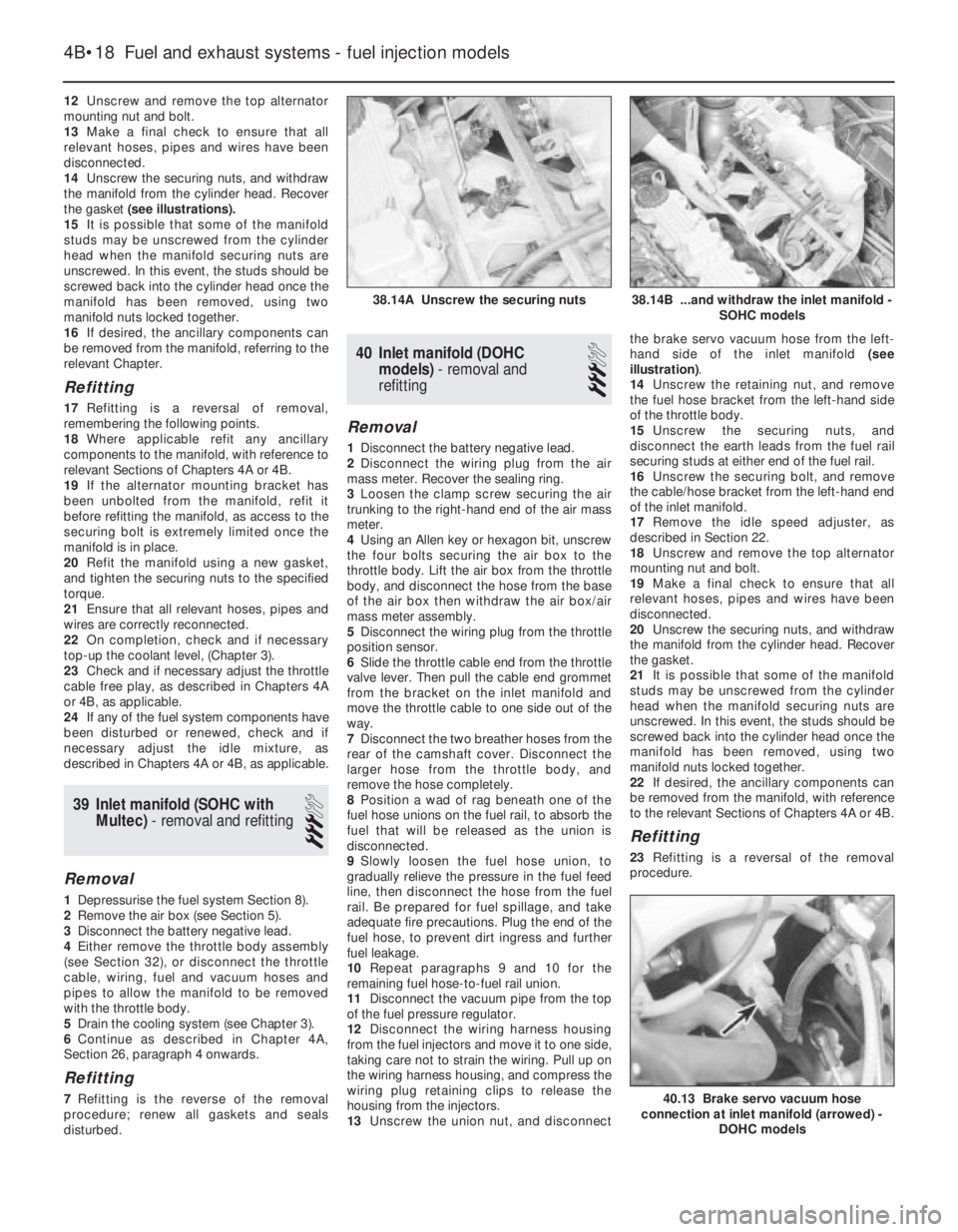
the gasket (see illustrations).
15It is possible that some of the manifold
studs may be unscrewed from the cylinder
head when the manifold securing nuts are
unscrewed. In this event, the studs should be
screwed back into the cylinder head once the
manifold has been removed, using two
manifold nuts locked together.
16If desired, the ancillary components can
be removed from the manifold, referring to the
relevant Chapter.
Refitting
17Refitting is a reversal of removal,
remembering the following points.
18Where applicable refit any ancillary
components to the manifold, with reference to
relevant Sections of Chapters 4A or 4B.
19If the alternator mounting bracket has
been unbolted from the manifold, refit it
before refitting the manifold, as access to the
securing bolt is extremely limited once the
manifold is in place.
20Refit the manifold using a new gasket,
and tighten the securing nuts to the specified
torque.
21Ensure that all relevant hoses, pipes and
wires are correctly reconnected.
22On completion, check and if necessary
top-up the coolant level, (Chapter 3).
23Check and if necessary adjust the throttle
cable free play, as described in Chapters 4A
or 4B, as applicable.
24If any of the fuel system components have
been disturbed or renewed, check and if
necessary adjust the idle mixture, as
described in Chapters 4A or 4B, as applicable.
39Inlet manifold (SOHCwith
Multec) - removal and refitting
3
Removal
1Depressurise the fuel system Section 8).
2Remove the air box (see Section 5).
3Disconnect the battery negative lead.
4Either remove the throttle body assembly
(see Section 32), or disconnect the throttle
cable, wiring, fuel and vacuum hoses and
pipes to allow the manifold to be removed
with the throttle body.
5Drain the cooling system (see Chapter 3).
6Continue as described in Chapter 4A,
Section 26, paragraph 4 onwards.
Refitting
7Refitting is the reverse of the removal
procedure; renew all gaskets and seals
disturbed.
40Inlet manifold (DOHC
models) - removal and
refitting
3
Removal
1Disconnect the battery negative lead.
2Disconnect the wiring plug from the air
mass meter. Recover the sealing ring.
3Loosen the clamp screw securing the air
trunking to the right-hand end of the air mass
meter.
4Using an Allen key or hexagon bit, unscrew
the four bolts securing the air box to the
throttle body. Lift the air box from the throttle
body, and disconnect the hose from the base
of the air box then withdraw the air box/air
mass meter assembly.
5Disconnect the wiring plug from the throttle
position sensor.
6Slide the throttle cable end from the throttle
valve lever. Then pull the cable end grommet
from the bracket on the inlet manifold and
move the throttle cable to one side out of the
way.
7Disconnect the two breather hoses from the
rear of the camshaft cover. Disconnect the
larger hose from the throttle body, and
remove the hose completely.
8Position a wad of rag beneath one of the
fuel hose unions on the fuel rail, to absorb the
fuel that will be released as the union is
disconnected.
9Slowly loosen the fuel hose union, to
gradually relieve the pressure in the fuel feed
line, then disconnect the hose from the fuel
rail. Be prepared for fuel spillage, and take
adequate fire precautions. Plug the end of the
fuel hose, to prevent dirt ingress and further
fuel leakage.
10Repeat paragraphs 9 and 10 for the
remaining fuel hose-to-fuel rail union.
11Disconnect the vacuum pipe from the top
of the fuel pressure regulator.
12Disconnect the wiring harness housing
from the fuel injectors and move it to one side,
taking care not to strain the wiring. Pull up on
the wiring harness housing, and compress the
wiring plug retaining clips to release the
housing from the injectors.
13Unscrew the union nut, and disconnectthe brake servo vacuum hose from the left-
hand side of the inlet manifold (see
illustration).
14Unscrew the retaining nut, and remove
the fuel hose bracket from the left-hand side
of the throttle body.
15Unscrew the securing nuts, and
disconnect the earth leads from the fuel rail
securing studs at either end of the fuel rail.
16Unscrew the securing bolt, and remove
the cable/hose bracket from the left-hand end
of the inlet manifold.
17Remove the idle speed adjuster, as
described in Section 22.
18Unscrew and remove the top alternator
mounting nut and bolt.
19Make a final check to ensure that all
relevant hoses, pipes and wires have been
disconnected.
20Unscrew the securing nuts, and withdraw
the manifold from the cylinder head. Recover
the gasket.
21It is possible that some of the manifold
studs may be unscrewed from the cylinder
head when the manifold securing nuts are
unscrewed. In this event, the studs should be
screwed back into the cylinder head once the
manifold has been removed, using two
manifold nuts locked together.
22If desired, the ancillary components can
be removed from the manifold, with reference
to the relevant Sections of Chapters 4A or 4B.
Refitting
23Refitting is a reversal of the removal
procedure.
4B•18Fuel and exhaust systems - fuel injection models
38.14A Unscrew the securing nuts
40.13 Brake servo vacuum hose
connection at inlet manifold (arrowed) -
DOHC models
38.14B ...and withdraw the inlet manifold -
SOHC models
Page 176 of 525
Maintenance - component location 1•5
1
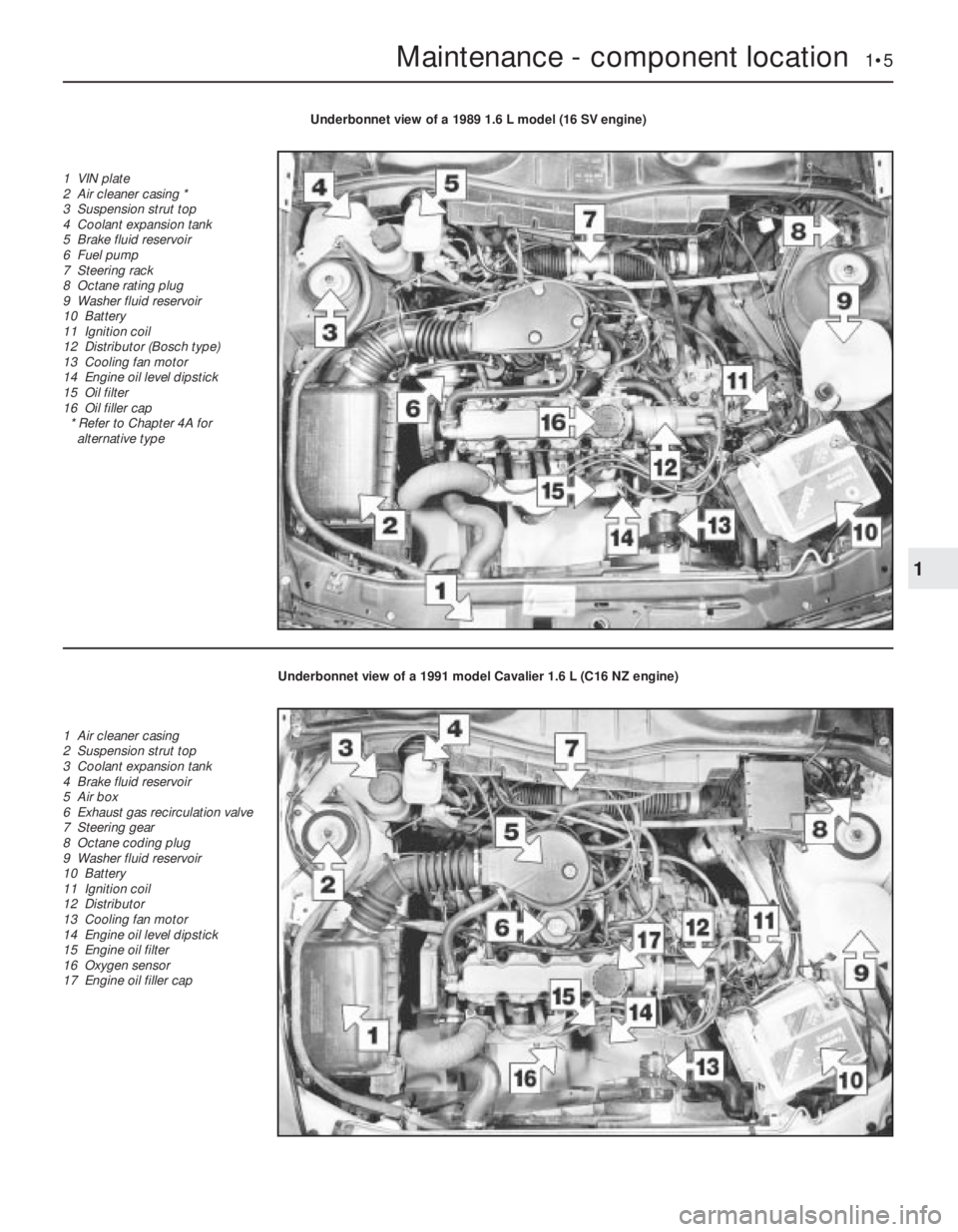
Underbonnet view of a 1989 1.6 L model (16 SV engine)
1 VIN plate
2 Air cleaner casing *
3 Suspension strut top
4 Coolant expansion tank
5 Brake fluid reservoir
6 Fuel pump
7 Steering rack
8 Octane rating plug
9 Washer fluid reservoir
10 Battery
11 Ignition coil
12 Distributor (Bosch type)
13 Cooling fan motor
14 Engine oil level dipstick
15 Oil filter
16 Oil filler cap
* Refer to Chapter 4A for
alternative type
Underbonnet view of a 1991 model Cavalier 1.6 L (C16 NZ engine)
1 Air cleaner casing
2 Suspension strut top
3 Coolant expansion tank
4 Brake fluid reservoir
5 Air box
6 Exhaust gas recirculation valve
7 Steering gear
8 Octane coding plug
9 Washer fluid reservoir
10 Battery
11 Ignition coil
12 Distributor
13 Cooling fan motor
14 Engine oil level dipstick
15 Engine oil filter
16 Oxygen sensor
17 Engine oil filler cap
Page 179 of 525
1Introduction
This Chapter is designed to help the home
mechanic maintain his/her vehicle for safety,
economy, long life and peak performance.
The Chapter contains a master maintenance
schedule, followed by Sections dealing specifically
with each task in the schedule. Visual checks,
adjustments, component renewal and other helpful
items are included. Refer to the accompanying
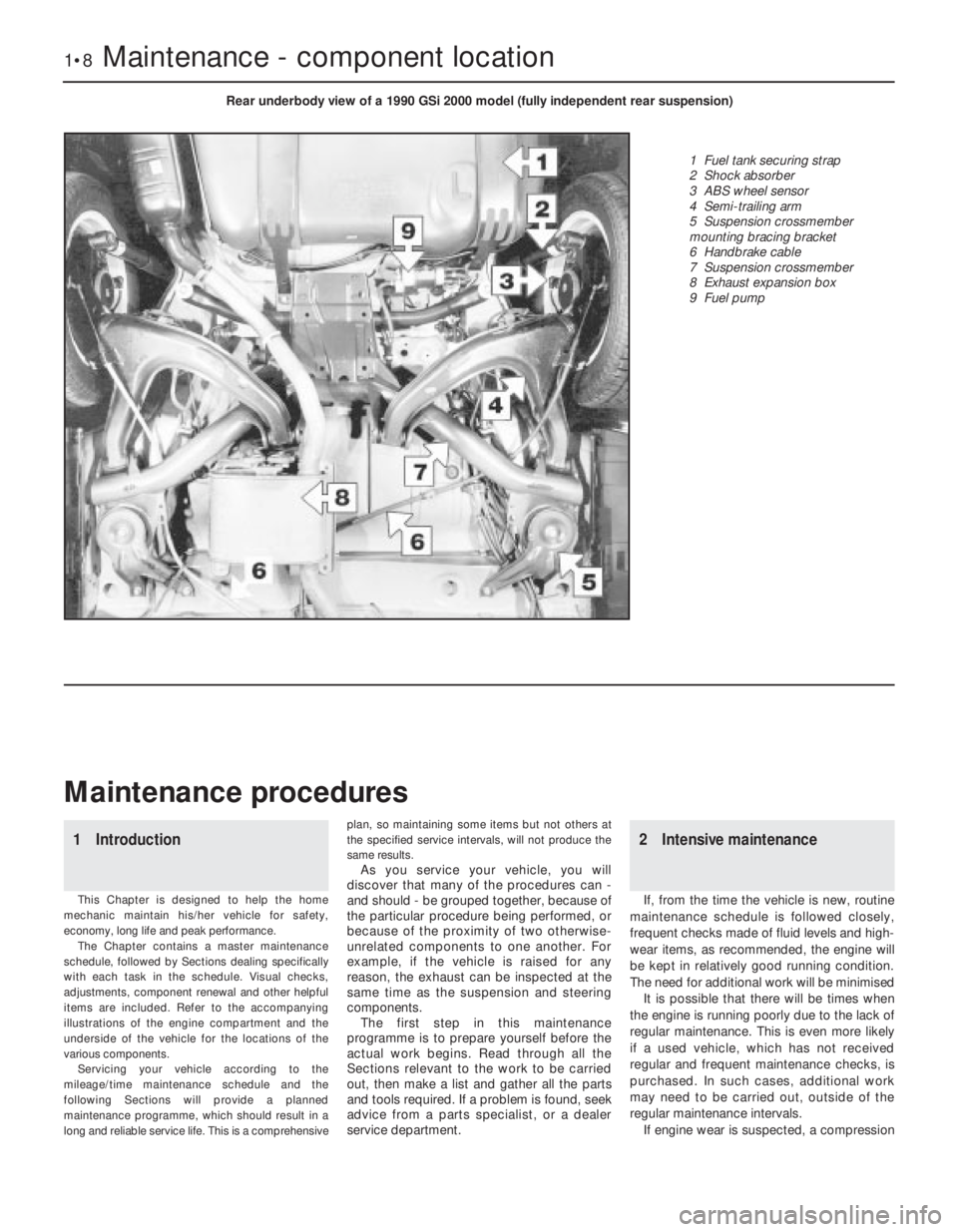
illustrations of the engine compartment and the
underside of the vehicle for the locations of the
various components.
Servicing your vehicle according to the
mileage/time maintenance schedule and the
following Sections will provide a planned
maintenance programme, which should result in a
long and reliable service life. This is a comprehensiveplan, so maintaining some items but not others at
the specified service intervals, will not produce the
same results.
As you service your vehicle, you will
discover that many of the procedures can -
and should - be grouped together, because of
the particular procedure being performed, or
because of the proximity of two otherwise-
unrelated components to one another. For
example, if the vehicle is raised for any
reason, the exhaust can be inspected at the
same time as the suspension and steering
components.
The first step in this maintenance
programme is to prepare yourself before the
actual work begins. Read through all the
Sections relevant to the work to be carried
out, then make a list and gather all the parts
and tools required. If a problem is found, seek
advice from a parts specialist, or a dealer
service department.
2Intensive maintenance
If, from the time the vehicle is new, routine
maintenance schedule is followed closely,
frequent checks made of fluid levels and high-
wear items, as recommended, the engine will
be kept in relatively good running condition.
The need for additional work will be minimised
It is possible that there will be times when
the engine is running poorly due to the lack of
regular maintenance. This is even more likely
if a used vehicle, which has not received
regular and frequent maintenance checks, is
purchased. In such cases, additional work
may need to be carried out, outside of the
regular maintenance intervals.
If engine wear is suspected, a compression
1•8Maintenance - component location
Rear underbody view of a 1990 GSi 2000 model (fully independent rear suspension)
1 Fuel tank securing strap
2 Shock absorber
3 ABS wheel sensor
4 Semi-trailing arm
5 Suspension crossmember
mounting bracing bracket
6 Handbrake cable
7 Suspension crossmember
8 Exhaust expansion box
9 Fuel pump
Maintenance procedures
Page 189 of 525
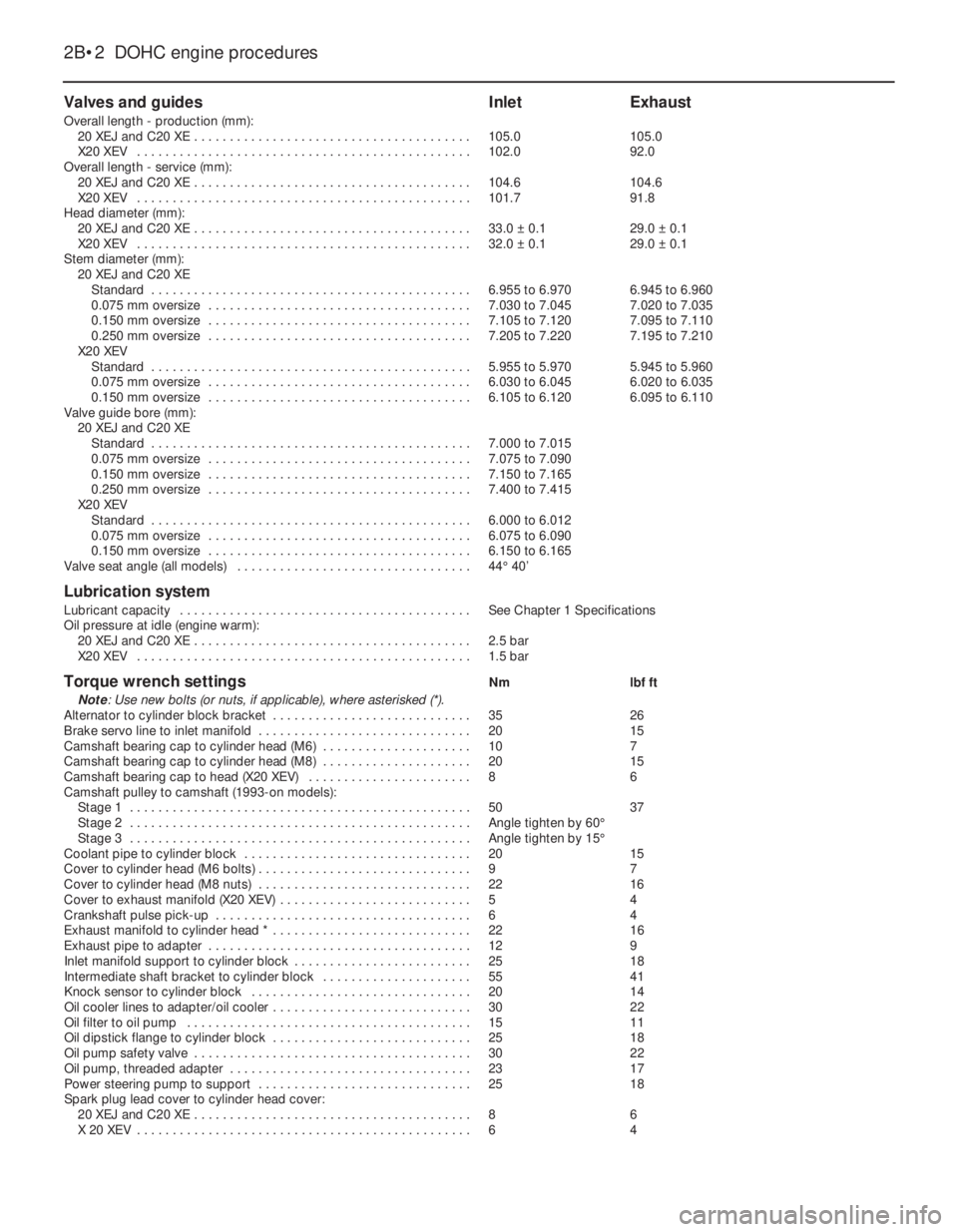
Valves and guidesInletExhaust
Overall length - production (mm):
20 XEJ and C20 XE . . . . . . . . . . . . . . . . . . . . . . . . . . . . . . . . . . . . . . .105.0105.0
X20 XEV . . . . . . . . . . . . . . . . . . . . . . . . . . . . . . . . . . . . . . . . . . . . . . .102.092.0
Overall length - service (mm):
20 XEJ and C20 XE . . . . . . . . . . . . . . . . . . . . . . . . . . . . . . . . . . . . . . .104.6104.6
X20 XEV . . . . . . . . . . . . . . . . . . . . . . . . . . . . . . . . . . . . . . . . . . . . . . .101.791.8
Head diameter (mm):
20 XEJ and C20 XE . . . . . . . . . . . . . . . . . . . . . . . . . . . . . . . . . . . . . . .33.0 ±0.129.0 ±0.1
X20 XEV . . . . . . . . . . . . . . . . . . . . . . . . . . . . . . . . . . . . . . . . . . . . . . .32.0 ±0.129.0 ±0.1
Stem diameter (mm):
20 XEJ and C20 XE
Standard . . . . . . . . . . . . . . . . . . . . . . . . . . . . . . . . . . . . . . . . . . . . .6.955 to 6.9706.945 to 6.960
0.075 mm oversize . . . . . . . . . . . . . . . . . . . . . . . . . . . . . . . . . . . . .7.030 to 7.0457.020 to 7.035
0.150 mm oversize . . . . . . . . . . . . . . . . . . . . . . . . . . . . . . . . . . . . .7.105 to 7.1207.095 to 7.110
0.250 mm oversize . . . . . . . . . . . . . . . . . . . . . . . . . . . . . . . . . . . . .7.205 to 7.2207.195 to 7.210
X20 XEV
Standard . . . . . . . . . . . . . . . . . . . . . . . . . . . . . . . . . . . . . . . . . . . . .5.955 to 5.9705.945 to 5.960
0.075 mm oversize . . . . . . . . . . . . . . . . . . . . . . . . . . . . . . . . . . . . .6.030 to 6.0456.020 to 6.035
0.150 mm oversize . . . . . . . . . . . . . . . . . . . . . . . . . . . . . . . . . . . . .6.105 to 6.1206.095 to 6.110
Valve guide bore (mm):
20 XEJ and C20 XE
Standard . . . . . . . . . . . . . . . . . . . . . . . . . . . . . . . . . . . . . . . . . . . . .7.000 to 7.015
0.075 mm oversize . . . . . . . . . . . . . . . . . . . . . . . . . . . . . . . . . . . . .7.075 to 7.090
0.150 mm oversize . . . . . . . . . . . . . . . . . . . . . . . . . . . . . . . . . . . . .7.150 to 7.165
0.250 mm oversize . . . . . . . . . . . . . . . . . . . . . . . . . . . . . . . . . . . . .7.400 to 7.415
X20 XEV
Standard . . . . . . . . . . . . . . . . . . . . . . . . . . . . . . . . . . . . . . . . . . . . .6.000 to 6.012
0.075 mm oversize . . . . . . . . . . . . . . . . . . . . . . . . . . . . . . . . . . . . .6.075 to 6.090
0.150 mm oversize . . . . . . . . . . . . . . . . . . . . . . . . . . . . . . . . . . . . .6.150 to 6.165
Valve seat angle (all models) . . . . . . . . . . . . . . . . . . . . . . . . . . . . . . . . .44°40’
Lubrication system
Lubricant capacity . . . . . . . . . . . . . . . . . . . . . . . . . . . . . . . . . . . . . . . . .See Chapter 1 Specifications
Oil pressure at idle (engine warm):
20 XEJ and C20 XE . . . . . . . . . . . . . . . . . . . . . . . . . . . . . . . . . . . . . . .2.5 bar
X20 XEV . . . . . . . . . . . . . . . . . . . . . . . . . . . . . . . . . . . . . . . . . . . . . . .1.5 bar
Torque wrench settingsNmlbf ft
Note: Use new bolts (or nuts, if applicable), where asterisked (*).
Alternator to cylinder block bracket . . . . . . . . . . . . . . . . . . . . . . . . . . . .3526
Brake servo line to inlet manifold . . . . . . . . . . . . . . . . . . . . . . . . . . . . . .2015
Camshaft bearing cap to cylinder head (M6) . . . . . . . . . . . . . . . . . . . . .107
Camshaft bearing cap to cylinder head (M8) . . . . . . . . . . . . . . . . . . . . .2015
Camshaft bearing cap to head (X20 XEV) . . . . . . . . . . . . . . . . . . . . . . .86
Camshaft pulley to camshaft (1993-on models):
Stage 1 . . . . . . . . . . . . . . . . . . . . . . . . . . . . . . . . . . . . . . . . . . . . . . . .5037
Stage 2 . . . . . . . . . . . . . . . . . . . . . . . . . . . . . . . . . . . . . . . . . . . . . . . .Angle tighten by 60°
Stage 3 . . . . . . . . . . . . . . . . . . . . . . . . . . . . . . . . . . . . . . . . . . . . . . . .Angle tighten by 15°
Coolant pipe to cylinder block . . . . . . . . . . . . . . . . . . . . . . . . . . . . . . . .2015
Cover to cylinder head (M6 bolts) . . . . . . . . . . . . . . . . . . . . . . . . . . . . . .97
Cover to cylinder head (M8 nuts) . . . . . . . . . . . . . . . . . . . . . . . . . . . . . .2216
Cover to exhaust manifold (X20 XEV) . . . . . . . . . . . . . . . . . . . . . . . . . . .54
Crankshaft pulse pick-up . . . . . . . . . . . . . . . . . . . . . . . . . . . . . . . . . . . .64
Exhaust manifold to cylinder head * . . . . . . . . . . . . . . . . . . . . . . . . . . . .2216
Exhaust pipe to adapter . . . . . . . . . . . . . . . . . . . . . . . . . . . . . . . . . . . . .129
Inlet manifold support to cylinder block . . . . . . . . . . . . . . . . . . . . . . . . .2518
Intermediate shaft bracket to cylinder block . . . . . . . . . . . . . . . . . . . . .5541
Knock sensor to cylinder block . . . . . . . . . . . . . . . . . . . . . . . . . . . . . . .2014
Oil cooler lines to adapter/oil cooler . . . . . . . . . . . . . . . . . . . . . . . . . . . .3022
Oil filter to oil pump . . . . . . . . . . . . . . . . . . . . . . . . . . . . . . . . . . . . . . . .1511
Oil dipstick flange to cylinder block . . . . . . . . . . . . . . . . . . . . . . . . . . . .2518
Oil pump safety valve . . . . . . . . . . . . . . . . . . . . . . . . . . . . . . . . . . . . . . .3022
Oil pump, threaded adapter . . . . . . . . . . . . . . . . . . . . . . . . . . . . . . . . . .2317
Power steering pump to support . . . . . . . . . . . . . . . . . . . . . . . . . . . . . .2518
Spark plug lead cover to cylinder head cover:
20 XEJ and C20 XE . . . . . . . . . . . . . . . . . . . . . . . . . . . . . . . . . . . . . . .86
X 20 XEV . . . . . . . . . . . . . . . . . . . . . . . . . . . . . . . . . . . . . . . . . . . . . . .64
2B•2DOHC engine procedures
Page 194 of 525
pitting. If evident, the cylinder head and all
bearing caps must be renewed as a matched
set, as there is no provision for refacing if the
bearing caps cannot be renewed individually.
8The camshaft(s) should show no marks or
scoring on the journal or cam lobe surfaces. if
evident, renew the camshaft(s).
9It is advisable to renew the camshaft front
oil seal(s) as a matter of course. Prise the old
seal(s) from the front of the camshaft(s) and
discard them.
Refitting
10Begin refitting by liberally coating the
contact faces of the hydraulic valve lifters and
the camshaft(s) with molybdenum disulphide
paste.
11Coat the mating faces of the front and
rear bearing caps with sealing compound and
refit the bearing caps in their original positions
as noted during removal.
12Tighten the camshaft bearing cap nuts to
the specified torque in half-turn stages, as
when loosening the nuts. Note that when
refitting the exhaust camshaft, the two smaller
rear bearing cap securing nuts should be
tightened after all the main camshaft bearing
cap nuts have been tightened. Note also that
the two smaller nuts should be tightened to a
lower torque wrench setting than the main
nuts.
13Turn the camshaft until the locating peg
for the camshaft sprocket is uppermost, then
lubricate the lips of a rear camshaft front oil
seal with a little grease, and fit the oil seal,
using a tube or socket of similar diameter with
a washer and the camshaft sprocket bolt.
Screw the camshaft sprocket bolt into the end
of the camshaft to draw the oil seal into
position on its shoulder.
14Repeat the procedure for the remaining
camshaft.
15Refit the distributor with reference to
Chapter 5. Fit a new timing belt and the
camshaft sprockets, then adjust the timing
belt as described in Section 4 or 5, as
applicable.
8Cylinder head -removal and
refitting (engine in vehicle)
4
Note: The engine must be cold when the
cylinder head is removed. Do not remove the
cylinder head from a hot engine. New cylinder
head bolts, a new cylinder head gasket and a
new timing belt must be used on refitting.
The torque settings (as shown in Chapter 2A)
are only applicable to latest specification head
bolts, available from Vauxhall. Earlier type or
alternative make, head bolts may require
different torques. Consult your supplier
Removal
1Disconnect the battery negative lead.
2Drain the cooling system, as described in
Chapter 3.3Remove the front section of the exhaust
system, as described in Chapter 4C.
4The cylinder head can be removed
complete with the inlet manifold, or the inlet
manifold can be detached from the cylinder
head before removal, with reference to
Chapter 4B. If no work is to be carried out on
the inlet manifold, it can be unbolted from the
cylinder head and supported to one side out
of the way, thus avoiding the need to
disconnect the relevant hoses, pipes and
wiring.
5If the cylinder head is to be removed
complete with the inlet manifold, disconnect
all relevant hoses, pipes and wiring from the
inlet manifold and associated components,
referring to Chapter 4B, and unbolt the
manifold support bracket from the manifold.
Loosen the alternator mountings with
reference to Chapter 5, then unbolt the upper
alternator mounting from the inlet manifold.
6If the inlet manifold is to be left in the engine
compartment, continue as follows, otherwise
go on to paragraph 17.
7Disconnect the wiring plug from the airflow
meter, and the breather hose from the air box
on the throttle body. Disconnect the air
cleaner trunking and remove the airflow
meter/air box assembly from the throttle
body. Refer to Chapter 4B if necessary.
8Disconnect the end of the throttle cable
from the throttle valve lever, then unbolt the
throttle cable support bracket and remove it
from the inlet manifold.
9Unscrew the two earth lead securing nuts
from the fuel rail (one at each end of the rail)
and disconnect the three earth leads.
10Disconnect the wiring plug from the
throttle position switch.
11Pull up on the wiring harness housing, and
disconnect the wiring plugs from the fuel
injectors by compressing the retaining clips.
Move the wiring harness housing to one side.
12Disconnect the two breather hoses from
the rear of the camshaft cover.
13Loosen the alternator mountings, with
reference to Chapter 5, then unbolt the upper
alternator mounting from the inlet manifold.
14Unbolt the manifold support bracket from
the manifold.15Make a final check to ensure that all
necessary hoses, pipes and wires have been
disconnected, then unscrew the securing nuts
and lift the inlet manifold from the cylinder
head. Ensure that the manifold is properly
supported, taking care not to strain any of the
hoses, pipes and wires, etc., which are still
connected.
16Recover the manifold gasket from the
cylinder head.
17Remove the timing belt, camshaft
sprockets, and timing belt tensioner and idler
pulleys, as described in Section 4.
18Unscrew the upper and middle studs for
the timing belt outer cover screws. Note that
the upper stud simply unscrews from the
cylinder head, but the middle stud is secured
by a bolt.
19Unscrew the two upper rear timing belt
cover securing bolts from the cylinder head.
20Remove the distributor cap and HT leads
with reference to Chapter 5.
21Disconnect the distributor wiring plug.
22Disconnect the coolant hose from the
left-hand end of the cylinder head.
23Unscrew the bolt securing the crankcase
breather tube bracket to the end of the
cylinder head.
24Disconnect the radiator top hose from the
thermostat housing, and disconnect the
wiring plugs from the temperature gauge
sender and the coolant temperature sensor
(both situated in the thermostat housing).
25Make a final check to ensure that all
relevant hoses, pipes and wires have been
disconnected.
26On X20 XEV models, remove the
camshaft, as described in Section 7.
27Using a Torx socket, and working in the
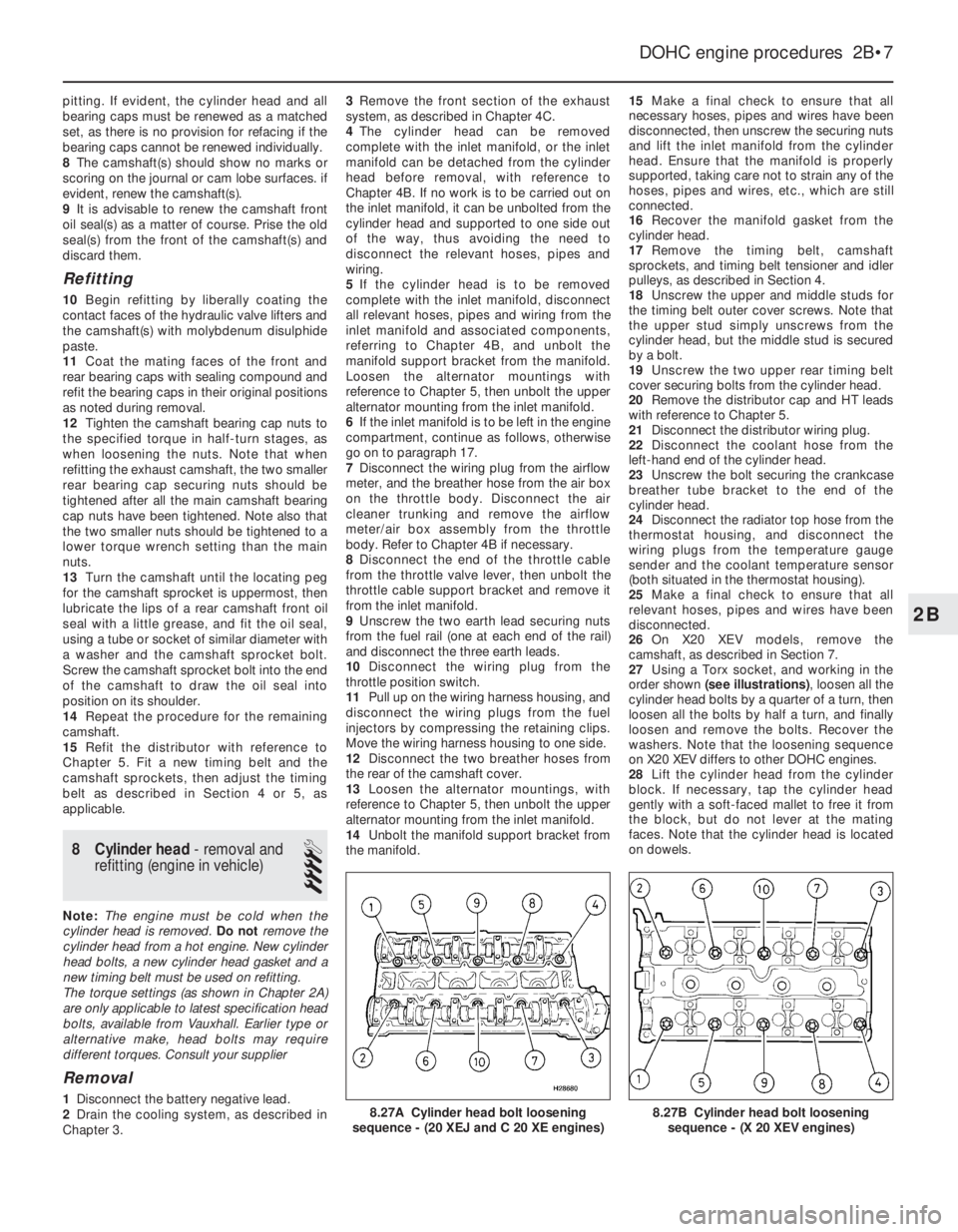
order shown (see illustrations), loosen all the
cylinder head bolts by a quarter of a turn, then
loosen all the bolts by half a turn, and finally
loosen and remove the bolts. Recover the
washers. Note that the loosening sequence
on X20 XEV differs to other DOHC engines.
28Lift the cylinder head from the cylinder
block. If necessary, tap the cylinder head
gently with a soft-faced mallet to free it from
the block, but do not lever at the mating
faces. Note that the cylinder head is located
on dowels.
DOHC engine procedures 2B•7
8.27B Cylinder head bolt loosening
sequence - (X 20 XEV engines)8.27A Cylinder head bolt loosening
sequence - (20 XEJ and C 20 XE engines)
2B
Page 203 of 525
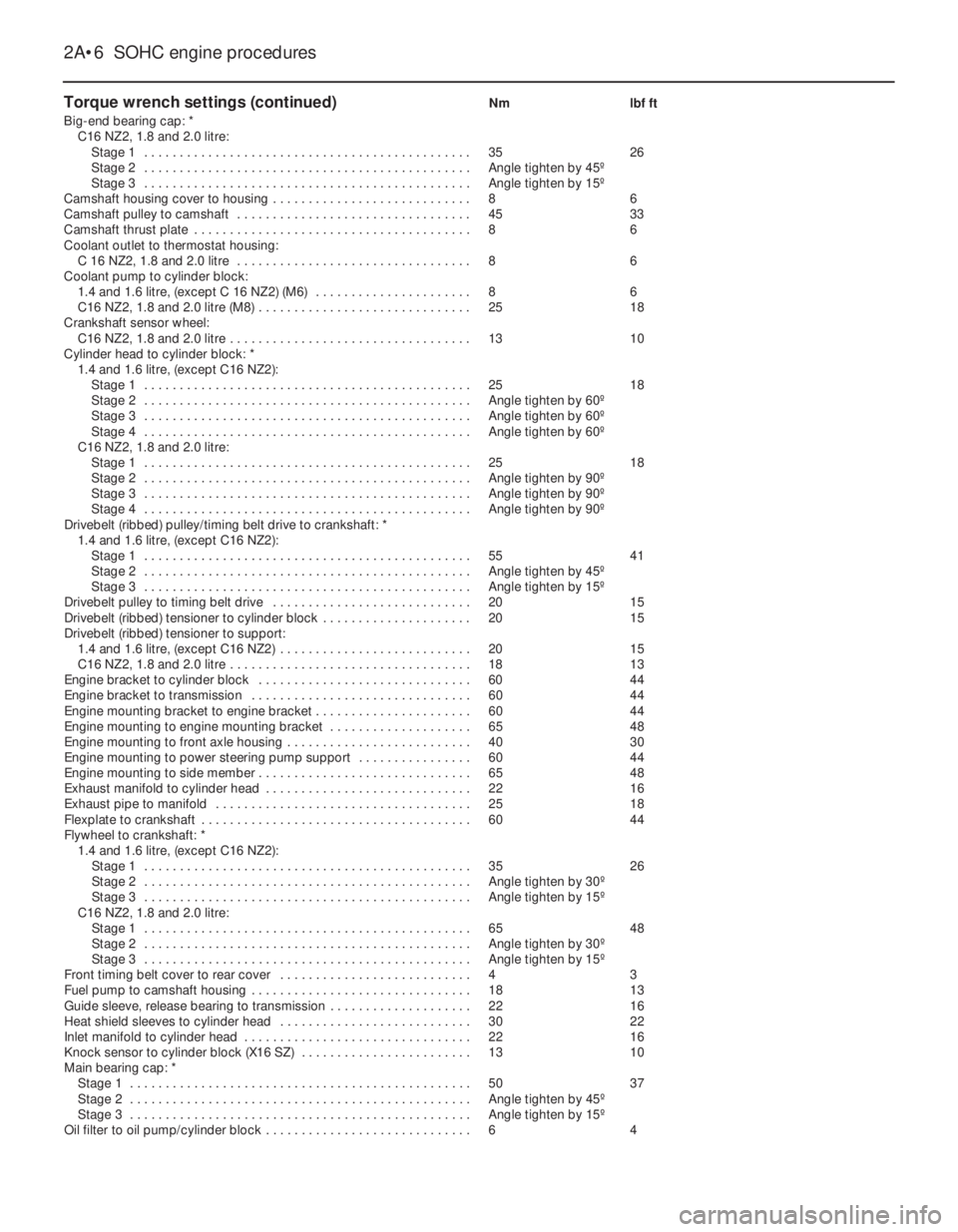
Torque wrench settings (continued)Nmlbf ft
Big-end bearing cap: *
C16 NZ2, 1.8 and 2.0 litre:
Stage 1 . . . . . . . . . . . . . . . . . . . . . . . . . . . . . . . . . . . . . . . . . . . . . .3526
Stage 2 . . . . . . . . . . . . . . . . . . . . . . . . . . . . . . . . . . . . . . . . . . . . . .Angle tighten by 45º
Stage 3 . . . . . . . . . . . . . . . . . . . . . . . . . . . . . . . . . . . . . . . . . . . . . .Angle tighten by 15º
Camshaft housing cover to housing . . . . . . . . . . . . . . . . . . . . . . . . . . . .86
Camshaft pulley to camshaft . . . . . . . . . . . . . . . . . . . . . . . . . . . . . . . . .4533
Camshaft thrust plate . . . . . . . . . . . . . . . . . . . . . . . . . . . . . . . . . . . . . . .86
Coolant outlet to thermostat housing:
C 16 NZ2, 1.8 and 2.0 litre . . . . . . . . . . . . . . . . . . . . . . . . . . . . . . . . .86
Coolant pump to cylinder block:
1.4 and 1.6 litre, (except C 16 NZ2) (M6) . . . . . . . . . . . . . . . . . . . . . .86
C16 NZ2, 1.8 and 2.0 litre (M8) . . . . . . . . . . . . . . . . . . . . . . . . . . . . . .2518
Crankshaft sensor wheel:
C16 NZ2, 1.8 and 2.0 litre . . . . . . . . . . . . . . . . . . . . . . . . . . . . . . . . . .1310
Cylinder head to cylinder block: *
1.4 and 1.6 litre, (except C16 NZ2):
Stage 1 . . . . . . . . . . . . . . . . . . . . . . . . . . . . . . . . . . . . . . . . . . . . . .2518
Stage 2 . . . . . . . . . . . . . . . . . . . . . . . . . . . . . . . . . . . . . . . . . . . . . .Angle tighten by 60º
Stage 3 . . . . . . . . . . . . . . . . . . . . . . . . . . . . . . . . . . . . . . . . . . . . . .Angle tighten by 60º
Stage 4 . . . . . . . . . . . . . . . . . . . . . . . . . . . . . . . . . . . . . . . . . . . . . .Angle tighten by 60º
C16 NZ2, 1.8 and 2.0 litre:
Stage 1 . . . . . . . . . . . . . . . . . . . . . . . . . . . . . . . . . . . . . . . . . . . . . .2518
Stage 2 . . . . . . . . . . . . . . . . . . . . . . . . . . . . . . . . . . . . . . . . . . . . . .Angle tighten by 90º
Stage 3 . . . . . . . . . . . . . . . . . . . . . . . . . . . . . . . . . . . . . . . . . . . . . .Angle tighten by 90º
Stage 4 . . . . . . . . . . . . . . . . . . . . . . . . . . . . . . . . . . . . . . . . . . . . . .Angle tighten by 90º
Drivebelt (ribbed) pulley/timing belt drive to crankshaft: *
1.4 and 1.6 litre, (except C16 NZ2):
Stage 1 . . . . . . . . . . . . . . . . . . . . . . . . . . . . . . . . . . . . . . . . . . . . . .5541
Stage 2 . . . . . . . . . . . . . . . . . . . . . . . . . . . . . . . . . . . . . . . . . . . . . .Angle tighten by 45º
Stage 3 . . . . . . . . . . . . . . . . . . . . . . . . . . . . . . . . . . . . . . . . . . . . . .Angle tighten by 15º
Drivebelt pulley to timing belt drive . . . . . . . . . . . . . . . . . . . . . . . . . . . .2015
Drivebelt (ribbed) tensioner to cylinder block . . . . . . . . . . . . . . . . . . . . .2015
Drivebelt (ribbed) tensioner to support:
1.4 and 1.6 litre, (except C16 NZ2) . . . . . . . . . . . . . . . . . . . . . . . . . . .2015
C16 NZ2, 1.8 and 2.0 litre . . . . . . . . . . . . . . . . . . . . . . . . . . . . . . . . . .1813
Engine bracket to cylinder block . . . . . . . . . . . . . . . . . . . . . . . . . . . . . .6044
Engine bracket to transmission . . . . . . . . . . . . . . . . . . . . . . . . . . . . . . .6044
Engine mounting bracket to engine bracket . . . . . . . . . . . . . . . . . . . . . .6044
Engine mounting to engine mounting bracket . . . . . . . . . . . . . . . . . . . .6548
Engine mounting to front axle housing . . . . . . . . . . . . . . . . . . . . . . . . . .4030
Engine mounting to power steering pump support . . . . . . . . . . . . . . . .6044
Engine mounting to side member . . . . . . . . . . . . . . . . . . . . . . . . . . . . . .6548
Exhaust manifold to cylinder head . . . . . . . . . . . . . . . . . . . . . . . . . . . . .2216
Exhaust pipe to manifold . . . . . . . . . . . . . . . . . . . . . . . . . . . . . . . . . . . .2518
Flexplate to crankshaft . . . . . . . . . . . . . . . . . . . . . . . . . . . . . . . . . . . . . .6044
Flywheel to crankshaft: *
1.4 and 1.6 litre, (except C16 NZ2):
Stage 1 . . . . . . . . . . . . . . . . . . . . . . . . . . . . . . . . . . . . . . . . . . . . . .3526
Stage 2 . . . . . . . . . . . . . . . . . . . . . . . . . . . . . . . . . . . . . . . . . . . . . .Angle tighten by 30º
Stage 3 . . . . . . . . . . . . . . . . . . . . . . . . . . . . . . . . . . . . . . . . . . . . . .Angle tighten by 15º
C16 NZ2, 1.8 and 2.0 litre:
Stage 1 . . . . . . . . . . . . . . . . . . . . . . . . . . . . . . . . . . . . . . . . . . . . . .6548
Stage 2 . . . . . . . . . . . . . . . . . . . . . . . . . . . . . . . . . . . . . . . . . . . . . .Angle tighten by 30º
Stage 3 . . . . . . . . . . . . . . . . . . . . . . . . . . . . . . . . . . . . . . . . . . . . . .Angle tighten by 15º
Front timing belt cover to rear cover . . . . . . . . . . . . . . . . . . . . . . . . . . .43
Fuel pump to camshaft housing . . . . . . . . . . . . . . . . . . . . . . . . . . . . . . .1813
Guide sleeve, release bearing to transmission . . . . . . . . . . . . . . . . . . . .2216
Heat shield sleeves to cylinder head . . . . . . . . . . . . . . . . . . . . . . . . . . .3022
Inlet manifold to cylinder head . . . . . . . . . . . . . . . . . . . . . . . . . . . . . . . .2216
Knock sensor to cylinder block (X16 SZ) . . . . . . . . . . . . . . . . . . . . . . . .1310
Main bearing cap: *
Stage 1 . . . . . . . . . . . . . . . . . . . . . . . . . . . . . . . . . . . . . . . . . . . . . . . .5037
Stage 2 . . . . . . . . . . . . . . . . . . . . . . . . . . . . . . . . . . . . . . . . . . . . . . . .Angle tighten by 45º
Stage 3 . . . . . . . . . . . . . . . . . . . . . . . . . . . . . . . . . . . . . . . . . . . . . . . .Angle tighten by 15º
Oil filter to oil pump/cylinder block . . . . . . . . . . . . . . . . . . . . . . . . . . . . .64
2A•6SOHC engine procedures
Page 204 of 525
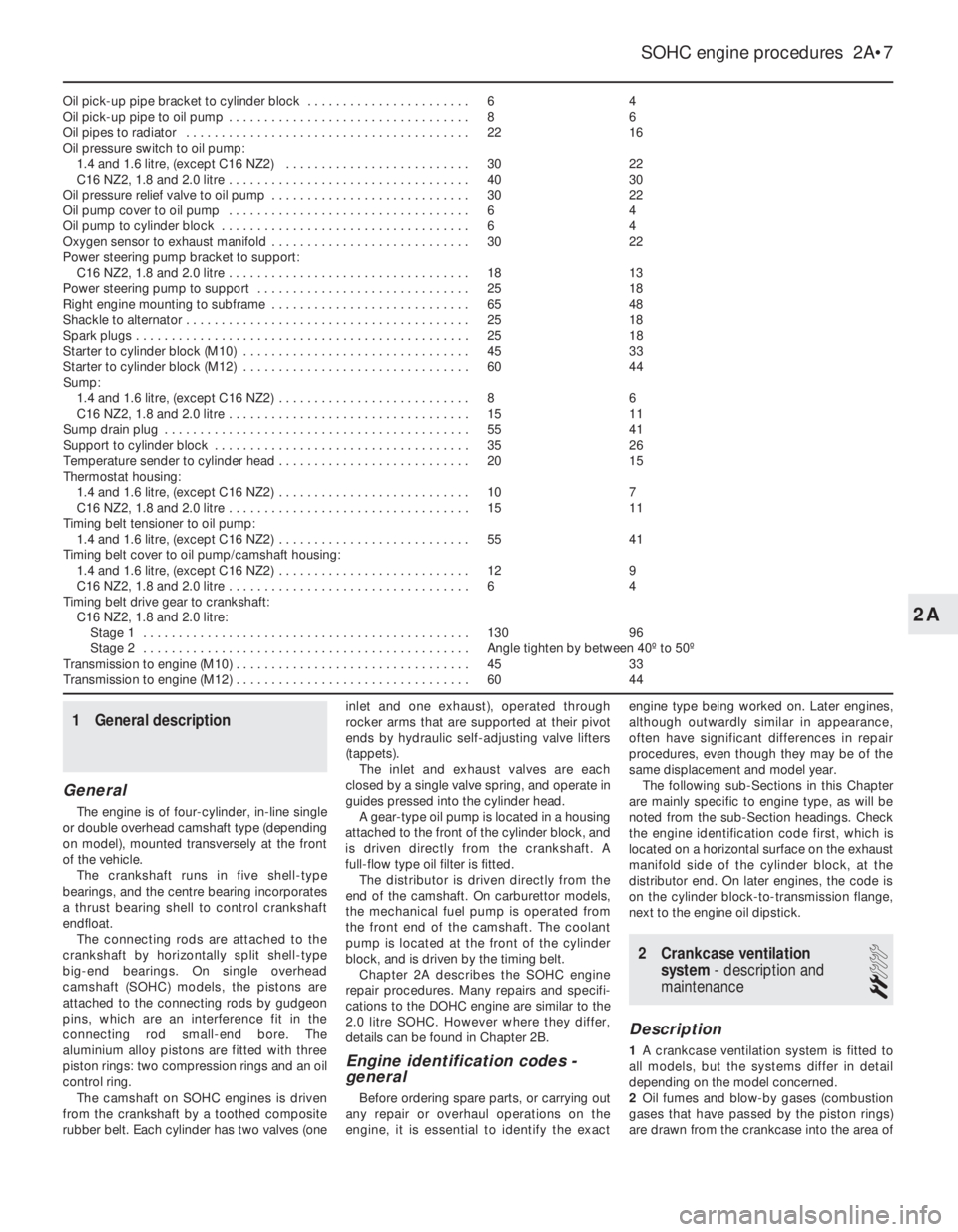
Oil pick-up pipe bracket to cylinder block . . . . . . . . . . . . . . . . . . . . . . .64
Oil pick-up pipe to oil pump . . . . . . . . . . . . . . . . . . . . . . . . . . . . . . . . . .86
Oil pipes to radiator . . . . . . . . . . . . . . . . . . . . . . . . . . . . . . . . . . . . . . . .2216
Oil pressure switch to oil pump:
1.4 and 1.6 litre, (except C16 NZ2) . . . . . . . . . . . . . . . . . . . . . . . . . .3022
C16 NZ2, 1.8 and 2.0 litre . . . . . . . . . . . . . . . . . . . . . . . . . . . . . . . . . .4030
Oil pressure relief valve to oil pump . . . . . . . . . . . . . . . . . . . . . . . . . . . .3022
Oil pump cover to oil pump . . . . . . . . . . . . . . . . . . . . . . . . . . . . . . . . . .64
Oil pump to cylinder block . . . . . . . . . . . . . . . . . . . . . . . . . . . . . . . . . . .64
Oxygen sensor to exhaust manifold . . . . . . . . . . . . . . . . . . . . . . . . . . . .3022
Power steering pump bracket to support:
C16 NZ2, 1.8 and 2.0 litre . . . . . . . . . . . . . . . . . . . . . . . . . . . . . . . . . .1813
Power steering pump to support . . . . . . . . . . . . . . . . . . . . . . . . . . . . . .2518
Right engine mounting to subframe . . . . . . . . . . . . . . . . . . . . . . . . . . . .6548
Shackle to alternator . . . . . . . . . . . . . . . . . . . . . . . . . . . . . . . . . . . . . . . .2518
Spark plugs . . . . . . . . . . . . . . . . . . . . . . . . . . . . . . . . . . . . . . . . . . . . . . .2518
Starter to cylinder block (M10) . . . . . . . . . . . . . . . . . . . . . . . . . . . . . . . .4533
Starter to cylinder block (M12) . . . . . . . . . . . . . . . . . . . . . . . . . . . . . . . .6044
Sump:
1.4 and 1.6 litre, (except C16 NZ2) . . . . . . . . . . . . . . . . . . . . . . . . . . .86
C16 NZ2, 1.8 and 2.0 litre . . . . . . . . . . . . . . . . . . . . . . . . . . . . . . . . . .1511
Sump drain plug . . . . . . . . . . . . . . . . . . . . . . . . . . . . . . . . . . . . . . . . . . .5541
Support to cylinder block . . . . . . . . . . . . . . . . . . . . . . . . . . . . . . . . . . . .3526
Temperature sender to cylinder head . . . . . . . . . . . . . . . . . . . . . . . . . . .2015
Thermostat housing:
1.4 and 1.6 litre, (except C16 NZ2) . . . . . . . . . . . . . . . . . . . . . . . . . . .107
C16 NZ2, 1.8 and 2.0 litre . . . . . . . . . . . . . . . . . . . . . . . . . . . . . . . . . .1511
Timing belt tensioner to oil pump:
1.4 and 1.6 litre, (except C16 NZ2) . . . . . . . . . . . . . . . . . . . . . . . . . . .5541
Timing belt cover to oil pump/camshaft housing:
1.4 and 1.6 litre, (except C16 NZ2) . . . . . . . . . . . . . . . . . . . . . . . . . . .129
C16 NZ2, 1.8 and 2.0 litre . . . . . . . . . . . . . . . . . . . . . . . . . . . . . . . . . .64
Timing belt drive gear to crankshaft:
C16 NZ2, 1.8 and 2.0 litre:
Stage 1 . . . . . . . . . . . . . . . . . . . . . . . . . . . . . . . . . . . . . . . . . . . . . .13096
Stage 2 . . . . . . . . . . . . . . . . . . . . . . . . . . . . . . . . . . . . . . . . . . . . . .Angle tighten by between 40º to 50º
Transmission to engine (M10) . . . . . . . . . . . . . . . . . . . . . . . . . . . . . . . . .4533
Transmission to engine (M12) . . . . . . . . . . . . . . . . . . . . . . . . . . . . . . . . .6044
1General description
General
The engine is of four-cylinder, in-line single
or double overhead camshaft type (depending
on model), mounted transversely at the front
of the vehicle.
The crankshaft runs in five shell-type
bearings, and the centre bearing incorporates
a thrust bearing shell to control crankshaft
endfloat.
The connecting rods are attached to the
crankshaft by horizontally split shell-type
big-end bearings. On single overhead
camshaft (SOHC) models, the pistons are
attached to the connecting rods by gudgeon
pins, which are an interference fit in the
connecting rod small-end bore. The
aluminium alloy pistons are fitted with three
piston rings: two compression rings and an oil
control ring.
The camshaft on SOHC engines is driven
from the crankshaft by a toothed composite
rubber belt. Each cylinder has two valves (oneinlet and one exhaust), operated through
rocker arms that are supported at their pivot
ends by hydraulic self-adjusting valve lifters
(tappets).
The inlet and exhaust valves are each
closed by a single valve spring, and operate in
guides pressed into the cylinder head.
A gear-type oil pump is located in a housing
attached to the front of the cylinder block, and
is driven directly from the crankshaft. A
full-flow type oil filter is fitted.
The distributor is driven directly from the
end of the camshaft. On carburettor models,
the mechanical fuel pump is operated from
the front end of the camshaft. The coolant
pump is located at the front of the cylinder
block, and is driven by the timing belt.
Chapter 2A describes the SOHC engine
repair procedures. Many repairs and specifi-
cations to the DOHC engine are similar to the
2.0 litre SOHC. However where they differ,
details can be found in Chapter 2B.
Engine identification codes -
general
Before ordering spare parts, or carrying out
any repair or overhaul operations on the
engine, it is essential to identify the exactengine type being worked on. Later engines,
although outwardly similar in appearance,
often have significant differences in repair
procedures, even though they may be of the
same displacement and model year.
The following sub-Sections in this Chapter
are mainly specific to engine type, as will be
noted from the sub-Section headings. Check
the engine identification code first, which is
located on a horizontal surface on the exhaust
manifold side of the cylinder block, at the
distributor end. On later engines, the code is
on the cylinder block-to-transmission flange,
next to the engine oil dipstick.
2Crankcase ventilation
system - description and
maintenance
2
Description
1A crankcase ventilation system is fitted to
all models, but the systems differ in detail
depending on the model concerned.
2Oil fumes and blow-by gases (combustion
gases that have passed by the piston rings)
are drawn from the crankcase into the area of
SOHC engine procedures 2A•7
2A
Page 206 of 525
12Disconnect the pressure sensor vacuum
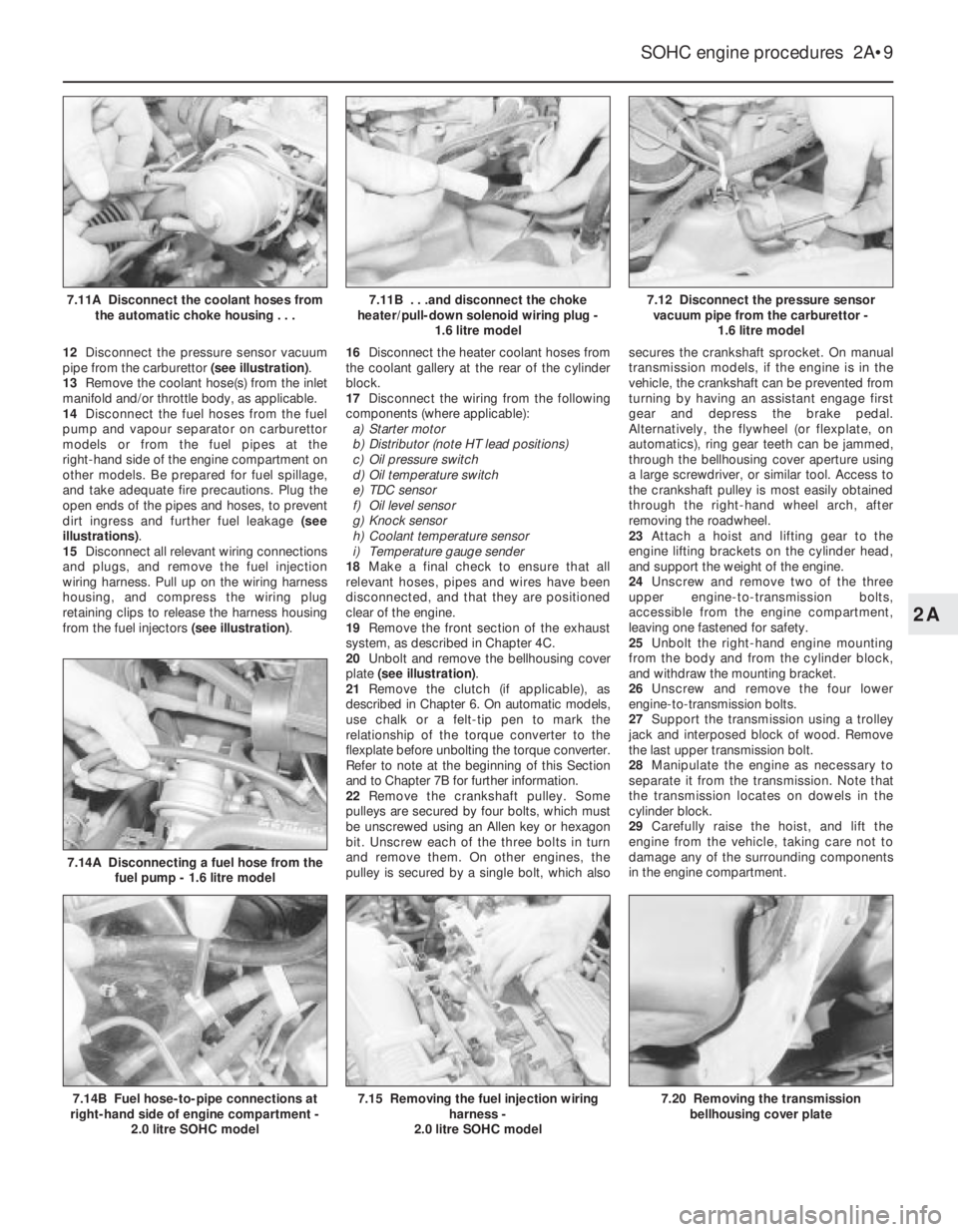
pipe from the carburettor (see illustration).
13Remove the coolant hose(s) from the inlet
manifold and/or throttle body, as applicable.
14Disconnect the fuel hoses from the fuel
pump and vapour separator on carburettor
models or from the fuel pipes at the
right-hand side of the engine compartment on
other models. Be prepared for fuel spillage,
and take adequate fire precautions. Plug the
open ends of the pipes and hoses, to prevent
dirt ingress and further fuel leakage (see
illustrations).
15Disconnect all relevant wiring connections
and plugs, and remove the fuel injection
wiring harness. Pull up on the wiring harness
housing, and compress the wiring plug
retaining clips to release the harness housing
from the fuel injectors (see illustration).16Disconnect the heater coolant hoses from
the coolant gallery at the rear of the cylinder
block.
17Disconnect the wiring from the following
components (where applicable):
a)Starter motor
b)Distributor (note HT lead positions)
c)Oil pressure switch
d)Oil temperature switch
e)TDC sensor
f)Oil level sensor
g)Knock sensor
h)Coolant temperature sensor
i)Temperature gauge sender
18Make a final check to ensure that all
relevant hoses, pipes and wires have been
disconnected, and that they are positioned
clear of the engine.
19Remove the front section of the exhaust
system, as described in Chapter 4C.
20Unbolt and remove the bellhousing cover
plate (see illustration).
21Remove the clutch (if applicable), as
described in Chapter 6. On automatic models,
use chalk or a felt-tip pen to mark the
relationship of the torque converter to the
flexplate before unbolting the torque converter.
Refer to note at the beginning of this Section
and to Chapter 7B for further information.
22Remove the crankshaft pulley. Some
pulleys are secured by four bolts, which must
be unscrewed using an Allen key or hexagon
bit. Unscrew each of the three bolts in turn
and remove them. On other engines, the
pulley is secured by a single bolt, which alsosecures the crankshaft sprocket. On manual
transmission models, if the engine is in the
vehicle, the crankshaft can be prevented from
turning by having an assistant engage first
gear and depress the brake pedal.
Alternatively, the flywheel (or flexplate, on
automatics), ring gear teeth can be jammed,
through the bellhousing cover aperture using
a large screwdriver, or similar tool. Access to
the crankshaft pulley is most easily obtained
through the right-hand wheel arch, after
removing the roadwheel.
23Attach a hoist and lifting gear to the
engine lifting brackets on the cylinder head,
and support the weight of the engine.
24Unscrew and remove two of the three
upper engine-to-transmission bolts,
accessible from the engine compartment,
leaving one fastened for safety.
25Unbolt the right-hand engine mounting
from the body and from the cylinder block,
and withdraw the mounting bracket.
26Unscrew and remove the four lower
engine-to-transmission bolts.
27Support the transmission using a trolley
jack and interposed block of wood. Remove
the last upper transmission bolt.
28Manipulate the engine as necessary to
separate it from the transmission. Note that
the transmission locates on dowels in the
cylinder block.
29Carefully raise the hoist, and lift the
engine from the vehicle, taking care not to
damage any of the surrounding components
in the engine compartment.
SOHC engine procedures 2A•9
7.12 Disconnect the pressure sensor
vacuum pipe from the carburettor -
1.6 litre model
7.20 Removing the transmission
bellhousing cover plate7.15 Removing the fuel injection wiring
harness -
2.0 litre SOHC model7.14B Fuel hose-to-pipe connections at
right-hand side of engine compartment -
2.0 litre SOHC model
7.14A Disconnecting a fuel hose from the
fuel pump - 1.6 litre model
7.11B . . .and disconnect the choke
heater/pull-down solenoid wiring plug -
1.6 litre model7.11A Disconnect the coolant hoses from
the automatic choke housing . . .
2A
Page 207 of 525
30With the engine removed, the
transmission can be supported by placing a
length of wood between the bellhousing and
the front suspension subframe. Once the
wooden support is in place, remove the trolley
jack from under the transmission.
Refitting
Note: New left and right-hand
engine/transmission mounting-to-body bolts
must be used on refitting.
31Use an M10 x 1.25 bottoming tap to clean
the threads in the torque converters threaded
bosses and ensure that new bolts are
available for reassembly, where applicable.
32Support the transmission with a trolley
jack and remove the length of wood from
between the bellhousing and the subframe.
33Support the engine with the hoist and
lifting tackle, and gently lower it into position
in the engine compartment.
34Mate the engine and transmission
together, ensuring that the transmission
locates on the dowels in the cylinder block,
then refit the three upper
engine-to-transmission bolts.
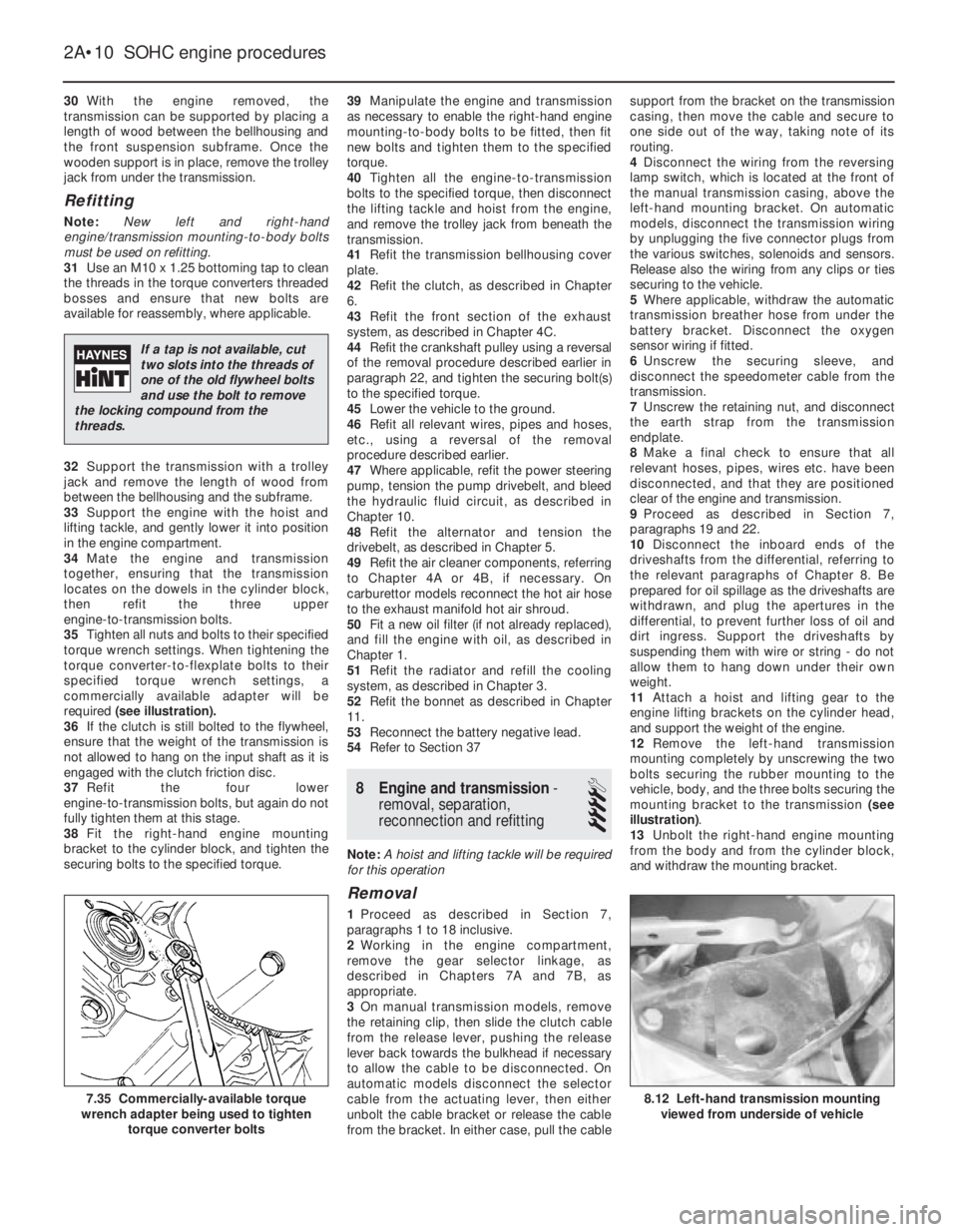
35Tighten all nuts and bolts to their specified
torque wrench settings. When tightening the
torque converter-to-flexplate bolts to their
specified torque wrench settings, a
commercially available adapter will be
required (see illustration).
36If the clutch is still bolted to the flywheel,
ensure that the weight of the transmission is
not allowed to hang on the input shaft as it is
engaged with the clutch friction disc.
37Refit the four lower
engine-to-transmission bolts, but again do not
fully tighten them at this stage.
38Fit the right-hand engine mounting
bracket to the cylinder block, and tighten the
securing bolts to the specified torque.39Manipulate the engine and transmission
as necessary to enable the right-hand engine
mounting-to-body bolts to be fitted, then fit
new bolts and tighten them to the specified
torque.
40Tighten all the engine-to-transmission
bolts to the specified torque, then disconnect
the lifting tackle and hoist from the engine,
and remove the trolley jack from beneath the
transmission.
41Refit the transmission bellhousing cover
plate.
42Refit the clutch, as described in Chapter
6.
43Refit the front section of the exhaust
system, as described in Chapter 4C.
44Refit the crankshaft pulley using a reversal
of the removal procedure described earlier in
paragraph 22, and tighten the securing bolt(s)
to the specified torque.
45Lower the vehicle to the ground.
46Refit all relevant wires, pipes and hoses,
etc., using a reversal of the removal
procedure described earlier.
47Where applicable, refit the power steering
pump, tension the pump drivebelt, and bleed
the hydraulic fluid circuit, as described in
Chapter 10.
48Refit the alternator and tension the
drivebelt, as described in Chapter 5.
49Refit the air cleaner components, referring
to Chapter 4A or 4B, if necessary. On
carburettor models reconnect the hot air hose
to the exhaust manifold hot air shroud.
50Fit a new oil filter (if not already replaced),
and fill the engine with oil, as described in
Chapter 1.
51Refit the radiator and refill the cooling
system, as described in Chapter 3.
52Refit the bonnet as described in Chapter
11.
53Reconnect the battery negative lead.
54Refer to Section 37
8Engine and transmission -
removal, separation,
reconnection and refitting
4
Note: A hoist and lifting tackle will be required
for this operation
Removal
1Proceed as described in Section 7,
paragraphs 1 to 18 inclusive.
2Working in the engine compartment,
remove the gear selector linkage, as
described in Chapters 7A and 7B, as
appropriate.
3On manual transmission models, remove
the retaining clip, then slide the clutch cable
from the release lever, pushing the release
lever back towards the bulkhead if necessary
to allow the cable to be disconnected. On
automatic models disconnect the selector
cable from the actuating lever, then either
unbolt the cable bracket or release the cable
from the bracket. In either case, pull the cablesupport from the bracket on the transmission
casing, then move the cable and secure to
one side out of the way, taking note of its
routing.
4Disconnect the wiring from the reversing
lamp switch, which is located at the front of
the manual transmission casing, above the
left-hand mounting bracket. On automatic
models, disconnect the transmission wiring
by unplugging the five connector plugs from
the various switches, solenoids and sensors.
Release also the wiring from any clips or ties
securing to the vehicle.
5Where applicable, withdraw the automatic
transmission breather hose from under the
battery bracket. Disconnect the oxygen
sensor wiring if fitted.
6Unscrew the securing sleeve, and
disconnect the speedometer cable from the
transmission.
7Unscrew the retaining nut, and disconnect
the earth strap from the transmission
endplate.
8Make a final check to ensure that all
relevant hoses, pipes, wires etc. have been
disconnected, and that they are positioned
clear of the engine and transmission.
9Proceed as described in Section 7,
paragraphs 19 and 22.
10Disconnect the inboard ends of the
driveshafts from the differential, referring to
the relevant paragraphs of Chapter 8. Be
prepared for oil spillage as the driveshafts are
withdrawn, and plug the apertures in the
differential, to prevent further loss of oil and
dirt ingress. Support the driveshafts by
suspending them with wire or string - do not
allow them to hang down under their own
weight.
11Attach a hoist and lifting gear to the
engine lifting brackets on the cylinder head,
and support the weight of the engine.
12Remove the left-hand transmission
mounting completely by unscrewing the two
bolts securing the rubber mounting to the
vehicle, body, and the three bolts securing the
mounting bracket to the transmission (see
illustration).
13Unbolt the right-hand engine mounting
from the body and from the cylinder block,
and withdraw the mounting bracket.
2A•10SOHC engine procedures
8.12 Left-hand transmission mounting
viewed from underside of vehicle7.35 Commercially-available torque
wrench adapter being used to tighten
torque converter bolts
If a tap is not available, cut
two slots into the threads of
one of the old flywheel bolts
and use the bolt to remove
the locking compound from the
threads.
Page 208 of 525
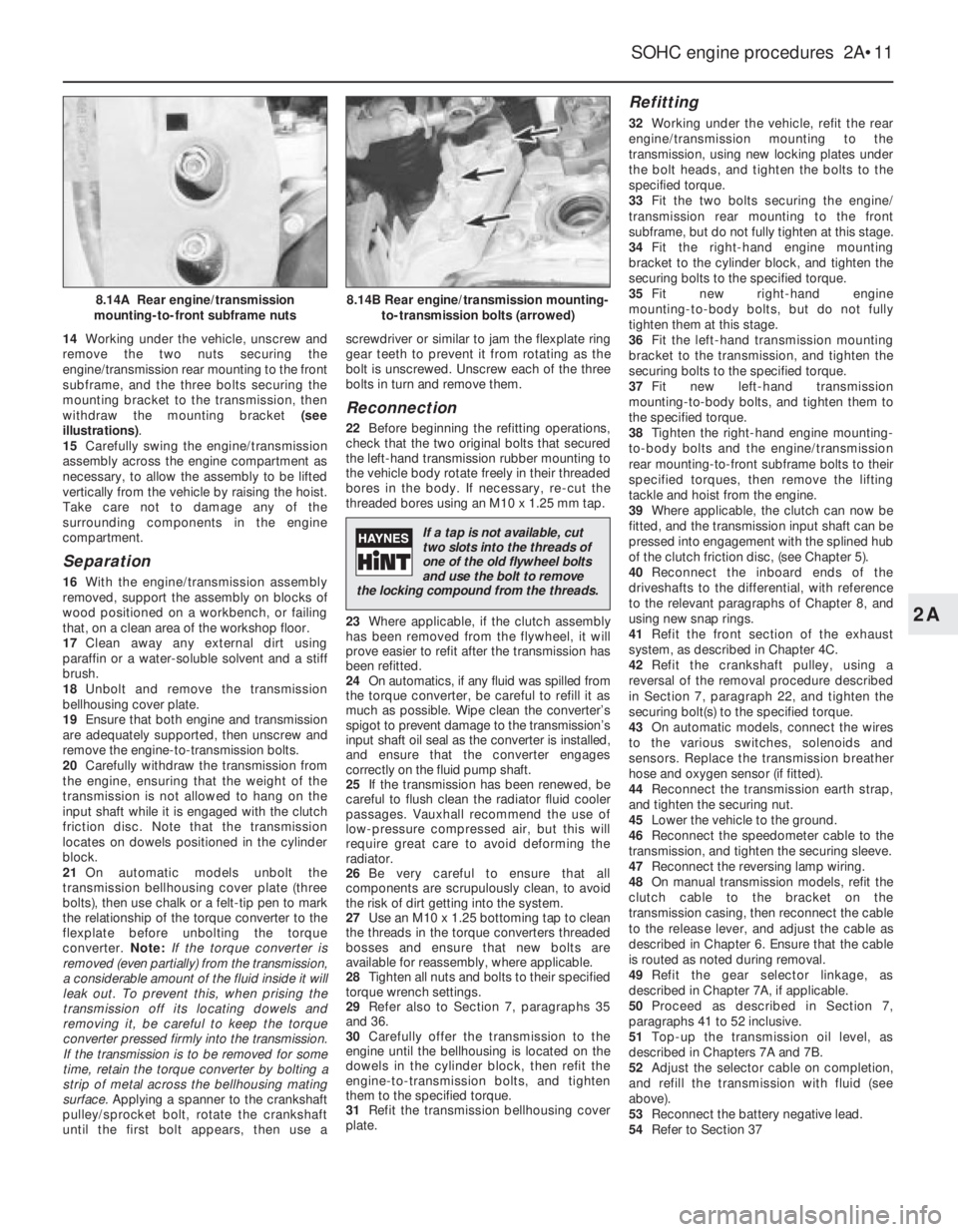
14Working under the vehicle, unscrew and
remove the two nuts securing the
engine/transmission rear mounting to the front
subframe, and the three bolts securing the
mounting bracket to the transmission, then
withdraw the mounting bracket (see
illustrations).
15Carefully swing the engine/transmission
assembly across the engine compartment as
necessary, to allow the assembly to be lifted
vertically from the vehicle by raising the hoist.
Take care not to damage any of the
surrounding components in the engine
compartment.
Separation
16With the engine/transmission assembly
removed, support the assembly on blocks of
wood positioned on a workbench, or failing
that, on a clean area of the workshop floor.
17Clean away any external dirt using
paraffin or a water-soluble solvent and a stiff
brush.
18Unbolt and remove the transmission
bellhousing cover plate.
19Ensure that both engine and transmission
are adequately supported, then unscrew and
remove the engine-to-transmission bolts.
20Carefully withdraw the transmission from
the engine, ensuring that the weight of the
transmission is not allowed to hang on the
input shaft while it is engaged with the clutch
friction disc. Note that the transmission
locates on dowels positioned in the cylinder
block.
21On automatic models unbolt the
transmission bellhousing cover plate (three
bolts), then use chalk or a felt-tip pen to mark
the relationship of the torque converter to the
flexplate before unbolting the torque
converter. Note:If the torque converter is
removed (even partially) from the transmission,
a considerable amount of the fluid inside it will
leak out. To prevent this, when prising the
transmission off its locating dowels and
removing it, be careful to keep the torque
converter pressed firmly into the transmission.
If the transmission is to be removed for some
time, retain the torque converter by bolting a
strip of metal across the bellhousing mating
surface. Applying a spanner to the crankshaft
pulley/sprocket bolt, rotate the crankshaft
until the first bolt appears, then use ascrewdriver or similar to jam the flexplate ring
gear teeth to prevent it from rotating as the
bolt is unscrewed. Unscrew each of the three
bolts in turn and remove them.
Reconnection
22Before beginning the refitting operations,
check that the two original bolts that secured
the left-hand transmission rubber mounting to
the vehicle body rotate freely in their threaded
bores in the body. If necessary, re-cut the
threaded bores using an M10 x 1.25 mm tap.
23Where applicable, if the clutch assembly
has been removed from the flywheel, it will
prove easier to refit after the transmission has
been refitted.
24On automatics, if any fluid was spilled from
the torque converter, be careful to refill it as
much as possible. Wipe clean the converter’s
spigot to prevent damage to the transmission’s
input shaft oil seal as the converter is installed,
and ensure that the converter engages
correctly on the fluid pump shaft.
25If the transmission has been renewed, be
careful to flush clean the radiator fluid cooler
passages. Vauxhall recommend the use of
low-pressure compressed air, but this will
require great care to avoid deforming the
radiator.
26Be very careful to ensure that all
components are scrupulously clean, to avoid
the risk of dirt getting into the system.
27Use an M10 x 1.25 bottoming tap to clean
the threads in the torque converters threaded
bosses and ensure that new bolts are
available for reassembly, where applicable.
28Tighten all nuts and bolts to their specified
torque wrench settings.
29Refer also to Section 7, paragraphs 35
and 36.
30Carefully offer the transmission to the
engine until the bellhousing is located on the
dowels in the cylinder block, then refit the
engine-to-transmission bolts, and tighten
them to the specified torque.
31Refit the transmission bellhousing cover
plate.
Refitting
32Working under the vehicle, refit the rear
engine/transmission mounting to the
transmission, using new locking plates under
the bolt heads, and tighten the bolts to the
specified torque.
33Fit the two bolts securing the engine/
transmission rear mounting to the front
subframe, but do not fully tighten at this stage.
34Fit the right-hand engine mounting
bracket to the cylinder block, and tighten the
securing bolts to the specified torque.
35Fit new right-hand engine
mounting-to-body bolts, but do not fully
tighten them at this stage.
36Fit the left-hand transmission mounting
bracket to the transmission, and tighten the
securing bolts to the specified torque.
37Fit new left-hand transmission
mounting-to-body bolts, and tighten them to
the specified torque.
38Tighten the right-hand engine mounting-
to-body bolts and the engine/transmission
rear mounting-to-front subframe bolts to their
specified torques, then remove the lifting
tackle and hoist from the engine.
39Where applicable, the clutch can now be
fitted, and the transmission input shaft can be
pressed into engagement with the splined hub
of the clutch friction disc, (see Chapter 5).
40Reconnect the inboard ends of the
driveshafts to the differential, with reference
to the relevant paragraphs of Chapter 8, and
using new snap rings.
41Refit the front section of the exhaust
system, as described in Chapter 4C.
42Refit the crankshaft pulley, using a
reversal of the removal procedure described
in Section 7, paragraph 22, and tighten the
securing bolt(s) to the specified torque.
43On automatic models, connect the wires
to the various switches, solenoids and
sensors. Replace the transmission breather
hose and oxygen sensor (if fitted).
44Reconnect the transmission earth strap,
and tighten the securing nut.
45Lower the vehicle to the ground.
46Reconnect the speedometer cable to the
transmission, and tighten the securing sleeve.
47Reconnect the reversing lamp wiring.
48On manual transmission models, refit the
clutch cable to the bracket on the
transmission casing, then reconnect the cable
to the release lever, and adjust the cable as
described in Chapter 6. Ensure that the cable
is routed as noted during removal.
49Refit the gear selector linkage, as
described in Chapter 7A, if applicable.
50Proceed as described in Section 7,
paragraphs 41 to 52 inclusive.
51Top-up the transmission oil level, as
described in Chapters 7A and 7B.
52Adjust the selector cable on completion,
and refill the transmission with fluid (see
above).
53Reconnect the battery negative lead.
54Refer to Section 37
SOHC engine procedures 2A•11
8.14B Rear engine/transmission mounting-
to-transmission bolts (arrowed)8.14A Rear engine/transmission
mounting-to-front subframe nuts
2A
If a tap is not available, cut
two slots into the threads of
one of the old flywheel bolts
and use the bolt to remove
the locking compound from the threads.