engine OPEL VECTRA 1988 Service Manual PDF
[x] Cancel search | Manufacturer: OPEL, Model Year: 1988, Model line: VECTRA, Model: OPEL VECTRA 1988Pages: 525, PDF Size: 58.26 MB
Page 158 of 525
4B
13Manipulate the air inlet tube to release the
securing lugs from the front body panel. This
is a tricky operation, and patience will be
required. For improved access, the headlamp
can be removed, as described in Chapter 12.
Refitting
14Refitting of all components is a reversal of
removal, noting that the air cleaner element
fits with the rubber locating flange uppermost.
5Air box - removal and refitting
2
Removal
1The air box, if fitted, is secured by two or
three bolts to the top of the throttle body.
Take note of the routing and connections of
the inlet air temperature control system
vacuum pipes.
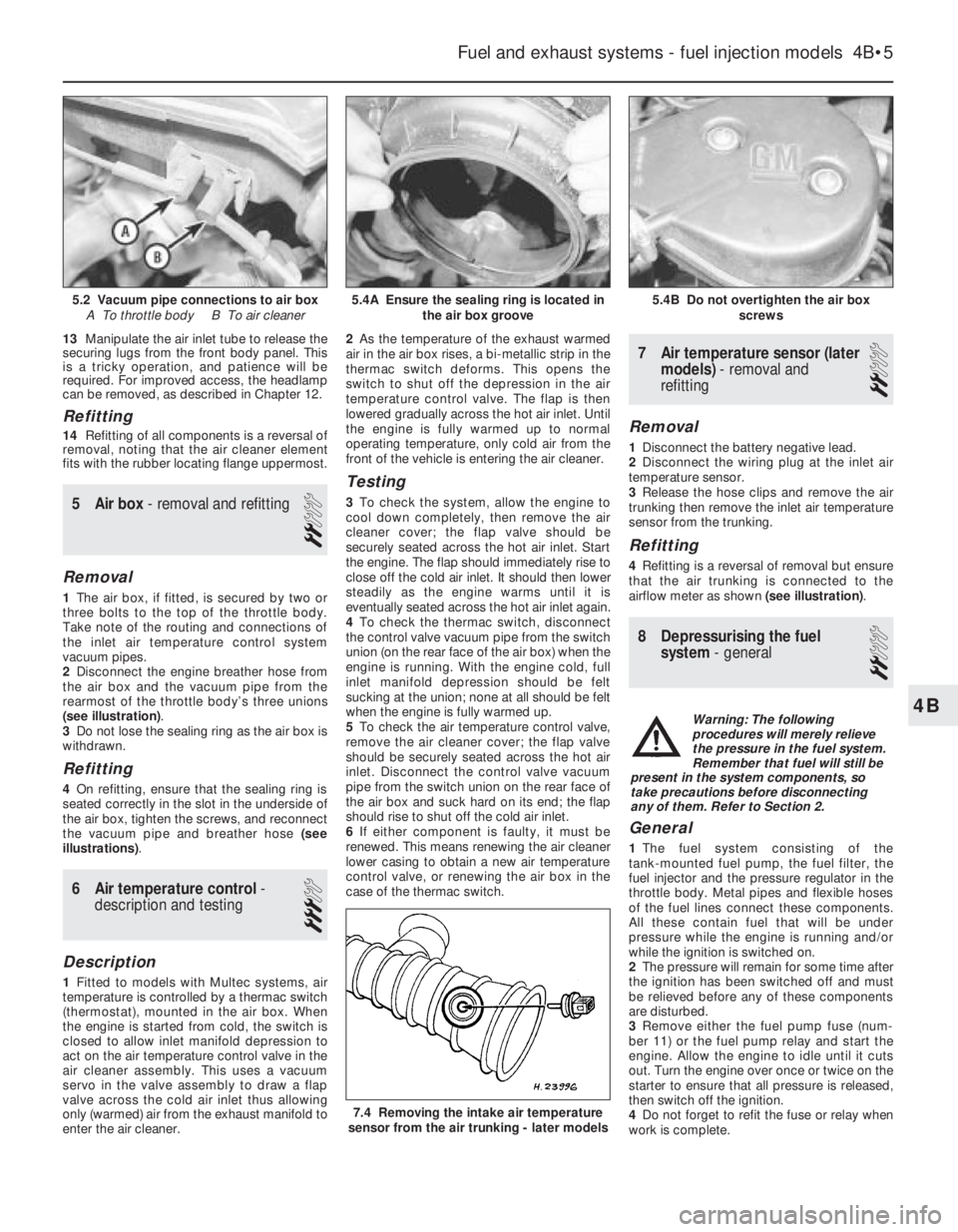
2Disconnect the engine breather hose from
the air box and the vacuum pipe from the
rearmost of the throttle body’s three unions
(see illustration).
3Do not lose the sealing ring as the air box is
withdrawn.
Refitting
4On refitting, ensure that the sealing ring is
seated correctly in the slot in the underside of
the air box, tighten the screws, and reconnect
the vacuum pipe and breather hose (see
illustrations).
6Air temperature control -
description and testing
3
Description
1Fitted to models with Multec systems, air
temperature is controlled by a thermac switch
(thermostat), mounted in the air box. When
the engine is started from cold, the switch is
closed to allow inlet manifold depression to
act on the air temperature control valve in the
air cleaner assembly. This uses a vacuum
servo in the valve assembly to draw a flap
valve across the cold air inlet thus allowing
only (warmed) air from the exhaust manifold to
enter the air cleaner.2As the temperature of the exhaust warmed
air in the air box rises, a bi-metallic strip in the
thermac switch deforms. This opens the
switch to shut off the depression in the air
temperature control valve. The flap is then
lowered gradually across the hot air inlet. Until
the engine is fully warmed up to normal
operating temperature, only cold air from the
front of the vehicle is entering the air cleaner.
Testing
3To check the system, allow the engine to
cool down completely, then remove the air
cleaner cover; the flap valve should be
securely seated across the hot air inlet. Start
the engine. The flap should immediately rise to
close off the cold air inlet. It should then lower
steadily as the engine warms until it is
eventually seated across the hot air inlet again.
4To check the thermac switch, disconnect
the control valve vacuum pipe from the switch
union (on the rear face of the air box) when the
engine is running. With the engine cold, full
inlet manifold depression should be felt
sucking at the union; none at all should be felt
when the engine is fully warmed up.
5To check the air temperature control valve,
remove the air cleaner cover; the flap valve
should be securely seated across the hot air
inlet. Disconnect the control valve vacuum
pipe from the switch union on the rear face of
the air box and suck hard on its end; the flap
should rise to shut off the cold air inlet.
6If either component is faulty, it must be
renewed. This means renewing the air cleaner
lower casing to obtain a new air temperature
control valve, or renewing the air box in the
case of the thermac switch.
7Air temperature sensor (later
models) - removal and
refitting
2
Removal
1Disconnect the battery negative lead.
2Disconnect the wiring plug at the inlet air
temperature sensor.
3Release the hose clips and remove the air
trunking then remove the inlet air temperature
sensor from the trunking.
Refitting
4Refitting is a reversal of removal but ensure
that the air trunking is connected to the
airflow meter as shown (see illustration).
8Depressurising the fuel
system - general
2
General
1The fuel system consisting of the
tank-mounted fuel pump, the fuel filter, the
fuel injector and the pressure regulator in the
throttle body. Metal pipes and flexible hoses
of the fuel lines connect these components.
All these contain fuel that will be under
pressure while the engine is running and/or
while the ignition is switched on.
2The pressure will remain for some time after
the ignition has been switched off and must
be relieved before any of these components
are disturbed.
3Remove either the fuel pump fuse (num-
ber 11) or the fuel pump relay and start the
engine. Allow the engine to idle until it cuts
out. Turn the engine over once or twice on the
starter to ensure that all pressure is released,
then switch off the ignition.
4Do not forget to refit the fuse or relay when
work is complete.
Fuel and exhaust systems - fuel injection models 4B•5
5.4B Do not overtighten the air box
screws
7.4 Removing the intake air temperature
sensor from the air trunking - later models
5.4A Ensure the sealing ring is located in
the air box groove5.2 Vacuum pipe connections to air box
A To throttle body B To air cleaner
Warning: The following
procedures will merely relieve
the pressure in the fuel system.
Remember that fuel will still be
present in the system components, so
take precautions before disconnecting
any of them. Refer to Section 2.
Page 159 of 525
9Fuel filter (‘Out-of-tank’ fuel
pump models) - removal and
refitting
3
Note: Refer to Section 2 before proceeding
Removal
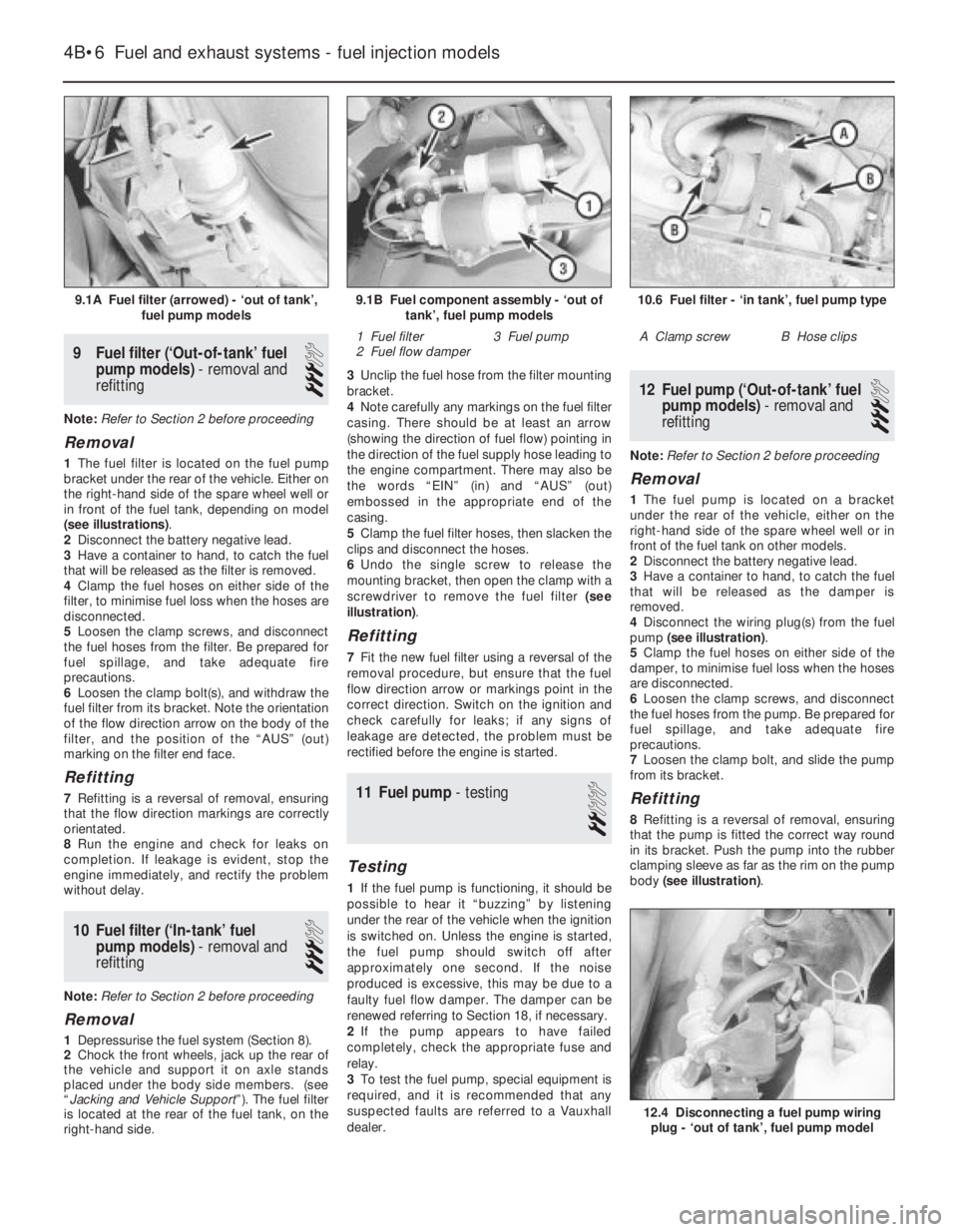
1The fuel filter is located on the fuel pump
bracket under the rear of the vehicle. Either on
the right-hand side of the spare wheel well or
in front of the fuel tank, depending on model
(see illustrations).
2Disconnect the battery negative lead.
3Have a container to hand, to catch the fuel
that will be released as the filter is removed.
4Clamp the fuel hoses on either side of the
filter, to minimise fuel loss when the hoses are
disconnected.
5Loosen the clamp screws, and disconnect
the fuel hoses from the filter. Be prepared for
fuel spillage, and take adequate fire
precautions.
6Loosen the clamp bolt(s), and withdraw the
fuel filter from its bracket. Note the orientation
of the flow direction arrow on the body of the
filter, and the position of the “AUS” (out)
marking on the filter end face.
Refitting
7Refitting is a reversal of removal, ensuring
that the flow direction markings are correctly
orientated.
8Run the engine and check for leaks on
completion. If leakage is evident, stop the
engine immediately, and rectify the problem
without delay.
10Fuel filter (‘In-tank’ fuel
pump models) - removal and
refitting
3
Note: Refer to Section 2 before proceeding
Removal
1Depressurise the fuel system (Section 8).
2Chock the front wheels, jack up the rear of
the vehicle and support it on axle stands
placed under the body side members. (see
“Jacking and Vehicle Support”). The fuel filter
is located at the rear of the fuel tank, on the
right-hand side.3Unclip the fuel hose from the filter mounting
bracket.
4Note carefully any markings on the fuel filter
casing. There should be at least an arrow
(showing the direction of fuel flow) pointing in
the direction of the fuel supply hose leading to
the engine compartment. There may also be
the words “EIN” (in) and “AUS” (out)
embossed in the appropriate end of the
casing.
5Clamp the fuel filter hoses, then slacken the
clips and disconnect the hoses.
6Undo the single screw to release the
mounting bracket, then open the clamp with a
screwdriver to remove the fuel filter (see
illustration).
Refitting
7Fit the new fuel filter using a reversal of the
removal procedure, but ensure that the fuel
flow direction arrow or markings point in the
correct direction. Switch on the ignition and
check carefully for leaks; if any signs of
leakage are detected, the problem must be
rectified before the engine is started.
11Fuel pump - testing
2
Testing
1If the fuel pump is functioning, it should be
possible to hear it “buzzing” by listening
under the rear of the vehicle when the ignition
is switched on. Unless the engine is started,
the fuel pump should switch off after
approximately one second. If the noise
produced is excessive, this may be due to a
faulty fuel flow damper. The damper can be
renewed referring to Section 18, if necessary.
2If the pump appears to have failed
completely, check the appropriate fuse and
relay.
3To test the fuel pump, special equipment is
required, and it is recommended that any
suspected faults are referred to a Vauxhall
dealer.
12Fuel pump (‘Out-of-tank’ fuel
pump models) - removal and
refitting
3
Note: Refer to Section 2 before proceeding
Removal
1The fuel pump is located on a bracket
under the rear of the vehicle, either on the
right-hand side of the spare wheel well or in
front of the fuel tank on other models.
2Disconnect the battery negative lead.
3Have a container to hand, to catch the fuel
that will be released as the damper is
removed.
4Disconnect the wiring plug(s) from the fuel
pump (see illustration).
5Clamp the fuel hoses on either side of the
damper, to minimise fuel loss when the hoses
are disconnected.
6Loosen the clamp screws, and disconnect
the fuel hoses from the pump. Be prepared for
fuel spillage, and take adequate fire
precautions.
7Loosen the clamp bolt, and slide the pump
from its bracket.
Refitting
8Refitting is a reversal of removal, ensuring
that the pump is fitted the correct way round
in its bracket. Push the pump into the rubber
clamping sleeve as far as the rim on the pump
body (see illustration).
4B•6Fuel and exhaust systems - fuel injection models
9.1A Fuel filter (arrowed) - ‘out of tank’,
fuel pump models10.6 Fuel filter - ‘in tank’, fuel pump type
A Clamp screwB Hose clips
12.4 Disconnecting a fuel pump wiring
plug - ‘out of tank’, fuel pump model
9.1B Fuel component assembly - ‘out of
tank’, fuel pump models
1 Fuel filter
2 Fuel flow damper3 Fuel pump
Page 160 of 525
4B
9Run the engine and check for leaks on
completion. If leakage is evident, stop the
engine immediately, and rectify the problem
without delay.
13Fuel pump (‘In-tank’ fuel
pump models) - removal and
refitting
3
Removal
1Depressurise the fuel system (Section 8),
then remove and refit the fuel filler cap to
ensure that the pressure is equalised inside
and outside the tank.
2Disconnect the battery negative terminal.
3Fold forwards the rear seat cushion. Peel
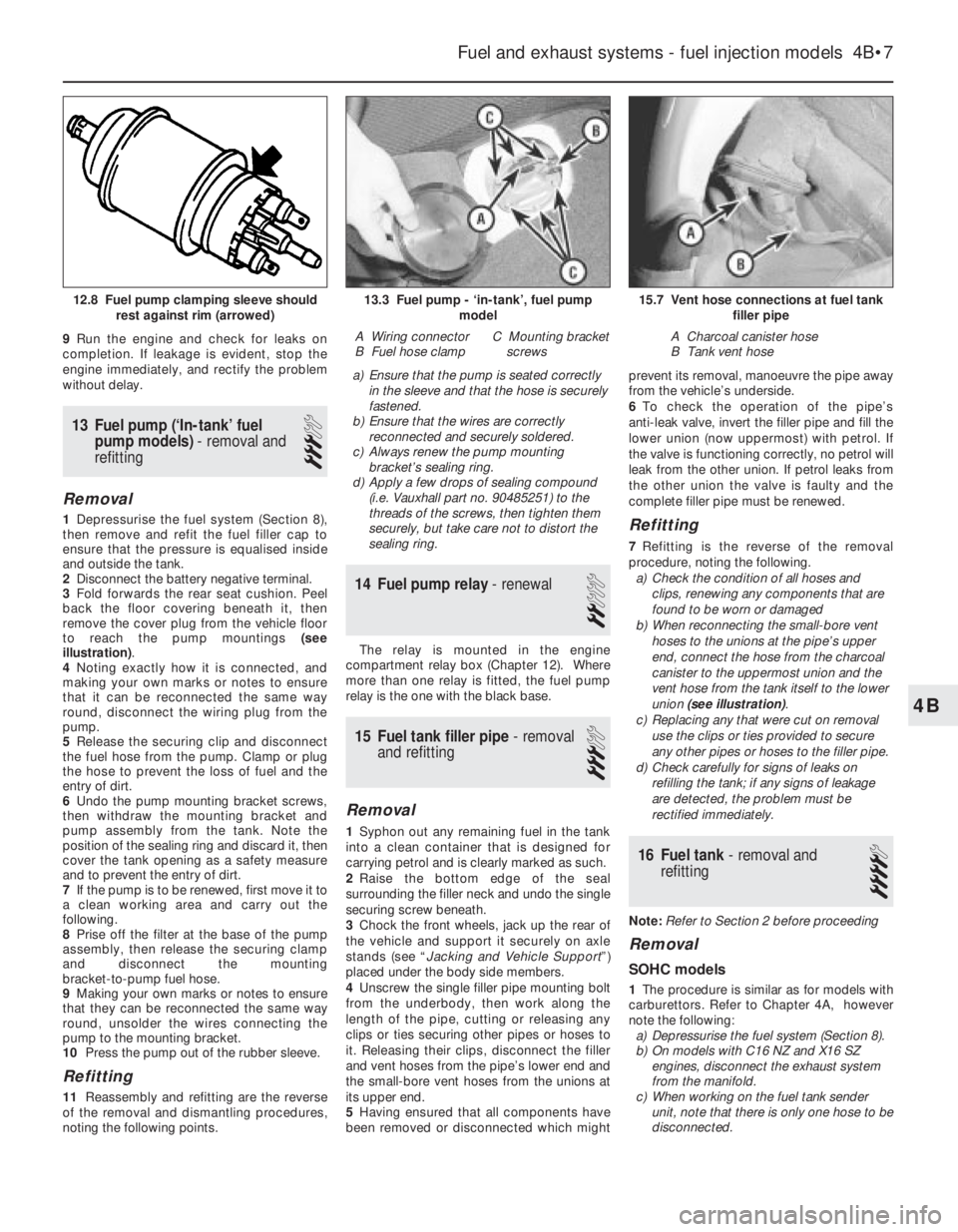
back the floor covering beneath it, then
remove the cover plug from the vehicle floor
to reach the pump mountings (see
illustration).
4Noting exactly how it is connected, and
making your own marks or notes to ensure
that it can be reconnected the same way
round, disconnect the wiring plug from the
pump.
5Release the securing clip and disconnect
the fuel hose from the pump. Clamp or plug
the hose to prevent the loss of fuel and the
entry of dirt.
6Undo the pump mounting bracket screws,
then withdraw the mounting bracket and
pump assembly from the tank. Note the
position of the sealing ring and discard it, then
cover the tank opening as a safety measure
and to prevent the entry of dirt.
7If the pump is to be renewed, first move it to
a clean working area and carry out the
following.
8Prise off the filter at the base of the pump
assembly, then release the securing clamp
and disconnect the mounting
bracket-to-pump fuel hose.
9Making your own marks or notes to ensure
that they can be reconnected the same way
round, unsolder the wires connecting the
pump to the mounting bracket.
10Press the pump out of the rubber sleeve.
Refitting
11Reassembly and refitting are the reverse
of the removal and dismantling procedures,
noting the following points.a)Ensure that the pump is seated correctly
in the sleeve and that the hose is securely
fastened.
b)Ensure that the wires are correctly
reconnected and securely soldered.
c)Always renew the pump mounting
bracket’s sealing ring.
d)Apply a few drops of sealing compound
(i.e. Vauxhall part no. 90485251) to the
threads of the screws, then tighten them
securely, but take care not to distort the
sealing ring.
14Fuel pump relay - renewal
2
The relay is mounted in the engine
compartment relay box (Chapter 12). Where
more than one relay is fitted, the fuel pump
relay is the one with the black base.
15Fuel tank filler pipe - removal
and refitting
3
Removal
1Syphon out any remaining fuel in the tank
into a clean container that is designed for
carrying petrol and is clearly marked as such.
2Raise the bottom edge of the seal
surrounding the filler neck and undo the single
securing screw beneath.
3Chock the front wheels, jack up the rear of
the vehicle and support it securely on axle
stands (see “Jacking and Vehicle Support”)
placed under the body side members.
4Unscrew the single filler pipe mounting bolt
from the underbody, then work along the
length of the pipe, cutting or releasing any
clips or ties securing other pipes or hoses to
it. Releasing their clips, disconnect the filler
and vent hoses from the pipe’s lower end and
the small-bore vent hoses from the unions at
its upper end.
5Having ensured that all components have
been removed or disconnected which mightprevent its removal, manoeuvre the pipe away
from the vehicle’s underside.
6To check the operation of the pipe’s
anti-leak valve, invert the filler pipe and fill the
lower union (now uppermost) with petrol. If
the valve is functioning correctly, no petrol will
leak from the other union. If petrol leaks from
the other union the valve is faulty and the
complete filler pipe must be renewed.
Refitting
7Refitting is the reverse of the removal
procedure, noting the following.
a)Check the condition of all hoses and
clips, renewing any components that are
found to be worn or damaged
b)When reconnecting the small-bore vent
hoses to the unions at the pipe’s upper
end, connect the hose from the charcoal
canister to the uppermost union and the
vent hose from the tank itself to the lower
union (see illustration).
c)Replacing any that were cut on removal
use the clips or ties provided to secure
any other pipes or hoses to the filler pipe.
d)Check carefully for signs of leaks on
refilling the tank; if any signs of leakage
are detected, the problem must be
rectified immediately.
16Fuel tank - removal and
refitting
4
Note: Refer to Section 2 before proceeding
Removal
SOHC models
1The procedure is similar as for models with
carburettors. Refer to Chapter 4A, however
note the following:
a)Depressurise the fuel system (Section 8).
b)On models with C16 NZ and X16 SZ
engines, disconnect the exhaust system
from the manifold.
c)When working on the fuel tank sender
unit, note that there is only one hose to be
disconnected.
Fuel and exhaust systems - fuel injection models 4B•7
15.7 Vent hose connections at fuel tank
filler pipe
A Charcoal canister hose
B Tank vent hose
13.3 Fuel pump - ‘in-tank’, fuel pump
model
A Wiring connector
B Fuel hose clampC Mounting bracket
screws
12.8 Fuel pump clamping sleeve should
rest against rim (arrowed)
Page 161 of 525
d)Disconnect the fuel pump hose and wiring
as described in Section 12.
e)When releasing the tank mounting straps,
note that the fuel filter must either be
moved aside or removed completely,
whichever is most convenient
f)One of the fuel hoses connects to a pipe
in the side of the tank.
DOHC models
2Disconnect the battery negative lead.
3Siphon out any remaining fuel in the tank
through the filler pipe. Siphon the fuel into a
clean metal container that can be sealed.
4Chock the front wheels, then jack up the
rear of the vehicle, and support on axle stands
placed under the body side members (see
“Jacking and Vehicle Support”).
5Open the fuel filler flap, then pull back the
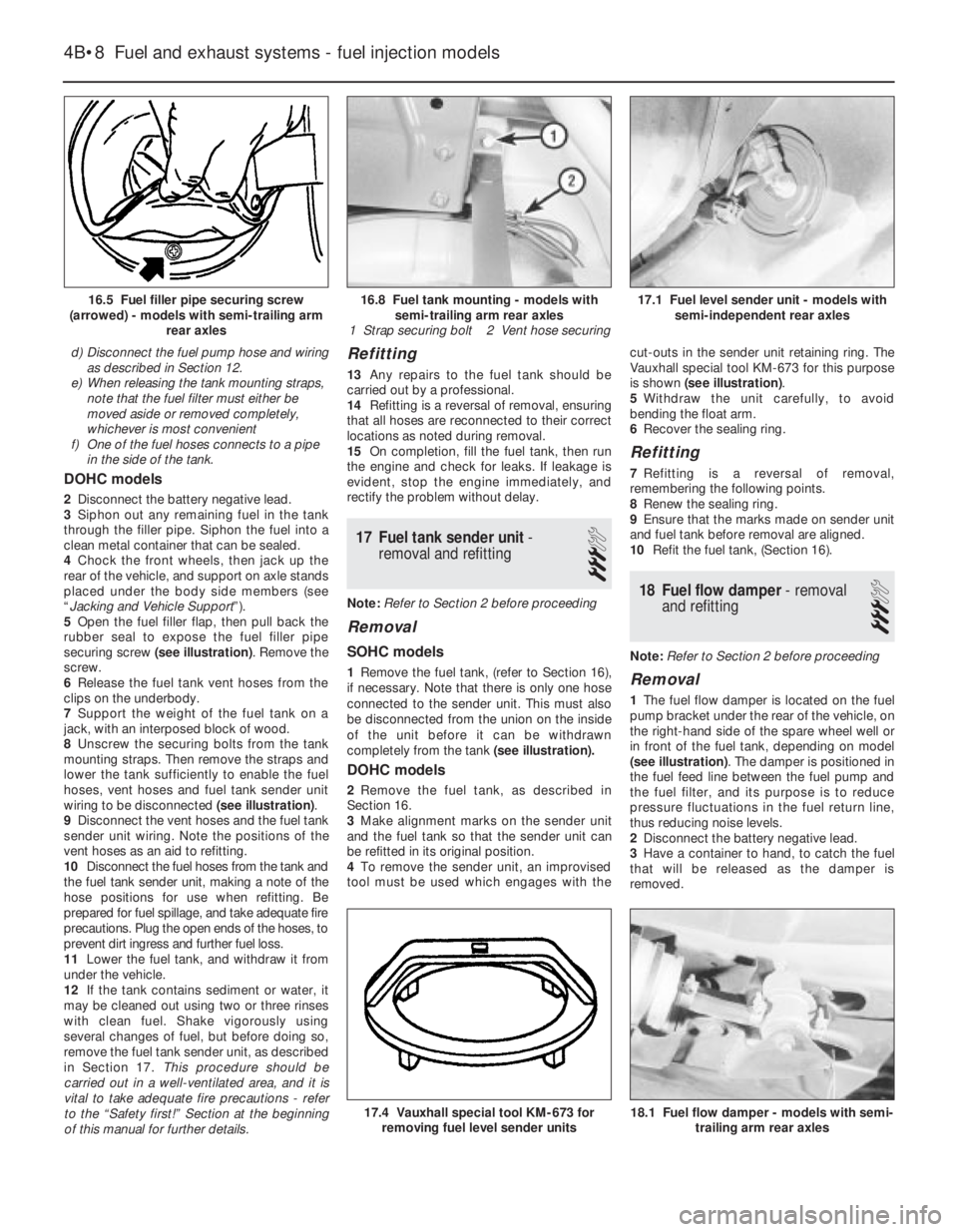
rubber seal to expose the fuel filler pipe
securing screw (see illustration). Remove the
screw.
6Release the fuel tank vent hoses from the
clips on the underbody.
7Support the weight of the fuel tank on a
jack, with an interposed block of wood.
8Unscrew the securing bolts from the tank
mounting straps. Then remove the straps and
lower the tank sufficiently to enable the fuel
hoses, vent hoses and fuel tank sender unit
wiring to be disconnected (see illustration).
9Disconnect the vent hoses and the fuel tank
sender unit wiring. Note the positions of the
vent hoses as an aid to refitting.
10Disconnect the fuel hoses from the tank and
the fuel tank sender unit, making a note of the
hose positions for use when refitting. Be
prepared for fuel spillage, and take adequate fire
precautions. Plug the open ends of the hoses, to
prevent dirt ingress and further fuel loss.
11Lower the fuel tank, and withdraw it from
under the vehicle.
12If the tank contains sediment or water, it
may be cleaned out using two or three rinses
with clean fuel. Shake vigorously using
several changes of fuel, but before doing so,
remove the fuel tank sender unit, as described
in Section 17. This procedure should be
carried out in a well-ventilated area, and it is
vital to take adequate fire precautions - refer
to the “Safety first!” Section at the beginning
of this manual for further details.
Refitting
13Any repairs to the fuel tank should be
carried out by a professional.
14Refitting is a reversal of removal, ensuring
that all hoses are reconnected to their correct
locations as noted during removal.
15On completion, fill the fuel tank, then run
the engine and check for leaks. If leakage is
evident, stop the engine immediately, and
rectify the problem without delay.
17Fuel tank sender unit -
removal and refitting
3
Note:Refer to Section 2 before proceeding
Removal
SOHC models
1Remove the fuel tank, (refer to Section 16),
if necessary. Note that there is only one hose
connected to the sender unit. This must also
be disconnected from the union on the inside
of the unit before it can be withdrawn
completely from the tank (see illustration).
DOHC models
2Remove the fuel tank, as described in
Section 16.
3Make alignment marks on the sender unit
and the fuel tank so that the sender unit can
be refitted in its original position.
4To remove the sender unit, an improvised
tool must be used which engages with thecut-outs in the sender unit retaining ring. The
Vauxhall special tool KM-673 for this purpose
is shown (see illustration).
5Withdraw the unit carefully, to avoid
bending the float arm.
6Recover the sealing ring.
Refitting
7Refitting is a reversal of removal,
remembering the following points.
8Renew the sealing ring.
9Ensure that the marks made on sender unit
and fuel tank before removal are aligned.
10Refit the fuel tank, (Section 16).
18Fuel flow damper - removal
and refitting
3
Note:Refer to Section 2 before proceeding
Removal
1The fuel flow damper is located on the fuel
pump bracket under the rear of the vehicle, on
the right-hand side of the spare wheel well or
in front of the fuel tank, depending on model
(see illustration). The damper is positioned in
the fuel feed line between the fuel pump and
the fuel filter, and its purpose is to reduce
pressure fluctuations in the fuel return line,
thus reducing noise levels.
2Disconnect the battery negative lead.
3Have a container to hand, to catch the fuel
that will be released as the damper is
removed.
4B•8Fuel and exhaust systems - fuel injection models
16.5 Fuel filler pipe securing screw
(arrowed) - models with semi-trailing arm
rear axles17.1 Fuel level sender unit - models with
semi-independent rear axles
18.1 Fuel flow damper - models with semi-
trailing arm rear axles17.4 Vauxhall special tool KM-673 for
removing fuel level sender units
16.8 Fuel tank mounting - models with
semi-trailing arm rear axles
1 Strap securing bolt 2 Vent hose securing
Page 162 of 525
4B
4Clamp the fuel hoses on either side of the
damper, to minimise fuel loss when the hoses
are disconnected.
5Loosen the clamp screws, and disconnect
the fuel hoses from the damper. Be prepared
for fuel spillage, and take adequate fire
precautions.
6Unscrew the securing nut, and withdraw
the damper from the bracket.
Refitting
7Refitting is a reversal of removal.
8Run the engine and check for leaks on
completion. If leakage is evident; stop the
engine immediately, and rectify the problem
without delay.
19Throttle cable - removal,
refitting and adjustment
3
Removal
1This procedure is basically the same as
described in Chapter 4A, but note the
following.
2Not all models are fitted with an air box.
Ignore references to it, if not applicable.
3For “carburettor” substitute “throttle body”,
and note that the cable bracket is bolted to
the inlet manifold.
4The throttle cable end may connect to a
balljoint on the throttle valve lever, which is
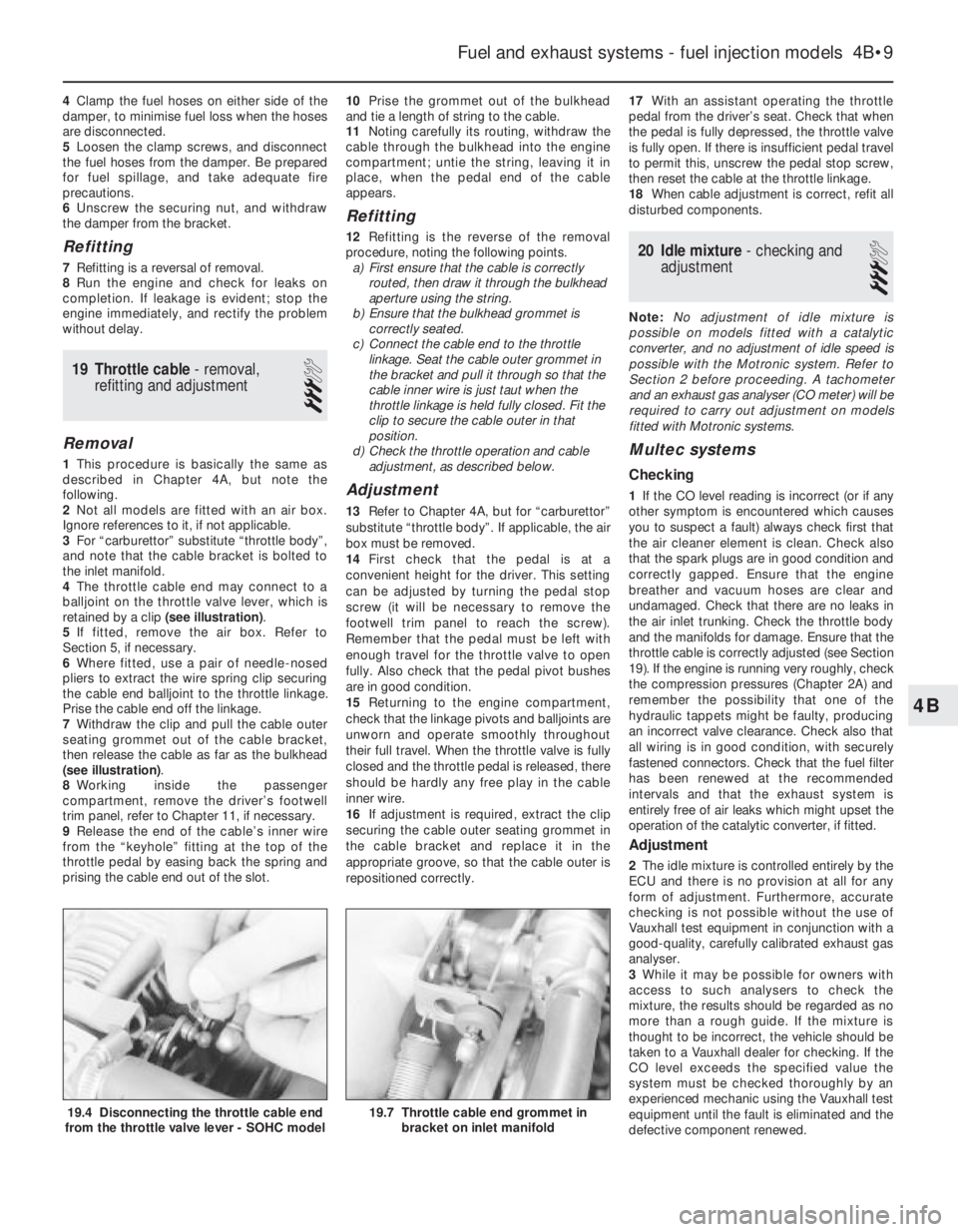
retained by a clip (see illustration).
5If fitted, remove the air box. Refer to
Section 5, if necessary.
6Where fitted, use a pair of needle-nosed
pliers to extract the wire spring clip securing
the cable end balljoint to the throttle linkage.
Prise the cable end off the linkage.
7Withdraw the clip and pull the cable outer
seating grommet out of the cable bracket,
then release the cable as far as the bulkhead
(see illustration).
8Working inside the passenger
compartment, remove the driver’s footwell
trim panel, refer to Chapter 11, if necessary.
9Release the end of the cable’s inner wire
from the “keyhole” fitting at the top of the
throttle pedal by easing back the spring and
prising the cable end out of the slot.10Prise the grommet out of the bulkhead
and tie a length of string to the cable.
11Noting carefully its routing, withdraw the
cable through the bulkhead into the engine
compartment; untie the string, leaving it in
place, when the pedal end of the cable
appears.
Refitting
12Refitting is the reverse of the removal
procedure, noting the following points.
a)First ensure that the cable is correctly
routed, then draw it through the bulkhead
aperture using the string.
b)Ensure that the bulkhead grommet is
correctly seated.
c)Connect the cable end to the throttle
linkage. Seat the cable outer grommet in
the bracket and pull it through so that the
cable inner wire is just taut when the
throttle linkage is held fully closed. Fit the
clip to secure the cable outer in that
position.
d)Check the throttle operation and cable
adjustment, as described below.
Adjustment
13Refer to Chapter 4A, but for “carburettor”
substitute “throttle body”. If applicable, the air
box must be removed.
14First check that the pedal is at a
convenient height for the driver. This setting
can be adjusted by turning the pedal stop
screw (it will be necessary to remove the
footwell trim panel to reach the screw).
Remember that the pedal must be left with
enough travel for the throttle valve to open
fully. Also check that the pedal pivot bushes
are in good condition.
15Returning to the engine compartment,
check that the linkage pivots and balljoints are
unworn and operate smoothly throughout
their full travel. When the throttle valve is fully
closed and the throttle pedal is released, there
should be hardly any free play in the cable
inner wire.
16If adjustment is required, extract the clip
securing the cable outer seating grommet in
the cable bracket and replace it in the
appropriate groove, so that the cable outer is
repositioned correctly.17With an assistant operating the throttle
pedal from the driver’s seat. Check that when
the pedal is fully depressed, the throttle valve
is fully open. If there is insufficient pedal travel
to permit this, unscrew the pedal stop screw,
then reset the cable at the throttle linkage.
18When cable adjustment is correct, refit all
disturbed components.
20Idle mixture - checking and
adjustment
3
Note: No adjustment of idle mixture is
possible on models fitted with a catalytic
converter, and no adjustment of idle speed is
possible with the Motronic system. Refer to
Section 2 before proceeding. A tachometer
and an exhaust gas analyser (CO meter) will be
required to carry out adjustment on models
fitted with Motronic systems.
Multec systems
Checking
1If the CO level reading is incorrect (or if any
other symptom is encountered which causes
you to suspect a fault) always check first that
the air cleaner element is clean. Check also
that the spark plugs are in good condition and
correctly gapped. Ensure that the engine
breather and vacuum hoses are clear and
undamaged. Check that there are no leaks in
the air inlet trunking. Check the throttle body
and the manifolds for damage. Ensure that the
throttle cable is correctly adjusted (see Section
19). If the engine is running very roughly, check
the compression pressures (Chapter 2A) and
remember the possibility that one of the
hydraulic tappets might be faulty, producing
an incorrect valve clearance. Check also that
all wiring is in good condition, with securely
fastened connectors. Check that the fuel filter
has been renewed at the recommended
intervals and that the exhaust system is
entirely free of air leaks which might upset the
operation of the catalytic converter, if fitted.
Adjustment
2The idle mixture is controlled entirely by the
ECU and there is no provision at all for any
form of adjustment. Furthermore, accurate
checking is not possible without the use of
Vauxhall test equipment in conjunction with a
good-quality, carefully calibrated exhaust gas
analyser.
3While it may be possible for owners with
access to such analysers to check the
mixture, the results should be regarded as no
more than a rough guide. If the mixture is
thought to be incorrect, the vehicle should be
taken to a Vauxhall dealer for checking. If the
CO level exceeds the specified value the
system must be checked thoroughly by an
experienced mechanic using the Vauxhall test
equipment until the fault is eliminated and the
defective component renewed.
Fuel and exhaust systems - fuel injection models 4B•9
19.7 Throttle cable end grommet in
bracket on inlet manifold19.4 Disconnecting the throttle cable end
from the throttle valve lever - SOHC model
Page 163 of 525
4Where applicable, the only test of the
catalytic converter’s efficiency is to check the
level of CO in the exhaust gas. This is
measured at the tailpipe with the engine
running (with no load) at 3000 rpm. If the CO
level exceeds the specified value, the Vauxhall
test equipment must be used to check the
entire fuel injection/ignition system. If the
engine is mechanically sound, once the
system has been eliminated, the fault must lie
in the converter, which must be renewed.
Motronic systems
Checking
5In order to check the idle mixture adjustment,
the following conditions must be met:
a)The engine must be at normal operating
temperature
b)All electrical consumers (cooling fan,
heater blower, headlamps etc.) must be
switched off
c)The spark plug gaps must be correctly
adjusted see Chapter 1
d)The throttle cable free play must be
correctly adjusted - see Section 19
e)The air inlet trunking must be free from
leaks, and the air filter must be clean
Adjustment
6Connect a tachometer and an exhaust gas
analyser to the vehicle in accordance with the
equipment manufacturer’s instructions.
7Start the engine and turn it at 2000 rpm for
approximately 30 seconds, then allow it to
idle. Check that the idle speed is within the
specified limits. No adjustment of idle speed
is possible, and if outside the specified limits,
the problem should be referred to a dealer.
8With the idle speed correct, check the CO
level in the exhaust gas. If it is outside the
specified limits, adjust by means of the idle
mixture adjustment screw in the airflow meter
or air mass meter, as applicable. In
production, the screw is covered by a
tamperproof plug; ensure that no local or
national laws are being broken before
removing the plug.9If the cooling fan cuts in during the
adjustment procedure, stop the adjustments,
and proceed when the cooling fan stops.
10When the idle mixture is correctly set,
stop the engine and disconnect the test
equipment.
Simtec systems
11Adjustment is not possible on these
models.
21Fuel pressure regulator -
removal and refitting
3
Note:Refer to Section 2 before proceeding
Removal
SOHC models (except Multec systems)
1Disconnect the battery negative lead.
2For improved access, remove the idle
speed adjuster as described in Section 22.
Disconnect the wiring harness housing from
the fuel injectors and move it to one side,
taking care not to strain the wiring. Pull up on
the wiring harness housing, and compress the
wiring plug retaining clips to release the
harness housing from the injectors.
3Position a wad of rag beneath the pressure
regulator, to absorb the fuel that will be
released as the regulator is removed.
4Loosen the clamp screws and disconnect
the fuel hoses from the regulator. Be prepared
for fuel spillage, and take adequate fire
precautions.
5Disconnect the vacuum pipe from the top
of the pressure regulator and withdraw the
regulator.
SOHC models (with Multec system)
6Depressurise the fuel system, as described
in Section 8.
7Remove the air box. Refer to Section 5, if
necessary.
8Disconnect the battery earth lead.9Noting the dowels locating the cover,
carefully unscrew the fuel pressure regulator
cover Torx-type screws (size TX 15). Ensure
that the spring does not fly out as the cover is
released. Remove the cover spring seat,
spring and diaphragm, noting how each is
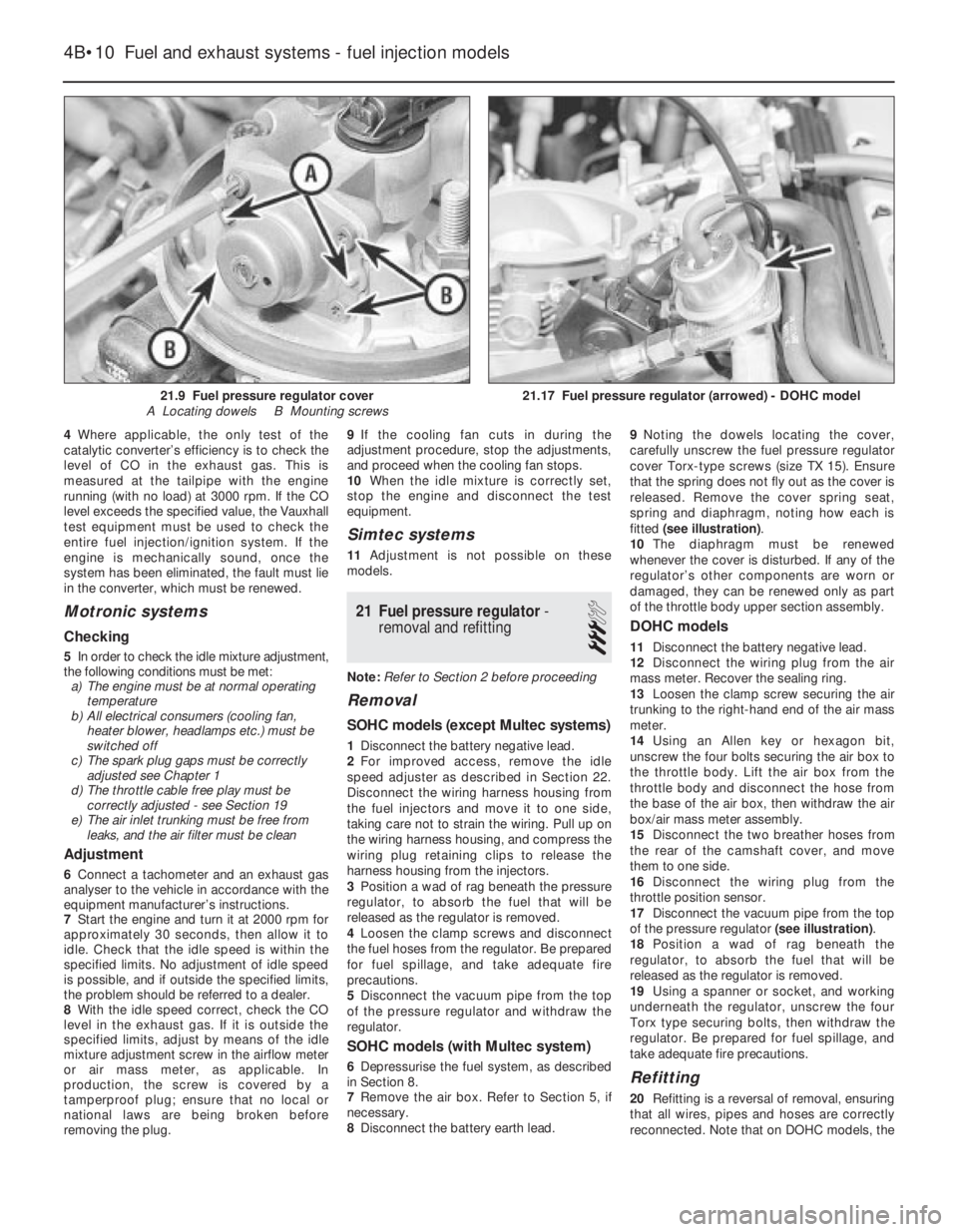
fitted (see illustration).
10The diaphragm must be renewed
whenever the cover is disturbed. If any of the
regulator’s other components are worn or
damaged, they can be renewed only as part
of the throttle body upper section assembly.
DOHC models
11Disconnect the battery negative lead.
12Disconnect the wiring plug from the air
mass meter. Recover the sealing ring.
13Loosen the clamp screw securing the air
trunking to the right-hand end of the air mass
meter.
14Using an Allen key or hexagon bit,
unscrew the four bolts securing the air box to
the throttle body. Lift the air box from the
throttle body and disconnect the hose from
the base of the air box, then withdraw the air
box/air mass meter assembly.
15Disconnect the two breather hoses from
the rear of the camshaft cover, and move
them to one side.
16Disconnect the wiring plug from the
throttle position sensor.
17Disconnect the vacuum pipe from the top
of the pressure regulator (see illustration).
18Position a wad of rag beneath the
regulator, to absorb the fuel that will be
released as the regulator is removed.
19Using a spanner or socket, and working
underneath the regulator, unscrew the four
Torx type securing bolts, then withdraw the
regulator. Be prepared for fuel spillage, and
take adequate fire precautions.
Refitting
20Refitting is a reversal of removal, ensuring
that all wires, pipes and hoses are correctly
reconnected. Note that on DOHC models, the
4B•10Fuel and exhaust systems - fuel injection models
21.17 Fuel pressure regulator (arrowed) - DOHC model21.9 Fuel pressure regulator cover
A Locating dowels B Mounting screws
Page 164 of 525
regulator vacuum pipe should be routed over
the top of the camshaft cover breather hoses.
21On models with the Multec system note
also the following:
a)Fit the new diaphragm so that it locates in
the throttle body groove.
b)Ensure that the spring and spring seat are
correctly engaged with each other and
with the diaphragm and regulator cover.
Then press the cover over its locating
dowels and hold it in place while the
screws are tightened.
c)Tighten the screws carefully to the
specified torque wrench setting.
22On completion, check the regulator for
leaks, pressurising the system by switching
the ignition on and off several times, before
the engine is started.
22Idle speed adjuster - removal
and refitting
3
Note:Idle speed adjustment on models fitted
with Multec systems, is not possible, as it is
controlled by the ECU. Refer to Section 1.
Removal
SOHC models (except Multec system)
1Disconnect the battery negative lead.
2Disconnect the wiring plug from the idle
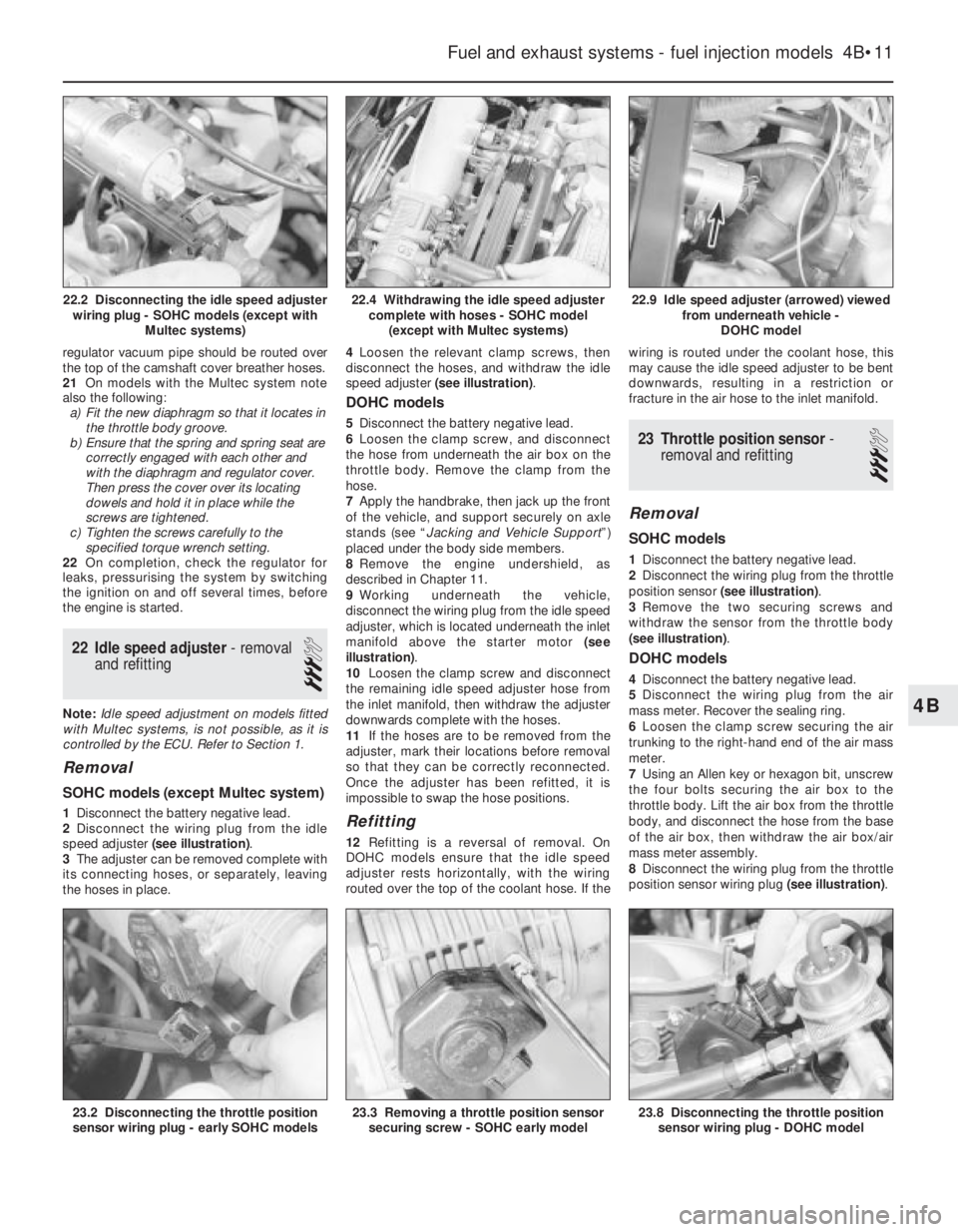
speed adjuster (see illustration).
3The adjuster can be removed complete with
its connecting hoses, or separately, leaving
the hoses in place.4Loosen the relevant clamp screws, then
disconnect the hoses, and withdraw the idle
speed adjuster (see illustration).
DOHC models
5Disconnect the battery negative lead.
6Loosen the clamp screw, and disconnect
the hose from underneath the air box on the
throttle body. Remove the clamp from the
hose.
7Apply the handbrake, then jack up the front
of the vehicle, and support securely on axle
stands (see “Jacking and Vehicle Support”)
placed under the body side members.
8Remove the engine undershield, as
described in Chapter 11.
9Working underneath the vehicle,
disconnect the wiring plug from the idle speed
adjuster, which is located underneath the inlet
manifold above the starter motor (see
illustration).
10Loosen the clamp screw and disconnect
the remaining idle speed adjuster hose from
the inlet manifold, then withdraw the adjuster
downwards complete with the hoses.
11If the hoses are to be removed from the
adjuster, mark their locations before removal
so that they can be correctly reconnected.
Once the adjuster has been refitted, it is
impossible to swap the hose positions.
Refitting
12Refitting is a reversal of removal. On
DOHC models ensure that the idle speed
adjuster rests horizontally, with the wiring
routed over the top of the coolant hose. If thewiring is routed under the coolant hose, this
may cause the idle speed adjuster to be bent
downwards, resulting in a restriction or
fracture in the air hose to the inlet manifold.
23Throttle position sensor -
removal and refitting
3
Removal
SOHC models
1Disconnect the battery negative lead.
2Disconnect the wiring plug from the throttle
position sensor (see illustration).
3Remove the two securing screws and
withdraw the sensor from the throttle body
(see illustration).
DOHC models
4Disconnect the battery negative lead.
5Disconnect the wiring plug from the air
mass meter. Recover the sealing ring.
6Loosen the clamp screw securing the air
trunking to the right-hand end of the air mass
meter.
7Using an Allen key or hexagon bit, unscrew
the four bolts securing the air box to the
throttle body. Lift the air box from the throttle
body, and disconnect the hose from the base
of the air box, then withdraw the air box/air
mass meter assembly.
8Disconnect the wiring plug from the throttle
position sensor wiring plug (see illustration).
Fuel and exhaust systems - fuel injection models 4B•11
22.9 Idle speed adjuster (arrowed) viewed
from underneath vehicle -
DOHC model
23.8 Disconnecting the throttle position
sensor wiring plug - DOHC model23.3 Removing a throttle position sensor
securing screw - SOHC early model23.2 Disconnecting the throttle position
sensor wiring plug - early SOHC models
22.4 Withdrawing the idle speed adjuster
complete with hoses - SOHC model
(except with Multec systems)22.2 Disconnecting the idle speed adjuster
wiring plug - SOHC models (except with
Multec systems)
4B
Page 167 of 525
23Disconnect the wiring harness housing
from the fuel injectors, and move it to one
side, taking care not to strain the wiring. Pull
up on the wiring harness housing, and
compress the wiring plug retaining clips to
release the housing from the injectors.
24Unscrew and remove the two fuel rail
securing nuts, and withdraw the fuel rail
complete with fuel injectors from the inlet
manifold. Note the position of the earth leads
on the fuel rail securing studs (see
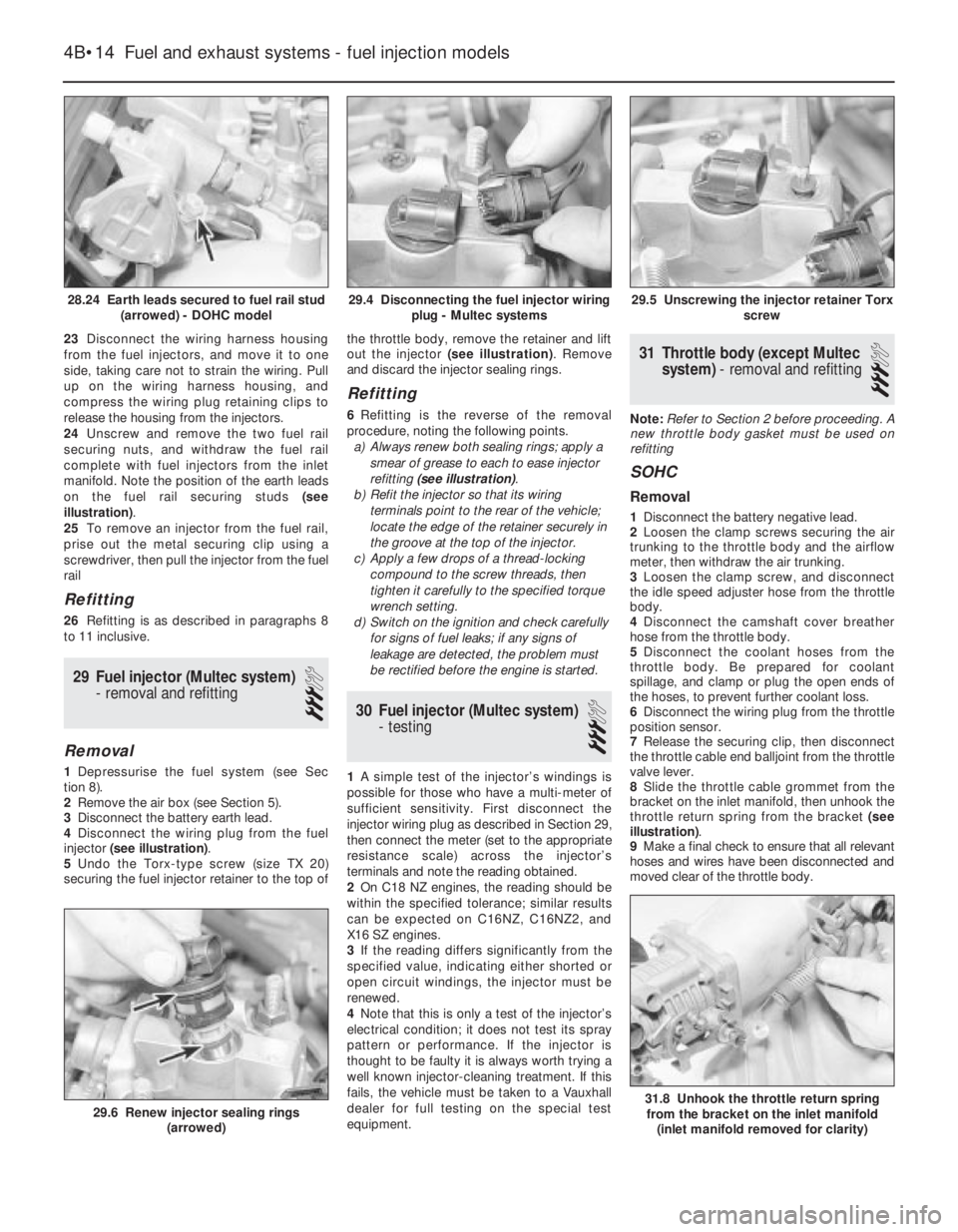
illustration).
25To remove an injector from the fuel rail,
prise out the metal securing clip using a
screwdriver, then pull the injector from the fuel
rail
Refitting
26Refitting is as described in paragraphs 8
to 11 inclusive.
29Fuel injector (Multec system)
- removal and refitting
3
Removal
1Depressurise the fuel system (see Sec
tion 8).
2Remove the air box (see Section 5).
3Disconnect the battery earth lead.
4Disconnect the wiring plug from the fuel
injector (see illustration).
5Undo the Torx-type screw (size TX 20)
securing the fuel injector retainer to the top ofthe throttle body, remove the retainer and lift
out the injector (see illustration). Remove
and discard the injector sealing rings.
Refitting
6Refitting is the reverse of the removal
procedure, noting the following points.
a)Always renew both sealing rings; apply a
smear of grease to each to ease injector
refitting (see illustration).
b)Refit the injector so that its wiring
terminals point to the rear of the vehicle;
locate the edge of the retainer securely in
the groove at the top of the injector.
c)Apply a few drops of a thread-locking
compound to the screw threads, then
tighten it carefully to the specified torque
wrench setting.
d)Switch on the ignition and check carefully
for signs of fuel leaks; if any signs of
leakage are detected, the problem must
be rectified before the engine is started.
30Fuel injector (Multec system)
- testing
3
1A simple test of the injector’s windings is
possible for those who have a multi-meter of
sufficient sensitivity. First disconnect the
injector wiring plug as described in Section 29,
then connect the meter (set to the appropriate
resistance scale) across the injector’s
terminals and note the reading obtained.
2On C18 NZ engines, the reading should be
within the specified tolerance; similar results
can be expected on C16NZ, C16NZ2, and
X16 SZ engines.
3If the reading differs significantly from the
specified value, indicating either shorted or
open circuit windings, the injector must be
renewed.
4Note that this is only a test of the injector’s
electrical condition; it does not test its spray
pattern or performance. If the injector is
thought to be faulty it is always worth trying a
well known injector-cleaning treatment. If this
fails, the vehicle must be taken to a Vauxhall
dealer for full testing on the special test
equipment.
31Throttle body (except Multec
system) - removal and refitting
3
Note:Refer to Section 2 before proceeding. A
new throttle body gasket must be used on
refitting
SOHC
Removal
1Disconnect the battery negative lead.
2Loosen the clamp screws securing the air
trunking to the throttle body and the airflow
meter, then withdraw the air trunking.
3Loosen the clamp screw, and disconnect
the idle speed adjuster hose from the throttle
body.
4Disconnect the camshaft cover breather
hose from the throttle body.
5Disconnect the coolant hoses from the
throttle body. Be prepared for coolant
spillage, and clamp or plug the open ends of
the hoses, to prevent further coolant loss.
6Disconnect the wiring plug from the throttle
position sensor.
7Release the securing clip, then disconnect
the throttle cable end balljoint from the throttle
valve lever.
8Slide the throttle cable grommet from the
bracket on the inlet manifold, then unhook the
throttle return spring from the bracket (see
illustration).
9Make a final check to ensure that all relevant
hoses and wires have been disconnected and
moved clear of the throttle body.
4B•14Fuel and exhaust systems - fuel injection models
28.24 Earth leads secured to fuel rail stud
(arrowed) - DOHC model29.5 Unscrewing the injector retainer Torx
screw
31.8 Unhook the throttle return spring
from the bracket on the inlet manifold
(inlet manifold removed for clarity)29.6 Renew injector sealing rings
(arrowed)
29.4 Disconnecting the fuel injector wiring
plug - Multec systems
Page 169 of 525
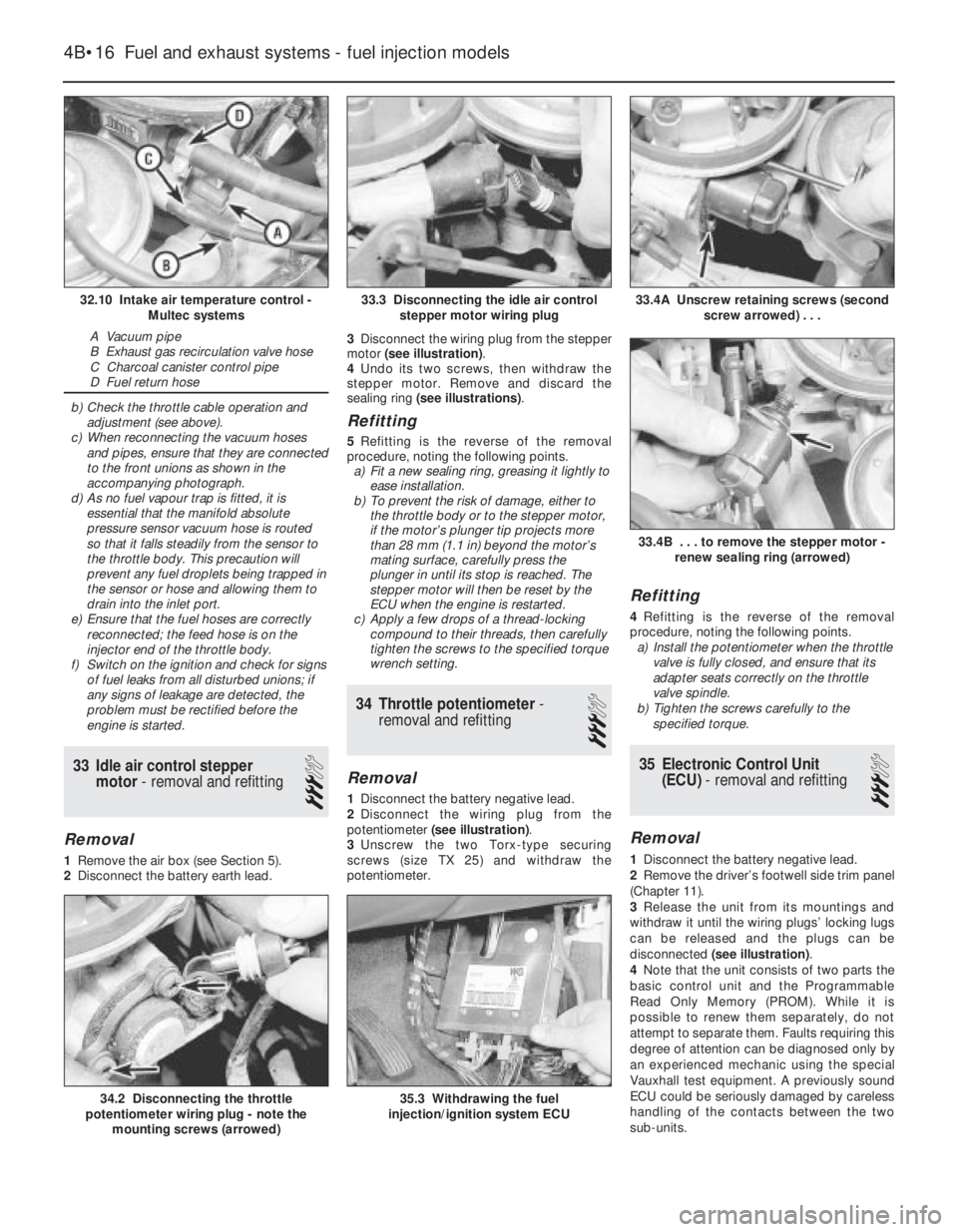
b)Check the throttle cable operation and
adjustment (see above).
c)When reconnecting the vacuum hoses
and pipes, ensure that they are connected
to the front unions as shown in the
accompanying photograph.
d)As no fuel vapour trap is fitted, it is
essential that the manifold absolute
pressure sensor vacuum hose is routed
so that it falls steadily from the sensor to
the throttle body. This precaution will
prevent any fuel droplets being trapped in
the sensor or hose and allowing them to
drain into the inlet port.
e)Ensure that the fuel hoses are correctly
reconnected; the feed hose is on the
injector end of the throttle body.
f)Switch on the ignition and check for signs
of fuel leaks from all disturbed unions; if
any signs of leakage are detected, the
problem must be rectified before the
engine is started.
33Idle air control stepper
motor - removal and refitting
3
Removal
1Remove the air box (see Section 5).
2Disconnect the battery earth lead.3Disconnect the wiring plug from the stepper
motor (see illustration).
4Undo its two screws, then withdraw the
stepper motor. Remove and discard the
sealing ring (see illustrations).
Refitting
5Refitting is the reverse of the removal
procedure, noting the following points.
a)Fit a new sealing ring, greasing it lightly to
ease installation.
b)To prevent the risk of damage, either to
the throttle body or to the stepper motor,
if the motor’s plunger tip projects more
than 28 mm (1.1 in) beyond the motor’s
mating surface, carefully press the
plunger in until its stop is reached. The
stepper motor will then be reset by the
ECU when the engine is restarted.
c)Apply a few drops of a thread-locking
compound to their threads, then carefully
tighten the screws to the specified torque
wrench setting.
34Throttle potentiometer -
removal and refitting
3
Removal
1Disconnect the battery negative lead.
2Disconnect the wiring plug from the
potentiometer (see illustration).
3Unscrew the two Torx-type securing
screws (size TX 25) and withdraw the
potentiometer.
Refitting
4Refitting is the reverse of the removal
procedure, noting the following points.
a)Install the potentiometer when the throttle
valve is fully closed, and ensure that its
adapter seats correctly on the throttle
valve spindle.
b)Tighten the screws carefully to the
specified torque.
35Electronic Control Unit
(ECU) - removal and refitting
3
Removal
1Disconnect the battery negative lead.
2Remove the driver’s footwell side trim panel
(Chapter 11).
3Release the unit from its mountings and
withdraw it until the wiring plugs’ locking lugs
can be released and the plugs can be
disconnected (see illustration).
4Note that the unit consists of two parts the
basic control unit and the Programmable
Read Only Memory (PROM). While it is
possible to renew them separately, do not
attempt to separate them. Faults requiring this
degree of attention can be diagnosed only by
an experienced mechanic using the special
Vauxhall test equipment. A previously sound
ECU could be seriously damaged by careless
handling of the contacts between the two
sub-units.
4B•16Fuel and exhaust systems - fuel injection models
32.10 Intake air temperature control -
Multec systems
A Vacuum pipe
B Exhaust gas recirculation valve hose
C Charcoal canister control pipe
D Fuel return hose
33.4A Unscrew retaining screws (second
screw arrowed) . . .
35.3 Withdrawing the fuel
injection/ignition system ECU34.2 Disconnecting the throttle
potentiometer wiring plug - note the
mounting screws (arrowed)
33.4B . . . to remove the stepper motor -
renew sealing ring (arrowed)
33.3 Disconnecting the idle air control
stepper motor wiring plug
Page 170 of 525
Refitting
5Refitting is a reversal of the removal
procedure, ensuring that the wiring plugs are
correctly reconnected and that the unit is
located securely.
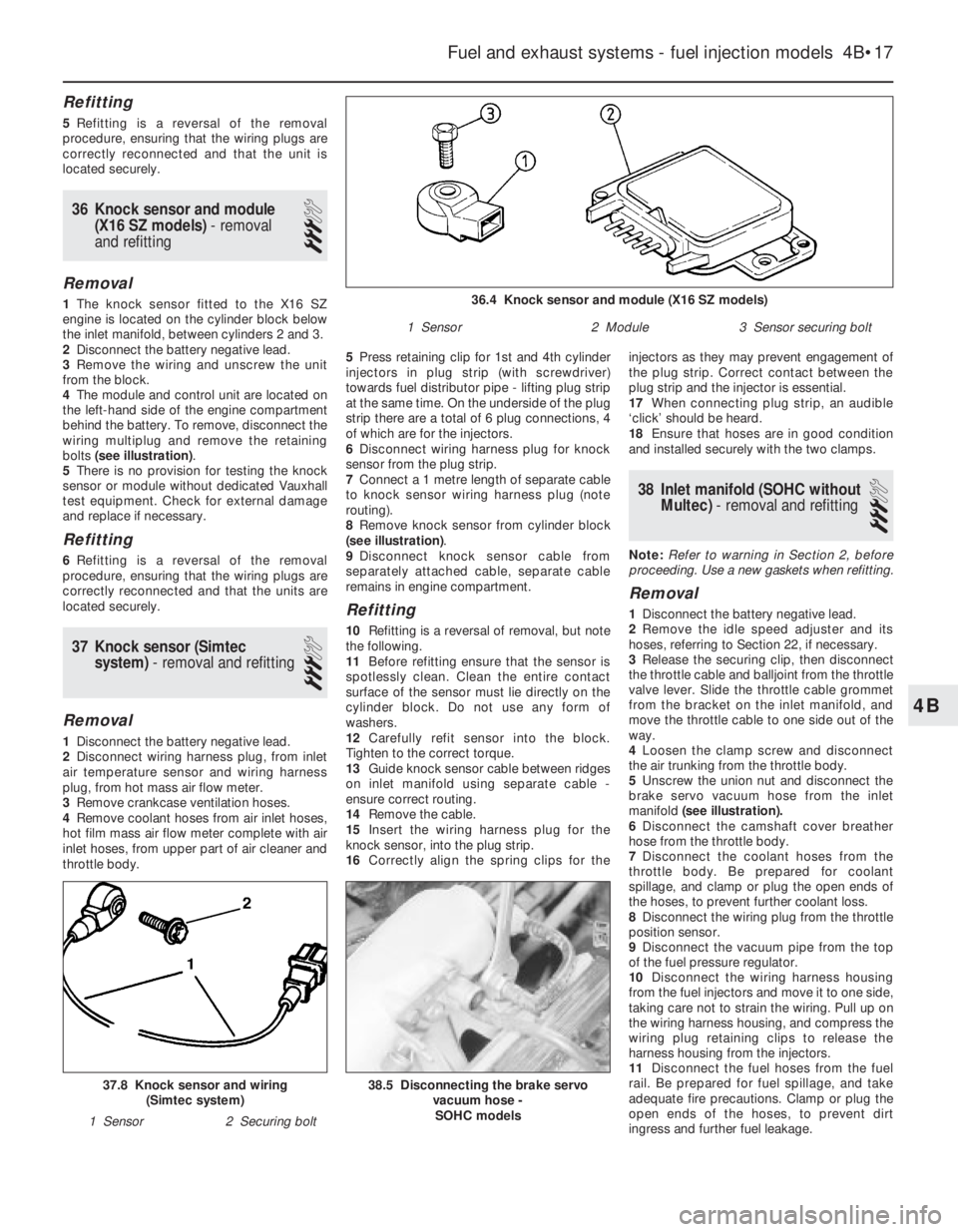
36Knock sensor and module
(X16 SZ models) - removal
and refitting
3
Removal
1The knock sensor fitted to the X16 SZ
engine is located on the cylinder block below
the inlet manifold, between cylinders 2 and 3.
2Disconnect the battery negative lead.
3Remove the wiring and unscrew the unit
from the block.
4The module and control unit are located on
the left-hand side of the engine compartment
behind the battery. To remove, disconnect the
wiring multiplug and remove the retaining
bolts (see illustration).
5There is no provision for testing the knock
sensor or module without dedicated Vauxhall
test equipment. Check for external damage
and replace if necessary.
Refitting
6Refitting is a reversal of the removal
procedure, ensuring that the wiring plugs are
correctly reconnected and that the units are
located securely.
37Knock sensor (Simtec
system) - removal and refitting
3
Removal
1Disconnect the battery negative lead.
2Disconnect wiring harness plug, from inlet
air temperature sensor and wiring harness
plug, from hot mass air flow meter.
3Remove crankcase ventilation hoses.
4Remove coolant hoses from air inlet hoses,
hot film mass air flow meter complete with air
inlet hoses, from upper part of air cleaner and
throttle body.5Press retaining clip for 1st and 4th cylinder
injectors in plug strip (with screwdriver)
towards fuel distributor pipe - lifting plug strip
at the same time. On the underside of the plug
strip there are a total of 6 plug connections, 4
of which are for the injectors.
6Disconnect wiring harness plug for knock
sensor from the plug strip.
7Connect a 1 metre length of separate cable
to knock sensor wiring harness plug (note
routing).
8Remove knock sensor from cylinder block
(see illustration).
9Disconnect knock sensor cable from
separately attached cable, separate cable
remains in engine compartment.
Refitting
10Refitting is a reversal of removal, but note
the following.
11Before refitting ensure that the sensor is
spotlessly clean. Clean the entire contact
surface of the sensor must lie directly on the
cylinder block. Do not use any form of
washers.
12Carefully refit sensor into the block.
Tighten to the correct torque.
13Guide knock sensor cable between ridges
on inlet manifold using separate cable -
ensure correct routing.
14Remove the cable.
15Insert the wiring harness plug for the
knock sensor, into the plug strip.
16Correctly align the spring clips for theinjectors as they may prevent engagement of
the plug strip. Correct contact between the
plug strip and the injector is essential.
17When connecting plug strip, an audible
‘click’ should be heard.
18Ensure that hoses are in good condition
and installed securely with the two clamps.
38Inlet manifold (SOHC without
Multec) - removal and refitting
3
Note:Refer to warning in Section 2, before
proceeding. Use a new gaskets when refitting.
Removal
1Disconnect the battery negative lead.
2Remove the idle speed adjuster and its
hoses, referring to Section 22, if necessary.
3Release the securing clip, then disconnect
the throttle cable and balljoint from the throttle
valve lever. Slide the throttle cable grommet
from the bracket on the inlet manifold, and
move the throttle cable to one side out of the
way.
4Loosen the clamp screw and disconnect
the air trunking from the throttle body.
5Unscrew the union nut and disconnect the
brake servo vacuum hose from the inlet
manifold(see illustration).
6Disconnect the camshaft cover breather
hose from the throttle body.
7Disconnect the coolant hoses from the
throttle body. Be prepared for coolant
spillage, and clamp or plug the open ends of
the hoses, to prevent further coolant loss.
8Disconnect the wiring plug from the throttle
position sensor.
9Disconnect the vacuum pipe from the top
of the fuel pressure regulator.
10Disconnect the wiring harness housing
from the fuel injectors and move it to one side,
taking care not to strain the wiring. Pull up on
the wiring harness housing, and compress the
wiring plug retaining clips to release the
harness housing from the injectors.
11Disconnect the fuel hoses from the fuel
rail. Be prepared for fuel spillage, and take
adequate fire precautions. Clamp or plug the
open ends of the hoses, to prevent dirt
ingress and further fuel leakage.
Fuel and exhaust systems - fuel injection models 4B•17
38.5 Disconnecting the brake servo
vacuum hose -
SOHC models37.8 Knock sensor and wiring
(Simtec system)
1 Sensor2 Securing bolt
36.4 Knock sensor and module (X16 SZ models)
1 Sensor2 Module3 Sensor securing bolt
4B