locking OPEL VIVARO 2015 Owner's Manual
[x] Cancel search | Manufacturer: OPEL, Model Year: 2015, Model line: VIVARO, Model: OPEL VIVARO 2015Pages: 205, PDF Size: 4.47 MB
Page 52 of 205

50Seats, restraints9Warning
Removable seats are heavy! Do
not attempt to remove without
assistance.
When installing the seats, ensure that the seats are properly located
on the anchor points and that the
locking catches are fully engaged.
When re-installing seats always
ensure that the row with the folding access seat B is positioned correctly
in front of the fixed seat row A.
Seat belts
The seat belts are locked during
heavy acceleration or deceleration of
the vehicle holding the occupants in
the sitting position. Therefore, the risk of injury is considerably reduced.
9 Warning
Fasten seat belt before each trip.
In the event of an accident, people
not wearing seat belts endanger their fellow occupants and
themselves.
Seat belts are only designed for use
by one person at a time. Child
restraint system 3 60.
Periodically check all parts of the belt system for damage and proper
functionality.
Have damaged components
replaced. After an accident, have the
belts and triggered belt tensioners
replaced by a workshop.
Note
Make sure that the belts are not
damaged by shoes or sharp-edged
objects or trapped. Prevent dirt from
getting into the belt retractors.
Seat belt reminder X 3 85.
Belt force limiters
On the front seats, stress on the body is reduced by the gradual release of
the belt during a collision.
Belt tensioners In the event of a head-on or rear-endcollision of a certain severity, the front
seat belts are tightened.
Page 90 of 205
88Instruments and controlsElectronic Stability
Program off
Ø illuminates yellow.
If ESP ®Plus
has been deactivated with
button Ø on the instrument panel,
control indicator Ø illuminates and a
corresponding message appears in
the Driver Information Centre 3 90.
ESP® Plus
3 125, Traction Control
system 3 124.
Engine coolant
temperature
W illuminates blue or red.
Illuminates red briefly when the
ignition is switched on, then turns
blue.
Illuminates red when the engine
is running Stop, switch off engine.Caution
Coolant temperature too high.
Check coolant level 3 142.
If there is sufficient coolant, consult a workshop.
The control indicator must be blue
before continuing driving.
Preheating
! illuminates yellow.
Preheating is activated. Only
activates when outside temperature
is low.
Tyre pressure monitoring
system
w illuminates or flashes.
Illuminates Tyre pressure loss. Stop immediately
and check tyre pressure.
Flashes Fault in system or tyre without
pressure sensor mounted ( e.g. spare
wheel). After a delay the control
indicator illuminates continuously.
Consult a workshop.Tyre pressure monitoring system 3 158.
Engine oil pressure
I illuminates red.
Illuminates briefly when the ignition is
switched on.
Illuminates when the engine is running
If control indicator I illuminates
when the engine is running (together
with control indicator C and a
warning chime): Stop, switch off
engine.Caution
Engine lubrication may be
interrupted. This may result in
damage to the engine and/or
locking of the drive wheels.
1. Depress clutch.
2. Select neutral gear (or move selector lever to N).
Page 93 of 205
Instruments and controls91Vehicle messages
Messages are displayed in the Driver
Information Centre and may be
accompanied by illumination of
control indicator F or C in the
instrument cluster.
Information messages Information messages regarding,
e.g. engine starting conditions, stop-
start system, parking brake
application, central locking, steering
wheel lock etc. provide the current
status of certain vehicle functions and
instructions for use.
Fault messages Fault messages regarding, e.g. fuel
filter, airbags, exhaust emissions etc.
are displayed together with control
indicator F. Drive with caution and
seek the assistance of a workshop as
soon as possible.
To remove fault messages from the
display, press button on end of wiper
lever. After a few seconds the
message may disappearautomatically and F remains
illuminated. The fault will then be
stored in the on board system.
Warning messagesWarning messages regarding, e.g.
engine, battery or brake system
failure, are displayed together with
control indicator C and may be
accompanied by a warning chime.
Stop engine immediately and seek
the assistance of a workshop.
Fuel economy messages
Fuel economy messages provide tips to improve fuel efficiency. Journeys
can be saved in the system memory,
enabling you to compare
performances.
Refer to Infotainment system manual
for further information.
Fuel economy rating 3 92.
Warning chimes
A corresponding message may also
appear in the Driver Information
Centre when a warning chime is
sounded.When starting the engine or
whilst driving: ■ If seat belt is not fastened 3 50.
■ During operation of the turn and lane-change signals 3 97.
■ During illumination of certain control indicators.
■ If the parking assist detects an object 3 130.
■ If the vehicle speed briefly exceeds
a set limit 3 126, 3 130.
■ If a door or the bonnet is not properly closed when vehicle
exceeds a certain speed.
■ If there is a fault in the brake system
3 87.
■ If the vehicle battery is not charging
3 86.
■ If engine lubrication is interrupted 3 88.
■ If the electronic key is outside of the
detection range.
Electronic key system 3 23, Power
button 3 114.
Page 102 of 205
100LightingLighting featuresEntry lighting
Welcome lighting Vehicle lights are switched on for a
short time to facilitate locating the
vehicle when it is dark.
Remote control operation
Lights switch on when unlocking the
vehicle with the remote control.
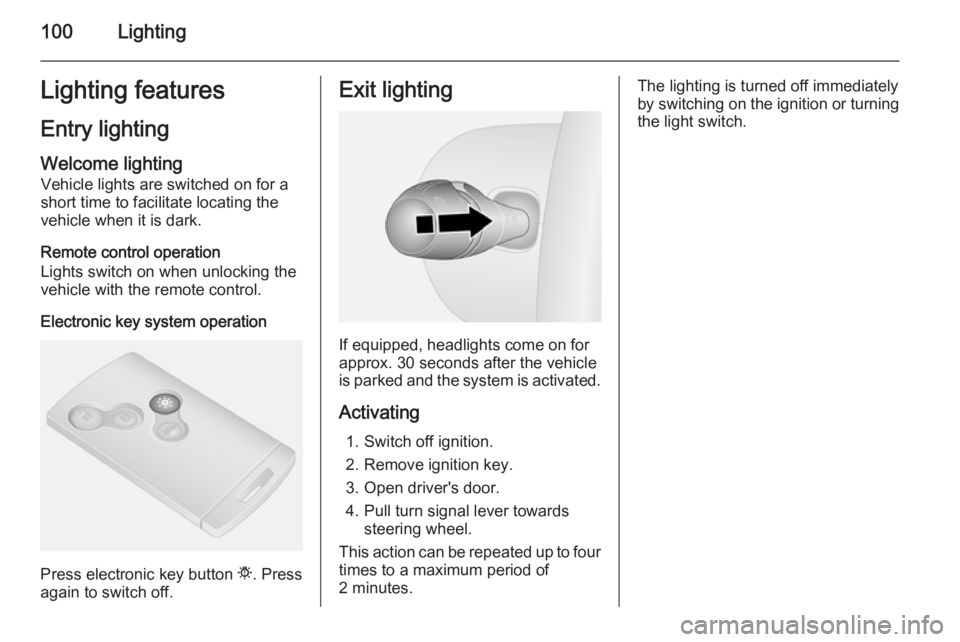
Electronic key system operation
Press electronic key button t. Press
again to switch off.
Exit lighting
If equipped, headlights come on for
approx. 30 seconds after the vehicle
is parked and the system is activated.
Activating 1. Switch off ignition.
2. Remove ignition key.
3. Open driver's door.
4. Pull turn signal lever towards steering wheel.
This action can be repeated up to four
times to a maximum period of
2 minutes.
The lighting is turned off immediately
by switching on the ignition or turning
the light switch.
Page 117 of 205
Driving and operating115
At very low outside temperatures
(e.g. below -10 °C) keep the clutch
pedal depressed while pressing the
Start/Stop button until the engine
starts.
If one of the starting conditions is not
applied, a corresponding message
appears in the Driver Information
Centre 3 90.
Vehicle messages 3 91.
Engine stop Electronic key must be inside the
vehicle, either in the card reader or
the front passenger compartment.
With the vehicle stationary, press the
Start/Stop button to stop the engine.
The steering wheel lock is engaged
when the driver's door is opened and the vehicle is locked.
If the electronic key is not detected, a
corresponding message appears in
the Driver Information Centre 3 90 . In
this event, press the Start/Stop button
for 2 seconds to stop the engine.
Central locking system 3 25.Retained power off
Press the Start/Stop button for more
than two seconds; the engine is
stopped while some functions, e.g.
Infotainment system, are available for
use for approx. 10 minutes.
These functions stop working when
the driver's door is opened and the
vehicle is locked.
Note
Always take the electronic key with you when exiting the vehicle.
The electronic key being left in the
card reader is indicated by a warning
chime 3 91 and a message in the
Driver Information Centre 3 91 when
the driver's door is opened.9 Danger
Never leave an electronic key
inside the vehicle when children or animals are left in the vehicle, to
avoid unintended operation of
windows, doors or engine. Risk of
fatal injury.
Fault
If the engine cannot be started, the
cause may be one of the following:
■ Fault in electronic key.
■ Electronic key out of reception range.
■ Battery voltage too low.
■ Overload of the central locking system by operating at frequentintervals, the power supply is
interrupted for a short time.
■ Interference from higher-power radio waves from other sources.
Battery replacement 3 21.
Central locking system 3 25.
Electronic key system 3 23.
Page 121 of 205
Driving and operating119
■ the self-cleaning function of thediesel particle filter is not active
3 120.
■ the vehicle has moved since the last Autostop.
Otherwise an Autostop will be
inhibited.
Restart of the engine by the
driver
Depress the clutch pedal to restart the
engine.
Control indicator Ï 3 89 extinguishes
in the instrument cluster when the
engine is restarted.
Restart of the engine by the
stop-start system
The selector lever must be in neutral to enable an automatic restart.
If one of the following conditions
occurs during an Autostop, the
engine will be restarted automatically
by the stop-start system:
■ The stop-start system is manually deactivated.
■ the bonnet is opened.■ the vehicle battery is discharged.
■ the engine temperature is too low.
■ the brake vacuum is not sufficient.
■ the vehicle starts to move.
■ the defrosting function is activated 3 103.
If an electrical accessory, e.g. a
portable CD player, is connected to
the power outlet, a brief power drop during engine restart may be
noticeable.
Fault If a fault occurs in the stop-start
system, the LED in button Î
illuminates, and a corresponding
message appears in the Driver
Information Centre 3 90. Seek the
assistance of a workshop.
Vehicle messages 3 91.
Warning chimes 3 91.Parking9 Warning
■ Do not park the vehicle on an
easily ignitable surface. The
high temperature of the exhaust system could ignite the surface.
■ Always apply parking brake without pressing release button.Apply as firmly as possible on a
downhill slope or uphill slope.
Depress foot brake at the same
time to reduce operating force.
■ Switch off the engine.
■ If the vehicle is on a level surface or uphill slope, engage
first gear. On an uphill slope,
turn the front wheels away from the kerb.
If the vehicle is on a downhill
slope, engage reverse gear.
Turn the front wheels towards
the kerb.
Lock the vehicle 3 25 and activate the
anti-theft locking system 3 34 and
anti-theft alarm system 3 35.
Page 124 of 205
122Driving and operatingBrakes
The brake system comprises two
independent brake circuits.
If a brake circuit fails, the vehicle can
still be braked using the other brake
circuit. However, braking effect is
achieved only when you depress the
brake pedal firmly. You need to use
considerably more force for this. The
braking distance is extended. Seek
the assistance of a workshop before
continuing your journey.
When the engine is not running, the
support of the brake servo unit
disappears once the brake pedal has been depressed once or twice.
Braking effect is not reduced, but
braking requires significantly greater
force. It is especially important to bear this in mind when being towed.
If control indicator R illuminates in
the instrument cluster while driving and a corresponding message
appears in the Driver Information
Centre, there is a fault in the braking
system. Seek the assistance of a
workshop immediately.Control indicator R 3 87.
Vehicle messages 3 91.
Antilock brake system
Antilock brake system (ABS)
prevents the wheels from locking.
ABS starts to regulate brake pressure as soon as a wheel shows a tendency to lock. The vehicle remains
steerable, even during hard braking.
ABS control is made apparent
through a pulse in the brake pedal
and the noise of the regulation
process.
For optimum braking, keep the brake
pedal fully depressed throughout the
braking process, despite the fact that the pedal is pulsating. Do not reduce
the pressure on the pedal.
Control indicator u 3 87.
Fault
If control indicator u does not go out
a few seconds after the ignition is
switched on, or if it illuminates while driving, there is a fault in the ABS.
Control indicator F 3 86 may alsoilluminate in the instrument cluster
together with a corresponding
message in the Driver Information
Centre. The brake system remains
operational but without ABS
regulation.9 Warning
If there is a fault in the ABS, the
wheels may be liable to lock due
to braking that is heavier than
normal. The advantages of ABS are no longer available. During
hard braking, the vehicle can no longer be steered and may
swerve.
If control indicators u, F , R 3 87
and C 3 86 illuminate, there is a fault
in the braking system. A
corresponding message also
appears in the Driver Information
Centre 3 90. Have the cause of the
fault remedied by a workshop.
Vehicle messages 3 91.
Page 157 of 205
Vehicle care155
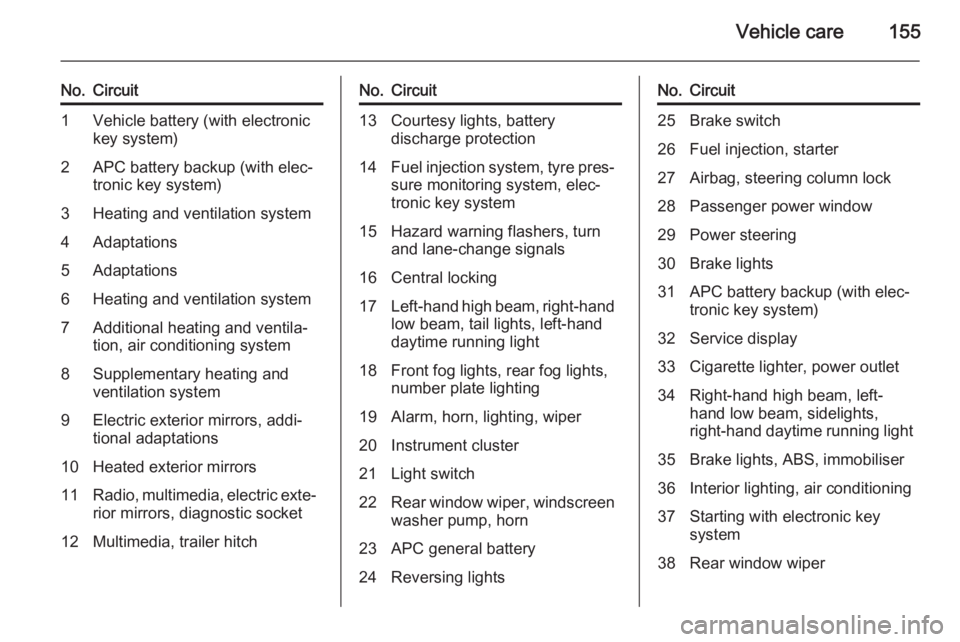
No.Circuit1Vehicle battery (with electronic
key system)2APC battery backup (with elec‐
tronic key system)3Heating and ventilation system4Adaptations5Adaptations6Heating and ventilation system7Additional heating and ventila‐
tion, air conditioning system8Supplementary heating and
ventilation system9Electric exterior mirrors, addi‐
tional adaptations10Heated exterior mirrors11Radio, multimedia, electric exte‐ rior mirrors, diagnostic socket12Multimedia, trailer hitchNo.Circuit13Courtesy lights, battery
discharge protection14Fuel injection system, tyre pres‐ sure monitoring system, elec‐
tronic key system15Hazard warning flashers, turn and lane-change signals16Central locking17Left-hand high beam, right-hand
low beam, tail lights, left-hand
daytime running light18Front fog lights, rear fog lights,
number plate lighting19Alarm, horn, lighting, wiper20Instrument cluster21Light switch22Rear window wiper, windscreen
washer pump, horn23APC general battery24Reversing lightsNo.Circuit25Brake switch26Fuel injection, starter27Airbag, steering column lock28Passenger power window29Power steering30Brake lights31APC battery backup (with elec‐
tronic key system)32Service display33Cigarette lighter, power outlet34Right-hand high beam, left-
hand low beam, sidelights,
right-hand daytime running light35Brake lights, ABS, immobiliser36Interior lighting, air conditioning37Starting with electronic key
system38Rear window wiper
Page 196 of 205

194Customer information
■ Vehicle reactions in particulardriving situations (e.g. inflation of
an airbag, activation of the stability
regulation system)
■ Environmental conditions (e.g. temperature)
These data are exclusively technical
and help identifying and correcting
errors as well as optimizing vehicle
functions.
Motion profiles indicating travelled
routes cannot be created with these
data.
If services are used (e.g. repair
works, service processes, warranty
cases, quality assurance),
employees of the service network
(manufacturer included) are able to
read out this technical information
from the event and error data storage
modules applying special diagnostic
devices. If required, you will receive
further information at these
workshops. After an error has been
corrected, the data are deleted from
the error storage module or they are
constantly overwritten.When using the vehicle, situations
may occur in which these technical
data related to other information
(accident report, damages on the
vehicle, witness statements etc.) may be associated with a specific person -
possibly, with the assistance of an
expert.
Additional functions contractually
agreed upon with the client (e.g.
vehicle location in emergency cases)
allow the transmission of particular vehicle data from the vehicle.Radio Frequency
Identification (RFID) RFID technology is used in somevehicles for functions such as tyre
pressure monitoring and ignition
system security. It is also used in
connection with conveniences such
as radio remote controls for door
locking/unlocking and starting, and in-
vehicle transmitters for garage door
openers. RFID technology in Opel
vehicles does not use or record
personal information or link with any
other Opel system containing
personal information.
Page 198 of 205
196IndexAAccessories and vehicle modifications .......................... 138
Adaptive forward lighting .............97
Adjustable air vents ...................110
AGM (Absorptive Glass Mat) battery ..................................... 144
Airbag and belt tensioners ...........85
Airbag deactivation ................58, 85
Airbag label................................... 53
Airbag system .............................. 53
Air conditioning regular operation ................................ 111
Air conditioning system .............. 102
Air intake .................................... 111
Air recirculation ...................102, 169
Air vents...................................... 110
Alert .............................................. 91
Antifreeze ................................... 142
Antilock brake system ................ 122
Antilock brake system (ABS) .......87
Anti-theft alarm system ................35
Anti-theft bolts............................. 165
Anti-theft locking system .............. 34
Anti-theft security lock ..................25
Appearance care ........................171
Armrest ........................................ 47
Ashtrays ....................................... 80
Automatic anti-dazzle ..................40Automatic fuel cut-off ..................117
Automatic light control .................95
Automatic locking ........................30
Autostop ............................... 89, 116
Auxiliary heater ........................... 106
B Battery ........................................ 144
Battery, jump starting.................. 168
Belts.............................................. 50
Bench seat.................................... 69
Bonnet ....................................... 140
Bottle holders................................ 68
Brake and clutch fluid .................176
Brake assist ............................... 123
Brake fluid .................................. 143 Brakes ............................... 122, 143
Brake system ............................... 87
Breakdown.................................. 169
Bulb replacement ....................... 147
C Capacities .................................. 191
Car Pass ...................................... 21
Catalytic converter .....................120
Central locking system ................25
Centre high-mounted brake light 149
Changing tyre and wheel size ...161
Charging system .......................... 86
Child locks ................................... 30