tow OPEL VIVARO B 2018.5 Manual user
[x] Cancel search | Manufacturer: OPEL, Model Year: 2018.5, Model line: VIVARO B, Model: OPEL VIVARO B 2018.5Pages: 241, PDF Size: 5.58 MB
Page 166 of 241

164Driving and operatingSince engine power decreases as
altitude increases due to the air
becoming thinner, therefore reducing
climbing ability, the permissible gross
train weight also decreases by 10%
for every 1000 m of additional
altitude. The gross train weight does
not have to be reduced when driving
on roads with slight inclines (less than 8%, e.g. motorways).
The permissible gross train weight
must not be exceeded. This weight is
specified on the identification plate
3 210.
Vertical coupling load
The vertical coupling load is the load
exerted by the trailer on the coupling
ball. It can be varied by changing the
weight distribution when loading the
trailer.
The maximum permissible vertical
coupling load is specified on the
towing equipment identification plate
and in the vehicle documents. Always aim for the maximum load, especially in the case of heavy trailers. The
vertical coupling load should never
fall below 25 kg.In the case of trailer loads of
1200 kg or more, the vertical coupling load should not be less than 50 kg.
Rear axle load When the trailer is coupled and the
towing vehicle fully loaded (including all occupants), the permissible rear
axle load (see identification plate or
vehicle documents) must not be
exceeded.
Trailer stability assist If the system detects snaking
movements, engine power is reduced
and the vehicle / trailer combination is
selectively braked until the snaking
ceases. While the system is working,
keep steering wheel as still as
possible.
Trailer stability assist (TSA) is a
function of the Electronic Stability
Program (ESP® Plus
) 3 151.
Page 167 of 241

Vehicle care165Vehicle careGeneral Information...................166
Accessories and vehicle modifications .......................... 166
Vehicle storage ........................166
End-of-life vehicle recovery .....167
Vehicle checks ........................... 167
Performing work ......................167
Bonnet ..................................... 167
Engine oil ................................. 168
Engine air filter ........................ 169
Engine coolant ......................... 170
Power steering fluid .................170
Washer fluid ............................ 171
Brakes ..................................... 171
Brake fluid ............................... 171
Vehicle battery ......................... 172
Diesel fuel filter ........................174
Diesel fuel system bleeding .....174
Wiper blade replacement ........175
Bulb replacement .......................176
Headlights ............................... 176
Fog lights ................................. 177
Front turn lights .......................177
Tail lights ................................. 177
Side turn lights ......................... 178Centre high-mounted brake
light ......................................... 178
Reversing light ......................... 179
Number plate light ...................180
Fog tail light ............................. 180
Interior lights ............................ 181
Instrument panel illumination ...182
Electrical system ........................182
Fuses ....................................... 182
Instrument panel fuse box .......183
Vehicle tools .............................. 186
Tools ........................................ 186
Wheels and tyres .......................187
Tyres ....................................... 187
Winter tyres ............................. 187
Tyre designations ....................187
Tyre pressure .......................... 187
Tyre pressure monitoring system .................................... 189
Tread depth ............................. 191
Changing tyre and wheel size . 191
Wheel covers ........................... 191
Tyre chains .............................. 192
Tyre repair kit .......................... 192
Wheel changing .......................195
Spare wheel ............................ 197
Jump starting ............................. 198Towing....................................... 200
Towing the vehicle ...................200
Towing another vehicle ...........201
Appearance care .......................201
Exterior care ............................ 201
Interior care ............................. 203
Page 171 of 241

Vehicle care169Caution
Do not allow the engine oil level todrop below the minimum level!
We recommend the use of the same
grade of engine oil that was used at
the last change.
Between the MIN and MAX marks a
volume of approx. 2.1 l for engines R9M 408, R9M 413 and R9M 415
respectively approx. 3.5 l for engines
R9M 450 and R9M 452 can be filled
in.
The engine oil level must not exceed the maximum mark MAX on the
dipstick.Caution
Overfilled engine oil must be
drained or suctioned out. If the oil exceeds the maximum level, do
not start the vehicle and contact a
workshop.
To prevent spillage when
replenishing the engine oil, we
recommend using a funnel to top-up the engine oil. Ensure funnel is
securely located onto the filler pipe.
After topping-up, put the funnel into a
plastic bag and stow it securely.
A stabilization of the engine oil
consumption will not take place until
the vehicle has been driven several
thousand kilometres. Only then can
the actual degree of consumption be
established.
If consumption exceeds more than
0.6 l every 1000 km after this running-
in period, consult a workshop.
Fit the cap on straight and tighten it.
Engine air filter
Engine air flow indicator
On certain models, an indicator is
located in the engine induction
system and indicates if the air-intake
to the engine is restricted.
Clear:No restrictionRed tell-tale:Restricted
If the red tell-tale is displayed when
the engine is running, consult a
workshop.
Page 188 of 241

186Vehicle careNo.Circuit40Rear power outlet41Starting / Body control module42Heated seats43Tachograph44Windscreen wiper45Heating / Air conditioning
After having changed defective fuses,
replace the trim panel.
Vehicle tools
Tools
The jack, wheel wrench, wheel bolt
sleeve, torx key, adapters, wheel
cover hook, towing eye are contained
in a unit, stowed under the driver's
seat.
Slide seat forwards and fold the
backrest forwards 3 48 to access the
tool box. The tool box may be secured
in position with a wing nut. Rotate
wing nut anticlockwise to release.
Wheel changing 3 195.
Spare wheel 3 197.
Vehicles with tyre repair kit: The wheel cover hook and torx key are
stored within the tyre repair kit case,
stowed under the driver's seat.
Tyre repair kit 3 192.
Page 191 of 241

Vehicle care189Trailer towingWhen towing a trailer with a fully
laden vehicle, the tyre pressure must
be increased by 20 kPa/0.2 bar
(3.0 psi) and the maximum speed
limited to 100 km/h.
Trailer towing 3 163.
Tyre pressure monitoring
system
The tyre pressure monitoring system
uses radio and sensor technology to
check tyre pressure levels.Caution
Tyre pressure monitoring system
warns only about low tyre pressure condition and does not replace
regular tyre maintenance by the
driver.
All wheels must be equipped with pressure sensors and the tyres must
have the prescribed pressure.
Note
In countries where the tyre pressure
monitoring system is legally
required, the use of wheels without
pressure sensors will invalidate the
vehicle operating permit.
The tyre pressure monitoring system
sensors monitor the air pressure in
the tyres and transmit tyre pressure
readings to a receiver located in the
vehicle.
Tyre pressure chart 3 223.
Low tyre pressure conditionA detected low tyre pressure
condition is indicated by illumination
of control indicator w 3 101 and a
corresponding message appears in
the Driver Information Centre.
If w illuminates, stop as soon as
possible and inflate the tyres as
recommended 3 223.
After inflating, some driving may be
required to update the tyre pressure
values in the system. During this time
w may illuminate.
If w illuminates at lower temperatures
and extinguishes after some driving,
this could be an indicator for
approaching a low tyre pressure
condition. Check tyre pressure of all
four tyres.
If the tyre pressure must be reduced
or increased, switch off ignition.
Only mount wheels with pressure
sensors, otherwise w flashes for
several seconds then illuminates
continuously together with control
indicator j 3 99 and a corresponding
message appears in the Driver
Information Centre.
Page 196 of 241

194Vehicle care
12. The prescribed tyre pressureshould be obtained within
15 minutes.
Tyre pressure 3 223.
When the correct pressure is
obtained, switch off the
compressor.
If the prescribed tyre pressure is
not obtained within 15 minutes,
remove the tyre repair kit. Move
the vehicle one tyre rotation
(approx. 2 m). Reattach the tyre
repair kit and continue the filling
procedure for 15 minutes. If the
prescribed tyre pressure is still not
obtained, the tyre is too badly
damaged. Seek the assistance of
a workshop.
Drain excess tyre pressure with
the button beside the pressure
indicator.
Do not run the compressor for
longer than 15 minutes.
13. Detach the tyre repair kit.
14. Remove any excess sealant using a cloth.
15. Take the label indicating maximum permitted speed from
the tyre repair kit and affix in the
driver's field of view.
16. Store the sealant bottle in the plastic bag. Return tyre repair kit
to case and stow under the driver's seat.
17. Continue driving immediately so that the sealant is evenly
distributed throughout the tyre.
After driving approx. 10 km, but no more than 10 minutes, stop and
check tyre pressure using the
compressor. Screw air hose from
compressor directly onto tyre
valve when doing this.
18. If the tyre pressure is more than 2.2 bar (220 kPa/31 psi), set it to
the correct value. Repeat the
procedure until there is no more
loss of pressure.
If the tyre pressure has fallen
below 2.2 bar (220 kPa/31 psi),
the vehicle must not be driven.
Page 197 of 241

Vehicle care195Seek the assistance of a
workshop.
19. Detach the tyre repair kit, return to
case and stow under the driver's
seat.9 Warning
Do not allow the sealant to contact
skin, eyes or clothing. If swallowed seek medical assistance
immediately.
Note
The driving characteristics of the
repaired tyre is severely affected,
therefore have this tyre replaced.
If unusual noise is heard or the
compressor becomes hot, turn
compressor off for at least
30 minutes.
Pay attention to storage information
and expiry date on sealant bottle. Its
sealing capability is not guaranteed
after this time.
Replace the used sealant bottle.
Dispose of the sealant bottle as
prescribed by applicable laws.
Wheel changing
Some vehicles are equipped with a
tyre repair kit instead of a spare wheel
3 192.
Make the following preparations and
observe the following information:
● Park the vehicle on a level, firm and non-slippery surface. The
front wheels must be in the
straight-ahead position.
● Apply the parking brake and engage first gear or reverse gear.
● Remove the spare wheel 3 197.
● Never change more than one wheel at a time.
● Use the jack only to change wheels in case of puncture, not
for a seasonal winter or summer
tyre change.
● The jack is maintenance-free. ● If the ground on which the vehicle
is standing is soft, a solid board
(max. 1 cm thick) should be
placed under the jack.
● Remove heavy objects out of the
vehicle before jacking up.● No people or animals may be in the vehicle when it is jacked-up.
● Never crawl under a jacked-up vehicle.
● Do not start the engine when the vehicle is raised on the jack.
● Clean wheel bolts / nuts and thread with a clean cloth before
mounting the wheel.9 Warning
Do not grease wheel bolt, wheel
nut and wheel nut cone.
1. Remove the wheel cover (using the hook supplied).
Vehicle tools 3 186.
Page 199 of 241

Vehicle care19711. Stow the replaced wheel 3 197
and the vehicle tools 3 186.
12. Have the new wheel balanced on the vehicle.
Check the tyre pressure of the
installed tyre 3 223.
Check the wheel bolt torque.
Have the defective tyre renewed or repaired as soon as possible.
Spare wheel Some vehicles are equipped with a
tyre repair kit instead of a spare wheel
3 192.
The spare wheel can be classified as
a temporary spare wheel depending
on the size compared to the other
mounted wheels and country
regulations. In this case a permissible maximum speed applies, even
though no label at the spare wheel
indicates this.Caution
The use of a spare wheel that is smaller than the other wheels or in combination with winter tyres
could affect driveability. Have the defective tyre replaced as soon as
possible.
It may be necessary to jack the
vehicle up to gain access to the spare
wheel on a fully loaded vehicle with a
flat rear tyre.
Wheel changing 3 195.
The spare wheel is mounted under
the rear underbody and may be
secured using a security bolt that can
only be removed using the wheel bolt sleeve supplied.
Vehicle tools 3 186.9 Warning
Due to the weight of the tyre
assembly, exercise caution when
releasing the spare wheel carrier.
Do not fully remove bolt 1.
Support the spare wheel with a
suitable object to prevent the
wheel falling suddenly when
loosening the carrier bolts - risk of injury!
To release the spare wheel carrier,fully remove bolt 2 then loosen bolt 1,
ensuring it is not fully removed. Then
move the spare wheel carrier up and
down and from side to side, until it
clears bolt 1, and lower the carrier
assembly.
When installing the wheel ensure that
the spare wheel carrier is correctly
positioned before tightening the bolts.
Page 202 of 241
200Vehicle careTowingTowing the vehicle
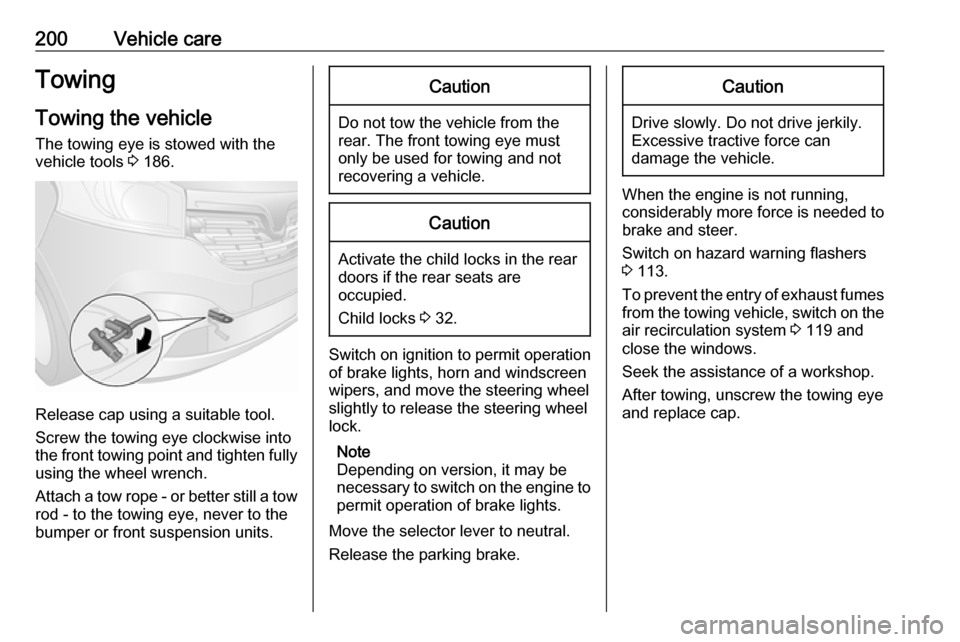
The towing eye is stowed with the
vehicle tools 3 186.
Release cap using a suitable tool.
Screw the towing eye clockwise into
the front towing point and tighten fully
using the wheel wrench.
Attach a tow rope - or better still a tow rod - to the towing eye, never to the
bumper or front suspension units.
Caution
Do not tow the vehicle from the
rear. The front towing eye must
only be used for towing and not
recovering a vehicle.
Caution
Activate the child locks in the rear
doors if the rear seats are
occupied.
Child locks 3 32.
Switch on ignition to permit operation
of brake lights, horn and windscreen
wipers, and move the steering wheel
slightly to release the steering wheel
lock.
Note
Depending on version, it may be
necessary to switch on the engine to
permit operation of brake lights.
Move the selector lever to neutral.
Release the parking brake.
Caution
Drive slowly. Do not drive jerkily.
Excessive tractive force can
damage the vehicle.
When the engine is not running,
considerably more force is needed to
brake and steer.
Switch on hazard warning flashers
3 113.
To prevent the entry of exhaust fumes
from the towing vehicle, switch on the air recirculation system 3 119 and
close the windows.
Seek the assistance of a workshop.
After towing, unscrew the towing eye
and replace cap.
Page 203 of 241
Vehicle care201Towing another vehicle
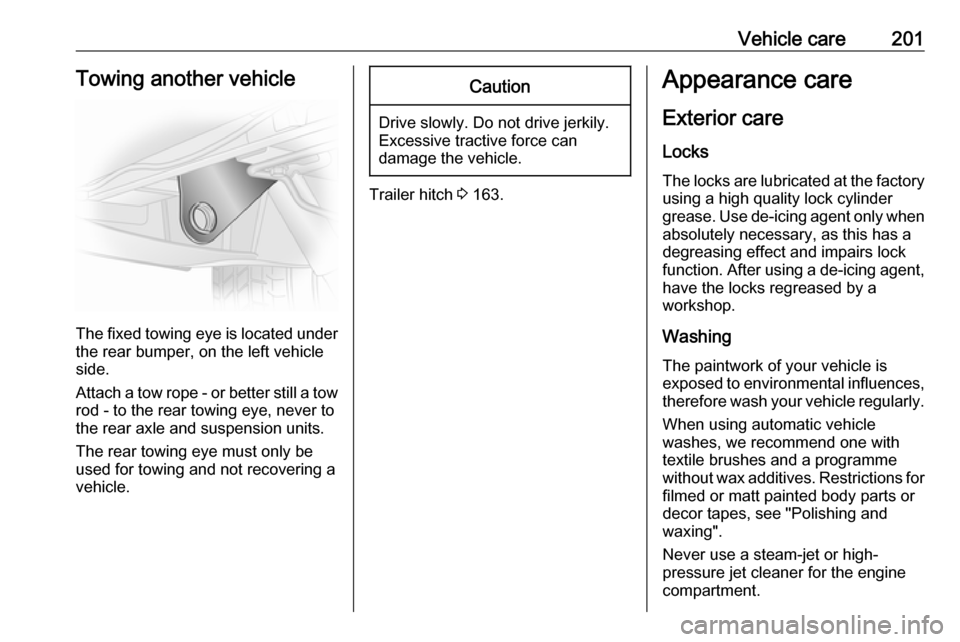
The fixed towing eye is located underthe rear bumper, on the left vehicle
side.
Attach a tow rope - or better still a tow
rod - to the rear towing eye, never to
the rear axle and suspension units.
The rear towing eye must only be
used for towing and not recovering a
vehicle.
Caution
Drive slowly. Do not drive jerkily.
Excessive tractive force can
damage the vehicle.
Trailer hitch 3 163.
Appearance care
Exterior care
Locks The locks are lubricated at the factoryusing a high quality lock cylinder
grease. Use de-icing agent only when absolutely necessary, as this has adegreasing effect and impairs lockfunction. After using a de-icing agent,
have the locks regreased by a
workshop.
Washing
The paintwork of your vehicle is
exposed to environmental influences, therefore wash your vehicle regularly.
When using automatic vehicle
washes, we recommend one with
textile brushes and a programme
without wax additives. Restrictions for
filmed or matt painted body parts or
decor tapes, see "Polishing and
waxing".
Never use a steam-jet or high-
pressure jet cleaner for the engine
compartment.