instrument panel OPEL VIVARO B 2018 Manual user
[x] Cancel search | Manufacturer: OPEL, Model Year: 2018, Model line: VIVARO B, Model: OPEL VIVARO B 2018Pages: 237, PDF Size: 5.57 MB
Page 152 of 237
150Driving and operatingIf necessary, in the event of soft
ground, mud or snow-covered road
surfaces, the Traction control system
(TC) can be deactivated to enhance
traction:
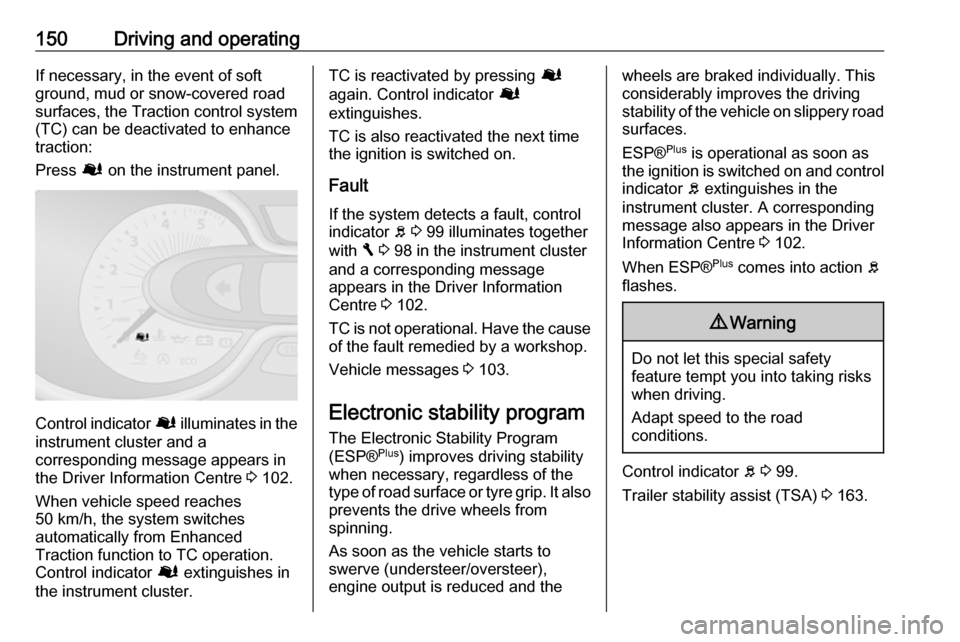
Press Ø on the instrument panel.
Control indicator Ø illuminates in the
instrument cluster and a
corresponding message appears in
the Driver Information Centre 3 102.
When vehicle speed reaches 50 km/h, the system switches
automatically from Enhanced
Traction function to TC operation.
Control indicator Ø extinguishes in
the instrument cluster.
TC is reactivated by pressing Ø
again. Control indicator Ø
extinguishes.
TC is also reactivated the next time
the ignition is switched on.
Fault
If the system detects a fault, control indicator b 3 99 illuminates together
with F 3 98 in the instrument cluster
and a corresponding message
appears in the Driver Information
Centre 3 102.
TC is not operational. Have the cause of the fault remedied by a workshop.
Vehicle messages 3 103.
Electronic stability program The Electronic Stability Program
(ESP® Plus
) improves driving stability
when necessary, regardless of the
type of road surface or tyre grip. It also
prevents the drive wheels from
spinning.
As soon as the vehicle starts to
swerve (understeer/oversteer),
engine output is reduced and thewheels are braked individually. This
considerably improves the driving
stability of the vehicle on slippery road
surfaces.
ESP® Plus
is operational as soon as
the ignition is switched on and control
indicator b extinguishes in the
instrument cluster. A corresponding
message also appears in the Driver
Information Centre 3 102.
When ESP® Plus
comes into action b
flashes.9 Warning
Do not let this special safety
feature tempt you into taking risks
when driving.
Adapt speed to the road
conditions.
Control indicator b 3 99.
Trailer stability assist (TSA) 3 163.
Page 153 of 237
Driving and operating151Enhanced Traction function
If necessary, in the event of soft
ground, mud or snow-covered road
surfaces, ESP® Plus
can be
deactivated to enhance traction:
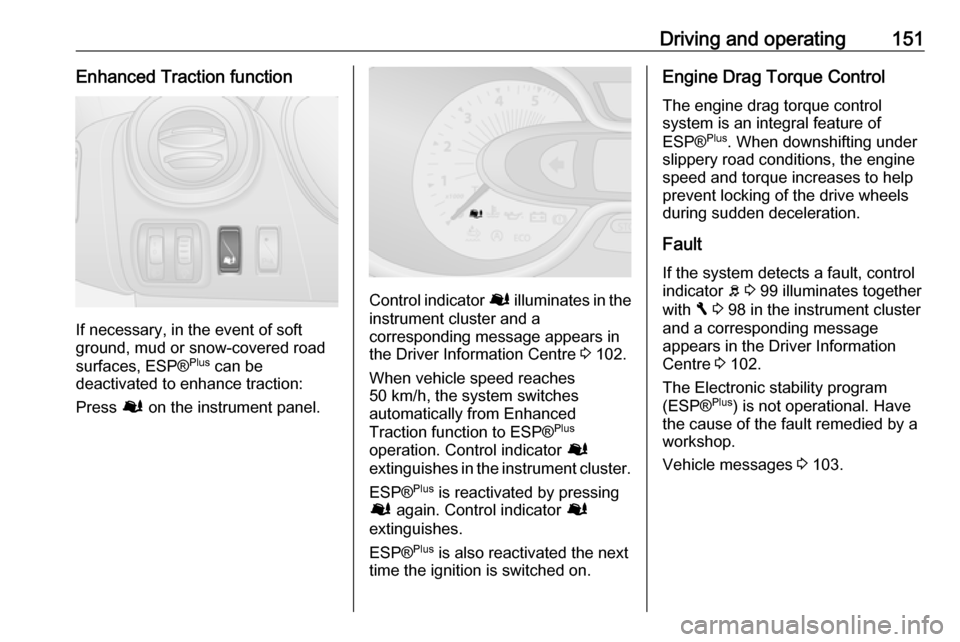
Press Ø on the instrument panel.
Control indicator Ø illuminates in the
instrument cluster and a
corresponding message appears in
the Driver Information Centre 3 102.
When vehicle speed reaches
50 km/h, the system switches
automatically from Enhanced
Traction function to ESP® Plus
operation. Control indicator Ø
extinguishes in the instrument cluster.
ESP® Plus
is reactivated by pressing
Ø again. Control indicator Ø
extinguishes.
ESP® Plus
is also reactivated the next
time the ignition is switched on.
Engine Drag Torque Control
The engine drag torque control
system is an integral feature of
ESP® Plus
. When downshifting under
slippery road conditions, the engine speed and torque increases to help
prevent locking of the drive wheels
during sudden deceleration.
Fault
If the system detects a fault, control indicator b 3 99 illuminates together
with F 3 98 in the instrument cluster
and a corresponding message
appears in the Driver Information
Centre 3 102.
The Electronic stability program
(ESP® Plus
) is not operational. Have
the cause of the fault remedied by a
workshop.
Vehicle messages 3 103.
Page 157 of 237

Driving and operating155Pressing < will also reactivate the
speed limiter function, but at the
current vehicle speed only, not the
stored speed.
Deleting the limit speed
Press U; Yellow control indicator U
extinguishes in the instrument cluster.
Speed limiter
Maximum speed limiter
In accordance with local or national
regulations, the vehicle may be
equipped with a fixed maximum
speed limiter that cannot be disabled.
If equipped, a warning label indicating the fixed maximum speed limit (90 to
130 km/h) is located on the
instrument panel.
Deviations from the maximum speed
limit may occur briefly when driving
downhill, for physical reasons.
A warning buzzer will sound for
ten seconds every 40 seconds if the vehicle briefly exceeds the set limit.
Vehicles also equipped with cruise
control speed limiter: the maximum
speed cannot be exceeded by
depressing the accelerator pedal
firmly beyond the point of resistance.
Cruise control speed limiter 3 152.
Parking assist9 Warning
It is the driver who bears full
responsibility for the parking
manoeuvre.
Always check the surrounding
area while reversing and using the rear parking assist system.
The parking assist makes reverse
parking easier by measuring the
distance between the rear of the
vehicle and obstacles.
The system consists of four ultrasonic parking sensors in the rear bumper.
Note
Attached parts in the detection area
cause system malfunction.
Activation
When reverse gear is engaged, the
system switches itself on
automatically. Readiness for
operation is indicated by a brief
acoustic signal.
Page 158 of 237

156Driving and operatingAn obstacle is indicated by buzzers
and, depending on vehicle, is also
indicated in the Info-Display. The
interval between the buzzers
becomes shorter as the vehicle gets
closer to the obstacle. When the
distance is less than 30 cm, the buzzer is continuous.
Note
In versions with Info-Display
indication, the volume of the buzzer
can be adjusted via the Infotainment
system. Refer to Infotainment
manual for further information.
DeactivationIt is possible to permanently or
temporarily deactivate the system.
Note
In versions with Info-Display
indication, the function can be
deactivated via the Infotainment
system. Refer to Infotainment
manual for further information.
Temporary deactivation
Temporarily deactivate the system by
pressing r on the instrument panel
with the ignition on. LED illuminates in
the button when deactivated.
When reverse gear is selected, no
acoustic signal will sound, indicating
deactivation.
The function is reactivated by
pressing r again or the next time
the ignition is switched on.
Permanent deactivation
Permanently deactivate the system
by pressing and holding r on the
instrument panel for approx.
three seconds with the ignition on.
LED illuminates continuously in the
button when permanently
deactivated.The system is deactivated and will not
operate. When reverse gear is
selected, no acoustic signal will
sound, indicating deactivation.
The function is reactivated by
pressing and holding r for approx.
three seconds.
Fault
If the system detects an operating fault, when selecting reverse gear a
continuous acoustic alarm will sound
for approx. five seconds, a
corresponding message appears in
the Driver Information Centre 3 102
and F illuminates in the instrument
cluster 3 98. Consult a workshop to
have the cause of the fault remedied.Caution
When reversing, the area should
be free from obstacles which could impact on the underside of the
vehicle.
Impact to the rear axle, which may
not be visible, could lead to
uncharacteristic changes in the
Page 166 of 237

164Vehicle careVehicle careGeneral Information...................165
Accessories and vehicle modifications .......................... 165
Vehicle storage ........................165
End-of-life vehicle recovery .....166
Vehicle checks ........................... 166
Performing work ......................166
Bonnet ..................................... 166
Engine oil ................................. 167
Engine air filter ........................ 168
Engine coolant ......................... 169
Power steering fluid .................169
Washer fluid ............................ 170
Brakes ..................................... 170
Brake fluid ............................... 170
Vehicle battery ......................... 171
Diesel fuel filter ........................173
Diesel fuel system bleeding .....173
Wiper blade replacement ........174
Bulb replacement .......................175
Headlights ............................... 175
Fog lights ................................. 176
Front turn signal lights .............176
Tail lights ................................. 176
Side turn signal lights ..............177Centre high-mounted brake
light ......................................... 177
Reversing light ......................... 178
Number plate light ...................179
Fog tail light ............................. 179
Interior lights ............................ 180
Instrument panel illumination ...180
Electrical system ........................181
Fuses ....................................... 181
Instrument panel fuse box .......182
Vehicle tools .............................. 185
Tools ........................................ 185
Wheels and tyres .......................186
Tyres ....................................... 186
Winter tyres ............................. 186
Tyre designations ....................186
Tyre pressure .......................... 186
Tyre pressure monitoring system .................................... 188
Tread depth ............................. 190
Changing tyre and wheel size . 190
Wheel covers ........................... 190
Tyre chains .............................. 191
Tyre repair kit .......................... 191
Wheel changing .......................194
Spare wheel ............................ 195
Jump starting ............................. 197Towing....................................... 198
Towing the vehicle ...................198
Towing another vehicle ...........199
Appearance care .......................200
Exterior care ............................ 200
Interior care ............................. 202
Page 171 of 237

Vehicle care169Engine coolant
The coolant provides freeze
protection down to approx. -28 °C.Caution
Only use approved antifreeze.
Coolant level
Caution
Too low a coolant level can cause engine damage.
If the cooling system is cold, the
coolant level should be just above the
MINI mark. Top-up if the level is low.9Warning
Allow the engine to cool before
opening the cap. Carefully open
the cap, relieving the pressure
slowly.
Top-up with antifreeze. If no
antifreeze is available, use clean tap
water or distilled water. Install the cap
tightly. Have the antifreeze
concentration checked and have the
cause of the coolant loss remedied by a workshop.
If a substantial amount of coolant is
required, it will be necessary to bleed
any trapped air from the cooling
system. Seek the assistance of a
workshop.
If the coolant temperature is too high, control indicator W 3 99 illuminates
red in the instrument cluster, together
with C 3 98. Consult a workshop if
coolant level is sufficient.
Power steering fluidCaution
Extremely small amounts of
contamination can cause steering
system damage and cause it to not work properly. Do not allow
contaminates to contact the fluid
side of the reservoir cap or from
entering the reservoir.
The power steering fluid reservoir is located below the front left wheel
arch, behind a trim panel.
The fluid level normally does not need
to be checked. If an unusual noise is
heard during steering or if the power
steering reacts conspicuously, seek
the assistance of a workshop.
Page 182 of 237

180Vehicle care6.Reattach wiring connector to lamp
assembly.
7. Install lamp assembly with the two bolts.
Interior lights
Front and rear courtesy lights
1. Release lens assembly from the clips and the locator using a flat
blade screwdriver.
2. Renew bulb.
3. Install lens assembly.
Load compartment light
1. Release lens assembly from the clips using a flat blade
screwdriver.
2. Remove rear cover on lamp assembly.
3. Renew bulb.
4. Install rear cover and lamp assembly.
Glovebox light
1. Remove lens assembly using aflat blade screwdriver.
2. Renew bulb.
3. Install lens assembly.
Instrument panel illumination
Have bulbs replaced by a workshop.
Page 183 of 237
Vehicle care181Electrical system
Fuses Data on the replacement fuse must
match the data on the defective fuse.
There are two fuse boxes in the
vehicle:
● on the left-hand side of the instrument panel, behind the trim
panel
● in the engine compartment located next to the battery
Note
The engine compartment fuse box
should only be accessed by a
workshop.
Before replacing a fuse, turn off the
respective switch and the ignition.
There are different types of fuses in
the vehicle.
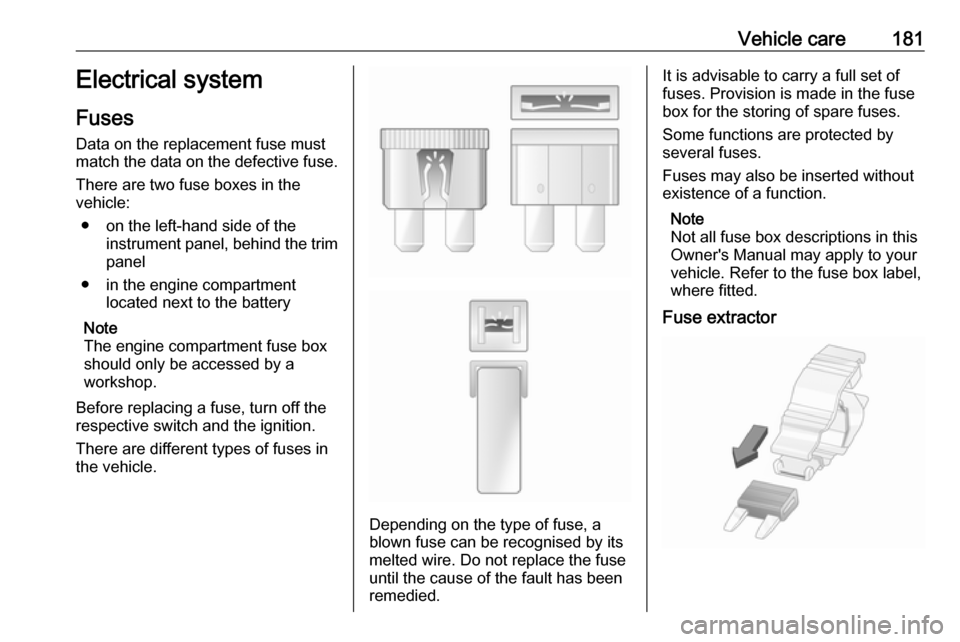
Depending on the type of fuse, a
blown fuse can be recognised by its
melted wire. Do not replace the fuse until the cause of the fault has been
remedied.
It is advisable to carry a full set of
fuses. Provision is made in the fuse
box for the storing of spare fuses.
Some functions are protected by
several fuses.
Fuses may also be inserted without existence of a function.
Note
Not all fuse box descriptions in this
Owner's Manual may apply to your
vehicle. Refer to the fuse box label,
where fitted.
Fuse extractor
Page 184 of 237
182Vehicle care
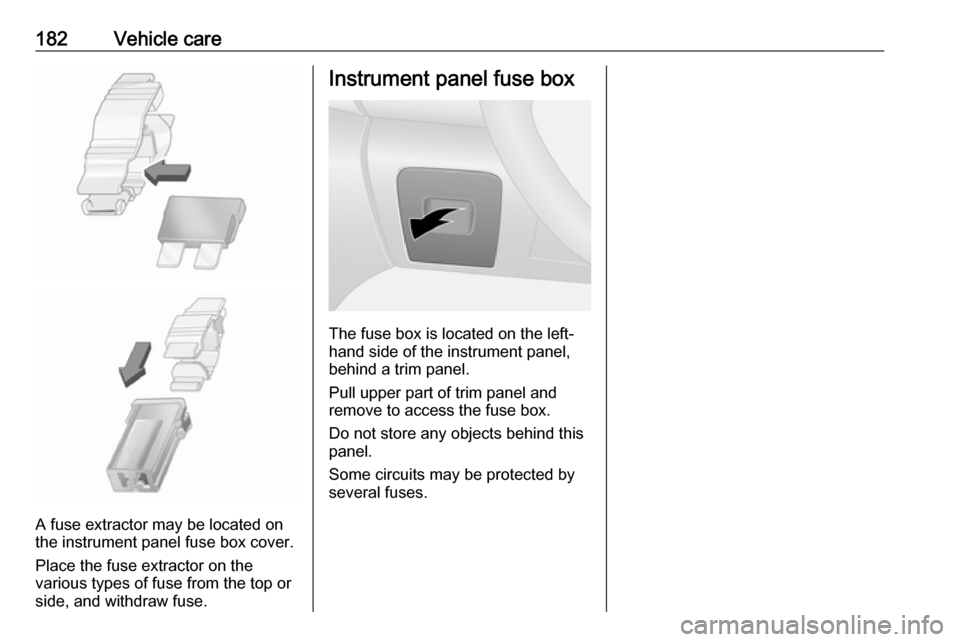
A fuse extractor may be located on
the instrument panel fuse box cover.
Place the fuse extractor on the
various types of fuse from the top or
side, and withdraw fuse.
Instrument panel fuse box
The fuse box is located on the left-
hand side of the instrument panel, behind a trim panel.
Pull upper part of trim panel and
remove to access the fuse box.
Do not store any objects behind this
panel.
Some circuits may be protected by
several fuses.
Page 204 of 237

202Vehicle careClean rims with a pH-neutral wheel
cleaner.
Rims are painted and can be treated
with the same agents as the body.
Paintwork damageRectify minor paintwork damage with
a touch-up pen before rust forms.
Have more extensive damage or rust
areas repaired by a workshop.
Underbody Some areas of the vehicle underbody
have a PVC undercoating while other
critical areas have a durable
protective wax coating.
After the underbody is washed, check
the underbody and have it waxed if
necessary.
Bitumen / rubber materials could
damage the PVC coating. Have
underbody work carried out by a
workshop.
Before and after winter, wash the
underbody and have the protective
wax coating checked.Towing equipment
Do not clean the coupling ball bar with
a steam-jet or high-pressure jet
cleaner.
Interior care
Interior and upholstery Only clean the vehicle interior,
including the instrument panel fascia
and panelling, with a dry cloth or
interior cleaner.
Clean any leather upholstery with
clear water and a soft cloth. In case of
heavy soiling, use leather care.
The instrument cluster and the
displays should only be cleaned using a soft damp cloth. If necessary use aweak soap solution.
Clean fabric upholstery with a
vacuum cleaner and brush. Remove
stains with an upholstery cleaner.
Clothing fabrics may not be
colourfast. This could cause visible
discolourations, especially on light-coloured upholstery. Removable
stains and discolourations should be
cleaned as soon as possible.
Clean seat belts with lukewarm water or interior cleaner.Caution
Close Velcro fasteners as open
Velcro fasteners on clothing could
damage seat upholstery.
The same applies to clothing with
sharp-edged objects, like zips or
belts or studded jeans.
Plastic and rubber parts
Plastic and rubber parts can be
cleaned with the same cleaner as
used to clean the body. Use interior cleaner if necessary. Do not use any
other agent. Avoid solvents and petrol in particular. Do not use high-
pressure jet cleaners.