battery OPEL VIVARO B 2019 Manual user
[x] Cancel search | Manufacturer: OPEL, Model Year: 2019, Model line: VIVARO B, Model: OPEL VIVARO B 2019Pages: 235, PDF Size: 5.67 MB
Page 201 of 235
Vehicle care199Jump starting
Do not start with a quick charger.
A vehicle with a discharged battery
can be started using jump leads and
the vehicle battery of another vehicle.9 Warning
Be extremely careful when starting
with jump leads. Any deviation
from the following instructions can
lead to injuries or damage caused
by battery explosion or damage to the electrical systems of both
vehicles.
9 Warning
Avoid contact of the battery with
eyes, skin, fabrics and painted
surfaces. The fluid contains
sulphuric acid which can cause
injuries and damage in the event
of direct contact.
● Never expose the battery to naked flames or sparks.
● A discharged vehicle battery canalready freeze at a temperature
of 0 °C. Defrost the frozen battery
before connecting jump leads.
● Wear eye protection and protective clothing when
handling a battery.
● Use a booster battery with the same voltage (12 V). Its capacity
(Ah) must not be much less than
that of the discharged battery.
● Use jump leads with insulated terminals and a cross section of
at least 16 mm 2
(25 mm 2
for
diesel engines).
● Do not disconnect the discharged
vehicle battery from the vehicle.
● Switch off all unnecessary electrical consumers.
● Do not lean over the battery during jump starting.
● Do not allow the terminals of one
lead to touch those of the other
lead.
● The vehicles must not come into contact with each other during
the jump starting process.● Apply the parking brake, transmission in neutral.
● Open the positive terminal protection caps of both batteries.
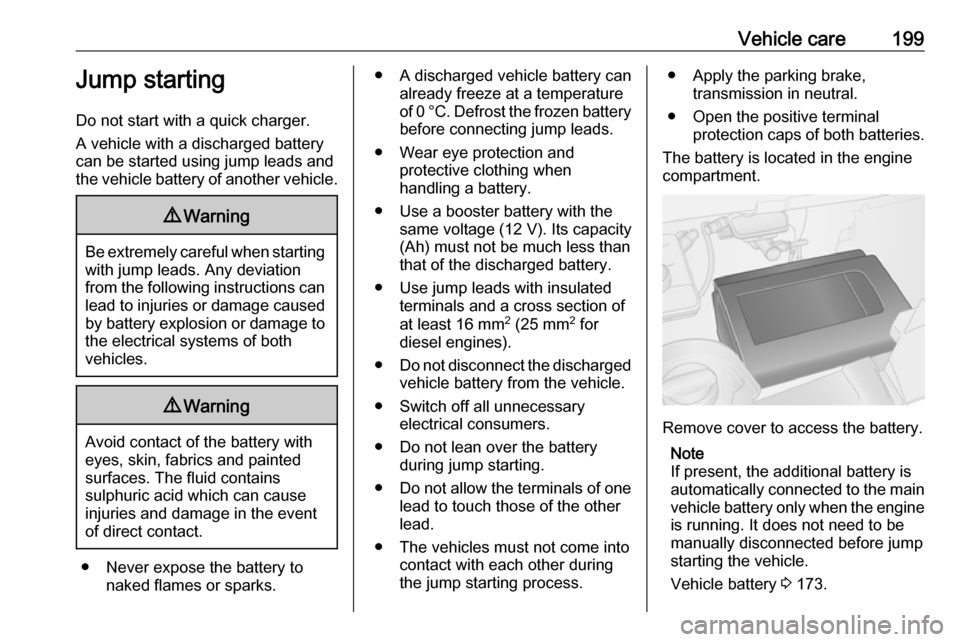
The battery is located in the engine compartment.
Remove cover to access the battery.
Note
If present, the additional battery is automatically connected to the main vehicle battery only when the engine
is running. It does not need to be manually disconnected before jump
starting the vehicle.
Vehicle battery 3 173.
Page 202 of 235
200Vehicle care
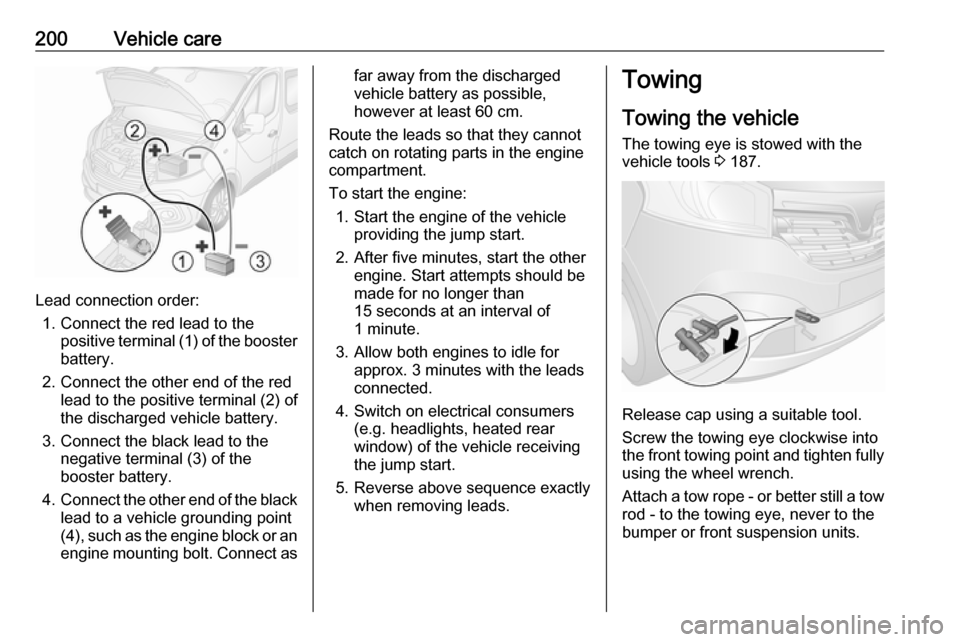
Lead connection order:1. Connect the red lead to the positive terminal (1) of the booster
battery.
2. Connect the other end of the red lead to the positive terminal (2) of
the discharged vehicle battery.
3. Connect the black lead to the negative terminal (3) of the
booster battery.
4. Connect the other end of the black
lead to a vehicle grounding point
(4), such as the engine block or an
engine mounting bolt. Connect as
far away from the discharged
vehicle battery as possible,
however at least 60 cm.
Route the leads so that they cannot
catch on rotating parts in the engine
compartment.
To start the engine: 1. Start the engine of the vehicle providing the jump start.
2. After five minutes, start the other engine. Start attempts should be
made for no longer than
15 seconds at an interval of
1 minute.
3. Allow both engines to idle for approx. 3 minutes with the leads
connected.
4. Switch on electrical consumers (e.g. headlights, heated rear
window) of the vehicle receiving
the jump start.
5. Reverse above sequence exactly when removing leads.Towing
Towing the vehicle The towing eye is stowed with thevehicle tools 3 187.
Release cap using a suitable tool.
Screw the towing eye clockwise into
the front towing point and tighten fully
using the wheel wrench.
Attach a tow rope - or better still a tow rod - to the towing eye, never to the
bumper or front suspension units.
Page 224 of 235

222Customer informationOperating data in the vehicleControl units process data for
operation of the vehicle.
This data includes, e.g.: ● vehicle status information (e.g. speed, movement delay, lateral
acceleration, wheel rotation rate, "seat belts fastened" display)
● ambient conditions (e.g. temperature, rain sensor,
distance sensor)
As a rule such data is transient, not
stored for longer than an operational
cycle, and only processed on board the vehicle itself. Control units often
include data storage (including the
vehicle key). This is used to allow
information to be documented
temporarily or permanently on vehicle
condition, component stress,
maintenance requirements and
technical events and errors.Depending on technical equipment
level, the data stored is as follows:
● system component operating states (e.g. fill level, tyre
pressure, battery status)
● faults and defects in important system components (e.g. lights,
brakes)
● system reactions in special driving situations (e.g. triggering
of an airbag, actuation of the
stability control systems)
● information on events damaging the vehicle
● for electric vehicles the amount of
charge in the high-voltage
battery, estimated range
In special cases (e.g. if the vehicle
has detected a malfunction), it may be
necessary to save data that would
otherwise just be volatile.
When you use services (e.g. repairs,
maintenance), the operating data
saved can be read together with the
vehicle identification number and
used when necessary. Staff working
for the service network ( e.g. garages,
manufacturers) or third parties (e.g.breakdown services) can read the
data from the vehicle. The same
applies to warranty work and quality
assurance measures.
Data is generally read via the OBD
(On-Board Diagnostics) port
prescribed by law in the vehicle. The operating data which is read out,
documents the technical condition of
the vehicle or individual components
and assists with fault diagnosis,
compliance with warranty obligations
and quality improvement. This data,
in particular information on
component stress, technical events,
operator errors and other faults, is
transmitted to the manufacturer
where appropriate, together with the
vehicle identification number. The
manufacturer is also subject to
product liability. The manufacturer
potentially also uses operating data
from vehicles for product recalls. This
data can also be used to check
customer warranty and guarantee
claims.
Fault memories in the vehicle can be
reset by a service company when
carrying out servicing or repairs or at
your request.
Page 228 of 235

226IndexAAbsorptive Glass Mat battery .....173
Accessories and vehicle modifications .......................... 167
AdBlue ................ 101, 106, 142, 207
AdBlue tank ................................ 215
Adjustable air vents ...................129
AGM battery ............................... 173
Airbag and belt tensioners ...........98
Airbag deactivation ................64, 98
Airbag label............................. 60, 64
Airbag system .............................. 60
Air conditioning regular operation ................................ 130
Air conditioning system .............. 119
Air intake .................................... 130
Air recirculation ...................119, 200
Air vents...................................... 129
Alert ............................................ 105
Antifreeze ................................... 171
Antilock brake system ................ 148
Antilock brake system (ABS) .....100
Anti-theft alarm system ................38
Anti-theft bolts............................. 196
Anti-theft locking system .............. 37
Anti-theft security lock ..................25
Appearance care ........................202
Armrest ........................................ 50
Ashtrays ....................................... 90 Automatic anti-dazzle ..................42Automatic fuel cut-off ..................136
Automatic light control ...............111
Automatic locking ........................31
Autostop ............................. 135, 137
Auxiliary heater ........................... 124
B Battery .................... 22, 23, 124, 173
Battery discharge protection ......117
Battery, jump starting.................. 199
Belts.............................................. 55 Bench seat.................................... 76
Bonnet ....................................... 168
Bottle holders................................ 76
Brake and clutch fluid .................207
Brake assist ............................... 149
Brake fluid .................................. 172
Brakes ............................... 148, 172
Brake system ............................... 99
Breakdown.................................. 200
Bulb replacement ....................... 177
C
Capacities .................................. 215
Car Pass ...................................... 22
Catalytic converter .....................141
Central locking system ................26
Centre high-mounted brake light 179
Changing tyre and wheel size ...192
Charging system .......................... 99
Child locks ................................... 32
Page 233 of 235

231Tyre repair kit ............................. 193
Tyres .......................................... 188
Tyres and wheel size, changing. 192
U
Ultrasonic parking assist............. 156
Underseat storage .......................76
Upholstery .................................. 204
USB socket ................................... 89
Using this manual ..........................3
V Vehicle battery ...................173, 199
Vehicle checks............................ 168
Vehicle data ................................ 211
Vehicle data recording and privacy ..................................... 221
Vehicle dimensions .................... 212
Vehicle Identification Number ....209
Vehicle jack ................................ 187
Vehicle messages .....................104
Vehicle security ............................ 37
Vehicle shutdown ......................136
Vehicle specific data ......................3
Vehicle storage ........................... 167
Vehicle tools ....................... 187, 200
Vehicle unlocking ........................... 6
Ventilation ................................... 118W
Warning chimes .........................105
Warning lights ............................... 91
Warning messages .....................104
Warning triangle .......................... 82
Washer and wiper systems .........16
Washer fluid ............................... 172
Washing the vehicle ...................202
Welcome lighting ........................116
Wheel changing .........................196
Wheel cover hook .......................187
Wheel covers ............................. 192
Wheels and tyres .......................188
Wheel wrench ............................. 187
Wide view mirror ........................... 42
Windows ....................................... 43
Windscreen................................... 43
Windscreen stickers .....................43
Windscreen wiper and washer ....86
Winter tyres ............................... 188
Wiper blade replacement ..........176