ABS OPEL ZAFIRA 2009 User Guide
[x] Cancel search | Manufacturer: OPEL, Model Year: 2009, Model line: ZAFIRA, Model: OPEL ZAFIRA 2009Pages: 228, PDF Size: 7.3 MB
Page 169 of 228
Vehicle care
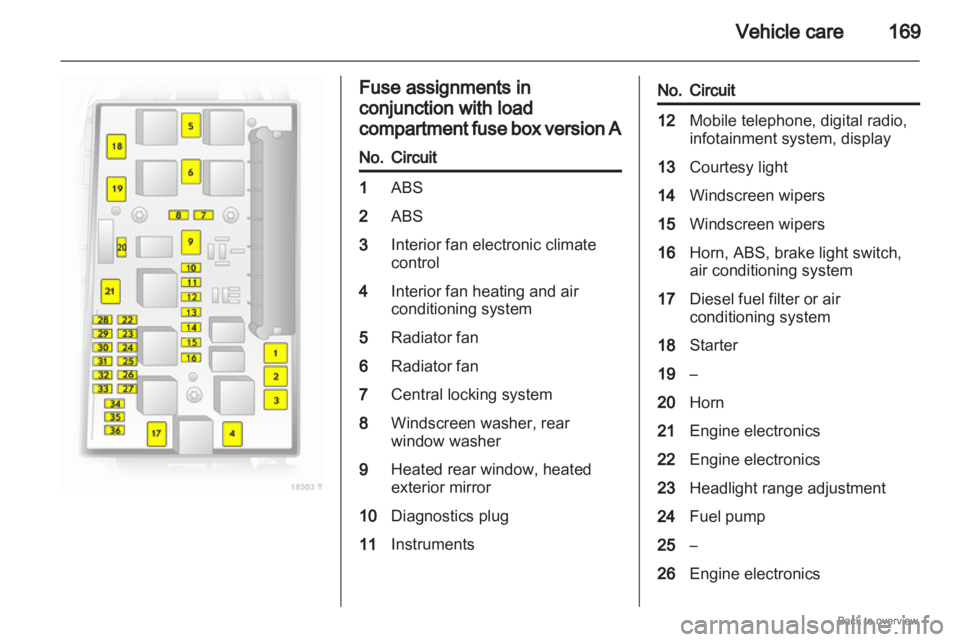
169 Fuse assignments in
conjunction with load
compartment
fuse box version A
No. Circuit
1
ABS
2 ABS
3 Interior fan electronic climate
control
4 Interior fan heating and air
conditioning system
5 Radiator fan
6 Radiator fan
7 Central locking system
8 Windscreen washer, rear
window washer
9 Heated rear window, heated
exterior mirror
10 Diagnostics plug
11 Instruments No. Circuit
12
Mobile telephone, digital radio,
infotainment system, display
13 Courtesy light
14 Windscreen wipers
15 Windscreen wipers
16 Horn, ABS, brake light switch,
air conditioning system
17 Diesel fuel filter or air
conditioning system
18 Starter
19 –
20 Horn
21 Engine electronics
22 Engine electronics
23 Headlight range adjustment
24 Fuel pump
25 –
26 Engine electronics
Page 170 of 228

170
Vehicle care
No. Circuit
27
Heating, air conditioning
system, air quality sensor
28 –
29 Power steering
30 Engine electronics
31 Rear window wiper
32 Brake light switch
33 Headlight range adjustment,
light switch, clutch switch,
instrument, driver's door
module
34 Steering column control unit
35 Infotainment system
36 Cigarette lighter, front power
outlet Fuse assignments in
conjunction with load
compartment
fuse box version B
No. Circuit
1
ABS
2 ABS
3 Interior fan electronic climate
control
4 Interior fan heating and air
conditioning system
5 Radiator fan
6 Radiator fan
7 Windscreen washer system
8 Horn
9 Headlamp washer system
10 Emergency unlocking of central
locking system
11 –
12 – No. Circuit
13
Fog light
14 Windscreen wipers
15 Windscreen wipers
16 Control module electronics,
Open&Start system, ABS,
brake light switch
17 Diesel fuel filter heating
18 Starter
19 Transmission electronics
20 Air conditioning system
21 Engine electronics
22 Engine electronics
23 Adaptive Forward Lighting,
headlight range adjustment
24 Fuel pump
25 Transmission electronics
26 Engine electronics
27 Power steering
Page 171 of 228
Vehicle care
171
No. Circuit
28
Transmission electronics
29 Transmission electronics
30 Engine electronics
31 Adaptive Forward Lighting,
headlight range adjustment
32 Brake system, air conditioning
system, clutch switch
33 Adaptive Forward Lighting,
headlight range adjustment,
light switch
34 Steering column control unit
35 Infotainment system
36 Mobile telephone, digital radio,
infotainment system, display Load compartment fuse
box
The fuse box is behind a cover. Press
the locking tabs forward and remove
the cover.
Do not store any objects behind the
cover.
Depending on the equipment, there
are two different fuse boxes.
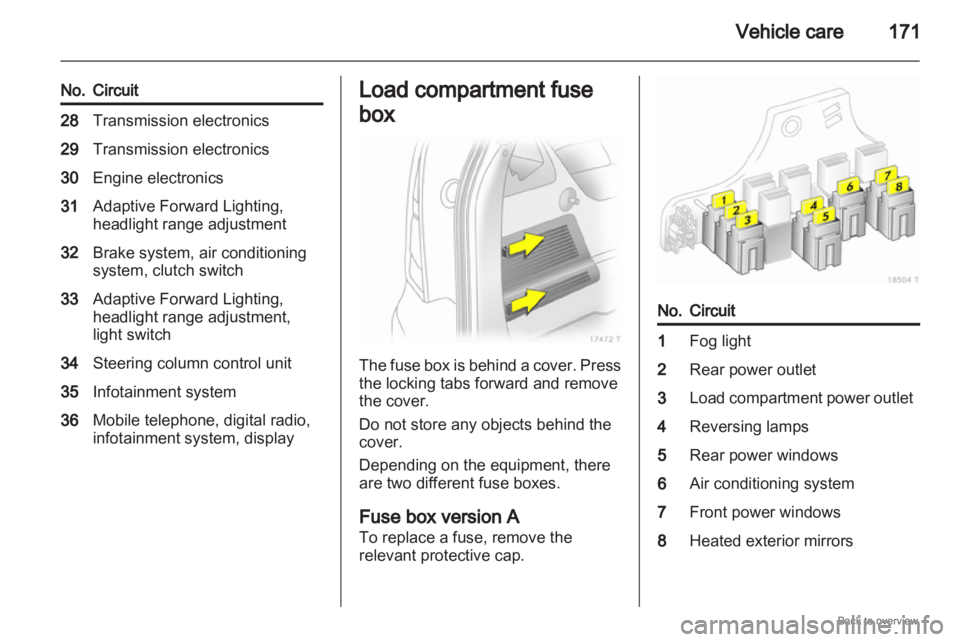
Fuse box version A
To replace a fuse, remove the
relevant protective cap. No. Circuit
1
Fog light
2 Rear power outlet
3 Load compartment power outlet
4 Reversing lamps
5 Rear power windows
6 Air conditioning system
7 Front power windows
8 Heated exterior mirrors
Page 179 of 228
Vehicle care
179
The use of tyre chains is not permitted
on the temporary spare wheel.
Tyre repair kit
Minor damage to the tyre tread or
sidewall
can be repaired with the tyre
repair kit.
Do not remove foreign bodies from
the tyres.
Tyre damage exceeding 4 mm or that
is near the rim cannot be repaired with
the tyre repair kit. 9
Warning Do not drive faster than 80 km/h.
Do not use for a lengthy period.
Steering and handling may be
affected.
If you have a flat tyre:
Apply
the hand brake and engage first
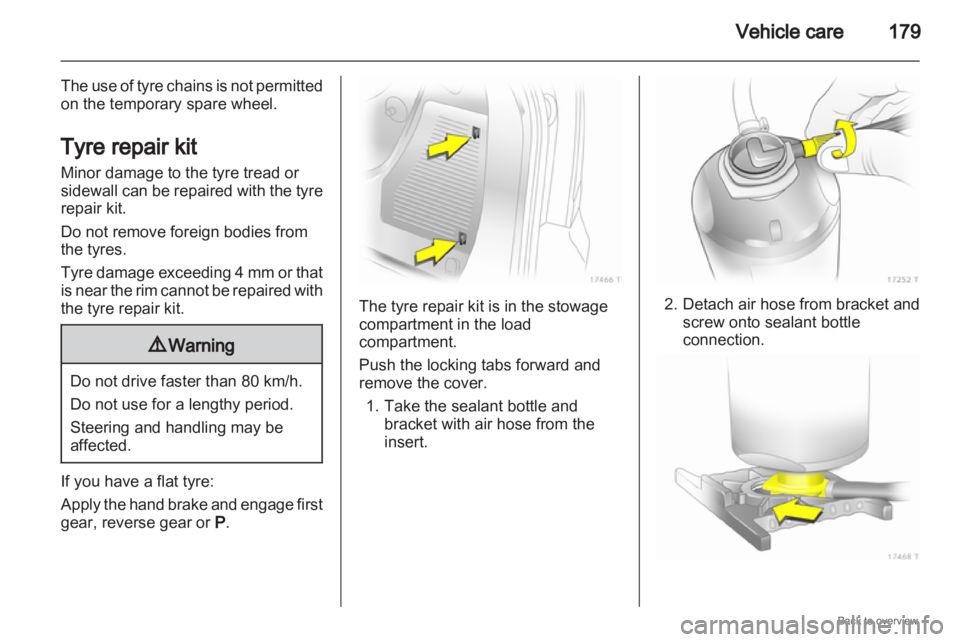
gear, reverse gear or P. The tyre repair kit is in the stowage
compartment in the load
compartment.
Push the locking tabs forward and
remove the cover.
1.
Take the sealant bottle andbracket with air hose from the
insert. 2. Detach air hose from bracket and
screw onto sealant bottle
connection.
Page 189 of 228
Vehicle care
189
Appearance care
Exterior care
Locks
The
locks are lubricated at the factory
using a high quality lock cylinder
grease. Use de-icing agent only when
absolutely necessary, as this has
a degreasing effect and impairs lock
function. After using de-icing agent,
have the locks regreased by
a workshop.
Washing
The paintwork of your vehicle is
exposed to environmental influences.
Wash and wax your vehicle regularly.
When using automatic car washes,
select a programme that includes
waxing.
Bird droppings, dead insects, resin,
pollen and the like should be cleaned
off immediately, as they contain
aggressive constituents which can
cause paint damage. If using a car wash, comply with the
car
wash manufacturer's instructions.
The windscreen wipers and rear
window wiper must be switched off.
Remove antenna and external
accessories such as roof racks etc.
If you wash your vehicle by hand,
make sure that the insides of the
wheel housings are also thoroughly
rinsed out.
Clean edges and folds on opened
doors and the bonnet as well as the
areas they cover.
Thoroughly rinse and leather-off the
vehicle. Rinse leather frequently. Use
separate leathers for painted and
glass surfaces: remnants of wax on
the windows will impair vision.
Do not use hard objects to remove
spots of tar. Use tar removal spray on
painted surfaces.
Exterior lights
Headlamp and other lamp covers are
made of plastic. Do not use any
abrasive or caustic agents, do not use
an ice scraper, and do not clean them
dry. Polishing and waxing
Wax the vehicle regularly (at the
latest when water no longer beads).
Otherwise, the paintwork will dry out.
Polishing
is necessary only if the paint
has become dull or if solid deposits
have become attached to it.
Paintwork polish with silicone forms
a protective film, making waxing
unnecessary.
Plastic body parts must not be treated
with wax or polishing agents.
Windows and windscreen wiper
blades
Use a soft lint-free cloth or chamois
leather together with window cleaner
and insect remover.
When cleaning the rear window,
make sure the heating element inside
the window is not damaged.
For mechanical removal of ice, use
a sharp-edged ice scraper. Press the
scraper firmly against the glass so
that no dirt can get under it and
scratch the glass.
Page 206 of 228
206
Service and maintenance
Over time, brake fluid absorbs
moisture which will reduce braking
effectiveness. The brake fluid should
therefore
be replaced at the specified
interval.
Brake fluid should be stored in
a sealed container to avoid water
absorption.
Ensure brake fluid does not become
contaminated.
Page 224 of 228
224
Index
A
Accessories and vehicle
modifications .......................... 154
Active head restraints on front seats .........................................
23
Adaptive Forward Lighting ........ .................................... 25, 92, 110
Additional servicing .................... 204
Adjustable air vents ...................124
Airbag and belt tensioners ...........87
Airbag system .............................. 57
Air conditioning regular operation ................................ 126
Air conditioning system .............. 119
Air intake .................................... 125
Air quality sensor ........................121
Antilock brake system ................ 140
Antilock brake system (ABS) ....... 89
Anti-theft alarm system ........ 36, 101
Anti-theft locking system .............. 36
Apply footbrake ............................ 92
Armrest ........................................ 49
Ashtrays ....................................... 82
Automatic anti-dazzle ..................40
Automatic climate control system .................................... 120
Automatic level control ..............144
Automatic light control ...............108
Automatic transmission .............131 Auxiliary devices
........................116
Auxiliary heater ........................... 124
B
Battery ....................................... 158
Battery discharge protection ......114
Battery voltage ...........................
100
Board-Info-Display .......................93
Bonnet ....................................... 155
Brake and clutch system ............. 89
Brake assist ............................... 142
Brake fluid .................................. 158
Brake light switch ....................... 101
Brakes ............................... 140, 158
Bulb replacement ....................... 160
C
Capacities .................................. 219
Cargo management system ........71
Car Pass ...................................... 27
Catalytic converter .....................130
Central locking system ................32
Centre console lighting ..............114
Changing tyre and wheel size ...178
Charging system .......................... 88
Check control ............................... 23
Child locks ................................... 35
Child restraint installation locations ................................... 63