clutch OPEL ZAFIRA 2009 User Guide
[x] Cancel search | Manufacturer: OPEL, Model Year: 2009, Model line: ZAFIRA, Model: OPEL ZAFIRA 2009Pages: 228, PDF Size: 7.3 MB
Page 139 of 228

Driving and operating
139
Activation
Press the T button. The transmission
switches to automatic mode. The
vehicle starts off in 2nd gear. Sport
mode is deactivated.
Deactivation
The Winter programme is switched off
by:
■ pressing the T button again
■ turning off the ignition,
■ switching to manual mode (when switched back to automatic mode,
the Winter programme is again
active)
■ when clutch temperature is too high Kickdown
If the accelerator pedal is pressed
past the pressure point, the
transmission shifts to a lower gear
depending on engine speed.
Fault
To prevent damage to the manual
transmission
automated, the clutch is
engaged automatically at high clutch
temperatures.
A illuminates in the event of a fault.
Continued driving is possible. Manual
mode cannot be used for shifting. If F appears in the transmission
display, continued driving is not
possible.
Have the cause of the fault remedied
by a workshop.
Interruption of power
supply
The clutch is not disengaged if there
is an interruption of the power supply
when a gear is engaged. The vehicle
cannot move.
If the battery is discharged, start the
vehicle using jump leads 3 185.
If the cause of the fault is not
a discharged battery, seek the
assistance of a workshop.
Page 140 of 228
140
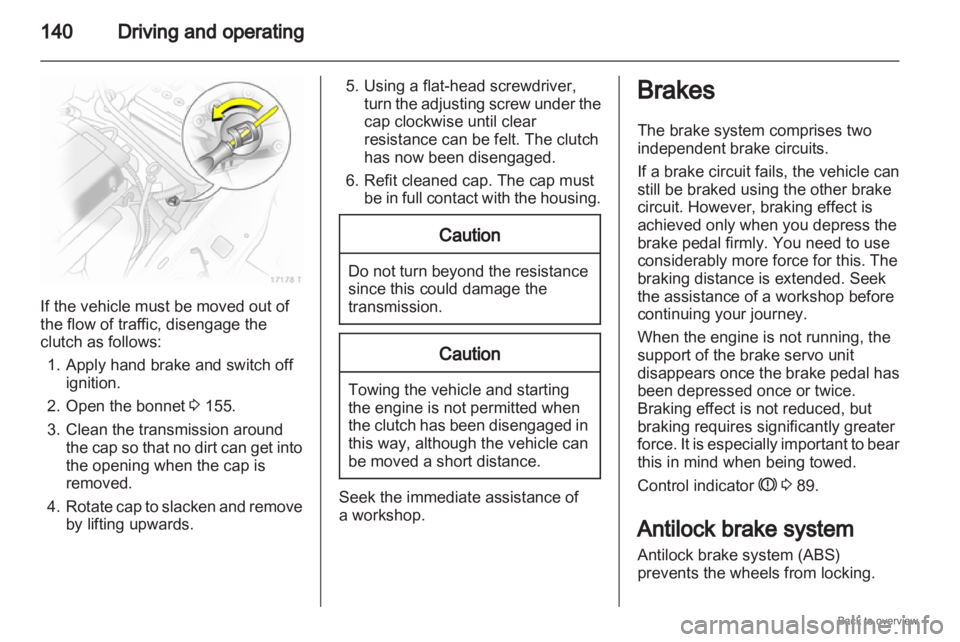
Driving and operatingIf the vehicle must be moved out of
the flow of traffic, disengage the
clutch as follows:
1.
Apply hand brake and switch offignition.
2. Open the bonnet 3 155.
3. Clean the transmission around the cap so that no dirt can get into
the opening when the cap is
removed.
4. Rotate cap to slacken and remove by lifting upwards. 5. Using a flat-head screwdriver,
turn
the adjusting screw under the
cap clockwise until clear
resistance can be felt. The clutch
has now been disengaged.
6. Refit cleaned cap. The cap must be in full contact with the housing. Caution
Do not turn beyond the resistance
since this could damage the
transmission.
Caution
Towing the vehicle and starting
the engine is not permitted when
the
clutch has been disengaged in
this way, although the vehicle can
be moved a short distance. Seek the immediate assistance of
a workshop. Brakes
The brake system comprises two
independent brake circuits.
If a brake circuit fails, the vehicle can
still be braked using the other brake
circuit. However, braking effect is
achieved only when you depress the
brake pedal firmly. You need to use
considerably more force for this. The
braking distance is extended. Seek
the assistance of a workshop before
continuing your journey.
When the engine is not running, the
support of the brake servo unit
disappears
once the brake pedal has
been depressed once or twice.
Braking effect is not reduced, but
braking requires significantly greater
force. It is especially important to bear
this in mind when being towed.
Control indicator R 3 89.
Antilock brake system
Antilock brake system (ABS)
prevents the wheels from locking.
Page 145 of 228
Driving and operating
145
Reduction
With cruise control active, hold down
button g
or briefly press it repeatedly:
speed is reduced continuously or in
small increments.
When button g is released the current
speed is stored and maintained.
Deactivation
Briefly press the § button: cruise
control is deactivated.
Automatic deactivation:
■ Vehicle speed below approx. 30 km/h
■ The brake pedal is depressed
■ The clutch pedal is depressed
■ Selector lever in N. Object detection
systems
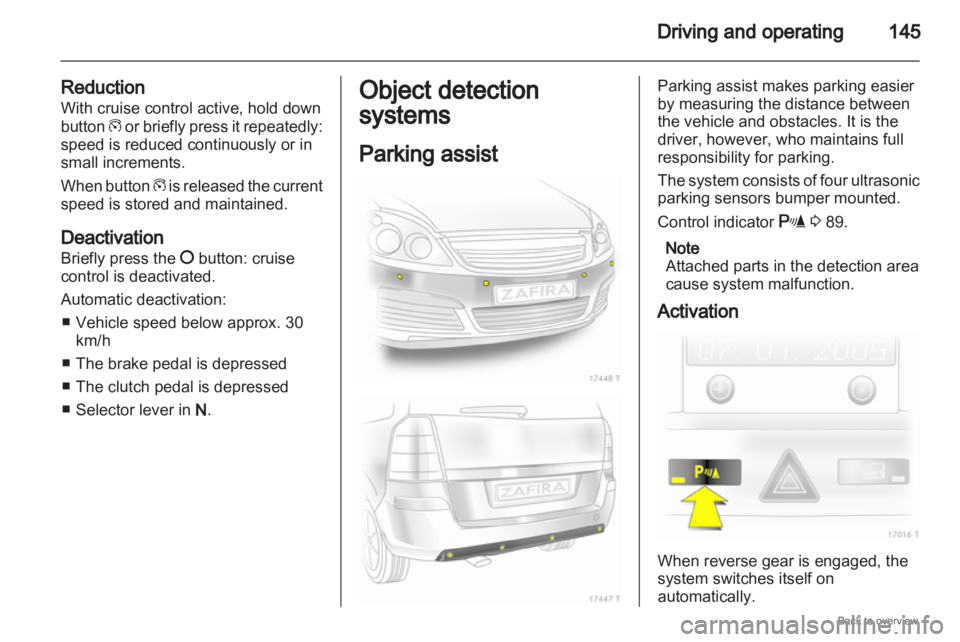
Parking assist Parking assist makes parking easier
by measuring the distance between
the vehicle and obstacles. It is the
driver, however, who maintains full
responsibility for parking.
The
system consists of four ultrasonic
parking sensors bumper mounted.
Control indicator r 3 89.
Note
Attached parts in the detection area
cause system malfunction.
Activation When reverse gear is engaged, the
system switches itself on
automatically.
Page 170 of 228

170
Vehicle care
No. Circuit
27
Heating, air conditioning
system, air quality sensor
28 –
29 Power steering
30 Engine electronics
31 Rear window wiper
32 Brake light switch
33 Headlight range adjustment,
light switch, clutch switch,
instrument, driver's door
module
34 Steering column control unit
35 Infotainment system
36 Cigarette lighter, front power
outlet Fuse assignments in
conjunction with load
compartment
fuse box version B
No. Circuit
1
ABS
2 ABS
3 Interior fan electronic climate
control
4 Interior fan heating and air
conditioning system
5 Radiator fan
6 Radiator fan
7 Windscreen washer system
8 Horn
9 Headlamp washer system
10 Emergency unlocking of central
locking system
11 –
12 – No. Circuit
13
Fog light
14 Windscreen wipers
15 Windscreen wipers
16 Control module electronics,
Open&Start system, ABS,
brake light switch
17 Diesel fuel filter heating
18 Starter
19 Transmission electronics
20 Air conditioning system
21 Engine electronics
22 Engine electronics
23 Adaptive Forward Lighting,
headlight range adjustment
24 Fuel pump
25 Transmission electronics
26 Engine electronics
27 Power steering
Page 171 of 228
Vehicle care
171
No. Circuit
28
Transmission electronics
29 Transmission electronics
30 Engine electronics
31 Adaptive Forward Lighting,
headlight range adjustment
32 Brake system, air conditioning
system, clutch switch
33 Adaptive Forward Lighting,
headlight range adjustment,
light switch
34 Steering column control unit
35 Infotainment system
36 Mobile telephone, digital radio,
infotainment system, display Load compartment fuse
box
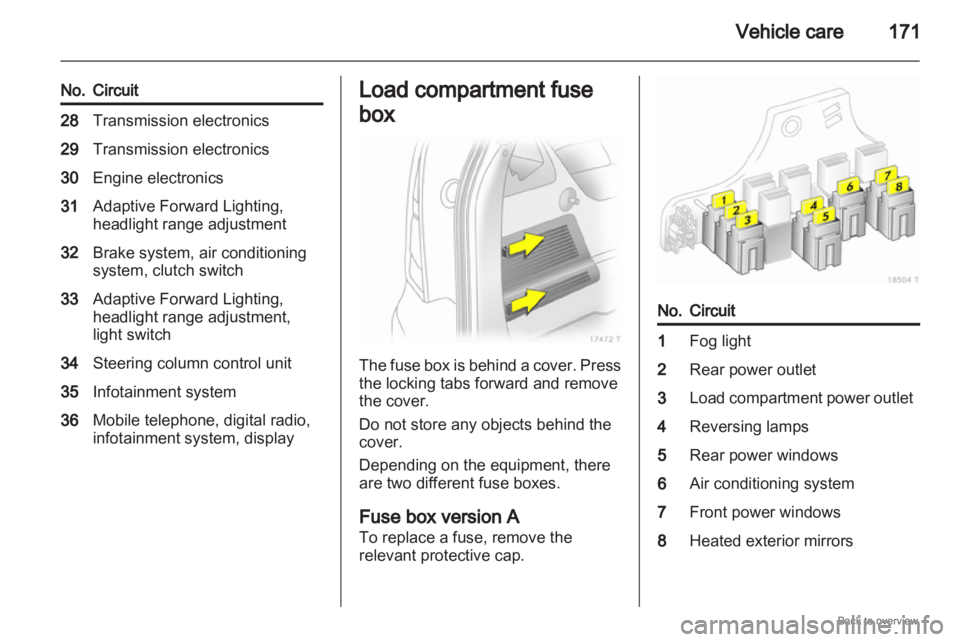
The fuse box is behind a cover. Press
the locking tabs forward and remove
the cover.
Do not store any objects behind the
cover.
Depending on the equipment, there
are two different fuse boxes.
Fuse box version A
To replace a fuse, remove the
relevant protective cap. No. Circuit
1
Fog light
2 Rear power outlet
3 Load compartment power outlet
4 Reversing lamps
5 Rear power windows
6 Air conditioning system
7 Front power windows
8 Heated exterior mirrors
Page 197 of 228
Service and maintenance
197Service operations by year
1)
km ( x 1000) 1) 1
30 2
60 3
90 4
120 5
150
Replace and drain fuel filter, diesel (grade EN 590) X X
Replace fuel filter, external, CNG (grade EN 228), Z 16 YNG Every 4 years / 60.000 km
Check and adjust parking brake (no weight on wheels); visually inspect wheel mounting
and suspension springs front and rear, brake lines, brake pressure hoses, fuel lines,
gas lines of CNG vehicles, level control and exhaust system X X
Check exterior of body/underbody corrosion protection and note any damage in the
Service Booklet X X X X X
+o
Visually inspect front and rear wheel brakes
2)
, if a tyre pressure monitoring system is
fitted, do not swap wheels over X X
Annual service check if annual mileage exceeds 20 000 km
Engine, transmission (AT, MT), inspect air-conditioning compressor for leaks
2) X X X X X
Visually inspect folding covers on steering, tie rods and axle drive X X X X X
Tie rod and supporting joint checking X X X X X
+ Change brake and clutch fluid automated manual transmission (MTA) Every 2 years
2)
In case of too high consumption / leakage, perform additional work with customer's agreement.
Page 202 of 228

202
Service and maintenanceService operations by year
3)
km ( x 1000) 1) 1
15 2
30 3
45 4
60 5
75
+o
Visually inspect front and rear wheel brakes
4)
, if a tyre pressure monitoring system is
fitted, do not swap wheels over X X
Annual service check if annual mileage exceeds 20 000 km
Engine, transmission (AT, MT), inspect air-conditioning compressor for leaks
4) X X X X X
Visually inspect folding covers on steering, tie rods and axle drive X X X X X
Tie rod and supporting joint checking X X X X X
+ Change brake and clutch fluid automated manual transmission (MTA) Every 2 years
Undo wheel fastening (take care if tyre pressure monitoring system is present) and
tighten to torque: 110 Nm.
The wheel bolt taper should be greased or oiled lightly during assembly.
Check tyre condition. Check/correct tyre pressure (including spare wheel)
With tyre repair system - check completeness and expiry date of kit. Replace sealant
bottle every 4 years. X X
+
Annual service check if annual mileage exceeds 20 000 km
Visually inspect first-aid kit, (presence in designated stowage compartment,
completeness and expiry date), lashing eyes and warning triangle Every 2 years
Check/correct headlamp adjustment (including auxiliary headlamps) X X
4)
In case of too high consumption / leakage, perform additional work with customer's agreement.
Page 205 of 228
Service and maintenance
205
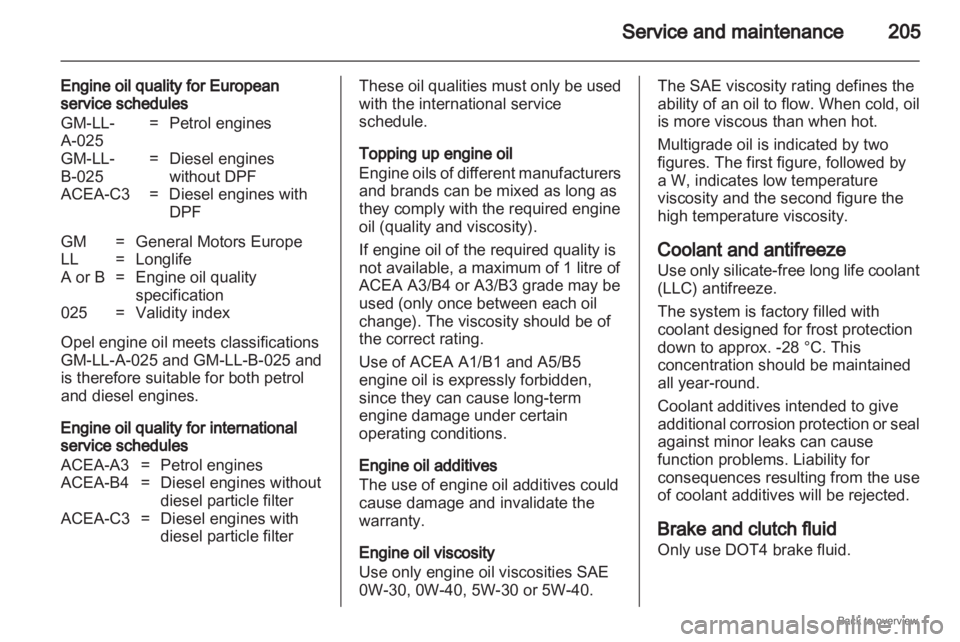
Engine oil quality for European
service schedules
GM-LL-
A-025 = Petrol engines
GM-LL-
B-025 = Diesel engines
without DPF
ACEA-C3 = Diesel engines with DPF
GM = General Motors Europe
LL = Longlife
A or B = Engine oil quality specification
025 = Validity index
Opel engine oil meets classifications
GM-LL-A-025 and GM-LL-B-025 and
is therefore suitable for both petrol
and diesel engines.
Engine oil quality for international
service schedules
ACEA-A3 = Petrol engines
ACEA-B4 = Diesel engines without diesel particle filter
ACEA-C3 = Diesel engines with diesel particle filter These oil qualities must only be used
with the international service
schedule.
Topping up engine oil
Engine
oils of different manufacturers
and brands can be mixed as long as
they comply with the required engine
oil (quality and viscosity).
If engine oil of the required quality is
not available, a maximum of 1 litre of
ACEA A3/B4 or A3/B3 grade may be
used (only once between each oil
change). The viscosity should be of
the correct rating.
Use of ACEA A1/B1 and A5/B5
engine oil is expressly forbidden,
since they can cause long-term
engine damage under certain
operating conditions.
Engine oil additives
The use of engine oil additives could
cause damage and invalidate the
warranty.
Engine oil viscosity
Use only engine oil viscosities SAE
0W-30, 0W-40, 5W-30 or 5W-40. The SAE viscosity rating defines the
ability of an oil to flow. When cold, oil
is more viscous than when hot.
Multigrade oil is indicated by two
figures. The first figure, followed by
a W, indicates low temperature
viscosity and the second figure the
high temperature viscosity.
Coolant and antifreeze
Use
only silicate-free long life coolant
(LLC) antifreeze.
The system is factory filled with
coolant designed for frost protection
down to approx. -28 °C. This
concentration should be maintained
all year-round.
Coolant additives intended to give
additional corrosion protection or seal
against minor leaks can cause
function problems. Liability for
consequences resulting from the use
of coolant additives will be rejected.
Brake and clutch fluid
Only use DOT4 brake fluid.
Page 224 of 228
224
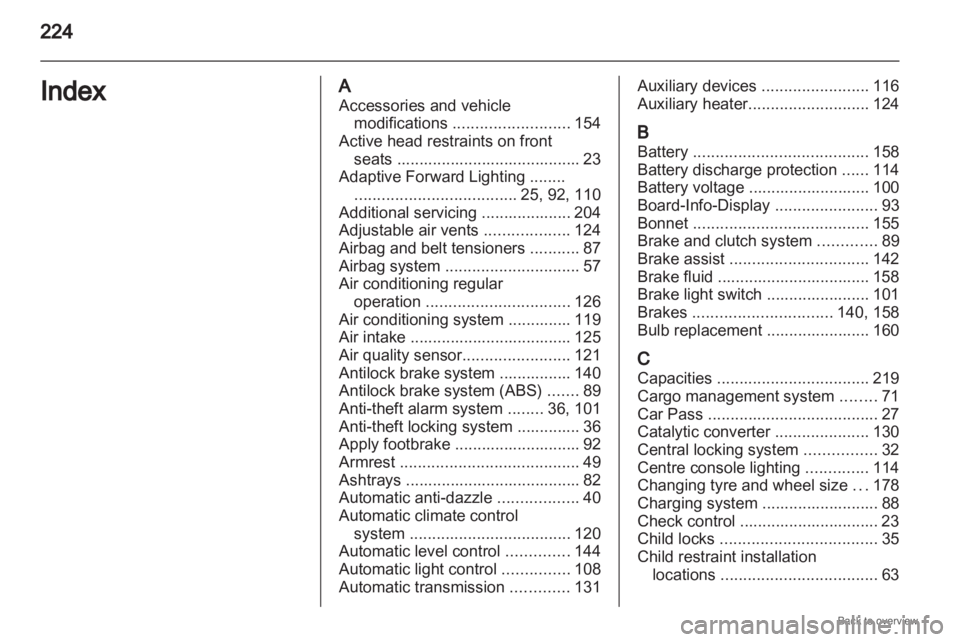
Index
A
Accessories and vehicle
modifications .......................... 154
Active head restraints on front seats .........................................
23
Adaptive Forward Lighting ........ .................................... 25, 92, 110
Additional servicing .................... 204
Adjustable air vents ...................124
Airbag and belt tensioners ...........87
Airbag system .............................. 57
Air conditioning regular operation ................................ 126
Air conditioning system .............. 119
Air intake .................................... 125
Air quality sensor ........................121
Antilock brake system ................ 140
Antilock brake system (ABS) ....... 89
Anti-theft alarm system ........ 36, 101
Anti-theft locking system .............. 36
Apply footbrake ............................ 92
Armrest ........................................ 49
Ashtrays ....................................... 82
Automatic anti-dazzle ..................40
Automatic climate control system .................................... 120
Automatic level control ..............144
Automatic light control ...............108
Automatic transmission .............131 Auxiliary devices
........................116
Auxiliary heater ........................... 124
B
Battery ....................................... 158
Battery discharge protection ......114
Battery voltage ...........................
100
Board-Info-Display .......................93
Bonnet ....................................... 155
Brake and clutch system ............. 89
Brake assist ............................... 142
Brake fluid .................................. 158
Brake light switch ....................... 101
Brakes ............................... 140, 158
Bulb replacement ....................... 160
C
Capacities .................................. 219
Cargo management system ........71
Car Pass ...................................... 27
Catalytic converter .....................130
Central locking system ................32
Centre console lighting ..............114
Changing tyre and wheel size ...178
Charging system .......................... 88
Check control ............................... 23
Child locks ................................... 35
Child restraint installation locations ................................... 63