stop start OPEL ZAFIRA 2009 User Guide
[x] Cancel search | Manufacturer: OPEL, Model Year: 2009, Model line: ZAFIRA, Model: OPEL ZAFIRA 2009Pages: 228, PDF Size: 7.3 MB
Page 105 of 228
Instruments and controls
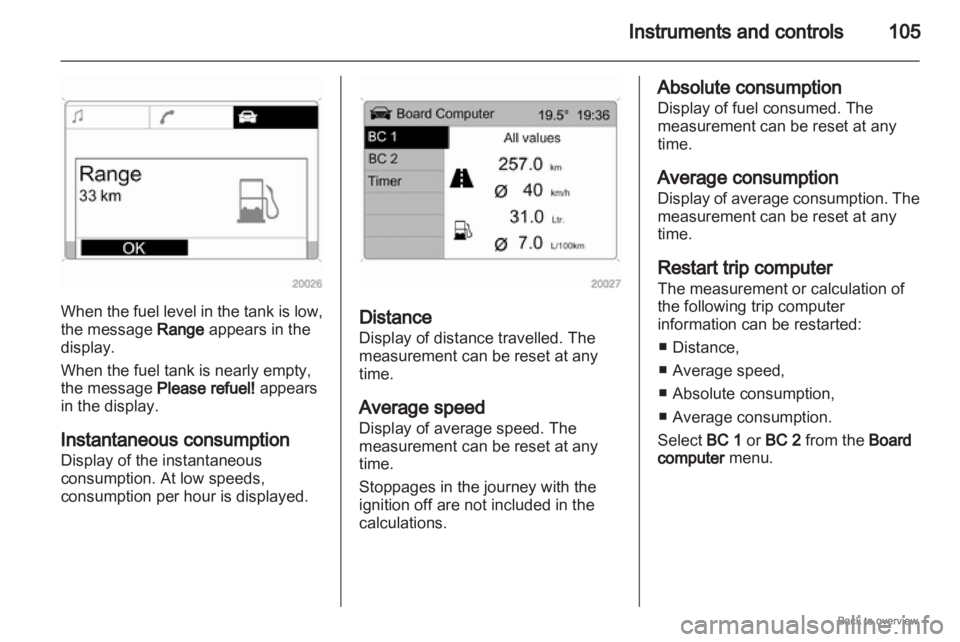
105When the fuel level in the tank is low,
the message Range appears in the
display.
When the fuel tank is nearly empty,
the message Please refuel! appears
in the display.
Instantaneous consumption
Display of the instantaneous
consumption. At low speeds,
consumption per hour is displayed.
Distance
Display of distance travelled. The
measurement can be reset at any
time.
Average speed
Display of average speed. The
measurement can be reset at any
time.
Stoppages in the journey with the
ignition off are not included in the
calculations. Absolute consumption
Display of fuel consumed. The
measurement can be reset at any
time.
Average consumption
Display
of average consumption. The
measurement can be reset at any
time.
Restart trip computer
The measurement or calculation of
the following trip computer
information can be restarted:
■ Distance,
■ Average speed,
■ Absolute consumption,
■ Average consumption.
Select BC 1 or BC 2 from the Board
computer menu.
Page 106 of 228
106
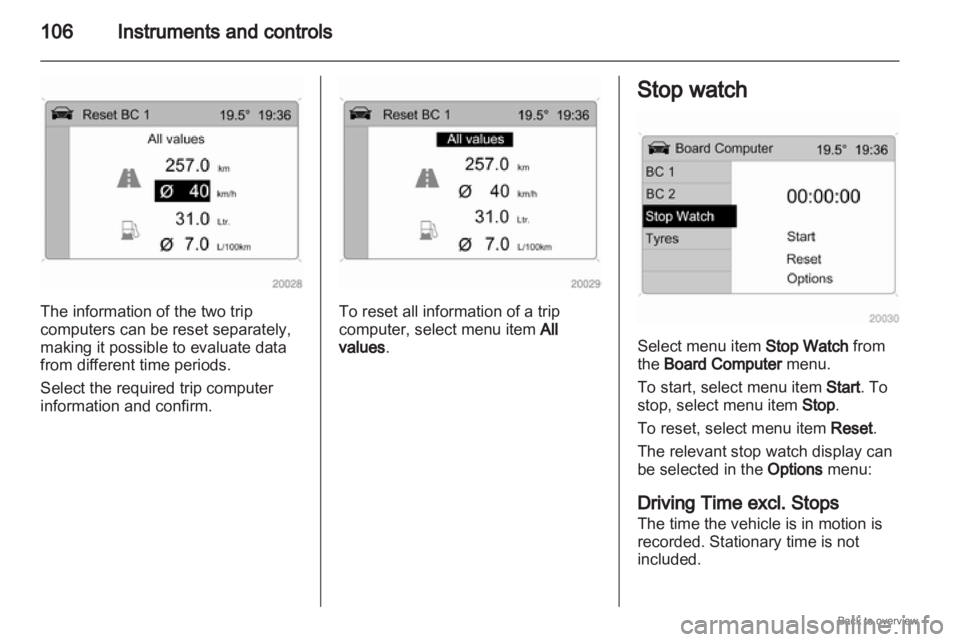
Instruments and controlsThe information of the two trip
computers can be reset separately,
making it possible to evaluate data
from different time periods.
Select the required trip computer
information and confirm. To reset all information of a trip
computer, select menu item
All
values. Stop watch
Select menu item Stop Watch from
the Board Computer menu.
To start, select menu item Start. To
stop, select menu item Stop.
To reset, select menu item Reset.
The relevant stop watch display can
be selected in the
Options menu:
Driving Time excl. Stops
The time the vehicle is in motion is
recorded. Stationary time is not
included.
Page 107 of 228
Instruments and controls
107
Driving Time incl Stops
The time the vehicle is in motion is
recorded. The time the vehicle is
stationary with the ignition switched
on is included.
Travel Time
Measurement of the time from
manual
activation via Start to manual
deactivation via Reset.
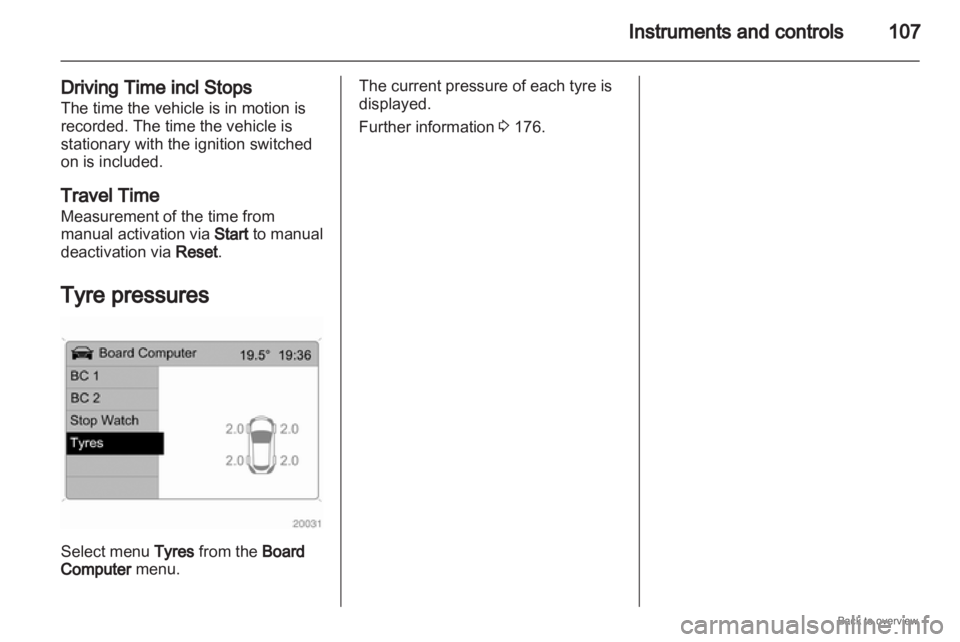
Tyre pressures Select menu Tyres from the Board
Computer menu. The current pressure of each tyre is
displayed.
Further information
3 176.
Page 128 of 228
128
Driving and operating
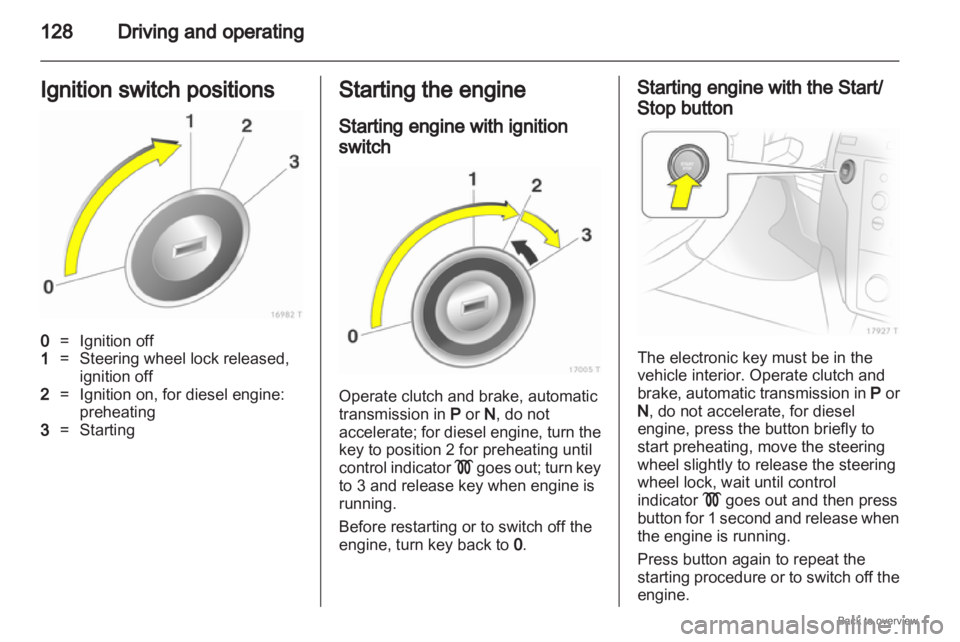
Ignition switch positions 0
= Ignition off
1 = Steering wheel lock released,
ignition off
2 = Ignition on, for diesel engine:
preheating
3 = Starting Starting the engine
Starting engine with ignition
switch
Operate clutch and brake, automatic
transmission in
P or N, do not
accelerate;
for diesel engine, turn the
key to position 2 for preheating until
control indicator ! goes out; turn key
to 3 and release key when engine is
running.
Before restarting or to switch off the
engine, turn key back to 0. Starting engine with the Start/
Stop button
The electronic key must be in the
vehicle interior. Operate clutch and
brake,
automatic transmission in P or
N , do not accelerate, for diesel
engine, press the button briefly to
start preheating, move the steering
wheel slightly to release the steering
wheel lock, wait until control
indicator ! goes out and then press
button for 1 second and release when
the engine is running.
Press button again to repeat the
starting procedure or to switch off the
engine.
Page 130 of 228

130
Driving and operating
consumption may be higher during
this period. The emission of smells
and smoke during this process is
normal. Under certain driving conditions, e.g.
short distances, the system cannot
clean itself automatically.
If the filter requires cleaning and
previous driving conditions did not
enable automatic cleaning, control
indicator
!
flashes. Continue driving,
keeping engine speed above 2000
revolutions per minute. Shift down if
necessary. Diesel particle filter
cleaning is then started. Stopping the journey or switching off
the engine during cleaning is not
recommended. Cleaning takes place
quickest at high engine speeds and
loads. The control indicator ! extinguishes
as soon as the self-cleaning
operation is complete.
Catalytic converter
The catalytic converter reduces the
amount of harmful substances in the
exhaust gas.
Caution
Fuel grades other than those listed
on pages
3 146, 3 209 could
damage the catalytic converter or
electronic components.
Unburnt petrol will overheat and
damage the catalytic converter.
Therefore avoid excessive use of
the starter, running the fuel tank
dry and starting the engine by
pushing or towing. In the event of misfiring, uneven
engine
running, a reduction in engine
performance or other unusual
problems, have the cause of the fault
rectified by a workshop as soon as
possible. In an emergency, driving
Page 134 of 228

134
Driving and operating
No automatic shifting to a higher gear
takes place at high engine revs.
For reasons of safety, kickdown is
also available in manual mode
3 134.
Electronic driving
programmes ■ Following
a cold start, the operating
temperature programme increases
engine speed to quickly bring the
catalytic converter to the required
temperature.
■ The automatic neutral shift function automatically shifts to idling when
the vehicle is stopped with
a forward gear engaged.
■ When Sport mode is engaged, the vehicle shifts at higher engine
speeds (unless cruise control is
on). Sport mode 3 143. Winter programme T
Activate the Winter programme to
assist starting off on a slippery road
surface.
Activation
on vehicles without manual
mode
Press the T button with P, R, N , D or
3 engaged. The vehicle starts off in
3rd gear. Activation on vehicles with manual
mode
In automatic mode, press the T
button. Depending on road
conditions, the vehicles starts off in
2nd or 3rd gear.
Deactivation
The
Winter programme is switched off
by:
■ pressing the T button again,
■ manually selecting 2 or 1 ,
■ changing to manual mode,
■ turning off the ignition,
■ or if the transmission oil temperature is too high.
Page 137 of 228
Driving and operating
137
If the Winter programme is activated,
T is illuminated.
Starting the engine
Depress the foot brake when starting
the engine. If the foot brake is not
depressed, j illuminates in the
instrument, "N" flashes in the
transmission display and the engine
cannot be started.
Starting is not possible if all brake
lights fail.
When
the foot brake is depressed, the
transmission automatically shifts to
N upon start. There may be a slight
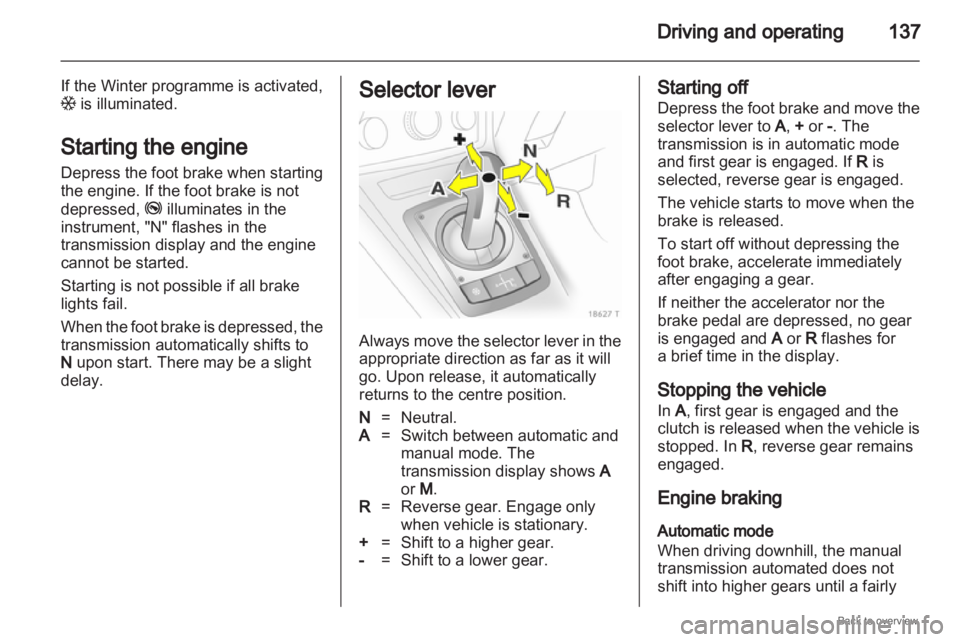
delay. Selector lever
Always move the selector lever in the
appropriate direction as far as it will
go. Upon release, it automatically
returns to the centre position.
N
= Neutral.
A = Switch between automatic and
manual mode. The
transmission display shows A
or M.
R = Reverse gear. Engage only
when vehicle is stationary.
+ = Shift to a higher gear.
- = Shift to a lower gear. Starting off
Depress
the foot brake and move the
selector lever to A, + or -. The
transmission is in automatic mode
and first gear is engaged. If R is
selected, reverse gear is engaged.
The vehicle starts to move when the
brake is released.
To start off without depressing the
foot brake, accelerate immediately
after engaging a gear.
If neither the accelerator nor the
brake pedal are depressed, no gear
is engaged and A or R flashes for
a brief time in the display.
Stopping the vehicle
In A, first gear is engaged and the
clutch is released when the vehicle is
stopped. In R , reverse gear remains
engaged.
Engine braking
Automatic mode
When driving downhill, the manual
transmission automated does not
shift into higher gears until a fairly
Page 187 of 228
Vehicle care
187
Towing
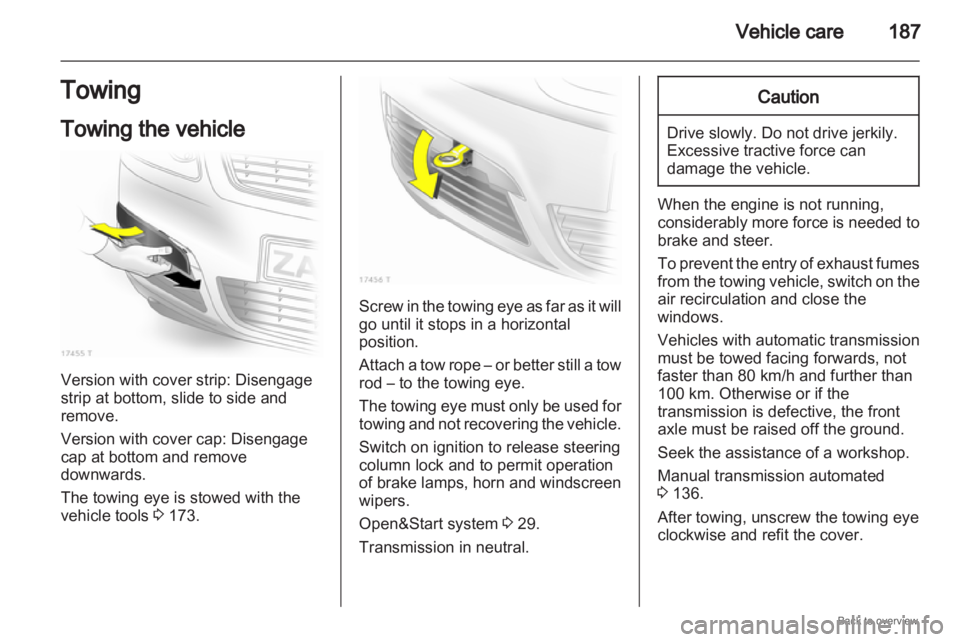
Towing the vehicle Version with cover strip: Disengage
strip at bottom, slide to side and
remove.
Version with cover cap: Disengage
cap at bottom and remove
downwards.
The towing eye is stowed with the
vehicle tools
3 173. Screw in the towing eye as far as it will
go until it stops in a horizontal
position.
Attach
a tow rope – or better still a tow
rod – to the towing eye.
The towing eye must only be used for
towing and not recovering the vehicle.
Switch on ignition to release steering
column lock and to permit operation
of brake lamps, horn and windscreen
wipers.
Open&Start system 3 29.
Transmission in neutral. Caution
Drive slowly. Do not drive jerkily.
Excessive tractive force can
damage the vehicle.
When the engine is not running,
considerably
more force is needed to
brake and steer.
To prevent the entry of exhaust fumes
from the towing vehicle, switch on the
air recirculation and close the
windows.
Vehicles with automatic transmission
must be towed facing forwards, not
faster than 80 km/h and further than
100 km. Otherwise or if the
transmission is defective, the front
axle must be raised off the ground.
Seek the assistance of a workshop.
Manual transmission automated
3 136.
After towing, unscrew the towing eye
clockwise and refit the cover.
Page 204 of 228
204
Service and maintenance
Additional servicing
Additional operations +
Additional operations are not required
every service but can be performed in
conjunction with a regular service.
Time allowances for such work are
not included in the scope of regular
services and will be charged for
additionally. It is more economic if
these operations are performed as
part of a scheduled service than
having them performed separately.
Extreme operating conditions o
Extreme operating conditions are
given when at least one of the
following occurs frequently:
■ cold starts,
■ stop and go,
■ trailer towing,
■ gradients and/or high altitudes,
■ poor road surfaces,
■ sand and dust,
■ extreme temperature fluctuations. Police vehicles, taxis and driving
school vehicles are also classified as
operating under extreme conditions.
Under extreme operating conditions,
it may be necessary to have certain
scheduled service work done more
frequently than the scheduled
intervals.
Seek technical advice on the
servicing
requirements dependent on
the specific operating conditions. Recommended fluids,
lubricants and parts
Recommended fluids and
lubricants
Only use products that have been
tested and approved. Damage
resulting from the use of non-
approved materials will not be
covered by the warranty.
9
Warning Operating materials are
hazardous and could be
poisonous. Handle with care. Pay
attention to information given on
the containers.
Engine oil
Engine oil is identified by its quality
and also its viscosity. Quality is more
important than viscosity when
selecting which engine oil to use.
Page 227 of 228

227
Rear seat audio system .......24, 116
Rear window wiper/washer .......... 79
Recommended fluids and lubricants ................................ 204
Refuelling ................................... 147
Reversing lights .........................112
Roof panelling .............................. 68
Roof rack ..................................... 74
Run-flat tyres ............................. 174
S
Safety net .................................... 72
Seat adjustment ....................... 7, 46
Seat belt ........................................ 8
Seat belt reminder .......................87
Seat belts ..................................... 54
Seat folding .................................. 48
Seat occupancy recognition ..61, 87
Seat position ................................ 46
Seats in second row ....................20
Seats in third row ......................... 21
Second row seats ........................49
Selector lever ..................... 132, 137
Service ............................... 126, 192
Service display ............................ 85
Service information ....................192
Service schedules ......................194
Service vehicle soon .................... 88
Side airbag system ......................59
Side turn signal lights ................165 Spare wheel ............................... 183
Speedometer
............................... 83
Sport mode .................... 24, 89, 143
Starting off ................................... 17
Starting the engine ............128, 137
Steering wheel adjustment ......9, 77
Steering wheel controls ...............77
Stop watch ................................. 106
Sunglasses storage .....................68
Sunvisor lights ........................... 114
Sun visors .................................... 43
Symbols ......................................... 4
T
Tachometer ................................. 83
Tail lights ................................... 164
Third row seats ............................ 51
Three-point seat belt ....................
55
Tools .......................................... 173
Top-tether child restraint systems .................................... 65
Towing another vehicle .............188
Towing equipment .....................150
Towing hitch installation dimensions ............................. 223
Towing the vehicle .....................187
Trailer stability assist .................153
Trailer towing ............................. 150
Transmission ............................... 16
Transmission display .........131, 136 Tread depth ...............................
177
Trip computer .............................. 23
Trip computer in Board-Info- Display ................................... 102
Trip computer in Graphic-Info- Display or Colour-Info-
Display ................................... 104
Triple-Info-Display .......................93
Trip odometer .............................. 83
Turn and lane-change signals ...111
Turn signal ................................... 87
Tyre chains ................................ 178
Tyre deflation detection system. .......................................... 25, 177
Tyre designations ......................175
Tyre pressure .................... 101, 175
Tyre pressure monitoring system .............................. 25, 176
Tyre pressures ...................
107, 220
Tyre repair kit ............................. 179
Tyres .......................................... 174
U
Ultrasonic parking assist .............. 89
Underseat storage .......................68
Using this manual .......................... 3
V
Vehicle dimensions .................... 218
Vehicle Identification Number ....207