warning OPEL ZAFIRA 2009 User Guide
[x] Cancel search | Manufacturer: OPEL, Model Year: 2009, Model line: ZAFIRA, Model: OPEL ZAFIRA 2009Pages: 228, PDF Size: 7.3 MB
Page 38 of 228
38
Keys, doors and windows
After the first 10 seconds of anti-theft
alarm system activation:
LED flashes
slowly = System active,
LED comes
on for approx.
1 second = Switch off function.
Seek the assistance of a workshop in
the event of faults.
Alarm
When triggered, the alarm gives off
an
acoustic signal (horn) and a visual
signal (hazard warning flashers). The
number and duration of which are
stipulated by legislation.
The alarm can be silenced by
pressing a button of the radio remote
control or by switching on the ignition.
The anti-theft alarm system is
deactivated at the same time. Immobiliser
The system checks whether the
vehicle
is allowed to start with the key
being used. If the transponder in the
key is recognised, the vehicle can be
started.
The electronic immobiliser activates
itself automatically after the key has
been removed from the ignition
switch or when the engine is switched
off by pressing the Start/Stop button.
If the control indicator A flashes
when the ignition is on, there is a fault
in the system; the engine cannot be
started. Switch off the ignition and
then repeat the start attempt.
If the control indicator continues
flashing, attempt to start the engine
using the spare key and seek the
assistance of a workshop.
If control indicator illuminates after
the engine has started, there is a fault
in the engine electronics or
transmission electronics 3 88,
3 135, 3 139, or there is water in the
diesel fuel filter 3 101. Note
The immobiliser does not lock the
doors. You should always lock the
vehicle
after leaving it and switch on
the anti-theft alarm system 3 32,
3 36.
Page 41 of 228
Keys, doors and windows
41
Windows
Manual windows
The door windows can be opened or
closed with the window winders.
Power windows 9
Warning Take care when operating the
power windows. Risk of injury,
particularly to children.
If there are children on the rear
seat, switch on the child safety
system for the electric windows.
Keep a close watch on the
windows when closing them.
Ensure that nothing becomes
trapped in them as they move. Power windows can be operated
■ with ignition on,
■ within 5 minutes of switching ignition off,
■ within 5 minutes of switching ignition key to position 1.
After switching off the ignition, the
standby feature ceases when the
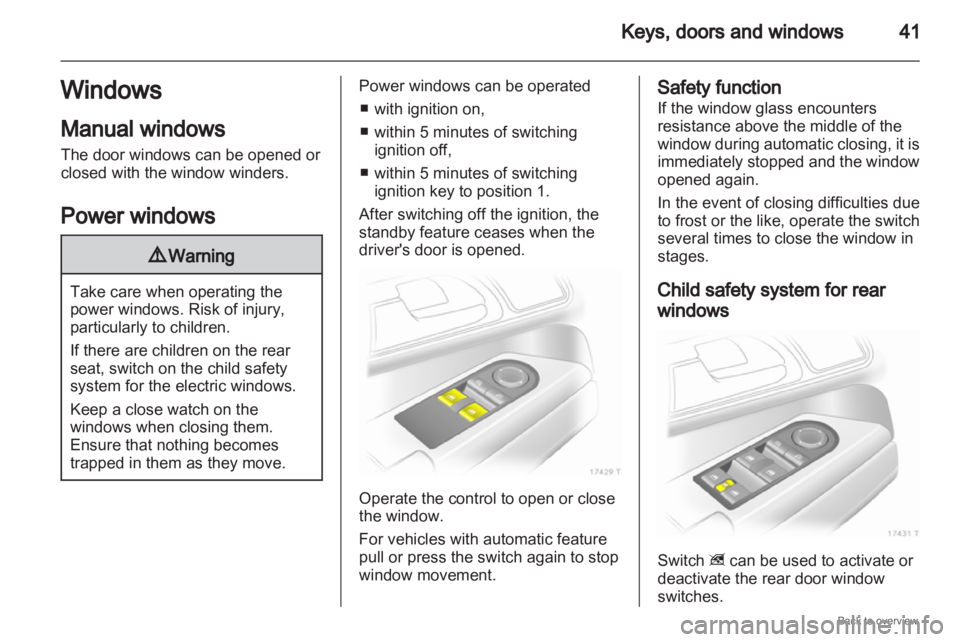
driver's door is opened. Operate the control to open or close
the window.
For vehicles with automatic feature
pull or press the switch again to stop
window movement. Safety function
If the window glass encounters
resistance above the middle of the
window
during automatic closing, it is
immediately stopped and the window
opened again.
In the event of closing difficulties due
to frost or the like, operate the switch
several times to close the window in
stages.
Child safety system for rear
windows Switch z can be used to activate or
deactivate the rear door window
switches.
Page 44 of 228

44
Seats, restraints
Seats, restraints
Head restraints ............................ 44
Front seats ................................... 46
Rear seats ................................... 49
Seat belts ..................................... 54
Airbag system .............................. 57
Child restraints ............................. 62 Head restraints
Position
9
Warning Only drive with the head restraint
set to the proper position.
The middle of the head restraint
should be at eye level. If this is not
possible for extremely tall persons,
set to highest position, and set to
lowest position for small persons. Adjustment
Head restraints with release button
Press the button, adjust height and
engage.
Page 46 of 228

46
Seats, restraints
Front seats
Seat position 9
Warning Only drive with the seat correctly
adjusted.
■ Sit with your buttocks as far back
against the backrest as possible.
Adjust the distance between the
seat and the pedals so that your
legs are slightly angled when tromping the pedals. Slide the
passenger seat as far back as
possible.
■
Sit with your shoulders as far back against the backrest as possible.
Set the backrest rake so that you
can easily reach the steering wheel
with your arms slightly bent.
Maintain contact between your
shoulders and the backrest when
turning the steering wheel. Do not
angle the backrest too far back. We
recommend a maximum rake of
approx. 25 °.
■ Adjust the steering wheel 3 77.
■ Set seat height high enough to have a clear field of vision on all
sides and of all display instruments.
There should be at least one hand
of clearance between your head
and the headlining. Your thighs
should rest lightly on the seat
without pressing into it.
■ Adjust the head restraint 3 44.
■ Adjust the height of the seat belt 3 55. ■ Adjust the thigh support so that
there is a space about two fingers
wide between the edge of the seat
and the hollow of the knee.
■ Adjust
the lumbar support so that it
supports the natural shape of the
spine.
Seat adjustment 9
Warning Never adjust seats while driving as
they could move uncontrollably.
Seat positioning
Page 49 of 228
Seats, restraints
49
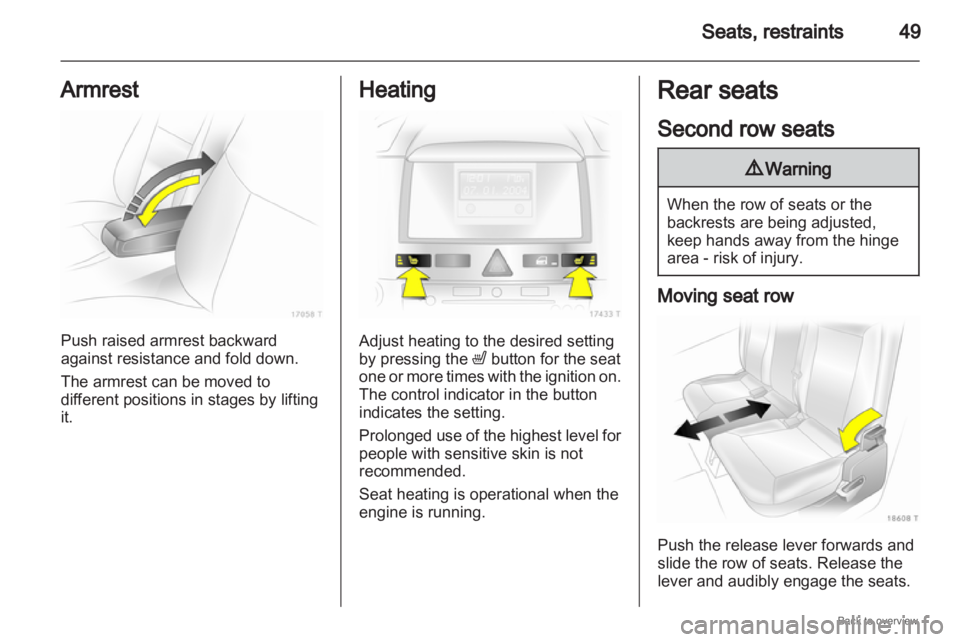
Armrest Push raised armrest backward
against resistance and fold down.
The armrest can be moved to
different positions in stages by lifting
it. Heating
Adjust heating to the desired setting
by pressing the
ß button for the seat
one
or more times with the ignition on.
The control indicator in the button
indicates the setting.
Prolonged use of the highest level for
people with sensitive skin is not
recommended.
Seat heating is operational when the
engine is running. Rear seats
Second row seats
9
Warning When the row of seats or the
backrests are being adjusted,
keep hands away from the hinge
area - risk of injury.
Moving seat row
Push the release lever forwards and
slide the row of seats. Release the
lever and audibly engage the seats.
Page 50 of 228

50
Seats, restraints
Lower seat row and slide
forwards
Remove the luggage compartment
cover as required 3 69.
Slide head restraints down 3 44.Place seat belt buckles in seat
pockets. Press release lever
1 down and
swivel the seat cushion upwards until
it engages.
Press down release lever 2 on both
sides, bring the backrest into the
upright position and engage.
Pull handle on back of centre
backrest, bring the backrest into the
upright position and engage.
Press release lever 3, slide the bench
to the frontmost position and engage.
To restore, press release lever 3 and
slide the bench to the required
position. Adjust the backrest and use release lever
1 to swivel the seat
cushion downwards. All positions
must audibly engage.
Adjust backrests of outboard
seats Press the release lever down, select
one of the two inclinations, release
the lever and engage the backrest.
9
Warning Occupants may only travel on
a seat if its backrest is properly
engaged in the rearward inclined
position.
Page 51 of 228

Seats, restraints
51
Folding down outboard
backrests of second row Remove the luggage compartment
cover as required
3 69.
Slide head restraints down 3 44.
Place seat belt buckles in seat
cushion pockets.
Press
the release lever down, set the
backrest to a vertical position or
angled forward or fold it to the seat
cushion and engage.
To move upright, push release lever
down and latch backrest in required
position. Folding down middle backrest in
second row
Slide the head restraint all the way
down 3 44.
Place seat belt buckles in seat
cushion pockets.
Pull the handle on the back, set the
backrest to a vertical position or fold
to the seat cushion and engage.
To
restore, pull the handle, straighten
and engage in required position. The centre seat backrest can be used
as
an armrest when folded down, and
contains drink holders and stowage
compartments.
Third row seats 9
Warning When the seats are being set up
or folded, keep hands away from
hinge area.
Page 52 of 228

52
Seats, restraints
Setting up seats Remove the floor covering and load
compartment cover 3 70.
Push the lever forward and slide the
second
seat row forward to the mark. Guide the seat belts through the belt
holders and insert the latch plates in
the holders.
9
Warning Before setting up, all components
must be removed from the side
rails and the seat belts hooked in
the
seat belt eyes in the floor of the
vehicle without twisting. From the luggage compartment, pull
up the seat by the handle.
Page 54 of 228
54
Seats, restraints
Seat belts The belts are locked during heavy
acceleration or deceleration of the
vehicle for the safety of the
occupants.
9
Warning Fasten seat belt before each trip.
In the event of an accident,
persons not wearing seat belts
endanger their fellow occupants
and themselves. Seat belt control indicator
X 3 87.
Seat belts are only designed for use
by
one person at a time. They are not
suitable for persons younger than 12
years of age or smaller than 150 cm.
Periodically check all parts of the belt
system for damage and proper
functionality.
Have damaged components
replaced. After an accident, have the
belts and triggered belt tensioners
replaced by a workshop.
Note
Make sure that the belts are not
damaged by shoes or sharp-edged
objects or trapped. Prevent dirt from
getting into the belt retractors.
Belt force limiters
In the front seats, stress on the body
is reduced by dampened release of
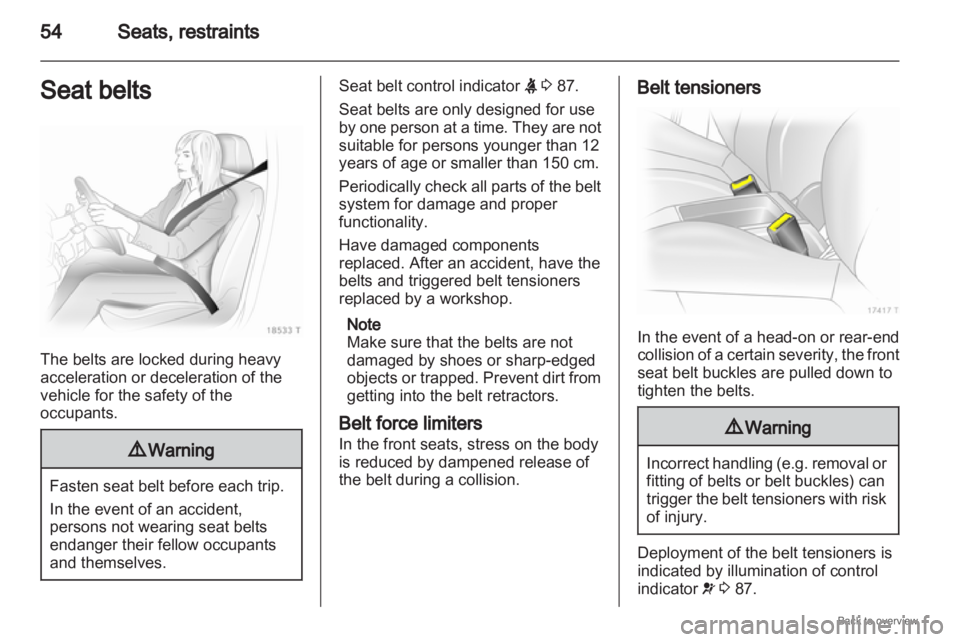
the belt during a collision. Belt tensioners
In the event of a head-on or rear-end
collision
of a certain severity, the front
seat belt buckles are pulled down to
tighten the belts. 9
Warning Incorrect handling (e.g. removal or
fitting of belts or belt buckles) can
trigger
the belt tensioners with risk
of injury. Deployment of the belt tensioners is
indicated by illumination of control
indicator
v 3 87.
Page 55 of 228

Seats, restraints
55
Triggered belt tensioners must be
replaced by a workshop. Belt
tensioners can only be triggered
once. Note
Do not affix or install accessories or
other objects that may interfere with
the operation of the belt tensioners.
Do not make any modifications to
belt tensioner components as this
will invalidate the vehicle type
approval.
Three-point seat belt
Fitting Withdraw belt from reel, guide it
untwisted across the body and
engage the latch plate in the buckle.
Tension the lap belt regularly whilst
driving by tugging the shoulder belt.
Loose or bulky clothing prevents the
belt from fitting snugly. Do not place
objects such as handbags or mobile
phones between the belt and your
body.
9
Warning The belt must not rest against hard
or fragile objects in the pockets of
your clothing. Height adjustment
1. Pull belt out slightly.
2.
Press button.
3. Adjust height and engage.
Adjust the height so that the belt lies
across the shoulder. It must not lie
across the throat or upper arm.
Do not adjust while driving.