warning OPEL ZAFIRA 2009 Service Manual
[x] Cancel search | Manufacturer: OPEL, Model Year: 2009, Model line: ZAFIRA, Model: OPEL ZAFIRA 2009Pages: 228, PDF Size: 7.3 MB
Page 141 of 228
Driving and operating
141
ABS starts to regulate brake pressure
as soon as a wheel shows a tendency
to lock. The vehicle remains
steerable, even during hard braking.
ABS control is made apparent though
a pulse in the brake pedal and the
noise of the regulation process.
For optimum braking, keep the brake
pedal fully depressed throughout the
braking process, despite the fact that
the pedal is pulsating. Do not reduce
the pressure on the pedal.
Control indicator u 3 89.
Adaptive brake lamp
During full braking, all three brake
lamps flash for the duration of ABS
control. Fault
9
Warning If there is a fault in the ABS, the
wheels may be liable to lock due
to braking that is heavier than
normal. The advantages of ABS
are no longer available. During
hard braking, the vehicle can no
longer be steered and may
swerve.
Have the cause of the fault remedied
by a workshop. Parking brake
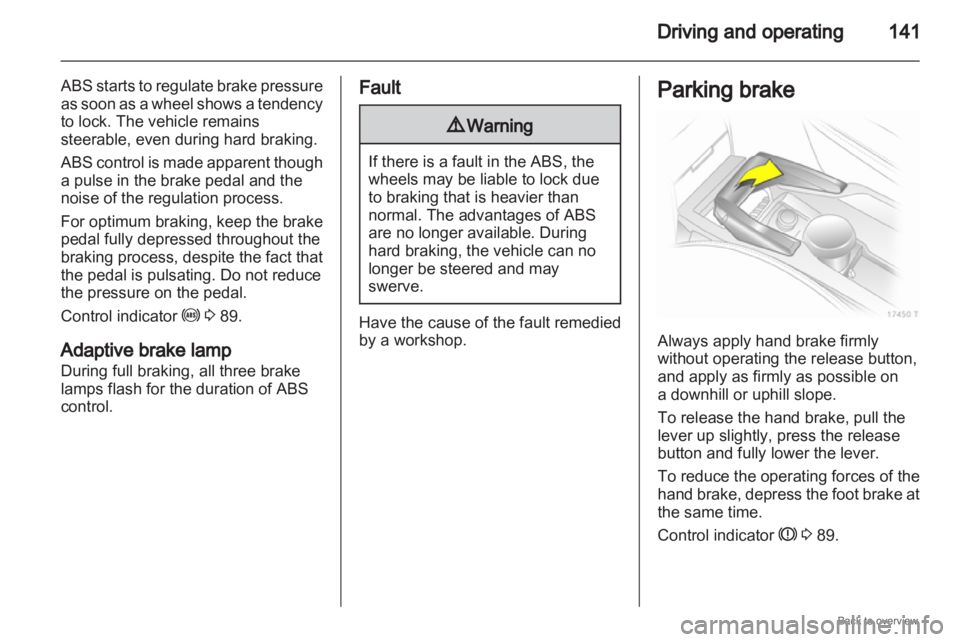
Always apply hand brake firmly
without operating the release button,
and apply as firmly as possible on
a downhill or uphill slope.
To release the hand brake, pull the
lever up slightly, press the release
button and fully lower the lever.
To
reduce the operating forces of the
hand brake, depress the foot brake at
the same time.
Control indicator R 3 89.
Page 142 of 228

142
Driving and operating
Brake assist
If the brake pedal is depressed
quickly and forcefully, maximum
brake force is automatically applied
(full braking).
Maintain steady pressure on the
brake
pedal for as long as full braking
is required. Maximum brake force is
automatically reduced when the
brake pedal is released.
Hill start assist
The system helps pull away on
inclines. After releasing the brake
pedal, if the hand brake is not applied
the brakes are released after a 2-
second delay. Ride control systems
Electronic stability
program
Electronic stability program
(ESP®
Plus
) improves driving stability
when necessary, regardless of the
type
of road surface or tyre grip. It also
prevents the drive wheels from
spinning.
As soon as the vehicle starts to
swerve (understeer/oversteer),
engine output is reduced and the
wheels are braked individually. This
considerably improves the driving
stability of the vehicle on slippery road
surfaces.
ESP® Plus
is operational as soon as
control indicator v extinguishes.
When ESP® Plus
comes into action v
flashes. 9
Warning Do not let this special safety
feature tempt you into taking risks
when driving.
Adapt speed to the road
conditions.
Control indicator
v 3 89.
Deactivation ESP®
Plus
can be deactivated when
Sport mode is engaged for high-
performance driving:
Page 143 of 228

Driving and operating
143
Hold the SPORT button depressed
for about 4 seconds. Control indicator
v illuminates. ESPoff also appears in
the service display. 9
Warning Do not deactivate ESP®
Plus
if
a
run-flat tyre 3 has lost pressure.ESP®
Plus
is reactivated by pressing
the SPORT
button. ESPon appears in
the service display. ESP® Plus
is also
reactivated the next time the ignition
is switched on.
Sport mode 3 143.
Interactive driving system
Interactive driving system (IDS Plus
)
combines the electronic stability
program (ESP® Plus
) with the antilock
brake system (ABS) and continuous
damping control (CDC) to improve
driving dynamics and vehicle safety. Sport mode
Suspension and steering become
more direct and provide better
contact with the road surface. The
engine reacts more quickly to
accelerator pedal movements.
Automatic
gear changing is also more
responsive.
Control indicator IDSPlus
3 91.
Activation Press SPORT button.
Control indicator
1 3 89. Winter programme activation not
possible.
Deactivation
Briefly press the SPORT button.
Sport mode is deactivated the next
time the ignition is switched on or if
the Winter programme is activated.
Continuous damping
control
Continuous damping control (CDC)
changes suspension with damping
adaptation
of each shock absorber to
the current driving situation and road
conditions.
When Sport mode is engaged, the
damping control is adapted to
a sportier driving style.
Control indicator IDS+ 3 91.
Page 146 of 228
146
Driving and operating
The system can also be activated at
low speed by pressing the r button.
An obstacle is indicated by buzzers.
The interval between the buzzers
becomes shorter as the vehicle gets
closer to the obstacle. When the
distance is less than 30 cm, the
buzzer is continuous. 9
Warning Under certain circumstances,
various reflective surfaces on
objects or clothing as well as
external
noise sources may cause
the system to fail to detect
obstacles. Deactivation
Deactivate the system by pressing
the r button.
The system automatically switches
itself off when the vehicle is driven
above a certain speed.
Towing equipment
The system automatically considers
a factory-fitted towing equipment. The rear parking sensors are
deactivated when towing.
Fuel
Fuel for petrol engines
Only
use unleaded fuel that complies
with DIN EN 228.
Fuels with ethanol content greater
than 5% may only be used if the
vehicle has been specifically
developed and approved for these
fuels.
Use fuel with the recommended
octane rating 3 209. Use of fuel with
too low an octane rating can reduce
engine power and torque and slightly
increases fuel consumption. Caution
Use of fuel with too low an octane
rating could lead to uncontrolled
combustion and engine damage.
Fuel for diesel engines
Only use diesel fuel that complies
with
DIN EN 590. The fuel must have
low sulphur content (max. 50 ppm).
Page 148 of 228
148
Driving and operating
The fuel filler cap can be retained in
the bracket on the fuel filler flap. Caution
Wipe off any overflowing fuel
immediately.
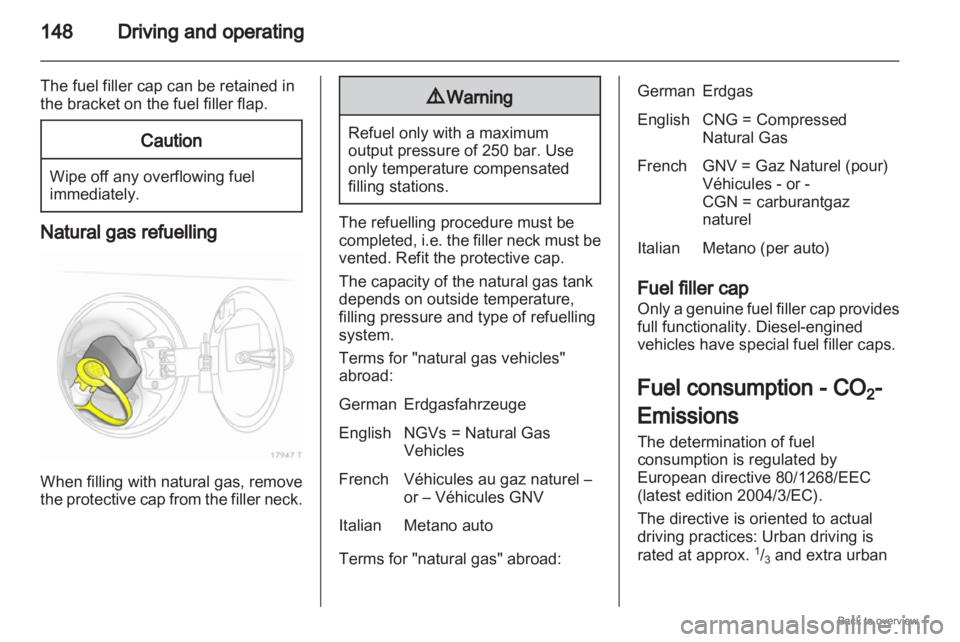
Natural gas refuelling
When filling with natural gas, remove
the
protective cap from the filler neck. 9
Warning Refuel only with a maximum
output pressure of 250 bar. Use
only temperature compensated
filling stations.
The refuelling procedure must be
completed,
i.e. the filler neck must be
vented. Refit the protective cap.
The capacity of the natural gas tank
depends on outside temperature,
filling pressure and type of refuelling
system.
Terms for "natural gas vehicles"
abroad:
German Erdgasfahrzeuge
English NGVs = Natural Gas Vehicles
French Véhicules au gaz naturel – or – Véhicules GNV
Italian Metano auto
Terms for "natural gas" abroad: German Erdgas
English CNG = Compressed
Natural Gas
French GNV = Gaz Naturel (pour) Véhicules - or -
CGN = carburantgaz
naturel
Italian Metano (per auto)
Fuel filler cap
Only
a genuine fuel filler cap provides
full functionality. Diesel-engined
vehicles have special fuel filler caps.
Fuel consumption - CO 2-
Emissions
The determination of fuel
consumption is regulated by
European directive 80/1268/EEC
(latest edition 2004/3/EC).
The directive is oriented to actual
driving practices: Urban driving is
rated at approx. 1
/3 and extra urban
Page 152 of 228
152
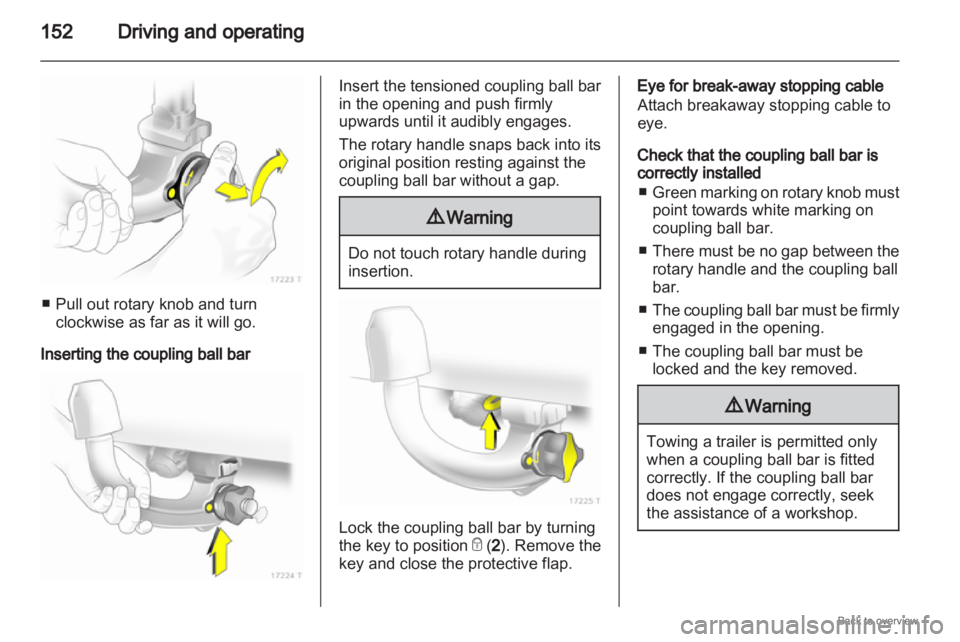
Driving and operating■ Pull out rotary knob and turn
clockwise as far as it will go.
Inserting the coupling ball bar Insert the tensioned coupling ball bar
in the opening and push firmly
upwards until it audibly engages.
The rotary handle snaps back into its
original position resting against the
coupling ball bar without a gap.
9
Warning Do not touch rotary handle during
insertion.
Lock the coupling ball bar by turning
the key to position
e (2). Remove the
key and close the protective flap. Eye for break-away stopping cable
Attach breakaway stopping cable to
eye.
Check that the coupling ball bar is
correctly installed
■ Green
marking on rotary knob must
point towards white marking on
coupling ball bar.
■ There must be no gap between the rotary handle and the coupling ball
bar.
■ The coupling ball bar must be firmly engaged in the opening.
■ The coupling ball bar must be locked and the key removed. 9
Warning Towing a trailer is permitted only
when a coupling ball bar is fitted
correctly. If the coupling ball bar
does not engage correctly, seek
the assistance of a workshop.
Page 155 of 228
Vehicle care
155
■ Check the engine oil level.
■ Check the coolant level.
■ Fit the number plate if necessary.
End-of-life vehicle
recovery
Information on end-of-life vehicle
recovery centres and the recycling of
end-of-life vehicles is available on our
website www.opel.com. Only entrust
this work to an authorised recycling
centre. Vehicle checks
Performing work
9
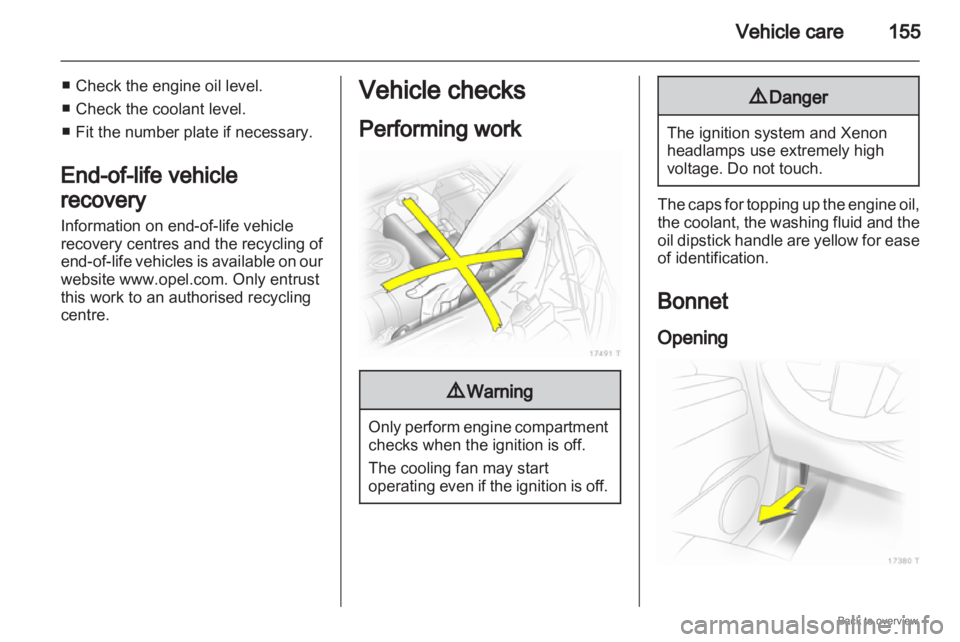
Warning Only perform engine compartment
checks when the ignition is off.
The cooling fan may start
operating
even if the ignition is off. 9
Danger The ignition system and Xenon
headlamps use extremely high
voltage. Do not touch.
The caps for topping up the engine oil,
the
coolant, the washing fluid and the
oil dipstick handle are yellow for ease
of identification.
Bonnet
Opening
Page 157 of 228
Vehicle care
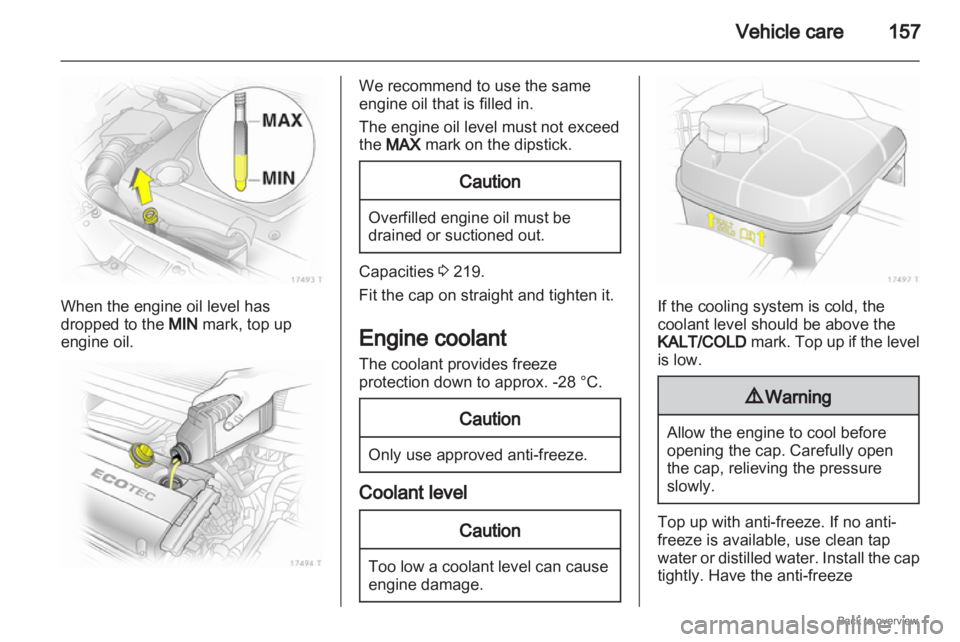
157When the engine oil level has
dropped to the
MIN mark, top up
engine oil. We recommend to use the same
engine oil that is filled in.
The engine oil level must not exceed
the MAX mark on the dipstick.
Caution
Overfilled engine oil must be
drained or suctioned out.
Capacities
3 219.
Fit the cap on straight and tighten it.
Engine coolant
The coolant provides freeze
protection down to approx. -28 °C. Caution
Only use approved anti-freeze.
Coolant level
Caution
Too low a coolant level can cause
engine damage. If the cooling system is cold, the
coolant level should be above the
KALT/COLD
mark. Top up if the level
is low. 9
Warning Allow the engine to cool before
opening the cap. Carefully open
the cap, relieving the pressure
slowly.
Top up with anti-freeze. If no anti-
freeze is available, use clean tap
water
or distilled water. Install the cap
tightly. Have the anti-freeze
Page 158 of 228
158
Vehicle care
concentration checked and have the
cause of the coolant loss remedied by
a workshop.
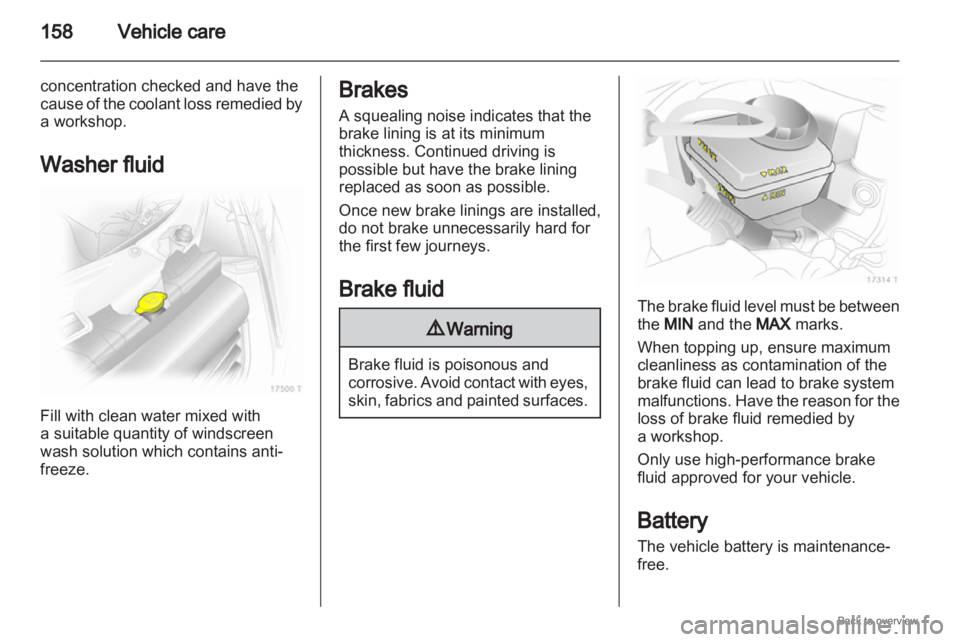
Washer fluid Fill with clean water mixed with
a suitable quantity of windscreen
wash solution which contains anti-
freeze. Brakes
A squealing noise indicates that the
brake lining is at its minimum
thickness. Continued driving is
possible but have the brake lining
replaced as soon as possible.
Once new brake linings are installed,
do not brake unnecessarily hard for
the first few journeys.
Brake fluid
9
Warning Brake fluid is poisonous and
corrosive.
Avoid contact with eyes,
skin, fabrics and painted surfaces. The brake fluid level must be between
the MIN and the MAX marks.
When topping up, ensure maximum
cleanliness as contamination of the
brake fluid can lead to brake system
malfunctions.
Have the reason for the
loss of brake fluid remedied by
a workshop.
Only use high-performance brake
fluid approved for your vehicle.
Battery
The vehicle battery is maintenance-
free.
Page 175 of 228
Vehicle care
175
Depending on tyre manufacturer, run-
flat tyres can be identified from
a marking on the tyre wall. E.g. ROF
= RunonFlat for Goodyear or SSR
= Self Supporting Runflat Tyre for
Continental.
Use of run-flat tyres is only permitted
in combination with factory approved
alloy wheels.
Do not use a tyre repair kit.
The ECO tyre pressure must not be
used.
Run-flat tyres must not be combined
with standard tyres.
If converting to standard tyres, note
that the vehicle is not equipped with
a spare wheel or tyre repair kit.
Driving with a damaged tyre
A
loss in tyre pressure is indicated by
the tyre pressure monitoring system
or the deflation detection system.
If a tyre has no pressure, continued
driving is possible
■ at a speed of max. 80 km/h
■ up to a distance of 80 km 9
Warning The vehicle will be more difficult to
steer and handle. Braking
distance will be longer.
Adapt driving style and speed to
the changed conditions.
Tyre designations
E.g. 195/65 R 15 91 H
195
=Tyre width, mm
65 =Cross-section ratio (tyre
height to tyre width), %
R = Belt type: Radial
RF =Type: RunFlat
15 =Wheel diameter, inches
91 =Load index e.g. 91 is
equivalent to 618 kg
H = Speed code letter
Speed code letter:
Q = up to 160 km/h
S = up to 180 km/h
T = up to 190 km/h
H = up to 210 km/h
V = up to 240 km/h
W = up to 270 km/h Tyre pressure
Check the pressure of cold tyres at
least every 14 days and before any
long journey. Do not forget the spare
wheel. This also applies to vehicles
with tyre pressure monitoring.
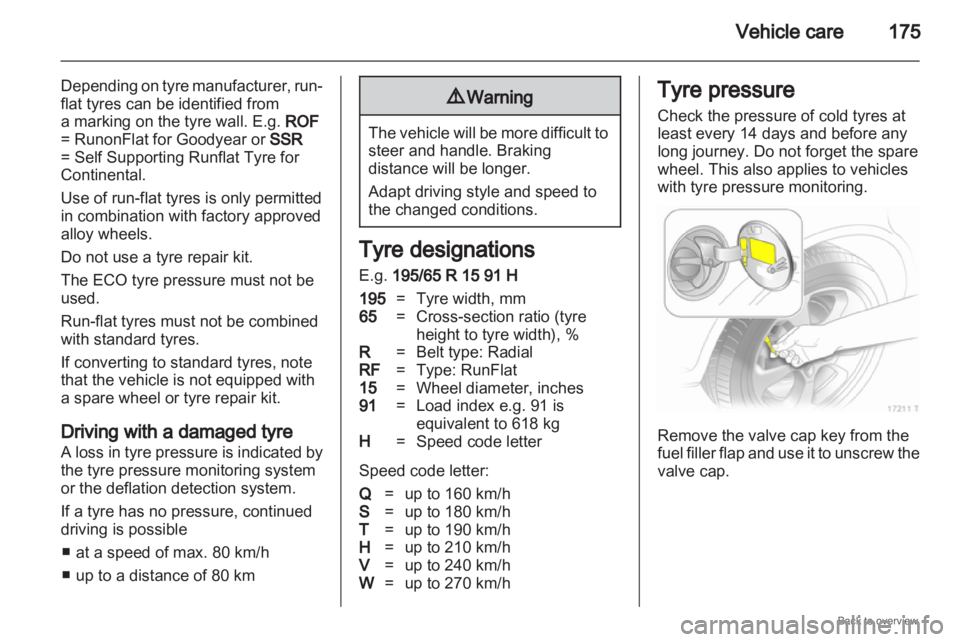
Remove the valve cap key from the
fuel
filler flap and use it to unscrew the
valve cap.