fuel type OPEL ZAFIRA 2009 Owners Manual
[x] Cancel search | Manufacturer: OPEL, Model Year: 2009, Model line: ZAFIRA, Model: OPEL ZAFIRA 2009Pages: 228, PDF Size: 7.3 MB
Page 26 of 228
26
In brief
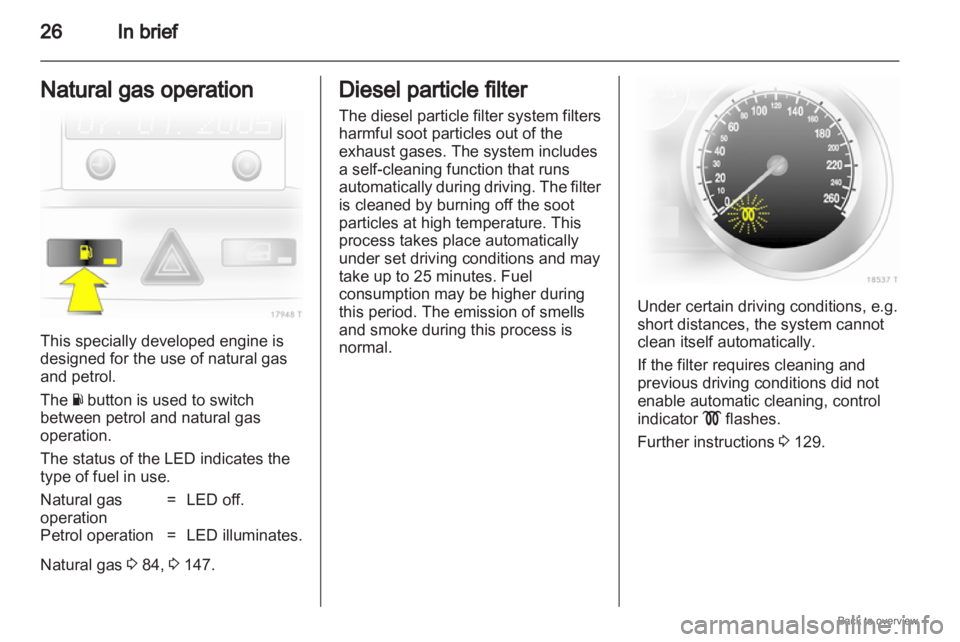
Natural gas operation This specially developed engine is
designed for the use of natural gas
and petrol.
The Y button is used to switch
between petrol and natural gas
operation.
The status of the LED indicates the
type of fuel in use.
Natural gas
operation
= LED off.
Petrol operation = LED illuminates.
Natural gas 3 84, 3 147. Diesel particle filter
The
diesel particle filter system filters
harmful soot particles out of the
exhaust gases. The system includes
a self-cleaning function that runs
automatically during driving. The filter
is cleaned by burning off the soot
particles at high temperature. This
process takes place automatically
under set driving conditions and may
take up to 25 minutes. Fuel
consumption may be higher during
this period. The emission of smells
and smoke during this process is
normal. Under certain driving conditions, e.g.
short distances, the system cannot
clean itself automatically.
If the filter requires cleaning and
previous driving conditions did not
enable automatic cleaning, control
indicator
! flashes.
Further instructions 3 129.
Page 32 of 228
32
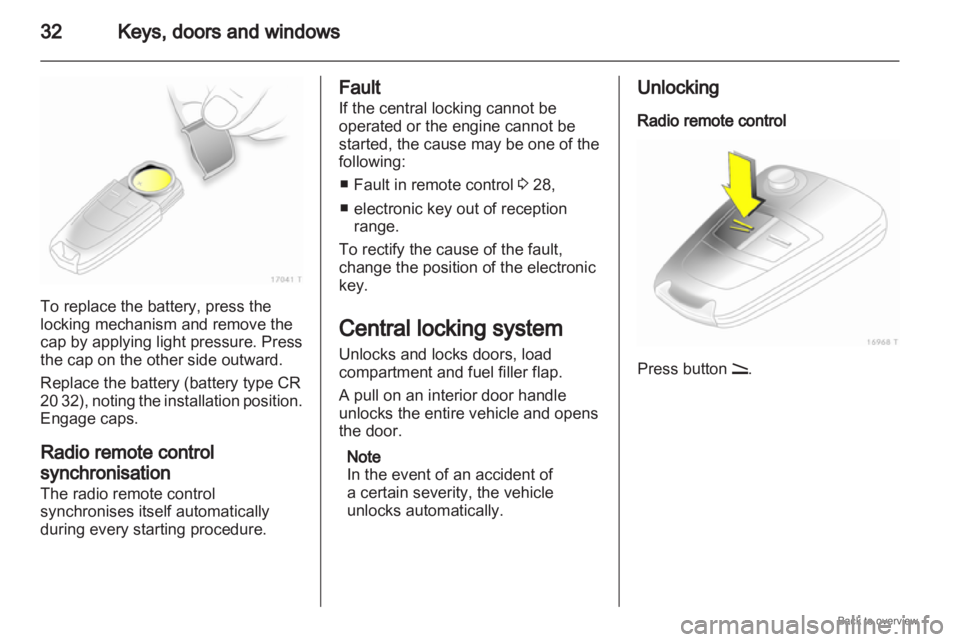
Keys, doors and windowsTo replace the battery, press the
locking mechanism and remove the
cap by applying light pressure. Press
the cap on the other side outward.
Replace the battery (battery type CR
20
32), noting the installation position.
Engage caps.
Radio remote control
synchronisation
The radio remote control
synchronises itself automatically
during every starting procedure. Fault
If the central locking cannot be
operated or the engine cannot be
started, the cause may be one of the
following:
■
Fault in remote control 3 28,
■ electronic key out of reception range.
To rectify the cause of the fault,
change the position of the electronic
key.
Central locking system
Unlocks and locks doors, load
compartment and fuel filler flap.
A pull on an interior door handle
unlocks the entire vehicle and opens
the door.
Note
In the event of an accident of
a certain severity, the vehicle
unlocks automatically. Unlocking
Radio remote control
Press button q.
Page 148 of 228
148
Driving and operating
The fuel filler cap can be retained in
the bracket on the fuel filler flap. Caution
Wipe off any overflowing fuel
immediately.
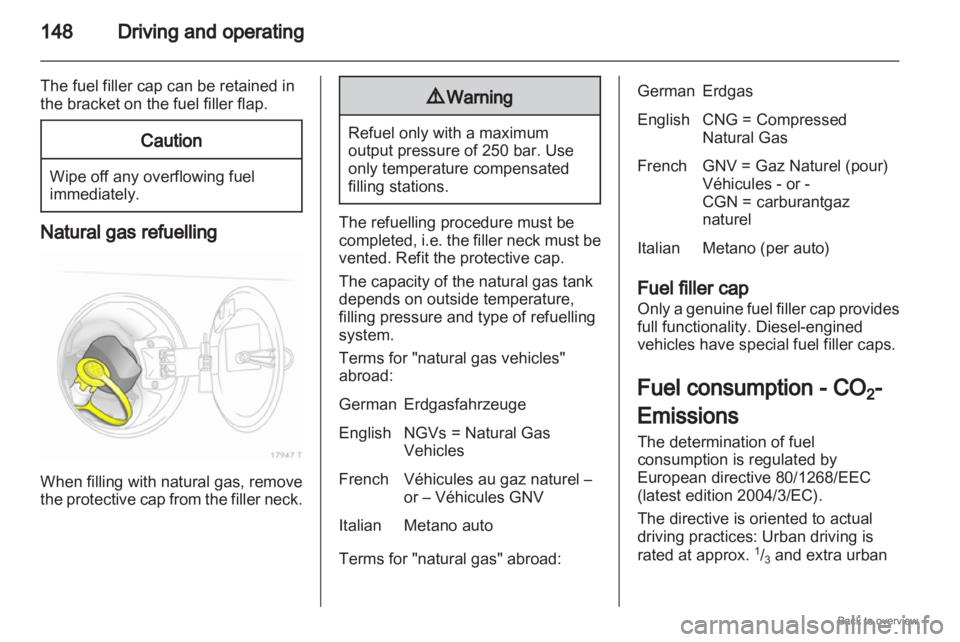
Natural gas refuelling
When filling with natural gas, remove
the
protective cap from the filler neck. 9
Warning Refuel only with a maximum
output pressure of 250 bar. Use
only temperature compensated
filling stations.
The refuelling procedure must be
completed,
i.e. the filler neck must be
vented. Refit the protective cap.
The capacity of the natural gas tank
depends on outside temperature,
filling pressure and type of refuelling
system.
Terms for "natural gas vehicles"
abroad:
German Erdgasfahrzeuge
English NGVs = Natural Gas Vehicles
French Véhicules au gaz naturel – or – Véhicules GNV
Italian Metano auto
Terms for "natural gas" abroad: German Erdgas
English CNG = Compressed
Natural Gas
French GNV = Gaz Naturel (pour) Véhicules - or -
CGN = carburantgaz
naturel
Italian Metano (per auto)
Fuel filler cap
Only
a genuine fuel filler cap provides
full functionality. Diesel-engined
vehicles have special fuel filler caps.
Fuel consumption - CO 2-
Emissions
The determination of fuel
consumption is regulated by
European directive 80/1268/EEC
(latest edition 2004/3/EC).
The directive is oriented to actual
driving practices: Urban driving is
rated at approx. 1
/3 and extra urban
Page 175 of 228
Vehicle care
175
Depending on tyre manufacturer, run-
flat tyres can be identified from
a marking on the tyre wall. E.g. ROF
= RunonFlat for Goodyear or SSR
= Self Supporting Runflat Tyre for
Continental.
Use of run-flat tyres is only permitted
in combination with factory approved
alloy wheels.
Do not use a tyre repair kit.
The ECO tyre pressure must not be
used.
Run-flat tyres must not be combined
with standard tyres.
If converting to standard tyres, note
that the vehicle is not equipped with
a spare wheel or tyre repair kit.
Driving with a damaged tyre
A
loss in tyre pressure is indicated by
the tyre pressure monitoring system
or the deflation detection system.
If a tyre has no pressure, continued
driving is possible
■ at a speed of max. 80 km/h
■ up to a distance of 80 km 9
Warning The vehicle will be more difficult to
steer and handle. Braking
distance will be longer.
Adapt driving style and speed to
the changed conditions.
Tyre designations
E.g. 195/65 R 15 91 H
195
=Tyre width, mm
65 =Cross-section ratio (tyre
height to tyre width), %
R = Belt type: Radial
RF =Type: RunFlat
15 =Wheel diameter, inches
91 =Load index e.g. 91 is
equivalent to 618 kg
H = Speed code letter
Speed code letter:
Q = up to 160 km/h
S = up to 180 km/h
T = up to 190 km/h
H = up to 210 km/h
V = up to 240 km/h
W = up to 270 km/h Tyre pressure
Check the pressure of cold tyres at
least every 14 days and before any
long journey. Do not forget the spare
wheel. This also applies to vehicles
with tyre pressure monitoring.
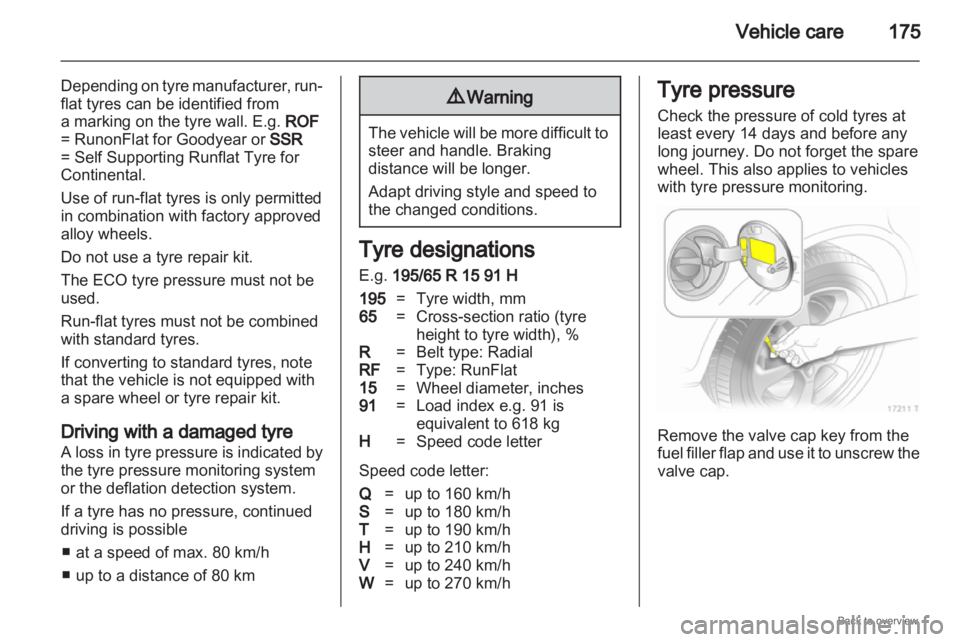
Remove the valve cap key from the
fuel
filler flap and use it to unscrew the
valve cap.
Page 209 of 228
![OPEL ZAFIRA 2009 Owners Manual Technical data
209
Vehicle data
Engine data
Sales designation 1.61.6 1.61.6 CNG
Engine identifier code Z 16 XEP Z 16 XER Z 16 XE1 Z 16 YNG
Number of cylinders 4 4 4 4
Piston displacement [cm
3
] 1598](/img/37/58241/w960_58241-208.png "OPEL ZAFIRA 2009 Owners Manual Technical data
209
Vehicle data
Engine data
Sales designation 1.61.6 1.61.6 CNG
Engine identifier code Z 16 XEP Z 16 XER Z 16 XE1 Z 16 YNG
Number of cylinders 4 4 4 4
Piston displacement [cm
3
] 1598")
Technical data
209
Vehicle data
Engine data
Sales designation 1.61.6 1.61.6 CNG
Engine identifier code Z 16 XEP Z 16 XER Z 16 XE1 Z 16 YNG
Number of cylinders 4 4 4 4
Piston displacement [cm
3
] 1598 1598 1598 1598
Brake horse power [kW/bhp]
7788 7769
at rpm 6000 6000 6000 6200
Torque [Nm]
150155 150133
at rpm 3900 4000 3900 4200
Fuel type Petrol Petrol Petrol Natural gas/petrol
Octane rating RON
recommended
9595 9595
possible 9898 9898
possible 91 91 91 –
Oil consumption [l/1000 km] 0.6 0.6 0.6 0.6
Page 210 of 228
![OPEL ZAFIRA 2009 Owners Manual 210
Technical data
Sales designation 1.82.0 Turbo 2.0 Turbo 2.2
Engine code Z 18 XER Z 20 LER Z 20 LEH Z 22 YH
Number of cylinders 4 4 4 4
Piston displacement [cm
3
] 1796 1998 1998 2198
Brake horse p](/img/37/58241/w960_58241-209.png "OPEL ZAFIRA 2009 Owners Manual 210
Technical data
Sales designation 1.82.0 Turbo 2.0 Turbo 2.2
Engine code Z 18 XER Z 20 LER Z 20 LEH Z 22 YH
Number of cylinders 4 4 4 4
Piston displacement [cm
3
] 1796 1998 1998 2198
Brake horse p")
210
Technical data
Sales designation 1.82.0 Turbo 2.0 Turbo 2.2
Engine code Z 18 XER Z 20 LER Z 20 LEH Z 22 YH
Number of cylinders 4 4 4 4
Piston displacement [cm
3
] 1796 1998 1998 2198
Brake horse power [kW/bhp]
103147177 110
at rpm 6300 5400 5600 5600
Torque [Nm]
175262320 215
at rpm 3800 4200 2400-5000 4000
Fuel type Petrol Petrol Petrol Petrol
Octane rating RON
recommended
959598 95
possible 989895 98
possible 91 91 91
1) –
Oil consumption [l/1000 km] 0.6 0.6 0.6 0.6
1)
Possible only if high engine load, full load or driving in mountainous terrain with a caravan/trailer or high payload is
avoided.
Page 211 of 228
![OPEL ZAFIRA 2009 Owners Manual Technical data
211
Sales designation 1.71.7 1.9 CDTI 1.9 CDTI 1.9 CDTI
Engine identifier code A 17 DTJ A 17 DTR Z 19 DTL Z 19 DT Z 19 DTH
Number of cylinders 4 4 4 4 4
Piston displacement [cm
3
] 1686](/img/37/58241/w960_58241-210.png "OPEL ZAFIRA 2009 Owners Manual Technical data
211
Sales designation 1.71.7 1.9 CDTI 1.9 CDTI 1.9 CDTI
Engine identifier code A 17 DTJ A 17 DTR Z 19 DTL Z 19 DT Z 19 DTH
Number of cylinders 4 4 4 4 4
Piston displacement [cm
3
] 1686")
Technical data
211
Sales designation 1.71.7 1.9 CDTI 1.9 CDTI 1.9 CDTI
Engine identifier code A 17 DTJ A 17 DTR Z 19 DTL Z 19 DT Z 19 DTH
Number of cylinders 4 4 4 4 4
Piston displacement [cm
3
] 1686 1686 1910 1910 1910
Brake horse power [kW/bhp]
8192 74 88110
at rpm 3800 4000 3500 3500 4000
Torque [Nm]
260 280260280320
at rpm 2300 2300 1700-2500 2000-2750 2000-2750
Fuel type Diesel Diesel Diesel Diesel Diesel
Oil consumption [l/1000 km] 0.6 0.6 0.6 0.6 0.6