trailer OPEL ZAFIRA 2009 Owners Manual
[x] Cancel search | Manufacturer: OPEL, Model Year: 2009, Model line: ZAFIRA, Model: OPEL ZAFIRA 2009Pages: 228, PDF Size: 7.3 MB
Page 87 of 228
Instruments and controls
87
Turn signal
O illuminates or flashes green.
Illuminated
The control indicator illuminates
briefly when the parking lamps are
switched on.
Flashes
The control indicator flashes if a turn
signal or the hazard warning flashers
are activated.
Fast flashing: failure of a direction
indicator lamp or associated fuse,
failure of direction indicator lamp on
trailer.
Bulb replacement 3 160. Fuses
3 167.
Turn signals 3 111.
Seat belt reminder
X illuminates or flashes red.
Illuminated
After the ignition is switched on until
the seat belt is fastened. Flashes
After starting off until the seat belt is
fastened.
Fastening the seat belt
3 55.
Airbag and belt tensioners
v illuminates red.
When the ignition is switched on, the
control indicator illuminates for about
4 seconds. If it does not illuminate,
does not go out after 4 seconds or
illuminates whilst driving, there is
a fault in the belt tensioner, the
airbags or the seat occupancy
recognition
system. The systems may
fail to trigger in the event of an
accident.
Deployment of the belt tensioners or
airbags is indicated by continuous
illumination of v. 9
Warning Have the cause of the fault
eliminated immediately by
a workshop. Airbag system, belt tensioners
3 57,
3 54.
Seat occupancy
recognition
y illuminates or flashes yellow.
Illuminated
If the vehicle is equipped with seat
occupancy
recognition, y illuminates
for about 4 seconds after the ignition
is switched on.
If a child restraint system with
transponders is detected, y remains
illuminated. Only then may a child
restraint system with transponders be
used on the front passenger seat as
the front passenger airbag systems
are deactivated 3 61.
Page 101 of 228
Instruments and controls
101
Brake light switch
Brake light does not come on during
braking. Have the cause of the fault
remedied immediately by
a workshop.
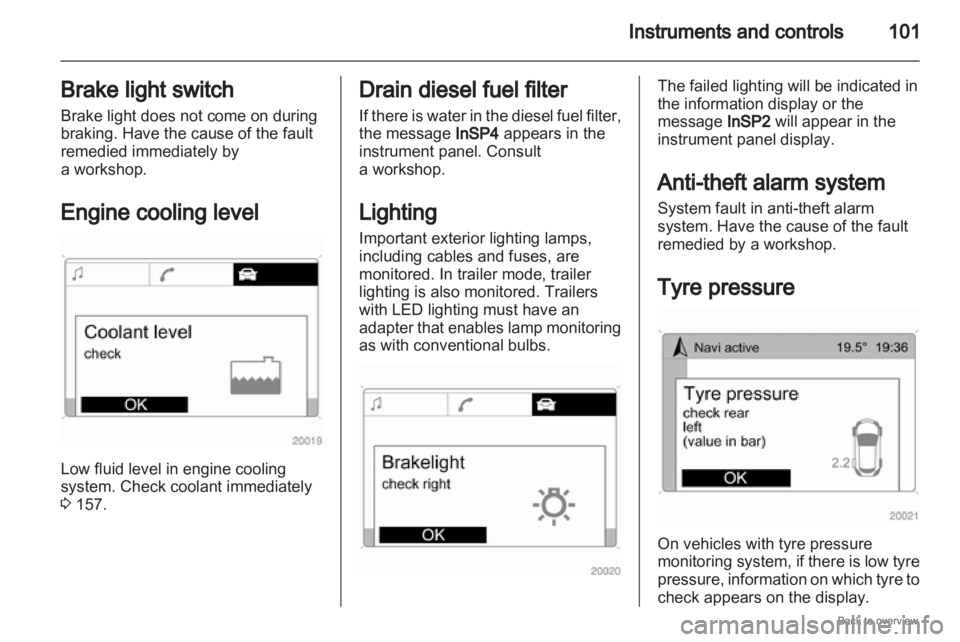
Engine cooling level Low fluid level in engine cooling
system. Check coolant immediately
3 157. Drain diesel fuel filter
If
there is water in the diesel fuel filter,
the message InSP4 appears in the
instrument panel. Consult
a workshop.
Lighting
Important exterior lighting lamps,
including cables and fuses, are
monitored. In trailer mode, trailer
lighting is also monitored. Trailers
with LED lighting must have an
adapter that enables lamp monitoring
as with conventional bulbs. The failed lighting will be indicated in
the information display or the
message InSP2 will appear in the
instrument panel display.
Anti-theft alarm system
System fault in anti-theft alarm
system. Have the cause of the fault
remedied by a workshop.
Tyre pressure On vehicles with tyre pressure
monitoring
system, if there is low tyre
pressure, information on which tyre to
check appears on the display.
Page 149 of 228
Driving and operating
149
driving with approx. 2
/3 . Cold starts
and acceleration phases are also
taken into consideration.
The specification of CO 2 emission is
also a constituent of the directive.
The figures given must not be taken
as a guarantee for the actual fuel
consumption of a particular vehicle.
Furthermore, fuel consumption is
dependent on personal driving style
as
well as road and traffic conditions.
All values are based on the EU base
model with standard equipment.
The calculation of fuel consumption
takes account of the vehicle’s kerb
weight, ascertained in accordance
with the regulations. Options may
result in slightly higher fuel
consumption and CO 2 emission
levels and a lower top speed.
Fuel consumption, CO 2 emissions
3 213. Natural gas
The fuel consumption information
was obtained using reference fuel
G20 (methane proportion 99 - 100
mol%) under prescribed driving
conditions. When using natural gas
with a lower proportion of methane,
the fuel consumption can differ from
the specified values.
Towing
General information
Only use towing equipment that has
been approved for your vehicle.
Entrust retrofitting of towing
equipment to a workshop. It may be
necessary to make changes that
affect the cooling system, heat
shields or other equipment.
Installation dimensions of factory-
fitted towing equipment
3 223.
Driving characteristics and
towing tips
Before attaching a trailer, lubricate
the
coupling ball. However, do not do
so if a stabiliser, which acts on the
coupling ball, is being used to reduce
snaking movements.
For trailers with low driving stability
and trailers with a permitted gross
vehicle weight of more than 1300 kg
a speed of 80 km/h must not be
exceeded; the use of a stabiliser is
recommended.
Page 150 of 228
150
Driving and operating
If the trailer starts snaking, drive more
slowly, do not attempt to correct the
steering and brake sharply if
necessary.
When driving downhill, drive in the
same gear as if driving uphill and
drive at a similar speed.
Adjust tyre pressure to the value
specified for full load 3 220.
Trailer towing
Trailer loads
The permissible trailer loads are
vehicle and engine-dependent
maximum values which must not be
exceeded. The actual trailer load is
the difference between the actual
gross weight of the trailer and the
actual coupling socket load with the
trailer coupled.
The permissible trailer loads are
specified
in the vehicle documents. In
general, they are valid for gradients
up to max. 12 % The permitted trailer load applies up
to the specified incline and up to an
altitude of 1000 metres above sea
level. Since engine power decreases
as altitude increases because of the
air becoming thinner, therefore
reducing climbing ability, the
permissible gross train weight also
decreases by 10 % for every 1000
metres of additional altitude. The
gross
train weight does not have to be
reduced when driving on roads with
slight inclines (less than 8 %, e. g.
motorways).
The permissible gross train weight
must not be exceeded. This weight is
specified on the identification plate
3 208.
Vertical coupling load
The vertical coupling load is the load
exerted by the trailer on the coupling
ball. It can be varied by changing the
weight distribution when loading the
trailer.
The maximum permissible vertical
coupling load (75 kg) is specified on
the towing equipment identification
plate and in the vehicle documents. Always aim for the maximum load,
especially in the case of heavy
trailers. The vertical coupling load
should never fall below 25 kg.
Rear axle load
When the trailer is coupled and the
towing vehicle fully loaded, the
permissible rear axle load (see
identification plate or vehicle
documents) may be exceeded by 90
kg
and the gross vehicle weight rating
by 75 kg. If the permissible rear axle
load is exceeded, a maximum speed
of 100 km/h applies.
Towing equipment Caution
When operating without a trailer,
remove the coupling ball bar.
Page 152 of 228
152
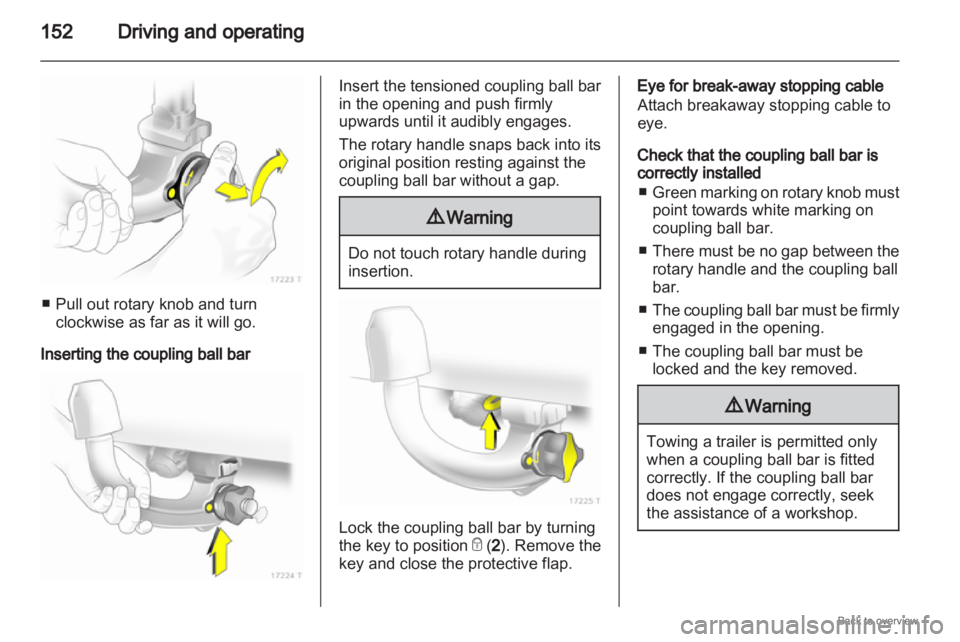
Driving and operating■ Pull out rotary knob and turn
clockwise as far as it will go.
Inserting the coupling ball bar Insert the tensioned coupling ball bar
in the opening and push firmly
upwards until it audibly engages.
The rotary handle snaps back into its
original position resting against the
coupling ball bar without a gap.
9
Warning Do not touch rotary handle during
insertion.
Lock the coupling ball bar by turning
the key to position
e (2). Remove the
key and close the protective flap. Eye for break-away stopping cable
Attach breakaway stopping cable to
eye.
Check that the coupling ball bar is
correctly installed
■ Green
marking on rotary knob must
point towards white marking on
coupling ball bar.
■ There must be no gap between the rotary handle and the coupling ball
bar.
■ The coupling ball bar must be firmly engaged in the opening.
■ The coupling ball bar must be locked and the key removed. 9
Warning Towing a trailer is permitted only
when a coupling ball bar is fitted
correctly. If the coupling ball bar
does not engage correctly, seek
the assistance of a workshop.
Page 153 of 228
Driving and operating
153
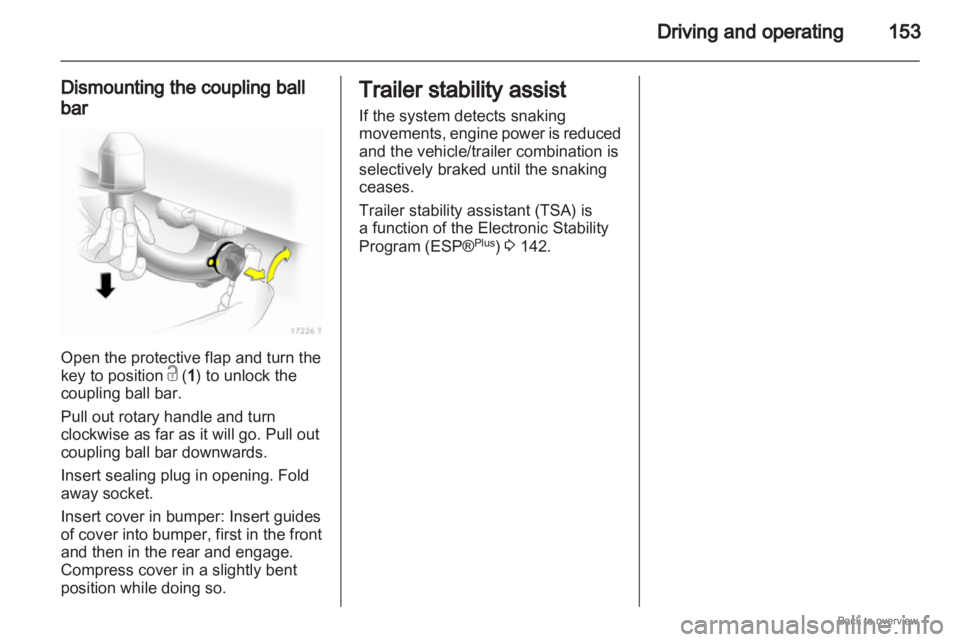
Dismounting the coupling ball
bar Open the protective flap and turn the
key to position c (1
) to unlock the
coupling ball bar.
Pull out rotary handle and turn
clockwise as far as it will go. Pull out
coupling ball bar downwards.
Insert sealing plug in opening. Fold
away socket.
Insert cover in bumper: Insert guides
of cover into bumper, first in the front
and then in the rear and engage.
Compress cover in a slightly bent
position while doing so. Trailer stability assist
If the system detects snaking
movements,
engine power is reduced
and the vehicle/trailer combination is
selectively braked until the snaking
ceases.
Trailer stability assistant (TSA) is
a function of the Electronic Stability
Program (ESP® Plus
) 3 142.
Page 204 of 228
204
Service and maintenance
Additional servicing
Additional operations +
Additional operations are not required
every service but can be performed in
conjunction with a regular service.
Time allowances for such work are
not included in the scope of regular
services and will be charged for
additionally. It is more economic if
these operations are performed as
part of a scheduled service than
having them performed separately.
Extreme operating conditions o
Extreme operating conditions are
given when at least one of the
following occurs frequently:
■ cold starts,
■ stop and go,
■ trailer towing,
■ gradients and/or high altitudes,
■ poor road surfaces,
■ sand and dust,
■ extreme temperature fluctuations. Police vehicles, taxis and driving
school vehicles are also classified as
operating under extreme conditions.
Under extreme operating conditions,
it may be necessary to have certain
scheduled service work done more
frequently than the scheduled
intervals.
Seek technical advice on the
servicing
requirements dependent on
the specific operating conditions. Recommended fluids,
lubricants and parts
Recommended fluids and
lubricants
Only use products that have been
tested and approved. Damage
resulting from the use of non-
approved materials will not be
covered by the warranty.
9
Warning Operating materials are
hazardous and could be
poisonous. Handle with care. Pay
attention to information given on
the containers.
Engine oil
Engine oil is identified by its quality
and also its viscosity. Quality is more
important than viscosity when
selecting which engine oil to use.
Page 210 of 228
![OPEL ZAFIRA 2009 Owners Manual 210
Technical data
Sales designation 1.82.0 Turbo 2.0 Turbo 2.2
Engine code Z 18 XER Z 20 LER Z 20 LEH Z 22 YH
Number of cylinders 4 4 4 4
Piston displacement [cm
3
] 1796 1998 1998 2198
Brake horse p](/img/37/58241/w960_58241-209.png "OPEL ZAFIRA 2009 Owners Manual 210
Technical data
Sales designation 1.82.0 Turbo 2.0 Turbo 2.2
Engine code Z 18 XER Z 20 LER Z 20 LEH Z 22 YH
Number of cylinders 4 4 4 4
Piston displacement [cm
3
] 1796 1998 1998 2198
Brake horse p")
210
Technical data
Sales designation 1.82.0 Turbo 2.0 Turbo 2.2
Engine code Z 18 XER Z 20 LER Z 20 LEH Z 22 YH
Number of cylinders 4 4 4 4
Piston displacement [cm
3
] 1796 1998 1998 2198
Brake horse power [kW/bhp]
103147177 110
at rpm 6300 5400 5600 5600
Torque [Nm]
175262320 215
at rpm 3800 4200 2400-5000 4000
Fuel type Petrol Petrol Petrol Petrol
Octane rating RON
recommended
959598 95
possible 989895 98
possible 91 91 91
1) –
Oil consumption [l/1000 km] 0.6 0.6 0.6 0.6
1)
Possible only if high engine load, full load or driving in mountainous terrain with a caravan/trailer or high payload is
avoided.
Page 227 of 228

227
Rear seat audio system .......24, 116
Rear window wiper/washer .......... 79
Recommended fluids and lubricants ................................ 204
Refuelling ................................... 147
Reversing lights .........................112
Roof panelling .............................. 68
Roof rack ..................................... 74
Run-flat tyres ............................. 174
S
Safety net .................................... 72
Seat adjustment ....................... 7, 46
Seat belt ........................................ 8
Seat belt reminder .......................87
Seat belts ..................................... 54
Seat folding .................................. 48
Seat occupancy recognition ..61, 87
Seat position ................................ 46
Seats in second row ....................20
Seats in third row ......................... 21
Second row seats ........................49
Selector lever ..................... 132, 137
Service ............................... 126, 192
Service display ............................ 85
Service information ....................192
Service schedules ......................194
Service vehicle soon .................... 88
Side airbag system ......................59
Side turn signal lights ................165 Spare wheel ............................... 183
Speedometer
............................... 83
Sport mode .................... 24, 89, 143
Starting off ................................... 17
Starting the engine ............128, 137
Steering wheel adjustment ......9, 77
Steering wheel controls ...............77
Stop watch ................................. 106
Sunglasses storage .....................68
Sunvisor lights ........................... 114
Sun visors .................................... 43
Symbols ......................................... 4
T
Tachometer ................................. 83
Tail lights ................................... 164
Third row seats ............................ 51
Three-point seat belt ....................
55
Tools .......................................... 173
Top-tether child restraint systems .................................... 65
Towing another vehicle .............188
Towing equipment .....................150
Towing hitch installation dimensions ............................. 223
Towing the vehicle .....................187
Trailer stability assist .................153
Trailer towing ............................. 150
Transmission ............................... 16
Transmission display .........131, 136 Tread depth ...............................
177
Trip computer .............................. 23
Trip computer in Board-Info- Display ................................... 102
Trip computer in Graphic-Info- Display or Colour-Info-
Display ................................... 104
Triple-Info-Display .......................93
Trip odometer .............................. 83
Turn and lane-change signals ...111
Turn signal ................................... 87
Tyre chains ................................ 178
Tyre deflation detection system. .......................................... 25, 177
Tyre designations ......................175
Tyre pressure .................... 101, 175
Tyre pressure monitoring system .............................. 25, 176
Tyre pressures ...................
107, 220
Tyre repair kit ............................. 179
Tyres .......................................... 174
U
Ultrasonic parking assist .............. 89
Underseat storage .......................68
Using this manual .......................... 3
V
Vehicle dimensions .................... 218
Vehicle Identification Number ....207