belt OPEL ZAFIRA C 2018.5 Manual user
[x] Cancel search | Manufacturer: OPEL, Model Year: 2018.5, Model line: ZAFIRA C, Model: OPEL ZAFIRA C 2018.5Pages: 341, PDF Size: 10.22 MB
Page 56 of 341
54Seats, restraintsAirbag systemThe airbag system consists of a
number of individual systems
depending on the scope of
equipment.
When triggered the airbags inflate
within milliseconds. They also deflate
so quickly that it is often unnoticeable during the collision.9 Warning
The airbag system deploys in an
explosive manner, repairs must be performed by skilled personnel
only.
9 Warning
Adding accessories that change
the vehicle's frame, bumper
system, height, front end or side
sheet metal, may keep the airbag
system from working properly. The operation of the airbag system can
also be affected by changing any
parts of the front seats, seat belts,
airbag sensing and diagnostic
module, steering wheel,
instrument panel, inner door seals including the speakers, any of the
airbag modules, ceiling or pillar
trim, front sensors, side impact
sensors or airbag wiring.
Note
The airbag systems and belt
pretensioner control electronics are
located in the centre console area.
Do not put any magnetic objects in
this area.
Do not affix any objects onto the
airbag covers and do not cover them with other materials. Have damagedcovers replaced by a workshop.
Each airbag is triggered only once.
Have deployed airbags replaced by
a workshop. Furthermore, it may be
necessary to have the steering
wheel, the instrument panel, parts of
the panelling, the door seals,
handles and the seats replaced.
Do not make any modifications to
the airbag system as this will
invalidate the vehicle operating
permit.
Control indicator v for airbag systems
3 111.
Child restraint systems on front passenger seat with airbag
systems
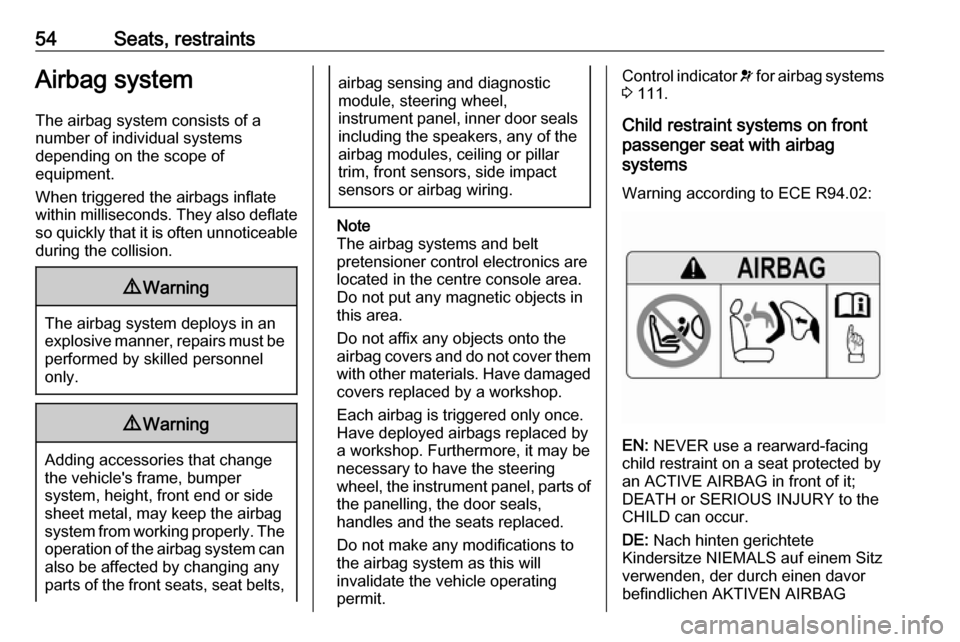
Warning according to ECE R94.02:
EN: NEVER use a rearward-facing
child restraint on a seat protected by
an ACTIVE AIRBAG in front of it;
DEATH or SERIOUS INJURY to the
CHILD can occur.
DE: Nach hinten gerichtete
Kindersitze NIEMALS auf einem Sitz
verwenden, der durch einen davor
befindlichen AKTIVEN AIRBAG
Page 59 of 341
Seats, restraints57ET: ÄRGE kasutage tahapoole
suunatud lapseturvaistet istmel, mille
ees on AKTIIVSE TURVAPADJAGA
kaitstud iste, sest see võib
põhjustada LAPSE SURMA või
TÕSISE VIGASTUSE.
MT: QATT tuża trażżin għat-tfal li
jħares lejn in-naħa ta’ wara fuq sit
protett b’AIRBAG ATTIV quddiemu;
dan jista’ jikkawża l-MEWT jew
ĠRIEĦI SERJI lit-TFAL.
GA: Ná húsáid srian sábháilteachta
linbh cúil RIAMH ar shuíochán a
bhfuil mála aeir ag feidhmiú os a
chomhair. Tá baol BÁIS nó GORTÚ
DONA don PHÁISTE ag baint leis.
Beyond the warning required by
ECE R94.02, for safety reasons a
forward-facing child restraint system
must only be used subject to the
instructions and restrictions in the
table 3 63.9 Danger
Do not use a child restraint system
on the passenger seat with active
front airbag.
The airbag label is located on both
sides of the front passenger sun visor.
Airbag deactivation 3 59.
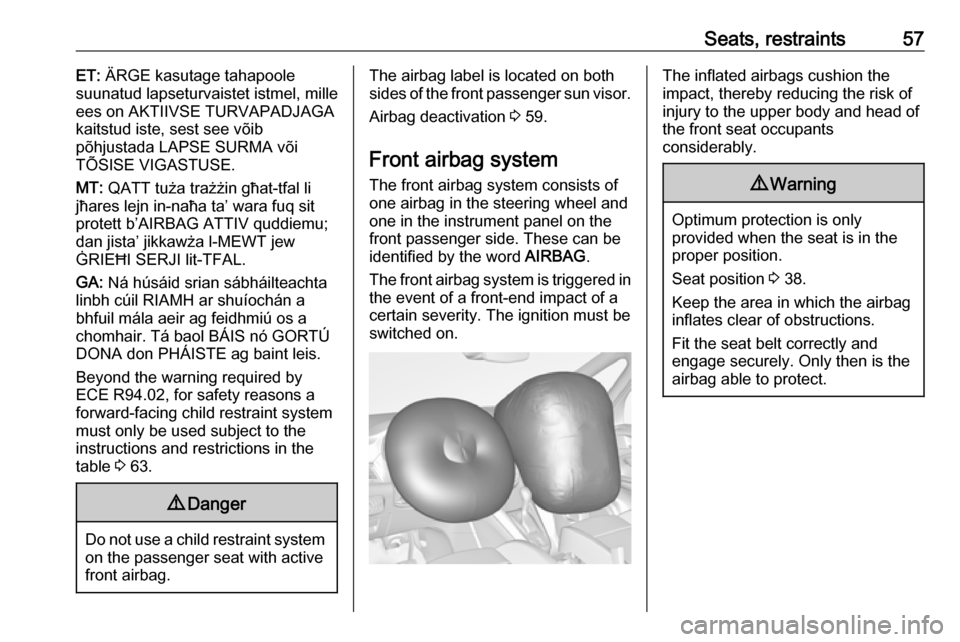
Front airbag system The front airbag system consists of
one airbag in the steering wheel and
one in the instrument panel on the
front passenger side. These can be
identified by the word AIRBAG.
The front airbag system is triggered in
the event of a front-end impact of a
certain severity. The ignition must be
switched on.The inflated airbags cushion the
impact, thereby reducing the risk of
injury to the upper body and head of
the front seat occupants
considerably.9 Warning
Optimum protection is only
provided when the seat is in the
proper position.
Seat position 3 38.
Keep the area in which the airbag
inflates clear of obstructions.
Fit the seat belt correctly and
engage securely. Only then is the
airbag able to protect.
Page 61 of 341
Seats, restraints599Warning
Keep the area in which the airbag
inflates clear of obstructions.
The hooks on the handles in the
roof frame are only suitable for
hanging up light articles of
clothing, without coat hangers. Do not keep any items in these
clothes.
Airbag deactivation
The front passenger airbag system has to be deactivated if a child
restraint system is to be fitted on this
seat. The side airbag and curtain
airbag systems, the belt
pretensioners and all driver airbag
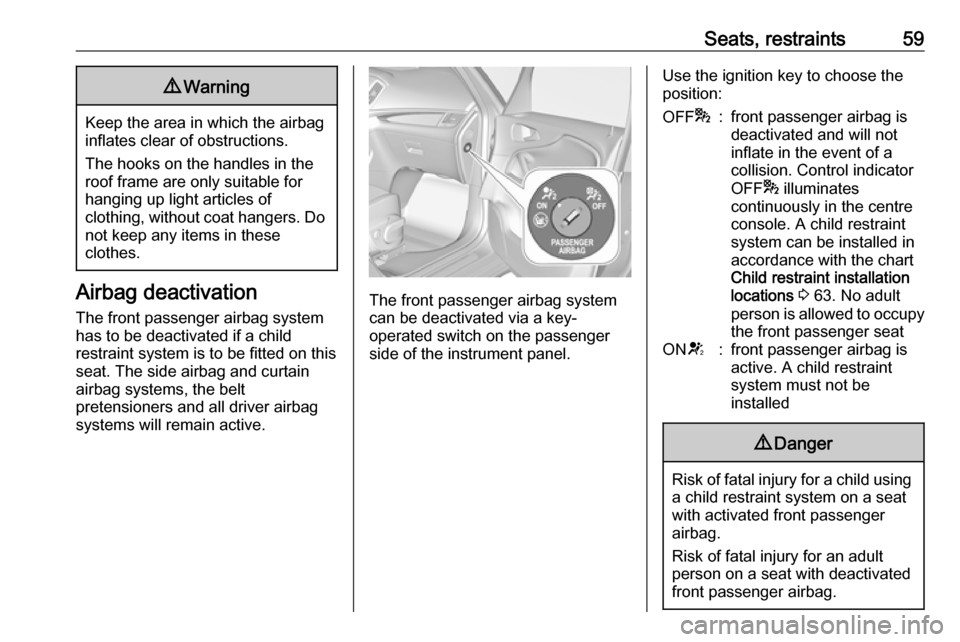
systems will remain active.The front passenger airbag system
can be deactivated via a key-
operated switch on the passenger
side of the instrument panel.
Use the ignition key to choose the
position:OFF *:front passenger airbag is
deactivated and will not
inflate in the event of a
collision. Control indicator
OFF * illuminates
continuously in the centre console. A child restraint
system can be installed in
accordance with the chart
Child restraint installation
locations 3 63. No adult
person is allowed to occupy
the front passenger seatON V:front passenger airbag is
active. A child restraint
system must not be
installed9 Danger
Risk of fatal injury for a child using
a child restraint system on a seat
with activated front passenger
airbag.
Risk of fatal injury for an adult
person on a seat with deactivated
front passenger airbag.
Page 63 of 341
Seats, restraints61When a child restraint system is being
used, pay attention to the following
usage and installation instructions and also those supplied with the child
restraint system.
Always comply with local or national
regulations. In some countries, the
use of child restraint systems is
forbidden on certain seats.
Child restraint systems can be
fastened with:
● Three-point seat belt
● ISOFIX brackets
● Top-tether
Three-point seat belt
Child restraint systems can be
fastened by using a three-point seat
belt. Depending on the size of the
used child restraint systems, up to
two child restraint systems can be
attached to the outboard seats in the
second row and on the seats in the
third row. After fastening the child
restraint system the seat belt has to
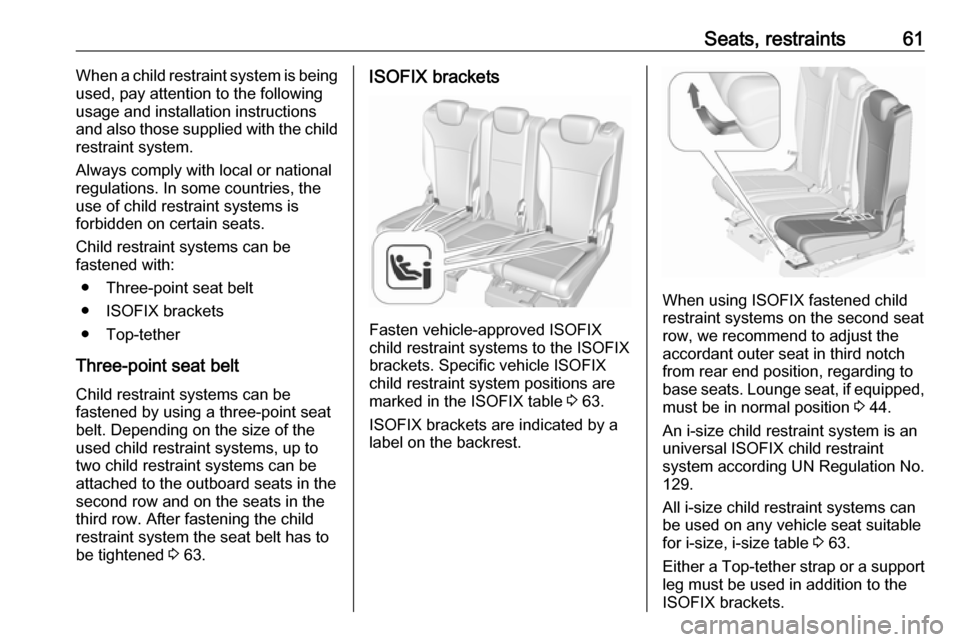
be tightened 3 63.ISOFIX brackets
Fasten vehicle-approved ISOFIX
child restraint systems to the ISOFIX
brackets. Specific vehicle ISOFIX
child restraint system positions are
marked in the ISOFIX table 3 63.
ISOFIX brackets are indicated by a
label on the backrest.
When using ISOFIX fastened child
restraint systems on the second seat
row, we recommend to adjust the
accordant outer seat in third notch
from rear end position, regarding to
base seats. Lounge seat, if equipped, must be in normal position 3 44.
An i-size child restraint system is an universal ISOFIX child restraint
system according UN Regulation No.
129.
All i-size child restraint systems can
be used on any vehicle seat suitable
for i-size, i-size table 3 63.
Either a Top-tether strap or a support
leg must be used in addition to the
ISOFIX brackets.
Page 64 of 341
62Seats, restraints
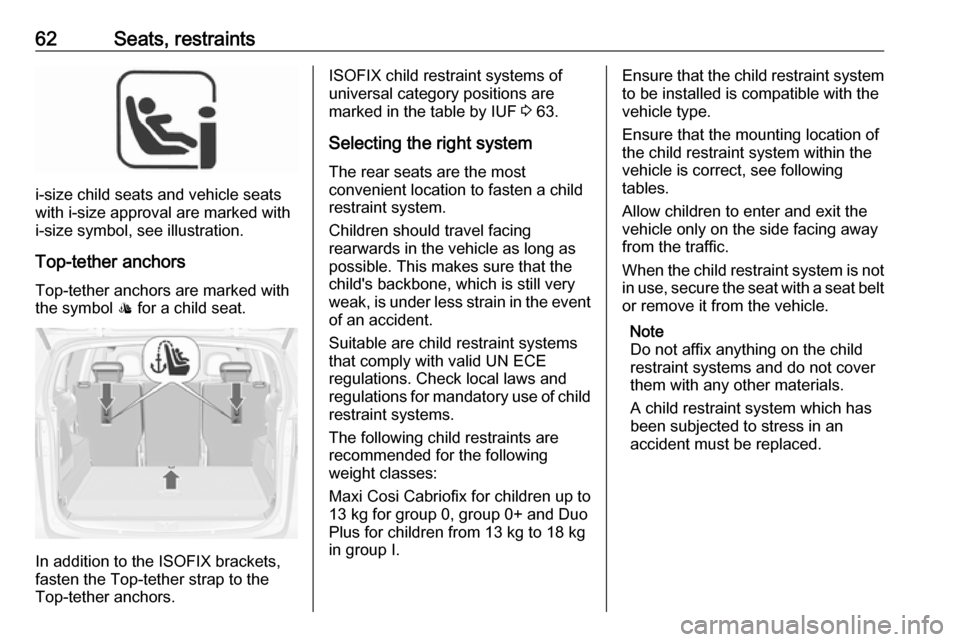
i-size child seats and vehicle seats
with i-size approval are marked with
i-size symbol, see illustration.
Top-tether anchors Top-tether anchors are marked with
the symbol : for a child seat.
In addition to the ISOFIX brackets,
fasten the Top-tether strap to the
Top-tether anchors.
ISOFIX child restraint systems of
universal category positions are
marked in the table by IUF 3 63.
Selecting the right system The rear seats are the most
convenient location to fasten a child
restraint system.
Children should travel facing
rearwards in the vehicle as long as
possible. This makes sure that the child's backbone, which is still very
weak, is under less strain in the event of an accident.
Suitable are child restraint systems
that comply with valid UN ECE
regulations. Check local laws and
regulations for mandatory use of child
restraint systems.
The following child restraints are recommended for the following
weight classes:
Maxi Cosi Cabriofix for children up to
13 kg for group 0, group 0+ and Duo
Plus for children from 13 kg to 18 kg
in group I.Ensure that the child restraint system to be installed is compatible with the
vehicle type.
Ensure that the mounting location of
the child restraint system within the
vehicle is correct, see following
tables.
Allow children to enter and exit the
vehicle only on the side facing away
from the traffic.
When the child restraint system is not in use, secure the seat with a seat beltor remove it from the vehicle.
Note
Do not affix anything on the child
restraint systems and do not cover
them with any other materials.
A child restraint system which has
been subjected to stress in an
accident must be replaced.
Page 65 of 341

Seats, restraints63Child restraint installation locations
Permissible options for fastening a child restraint system with a three-point seat belt
Weight class
On front passenger seatOn outboard seats in
the second rowOn centre seat
in the second
rowOn seats in the
third rowactivated airbagdeactivated airbagGroup 0: up to 10 kgXU 1,2U/L 3XU/L3Group 0+: up to 13 kgXU1,2U/L 3XU/L3Group I: 9 to 18 kgXU1,2U/L 3,4XU/L3,4Group II: 15 to 25 kgXXU/L3,4XU/L3,4Group III: 22 to 36 kgXXU/L3,4XU/L3,4U:universal suitability in conjunction with three-point seat beltL:suitable for particular child restraint systems of the 'specific-vehicle', 'restricted' or 'semi-universal' categories. The
child restraint system must be approved for the specific vehicle type (refer to the vehicle type list of the child restraint
system)X:no child restraint system permitted in this weight class1:move seat forwards as far as necessary and adjust seat backrest as far as necessary to a vertical position to ensure that the belt runs forwards from the upper anchorage point2:move seat upwards as far as necessary and adjust seat backrest as far as necessary to a vertical position to ensurethat the belt is tight on the buckle side3:move the respective front seat ahead of the child restraint system forwards as far as necessary4:adjust the respective headrest as necessary or remove if required
Page 67 of 341

Seats, restraints65IL:suitable for particular ISOFIX restraint systems of the 'specific-vehicle', 'restricted' or 'semi-universal' categories.The ISOFIX restraint system must be approved for the specific vehicle type (refer to the vehicle type list of the child
restraint system)IUF:suitable for ISOFIX forward-facing child restraint systems of universal category approved for use in this weight classX:no ISOFIX child restraint system approved in this weight class1:move seat forwards as far as necessary and adjust seat backrest as far as necessary to a vertical position to ensure
that the belt runs forwards from the upper anchorage point2:move seat upwards as far as necessary and adjust seat backrest as far as necessary to a vertical position to ensure
that the belt is tight on the buckle side3:move the respective front seat ahead of the child restraint system forwards as far as necessary4:adjust the respective headrest as necessary or remove if requiredA – ISO//F3:forward-facing child restraint system for children of maximum size in the weight class 9 to 18 kg.B – ISO//F2:forward-facing child restraint system for smaller children in the weight class 9 to 18 kg.B1 – ISO//F2X:forward-facing child restraint system for smaller children in the weight class 9 to 18 kg.C – ISO//R3:rear-facing child restraint system for children of maximum size in the weight class up to 18 kg.D – ISO//R2:rear-facing child restraint system for smaller children in the weight class up to 18 kg.E – ISO//R1:rear-facing child restraint system for young children in the weight class up to 13 kg.
Permissible options for fitting an i-Size child restraint system with ISOFIX brackets
On front passenger seatOn outboard seats in
the second rowOn centre seat in the
second rowOn the seats in the
third rowactivated airbagdeactivated airbagi-Size child
restraint
systemsXXi - UXXi - U:suitable for i-Size 'universal' forward and rearward facing child restraint systemsX:seating position not suitable for i-Size 'universal' child restraint systems
Page 81 of 341
Storage79Load compartment
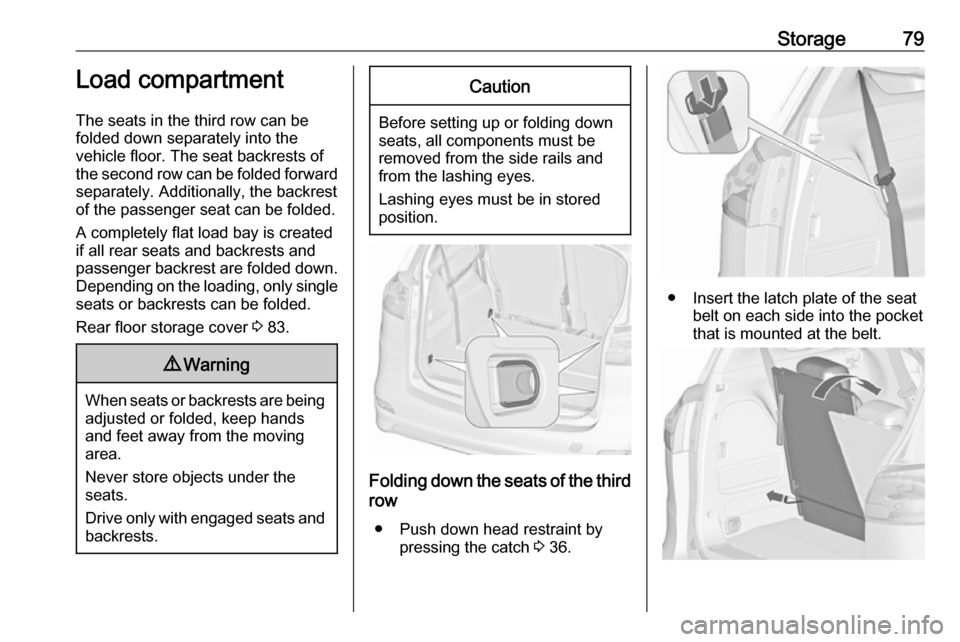
The seats in the third row can be
folded down separately into the
vehicle floor. The seat backrests of
the second row can be folded forward separately. Additionally, the backrest
of the passenger seat can be folded.
A completely flat load bay is created
if all rear seats and backrests and
passenger backrest are folded down.
Depending on the loading, only single
seats or backrests can be folded.
Rear floor storage cover 3 83.9 Warning
When seats or backrests are being
adjusted or folded, keep hands
and feet away from the moving
area.
Never store objects under the
seats.
Drive only with engaged seats and
backrests.
Caution
Before setting up or folding down
seats, all components must be
removed from the side rails and
from the lashing eyes.
Lashing eyes must be in stored
position.
Folding down the seats of the third
row
● Push down head restraint by pressing the catch 3 36.
● Insert the latch plate of the seat
belt on each side into the pocket
that is mounted at the belt.
Page 83 of 341

Storage819Warning
Only drive the vehicle if the
backrests are securely locked into position. Otherwise there is a risk
of personal injury or damage to the
load or vehicle in the event of
heavy braking or a collision.
Rear storage
On both sides of the load
compartment there are storage
shelves.
To open, release cover in side trim
panel and remove.
Floor storage
On version without third seat row,
there are storage boxes under the
floor cover. Lift up the cover to open.
Load compartment cover
Do not place any heavy or sharp-
edged objects on the load
compartment cover.
Before operating the load
compartment cover, insert the latch
plate of the seat belt on each side into
the pocket that is mounted at the belt.
Page 98 of 341

96Instruments and controlsInstruments and
controlsControls ....................................... 97
Steering wheel adjustment ........97
Steering wheel controls .............97
Heated steering wheel ...............97
Horn ........................................... 98
Windscreen wiper and washer ..98
Rear window wiper and washer ...................................... 99
Outside temperature ................100
Clock ....................................... 100
Power outlets ........................... 101
Cigarette lighter .......................102
Ashtrays .................................. 102
Warning lights, gauges and indi‐ cators ......................................... 103
Instrument cluster ....................103
Speedometer ........................... 103
Odometer ................................ 103
Trip odometer .......................... 103
Tachometer ............................. 104
Fuel gauge .............................. 104
Fuel selector ............................ 105
Engine coolant temperature gauge ..................................... 107Service display........................ 107
Control indicators ....................108
Turn lights ................................ 110
Seat belt reminder ...................111
Airbag and belt tensioners .......111
Airbag deactivation ..................112
Charging system .....................112
Malfunction indicator light ........112
Brake and clutch system .........112
Operate pedal .......................... 113
Electric parking brake ..............113
Electric parking brake fault ......113
Antilock brake system (ABS) ...113
Gear shifting ............................ 114
Power steering ........................ 114
Following distance ...................114
Lane departure warning ..........114
Electronic Stability Control off . 114
Electronic Stability Control and Traction Control system .........114
Traction Control system off .....114
Preheating ............................... 115
Exhaust filter ............................ 115
AdBlue ..................................... 115
Tyre pressure monitoring system .................................... 115
Engine oil pressure ..................115
Low fuel ................................... 116
Immobiliser .............................. 116
Exterior light ............................ 116High beam............................... 116
High beam assist .....................116
LED headlights ........................ 116
Fog light ................................... 116
Rear fog light ........................... 116
Cruise control .......................... 116
Adaptive cruise control ............117
Vehicle detected ahead ...........117
Speed limiter ........................... 117
Traffic sign assistant ................117
Door open ................................ 117
Displays ..................................... 117
Driver Information Centre ........117
Info Display .............................. 121
Vehicle messages ......................122
Warning chimes .......................123
Battery voltage ........................ 123
Vehicle personalisation ..............124
Telematics service .....................125
OnStar ..................................... 125