radio PEUGEOT 106 2001.5 User Guide
[x] Cancel search | Manufacturer: PEUGEOT, Model Year: 2001.5, Model line: 106, Model: PEUGEOT 106 2001.5Pages: 107, PDF Size: 2.92 MB
Page 37 of 107
YOUR 106 IN DETAIL39
AUDIO SETTINGS Press the “AUDIO”button several times in succession to access the bass (BASS), treble (TREB), loudness
(LOUD) , fader (FAD)and balance (BAL).
Exit from audio mode is automatic after a few seconds, without pressing any button or by pressing the “AUDIO”
button after adjusting the balance. Note: the bass and treble settings are specific to each source. It is possible to set the radio, CD, or CD multi-
changer differently. Bass setting When “BASS” is displayed, press the “D”or “E” buttons to vary the setting.
Ð “BASS –9” for a minimum bass setting,
Ð “BASS 0” for a normal position,
Ð “BASS +9” for a maximum bass setting.
T reble setting
When “TREB” is displayed, press the “D”or “E” buttons to vary the setting.
Ð “TREB –9” for a minimum treble setting,
Ð “TREB 0” for a normal position,
Ð “TREB +9” for a maximum treble setting.
Adjusting the loudness
This function automatically emphasises bass and treble tones when the volume is low. Press the “D”or “E” buttons to switch this function on or off.
Setting the front/rear sound distribution (Fader) When “FAD” is displayed, press the “D”or “E” buttons to vary the setting.
The “D”button increases the volume at the front.
The “E” button increases the volume at the rear.
This function can be deactived by pressing buttons “M”and “F”simultaneously.
Setting the right/left sound distribution (Balance)When “BAL” is displayed, press the “D”or “E” buttons to vary the setting.
The “D”button increases the volume on the right-hand side.
The “E”button increases the volume on the left-hand side.
06-05-2002
Page 38 of 107
YOUR 106 IN DETAIL40
RADIO Notes on radio reception Your radio is subject to phenomena which do not affect domestic sets. Both MW/LW and FM reception are
subject to various forms of interference which are no reflection on the quality of your set, but are due to the nature of the signals and the way in which they are transmitted.
On MW/LW, interference may be noticed when passing underneath high voltage power lines or bridges or through tunnels.
On FM, interference may be the result of increasing distance from the transmitter, reflection of the signal by
obstacles (mountains, hills, buildings etc), or of being in an area which is not covered by a transmitter. Selecting the radio Press the "J"button.
Selecting a wavebandBy short presses on the “J”button, you can select the FM1, FM2, FM3 and AM wavebands.
Automatic station searchBriefly press button “G” or “H” to search for the station immediately above or below. By continuing to press the
button in the direction selected, you will obtain continuous scrolling of the frequency. The scrolling stops on the first station found as soon as you release the button.
If TA, traffic information programme, is selected, only stations broadcasting this type of programme are selected.Searching for a station occurs first in “LO”sensitivity (selection of the most powerful transmitters) during
scanning of the waveband, then in “DX” sensitivity (selection of the weakest and most distant transmitters).
To scan the waveband in “DX”sensitivity, press twice on button “G”or “H” .
Manual station search Press the “MAN”button.
Briefly press button “G” or “H” respectively to increase or reduce the frequency displayed.
By continuing to press the button in the direction selected, you will obtain continuous scrolling of the frequency. Scrolling stops as soon as you release the button.Pressing the “MAN”button again returns you to automatic station search.
06-05-2002
Page 39 of 107
YOUR 106 IN DETAIL41
Manual storing of stations in the memory Select the station required. Press for more than two seconds one of the buttons“1”to“6” .
The sound stops then becomes audible again, confirming that the station has been stored in memory.
Automatic storing of FM stations in the memory (autostore) Press the “J”button for more than two seconds, to automatically store the 6 stations with the strongest signal
in FM. These stations are stored in the FM3 waveband. Ð If it is not possible to find 6 stations, the remaining memories are empty.
Recalling stations stored in the memory For each waveband, briefly pressing the buttons “1”to “6” recalls the corresponding stored station.
RDS FUNCTION Using the RDS (Radio Data System) function on FM RDS allows you to continue to listen to the same station, whatever frequency it is using for the region you are going through.
Switch the function on or off by briefly pressing the “RDS”button.
RDS station following
The display indicates the name of the station selected. The radio is continually searching for the station which has the best reception and which is transmitting the same programme.
06-05-2002
Page 40 of 107
YOUR 106 IN DETAIL42
Traffic information programme
Press the “TA”button to switch the function on or off.
Any traffic information flash will be given priority, whatever source you are listening to (radio, CD or CD changer). Note: the volume of the traffic information announcements is independent of the volume of normal radio
listening. You can adjust it using the volume button. The setting will be stored and will be used when thenext messages are broadcast.
While traffic information is being broadcast, the display will alternately show “TRAFFIC” and the name of the station.
When the station selected cannot broadcast traffic information, the display shows “NO TA”.
Regional following mode (REG) When they are part of a network, certain stations broadcast regional programmes in the various areas they serve. With regional following mode you can keep listening to the same programme.To do this press the “RDS”button for more than two seconds to switch this function on or off.
PTY function This allows you to listen to stations broadcasting a specific type of programme (news, culture, sport, rock etc.). With FM selected, press the “TA”button for two seconds to switch this function on or off.
To find a PTY programme:
Ð switch on the PTYfunction,
Ð briefly press button “G”or “H” to scroll down the list of the various types of programmes offered,
Ð when the programme of your choice is displayed, keep button “G”or “H” pressed for more than two seconds
to carry out an automatic search (after an automatic search the PTY function is switched off).
In PTY mode the different types of programmes can be stored in memory. To do this, press down the preselec-
tion buttons “1”to “6” for more than two seconds. Recalling the type of programme stored in the memory is by
a brief press on the corresponding button.
06-05-2002
Page 69 of 107
YOUR 106 IN DETAIL66
5
78
10
9
1
6
1112
432
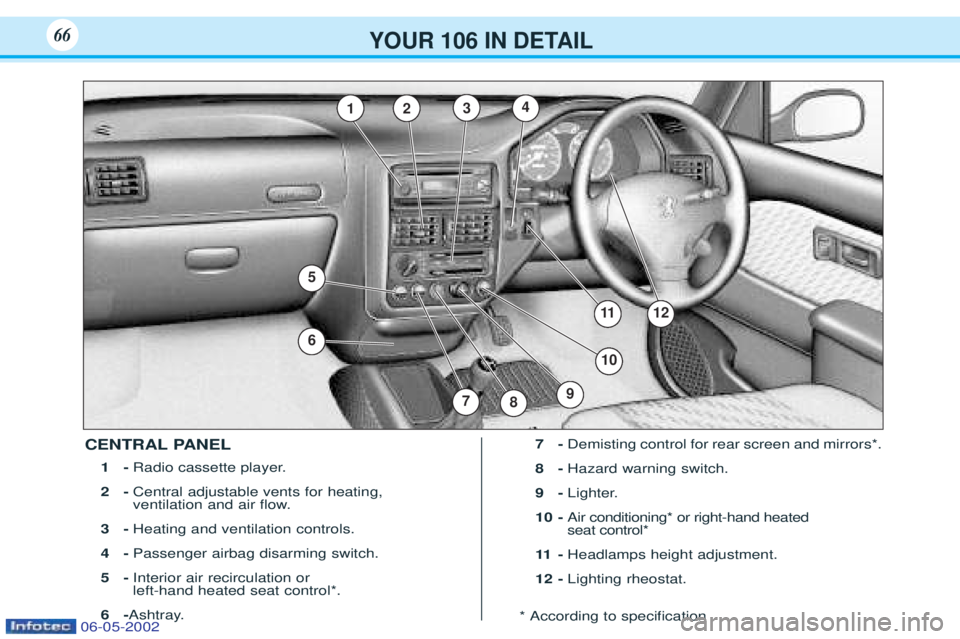
CENTRAL PANEL1- Radio cassette player.
2- Central adjustable vents for heating,
ventilation and air ßow.
3- Heating and ventilation controls.
4- Passenger airbag disarming switch.
5- Interior air recirculation or left-hand heated seat control*.
6- Ashtray. 7-
Demisting control for rear screen and mirrors*.
8- Hazard warning switch.
9- Lighter.
10 - Air conditioning* or right-hand heated seat control*
11 - Headlamps height adjustment.
12 - Lighting rheostat.
* According to speciÞcation
06-05-2002
Page 92 of 107
PRACTICAL INFORMATION86
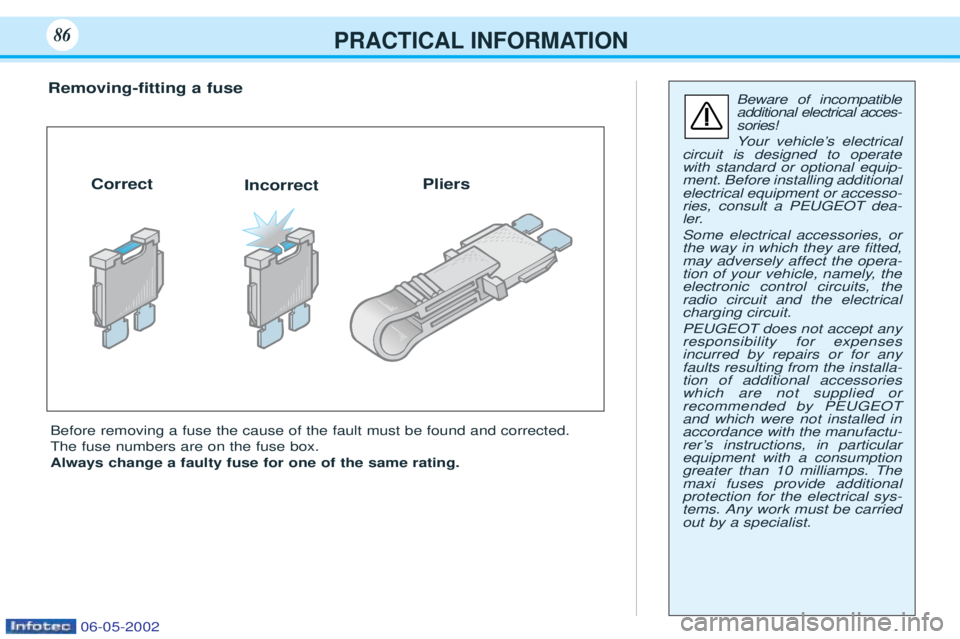
Before removing a fuse the cause of the fault must be found and corrected. The fuse numbers are on the fuse box.Always change a faulty fuse for one of the same rating.
Removing-
fitting a fuse
Beware of incompatible additional electrical acces-sories! Yo ur vehicleÕs electrical
circuit is designed to operate with standard or optional equip-ment. Before installing additionalelectrical equipment or accesso-ries, consult a PEUGEOT dea-
ler. Some electrical accessories, or the way in which they are Þtted,may adversely affect the opera-
tion of your vehicle, namely, theelectronic control circuits, theradio circuit and the electricalcharging circuit. PEUGEOT does not accept any responsibility for expensesincurred by repairs or for anyfaults resulting from the installa-tion of additional accessorieswhich are not supplied orrecommended by PEUGEOTand which were not installed inaccordance with the manufactu-
rerÕs instructions, in particularequipment with a consumptiongreater than 10 milliamps. Themaxi fuses provide additionalprotection for the electrical sys-tems. Any work must be carriedout by a specialist.
Correct Incorrect Pliers
06-05-2002
Page 96 of 107
PRACTICAL INFORMATION88
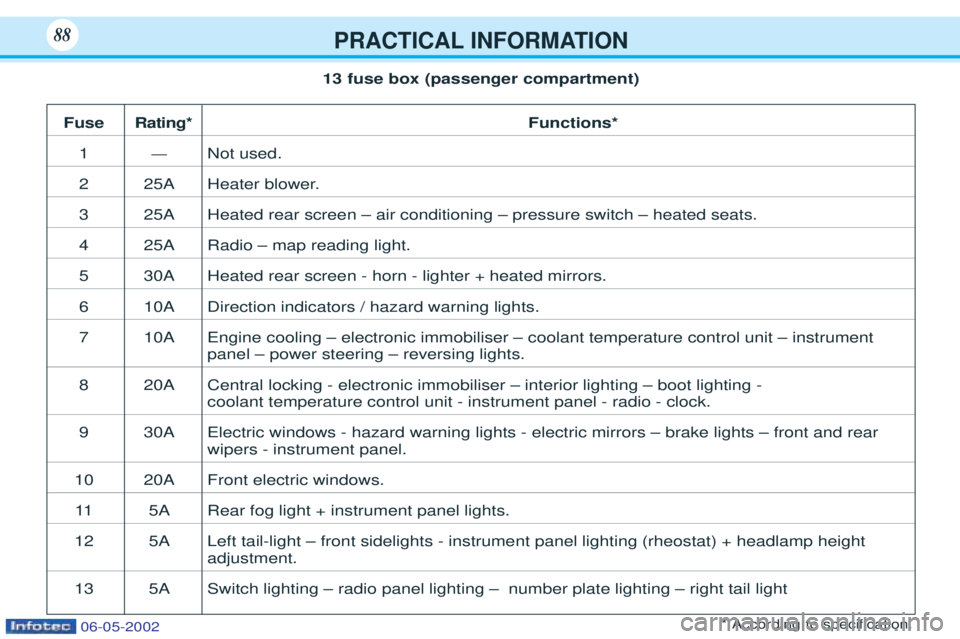
Fuse Rating*Functions*
1ÑNot used.
2 25A Heater blower.
325A Heated rear screen Ð air conditioning Ð pressure switch Ð heated seats.
425A Radio Ð map reading light.
530A Heated rear screen - horn - lighter + heated mirrors.
610A Direction indicators / hazard warning lights.
710A Engine cooling Ð electronic immobiliser Ð coolant temperature control unit Ð instrument
panel Ð power steering Ð reversing lights.
8 20A Central locking - electronic immobiliser Ð interior lighting Ð boot lighting -
coolant temperature control unit - instrument panel - radio - clock.
9 30A Electric windows - hazard warning lights - electric mirrors Ð brake lights Ð front and rear
wipers - instrument panel.
10 20A Front electric windows.
11 5A Rear fog light + instrument panel lights.
12 5A Left tail-light Ð front sidelights - instrument panel lighting (rheostat) + headlamp height
adjustment.
13 5A Switch lighting Ð radio panel lighting Ð number plate lighting Ð right tail light
13 fuse box (passenger compartment)
* According to speciÞcation.
06-05-2002
Page 98 of 107
PRACTICAL INFORMATION92
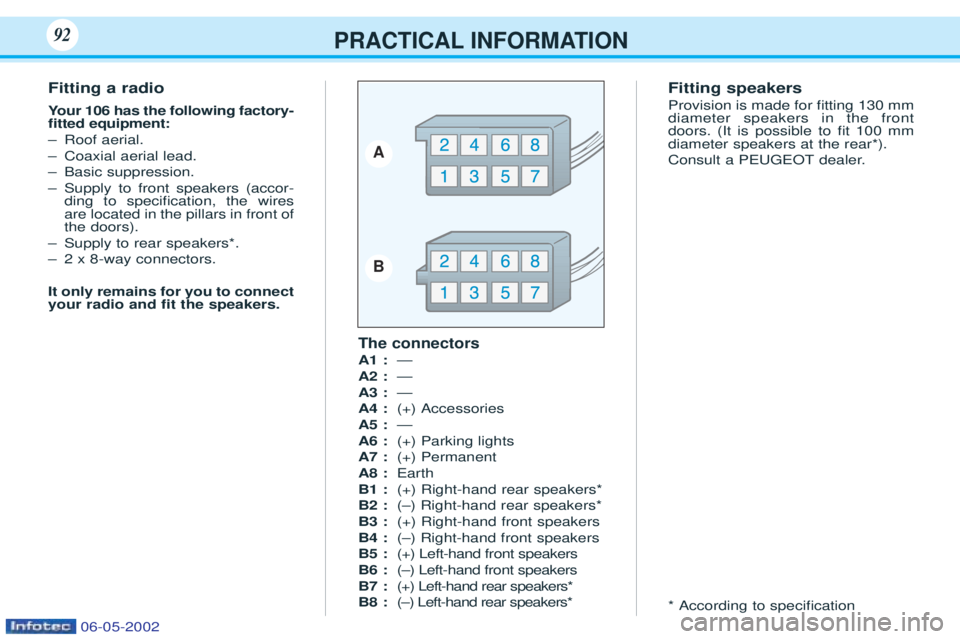
Fitting a radio Your 106 has the following factory-
fi tted equipment:
Ð Roof aerial.
Ð Coaxial aerial lead.
Ð Basic suppression.
Ð Supply to front speakers (accor- ding to speciÞcation, the wiresare located in the pillars in front ofthe doors).
Ð Supply to rear speakers*.
Ð2 x 8-way connectors.
It only remains for you to connectyour radio and fit the speakers.
The connectors
A1 : Ñ
A2 : Ñ
A3 : Ñ
A4 : (+) Accessories
A5 : Ñ
A6 : (+) Parking lights
A7 : (+) Permanent
A8 : Earth
B1 : (+) Right-hand rear speakers*
B2 : (Ð) Right-hand rear speakers*
B3 : (+) Right-hand front speakers
B4 : (Ð) Right-hand front speakers
B5 : (+) Left-hand front speakers
B6 : (Ð) Left-hand front speakers
B7 : (+) Left-hand rear speakers*
B8 : (Ð) Left-hand rear speakers* Fitting speakers Provision is made for Þtting 130 mm diameter speakers in the frontdoors. (It is possible to Þt 100 mmdiameter speakers at the rear*).
Consult a PEUGEOT dealer. * According to speciÞcation
A
B
06-05-2002