ignition PEUGEOT 106 2001.5 Owner's Manual
[x] Cancel search | Manufacturer: PEUGEOT, Model Year: 2001.5, Model line: 106, Model: PEUGEOT 106 2001.5Pages: 107, PDF Size: 2.92 MB
Page 72 of 107
YOUR 106 IN DETAIL70
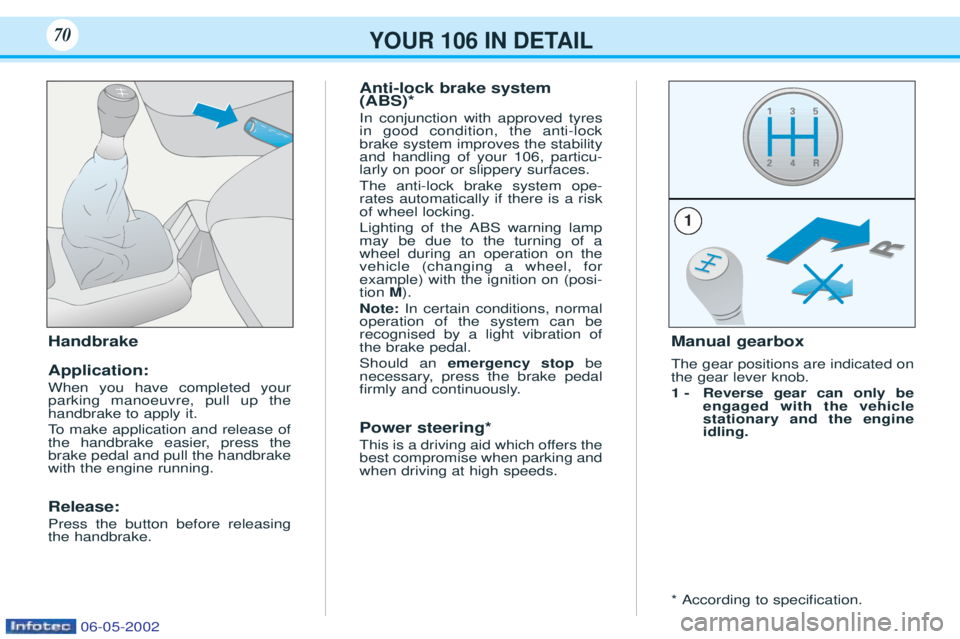
Handbrake Application: When you have completed your parking manoeuvre, pull up thehandbrake to apply it.
To make application and release of
the handbrake easier, press the brake pedal and pull the handbrakewith the engine running. Release: Press the button before releasing the handbrake. Anti-lock brake system(ABS)* In conjunction with approved tyres in good condition, the anti-lockbrake system improves the stabilityand handling of your 106, particu-larly on poor or slippery surfaces. The anti-lock brake system ope- rates automatically if there is a riskof wheel locking. Lighting of the ABS warning lamp may be due to the turning of awheel during an operation on thevehicle (changing a wheel, forexample) with the ignition on (posi-tion
M).
Note: In certain conditions, normal
operation of the system can berecognised by a light vibration ofthe brake pedal. Should an emergency stop be
necessary, press the brake pedal
Þrmly and continuously. Power steering*
This is a driving aid which offers the best compromise when parking andwhen driving at high speeds. Manual gearbox The gear positions are indicated on the gear lever knob.
1- R
everse gear can only be
engaged with the vehicle stationary and the engineidling.
* According to speciÞcation.
1
06-05-2002
Page 73 of 107
YOUR 106 IN DETAIL71
AIR BAGS* The airbag system has been desi- gned to maximise the safety of theoccupants in the event of seriouscollisions. It works in conjunctionwith the seat belts. The electronic detectors register and analyse any abrupt deceleration ofthe vehicle; if the triggering thresholdis reached the airbags inßate instant-ly and come between the occupantsand the vehicle. Immediately after the impact, the air-
bags deßate rapidly, so that they donot hinder the visibility of the occu-pants and their exit if necessary fromthe vehicle. The airbags are not deployed in the case of collisions which are notserious, for which the seat belt is suf-Þcient to ensure maximum protec-tion. The seriousness of a collisiondepends on the nature of the obs-tacle and the speed of the vehicle atthe moment of the collision. Airbags only operate when the ignition is switched on. Note: the gas escaping from the
cushion can be a minor irritant. FRONT AIR BAGS* These are folded in the centre of the steering wheel for the driver and in
the fascia for the front passenger.They are deployed simultaneously(except in cases where the airbag isdisarmed), for frontal impacts wherethere is a risk of injury to the head orchest.
-
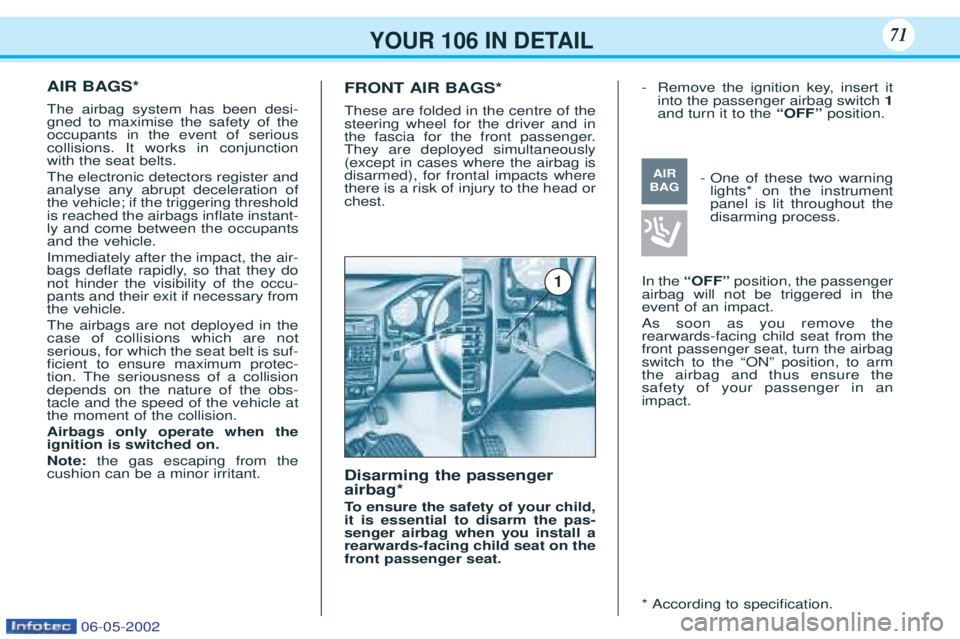
Remove the ignition key, insert itinto the passenger airbag switch 1
and turn it to the “OFF”position.
- One of these two warning lights* on the instrumentpanel is lit throughout thedisarming process.
In the “OFF” position, the passenger
airbag will not be triggered in theevent of an impact. As soon as you remove the rearwards-facing child seat from thefront passenger seat, turn the airbagswitch to the ÒONÓ position, to armthe airbag and thus ensure thesafety of your passenger in animpact. * According to speciÞcation.
Disarming the passenger airbag*
To ensure the safety of your child,
it is essential to disarm the pas- senger airbag when you install arearwards-facing child seat on thefront passenger seat.
1
AIR
BAG
06-05-2002
Page 74 of 107
YOUR 106 IN DETAIL72
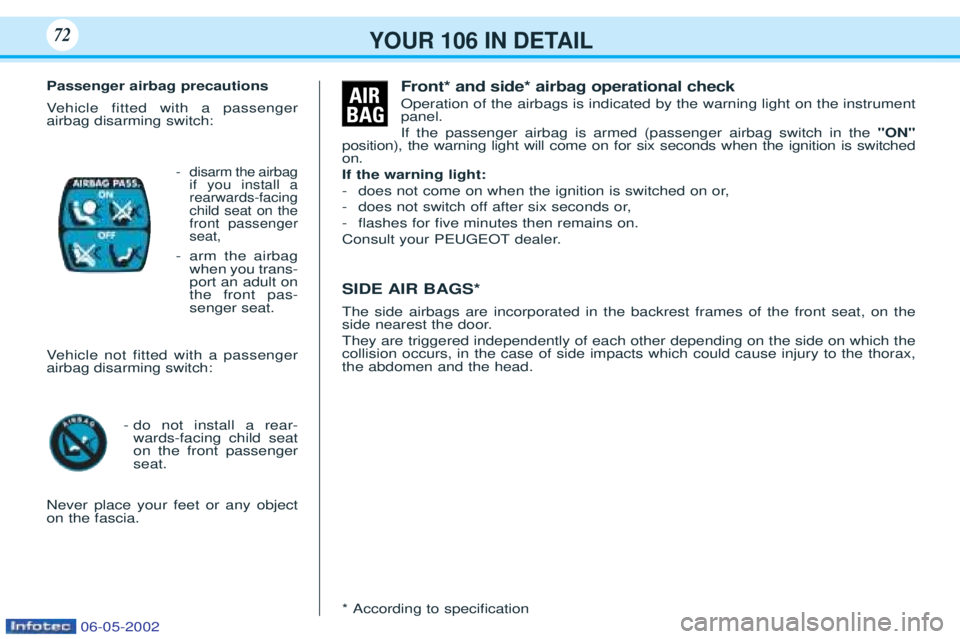
Passenger airbag precautions Vehicle fitted with a passenger
airbag disarming switch:
- disarm the airbag if you install arearwards-facingchild seat on thefront passengerseat,
-arm the airbagwhen you trans-port an adult onthe front pas-senger seat.
V ehicle not fitted with a passenger
airbag disarming switch:
-do not install a rear-wards-facing child seaton the front passengerseat.
Never place your feet or any objecton the fascia.
Front* and side* airbag operational check Operation of the airbags is indicated by the warning light on the instrument panel. If the passenger airbag is armed (passenger airbag switch in the "ON"
position), the warning light will come on for six seconds when the ignition is switched on. If the warning light:- does not come on when the ignition is switched on or,
- does not switch off after six seconds or,
-ß ashes for Þve minutes then remains on.
Consult your PEUGEOT dealer.
SIDE AIR BAGS* The side airbags are incorporated in the backrest frames of the front seat, on the
side nearest the door. They are triggered independently of each other depending on the side on which the collision occurs, in the case of side impacts which could cause injury to the thorax,the abdomen and the head. * According to speciÞcation
06-05-2002
Page 76 of 107
YOUR 106 IN DETAIL72
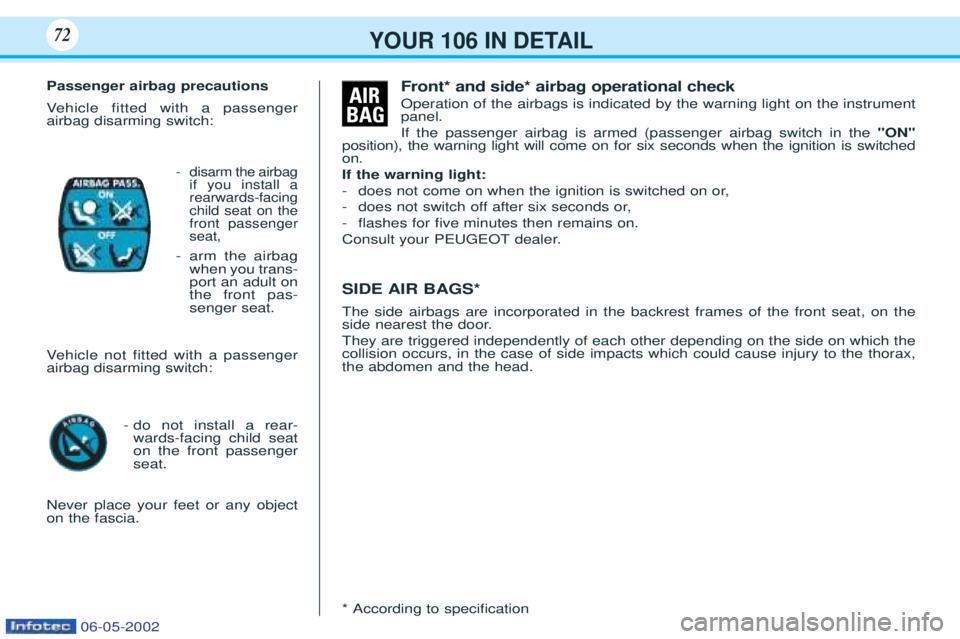
Passenger airbag precautions Vehicle fitted with a passenger
airbag disarming switch:
- disarm the airbag if you install arearwards-facingchild seat on thefront passengerseat,
-arm the airbagwhen you trans-port an adult onthe front pas-senger seat.
V ehicle not fitted with a passenger
airbag disarming switch:
-do not install a rear-wards-facing child seaton the front passengerseat.
Never place your feet or any objecton the fascia.
Front* and side* airbag operational check Operation of the airbags is indicated by the warning light on the instrument panel. If the passenger airbag is armed (passenger airbag switch in the "ON"
position), the warning light will come on for six seconds when the ignition is switched on. If the warning light:- does not come on when the ignition is switched on or,
- does not switch off after six seconds or,
-ß ashes for Þve minutes then remains on.
Consult your PEUGEOT dealer.
SIDE AIR BAGS* The side airbags are incorporated in the backrest frames of the front seat, on the
side nearest the door. They are triggered independently of each other depending on the side on which the collision occurs, in the case of side impacts which could cause injury to the thorax,the abdomen and the head. * According to speciÞcation
06-05-2002
Page 82 of 107
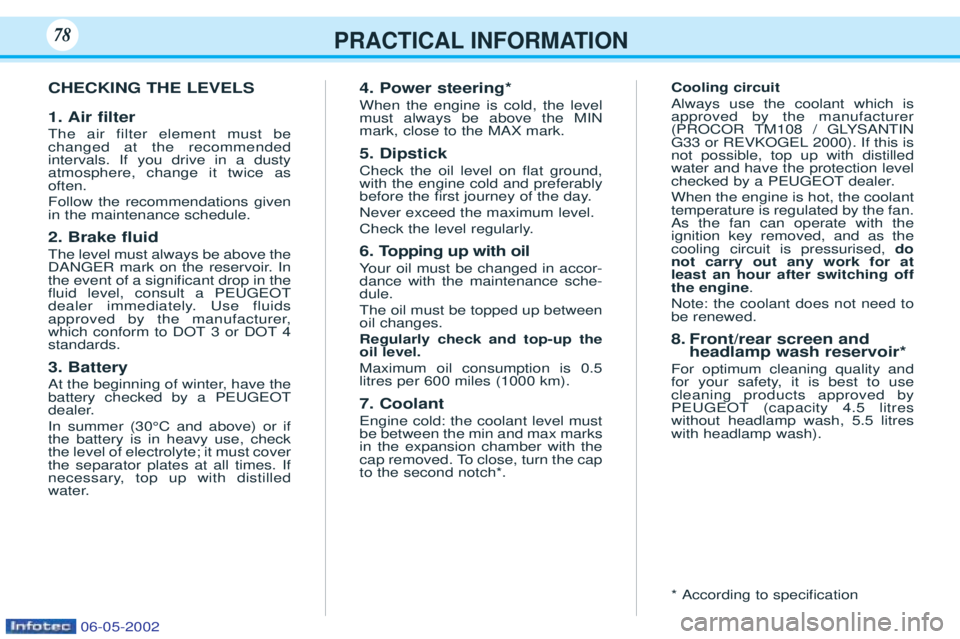
CHECKING THE LEVELS 1. Air filter
The air filter element must be changed at the recommendedintervals. If you drive in a dustyatmosphere, change it twice asoften. Follow the recommendations given in the maintenance schedule. 2. Brake fluid
The level must always be above the
DANGER mark on the reservoir. Inthe event of a signiÞcant drop in theßuid level, consult a PEUGEOT
dealer immediately. Use fluids
approved by the manufacturer,which conform to DOT 3 or DOT 4standards. 3. Battery
At the beginning of winter, have the battery checked by a PEUGEOT
dealer. In summer (30¡C and above) or if the battery is in heavy use, checkthe level of electrolyte; it must coverthe separator plates at all times. If
necessary, top up with distilled
water. 4. Power steering* When the engine is cold, the level must always be above the MINmark, close to the MAX mark. 5. Dipstick Check the oil level on ßat ground, with the engine cold and preferably
before the Þrst journey of the day. Never exceed the maximum level.
Check the level regularly.
6. T
opping up with oil
Y our oil must be changed in accor-
dance with the maintenance sche- dule. The oil must be topped up between oil changes. Regularly check and top-up the oil level. Maximum oil consumption is 0.5 litres per 600 miles (1000 km). 7. Coolant Engine cold: the coolant level must be between the min and max marksin the expansion chamber with the
cap removed. To close, turn the capto the second notch*. Cooling circuit Always use the coolant which is approved by the manufacturer
(PROCOR TM108 / GLYSANTING33 or REVKOGEL 2000). If this isnot possible, top up with distilledwater and have the protection level
checked by a PEUGEOT dealer. When the engine is hot, the coolant temperature is regulated by the fan.As the fan can operate with theignition key removed, and as thecooling circuit is pressurised,
do
not carry out any work for atleast an hour after switching offthe engine .
Note: the coolant does not need tobe renewed.
8. Front/rear screen and headlamp wash reservoir*
For optimum cleaning quality and
for your safety, it is best to use cleaning products approved byPEUGEOT (capacity 4.5 litreswithout headlamp wash, 5.5 litreswith headlamp wash). * According to speciÞcation
PRACTICAL INFORMATION7878
06-05-2002
Page 94 of 107
PRACTICAL INFORMATION90
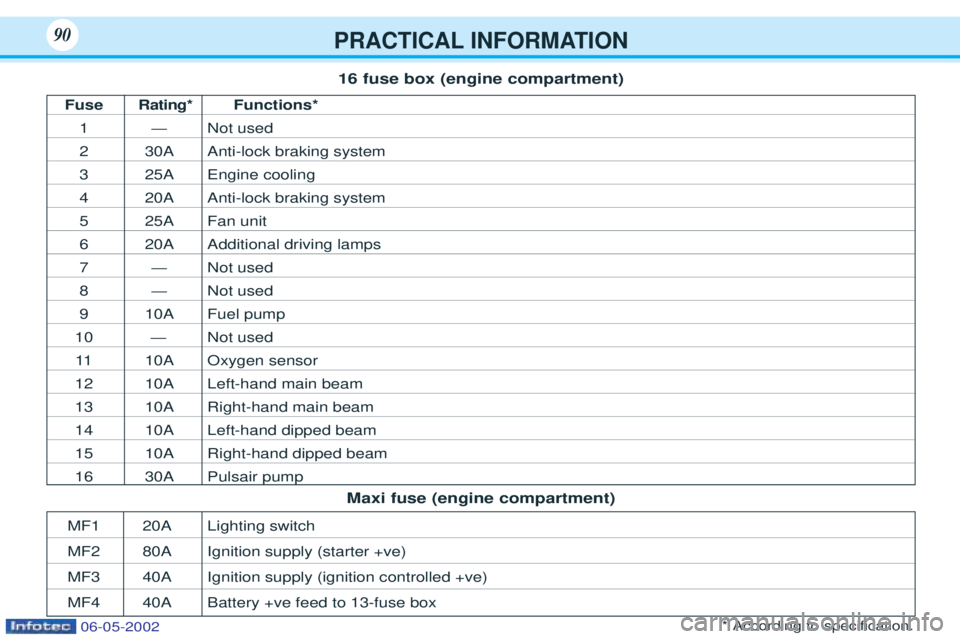
FuseRating* Functions*
1ÑNot used
2 30A Anti-lock braking system
325A Engine cooling
420A Anti-lock braking system
525A Fan unit
620A Additional driving lamps
7 ÑNot used
8 ÑNot used
9 10A Fuel pump
10 ÑNot used
11 10A Oxygen sensor
12 10A Left-hand main beam
13 10A Right-hand main beam
14 10A Left-hand dipped beam
15 10A Right-hand dipped beam
16 30A Pulsair pump
16 fuse box (engine compartment)
Maxi fuse (engine compartment)
MF1 20A Lighting switch
MF2 80A Ignition supply (starter +ve)
MF3 40A Ignition supply (ignition controlled +ve)
MF4 40A Battery +ve feed to 13-fuse box
* According to speciÞcation.06-05-2002
Page 97 of 107
PRACTICAL INFORMATION91
Battery
To charge the battery with a battery
charger: Ð Disconnect the battery starting with the negative ( Ð) terminal.
Ð
Follow the instructions for usegiven by the charger manufactu-
rer.
Ð Re-connect starting with thepositive (+) terminal.
Ð Check that the terminals andposts are clean. If they arecovered with sulphation (a whiteor green deposit), undo them andclean them. To
start and charge the battery
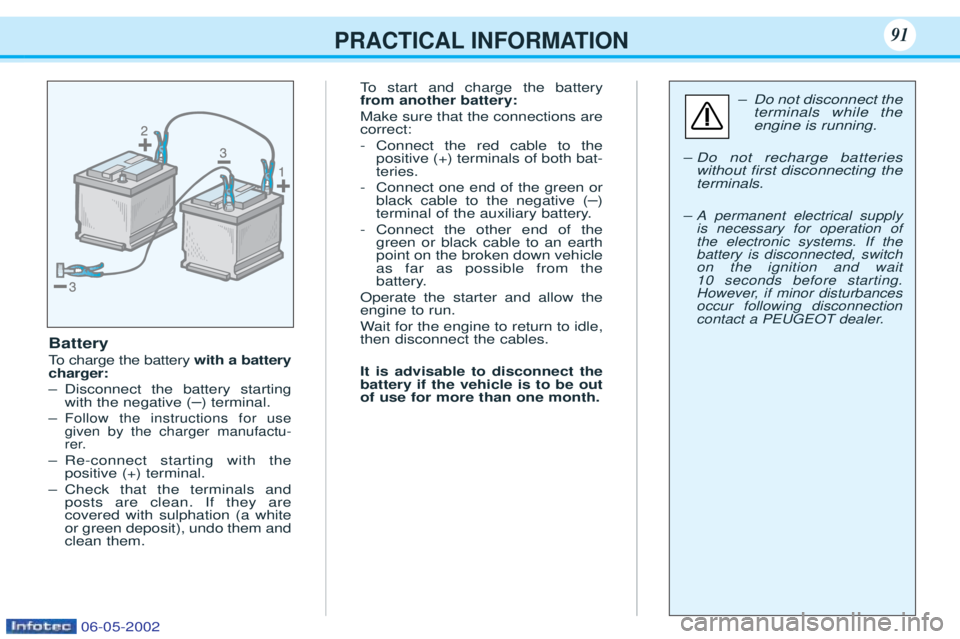
from another battery: Make sure that the connections are correct: - Connect the red cable to the positive (+) terminals of both bat-teries.
- Connect one end of the green orblack cable to the negative ( Ð
)
terminal of the auxiliary battery.
- Connect the other end of thegreen or black cable to an earthpoint on the broken down vehicleas far as possible from the
battery.
Operate the starter and allow theengine to run. W ait for the engine to return to idle,
then disconnect the cables. It is advisable to disconnect the battery if the vehicle is to be outof use for more than one month.
Ð Do not disconnect the terminals while theengine is running.
Ð Do not recharge batterieswithout Þrst disconnecting theterminals.
Ð
A permanent electrical supplyis necessary for operation ofthe electronic systems. If thebattery is disconnected, switchon the ignition and wait
10 seconds before starting.
However, if minor disturbancesoccur following disconnection
contact a PEUGEOT dealer.
06-05-2002