instrument panel PEUGEOT 108 2014 Owner's Manual
[x] Cancel search | Manufacturer: PEUGEOT, Model Year: 2014, Model line: 108, Model: PEUGEOT 108 2014Pages: 256, PDF Size: 5.88 MB
Page 92 of 256
90
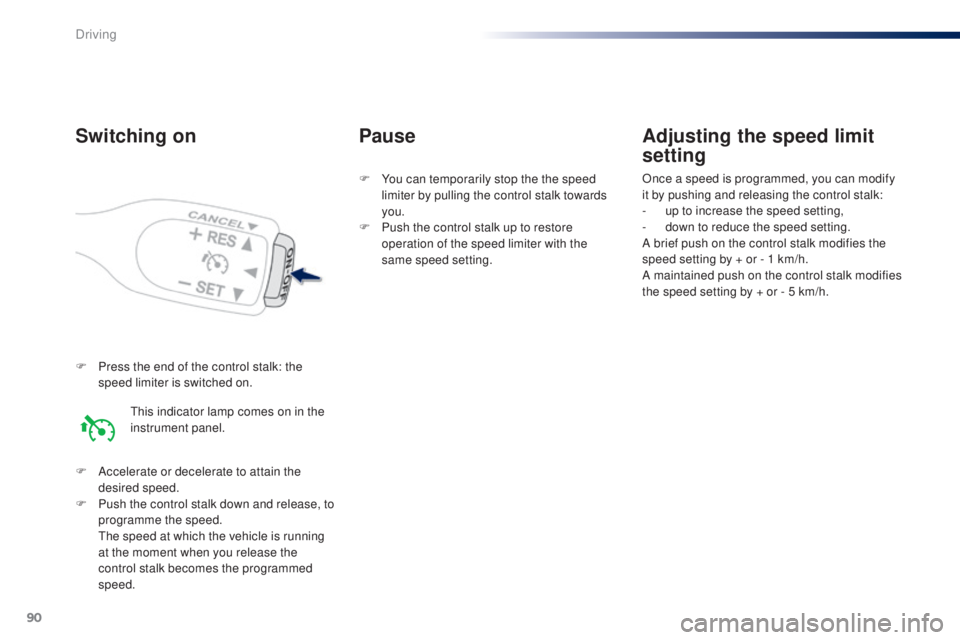
F Press the end of the control stalk: the speed limiter is switched on.
F
A
ccelerate or decelerate to attain the
desired speed.
F
P
ush the control stalk down and release, to
programme the speed.
t
h
e speed at which the vehicle is running
at the moment when you release the
control stalk becomes the programmed
speed.
Adjusting the speed limit
setting
Once a speed is programmed, you can modify
it by pushing and releasing the control stalk:
-
u
p to increase the speed setting,
-
d
own to reduce the speed setting.
A brief push on the control stalk modifies the
speed setting by + or - 1 km/h.
A maintained push on the control stalk modifies
the speed setting by + or - 5 km/h.
Switching on
this indicator lamp comes on in the
instrument panel.
Pause
F You can temporarily stop the the speed limiter by pulling the control stalk towards
you.
F
P
ush the control stalk up to restore
operation of the speed limiter with the
same speed setting.
Driving
Page 93 of 256
91
Switching off
F Press the end of the control stalk th e display of information related to the
speed limiter disappears.
Operating fault
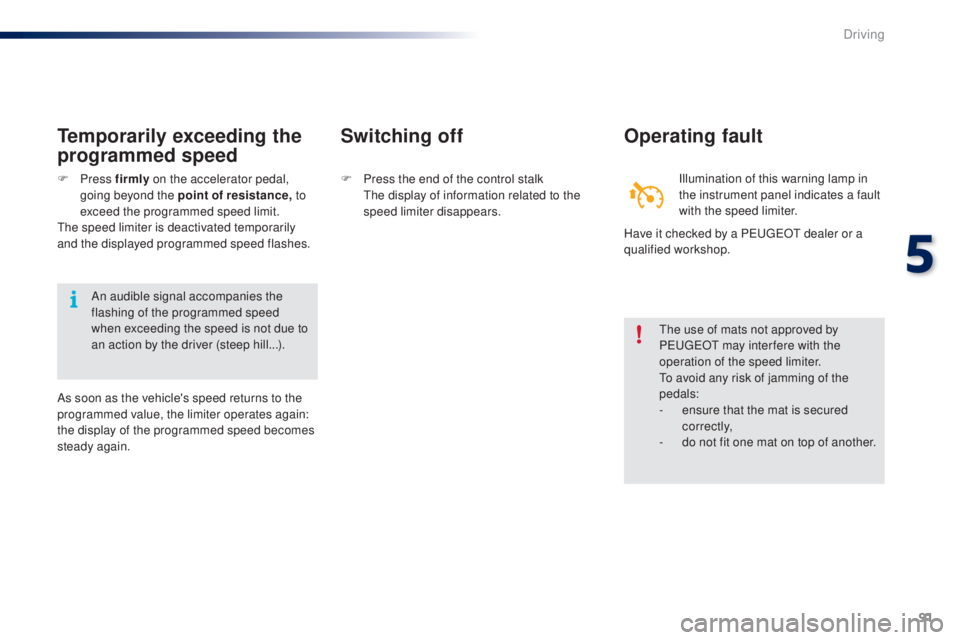
Illumination of this warning lamp in
the instrument panel indicates a fault
with the speed limiter.
th
e use of mats not approved by
P
e
uge
Ot
may inter fere with the
operation of the speed limiter.
to a
void any risk of jamming of the
pedals:
-
e
nsure that the mat is secured
c o r r e c t l y,
-
d
o not fit one mat on top of another.
Temporarily exceeding the
programmed speed
F Press f irmly on the accelerator pedal,
going beyond the point of resistance, to
exceed the programmed speed limit.
th
e speed limiter is deactivated temporarily
and the displayed programmed speed flashes. Have it checked by a P
e
uge
Ot
dealer or a
qualified workshop.
An audible signal accompanies the
flashing of the programmed speed
when exceeding the speed is not due to
an action by the driver (steep hill...).
As soon as the vehicle's speed returns to the
programmed value, the limiter operates again:
the display of the programmed speed becomes
steady again.
5
Driving
Page 96 of 256
94
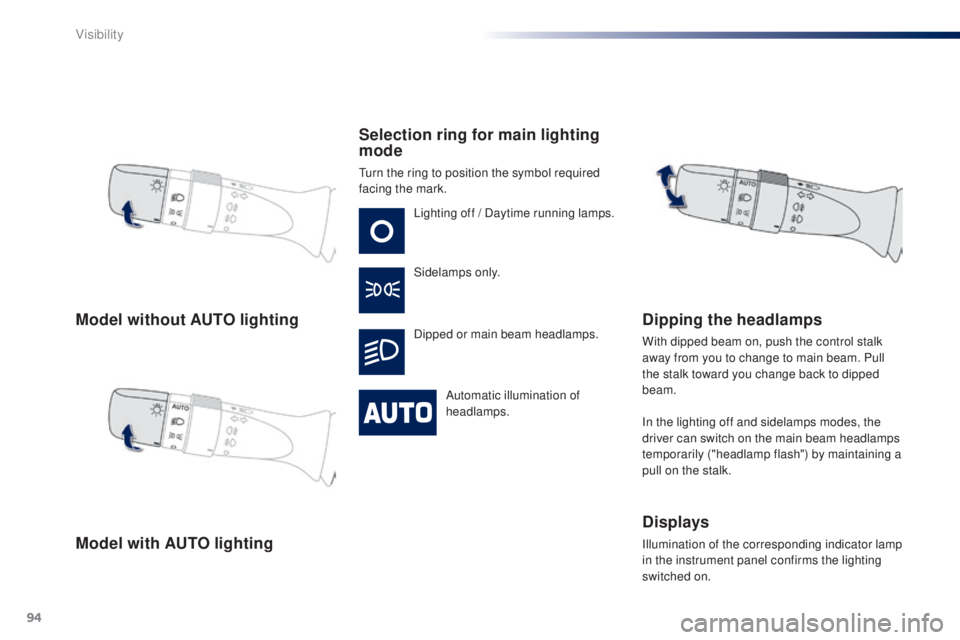
Model without AUTO lighting
Model with AUTO lightingSelection ring for main lighting
mode
turn the ring to position the symbol required
facing the mark.
Lighting off / Daytime running lamps.
Sidelamps only.
Dipped or main beam headlamps.
Automatic illumination of
headlamps.
Dipping the headlamps
With dipped beam on, push the control stalk
away from you to change to main beam. Pull
the stalk toward you change back to dipped
beam.
In the lighting off and sidelamps modes, the
driver can switch on the main beam headlamps
temporarily ("headlamp flash") by maintaining a
pull on the stalk.
Displays
Illumination of the corresponding indicator lamp
in the instrument panel confirms the lighting
switched on.
Visibility
Page 107 of 256
105
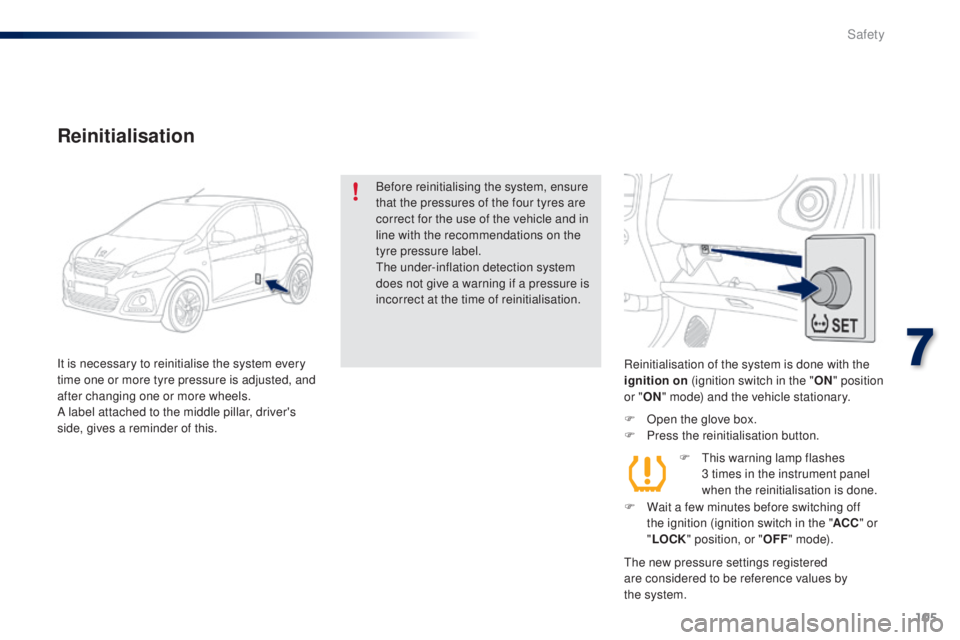
Reinitialisation of the system is done with the
ignition on (ignition switch in the " ON" position
or " ON" mode) and the vehicle stationary.
F
O
pen the glove box.
F
P
ress the reinitialisation button.
the
new pressure settings registered
are considered to be reference values by
the
system.
Reinitialisation
Before reinitialising the system, ensure
that the pressures of the four tyres are
correct for the use of the vehicle and in
line with the recommendations on the
tyre pressure label.
th
e under-inflation detection system
does not give a warning if a pressure is
incorrect at the time of reinitialisation.
It is necessary to reinitialise the system every
time one or more tyre pressure is adjusted, and
after changing one or more wheels.
A label attached to the middle pillar, driver's
side, gives a reminder of this. F
t
h
is warning lamp flashes
3
times in the instrument panel
when the reinitialisation is done.
F
W
ait a few minutes before switching off
the ignition (ignition switch in the " ACC" or
" LOCK " position, or " OFF" m o d e).
7
Safety
Page 110 of 256
108
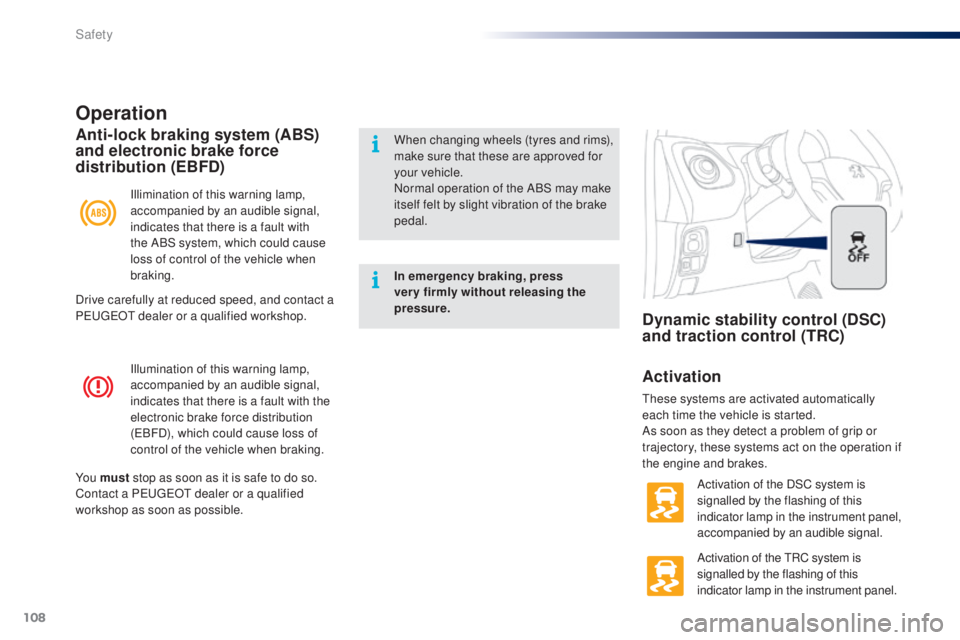
Illumination of this warning lamp,
accompanied by an audible signal,
indicates that there is a fault with the
electronic brake force distribution
(
eB
FD), which could cause loss of
control of the vehicle when braking.
Operation
Illimination of this warning lamp,
accompanied by an audible signal,
indicates that there is a fault with
the ABS system, which could cause
loss of control of the vehicle when
braking.
Anti-lock braking system (ABS)
and electronic brake force
distribution (EBFD)When changing wheels (tyres and rims),
make sure that these are approved for
your vehicle.
Normal operation of the ABS may make
itself felt by slight vibration of the brake
pedal.
In emergency braking, press
very firmly without releasing the
pressure.
Yo u must stop as soon as it is safe to do so.
Contact a P
e
uge
Ot
dealer or a qualified
workshop as soon as possible.
Dynamic stability control (DSC)
and traction control (TRC)
Activation
these systems are activated automatically
each time the vehicle is started.
As soon as they detect a problem of grip or
trajectory, these systems act on the operation if
the engine and brakes.
Activation of the DSC system is
signalled by the flashing of this
indicator lamp in the instrument panel,
accompanied by an audible signal.
Activation of the
t
R
C system is
signalled by the flashing of this
indicator lamp in the instrument panel.
Drive carefully at reduced speed, and contact a
P
e
uge
Ot
dealer or a qualified workshop.
Safety
Page 113 of 256
111
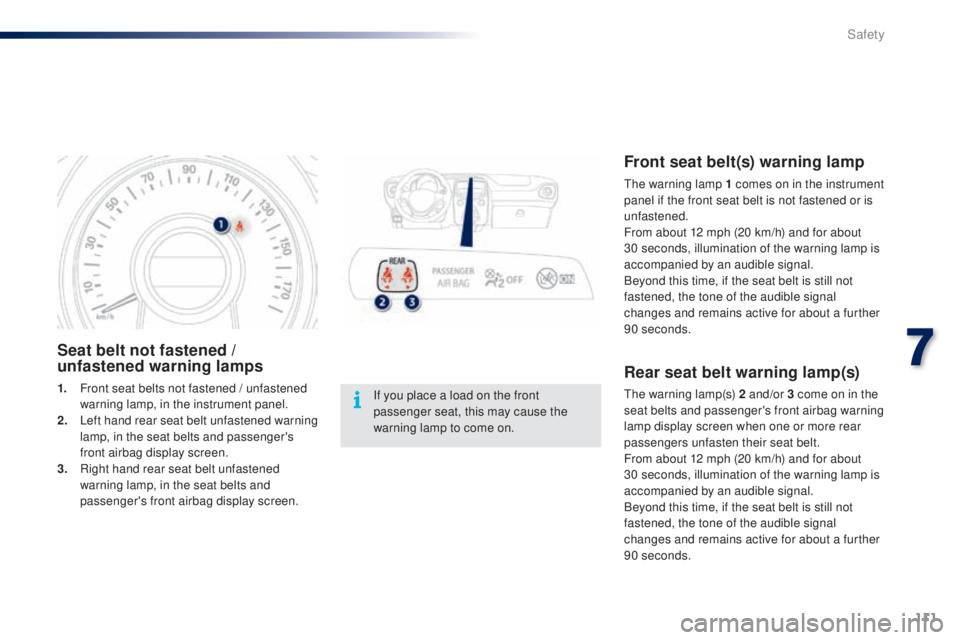
Seat belt not fastened /
unfastened warning lamps
1. Front seat belts not fastened / unfastened warning lamp, in the instrument panel.
2.
L
eft hand rear seat belt unfastened warning
lamp, in the seat belts and passenger's
front airbag display screen.
3.
R
ight hand rear seat belt unfastened
warning lamp, in the seat belts and
passenger's front airbag display screen.Rear seat belt warning lamp(s)
the warning lamp(s) 2 and/or 3 come on in the
seat belts and passenger's front airbag warning
lamp display screen when one or more rear
passengers unfasten their seat belt.
From about 12 mph (20 km/h) and for about
30 seconds, illumination of the warning lamp is
accompanied by an audible signal.
Beyond this time, if the seat belt is still not
fastened, the tone of the audible signal
changes and remains active for about a further
90 seconds.
If you place a load on the front
passenger seat, this may cause the
warning lamp to come on.
Front seat belt(s) warning lamp
the warning lamp 1
comes on in the instrument
panel if the front seat belt is not fastened or is
unfastened.
From about 12 mph (20 km/h) and for about
30 seconds, illumination of the warning lamp is
accompanied by an audible signal.
Beyond this time, if the seat belt is still not
fastened, the tone of the audible signal
changes and remains active for about a further
90 seconds.
7
Safety
Page 117 of 256
115
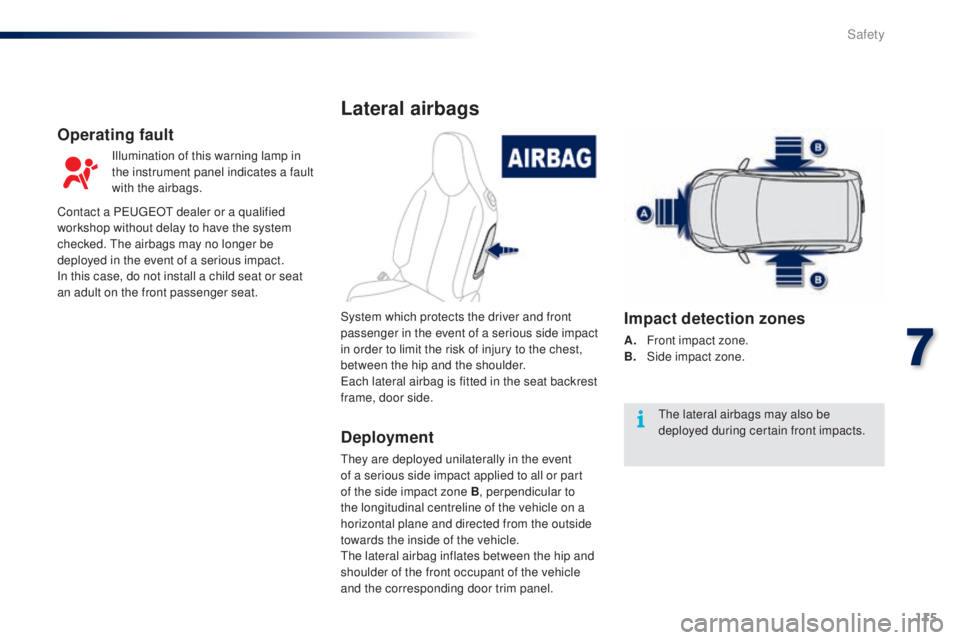
Lateral airbags
Deployment
they are deployed unilaterally in the event
of a serious side impact applied to all or part
of the side impact zone B, perpendicular to
the longitudinal centreline of the vehicle on a
horizontal plane and directed from the outside
towards the inside of the vehicle.
th
e lateral airbag inflates between the hip and
shoulder of the front occupant of the vehicle
and the corresponding door trim panel. System which protects the driver and front
passenger in the event of a serious side impact
in order to limit the risk of injury to the chest,
between the hip and the shoulder.
ea
ch lateral airbag is fitted in the seat backrest
frame, door side.
Impact detection zones
A. Front impact zone.
B. S ide impact zone.
Operating fault
Illumination of this warning lamp in
the instrument panel indicates a fault
with the airbags.
Contact a P
e
uge
Ot
dealer or a qualified
workshop without delay to have the system
checked.
t
h
e airbags may no longer be
deployed in the event of a serious impact.
In this case, do not install a child seat or seat
an adult on the front passenger seat.
th
e lateral airbags may also be
deployed during certain front impacts.
7
Safety
Page 118 of 256
116
In the event of a minor impact or bump
on the side of the vehicle or if the
vehicle rolls over, the airbags may not
be deployed.
In the event of a rear or front collision,
none of the lateral airbags is deployed.
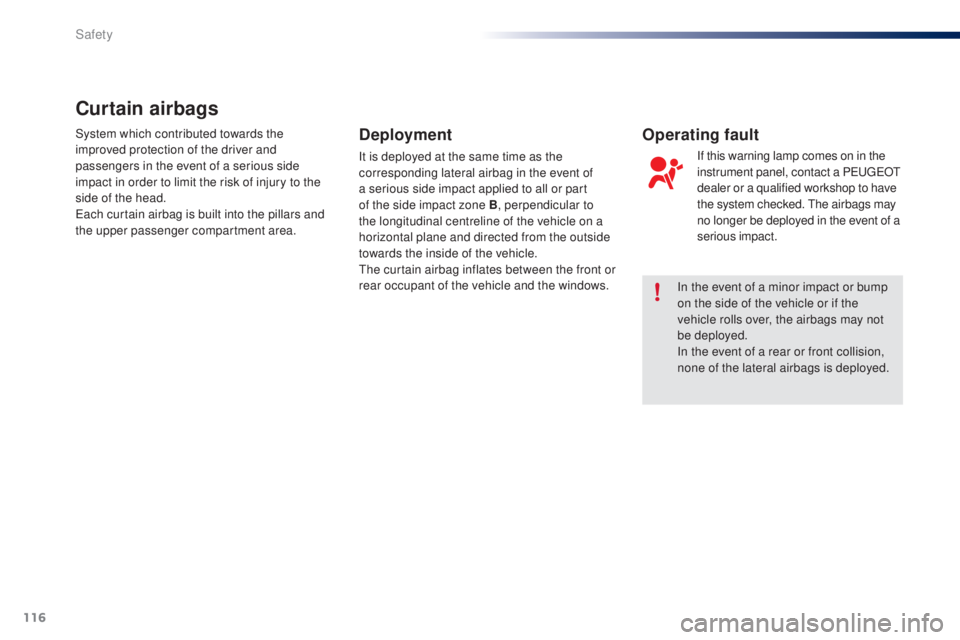
System which contributed towards the
improved protection of the driver and
passengers in the event of a serious side
impact in order to limit the risk of injury to the
side of the head.
ea
ch curtain airbag is built into the pillars and
the upper passenger compartment area.
Curtain airbags
Deployment
It is deployed at the same time as the
corresponding lateral airbag in the event of
a serious side impact applied to all or part
of the side impact zone B , perpendicular to
the longitudinal centreline of the vehicle on a
horizontal plane and directed from the outside
towards the inside of the vehicle.
th
e curtain airbag inflates between the front or
rear occupant of the vehicle and the windows. If this warning lamp comes on in the
instrument panel, contact a Pe
ugeOt
d
ealer or a qualified workshop to have
the system checked.
t
h
e airbags may
no longer be deployed in the event of a
serious impact.
Operating fault
Safety
Page 136 of 256
134
Fuel tank
Low fuel levelRefuelling
When the low fuel level is reached,
this warning lamp comes on and the
last bar flashes, accompanied by an
audible signal.
You have approximately 5 litres remaining.
In certain driving conditions and depending on
the engine, the distance which can be travelled
with the fuel remaining may be less than
30
miles (50 km).
When the frequency of the flashing increases,
you have approximately 3 litres remaining .
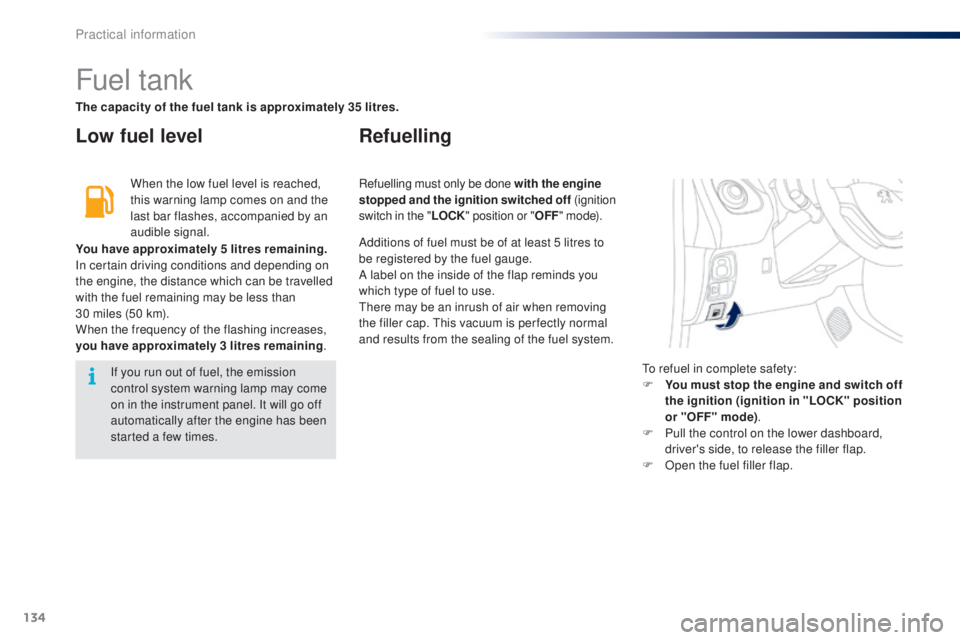
to r
efuel in complete safety:
F
Y
ou must stop the engine and switch off
the ignition (ignition in "LOCK" position
or "OFF" mode) .
F
P
ull the control on the lower dashboard,
driver's side, to release the filler flap.
F
O
pen the fuel filler flap.
If you run out of fuel, the emission
control system warning lamp may come
on in the instrument panel. It will go off
automatically after the engine has been
started a few times. Refuelling must only be done with the engine
stopped and the ignition switched off
(ignition
switch in the " LOCK" position or " OFF" m o d e).
The capacity of the fuel tank is approximately 35 litres.
Additions of fuel must be of at least 5 litres to
be registered by the fuel gauge.
A label on the inside of the flap reminds you
which type of fuel to use.
th
ere may be an inrush of air when removing
the filler cap.
t
h
is vacuum is per fectly normal
and results from the sealing of the fuel system.
Practical information
Page 156 of 256
154
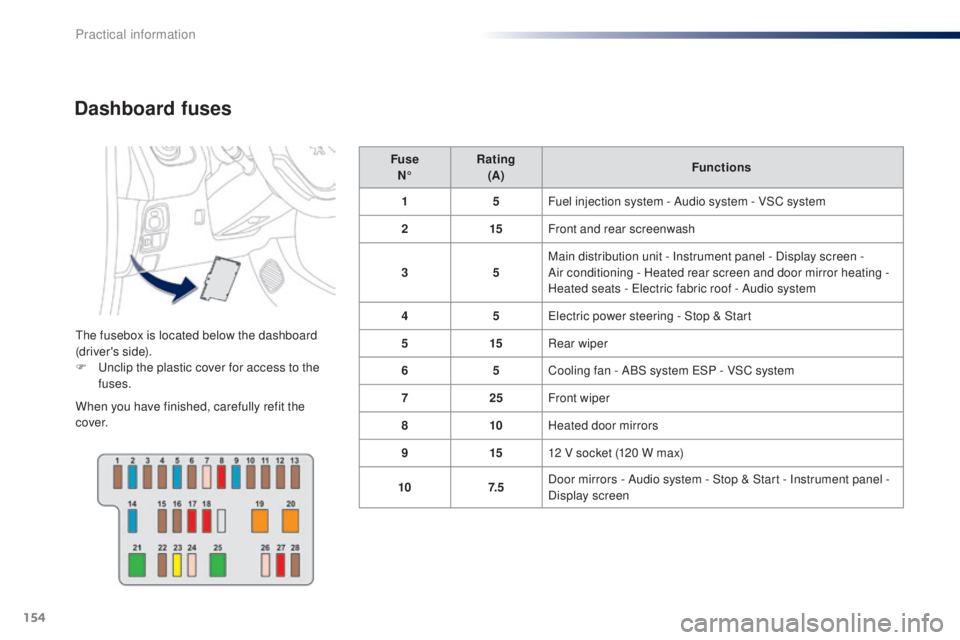
Dashboard fuses
the fusebox is located below the dashboard
(driver's side).
F u
n
clip the plastic cover for access to the
fuses.
When you have finished, carefully refit the
c ove r. Fuse
N° Rating
(A) Functions
1 5Fuel injection system - Audio system - VSC system
2 15Front and rear screenwash
3 5Main distribution unit - Instrument panel - Display screen -
Air conditioning - Heated rear screen and door mirror heating -
Heated seats - e
l
ectric fabric roof - Audio system
4 5
el
ectric power steering - Stop & Start
5 15Rear wiper
6 5Cooling fan - ABS system
e
S
P - VSC system
7 25Front wiper
8 10Heated door mirrors
9 1512 V socket (120 W max)
10 7. 5Door mirrors - Audio system - Stop & Start - Instrument panel -
Display screen
Practical information