seats PEUGEOT 108 2014 Owners Manual
[x] Cancel search | Manufacturer: PEUGEOT, Model Year: 2014, Model line: 108, Model: PEUGEOT 108 2014Pages: 256, PDF Size: 5.88 MB
Page 4 of 256
.
.
B3_en_Chap00a_sommaire_ed01-2014
Lighting control stalk 93
A utomatic illumination of headlamps
9
6
Headlamp adjustment
9
8
Wiper control stalk
9
9
Courtesy lamp
1
01
Boot lamp
1
01
Visibility
Instrument panel 1 0
Rev counter
1
0
Display screens
1
1
Indicator and warning lamps
1
3
Indicators
2
4
tr
ip computer
2
6
Setting the time
2
8
MonitoringOver view
Keys
30
"Keyless e
n
try and Starting" system
3
3
Doors
38
Boot
39
Front electric windows
4
1
Rear quarter windows
4
1
ele
ctric fabric roof
4
2
Access
Front seats 4 7
Rear seats
4
9
M i r r o r s
51
S
teering wheel adjustment
5
2
Ventilation
5
3
Heating
55
Manual air conditioning
5
6
Automatic air conditioning
5
8
Front demist - defrost
6
2
Rear screen demist - defrost
6
3
Comfort
Interior fittings 6 4
Rear parcel shelf
6
8
Boot fittings
6
9
Fittings
Starting - stopping the engine with the key 7 1
Starting - stopping the engine with the Keyless
en
try and Starting system
7
2
Manual parking brake
7
6
5-speed manual gearbox
7
6
e
tg
el
ectronic gearbox
7
7
ge
ar shift indicator
8
1
Hill start assist
8
2
Stop & Start
8
3
Speed limiter
8
6
Reversing camera
9
2
Driving
e
co-driving
Contents
Page 5 of 256
.
.
B3_en_Chap00a_sommaire_ed01-2014
Direction indicators 102
Horn
10
2
Hazard warning lamps
1
03
Under-inflation detection
1
03
e
SC system
1
07
Seat belts
1
10
Airbags
113
Safety
Child seats 1 18
Deactivating the passenger's front airbag
1
21
ISOFIX child seats
1
27
Child lock
1
33
Child safety Checks
Fuel tank 1
34
te
mporary puncture repair kit
1
36
Changing a wheel
1
41
Snow chains
1
46
Changing a bulb
1
47
Changing a fuse
1
52
12 V battery
1
61
el
ectrical energy economy mode
1
64
Changing a wiper blade
1
64
to
wing the vehicle
1
65
Fitting roof bars
1
66
Accessories
167
Practical informationte chnical data
7-inch touch screen 181
Radio
2
21
Audio equipment and telematics
Visual search
Alphabetical index
B o n n et 170
Petrol engines
1
71
Checking levels
1
72
C h e c ks
175
en
gines
177
We i g ht s
178
Dimensions
179
Identification markings
1
80
Contents
Page 11 of 256

9
Limit the causes of excess consumption
Spread loads throughout the vehicle; place the heaviest items in the
bottom of the boot, as close as possible to the rear seats.
Limit the loads carried in the vehicle and reduce wind resistance (roof
bars, roof rack...). u
s
e a roof box in preference.
Remove roof bars and roof racks after use.
At the end of winter, remove snow tyres and refit your summer tyres.
Observe the recommendations on
maintenance
Check the tyre pressures regularly, when cold, referring to the label in
the door aperture, driver's side.
Carry out this check in particular:
-
b
efore a long journey,
-
a
t each change of season,
-
a
fter a long period out of use.
Don't forget the spare wheel and the tyres on any trailer or caravan.
Have your vehicle serviced regularly (engine oil, oil filter, air filter,
passenger compartment filter...) and observe the schedule of
operations recommended in the warranty and maintenance record.
When refuelling, do not continue after the third cut-off of the nozzle to
avoid any over flow.
At the wheel of your new vehicle, it is only after the first 1 800 miles
(3
000 kilometres) that you will see the fuel consumption settle down to
a consistent average.
.
Eco-driving
Page 43 of 256
41
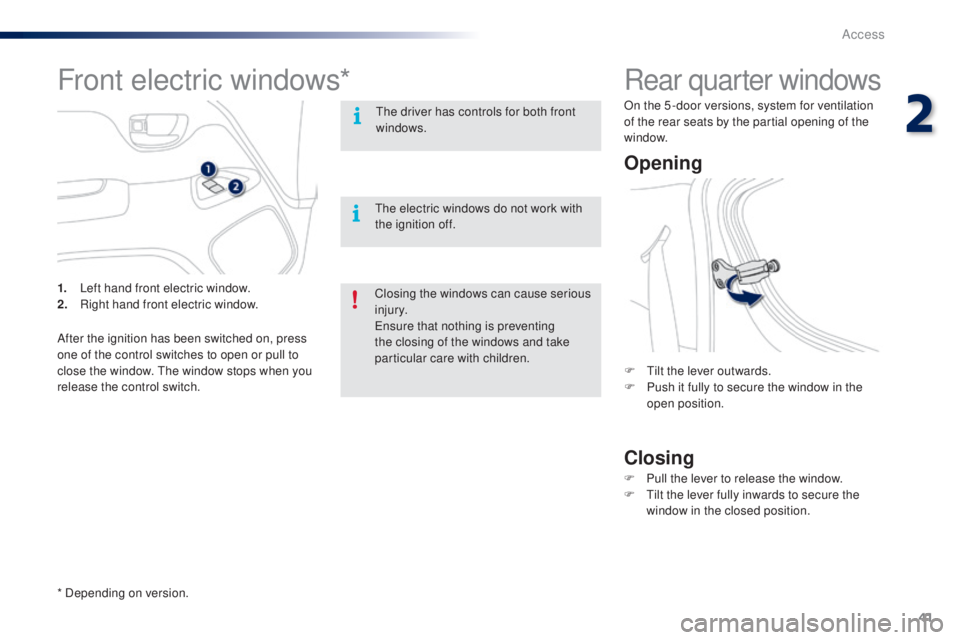
Rear quarter windows
Opening
Closing
F tilt the lever outwards.
F P ush it fully to secure the window in the
open position.
F
P
ull the lever to release the window.
F
t
i
lt the lever fully inwards to secure the
window in the closed position.
On the 5 -door versions, system for ventilation
of the rear seats by the partial opening of the
window.
Front electric windows*
the driver has controls for both front
windows.
th
e electric windows do not work with
the ignition off.
1.
L
eft hand front electric window.
2.
R
ight hand front electric window.
After the ignition has been switched on, press
one of the control switches to open or pull to
close the window.
t
he
window stops when you
release the control switch.
* Depending on version. Closing the windows can cause serious
injury.
en
sure that nothing is preventing
the closing of the windows and take
particular care with children.
2
Access
Page 49 of 256
47
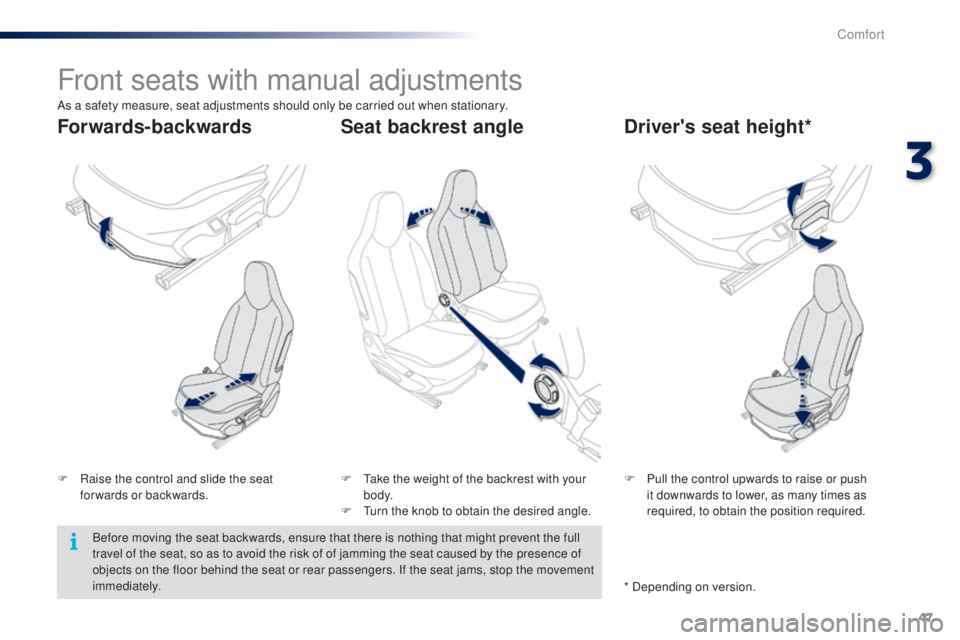
Front seats with manual adjustments
F Raise the control and slide the seat forwards or backwards. F
P ull the control upwards to raise or push
it downwards to lower, as many times as
required, to obtain the position required.
F
ta ke the weight of the backrest with your
b o dy.
F
t
u
rn the knob to obtain the desired angle.
Forwards-backwards Driver's seat height*
Seat backrest angle
As a safety measure, seat adjustments should only be carried out when stationary.
Before moving the seat backwards, ensure that there is nothing that might prevent the full
travel of the seat, so as to avoid the risk of of jamming the seat caused by the presence of
objects on the floor behind the seat or rear passengers. If the seat jams, stop the movement
immediately. * Depending on version.
3
Comfort
Page 50 of 256
48
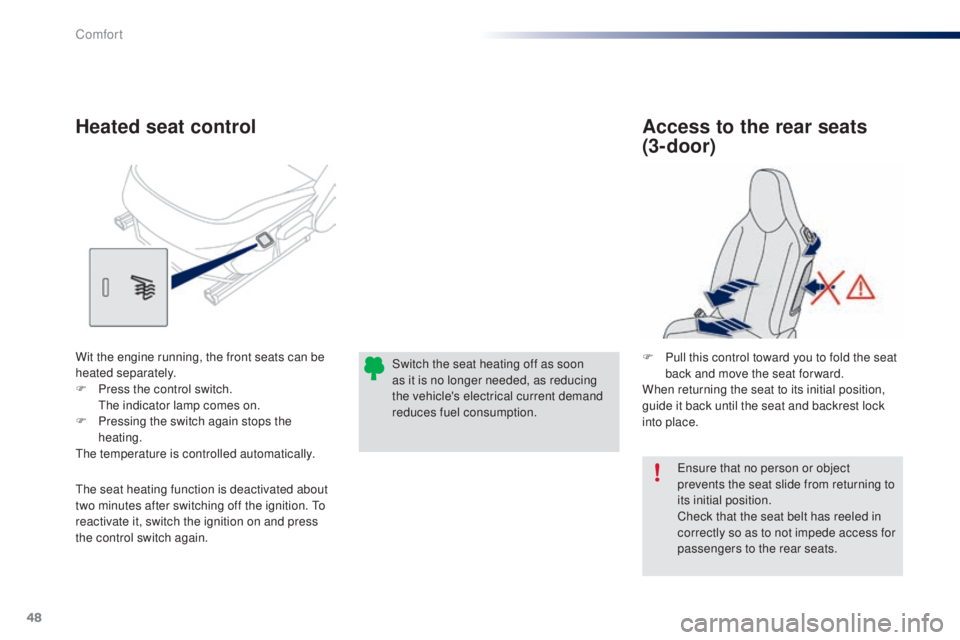
ensure that no person or object
prevents the seat slide from returning to
its initial position.
Check that the seat belt has reeled in
correctly so as to not impede access for
passengers to the rear seats.
Heated seat controlAccess to the rear seats
(3-door)
F Pull this control toward you to fold the seat
back and move the seat for ward.
When returning the seat to its initial position,
guide it back until the seat and backrest lock
into place.
Wit the engine running, the front seats can be
heated separately.
F
P
ress the control switch.
t
h
e indicator lamp comes on.
F
P
ressing the switch again stops the
heating.
the
temperature is controlled automatically.
the
seat heating function is deactivated about
two minutes after switching off the ignition.
t
o
r
eactivate it, switch the ignition on and press
the control switch again. Switch the seat heating off as soon
as it is no longer needed, as reducing
the vehicle's electrical current demand
reduces fuel consumption.
Comfort
Page 51 of 256
49
Your vehicle is fitted with a fixed one-piece cushion bench rear seat, and depending on version:
- a f olding split (50/50) backrest,
-
a f
olding one-piece backrest.
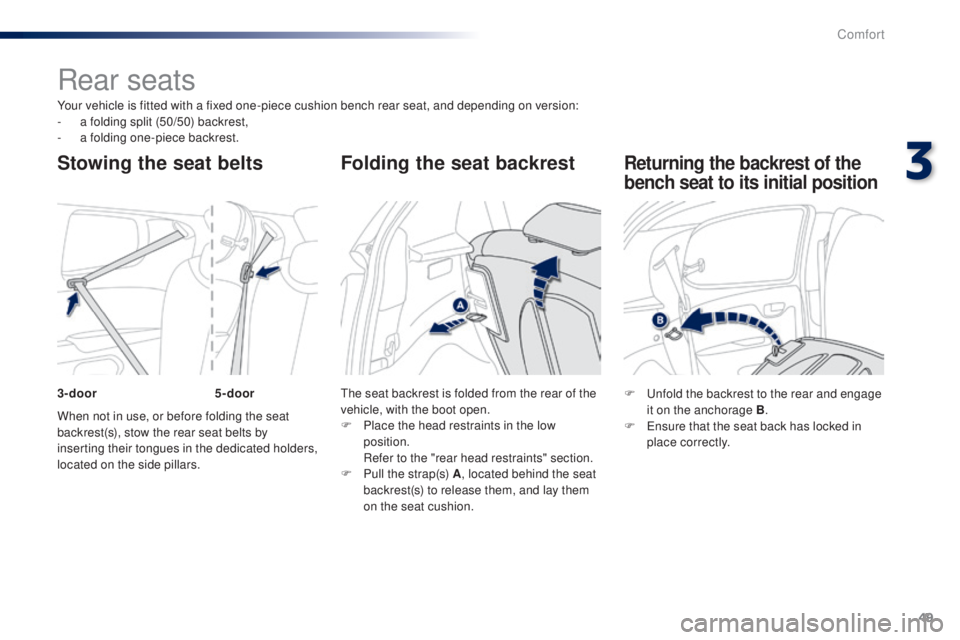
When not in use, or before folding the seat
backrest(s), stow the rear seat belts by
inserting their tongues in the dedicated holders,
located on the side pillars.
th
e seat backrest is folded from the rear of the
vehicle, with the boot open.
F
P
lace the head restraints in the low
position.
R
efer to the "rear head restraints" section.
F
P
ull the strap(s) A, located behind the seat
backrest(s) to release them, and lay them
on the seat cushion.
Rear seats
Stowing the seat belts Folding the seat backrest
F unfold the backrest to the rear and engage it on the anchorage B .
F
e
n
sure that the seat back has locked in
place correctly.
Returning the backrest of the
bench seat to its initial position
3-door 5-door
3
Comfort
Page 70 of 256
68
Rear parcel shelf
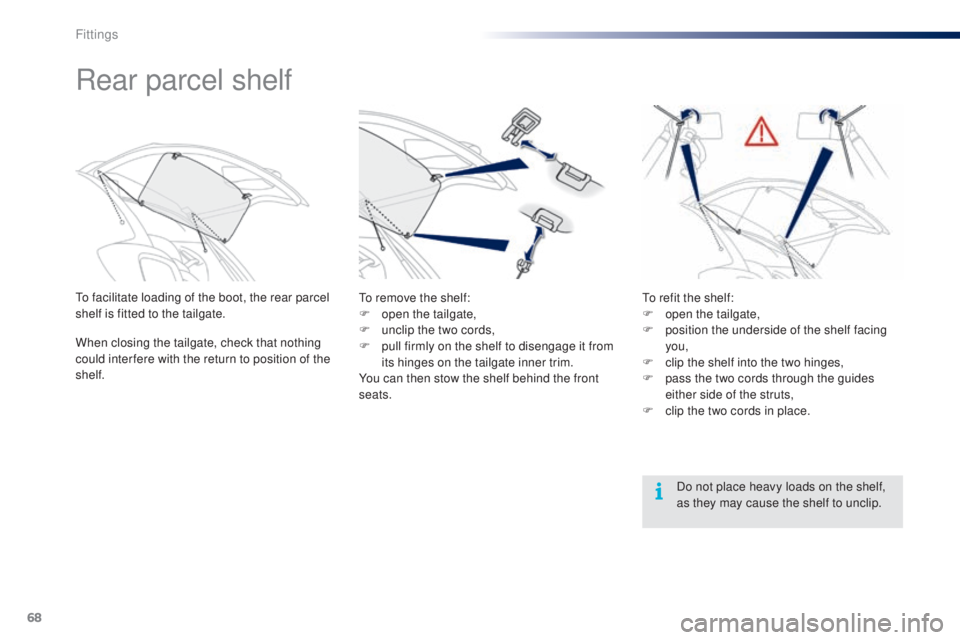
to facilitate loading of the boot, the rear parcel
shelf is fitted to the tailgate.
When closing the tailgate, check that nothing
could inter fere with the return to position of the
shelf.Do not place heavy loads on the shelf,
as they may cause the shelf to unclip.to remove the shelf:
F
o
pen the tailgate,
F
u
nclip the two cords,
F
p
ull firmly on the shelf to disengage it from
its hinges on the tailgate inner trim.
You can then stow the shelf behind the front
seats.to r efit the shelf:
F
o
pen the tailgate,
F
p
osition the underside of the shelf facing
you,
F
c
lip the shelf into the two hinges,
F
p
ass the two cords through the guides
either side of the struts,
F
c
lip the two cords in place.
Fittings
Page 112 of 256
110
Seat belts
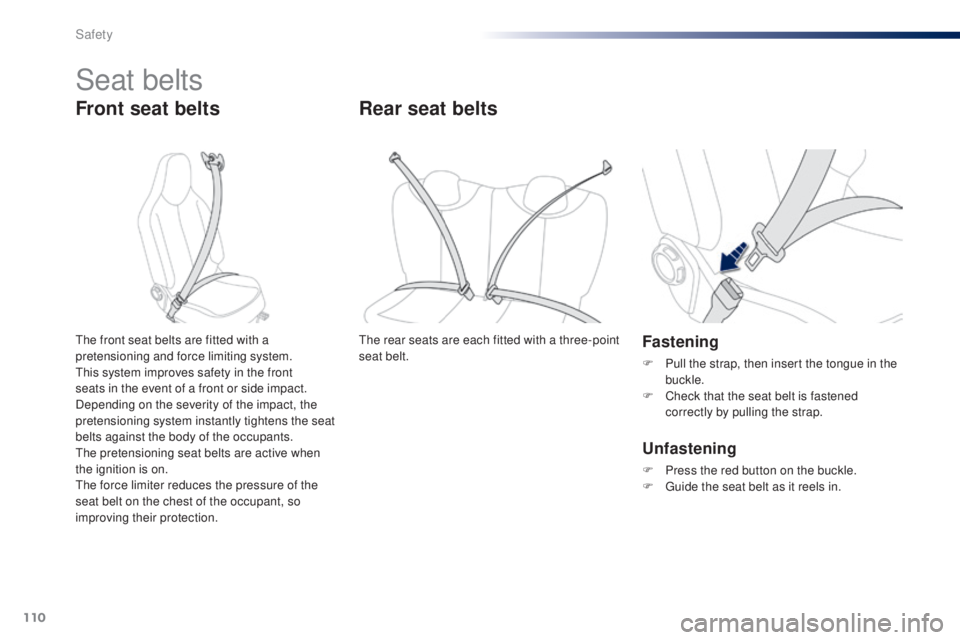
Front seat belts
Fastening
F Pull the strap, then insert the tongue in the buckle.
F
C
heck that the seat belt is fastened
correctly by pulling the strap.
th
e front seat belts are fitted with a
pretensioning and force limiting system.th
is system improves safety in the front
seats in the event of a front or side impact.
Depending on the severity of the impact, the
pretensioning system instantly tightens the seat
belts against the body of the occupants.
the
pretensioning seat belts are active when
the ignition is on.
th
e force limiter reduces the pressure of the
seat belt on the chest of the occupant, so
improving their protection.
Rear seat belts
the rear seats are each fitted with a three-point
seat belt.
Unfastening
F Press the red button on the buckle.
F gu ide the seat belt as it reels in.
Safety
Page 114 of 256
112
the driver must ensure that passengers use
the seat belts correctly and that they are all
restrained securely before setting off.
Wherever you are seated in the vehicle,
always fasten your seat belt, even for short
journeys.
Do not interchange the seat belt buckles as
they will not fulfil their role fully.
th
e seat belts are fitted with an inertia reel
permitting automatic adjustment of the
length of the strap to your size.
t
h
e seat belt
is stowed automatically when not in use.
Before and after use, ensure that the seat
belt is reeled in correctly.
th
e lower part of the strap must be
positioned as low as possible on the pelvis.
th
e upper part must be positioned in the
hollow of the shoulder.
th
e inertia reels are fitted with an automatic
locking device which comes into operation in
the event of a collision, emergency braking
or if the vehicle rolls over. You can release
the device by pulling the strap firmly and
then releasing it so that it reels in slightly.Recommendations for children
use a suitable child seat if the passenger is
less than 12 years old or shorter than one
and a half metres.
Never use the same seat belt to secure more
than one person.
Never allow a child to travel on your lap.
For more information, refer to the "Child
seats" section.
In order to be effective, a seat belt must:
-
b
e tightened as close to the body as
possible,
-
b
e pulled in front of you with a smooth
movement, checking that it does not
twist,
-
b
e used to restrain only one person,
-
n
ot bear any trace of cuts or fraying,
-
n
ot be converted or modified to avoid
affecting its performance.
In the event of an impact
Depending on the nature and
seriousness of the impact , the
pretensioning device may be deployed
before and independently of the airbags.
Deployment of the pretensioners is
accompanied by a slight discharge of
harmless smoke and a noise, due to the
activation of the pyrotechnic cartridge
incorporated in the system.
In all cases, the airbag warning lamp
comes
on.
Following an impact, have the seat belts
system checked, and if necessary replaced,
by a P
e
uge
Ot
dealer or a qualified
workshop.
In accordance with current safety
regulations, for all repairs on your vehicle's
seat belts, go to a qualified workshop with
the skills and equipment needed, which a
Pe
ugeOt d
ealer is able to provide.
Have your seat belts checked regularly by a
P
e
uge
Ot
dealer or a qualified workshop,
particularly if the straps show signs of
damage.
Clean the seat belt straps with soapy
water or a textile cleaning product, sold by
P
e
uge
Ot d
ealers.
After folding or moving a seat or rear bench
seat, ensure that the seat belt is positioned
and reeled in correctly.
Safety