ignition PEUGEOT 108 2016 User Guide
[x] Cancel search | Manufacturer: PEUGEOT, Model Year: 2016, Model line: 108, Model: PEUGEOT 108 2016Pages: 268, PDF Size: 6.17 MB
Page 45 of 268
43
108_en_Chap02_ouvertures_ed01-2016
opening
F Briefly press the control in the opening direction to open the the roof in stages.
or
F
P
ress and hold the control in the opening
direction, until the manoeuvre is complete,
to open the roof completely.
P
ressing again stops the movement of
the
roof.
Closing
F Briefly press the control in the closing direction to open the the roof in stages.
or
F
P
ress and hold the control in the closing
direction, until the manoeuvre is complete,
to close the roof to position 1 .
P
ressing again stops the movement of the
roof.
F
t
o c
lose the roof completely, press and
hold the control (between positions 1
and
0) until the roof locks closed.
th
e closing manoeuvre of the roof
could cause serious injuries: take
particular care with children.
If the roof does not close correctly:
-
c
heck that nothing is blocking the roof
(ignition off),
-
r
epeat the closing command (with the
engine running).
If the problem persists, contact a P
e
uge
Ot
dealer or a qualified workshop.
operating fault
In the event of an electrical fault,
contact a Pe ugeOt dealer or a
qualified workshop.
Protection of the electric motors
used for opening and closing the
roof
Following repeated opening and closing of the
roof, the electric motors may become too warm
and no longer allow the roof to be opened or
closed. Allow the motors to cool down with no
operation of the roof for 10 minutes.
2
Access
Page 46 of 268
44
108_en_Chap02_ouvertures_ed01-2016
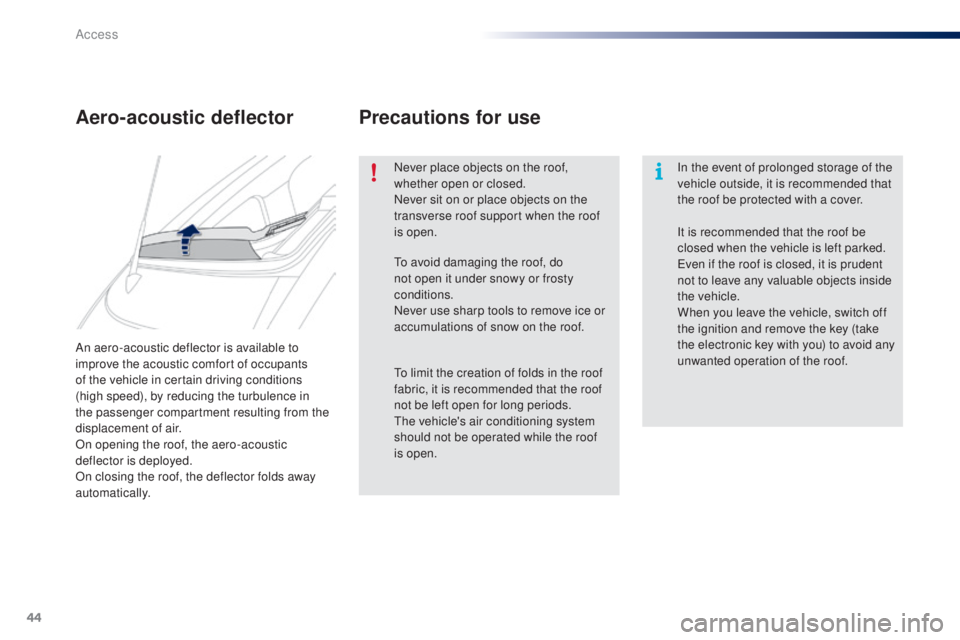
An aero-acoustic deflector is available to
improve the acoustic comfort of occupants
of the vehicle in certain driving conditions
(high speed), by reducing the turbulence in
the passenger compartment resulting from the
displacement of air.
On opening the roof, the aero-acoustic
deflector is deployed.
On closing the roof, the deflector folds away
automatically.
Aero-acoustic deflector Precautions for use
Never place objects on the roof,
whether open or closed.
Never sit on or place objects on the
transverse roof support when the roof
is open. In the event of prolonged storage of the
vehicle outside, it is recommended that
the roof be protected with a cover.
to a
void damaging the roof, do
not open it under snowy or frosty
conditions.
Never use sharp tools to remove ice or
accumulations of snow on the roof.
to l
imit the creation of folds in the roof
fabric, it is recommended that the roof
not be left open for long periods.
th
e vehicle's air conditioning system
should not be operated while the roof
is open. It is recommended that the roof be
closed when the vehicle is left parked.
ev
en if the roof is closed, it is prudent
not to leave any valuable objects inside
the vehicle.
When you leave the vehicle, switch off
the ignition and remove the key (take
the electronic key with you) to avoid any
unwanted operation of the roof.
Access
Page 49 of 268
47
108_en_Chap03_ergonomie-confort_ed01-2016
ensure that no person or object
prevents the seat slide from returning to
its initial position.
Check that the seat belt has reeled in
correctly so as to not impede access for
passengers to the rear seats.
Heated seat controlAccess to the rear seats
(3-door)
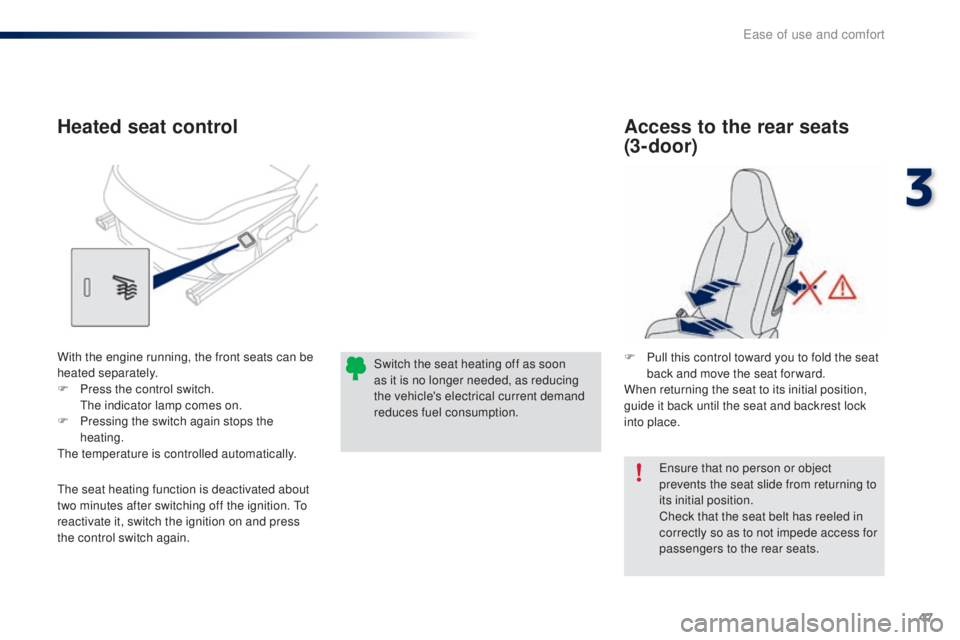
F Pull this control toward you to fold the seat
back and move the seat for ward.
When returning the seat to its initial position,
guide it back until the seat and backrest lock
into place.
With the engine running, the front seats can be
heated separately.
F
P
ress the control switch.
t
h
e indicator lamp comes on.
F
P
ressing the switch again stops the
heating.
the
temperature is controlled automatically.
the
seat heating function is deactivated about
two minutes after switching off the ignition.
t
o
r
eactivate it, switch the ignition on and press
the control switch again. Switch the seat heating off as soon
as it is no longer needed, as reducing
the vehicle's electrical current demand
reduces fuel consumption.
3
ease of use and comfort
Page 73 of 268
71
108_en_Chap04_conduite_ed01-2016
Starting - switching off the engine with the key
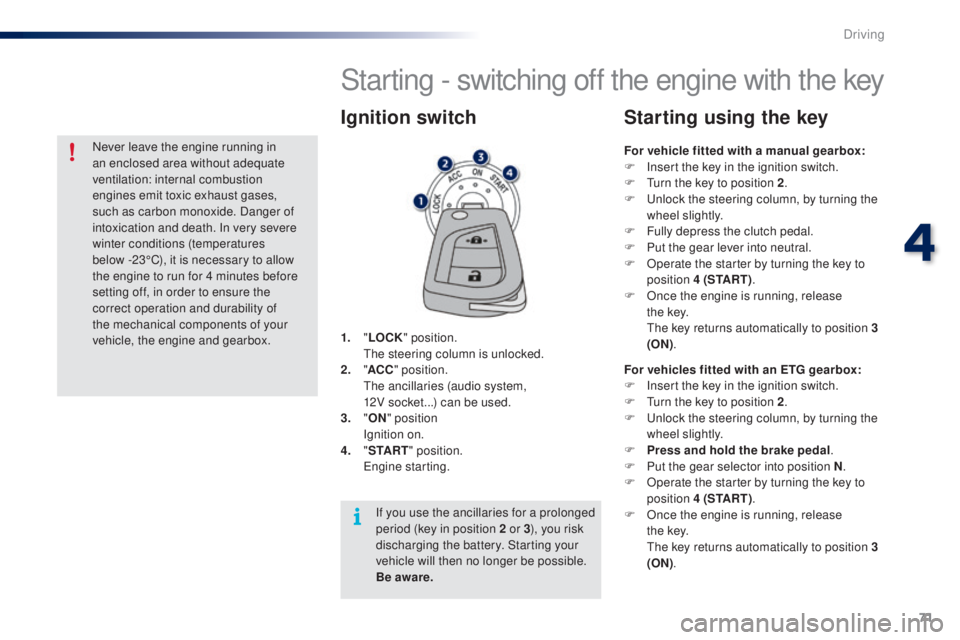
1. "L oCK " position.
th e steering column is unlocked.
2.
" AC
C" position.
t
h
e ancillaries (audio system,
12V
socket...) can be used.
3.
"
oN"
position
I
gnition on.
4.
" St
A R
t"
position.
e
n
gine starting.
Ignition switch
For vehicle fitted with a manual gearbox:
F I nsert the key in the ignition switch.
F
t
u
rn the key to position 2 .
F
u
n
lock the steering column, by turning the
wheel slightly.
F
F
ully depress the clutch pedal.
F
P
ut the gear lever into neutral.
F
O
perate the starter by turning the key to
position 4 (S
t
A R
t).
F
O
nce the engine is running, release
t h e
key.
t
h
e key returns automatically to position 3
(
o
N
).
Starting using the key
For vehicles fitted with an etg gearbox:
F I nsert the key in the ignition switch.
F
t
u
rn the key to position 2 .
F
u
n
lock the steering column, by turning the
wheel slightly.
F
P
ress and hold the brake pedal .
F
P
ut the gear selector into position N .
F
O
perate the starter by turning the key to
position 4 (S
t
A R
t).
F
O
nce the engine is running, release
t h e
key.
t
h
e key returns automatically to position 3
(
o
N
)
.
If you use the ancillaries for a prolonged
period (key in position 2 or 3 ), you risk
discharging the battery. Starting your
vehicle will then no longer be possible.
Be aware.
Never leave the engine running in
an enclosed area without adequate
ventilation: internal combustion
engines emit toxic exhaust gases,
such as carbon monoxide. Danger of
intoxication and death. In very severe
winter conditions (temperatures
below
-23°C), it is necessary to allow
the engine to run for 4 minutes before
setting off, in order to ensure the
correct operation and durability of
the mechanical components of your
vehicle, the engine and gearbox.
4
Driving
Page 74 of 268
72
108_en_Chap04_conduite_ed01-2016
If you use the ancillaries for a prolonged
period, the vehicle will automatically
switch to "
oFF" m
ode after about
20
minutes.
Be aware in order to avoid discharging
the battery.
Starting - switching off the engine
with the Keyless e
n
try and Starting
system
Changing the mode of the
vehicle
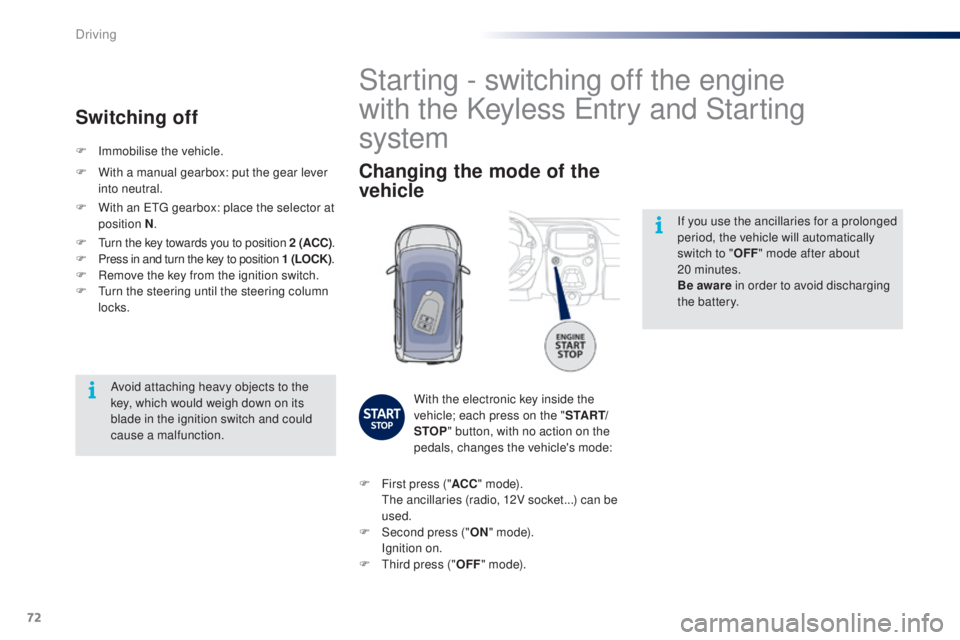
With the electronic key inside the
vehicle; each press on the " St
A Rt/
StoP " b
utton, with no action on the
pedals, changes the vehicle's mode:
F
F
irst press (" ACC" m o d e).
t
h
e ancillaries (radio, 12V socket...) can be
used.
F
Sec
ond press ("
oN "
m o d e).
I
gnition on.
F
t
h
ird press ("
oFF "
m o d e).
Avoid attaching heavy objects to the
key, which would weigh down on its
blade in the ignition switch and could
cause a malfunction.
F
Imm
obilise the vehicle.
Switching off
F With a manual gearbox: put the gear lever
into neutral.
F
W
ith an etg gearbox: place the selector at
position N .
F
t
u
rn the key towards you to position 2 (ACC) .
F
Press in and turn the key to position 1 (LoC K).F Remove the key from the ignition switch.
F
tu rn the steering until the steering column
locks.
Driving
Page 75 of 268
73
108_en_Chap04_conduite_ed01-2016
Starting using the
electronic key
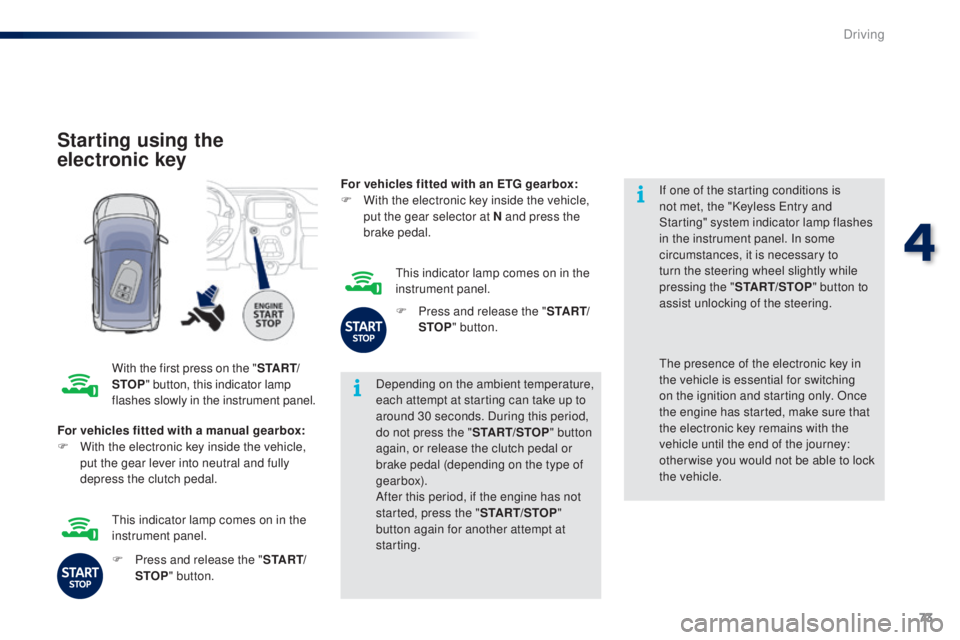
With the first press on the "St A Rt/
StoP " b
utton, this indicator lamp
flashes slowly in the instrument panel. Depending on the ambient temperature,
each attempt at starting can take up to
around 30 seconds. During this period,
do not press the "
S
t
A
R
t/
S to
P" b
utton
again, or release the clutch pedal or
brake pedal (depending on the type of
gearbox).
After this period, if the engine has not
started, press the " S
t
A
R
t/
S to
P"
b
utton again for another attempt at
starting. If one of the starting conditions is
not met, the "Keyless
e
n
try and
Starting" system indicator lamp flashes
in the instrument panel. In some
circumstances, it is necessary to
turn the steering wheel slightly while
pressing the " S t
A
R
t/
S to
P
" b
utton to
assist unlocking of the steering.
For vehicles fitted with a manual gearbox:
F
W
ith the electronic key inside the vehicle,
put the gear lever into neutral and fully
depress the clutch pedal.th e presence of the electronic key in
the vehicle is essential for switching
on the ignition and starting only. Once
the engine has started, make sure that
the electronic key remains with the
vehicle until the end of the journey:
other wise you would not be able to lock
the
vehicle.
F
P
ress and release the " S
t
A R
t/
StoP " b
utton.
th
is indicator lamp comes on in the
instrument panel. For vehicles fitted with an
etg gearbox:
F
W
ith the electronic key inside the vehicle,
put the gear selector at N and press the
brake pedal.
th
is indicator lamp comes on in the
instrument panel.
F
P
ress and release the "
S
t
A R
t/
StoP " b
utton.
4
Driving
Page 77 of 268
75
108_en_Chap04_conduite_ed01-2016
emergency switch-off
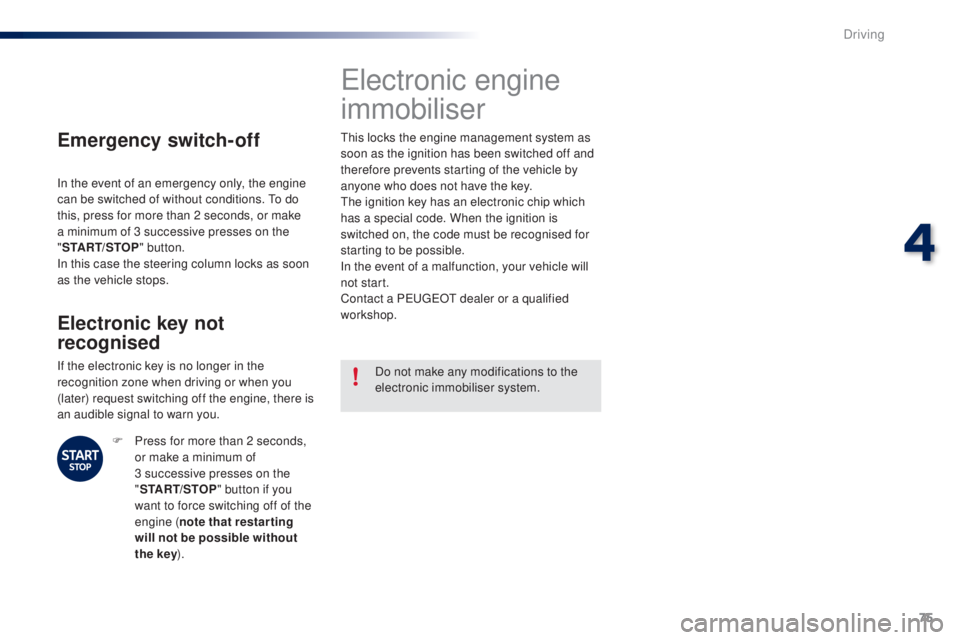
In the event of an emergency only, the engine
can be switched of without conditions. to d o
this, press for more than 2 seconds, or make
a minimum of 3 successive presses on the
" S
t
A
R
t/
S to
P" b
utton.
In this case the steering column locks as soon
as the vehicle stops.
electronic key not
recognised
If the electronic key is no longer in the
recognition zone when driving or when you
(later) request switching off the engine, there is
an audible signal to warn you.
F
P
ress for more than 2 seconds,
or make a minimum of
3
successive presses on the
" S
t
A
R
t/
S to
P" b
utton if you
want to force switching off of the
engine ( note that restarting
will not be possible without
the
key).
electronic engine
immobiliser
this locks the engine management system as
soon as the ignition has been switched off and
therefore prevents starting of the vehicle by
anyone who does not have the key.
th
e ignition key has an electronic chip which
has a special code. When the ignition is
switched on, the code must be recognised for
starting to be possible.
In the event of a malfunction, your vehicle will
not start.
Contact a P
e
uge
Ot
dealer or a qualified
workshop.
Do not make any modifications to the
electronic immobiliser system.
4
Driving
Page 78 of 268
76
108_en_Chap04_conduite_ed01-2016
Manual parking brake
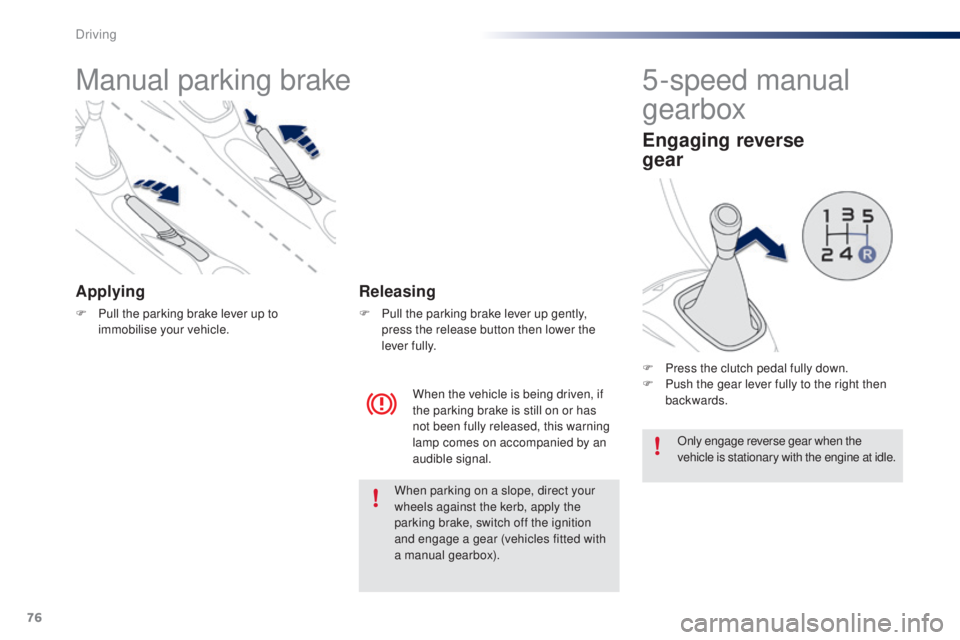
Applying
F Pull the parking brake lever up to immobilise your vehicle.
When the vehicle is being driven, if
the parking brake is still on or has
not been fully released, this warning
lamp comes on accompanied by an
audible signal.
Releasing
F Pull the parking brake lever up gently, press the release button then lower the
lever fully.
5-speed manual
gearbox
engaging reverse
gear
F Press the clutch pedal fully down.
F P ush the gear lever fully to the right then
backwards.
Only engage reverse gear when the
vehicle is stationary with the engine at idle.
When parking on a slope, direct your
wheels against the kerb, apply the
parking brake, switch off the ignition
and engage a gear (vehicles fitted with
a manual gearbox).
Driving
Page 82 of 268
80
108_en_Chap04_conduite_ed01-2016
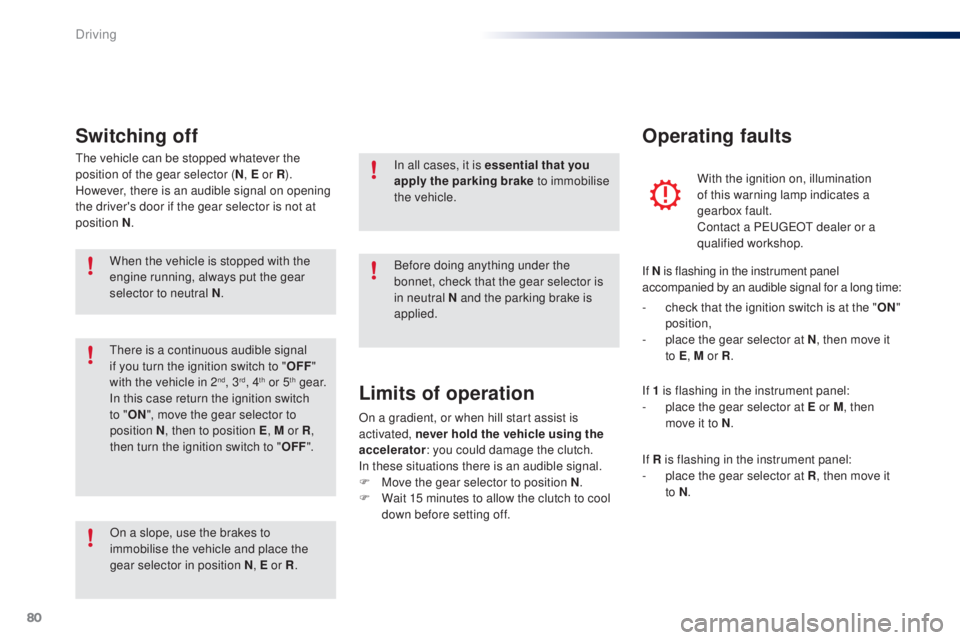
the vehicle can be stopped whatever the
position of the gear selector (N,
e or R).
However, there is an audible signal on opening
the driver's door if the gear selector is not at
position N .
Switching off
When the vehicle is stopped with the
engine running, always put the gear
selector to neutral N .
th
ere is a continuous audible signal
if you turn the ignition switch to "
oFF "
w
ith the vehicle in 2
nd, 3rd, 4th or 5th g e a r.
In this case return the ignition switch
to "
oN "
, move the gear selector to
position
N , then to position
e
,
M or R ,
then turn the ignition switch to "
oFF ".
O
n a slope, use the brakes to
immobilise the vehicle and place the
gear selector in position N ,
e
or R . With the ignition on, illumination
of this warning lamp indicates a
gearbox fault.
Contact a P
e
uge
Ot
dealer or a
qualified workshop.
operating faults
In all cases, it is essential that you
apply the parking brake to immobilise
the vehicle.
Before doing anything under the
bonnet, check that the gear selector is
in neutral N and the parking brake is
applied.
Limits of operation
On a gradient, or when hill start assist is
activated, never hold the vehicle using the
accelerator : you could damage the clutch.
In these situations there is an audible signal.
F
M
ove the gear selector to position N .
F
W
ait 15 minutes to allow the clutch to cool
down before setting off. -
c
heck that the ignition switch is at the "
oN
"
p
osition,
-
p
lace the gear selector at N
, then move it
to e
,
M or R
.
If 1 is flashing in the instrument panel:
- p lace the gear selector at e or M
, then
move it to N .
If R is flashing in the instrument panel:
-
p
lace the gear selector at R, then move it
to N .
If
N
is flashing in the instrument panel
accompanied by an audible signal for a long time:
Driving
Page 85 of 268
83
108_en_Chap04_conduite_ed01-2016
Stop & Start (Vti 68 S&S engine)
operation
going into engine St oP
mode
this indicator lamp comes on in the
instrument panel and the engine
goes into standby automatically:
-
w
hen stationary, in neutral, and you
release the clutch pedal.
Never refuel with the engine in
S
tO
P mode; you must switch off the
ignition with the button. For smoother operation, during
parking manoeuvres StO P mode is
not available for a few seconds after
coming out of reverse gear.
th
e Stop & Start does not affect the
vehicle's systems, such as for example,
braking, power steering...
th
e Stop & Start
system puts the engine
temporarily into standby - S
tO
P mode - during
stops in the traffic (red lights, traffic jams, or
other...).
th
e engine restarts automatically -
StA
Rt
mode - as soon as you want to move
off.
t
h
e restart takes place instantly, quickly
and silently.
Per fect for urban use, the Stop & Start system
reduces fuel consumption and exhaust
emissions as well as the noise level when
stationary.
Stop & Start time counters
A partial time counter counts the periods in
StO P mode during a journey.
It is displayed in the trip computer once the
Stop & Start is operating.
Press one of the " DISP" buttons to return to the
previous display.
A global time counter counts the periods in
S
tO
P mode since the last reset.
When it is displayed, press one of the
" DISP "
buttons to reset the counter.
4
Driving