lock PEUGEOT 108 2016 User Guide
[x] Cancel search | Manufacturer: PEUGEOT, Model Year: 2016, Model line: 108, Model: PEUGEOT 108 2016Pages: 268, PDF Size: 6.17 MB
Page 38 of 268
36
108_en_Chap02_ouvertures_ed01-2016
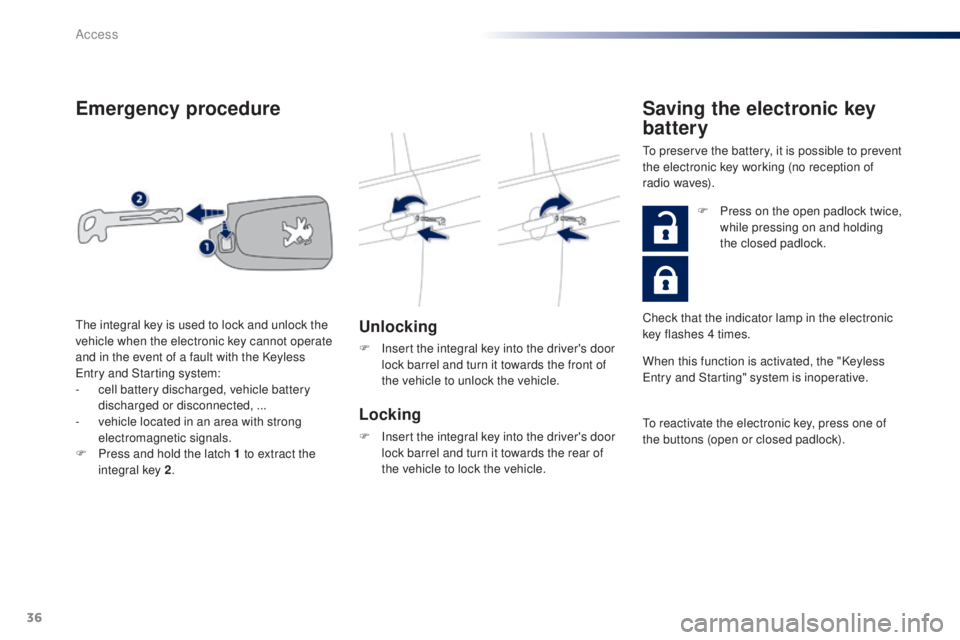
emergency procedure
unlocking
F Insert the integral key into the driver's door lock barrel and turn it towards the front of
the vehicle to unlock the vehicle.
Locking
F Insert the integral key into the driver's door lock barrel and turn it towards the rear of
the vehicle to lock the vehicle.
th
e integral key is used to lock and unlock the
vehicle when the electronic key cannot operate
and in the event of a fault with the Keyless
en
try and Starting system:
-
c
ell battery discharged, vehicle battery
discharged or disconnected, ...
-
v
ehicle located in an area with strong
electromagnetic signals.
F
P
ress and hold the latch 1 to extract the
integral key 2 .
Saving the electronic key
battery
to preserve the battery, it is possible to prevent
the electronic key working (no reception of
radio waves).
When this function is activated, the "Keyless
en
try and Starting" system is inoperative.
to r
eactivate the electronic key, press one of
the buttons (open or closed padlock). F
P
ress on the open padlock twice,
while pressing on and holding
the closed padlock.
Check that the indicator lamp in the electronic
key flashes 4 times.
Access
Page 39 of 268
37
108_en_Chap02_ouvertures_ed01-2016
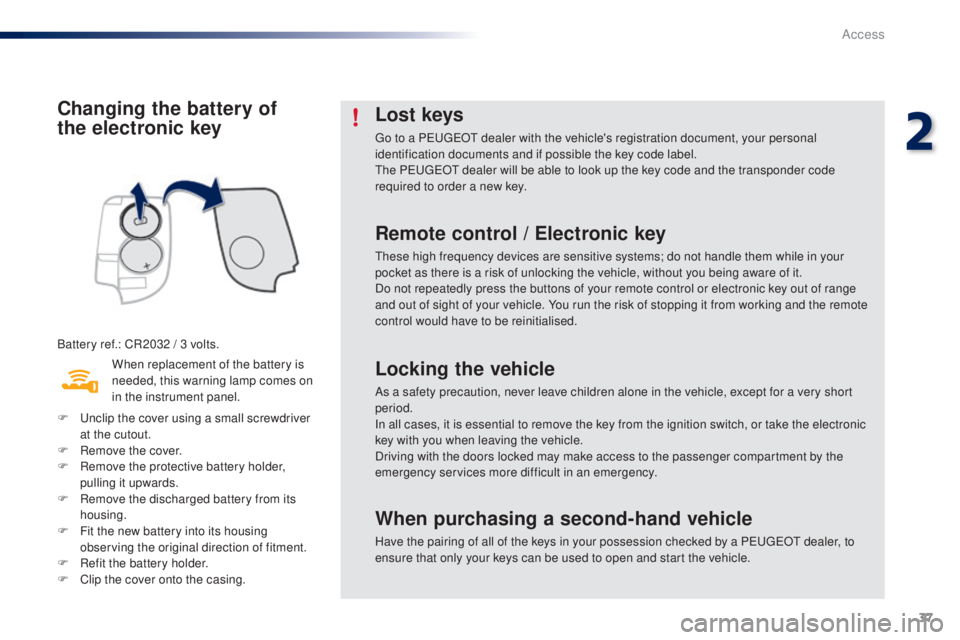
Changing the battery of
the electronic key
Battery ref.: CR2032 / 3 volts.When replacement of the battery is
needed, this warning lamp comes on
in the instrument panel.
F
u
n
clip the cover using a small screwdriver
at the cutout.
F
R
emove the cover.
F
R
emove the protective battery holder,
pulling it upwards.
F
R
emove the discharged battery from its
housing.
F
F
it the new battery into its housing
observing the original direction of fitment.
F
R
efit the battery holder.
F
C
lip the cover onto the casing.
Lost keys
go to a PeugeOt dealer with the vehicle's registration document, your personal
identification documents and if possible the key code label.
th
e P
e
uge
Ot
dealer will be able to look up the key code and the transponder code
required to order a new key.
Remote control / el ectronic key
these high frequency devices are sensitive systems; do not handle them while in your
pocket as there is a risk of unlocking the vehicle, without you being aware of it.
Do not repeatedly press the buttons of your remote control or electronic key out of range
and out of sight of your vehicle. You run the risk of stopping it from working and the remote
control would have to be reinitialised.
Locking the vehicle
As a safety precaution, never leave children alone in the vehicle, except for a very short
period.
In all cases, it is essential to remove the key from the ignition switch, or take the electronic
key with you when leaving the vehicle.
When purchasing a second-hand vehicle
Have the pairing of all of the keys in your possession checked by a Pe ugeOt dealer, to
ensure that only your keys can be used to open and start the vehicle. Driving with the doors locked may make access to the passenger compartment by the
emergency services more difficult in an emergency.
2
Access
Page 40 of 268
38
108_en_Chap02_ouvertures_ed01-2016
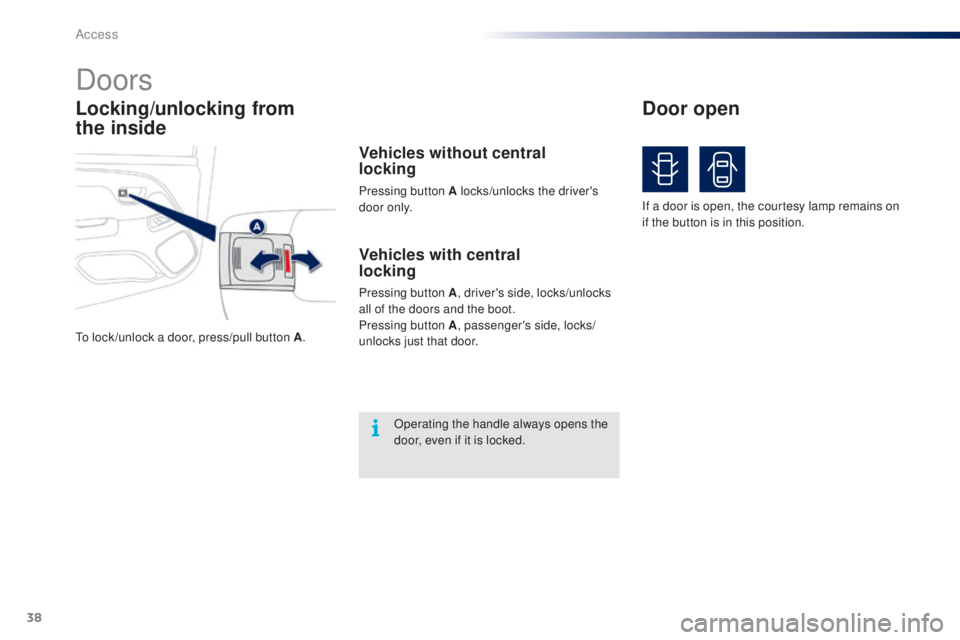
Locking/unlocking from
the inside
Doors
to lock /unlock a door, press/pull button A.
Vehicles with central
locking
Pressing button A, driver's side, locks/unlocks
all of the doors and the boot.
Pressing button A , passenger's side, locks/
unlocks just that door.
Door open
If a door is open, the courtesy lamp remains on
if the button is in this position.
Operating the handle always opens the
door, even if it is locked.
Vehicles without central
locking
Pressing button A locks/unlocks the driver's
d o o r o n l y.
Access
Page 41 of 268
39
108_en_Chap02_ouvertures_ed01-2016
Locking / unlocking and opening the boot
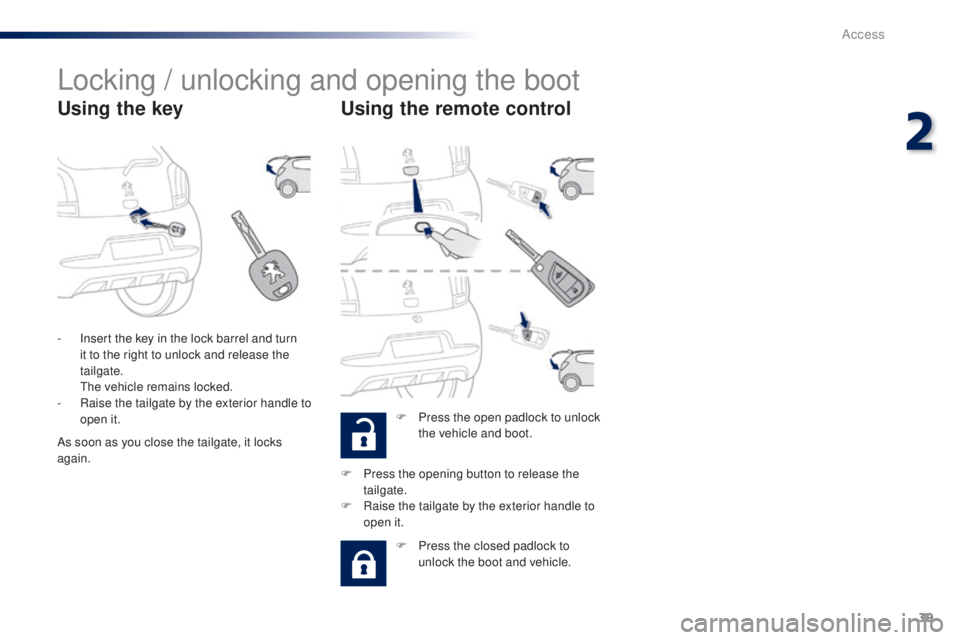
using the keyusing the remote control
F Press the open padlock to unlock
the vehicle and boot.
-
I
nsert the key in the lock barrel and turn
it to the right to unlock and release the
tailgate.
t
he
vehicle remains locked.
-
R
aise the tailgate by the exterior handle to
open it.
F
P
ress the opening button to release the
tailgate.
F
R
aise the tailgate by the exterior handle to
open it.
F
P
ress the closed padlock to
unlock the boot and vehicle.
As soon as you close the tailgate, it locks
again.
2
Access
Page 42 of 268
40
108_en_Chap02_ouvertures_ed01-2016
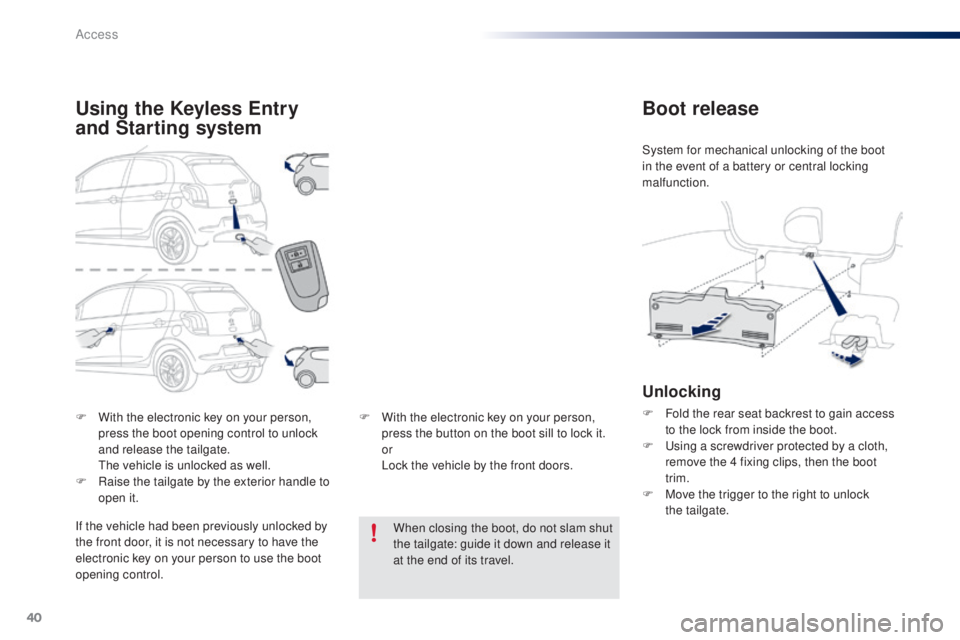
F With the electronic key on your person, press the boot opening control to unlock
and release the tailgate.
t
h
e vehicle is unlocked as well.
F
R
aise the tailgate by the exterior handle to
open it.
using the Keyless en try
and Starting system
If the vehicle had been previously unlocked by
the front door, it is not necessary to have the
electronic key on your person to use the boot
opening control. F
W
ith the electronic key on your person,
press the button on the boot sill to lock it.
or
L
ock the vehicle by the front doors.
When closing the boot, do not slam shut
the tailgate: guide it down and release it
at the end of its travel.
Boot release
System for mechanical unlocking of the boot
in the event of a battery or central locking
malfunction.
unlocking
F Fold the rear seat backrest to gain access to the lock from inside the boot.
F
u
s
ing a screwdriver protected by a cloth,
remove the 4 fixing clips, then the boot
trim.
F
M
ove the trigger to the right to unlock
the
tailgate.
Access
Page 45 of 268
43
108_en_Chap02_ouvertures_ed01-2016
opening
F Briefly press the control in the opening direction to open the the roof in stages.
or
F
P
ress and hold the control in the opening
direction, until the manoeuvre is complete,
to open the roof completely.
P
ressing again stops the movement of
the
roof.
Closing
F Briefly press the control in the closing direction to open the the roof in stages.
or
F
P
ress and hold the control in the closing
direction, until the manoeuvre is complete,
to close the roof to position 1 .
P
ressing again stops the movement of the
roof.
F
t
o c
lose the roof completely, press and
hold the control (between positions 1
and
0) until the roof locks closed.
th
e closing manoeuvre of the roof
could cause serious injuries: take
particular care with children.
If the roof does not close correctly:
-
c
heck that nothing is blocking the roof
(ignition off),
-
r
epeat the closing command (with the
engine running).
If the problem persists, contact a P
e
uge
Ot
dealer or a qualified workshop.
operating fault
In the event of an electrical fault,
contact a Pe ugeOt dealer or a
qualified workshop.
Protection of the electric motors
used for opening and closing the
roof
Following repeated opening and closing of the
roof, the electric motors may become too warm
and no longer allow the roof to be opened or
closed. Allow the motors to cool down with no
operation of the roof for 10 minutes.
2
Access
Page 49 of 268
47
108_en_Chap03_ergonomie-confort_ed01-2016
ensure that no person or object
prevents the seat slide from returning to
its initial position.
Check that the seat belt has reeled in
correctly so as to not impede access for
passengers to the rear seats.
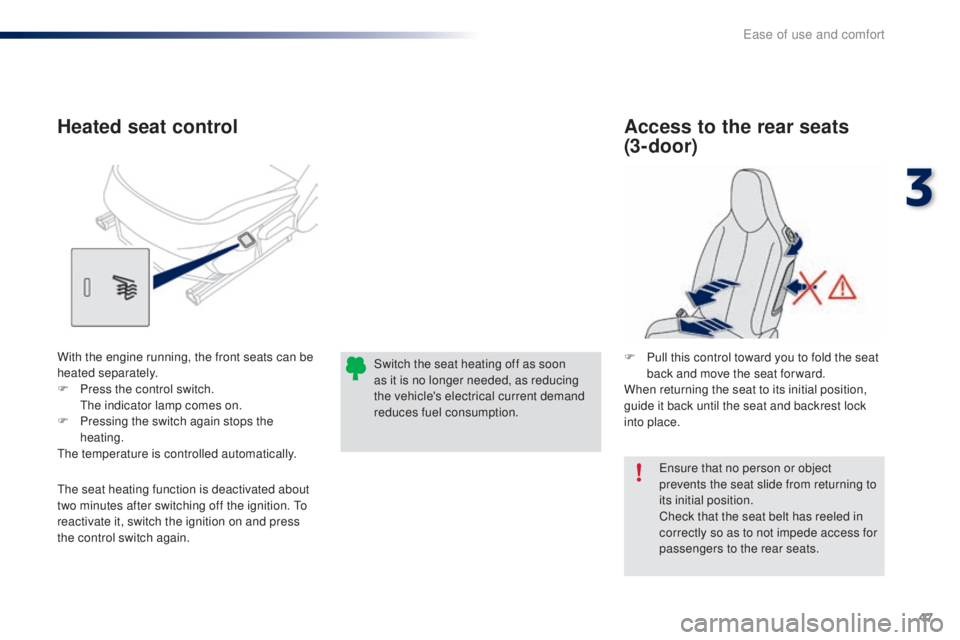
Heated seat controlAccess to the rear seats
(3-door)
F Pull this control toward you to fold the seat
back and move the seat for ward.
When returning the seat to its initial position,
guide it back until the seat and backrest lock
into place.
With the engine running, the front seats can be
heated separately.
F
P
ress the control switch.
t
h
e indicator lamp comes on.
F
P
ressing the switch again stops the
heating.
the
temperature is controlled automatically.
the
seat heating function is deactivated about
two minutes after switching off the ignition.
t
o
r
eactivate it, switch the ignition on and press
the control switch again. Switch the seat heating off as soon
as it is no longer needed, as reducing
the vehicle's electrical current demand
reduces fuel consumption.
3
ease of use and comfort
Page 50 of 268
48
108_en_Chap03_ergonomie-confort_ed01-2016
Your vehicle is fitted with a fixed one-piece cushion bench rear seat, and depending on version:
- a f olding split (50/50) backrest,
-
a f
olding one-piece backrest.
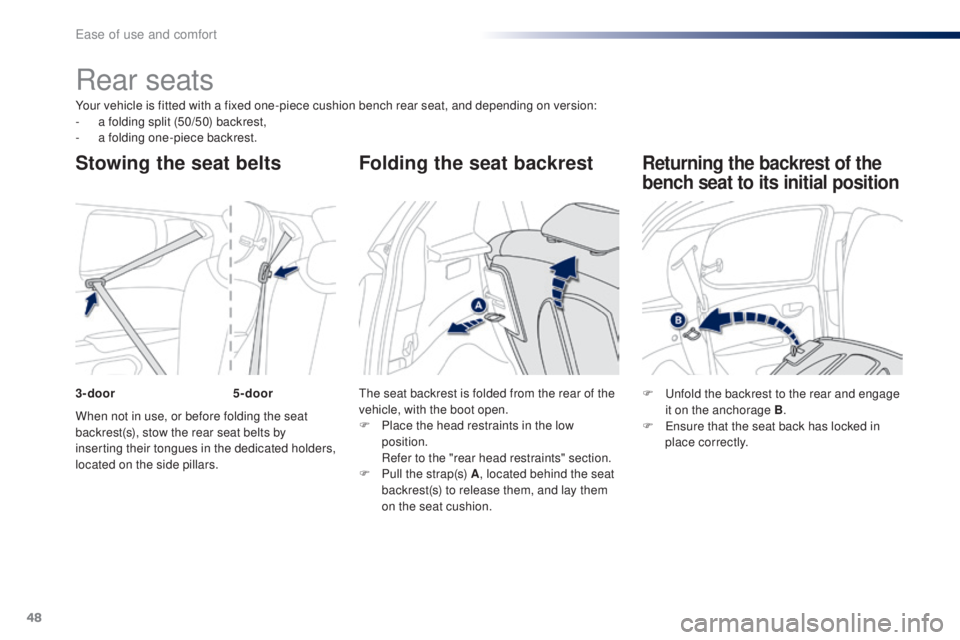
When not in use, or before folding the seat
backrest(s), stow the rear seat belts by
inserting their tongues in the dedicated holders,
located on the side pillars.
th
e seat backrest is folded from the rear of the
vehicle, with the boot open.
F
P
lace the head restraints in the low
position.
R
efer to the "rear head restraints" section.
F
P
ull the strap(s) A, located behind the seat
backrest(s) to release them, and lay them
on the seat cushion.
Rear seats
Stowing the seat belts Folding the seat backrest
F unfold the backrest to the rear and engage it on the anchorage B .
F
e
n
sure that the seat back has locked in
place correctly.
Returning the backrest of the
bench seat to its initial position
3-door 5-door
ease of use and comfort
Page 53 of 268
51
108_en_Chap03_ergonomie-confort_ed01-2016
Steering wheel adjustment
(with power steering)
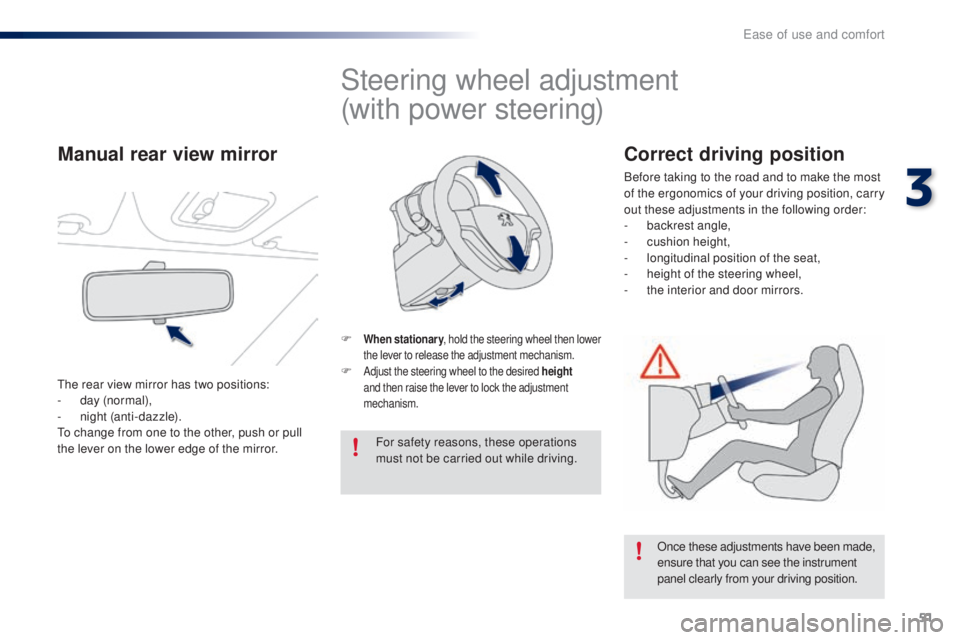
F When stationary, hold the steering wheel then lower
the lever to release the adjustment mechanism.
F Adjust the steering wheel to the desired height
and then raise the lever to lock the adjustment
mechanism.
For safety reasons, these operations
must not be carried out while driving.
Once these adjustments have been made,
ensure that you can see the instrument
panel clearly from your driving position.
Manual rear view mirror
the rear view mirror has two positions:
- d ay (normal),
-
n
ight (anti-dazzle).
to c
hange from one to the other, push or pull
the lever on the lower edge of the mirror.
Correct driving position
Before taking to the road and to make the most
of the ergonomics of your driving position, carry
out these adjustments in the following order:
-
b
ackrest angle,
-
c
ushion height,
-
l
ongitudinal position of the seat,
-
hei
ght of the steering wheel,
-
t
he interior and door mirrors.
3
ease of use and comfort
Page 55 of 268
53
108_en_Chap03_ergonomie-confort_ed01-2016
Recommendations for use
If the interior temperature remains very high after a prolonged period parked in the sun, first
ventilate the passenger compartment for a few minutes.
For an even air distribution, make sure that you do not block the outside air inlet grille, the
vents, the air passages and the air outlets to the footwells.
en
sure that the passenger compartment filter, located behind the glove box in the heater
unit, is in good condition. Have the filter elements replaced regularly. If you drive in dusty
conditions, change them twice as often.
Operate the air conditioning system for 5 to 10 minutes, once or twice a month, to keep it in
perfect working order.
In order to ensure that your air conditioning system continues to operate correctly, you are
advised to have it checked regularly.
If the system does not produce cold air, do not use it and contact a P
e
uge
Ot
dealer or a
qualified workshop.
th
e air conditioning system does not contain chlorine and does not present any danger to
the ozone layer.
th
e condensation created by the air conditioning results in a flow of water under the vehicle
when stationary which is per fectly normal.
3
ease of use and comfort