warning PEUGEOT 108 2016 Owner's Guide
[x] Cancel search | Manufacturer: PEUGEOT, Model Year: 2016, Model line: 108, Model: PEUGEOT 108 2016Pages: 268, PDF Size: 6.17 MB
Page 98 of 268
96
108_en_Chap04_conduite_ed01-2016
under-inflation alert
this is given by fixed illumination of
this warning lamp, accompanied by
an audible signal.
F
R
educe speed immediately, avoid
excessive steering movements and sudden
braking.
F
S
top the vehicle as soon as it is safe to
do
so.
th
e loss of pressure detected does not
always cause visible bulging of the tyre.
Do not satisfy yourself with just a visual
check.
F
I
f you have a compressor (such as the one
in the temporary puncture repair kit) check
the pressures of the four tyres when cold.
I
f it is not possible to carry out this check
straight away, drive carefully at reduced
speed.
or
F
I
n the event of a puncture, use the
temporary puncture repair kit or the spare
wheel (depending on equipment).
th
e alert is maintained until the system
is reinitialised.
Reinitialisation
Before reinitialising the system, ensure
that the pressures of the four tyres are
correct for the use of the vehicle and in
line with the recommendations on the
tyre pressure label.
th
e under-inflation alert can only be
relied on if the reinitialisation of the
system has done with the pressures in
the four tyres correctly adjusted.
th
e under-inflation detection system
does not give a warning if a pressure is
incorrect at the time of reinitialisation.
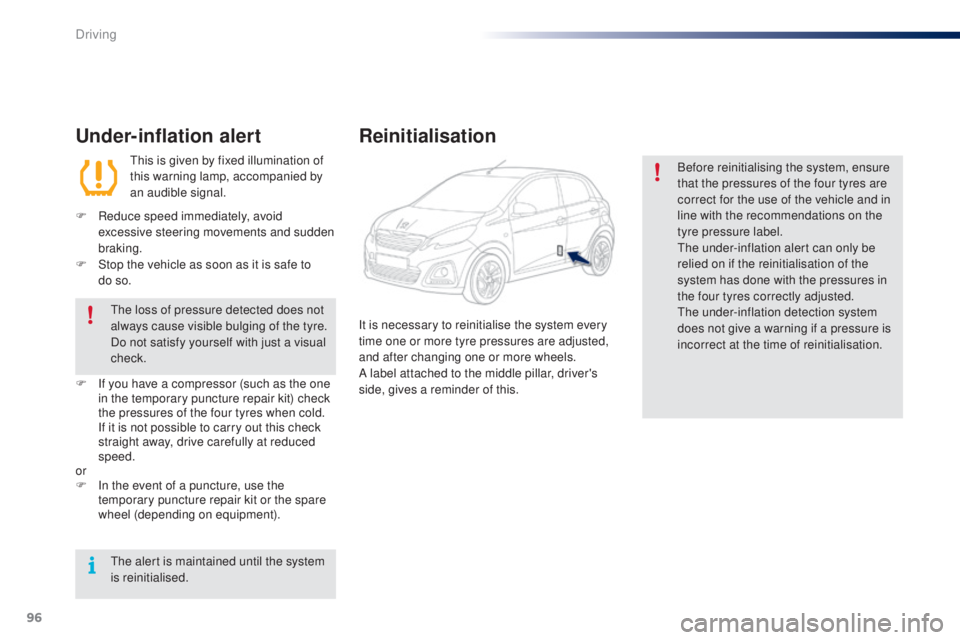
It is necessary to reinitialise the system every
time one or more tyre pressures are adjusted,
and after changing one or more wheels.
A label attached to the middle pillar, driver's
side, gives a reminder of this.
Driving
Page 99 of 268
97
108_en_Chap04_conduite_ed01-2016
the under-inflation alert can only be
considered reliable if reinitialisation of
the system is done with the the four tyre
pressures correctly set.
Snow chains
the system does not have to be
reinitialised after fitting or removing
snow chains.
operating fault
the flashing and then fixed illumination
of the under-inflation warning lamp
indicates a fault with the system.
In this case, under-inflation monitoring of the
tyres is no longer assured.
Have the system checked by a P
e
uge
Ot
dealer or a qualified workshop.
Before doing anything to the system,
the pressures of the four tyres must be
checked and the system reinitialised.
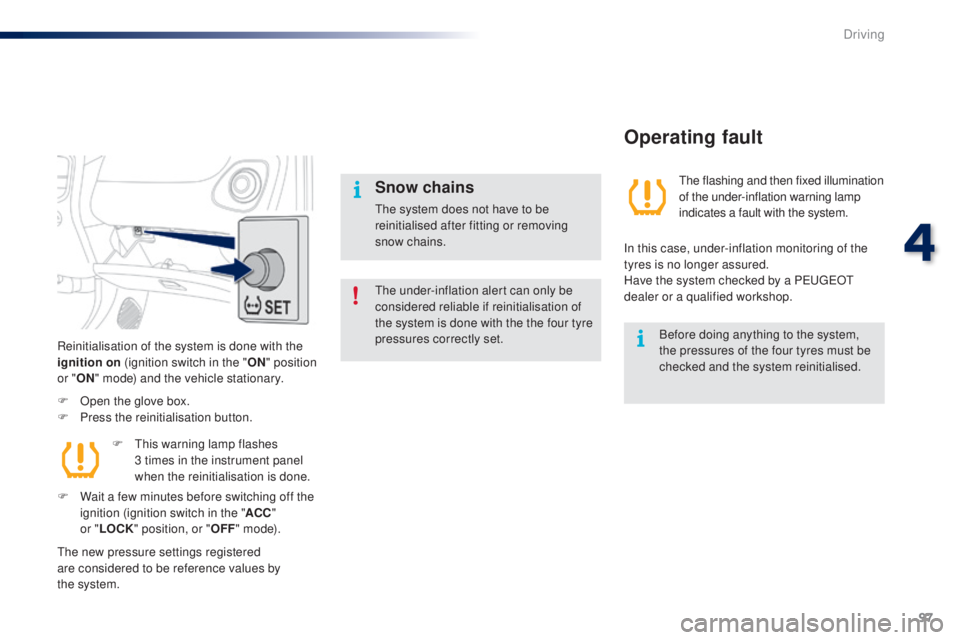
Reinitialisation of the system is done with the
ignition on
(ignition switch in the "
oN" p
osition
or "
oN " m
ode) and the vehicle stationary.
F
O
pen the glove box.
F
P
ress the reinitialisation button.
the
new pressure settings registered
are considered to be reference values by
the
system. F
t
h
is warning lamp flashes
3
times in the instrument panel
when the reinitialisation is done.
F
W
ait a few minutes before switching off the
ignition (ignition switch in the " ACC"
or " L
o
C
K " position, or "
oFF "
m o d e).
4
Driving
Page 108 of 268
106
108_en_Chap06_securite_ed01-2016
Horn
Audible warning to alert other road users to an
imminent danger.When manoeuvring the vehicle,
take care not to operate the horn
unintentionally.
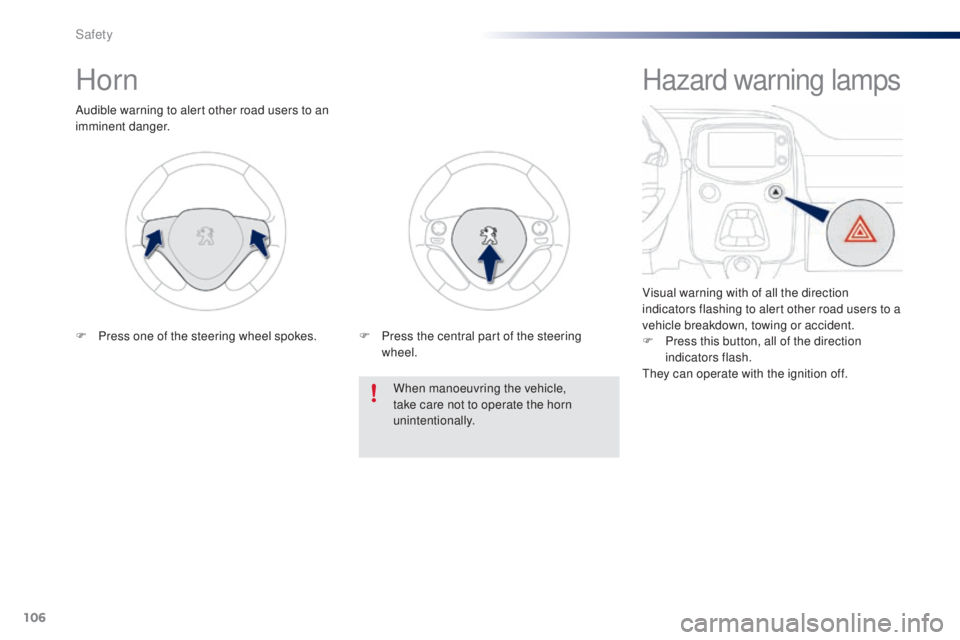
F
P
ress one of the steering wheel spokes. F
P
ress the central part of the steering
wheel.
Hazard warning lamps
Visual warning with of all the direction
indicators flashing to alert other road users to a
vehicle breakdown, towing or accident.
F
P
ress this button, all of the direction
indicators flash.
th
ey can operate with the ignition off.
Safety
Page 110 of 268
108
108_en_Chap06_securite_ed01-2016
Illumination of this warning lamp,
accompanied by an audible signal,
indicates that there is a fault with the
electronic brake force distribution
(
eB
FD), which could cause loss of
control of the vehicle when braking.
operation
Illimination of this warning lamp,
accompanied by an audible signal,
indicates that there is a fault with
the ABS system, which could cause
loss of control of the vehicle when
braking.
Anti-lock braking system (ABS)
and electronic brake force
distribution (
e
BFD)When changing wheels (tyres and rims),
make sure that these are approved for
your vehicle.
Normal operation of the ABS may make
itself felt by slight vibration of the brake
pedal.
In emergency braking, press
very firmly without releasing the
pressure.
Yo u must stop as soon as it is safe to do so .
Contact a P
e
uge
Ot
dealer or a qualified
workshop as soon as possible.
Dynamic stability control (DSC)
and traction control (tR C)
Activation
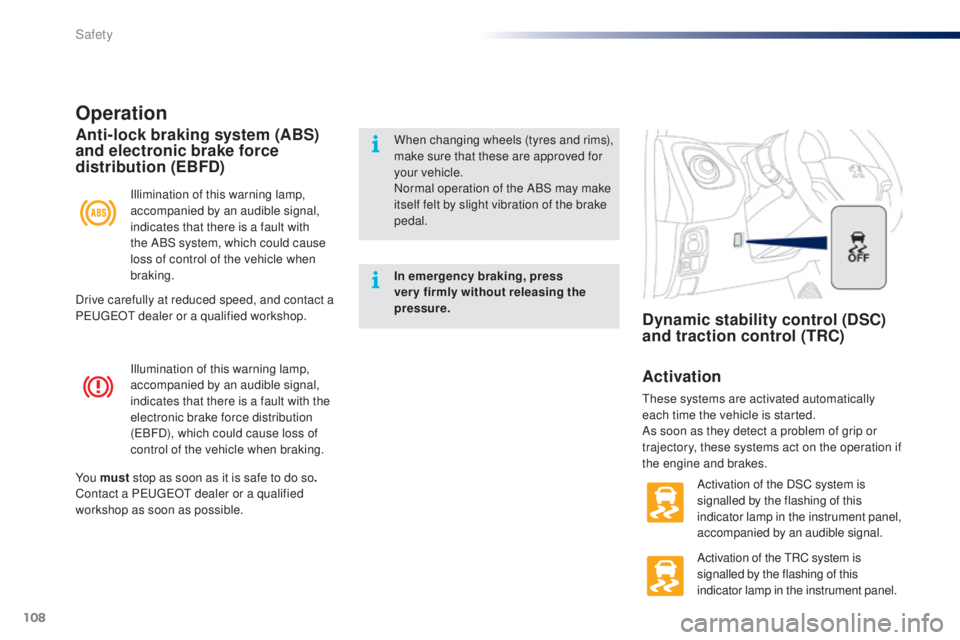
these systems are activated automatically
each time the vehicle is started.
As soon as they detect a problem of grip or
trajectory, these systems act on the operation if
the engine and brakes. Activation of the DSC system is
signalled by the flashing of this
indicator lamp in the instrument panel,
accompanied by an audible signal.
Activation of the
t
R
C system is
signalled by the flashing of this
indicator lamp in the instrument panel.
Drive carefully at reduced speed, and contact a
P
e
uge
Ot
dealer or a qualified workshop.
Safety
Page 111 of 268
109
108_en_Chap06_securite_ed01-2016
the tRC and DSC systems offer
increased safety in normal driving, but
should not encourage the driver to take
extra risks or drive at high speed.
th
e correct operation of these
systems depends on observation of
the manufacturer's recommendations
regarding the wheels (tyres and rims),
the braking components, the electronic
components and the assembly and
repair procedures used by P
e
uge
Ot
dealers.
After an impact, have the system
checked by a P
e
uge
Ot
dealer or a
qualified workshop.
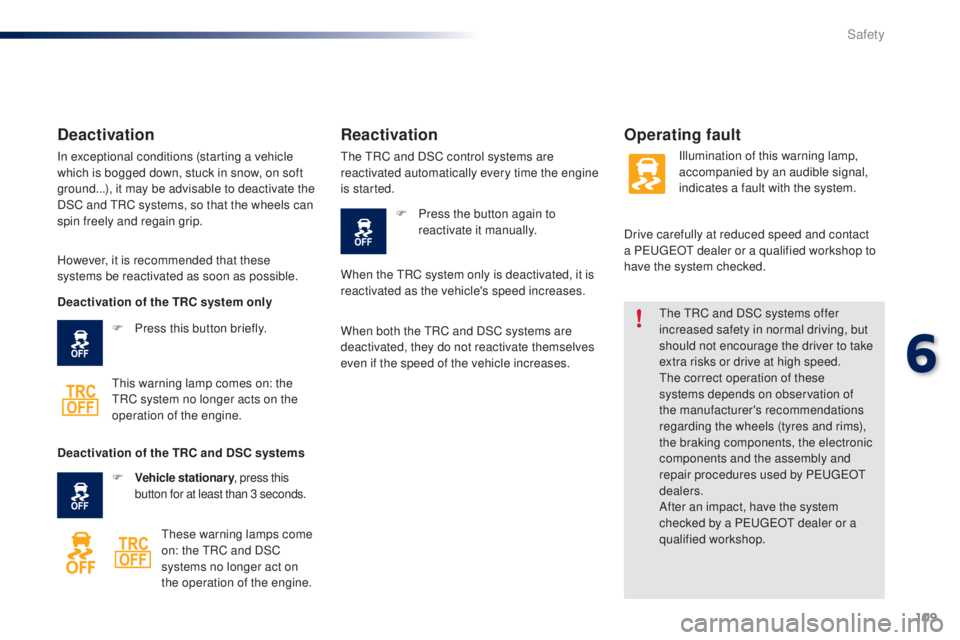
Deactivation
In exceptional conditions (starting a vehicle
which is bogged down, stuck in snow, on soft
ground...), it may be advisable to deactivate the
DSC and
t
R
C systems, so that the wheels can
spin freely and regain grip.
operating fault
However, it is recommended that these
systems be reactivated as soon as possible.
F
P
ress this button briefly.
th
is warning lamp comes on: the
tR
C system no longer acts on the
operation of the engine.
Reactivation
the tRC and DSC control systems are
reactivated automatically every time the engine
is started.
F
P
ress the button again to
reactivate it manually. Illumination of this warning lamp,
accompanied by an audible signal,
indicates a fault with the system.
Drive carefully at reduced speed and contact
a P
e
uge
Ot
dealer or a qualified workshop to
have the system checked.
Deactivation of the
t
R
C system only
Deactivation of the
t
R
C and DSC systems
F
V
ehicle stationary , press this
button for at least than 3 seconds.
th
ese warning lamps come
on: the
t
R
C and DSC
systems no longer act on
the operation of the engine. When the
t
R
C system only is deactivated, it is
reactivated as the vehicle's speed increases.
When both the
t
R
C and DSC systems are
deactivated, they do not reactivate themselves
even if the speed of the vehicle increases.
6
Safety
Page 113 of 268
111
108_en_Chap06_securite_ed01-2016
operation
three levels of operation are possible:
● P re-collision alert : if a risk of collision
with a vehicle is detected, a warning lamp
comes on in the instrument panel together
with an audible signal to encourage the
driver to make an avoiding manoeuvre.
t
h
e
thresholds for triggering the alert can be
set.
●
Br
aking assistance : increases the
braking started by the driver, only if a risk
of collision is detected.
●
A
utomatic pre-collision braking: when
your vehicle is too close to or closing
too quickly on the vehicle ahead of you,
the system automatically operates the
brakes to reduce the speed of impact. A
collision can be avoided automatically if the
difference in speed between your vehicle
and the one ahead is not more than 18 mph
(30 km/h).
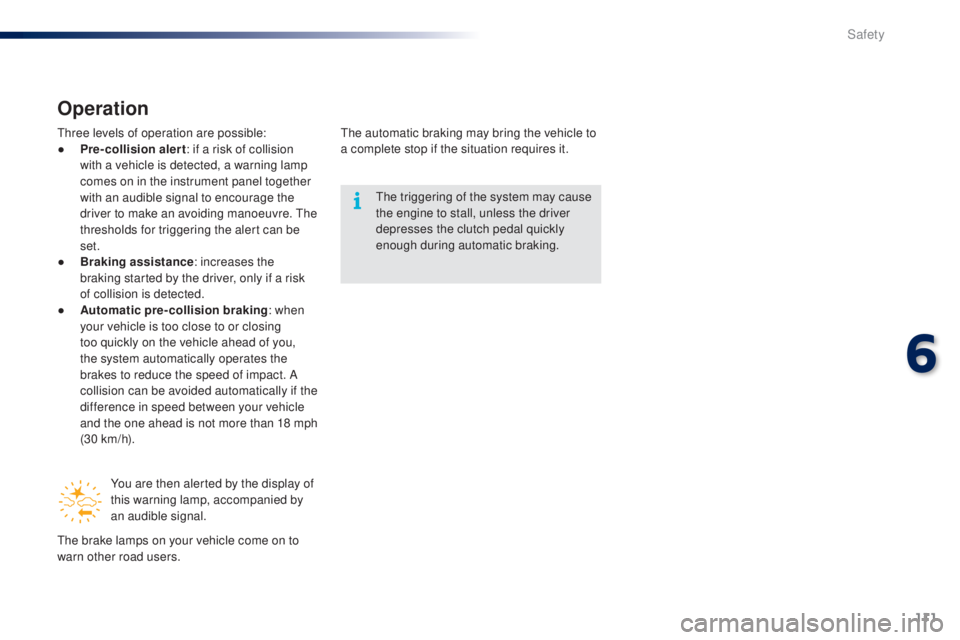
You are then alerted by the display of
this warning lamp, accompanied by
an audible signal.th e automatic braking may bring the vehicle to
a complete stop if the situation requires it.
th
e brake lamps on your vehicle come on to
warn other road users.
th
e triggering of the system may cause
the engine to stall, unless the driver
depresses the clutch pedal quickly
enough during automatic braking.
6
Safety
Page 114 of 268
112
108_en_Chap06_securite_ed01-2016
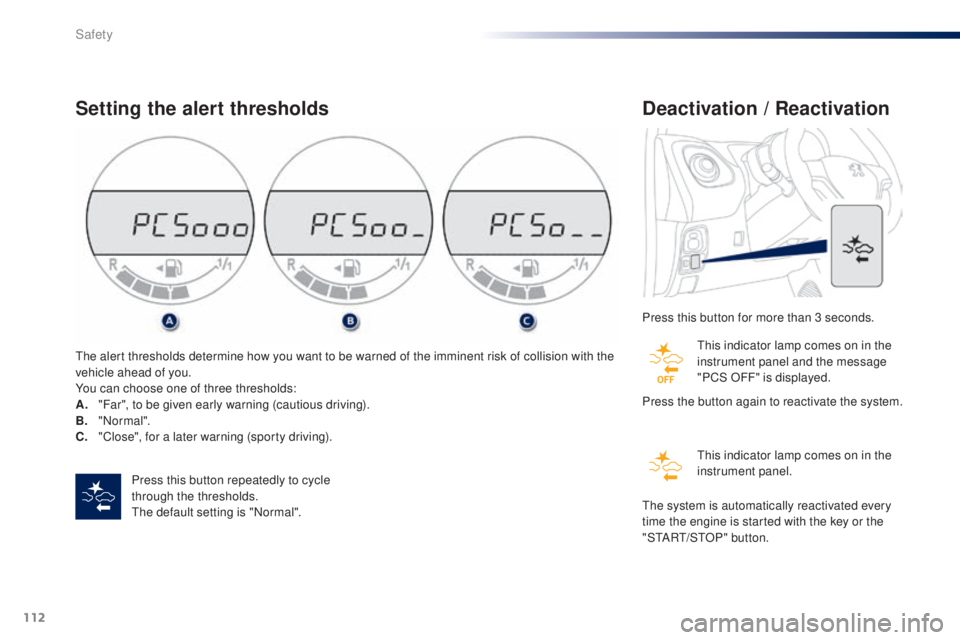
Setting the alert thresholds
Press this button repeatedly to cycle
through the thresholds.
the
default setting is "Normal".
th
e alert thresholds determine how you want to be warned of the imminent risk of collision with the
vehicle ahead of you.
You can choose one of three thresholds:
A.
"
Far", to be given early warning (cautious driving).
B.
"Normal".
C.
"
Close", for a later warning (sporty driving).
Deactivation / Reactivation
Press this button for more than 3 seconds.
Press the button again to reactivate the system.
th
e system is automatically reactivated every
time the engine is started with the key or the
"S
t
A
R
t/
S t
O
P" button.
th
is indicator lamp comes on in the
instrument panel.
th
is indicator lamp comes on in the
instrument panel and the message
"PCS OFF" is displayed.
Safety
Page 116 of 268
114
108_en_Chap06_securite_ed01-2016
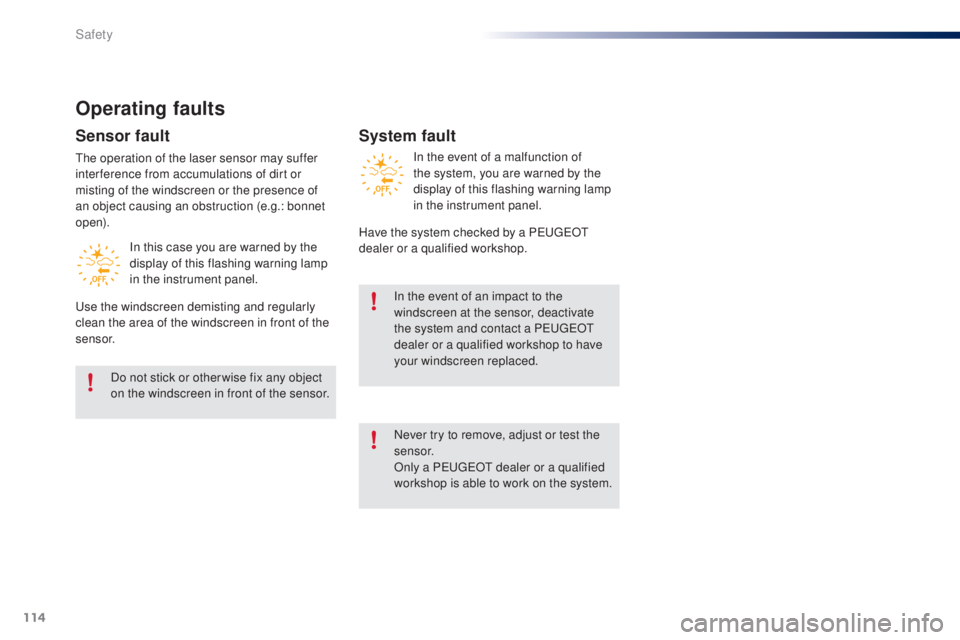
operating faults
Sensor fault
the operation of the laser sensor may suffer
inter ference from accumulations of dirt or
misting of the windscreen or the presence of
an object causing an obstruction (e.g.: bonnet
open).In this case you are warned by the
display of this flashing warning lamp
in the instrument panel.
use
the windscreen demisting and regularly
clean the area of the windscreen in front of the
sensor.
Do not stick or other wise fix any object
on the windscreen in front of the sensor.
System fault
In the event of a malfunction of
the system, you are warned by the
display of this flashing warning lamp
in the instrument panel.
Have the system checked by a P
e
uge
Ot
dealer or a qualified workshop.
In the event of an impact to the
windscreen at the sensor, deactivate
the system and contact a P
e
uge
Ot
dealer or a qualified workshop
to have
your windscreen replaced.
Never try to remove, adjust or test the
sensor.
Only a P
e
uge
Ot
dealer or a qualified
workshop is able to work on the system.
Safety
Page 118 of 268
116
108_en_Chap06_securite_ed01-2016
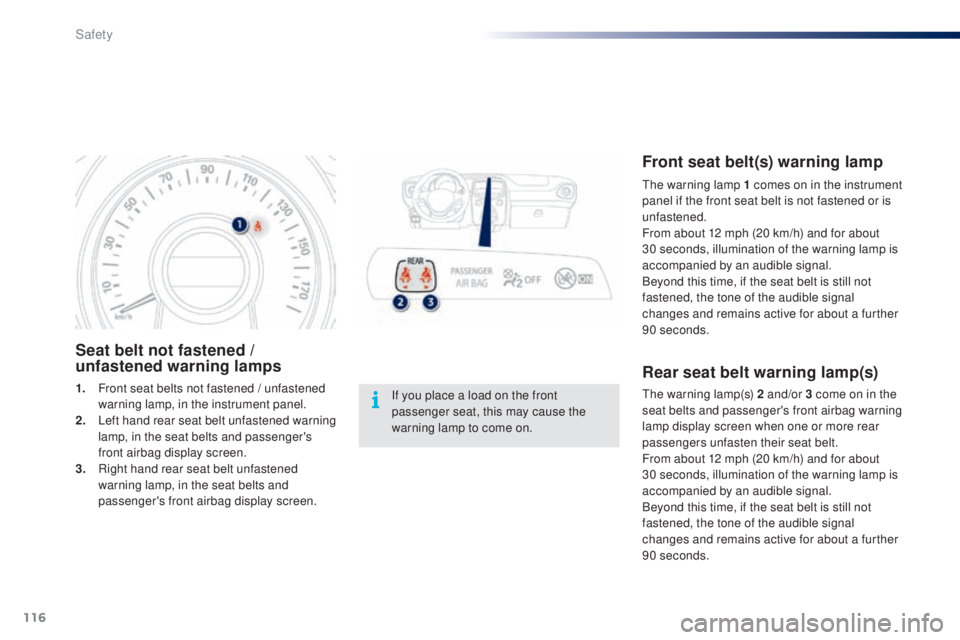
Seat belt not fastened /
unfastened warning lamps
1. Front seat belts not fastened / unfastened warning lamp, in the instrument panel.
2.
L
eft hand rear seat belt unfastened warning
lamp, in the seat belts and passenger's
front airbag display screen.
3.
R
ight hand rear seat belt unfastened
warning lamp, in the seat belts and
passenger's front airbag display screen.Rear seat belt warning lamp(s)
the warning lamp(s) 2 and/or 3 come on in the
seat belts and passenger's front airbag warning
lamp display screen when one or more rear
passengers unfasten their seat belt.
From about 12 mph (20 km/h) and for about
30 seconds, illumination of the warning lamp is
accompanied by an audible signal.
Beyond this time, if the seat belt is still not
fastened, the tone of the audible signal
changes and remains active for about a further
90 seconds.
If you place a load on the front
passenger seat, this may cause the
warning lamp to come on.
Front seat belt(s) warning lamp
the warning lamp 1
comes on in the instrument
panel if the front seat belt is not fastened or is
unfastened.
From about 12 mph (20 km/h) and for about
30 seconds, illumination of the warning lamp is
accompanied by an audible signal.
Beyond this time, if the seat belt is still not
fastened, the tone of the audible signal
changes and remains active for about a further
90 seconds.
Safety
Page 119 of 268
117
108_en_Chap06_securite_ed01-2016
the driver must ensure that passengers use
the seat belts correctly and that they are all
fastened before setting off.
Wherever you are seated in the vehicle,
always fasten your seat belt, even for short
journeys.
Do not interchange the seat belt buckles as
they will not fulfil their role fully.
th
e seat belts are fitted with an inertia reel
permitting automatic adjustment of the
length of the strap to your size.
t
h
e seat belt
is stowed automatically when not in use.
Before and after use, ensure that the seat
belt is reeled in correctly.
th
e lower part of the strap must be
positioned as low as possible on the pelvis.
th
e upper part must be positioned in the
hollow of the shoulder.
th
e inertia reels are fitted with an automatic
locking device which comes into operation in
the event of a collision, emergency braking
or if the vehicle rolls over. You can release
the device by pulling the strap firmly and
then releasing it so that it reels in slightly.Recommendations for children
use a suitable child seat if the passenger is
less than 12 years old or shorter than one
and a half metres.
Never use the same seat belt to secure more
than one person.
Never allow a child to travel on your lap.
For more information on child seats, refer to
the corresponding section.
In order to be effective, a seat belt must:
-
b
e tightened as close to the body as
possible,
-
b
e pulled in front of you with a smooth
movement, checking that it does not
twist,
-
b
e used to restrain only one person,
-
n
ot bear any trace of cuts or fraying,
-
n
ot be converted or modified to avoid
affecting its performance.
In the event of an impact
Depending on the nature and
seriousness of the impact , the
pretensioning device may be deployed
before and independently of the airbags.
Deployment of the pretensioners is
accompanied by a slight discharge of
harmless smoke and a noise, due to the
activation of the pyrotechnic cartridge
incorporated in the system.
In all cases, the airbag warning lamp
comes on.
Following an impact, have the seat belts
system checked, and if necessary replaced,
by a P
e
uge
Ot
dealer or a qualified
workshop.
In accordance with current safety
regulations, for all repairs on your vehicle's
seat belts, go to a qualified workshop with
the skills and equipment needed, which a
Pe
ugeOt d
ealer is able to provide.
Have your seat belts checked regularly by a
P
e
uge
Ot
dealer or a qualified workshop,
particularly if the straps show signs of
damage.
Clean the seat belt straps with soapy
water or a textile cleaning product, sold by
P
e
uge
Ot d
ealers.
After folding or moving a seat or rear bench
seat, ensure that the seat belt is positioned
and reeled in correctly.
Advice
6
Safety