seats PEUGEOT 108 2016 Owners Manual
[x] Cancel search | Manufacturer: PEUGEOT, Model Year: 2016, Model line: 108, Model: PEUGEOT 108 2016Pages: 268, PDF Size: 6.17 MB
Page 4 of 268
.
.
108_en_Chap00a_sommaire_ed01-2016
Instrument panels 11
Display screens
1
3
Indicator and warning lamps
1
5
Indicators
26
tr
ip computer
2
7
Setting the time
2
9
InstrumentsOver view
Keys
31
Keyless e
n
try and Starting system
3
4
Doors
38
Boot
39
Front electric windows
4
1
Rear quarter windows
4
1
ele
ctric fabric roof
4
2
Access
Front seats 4 6
Rear seats
4
8
Mirrors
50
Steering wheel adjustment
5
1
Ventilation
52
Heating
54
Manual air conditioning
5
5
Automatic air conditioning
5
7
Front demist - defrost
6
0
Rear screen demist - defrost
6
1
Courtesy lamp
6
2
Boot lamp
6
2
Interior fittings
6
3
Rear parcel shelf
6
7
Boot fittings
6
8
ease of use and comfort
Driving recommendations 70
Starting - switching off the engine
with the key
7
1
Starting - switching off the engine with
the
Keyless e
n
try and Starting system
7
2
Manual parking brake
7
6
5-speed manual gearbox
7
6
e
tg
el
ectronic gearbox
7
7
ge
ar shift indicator
8
1
Hill start assist
8
2
Stop & Start
8
3
Speed limiter
8
6
Reversing camera
9
2
Lane departure warning system
9
3
Under-inflation detection
9
5
Driving
e
co-driving
Contents
Page 5 of 268
.
108_en_Chap00a_sommaire_ed01-2016
exterior lighting control stalk 98
Automatic illumination of headlamps
1
01
Direction indicators
1
03
Headlamp beam height adjustment
1
03
Wiper control stalk
1
04
Lighting and visibility
Horn 10 6
Hazard warning lamps
1
06
e
SC system
1
07
Active City Brake
1
10
Seat belts
1
15
Airbags
118
Child seats
1
23
Deactivating the passenger's front airbag
1
26
ISOFIX child seats
1
32
Child lock
1
37
SafetyIn the event of a breakdown
Fuel tank 1 38
Snow chains
1
40
el
ectrical energy economy mode
1
41
Accessories
142
Changing a wiper blade
1
44
Fitting roof bars
1
44
Bonnet
14
6
Petrol engines
1
47
Checking levels
1
48
C h e c ks
151
Practical informationte chnical data
7-inch touch screen 185
Radio
2
35
Audio equipment and telematics
Alphabetical index
temporary puncture repair kit 1 53
Spare wheel
1
58
Changing a bulb
1
63
Changing a fuse
1
68
12 V battery
1
77
to
wing the vehicle
1
80
en
gines
181
Weights
182
Dimensions
183
Identification markings
1
84
Contents
Page 7 of 268
5
108_en_Chap00b_vue-ensemble_ed01-2016
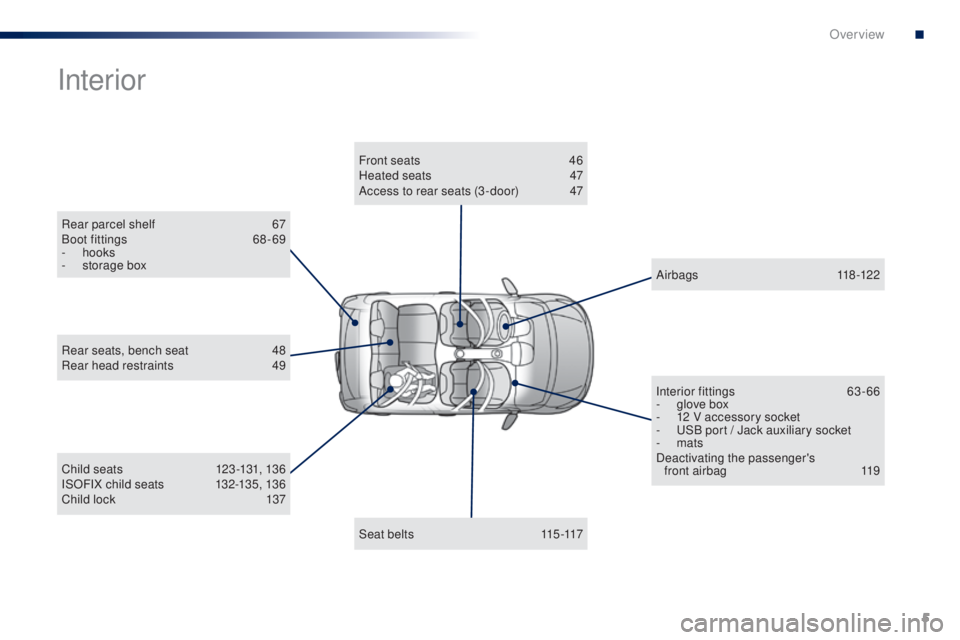
Rear parcel shelf 67
Boot fittings 6 8 - 69
-
hooks
-
s
torage box
Interior
Child seats 1 23 -131, 136
ISOFIX child seats 1 32-135, 136
Child lock
1
37
Rear seats, bench seat
4
8
Rear head restraints
4
9
Interior fittings
6
3-66
-
g
love box
-
1
2 V accessory socket
- u
S
B port / Jack auxiliary socket
- mats
Deactivating the passenger's front airbag 1 19
Airbags
118-122
Seat belts
1
15-117
Front seats
4
6
Heated seats
4
7
Access to rear seats (3 -door)
4
7
.
Over view
Page 12 of 268
10
108_en_Chap00c_eco-conduite_ed01-2016
Limit the causes of excess consumption
Spread loads throughout the vehicle; place the heaviest items in the
bottom of the boot, as close as possible to the rear seats.
Limit the loads carried in the vehicle and reduce wind resistance
(roof bars, roof rack...). u
s
e a roof box in preference.
Remove roof bars and roof racks after use.
At the end of winter, remove snow tyres and refit your summer tyres.
observe the recommendations on
maintenance
Check the tyre pressures regularly, when cold, referring to the label in
the door aperture, driver's side.
Carry out this check in particular:
-
b
efore a long journey,
-
a
t each change of season,
-
a
fter a long period out of use.
Don't forget the spare wheel and the tyres on any trailer or caravan.
Have your vehicle serviced regularly (engine oil, oil filter, air filter,
passenger compartment filter...) and observe the schedule of
operations recommended in the warranty and maintenance record.
When refuelling, do not continue after the third cut-off of the nozzle to
avoid any over flow.
At the wheel of your new vehicle, it is only after the first 1 800 miles
(3
000 kilometres) that you will see the fuel consumption settle down to
a consistent average.
eco-driving
Page 43 of 268
41
108_en_Chap02_ouvertures_ed01-2016
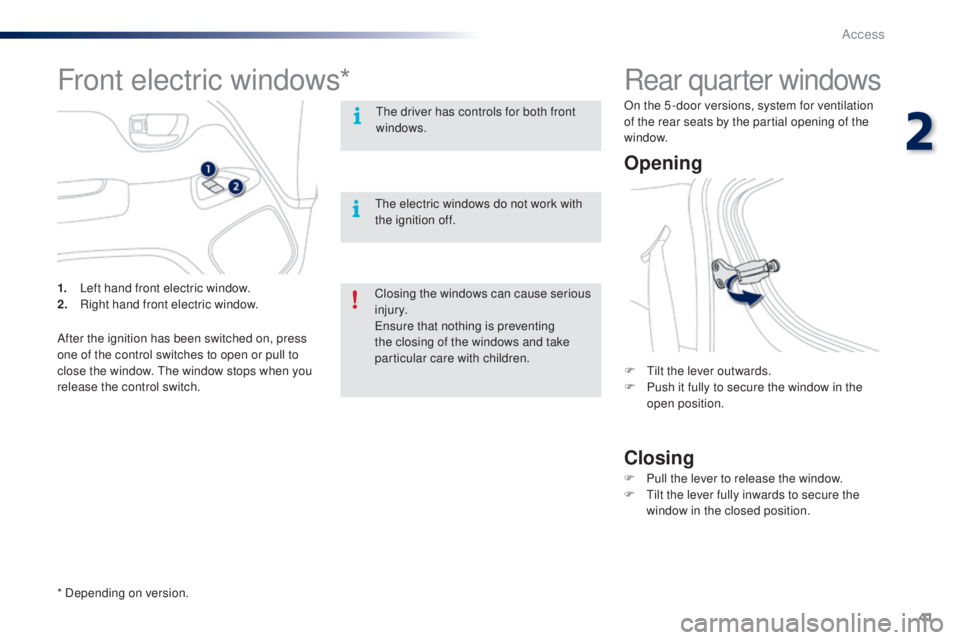
Rear quarter windows
opening
Closing
F tilt the lever outwards.
F P ush it fully to secure the window in the
open position.
F
P
ull the lever to release the window.
F
t
i
lt the lever fully inwards to secure the
window in the closed position.
On the 5 -door versions, system for ventilation
of the rear seats by the partial opening of the
window.
Front electric windows*
the driver has controls for both front
windows.
th
e electric windows do not work with
the ignition off.
1.
L
eft hand front electric window.
2.
R
ight hand front electric window.
After the ignition has been switched on, press
one of the control switches to open or pull to
close the window.
t
he
window stops when you
release the control switch.
* Depending on version. Closing the windows can cause serious
injury.
en
sure that nothing is preventing
the closing of the windows and take
particular care with children.
2
Access
Page 48 of 268
46
108_en_Chap03_ergonomie-confort_ed01-2016
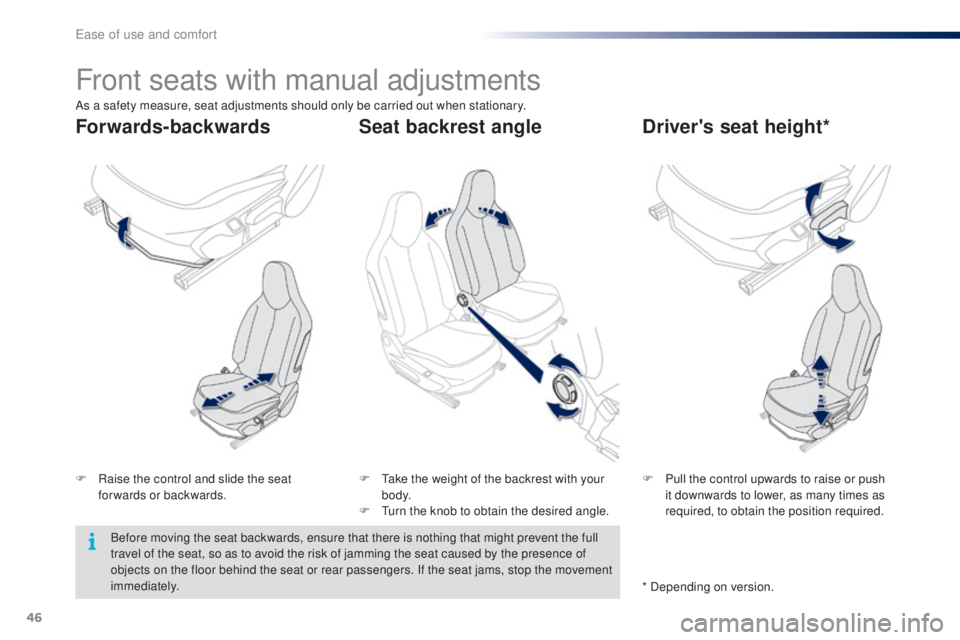
Front seats with manual adjustments
F Raise the control and slide the seat forwards or backwards. F
P ull the control upwards to raise or push
it downwards to lower, as many times as
required, to obtain the position required.
F
ta ke the weight of the backrest with your
b o dy.
F
t
u
rn the knob to obtain the desired angle.
Forwards-backwards Driver's seat height*
Seat backrest angle
As a safety measure, seat adjustments should only be carried out when stationary.
Before moving the seat backwards, ensure that there is nothing that might prevent the full
travel of the seat, so as to avoid the risk of jamming the seat caused by the presence of
objects on the floor behind the seat or rear passengers. If the seat jams, stop the movement
immediately. * Depending on version.
ease of use and comfort
Page 49 of 268
47
108_en_Chap03_ergonomie-confort_ed01-2016
ensure that no person or object
prevents the seat slide from returning to
its initial position.
Check that the seat belt has reeled in
correctly so as to not impede access for
passengers to the rear seats.
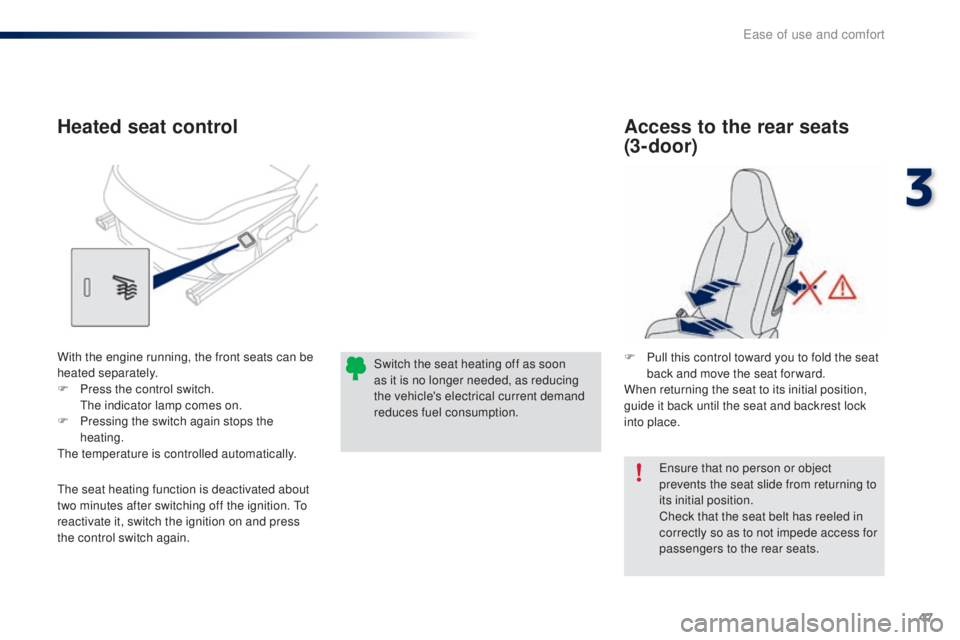
Heated seat controlAccess to the rear seats
(3-door)
F Pull this control toward you to fold the seat
back and move the seat for ward.
When returning the seat to its initial position,
guide it back until the seat and backrest lock
into place.
With the engine running, the front seats can be
heated separately.
F
P
ress the control switch.
t
h
e indicator lamp comes on.
F
P
ressing the switch again stops the
heating.
the
temperature is controlled automatically.
the
seat heating function is deactivated about
two minutes after switching off the ignition.
t
o
r
eactivate it, switch the ignition on and press
the control switch again. Switch the seat heating off as soon
as it is no longer needed, as reducing
the vehicle's electrical current demand
reduces fuel consumption.
3
ease of use and comfort
Page 50 of 268
48
108_en_Chap03_ergonomie-confort_ed01-2016
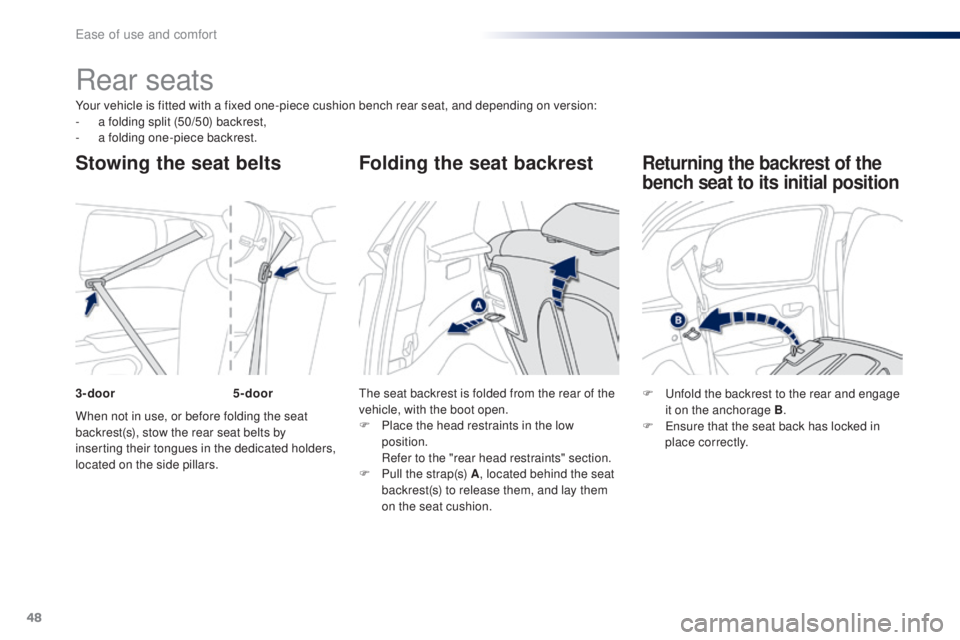
Your vehicle is fitted with a fixed one-piece cushion bench rear seat, and depending on version:
- a f olding split (50/50) backrest,
-
a f
olding one-piece backrest.
When not in use, or before folding the seat
backrest(s), stow the rear seat belts by
inserting their tongues in the dedicated holders,
located on the side pillars.
th
e seat backrest is folded from the rear of the
vehicle, with the boot open.
F
P
lace the head restraints in the low
position.
R
efer to the "rear head restraints" section.
F
P
ull the strap(s) A, located behind the seat
backrest(s) to release them, and lay them
on the seat cushion.
Rear seats
Stowing the seat belts Folding the seat backrest
F unfold the backrest to the rear and engage it on the anchorage B .
F
e
n
sure that the seat back has locked in
place correctly.
Returning the backrest of the
bench seat to its initial position
3-door 5-door
ease of use and comfort
Page 69 of 268
67
108_en_Chap03_ergonomie-confort_ed01-2016
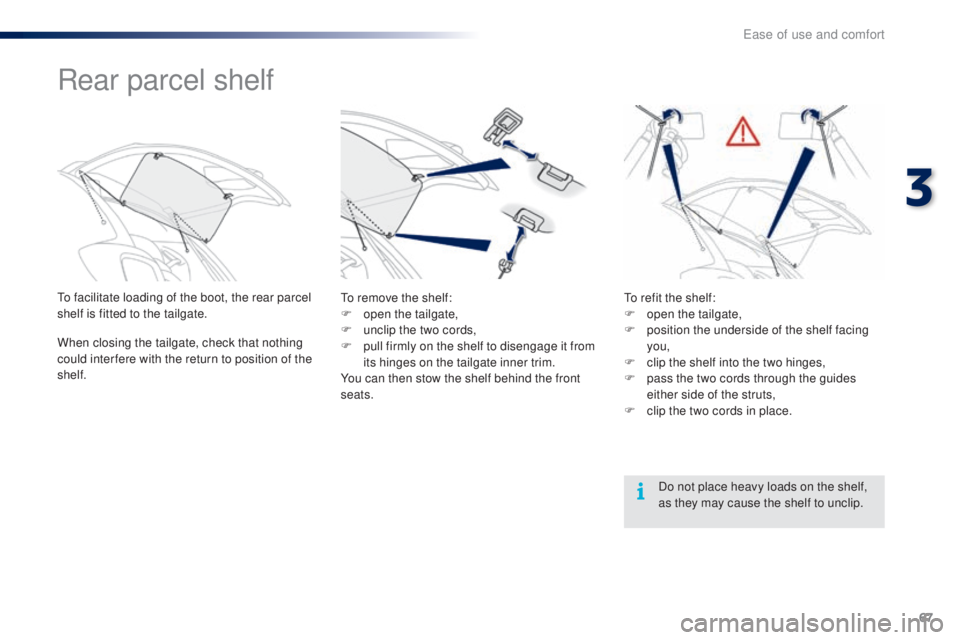
Rear parcel shelf
to facilitate loading of the boot, the rear parcel
shelf is fitted to the tailgate.
When closing the tailgate, check that nothing
could inter fere with the return to position of the
shelf.Do not place heavy loads on the shelf,
as they may cause the shelf to unclip.to remove the shelf:
F
o
pen the tailgate,
F
u
nclip the two cords,
F
p
ull firmly on the shelf to disengage it from
its hinges on the tailgate inner trim.
You can then stow the shelf behind the front
seats.to r efit the shelf:
F
o
pen the tailgate,
F
p
osition the underside of the shelf facing
you,
F
c
lip the shelf into the two hinges,
F
p
ass the two cords through the guides
either side of the struts,
F
c
lip the two cords in place.
3
ease of use and comfort
Page 117 of 268
115
108_en_Chap06_securite_ed01-2016
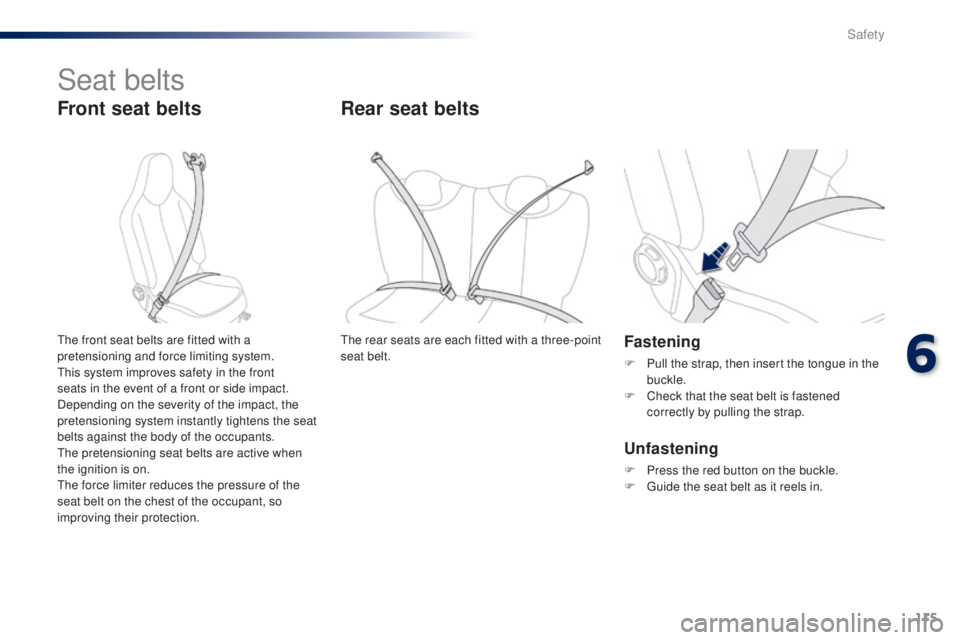
Seat belts
Front seat belts
Fastening
F Pull the strap, then insert the tongue in the buckle.
F
C
heck that the seat belt is fastened
correctly by pulling the strap.
th
e front seat belts are fitted with a
pretensioning and force limiting system.th
is system improves safety in the front
seats in the event of a front or side impact.
Depending on the severity of the impact, the
pretensioning system instantly tightens the seat
belts against the body of the occupants.
the
pretensioning seat belts are active when
the ignition is on.
th
e force limiter reduces the pressure of the
seat belt on the chest of the occupant, so
improving their protection.
Rear seat belts
the rear seats are each fitted with a three-point
seat belt.
unfastening
F Press the red button on the buckle.
F gu ide the seat belt as it reels in.
6
Safety