steering wheel PEUGEOT 108 2018 Owners Manual
[x] Cancel search | Manufacturer: PEUGEOT, Model Year: 2018, Model line: 108, Model: PEUGEOT 108 2018Pages: 180, PDF Size: 7.14 MB
Page 4 of 180
2
.
.
Instrument panels 8
D isplays 9
Warning and indicator lamps
9
I
ndic ators
18
Trip computer
1
8
Adjusting the time
2
0Keys
22
"
K
eyless Entry and Starting" system
2
3
Doors 26
Boot
27
Front electric windows
2
8
Quarter windows
2
9
Electric fabric roof
2
9
Advice on care
3
1
Front seats
3
2
Rear seats
3
4
Mirrors
35
Steering wheel adjustment
3
6
Ventilation
3
6
Heating
3
7
Manual air conditioning
3
7
Automatic air conditioning
3
8
Front demist – defrost
4
0
Rear screen demist – defrost
4
1
Courtesy lamp
4
1
Boot lighting
4
1
Interior fittings
4
2
Rear shelf
4
4
Boot fittings
4
5Lighting control stalk
4
6
Automatic headlamp illumination
4
8
Direction indicators
4
8
Headlamp adjustment
4
9
Wiper control stalk
4
9
Changing a
wiper blade
5
0
General safety recommendations 5 1
H o r n 51
Hazard warning lamps
5
2
ESC system
5
2
Seat belts
5
4
Airbags
56
Child seats
5
9
Deactivating the front passenger airbag
6
0
ISOFIX mountings and child seats
6
6
i-Size child seats
7
0
Child lock
7
1
InstrumentsAccess
Over view
Ease of use and comfort Lighting and visibility
Safety
Eco-driving
Instruments and controls 4
E co-driving
6
Contents
Page 7 of 180
5
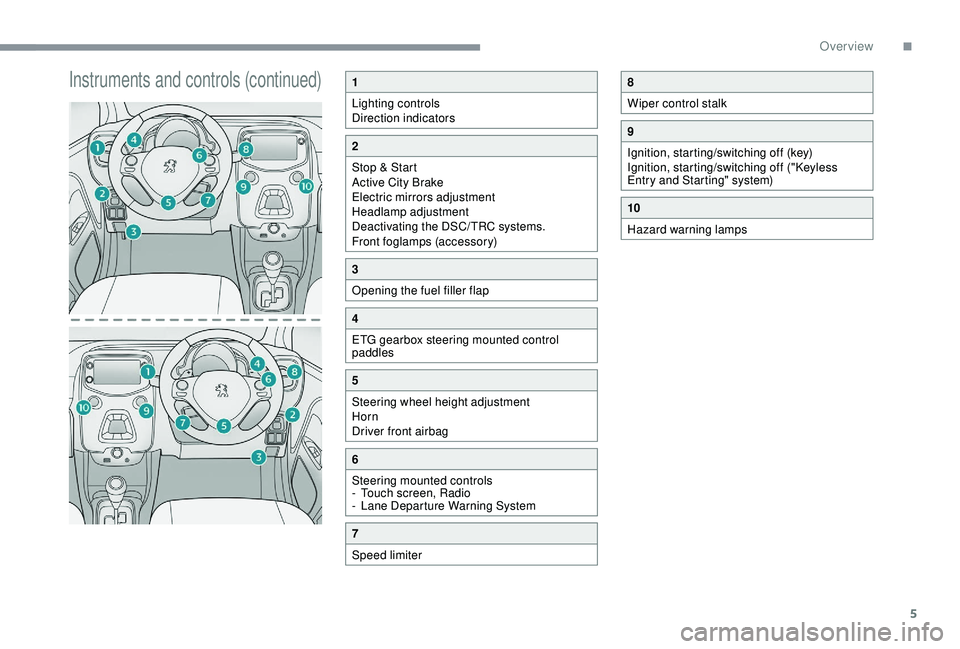
Instruments and controls (continued)1
Lighting controls
Direction indicators
2
Stop & Start
Active City Brake
Electric mirrors adjustment
Headlamp adjustment
Deactivating the DSC/TRC systems.
Front foglamps (accessory)
3
Opening the fuel filler flap
4
ETG gearbox steering mounted control
paddles
5
Steering wheel height adjustment
Horn
Driver front airbag
6
Steering mounted controls
-
T
ouch screen, Radio
-
L
ane Departure Warning System
7
Speed limiter
8
Wiper control stalk
9
Ignition, starting/switching off (key)
Ignition, starting/switching off ("Keyless
Entry and Starting" system)
10
Hazard warning lamps
.
Over view
Page 17 of 180
15
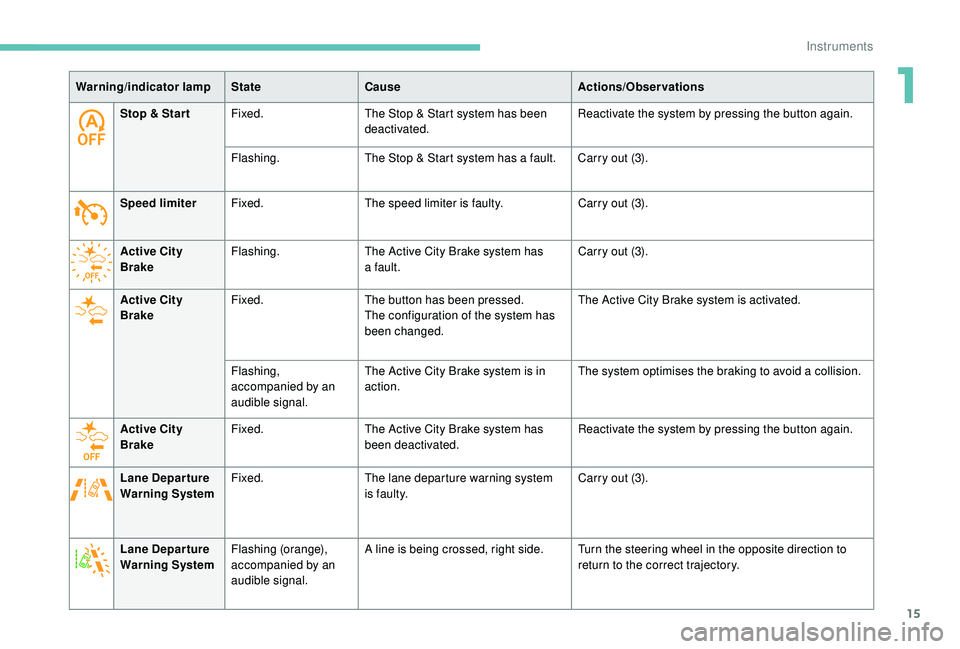
Warning/indicator lampStateCause Actions/Observations
Stop & Star t Fixed. The Stop & Start system has been
deactivated. Reactivate the system by pressing the button again.
Flashing. The Stop & Start system has a
fault. Carry out (3).
Speed limiter Fixed. The speed limiter is faulty. Carry out (3).
Active City
Brake Flashing.
The Active City Brake system has
a
fault.Carry out (3).
Active City
Brake Fixed.
The button has been pressed.
The configuration of the system has
been changed. The Active City Brake system is activated.
Flashing,
accompanied by an
audible signal. The Active City Brake system is in
action.
The system optimises the braking to avoid a
collision.
Active City
Brake Fixed.
The Active City Brake system has
been deactivated. Reactivate the system by pressing the button again.
Lane Depar ture
Warning System Fixed.
The lane departure warning system
is faulty. Carry out (3).
Lane Depar ture
Warning System Flashing (orange),
accompanied by an
audible signal. A line is being crossed, right side. Turn the steering wheel in the opposite direction to
return to the correct trajectory.
1
Instruments
Page 18 of 180
16
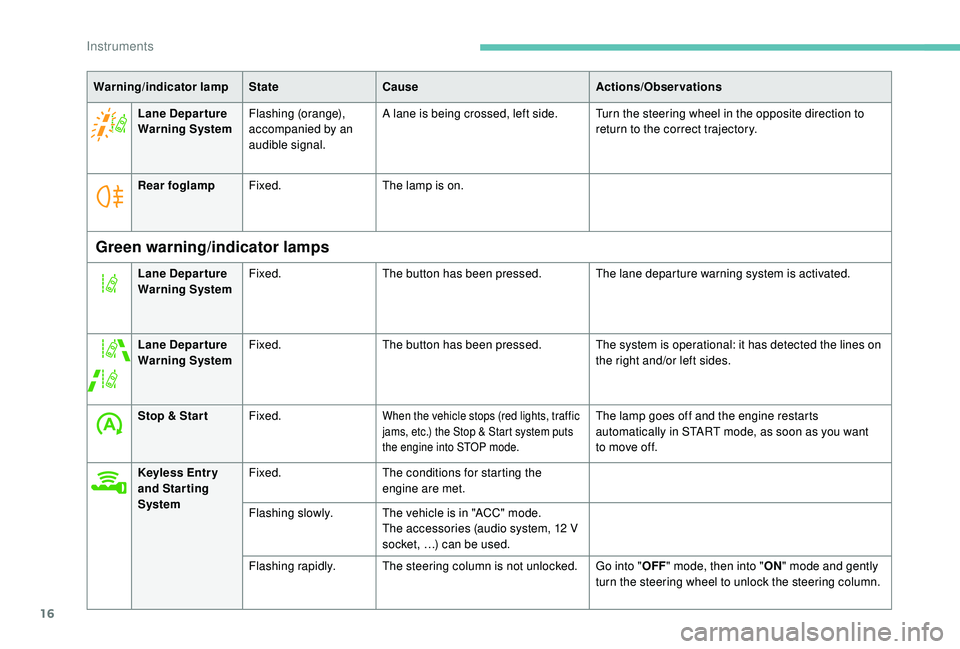
Warning/indicator lampStateCause Actions/Observations
Lane Depar ture
Warning System Flashing (orange),
accompanied by an
audible signal. A lane is being crossed, left side. Turn the steering wheel in the opposite direction to
return to the correct trajectory.
Rear foglamp Fixed. The lamp is on.
Green warning/indicator lamps
Lane Depar ture
Warning SystemFixed.
The button has been pressed. The lane departure warning system is activated.
Lane Depar ture
Warning System Fixed.
The button has been pressed. The system is operational: it has detected the lines on
the right and/or left sides.
Stop & Star t Fixed.
When the vehicle stops (red lights, traffic
jams, etc.) the Stop & Start system puts
the engine into STOP mode.The lamp goes off and the engine restarts
automatically in START mode, as soon as you want
to move off.
Keyless Entr y
and Star ting
System Fixed.
The conditions for starting the
engine are met.
Flashing slowly. The vehicle is in "ACC" mode.
The accessories (audio system, 12
V
socket, …) can be used.
Flashing rapidly. The steering column is not unlocked. Go into " OFF" mode, then into " ON" mode and gently
turn the steering wheel to unlock the steering column.
Instruments
Page 34 of 180
32
Front seats
For safety reasons, only adjust seats
when the vehicle is stationary.
Before moving the seat backwards,
ensure that there is nothing that might
prevent the full travel of the seat.
There is a risk of trapping or pinching
passengers if present in the rear seats
or jamming the seat if large objects are
placed on the floor behind the seat.
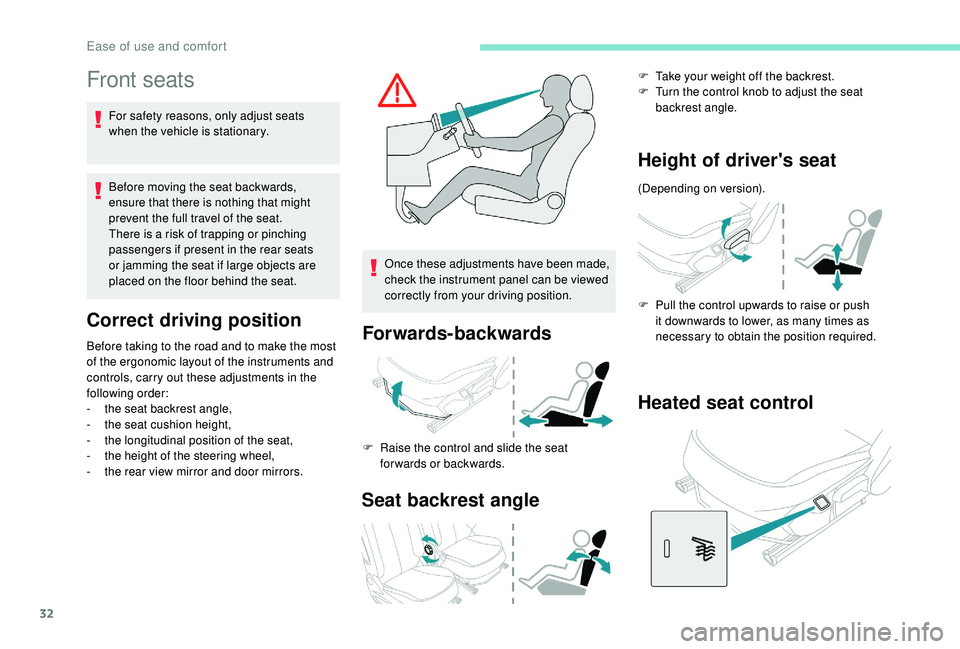
Correct driving position
Before taking to the road and to make the most
of the ergonomic layout of the instruments and
controls, carry out these adjustments in the
following order:
-
t
he seat backrest angle,
-
t
he seat cushion height,
-
t
he longitudinal position of the seat,
-
t
he height of the steering wheel,
-
t
he rear view mirror and door mirrors. Once these adjustments have been made,
check the instrument panel can be viewed
correctly from your driving position.Forwards-backwards
F Raise the control and slide the seat
forwards or backwards.
Seat backrest angle
F Take your weight off the backrest.
F T urn the control knob to adjust the seat
backrest angle.
Height of driver's seat
(Depending on version).
F
P
ull the control upwards to raise or push
it downwards to lower, as many times as
necessary to obtain the position required.
Heated seat control
Ease of use and comfort
Page 38 of 180
36
Steering wheel adjustment
(with power steering)
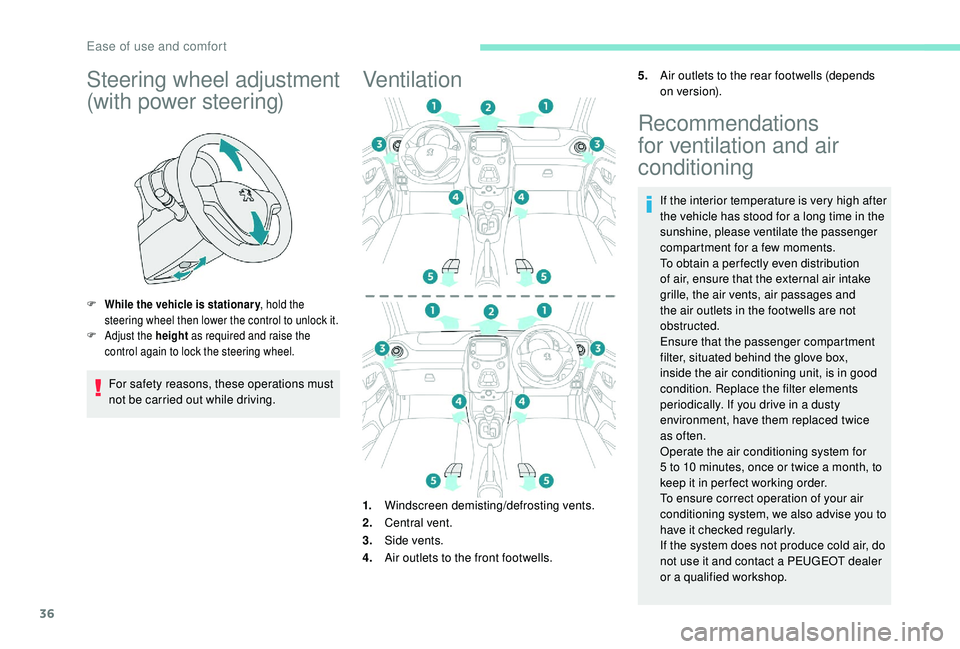
F While the vehicle is stationary, hold the
steering wheel then lower the control to unlock it.
F
A
djust the height as required and raise the
control again to lock the steering wheel.
For safety reasons, these operations must
not be carried out while driving.
Ventilation5. Air outlets to the rear footwells (depends
on version).
1. Windscreen demisting/defrosting vents.
2. Central vent.
3. Side vents.
4. Air outlets to the front footwells.
Recommendations
for ventilation and air
conditioning
If the interior temperature is very high after
the vehicle has stood for a
long time in the
sunshine, please ventilate the passenger
compartment for a
few moments.
To obtain a
per fectly even distribution
of air, ensure that the external air intake
grille, the air vents, air passages and
the air outlets in the footwells are not
obstructed.
Ensure that the passenger compartment
filter, situated behind the glove box,
inside the air conditioning unit, is in good
condition. Replace the filter elements
periodically. If you drive in a
dusty
environment, have them replaced twice
as often.
Operate the air conditioning system for
5
to 10 minutes, once or twice a month, to
keep it in per fect working order.
To ensure correct operation of your air
conditioning system, we also advise you to
have it checked regularly.
If the system does not produce cold air, do
not use it and contact a
PEUGEOT dealer
or a
qualified workshop.
Ease of use and comfort
Page 54 of 180
52
Hazard warning lamps
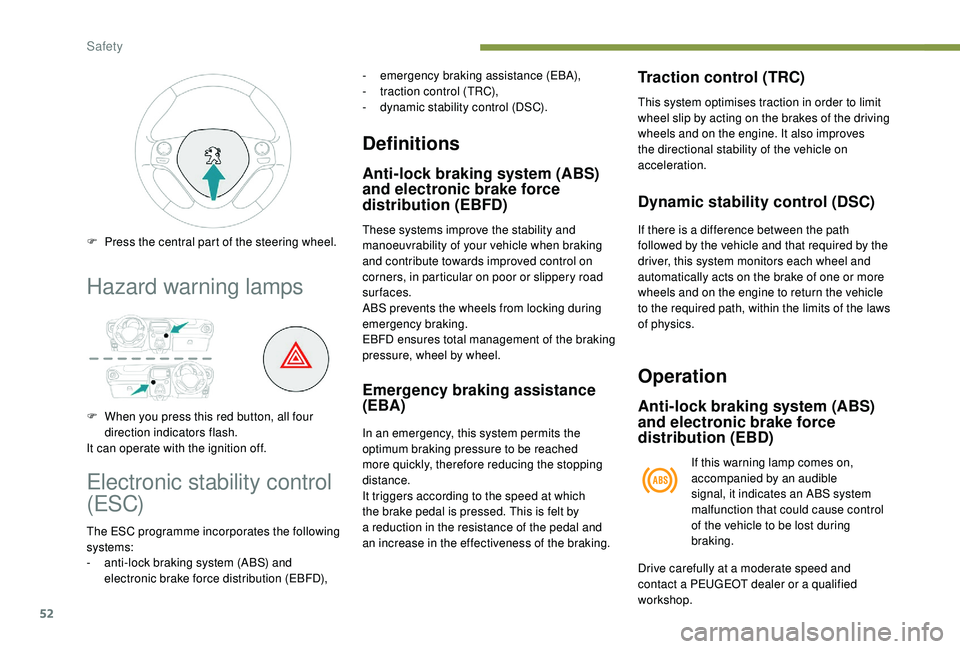
F When you press this red button, all four direction indicators flash.
It can operate with the ignition off. F
P
ress the central part of the steering wheel.
Electronic stability control
(ESC)
The ESC programme incorporates the following
systems:
-
a
nti-lock braking system (ABS) and
electronic brake force distribution (EBFD),
Definitions
Anti-lock braking system (ABS)
and electronic brake force
distribution (EBFD)
These systems improve the stability and
manoeuvrability of your vehicle when braking
and contribute towards improved control on
corners, in particular on poor or slippery road
surfaces.
ABS prevents the wheels from locking during
emergency braking.
EBFD ensures total management of the braking
pressure, wheel by wheel.
Emergency braking assistance
(EBA)
In an emergency, this system permits the
optimum braking pressure to be reached
more quickly, therefore reducing the stopping
distance.
It triggers according to the speed at which
the brake pedal is pressed. This is felt by
a
reduction in the resistance of the pedal and
an increase in the effectiveness of the braking.
Traction control (TRC)
This system optimises traction in order to limit
wheel slip by acting on the brakes of the driving
wheels and on the engine. It also improves
the directional stability of the vehicle on
acceleration.
-
em
ergency braking assistance (EBA),
-
t
raction control (TRC),
- d
ynamic stability control (DSC).
Dynamic stability control (DSC)
If there is a difference between the path
f ollowed by the vehicle and that required by the
driver, this system monitors each wheel and
automatically acts on the brake of one or more
wheels and on the engine to return the vehicle
to the required path, within the limits of the laws
of physics.
Operation
Anti-lock braking system (ABS)
and electronic brake force
distribution (EBD)
If this warning lamp comes on,
accompanied by an audible
signal, it indicates an ABS system
malfunction that could cause control
of the vehicle to be lost during
braking.
Drive carefully at a
moderate speed and
contact a
PEUGEOT dealer or a qualified
workshop.
Safety
Page 59 of 180
57
Impact detection zones
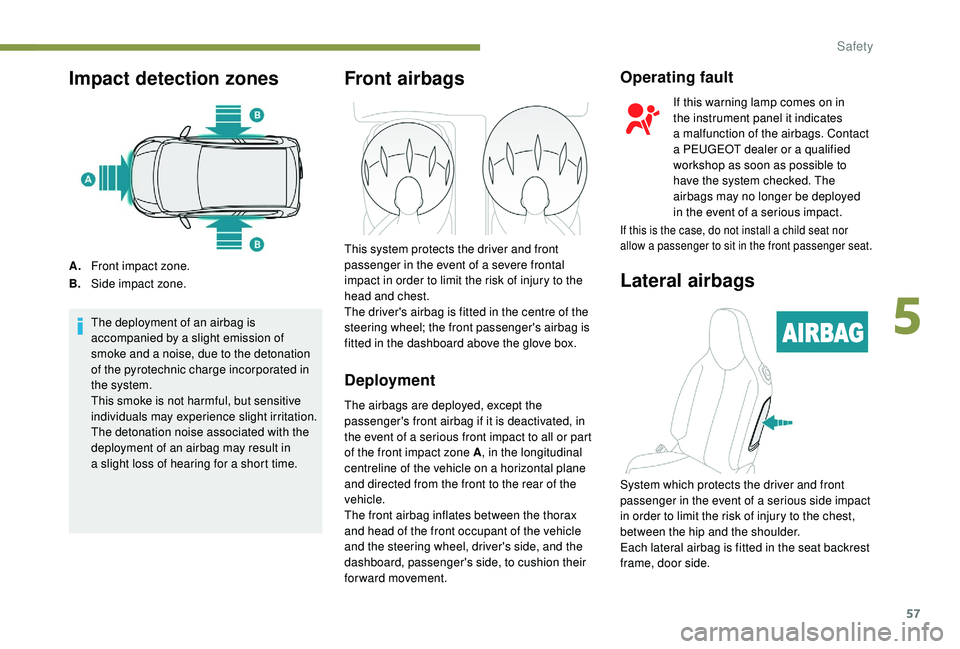
A.Front impact zone.
B. Side impact zone.
The deployment of an airbag is
accompanied by a
slight emission of
smoke and a
noise, due to the detonation
of the pyrotechnic charge incorporated in
the system.
This smoke is not harmful, but sensitive
individuals may experience slight irritation.
The detonation noise associated with the
deployment of an airbag may result in
a
slight loss of hearing for a short time.
Front airbags
This system protects the driver and front
passenger in the event of a severe frontal
impact in order to limit the risk of injury to the
head and chest.
The driver's airbag is fitted in the centre of the
steering wheel; the front passenger's airbag is
fitted in the dashboard above the glove box.
Deployment
The airbags are deployed, except the
passenger's front airbag if it is deactivated, in
the event of a
serious front impact to all or part
of the front impact zone A , in the longitudinal
centreline of the vehicle on a
horizontal plane
and directed from the front to the rear of the
vehicle.
The front airbag inflates between the thorax
and head of the front occupant of the vehicle
and the steering wheel, driver's side, and the
dashboard, passenger's side, to cushion their
for ward movement.
Operating fault
If this warning lamp comes on in
the instrument panel it indicates
a
malfunction of the airbags. Contact
a
PEUGEOT dealer or a qualified
workshop as soon as possible to
have the system checked. The
airbags may no longer be deployed
in the event of a
serious impact.
If this is the case, do not install a child seat nor
a llow a passenger to sit in the front passenger seat.
Lateral airbags
System which protects the driver and front
passenger in the event of a serious side impact
in order to limit the risk of injury to the chest,
between the hip and the shoulder.
Each lateral airbag is fitted in the seat backrest
frame, door side.
5
Safety
Page 61 of 180
59
Front airbags
Do not drive holding the steering wheel
by its spokes or resting your hands on the
centre part of the wheel.
Passengers must not place their feet on
the dashboard.
Do not smoke as deployment of the
airbags can cause burns or the risk of
injury from a cigarette or pipe.
Never remove or pierce the steering wheel
or hit it violently.
Do not fit or attach anything to the steering
wheel or dashboard, this could cause
injuries with deployment of the airbags.
Curtain airbags
Do not attach anything or hang anything to
the roof, as this could cause head injuries
when the curtain airbag is deployed.
If fitted to your vehicle, do not remove the
grab handles installed on the roof, they
play a
part in securing the curtain airbags. Lateral airbags
Use only approved covers on the seats,
compatible with the deployment of the
lateral airbags. For information on the
product range of seat covers suitable for
your vehicle, contact a
PEUGEOT dealer.
Do not attach anything to or hang anything
from the seat backrests (clothes, etc.) as
this could cause injuries to the thorax or
arm when the lateral airbag is deployed.
Do not sit with the upper part of the body
any nearer to the door than necessary.
General points relating to
child seats
The regulations on carrying children are
specific to each country. Refer to the
legislation in force in your country. -
S
tatistically, the safest seats in your
vehicle for carr ying children are the rear
seats.
-
A c
hild weighing less than 9 kg must
travel in the rear ward-facing position
both in the front and in the rear.
It is recommended that children travel on
the rear seats of your vehicle:
- "
rearward facing " up to the age of 3,
- "
forward facing " over the age of 3.
Ensure that the seat belt is positioned and
tightened correctly.
For child seats with a support leg, ensure
that the latter is in firm and steady contact
with the floor.
In the front: if necessary, adjust the
passenger seat.
At the rear: if necessary, adjust the
relevant front seat.
For maximum safety, please obser ve the
following recommendations:
-
I
n accordance with European regulations,
all children under the age of 12
or less
than one and a
half metres tall must
travel in approved child seats suited to
their weight , on seats fitted with a
seat belt
or ISOFIX mountings.
5
Safety
Page 75 of 180
73
Starting/Switching off the
engine with the key
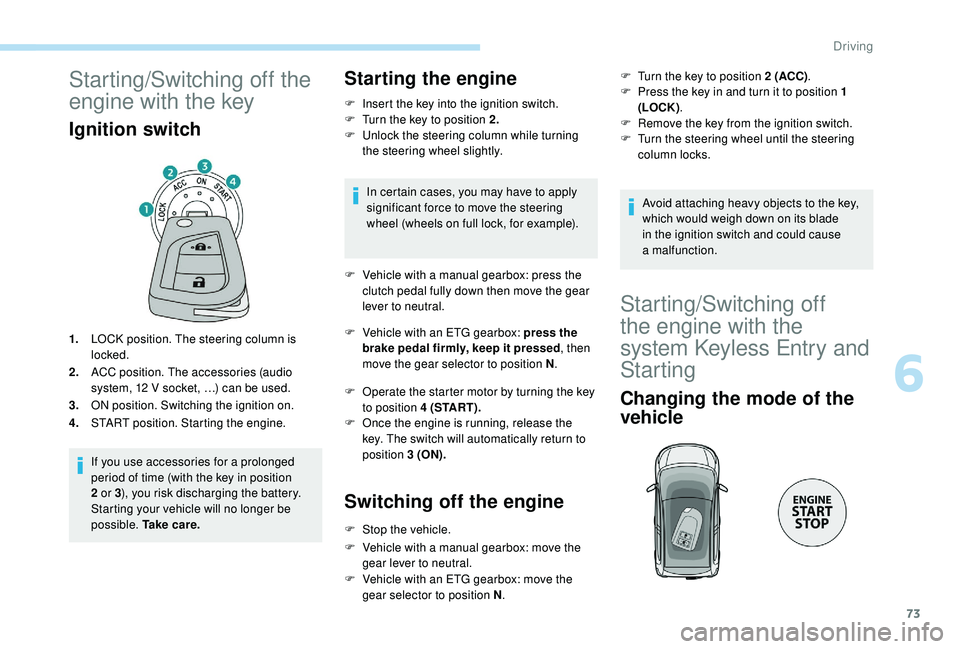
Ignition switch
1.LOCK position. The steering column is
locked.
2. ACC position. The accessories (audio
system, 12
V socket, …) can be used.
3. ON position. Switching the ignition on.
4. START position. Starting the engine.
If you use accessories for a
prolonged
period of time (with the key in position
2
or 3), you risk discharging the battery.
Starting your vehicle will no longer be
possible. Ta k e c a r e .
Starting the engine
F Insert the key into the ignition switch.
F T urn the key to position 2.
F
U
nlock the steering column while turning
the steering wheel slightly.
In certain cases, you may have to apply
significant force to move the steering
wheel (wheels on full lock, for example).
F
V
ehicle with a manual gearbox: press the
clutch pedal fully down then move the gear
lever to neutral.
F
V
ehicle with an ETG gearbox: press the
brake pedal firmly, keep it pressed , then
move the gear selector to position N .
F
O
perate the starter motor by turning the key
to position 4 (START).
F
O
nce the engine is running, release the
key. The switch will automatically return to
position 3 (ON).
Switching off the engine
F Stop the vehicle.
F
V
ehicle with a manual gearbox: move the
gear lever to neutral.
F
V
ehicle with an ETG gearbox: move the
gear selector to position N .F
T
urn the key to position 2 (ACC)
.
F
P
ress the key in and turn it to position 1
(LOCK) .
F
R
emove the key from the ignition switch.
F
T
urn the steering wheel until the steering
column locks.
Avoid attaching heavy objects to the key,
which would weigh down on its blade
in the ignition switch and could cause
a
malfunction.
Starting/Switching off
the engine with the
system
K
eyless Entry and
Starting
Changing the mode of the
vehicle
6
Driving