instrument panel PEUGEOT 2008 2013.5 User Guide
[x] Cancel search | Manufacturer: PEUGEOT, Model Year: 2013.5, Model line: 2008, Model: PEUGEOT 2008 2013.5Pages: 336, PDF Size: 9.23 MB
Page 25 of 336
1
23
Monitoring
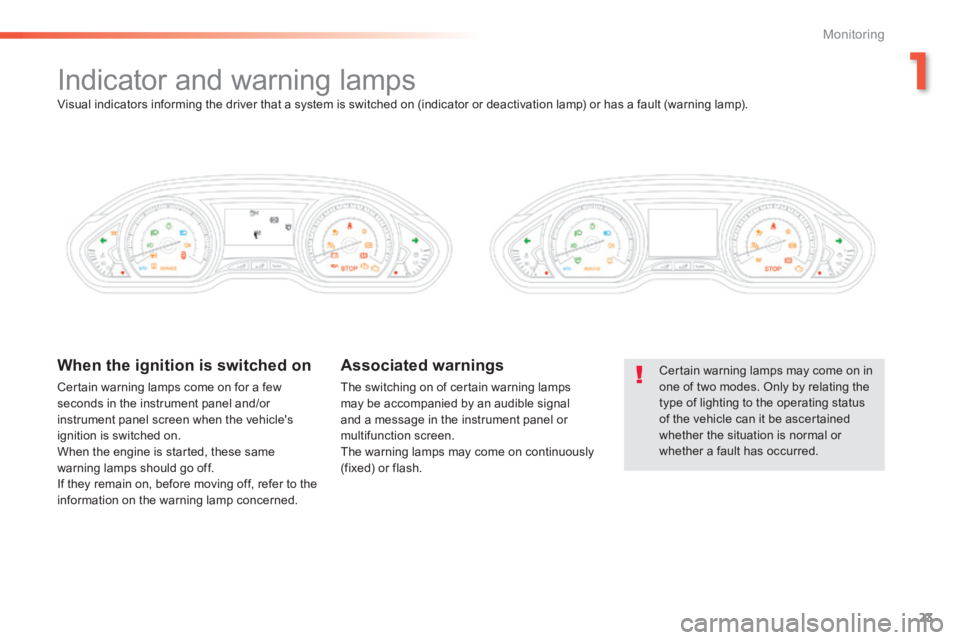
Indicator and warning lamps
Certain warning lamps may come on in one of two modes. Only by relating the type of lighting to the operating status of the vehicle can it be ascertained
whether the situation is normal or whether a fault has occurred.
When the ignition is switched on
Certain warning lamps come on for a few seconds in the instrument panel and/or instrument panel screen when the vehicle's ignition is switched on. When the engine is started, these same warning lamps should go off. If they remain on, before moving off, refer to the information on the warning lamp concerned.
Associated warnings
The switching on of certain warning lamps may be accompanied by an audible signal and a message in the instrument panel or multifunction screen. The warning lamps may come on continuously (fixed) or flash.
Visual indicators informing the driver that a system is switched on (indicator or deactivation lamp) or has a fault (warning lamp).
Page 26 of 336
24
Monitoring
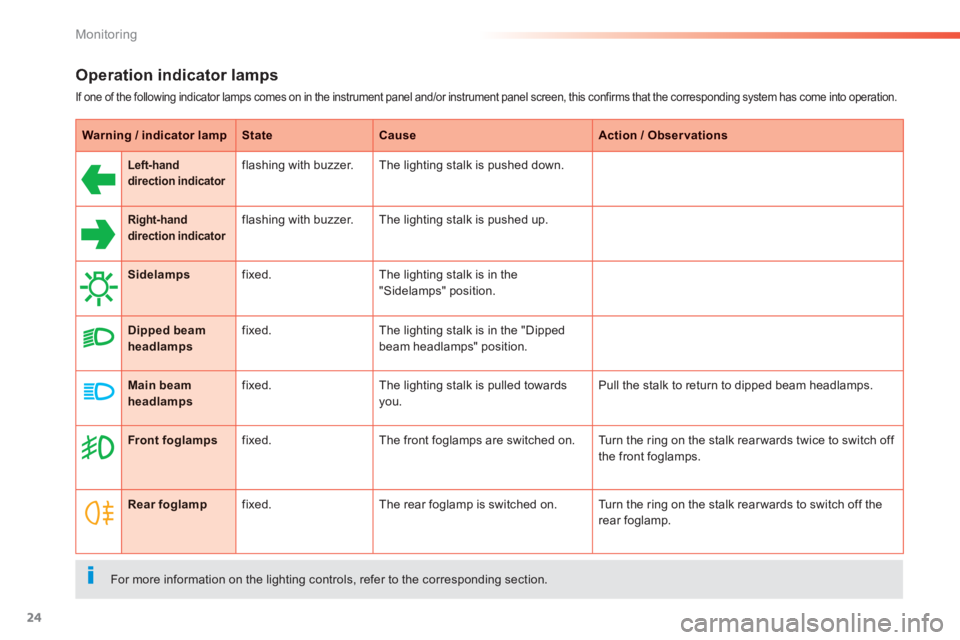
Operation indicator lamps
If one of the following indicator lamps comes on in the instrument panel and/or instrument panel screen, this confirms that the corresponding system has come into operation.
Warning / indicator lampStateCauseAction / Observations
Left-hand direction indicatorr r flashing with buzzer. The lighting stalk is pushed down.
Right-hand
direction indicatordirection indicator direction indicator
flashing with buzzer. The lighting stalk is pushed up.
Sidelamps fixed. The lighting stalk is in the "Sidelamps" position.
Dipped beam headlamps fixed. The lighting stalk is in the "Dipped beam headlamps" position.
Main beam headlamps fixed. The lighting stalk is pulled towards you. Pull the stalk to return to dipped beam headlamps.
Front foglamps fixed. The front foglamps are switched on. Turn the ring on the stalk rear wards twice to switch off the front foglamps.
Rear foglamp fixed. The rear foglamp is switched on. Turn the ring on the stalk rear wards to switch off the rear foglamp.
For more information on the lighting controls, refer to the corresponding section.
Page 28 of 336
26
Monitoring
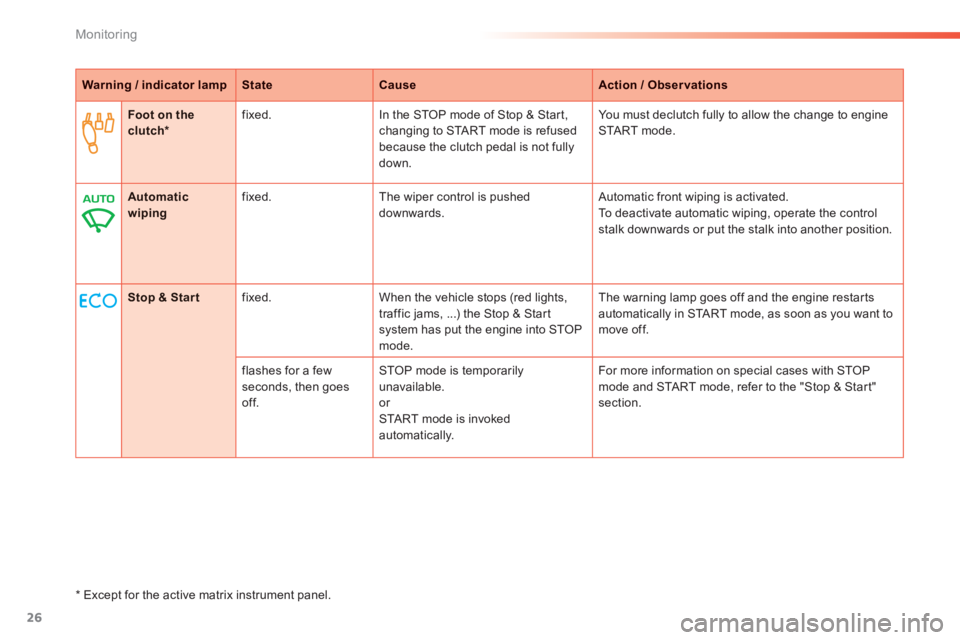
Warning / indicator lampStateCauseAction / Observations
Foot on the clutch * fixed. In the STOP mode of Stop & Start, changing to START mode is refused because the clutch pedal is not fully down.
You must declutch fully to allow the change to engine START mode.
Stop & Star t fixed. When the vehicle stops (red lights, traffic jams, ...) the Stop & Start system has put the engine into STOP mode.
The warning lamp goes off and the engine restarts automatically in START mode, as soon as you want to move off.
flashes for a few seconds, then goes of f.
STOP mode is temporarily unavailable. or START mode is invoked automatically.
For more information on special cases with STOP mode and START mode, refer to the "Stop & Start" section.
Automatic wiping fixed. The wiper control is pushed downwards. Automatic front wiping is activated. To deactivate automatic wiping, operate the control stalk downwards or put the stalk into another position.
* Except for the active matrix instrument panel.
Page 36 of 336
34
Monitoring
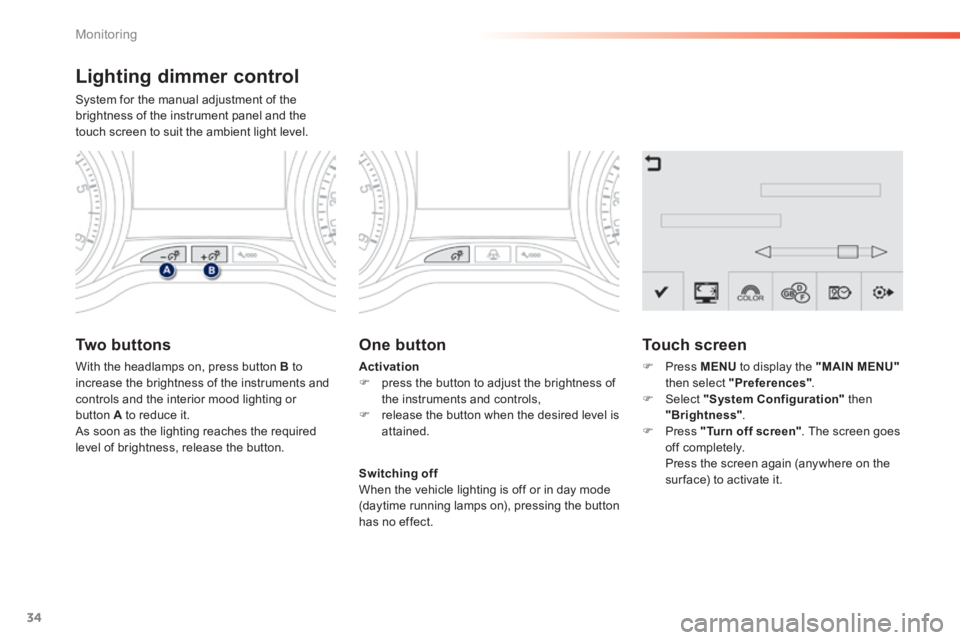
Lighting dimmer control
System for the manual adjustment of the brightness of the instrument panel and the touch screen to suit the ambient light level.
Two buttons
With the headlamps on, press button B to increase the brightness of the instruments and controls and the interior mood lighting or button A to reduce it. As soon as the lighting reaches the required level of brightness, release the button.
One button
Activation press the button to adjust the brightness of the instruments and controls, release the button when the desired level is attained.
Touch screen
Press MENU to display the "MAIN MENU"then select "Preferences" . Select "System Configuration" then "Brightness" . Press "Turn off screen" . The screen goes off completely. Press the screen again (anywhere on the sur face) to activate it. Switching off When the vehicle lighting is off or in day mode (daytime running lamps on), pressing the button has no effect.
Page 39 of 336
1
37
Monitoring
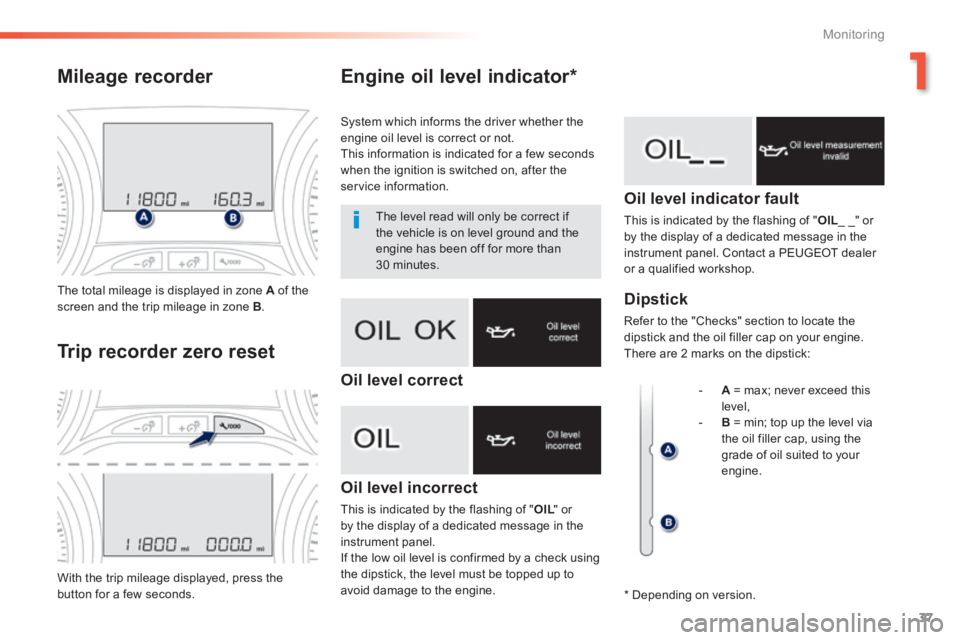
Engine oil level indicator *
Oil level incorrect
This is indicated by the flashing of " OIL " or OIL " or OILby the display of a dedicated message in the instrument panel. If the low oil level is confirmed by a check using the dipstick, the level must be topped up to
avoid damage to the engine.
Oil level indicator fault
This is indicated by the flashing of " OIL _ _" or
by the display of a dedicated message in the instrument panel. Contact a PEUGEOT dealer or a qualified workshop.
Dipstick
Refer to the "Checks" section to locate the dipstick and the oil filler cap on your engine.
There are 2 marks on the dipstick:
The total mileage is displayed in zone A of the screen and the trip mileage in zone B .
With the trip mileage displayed, press the button for a few seconds.
Mileage recorder
Trip recorder zero reset
System which informs the driver whether the engine oil level is correct or not. This information is indicated for a few seconds when the ignition is switched on, after the service information.
The level read will only be correct if the vehicle is on level ground and the engine has been off for more than 30 minutes.
- A = max; never exceed this level, - B = min; top up the level via
the oil filler cap, using the grade of oil suited to your engine.
Oil level correct
* Depending on version.
Page 40 of 336
38
Monitoring
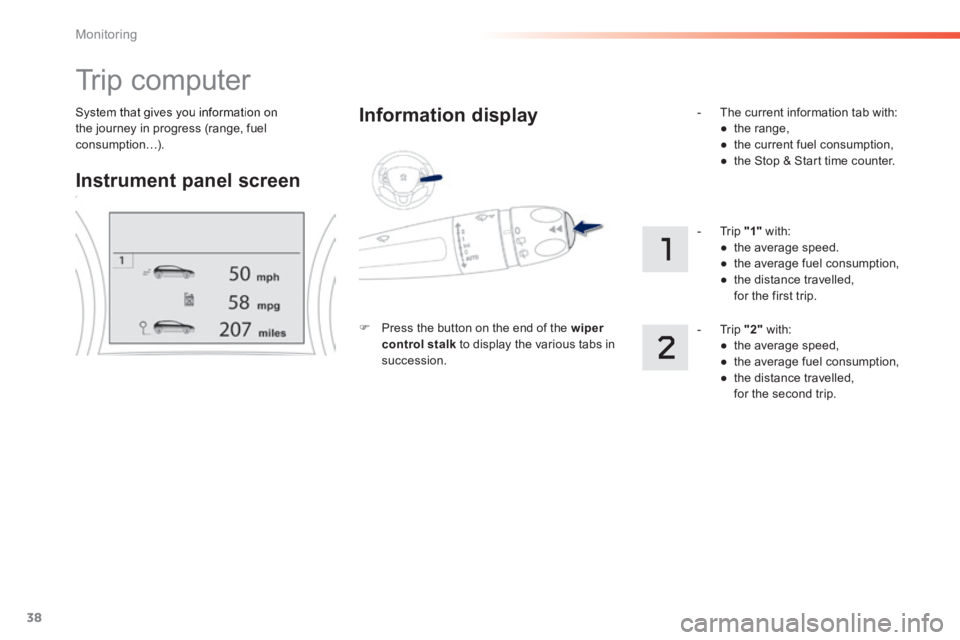
System that gives you information on the journey in progress (range, fuel consumption…).
Trip computer
Instrument panel screen
Information display
Press the button on the end of the wiper control stalk to display the various tabs in succession.
- The current information tab with: ● t h e r a n g e , ● the current fuel consumption, ● the Stop & Start time counter.
- Trip "1" with: ● the average speed. ● the average fuel consumption, ● the distance travelled, for the first trip.
- Trip "2" with: ● the average speed, ● the average fuel consumption, ● the distance travelled, for the second trip.
Page 45 of 336
1
43
Monitoring
LCD instrument panel
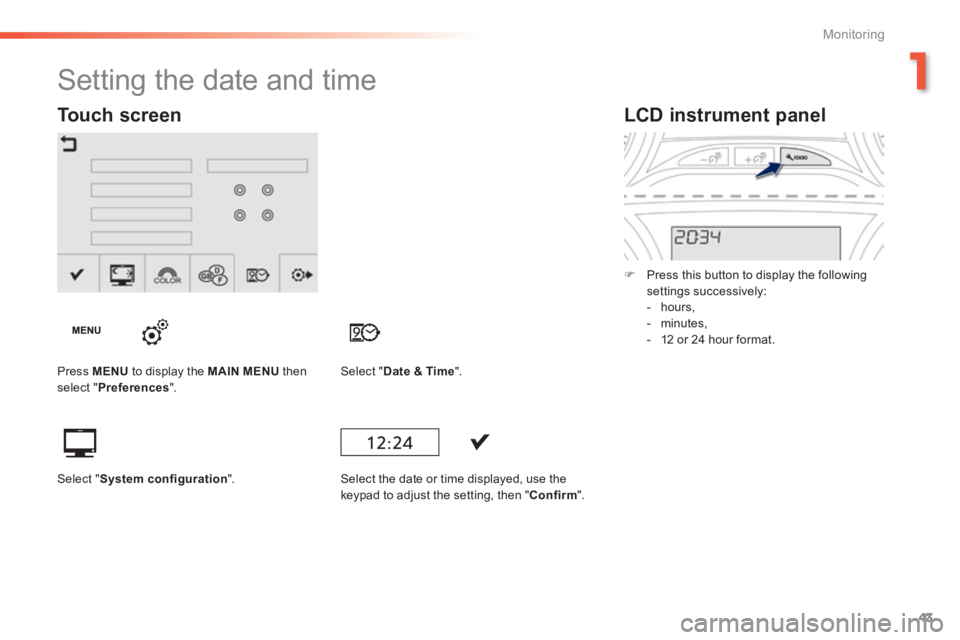
Press this button to display the following settings successively: - hours, - minutes, - 12 or 24 hour format.
Setting the date and time
Press MENU to display the MAIN MENU then select " Preferences ". Select " Date & Time ".
Select the date or time displayed, use the keypad to adjust the setting, then " Confirm ".
Touch screen
Select " System configuration ".
Page 51 of 336
49
2
Access
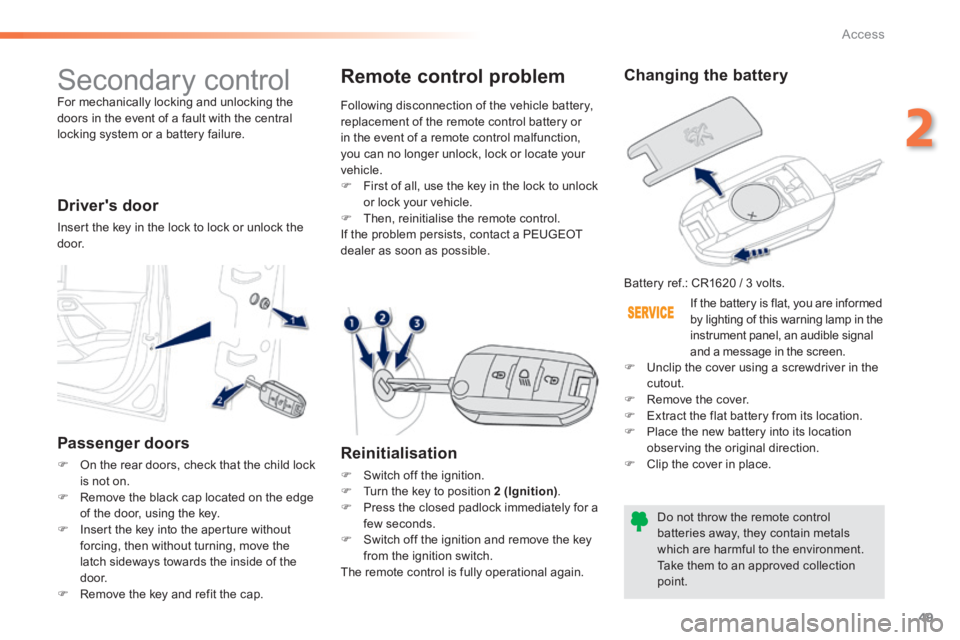
Secondary control For mechanically locking and unlocking the doors in the event of a fault with the central locking system or a battery failure.
Driver's door
Insert the key in the lock to lock or unlock the d o o r.
Passenger doors
On the rear doors, check that the child lock is not on. Remove the black cap located on the edge of the door, using the key. Insert the key into the aperture without
forcing, then without turning, move the latch sideways towards the inside of the d o o r. Remove the key and refit the cap.
Changing the battery
Battery ref.: CR1620 / 3 volts.
Do not throw the remote control batteries away, they contain metals which are harmful to the environment. Take them to an approved collection point.
Remote control problem
Reinitialisation
Switch off the ignition. Turn the key to position 2 (Ignition) . Press the closed padlock immediately for a few seconds. Switch off the ignition and remove the key from the ignition switch. The remote control is fully operational again.
Following disconnection of the vehicle battery, replacement of the remote control battery or in the event of a remote control malfunction, you can no longer unlock, lock or locate your vehicle. First of all, use the key in the lock to unlock or lock your vehicle. Then, reinitialise the remote control.
If the problem persists, contact a PEUGEOT dealer as soon as possible.
If the battery is flat, you are informed by lighting of this warning lamp in the instrument panel, an audible signal and a message in the screen. Unclip the cover using a screwdriver in the cutout. Remove the cover. Extract the flat battery from its location.
Place the new battery into its location observing the original direction. Clip the cover in place.
Page 75 of 336
73
3
Comfort
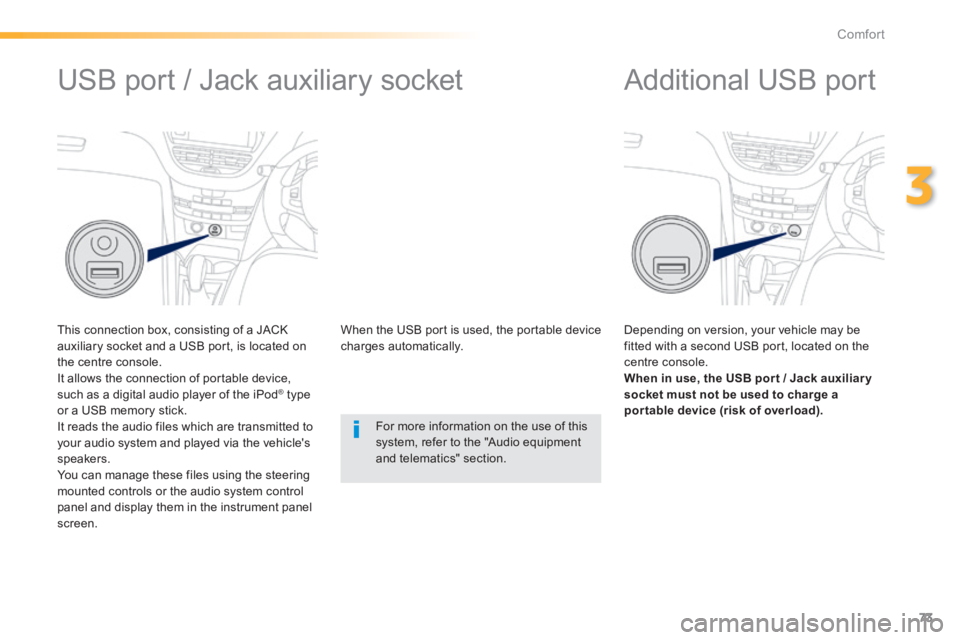
Additional USB port
Depending on version, your vehicle may be fitted with a second USB port, located on the centre console. When in use, the USB por t / Jack auxiliar y socket must not be used to charge a por table device (risk of overload).
USB port / Jack auxiliary socket
This connection box, consisting of a JACK auxiliary socket and a USB port, is located on the centre console. It allows the connection of portable device, such as a digital audio player of the iPod ® type ® type ®
or a USB memory stick. It reads the audio files which are transmitted to your audio system and played via the vehicle's speakers. You can manage these files using the steering mounted controls or the audio system control panel and display them in the instrument panel screen.
When the USB port is used, the portable device charges automatically.
For more information on the use of this
system, refer to the "Audio equipment and telematics" section.
Page 85 of 336
83
4
Driving
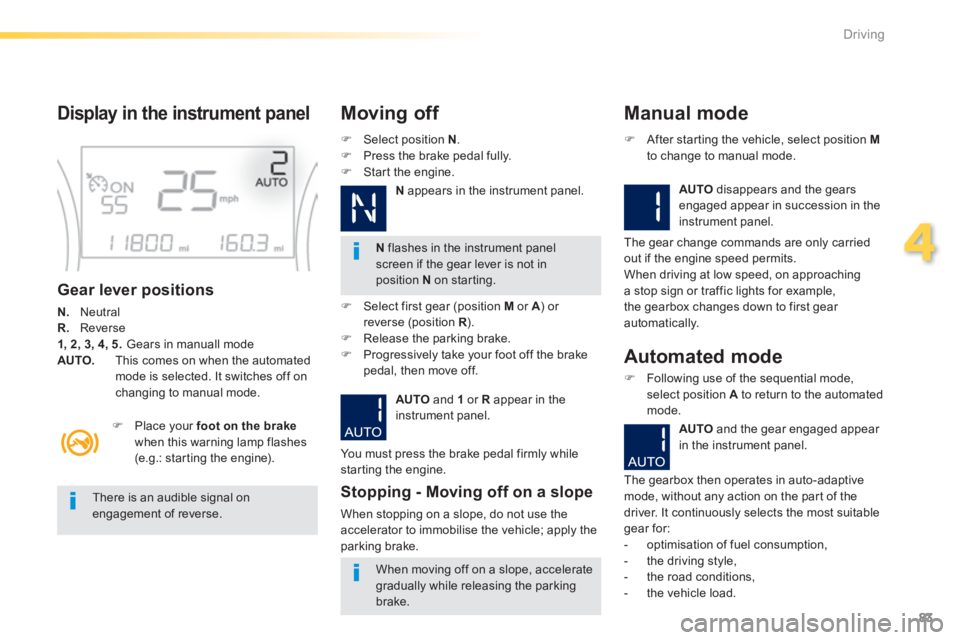
Display in the instrument panel
Gear lever positions
N. Neutral R. Reverse 1, 2, 3, 4, 5. Gears in manuall mode AUTO. This comes on when the automated mode is selected. It switches off on changing to manual mode.
Select position N . Press the brake pedal fully. Start the engine.
Moving off
N flashes in the instrument panel screen if the gear lever is not in position N on starting.
Place your foot on the brakewhen this warning lamp flashes (e.g.: starting the engine).
There is an audible signal on engagement of reverse.
When moving off on a slope, accelerate
gradually while releasing the parking brake.
Select first gear (position M or A ) or A ) or Areverse (position R ) .R ) .R Release the parking brake. Progressively take your foot off the brake pedal, then move off.
AUTO and 1 or R appear in the instrument panel.
Stopping - Moving off on a slope
When stopping on a slope, do not use the accelerator to immobilise the vehicle; apply the parking brake.
Manual mode
AUTO disappears and the gears engaged appear in succession in the instrument panel.
After starting the vehicle, select position Mto change to manual mode.
The gear change commands are only carried out if the engine speed permits. When driving at low speed, on approaching a stop sign or traffic lights for example, the gearbox changes down to first gear automatically.
You must press the brake pedal firmly while starting the engine.
Automated mode
Following use of the sequential mode, select position A to return to the automated mode.
AUTO and the gear engaged appear
in the instrument panel.
The gearbox then operates in auto-adaptive mode, without any action on the part of the driver. It continuously selects the most suitable gear for: - optimisation of fuel consumption, - the driving style, - the road conditions,
- the vehicle load.
N appears in the instrument panel.