check engine PEUGEOT 2008 2013 Owner's Manual
[x] Cancel search | Manufacturer: PEUGEOT, Model Year: 2013, Model line: 2008, Model: PEUGEOT 2008 2013Pages: 324, PDF Size: 8.39 MB
Page 189 of 324
187
8
Checks
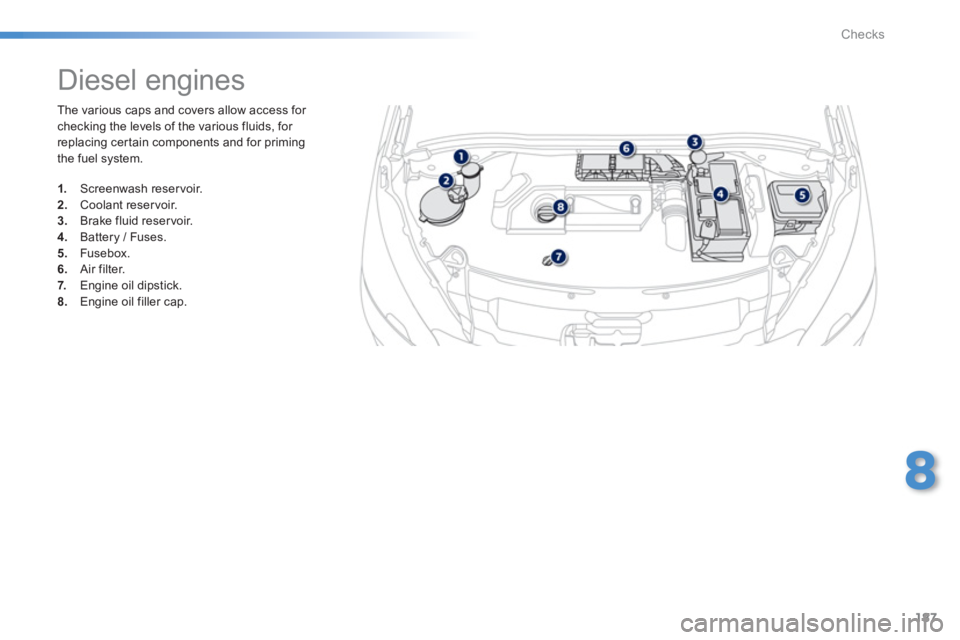
The various caps and covers allow access for checking the levels of the various fluids, for
replacing cer tain components and for primingthe fuel system.
Diesel engines
1.
Screenwash reservoir. 2.Coolant reservoir.3.Brake fluid reservoir.4.
Battery / Fuses.
5. Fusebox.
6.Air filter.
7. Engine oil dipstick.8.Engine oil filler cap.
Page 190 of 324
188
Checks
Low fuel level
When the fuel tank minimum level is reached this warning lamp comes on in the instrument panel. There remainsapproximately 5 litres
of fuel in the tank.
When the warning lamp flashes there is very little fuel remaining in the tank.
The key cannot be removed from the lock until the cap is refitted. Removing the filler cap may cause an inrush of air. This vacuum is per fectly normal and results from the sealing of
the system.
Fuel tank
Fuel tank capacity: approximately 50 litres.
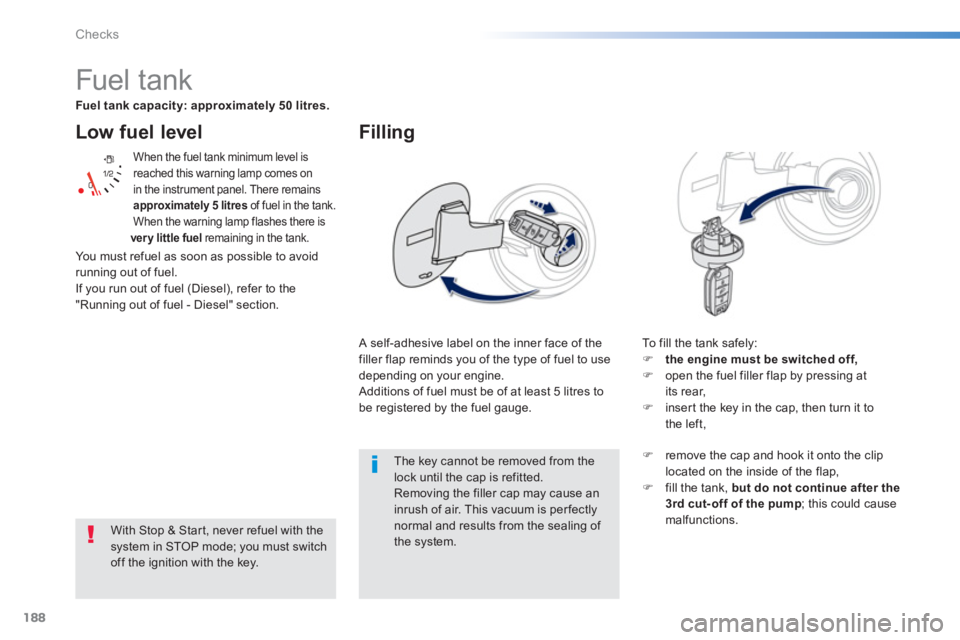
A self-adhesive label on the inner face of thefiller flap reminds you of the type of fuel to use
depending on your engine.
Additions of fuel must be of at least 5 litres to be registered by the fuel gauge.
Filling
To fill the tank safely: )the engine must be switched off,)open the fuel filler flap by pressing at
its rear, )inser t the key in the cap, then turn it to
the left,
With Stop & Star t, never refuel with the system in STOP mode; you must switch off the ignition with the key.
)remove the cap and hook it onto the cliplocated on the inside of the flap, )fill the tank, but do not continue after the
3rd cut- off of the pump ; this could causemalfunctions. You must re
fuel as soon as possible to avoid running out of fuel.
If you run out of fuel (Diesel), refer to the
"Running out of fuel - Diesel" section.
Page 191 of 324
189
8
Checks
If you have put in the wrong fuel for the engine of your vehicle, you musthave the fuel tank drained and filledwith the correct fuel before star ting the engine.
Fuel supply cut-off
Your vehicle is fitted with a safety system that
cuts off the supply of fuel in the event of animpact. When
you have filled the tank:)put the cap back in place,)turn the key to the right, then remove it from the cap, )close the flap.
Page 192 of 324
190
Checks
Operation
When a petrol filler nozzle is introduced into the
fuel filler neck of your Diesel vehicle, it comes
into contact with the flap. The system remainsclosed and prevents filling.
Do not persist but introduce a Diesel type filler nozzle.
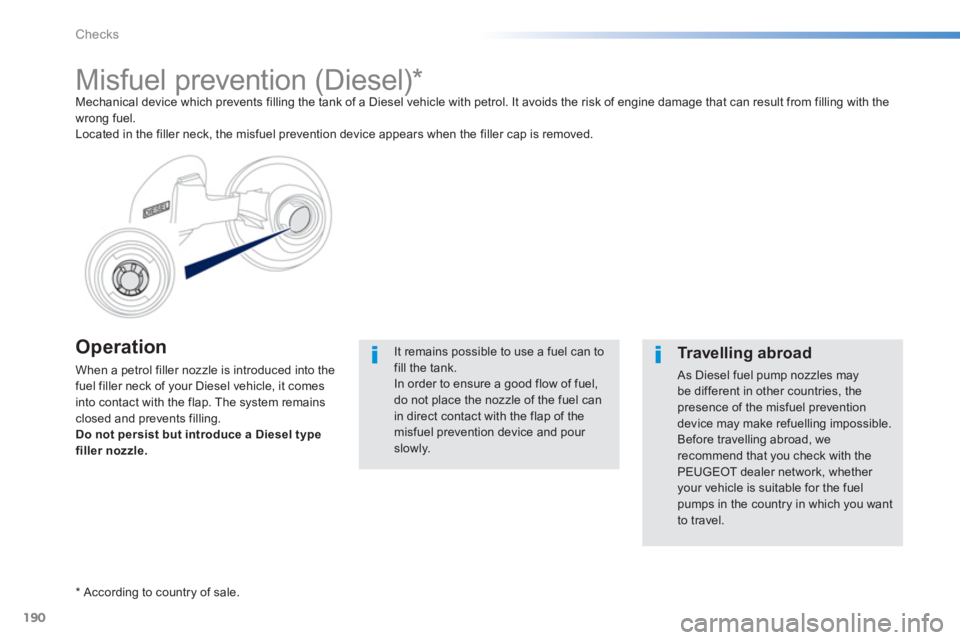
Misfuel prevention (Diesel) * Mechanical device which prevents filling the tank of a Diesel vehicle with petrol. It avoids the risk of engine damage that can result from filling with the
wrong fuel.
Located in the filler neck, the misfuel prevention device appears when the filler cap is removed.
* Accordin
g to country of sale.
It remains possible to use a fuel can to fill the tank. In order to ensure a good flow of fuel,do not place the nozzle of the fuel can in direct contact with the flap of the misfuel prevention device and pour slowly.
Tr a v e l l i ng abroad
As Diesel fuel pump nozzles maybe different in other countries, thepresence of the misfuel preventiondevice may make refuelling impossible.
Before travelling abroad, werecommend that you check with thePEUGEOT dealer network, whether your vehicle is suitable for the fuel pumps in the country in which you want to travel.
Page 193 of 324
191
8
Checks
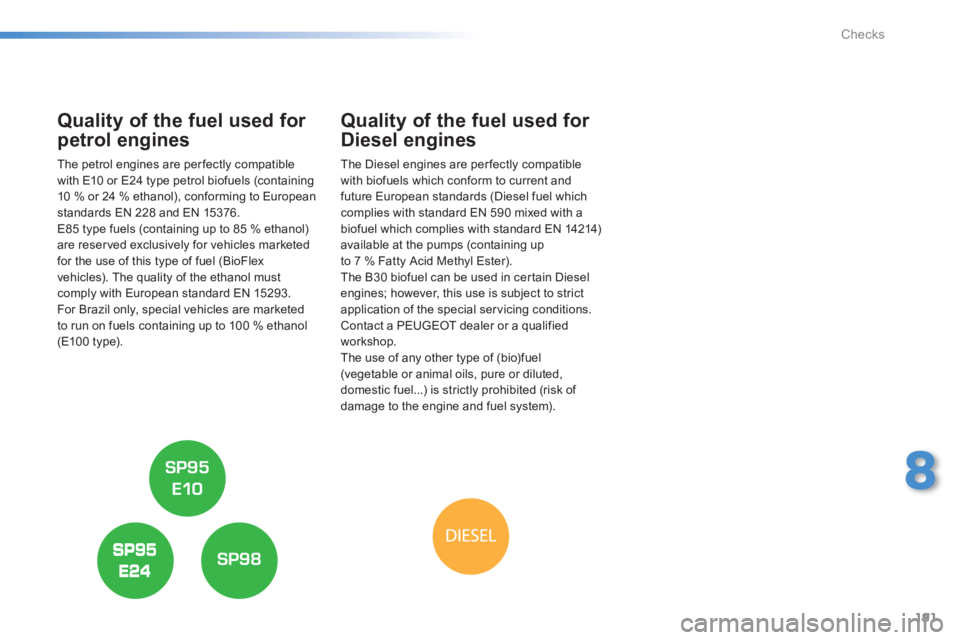
Quality of the fuel used for
petrol engines
The petrol engines are perfectly compatible
with E10 or E24 type petrol biofuels (containing10 % or 24 % ethanol), conforming to Europeanstandards EN 228 and EN 15376.
E85 type
fuels (containing up to 85 % ethanol)
are reser ved exclusively for vehicles marketed
for the use of this type of fuel (BioFlex
vehicles). The quality of the ethanol mustcomply with European standard EN 15293.
For Brazil only, special vehicles are marketed
to run on fuels containing up to 100 % ethanol(E10 0 type).
Quality of the fuel used for
Diesel engines
The Diesel engines are per fectly compatiblewith biofuels which conform to current and future European standards (Diesel fuel which complies with standard EN 590 mixed with a
bio
fuel which complies with standard EN 14214)available at the pumps (containing up
to 7 % Fatty Acid Methyl Ester).
The B30 biofuel can be used in cer tain Diesel
engines; however, this use is subject to strictapplication of the special ser vicing conditions.Contact a PEUGEOT dealer or a qualifiedworkshop.
The use of any other type of (bio)fuel (vegetable or animal oils, pure or diluted,
domestic fuel...) is strictly prohibited (risk of
damage to the engine and fuel system).
Page 194 of 324
192
Checks
On vehicle fitted with HDi engines, the fuelsystem must be primed if you run out of fuel; refer to the engine compar tment view on the
"Diesel engine" section.
If the tank on your vehicle is fitted with a misfuel prevention device, refer to the corresponding section.
Running out of fuel (Diesel)
If the engine does not star t first time, don't keep trying. Start the procedureagain from the beginning.
)
Fill the fuel tank with at least five litres of
diesel. )
Open the bonnet.)
Press and release the priming pump until
resistance is felt (there may be resistanceon the first press).
) Operate the star ter until the engine star ts. )
Close the bonnet.
1.4 litre HDi engine
)Fill the fuel tank with at least five litres of diesel.)Open the bonnet. )If necessary, unclip the styling cover for access to the priming pump. )Squeeze and release the priming pump
repeatedly until resistance is felt (there maybe resistance at the first press).)Operate the star ter until the engine star ts (if the engine does not star t at the first attempt, wait around 15 seconds before
trying again).)If the engine does not star t after a few attempts, operate the priming pump again
then start the engine. )Clip the styling cover back in place.)Close the bonnet.
1.6 litre HDi engine
Page 195 of 324
193
8
Checks
Checking levels
Oil level
The check is carried out either when
the ignition is switched on using theoil level indicator in the instrumentpanel, or using the dipstick.
Engine oil change
Refer to the servicing and warranty booklet for
details of the inter val for this operation.
In order to maintain the reliabilit
y of the engine and emission control system, the use of additives in the engine oil is prohibited.
Oil specifi cation
The oil must be the correct grade for your
engine and conform to the manufacturer'srecommendations.
Th
e brake fluid level should be close
to the "MA X" mark. If it is not, check
the brake pad wear.
Brake fluid level
Changing the fl uid
Refer to the ser vicing and warranty booklet for
details of the interval for this operation.
Fluid specifi cation
The brake fluid must conform to themanufacturer's recommendations and meet
the DOT3 or DOT4 standard.
Take care when working under the bonnet, as certain areas of the engine may be extremely hot (risk of burns) and the cooling fan could star t at
any time (even with the ignition off).
If a level drops si
gnificantly, have the corresponding system checked by a PEUGEOT dealer or a qualified workshop.
Check all of these levels regularly, in line with the ser vicing booklet and the requirements of the warranties. Top them up if necessary, unless other wise indicated.
It is normal to top up the oil levelbetween two ser vices (or oil changes).PEUGEOT recommends that you check the level, and top up if necessary, every
3 000 miles (5 000 kms).
After topping up the oil, the check when switching on the ignition with the oil level
indicator in the instrument panel is not valid
durin
g the 30 minutes after topping up. It will onl
y be correct if the vehicle is on level ground and the engine has been off for more
than 30 minutes.
Page 196 of 324
194
Checks
The coolant level should be close
to the "MA X" mark but should never exceed it.
In addition, as the cooling system is
pressurised, wait at least one hour after switching off the engine before carrying out any
work.
To avoid any risk of scalding, unscrew the cap
by two turns to allow the pressure to drop.When the pressure has dropped, remove the cap and top up the level.
Changing the coolant
The coolant does not have to be changed.
Fluid specifi cation
The coolant must conform to the
manufacturer's recommendations.
Fluid specifi cation
For optimum cleaning and to avoid freezing,
this fluid must not be topped up or replaced
with plain water.
Screenwash fluid level
Top up the level when necessary.
When the engine is warm, the temperature o
f
the coolant is regulated by the fan.
The cooling fan may star t after switching
off the engine: take care with ar ticles andclothing that might become caught by thefan blades.
Page 197 of 324
195
8
Checks
Avoid prolonged contact of used oil or fluids with the skin. Most of these fluids are harmful to
health or indeed very corrosive.
Do not discard used oil or fluids intosewers or onto the ground. Take used oil to a PEUGEOT dealer or a qualified workshop (France) or to an authorised waste disposal site.
Used products
Topping up
This additive must be topped up by a
PEUGEOT dealer or a qualified workshop
without delay.
Diesel additive level
(Diesel engine with particle
emission filter)
A low additive level is indicated by illumination
of the ser vice warning lamp, accompanied by an audible warning and a message in the screen (if a display screen is fitted).
Page 198 of 324
196
Checks
Checks
12 V battery
The battery does not require any maintenance.
However, check that the terminals are clean
and correctly tightened, particularly in summer and winter.
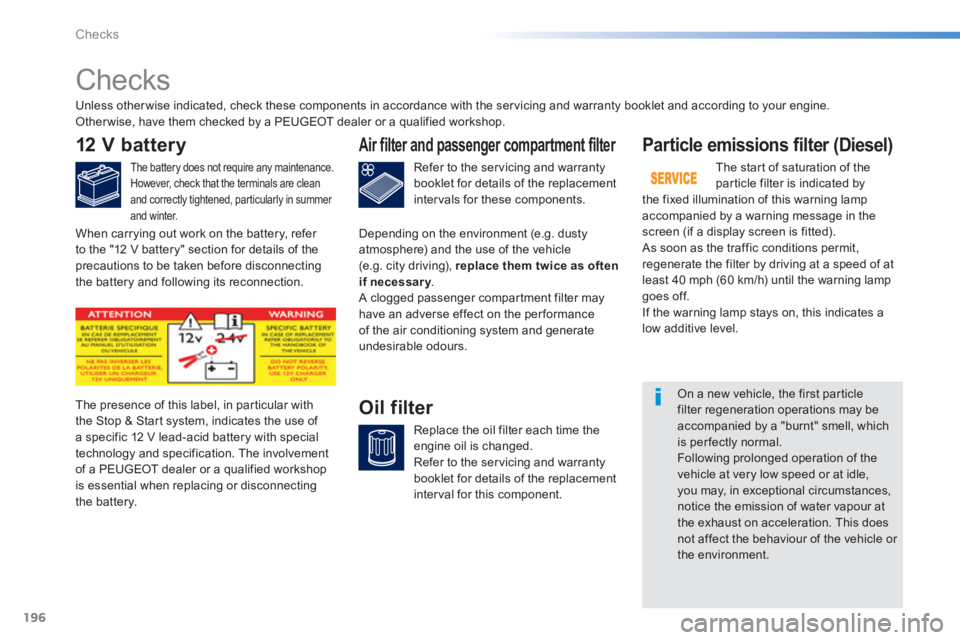
The presence of this label, in particular with
the Stop & Star t system, indicates the use of
a specific 12 V lead-acid battery with special
technology and specification. The involvement
of a PEUGEOT dealer or a qualified workshop is essential when replacing or disconnecting
the battery.
Particle emissions filter (Diesel)
The start of saturation of thepar ticle filter is indicated bythe fixed illumination of this warning lamp
accompanied by a warning message in the screen (if a display screen is fitted).
As soon as the traffic conditions permit,
regenerate the filter by driving at a speed of at
least 40 mph (60 km/h) until the warning lampgoes off.
If the warning lamp stays on, this indicates a
low additive level.
On a new vehicle, the first par ticlefilter regeneration operations may be accompanied by a "burnt" smell, whichis perfectly normal.
Following prolonged operation of the vehicle at very low speed or at idle, you may, in exceptional circumstances,notice the emission of water vapour at the exhaust on acceleration. This does not affect the behaviour of the vehicle or the environment. Unless other wise indicated, check these components in accordance with the ser vicin
g and warranty booklet and according to your engine. Other wise, have them checked by a PEUGEOT dealer or a qualified workshop.
Air filter and passenger compartment filter
Refer to the servicing and warranty
booklet for details of the replacement
inter vals for these components.
Oil filter
Replace the oil filter each time theengine oil is changed.
Refer to the ser vicing and warranty
booklet for details of the replacement
interval for this component. When carr
ying out work on the battery, refer
to the "12 V battery" section for details of theprecautions to be taken before disconnecting
the battery and following its reconnection. Dependin
g on the environment (e.g. dusty
atmosphere) and the use of the vehicle(e.g. city driving), replace them twice as oftenif necessary.y A clogged passenger compartment filter may
have an adverse effect on the performance
of the air conditioning system and generateundesirable odours.