engine PEUGEOT 2008 2013 Service Manual
[x] Cancel search | Manufacturer: PEUGEOT, Model Year: 2013, Model line: 2008, Model: PEUGEOT 2008 2013Pages: 324, PDF Size: 8.39 MB
Page 93 of 324
91
4
Driving
Gear shift indicator *
Operation
*
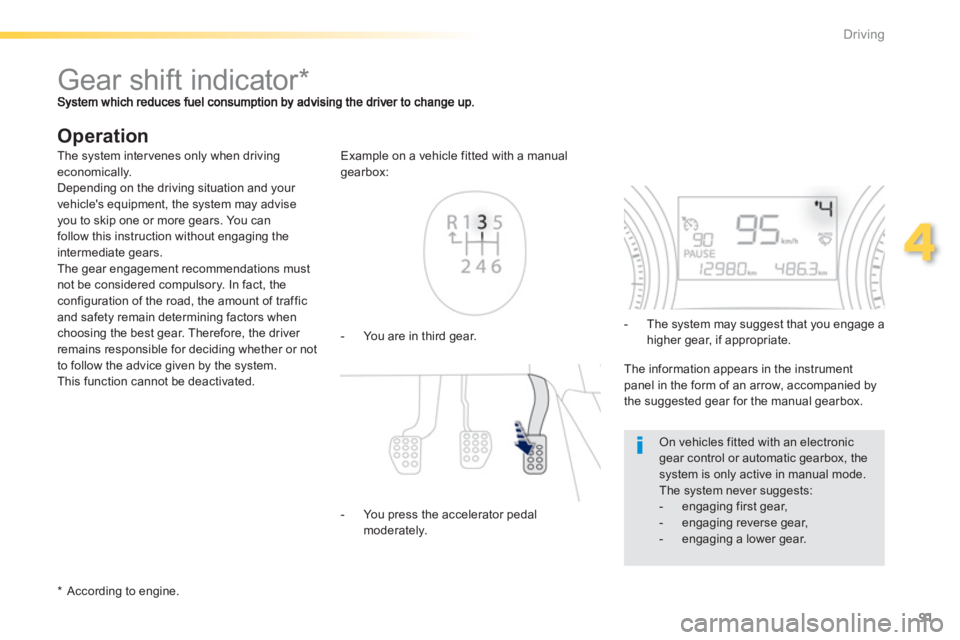
According to engine. - You are in third gear. Example on a vehicle
fitted with a manualgearbox:
-
You press the accelerator pedalmoderately.
- The s
ystem may suggest that you engage a higher gear, if appropriate.
The in
formation appears in the instrument
panel in the form of an arrow, accompanied bythe suggested gear for the manual gearbox.
On vehicles fitted with an electronicgear control or automatic gearbox, thesystem is only active in manual mode.
The system never suggests:
- engaging first gear,
- engaging reverse gear,
- engaging a lower gear.
The system intervenes only when driving economically.
Depending on the driving situation and your
vehicle's equipment, the system may advise you to skip one or more gears. You can
follow this instruction without engaging the
intermediate gears.
The gear engagement recommendations mustnot be considered compulsory. In fact, the configuration of the road, the amount of traffic
and safety remain determining factors whenchoosing the best gear. Therefore, the driver
remains responsible for deciding whether or not
to follow the advice given by the system.
This function cannot be deactivated.
Page 94 of 324
92
Driving
Stop & Start The Stop & Star t system puts the engine temporarily into standby - STOP mode - during stops in the traffic (red lights, traffic jams, or other...). The engine restar ts automatically - START mode - as soon as you want to move off. The restar t takes place instantly, quickly and silently.
Per fect for urban use, the Stop & Star t system reduces fuel consumption and exhaust emissions as well as the noise level when stationary.
Operation
Going into engine STOP mode
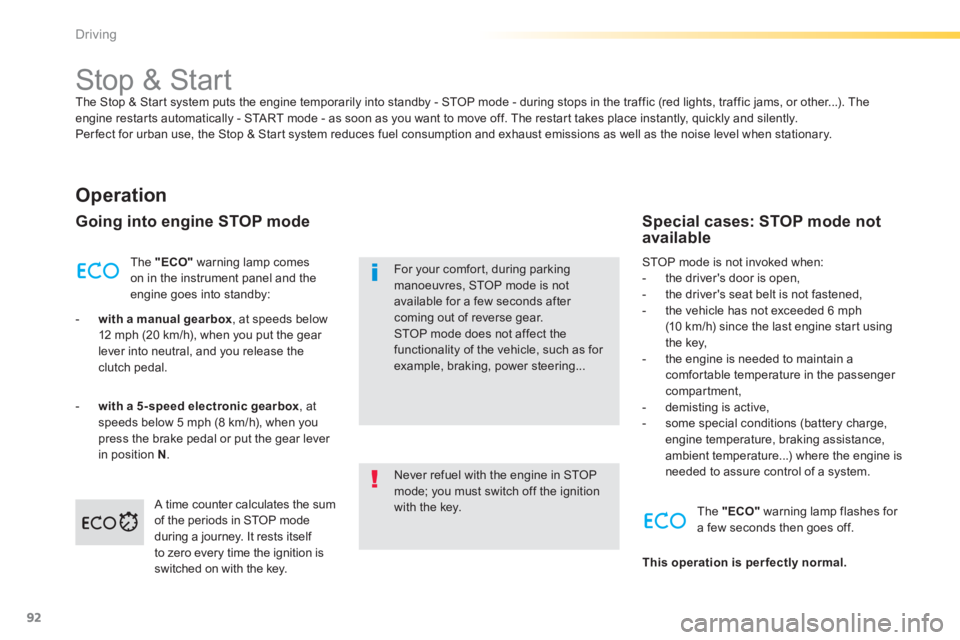
The "ECO"warning lamp comes
on in the instrument panel and the engine goes into standby:
- with a manual gearbox
, at speeds below
12 mph (20 km/h), when you put the gear lever into neutral, and you release theclutch pedal.
-with a 5-speed electronic gearbox , at
speeds below 5 mph (8 km/h), when you
press the brake pedal or put the gear lever in position N.
Never refuel with the engine in STOPmode; you must switch off the ignition with the key.
For your comfort, during parkingmanoeuvres, STOP mode is not available for a few seconds after coming out of reverse gear.STOP mode does not affect the functionality of the vehicle, such as for example, braking, power steering...
Special cases: STOP mode not available
STOP mode is not invoked when:
- the driver's door is open,
- the driver's seat belt is not fastened,
- the vehicle has not exceeded 6 mph(10 km/h) since the last engine start usingthe key,
- the engine is needed to maintain acomfortable temperature in the passenger compartment,
- demisting is active,
- some special conditions (battery charge, engine temperature, braking assistance,ambient temperature...) where the engine isneeded to assure control of a system.
A tim
e counter calculates the sum
of the periods in STOP mode
during a journey. It rests itself
to zero every time the ignition is
switched on with the key.
The "ECO"warning lamp flashes for
a few seconds then goes off.
This operation is per fectly normal.
Page 95 of 324
93
4
Driving
The "ECO"warning lamp goes off and the engine starts:
-
with a manual gearbox
, when you
depress the clutch pedal,
- with an electronic
gearbox
:
●
gear lever in position Aor M
, when yourelease the brake pedal,
●
or gear lever in position Nand the brake pedal released, when you move the gear lever to position A
or M,
●
or when you engage reverse gear.
For reasons of safet
y and for your comfort,START mode is invoked automatically when:
Special cases: START invoked
automatically
- you open the driver's door,
- you unfasten the driver's seat belt,
- the speed of the vehicle exceeds 7 mph(11 k m / h) with an electronic gearbox,
- some special conditions (battery charge,engine temperature, braking assistance,
ambient temperature...) where the engine is
needed for control of a system.
If the system has been deactivatedin STOP mode, the engine restar ts immediately.
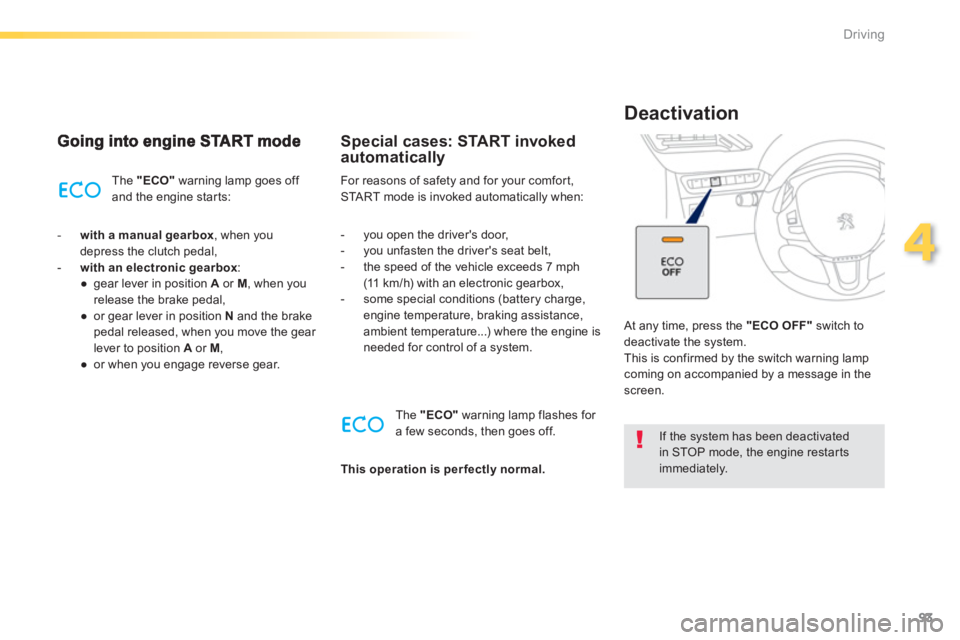
At any time, press the "ECO OFF"
switch todeactivate the system.
This is confirmed by the switch warning lamp coming on accompanied by a message in the screen.
Deactivation
The "ECO"
warning lamp flashes for
a few seconds, then goes off.
This operation is per fectly normal.
Page 96 of 324
94
Driving
The system is reactivated automaticallyat every new star t using the key.
Reactivation
Press the "ECO OFF"switch again.
The s
ystem is active again; this is confirmed
by the switch warning lamp going off,accompanied by a message in the screen.
Operating fault
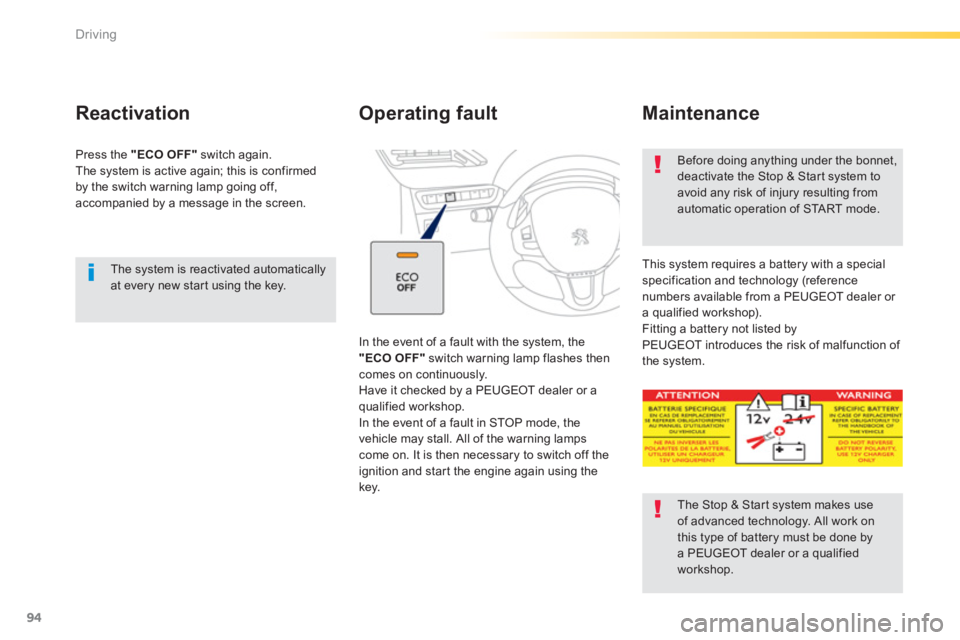
In the event of a fault with the system, the
"ECO OFF"
switch warning lamp flashes thencomes on continuously.
Have it checked by a PEUGEOT dealer or aqualified workshop.
In the event of a fault in STOP mode, the
vehicle ma
y stall. All of the warning lamps come on. It is then necessary to switch off the
ignition and star t the engine again using the key.
Before doing anything under the bonnet,deactivate the Stop & Start system toavoid any risk of injury resulting from automatic operation of STA R T m o d e .
This s
ystem requires a battery with a specialspecification and technology (reference numbers available from a PEUGEOT dealer or
a qualified workshop).
Fitting a battery not listed by
PEUGEOT introduces the risk of malfunction of
the system.
Maintenance
The Stop & Start system makes use of advanced technology. All work on this type of battery must be done by a PEUGEOT dealer or a qualifiedworkshop.
Page 97 of 324
95
4
Driving
Hill start assist
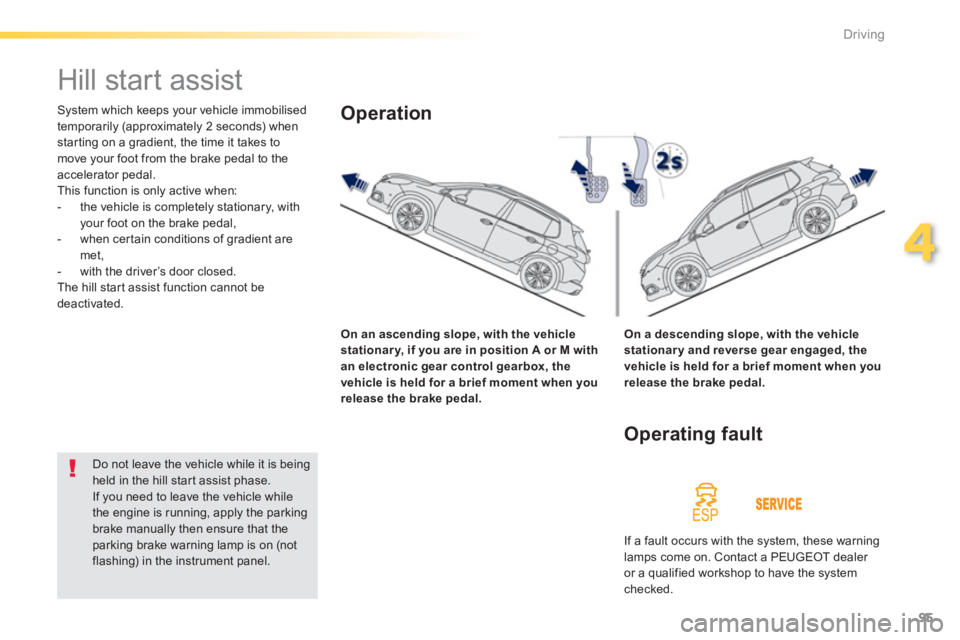
System which keeps your vehicle immobilised
temporarily (approximately 2 seconds) whenstarting on a gradient, the time it takes to move your foot from the brake pedal to the
accelerator pedal.
This function is only active when:
- the vehicle is completely stationary, with
your foot on the brake pedal,
- when cer tain conditions of gradient are met,
- with the driver’s door closed.
The hill start assist function cannot bedeactivated.
On an ascendin
g slope, with the vehicle
stationary, if you are in position A or M withan electronic gear control gearbox, the
vehicle is held for a brief moment when yourelease the brake pedal.
Operation
On a descending slope, with the vehicle
stationary and reverse gear engaged, thevehicle is held for a brief moment when you
release the brake pedal.
Do not leave the vehicle while it is beingheld in the hill star t assist phase.
If you need to leave the vehicle whilethe engine is running, apply the parking brake manually then ensure that theparking brake warning lamp is on (notflashing) in the instrument panel.
Operating fault
If a fault occurs with the system, these warninglamps come on. Contact a PEUGEOT dealer or a qualified workshop to have the systemchecked.
Page 105 of 324
103
4
Driving
Park Assist
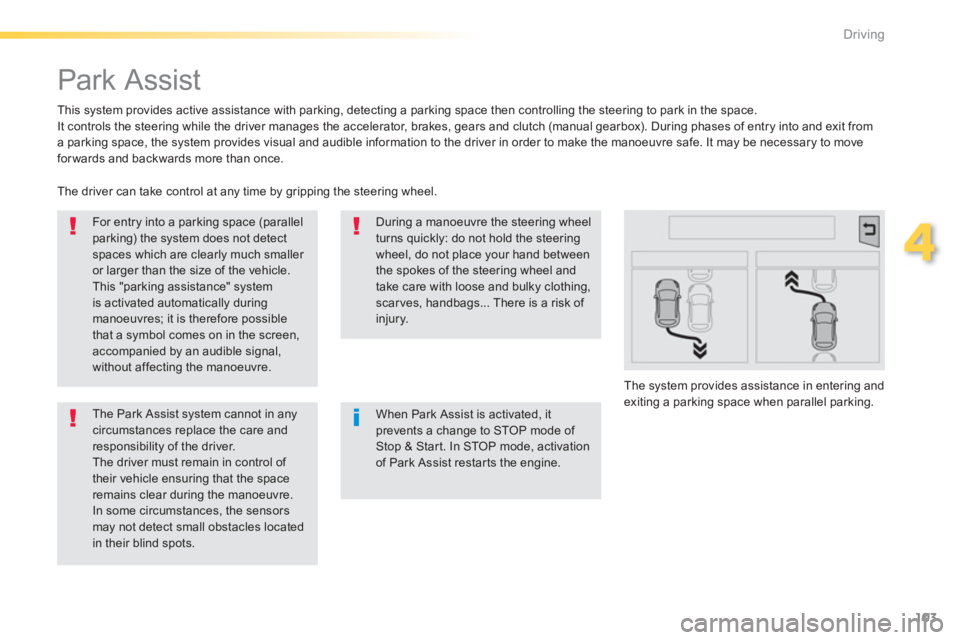
This system provides active assistance with parking, detecting a parking space then controlling the steering to park in the space.
It controls the steering while the driver manages the accelerator, brakes, gears and clutch (manual gearbox). During phases of entry into and exit from
a parking space, the system provides visual and audible information to the driver in order to make the manoeuvre safe. It may be necessary to move
forwards and backwards more than once.
For entry into a parking space (parallel
parking) the system does not detect spaces which are clearly much smaller or larger than the size of the vehicle.
This "parking assistance" system is activated automatically duringmanoeuvres; it is therefore possible that a symbol comes on in the screen,accompanied by an audible signal,without affecting the manoeuvre.
When Park Assist is activated, it prevents a change to STOP mode of Stop & Star t. In STOP mode, activationof Park Assist restarts the engine.
The Park Assist system cannot in anycircumstances replace the care and responsibility of the driver.
The driver must remain in control of their vehicle ensuring that the space remains clear during the manoeuvre. In some circumstances, the sensors may not detect small obstacles located in their blind spots.
During a manoeuvre the steering wheel
turns quickly: do not hold the steering wheel, do not place your hand betweenthe spokes of the steering wheel andtake care with loose and bulky clothing,scarves, handbags... There is a risk of injury.
The s
ystem provides assistance in entering and exiting a parking space when parallel parking.
The driver can take control at any time by gripping the steering wheel.
Page 107 of 324
105
4
Driving
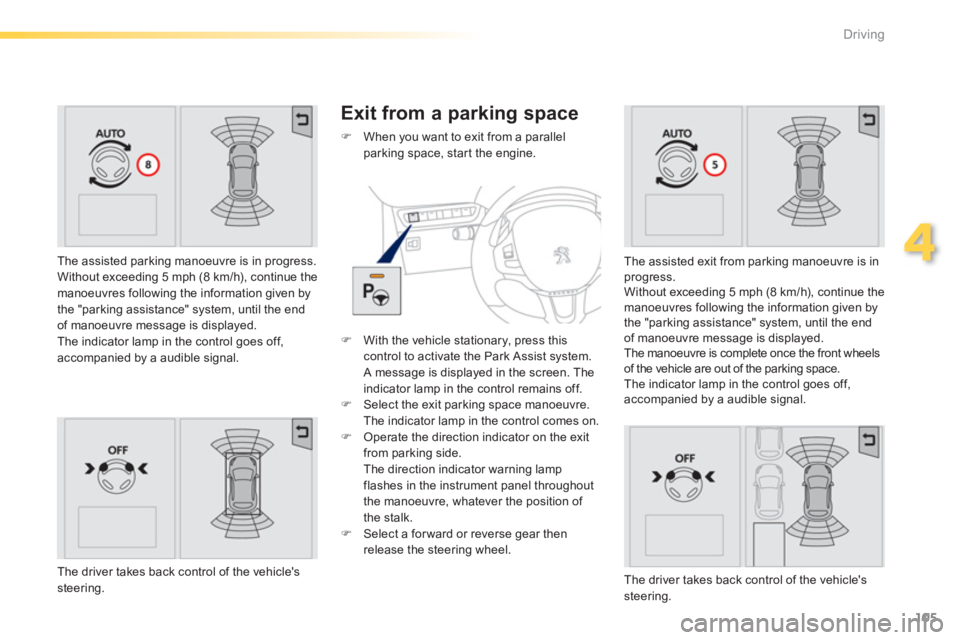
The assisted parking manoeuvre is in progress.
Without exceeding 5 mph (8 km/h), continue the manoeuvres following the information given by
the "parking assistance" system, until the end
of manoeuvre message is displayed.
The indicator lamp in the control goes off,
accompanied by a audible signal.
Th
e driver takes back control of the vehicle's
steering.
Exit from a parking space
)
With the vehicle stationary, press thiscontrol to activate the Park Assist system.
A message is displayed in the screen. The
indicator lamp in the control remains o
ff. ) Select the exit parking space manoeuvre.
The indicator lamp in the control comes on.
) Operate the direction indicator on the exit
from parking side.The direction indicator warning lamp flashes in the instrument panel throughout
the manoeuvre, whatever the position of
the stalk.
) Select a forward or reverse gear then release the steering wheel.
)
When you want to exit from a parallel
parking space, star t the engine.
The assisted exit
from parking manoeuvre is in
progress.
Without exceeding 5 mph (8 km/h), continue the
manoeuvres following the information given by
the "parking assistance" system, until the endof manoeuvre message is displayed.
The manoeuvre is complete once the front wheels
of the vehicle are out of the parking space.
The indicator lamp in the control goes off,
accompanied by a audible signal.
Th
e driver takes back control of the vehicle'ssteering.
Page 113 of 324
111
5
Visibility
Daytime running lamps
Daytime lighting, compulsory in cer tain
countries, which comes on automatically when
the engine is star ted making the vehicle more
visible to other users.
LED lamps
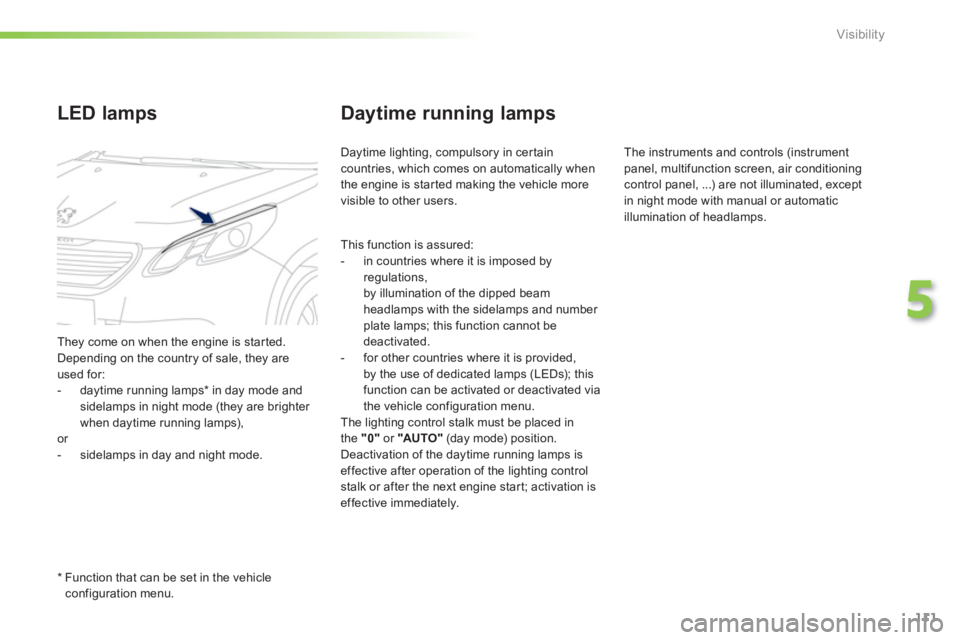
They come on when the engine is started.
Depending on the country of sale, they are used for:
- daytime running lamps *
in day mode and sidelamps in night mode (they are brighter
when daytime running lamps),
or
- sidelamps in day and night mode.
*
Function that can be set in the vehicleconfiguration menu. Thi
s function is assured:
- in countries where it is imposed byregulations,
by illumination of the dipped beam
headlamps with the sidelamps and number
plate lamps; this function cannot bedeactivated.
- for other countries where it is provided,
b
y the use of dedicated lamps (LEDs); this
function can be activated or deactivated via
the vehicle configuration menu. The lighting control stalk must be placed in
the "0"or "AUTO"
(day mode) position.
Deactivation of the daytime running lamps is
effective after operation of the lighting control
stalk or after the next engine start; activation is
effective immediately.
The instruments and controls
(instrument
panel, multifunction screen, air conditioningcontrol panel, ...) are not illuminated, except in night mode with manual or automatic
illumination of headlamps.
Page 122 of 324
120
Visibility
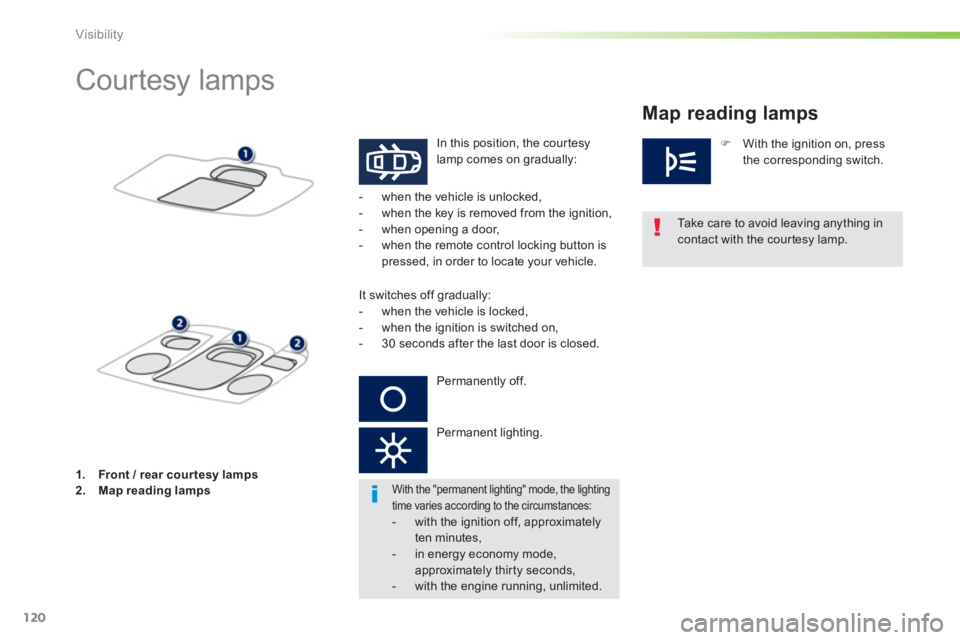
Courtesy lamps
In this position, the cour tesylamp comes on gradually:
Take care to avoid leaving anything incontact with the courtesy lamp.
- when the vehicle is unlocked,
- when the ke
y is removed from the ignition,
- when opening a door,
- when the remote control locking button is
pressed, in order to locate your vehicle.
It switches o
ff gradually:
- when the vehicle is locked,
- when the ignition is switched on,
- 30 seconds after the last door is closed.
Permanentl
y off.
Permanent lighting.
) With the ignition on, press
the corresponding switch.
1.Front / rear cour tesy lamps2.
Map reading lampsWith the "permanent lighting" mode, the lighting time varies according to the circumstances:- with the ignition off, approximately
ten minutes, - in energy economy mode, approximately thirty seconds,- with the engine running, unlimited.
Map reading lamps
Page 126 of 324
124
Safety
Electronic Stability Programme incorporatingthe following systems:
- the anti-lock braking system (ABS) and the
electronic brake force distribution (EBFD),
- the emergency braking assistance,
- the anti-slip regulation (ASR) or traction control,
- the d
ynamic stability control (DSC).
Electronic stability programme (ESP)
Definitions
Anti-lock braking system (ABS)
and electronic brake force
distribution
(EBFD)
This system improves the stability and
manoeuvrability of your vehicle when braking
and provides improved control in corners, in
par ticular on poor or slippery road surfaces.
The ABS prevents wheel lock in the event of emergency braking.
The electronic brake force distribution system
manages the braking pressure wheel by wheel.
Emergency braking assistance
In an emergency, this system enables you to reach the optimum braking pressure more
quickly and therefore reduce the stoppingdistance.
It is triggered in relation to the speed at which
the brake pedal is pressed. This is felt by areduction in the resistance of the pedal and an
increase in the effectiveness of the braking.
Anti-slip regulation (ASR)
The ASR system (also known as Traction Control) optimises traction in order to avoid
wheel slip by acting on the brakes of the drivingwheels and on the engine. It also improves
the directional stability of the vehicle onacceleration.
Dynamic stability control (DSC)
If there is a difference between the path
followed by the vehicle and that required by
the driver, the DSC monitors each wheel and
automatically acts on the brake of one or more
wheels and on the engine to return the vehicle
to the required path, within the limits of the laws
of physics.