tow PEUGEOT 2008 2015 Owner's Manual
[x] Cancel search | Manufacturer: PEUGEOT, Model Year: 2015, Model line: 2008, Model: PEUGEOT 2008 2015Pages: 340, PDF Size: 8.4 MB
Page 129 of 340
127
2008_en_Chap06_visibilite_ed01-2015
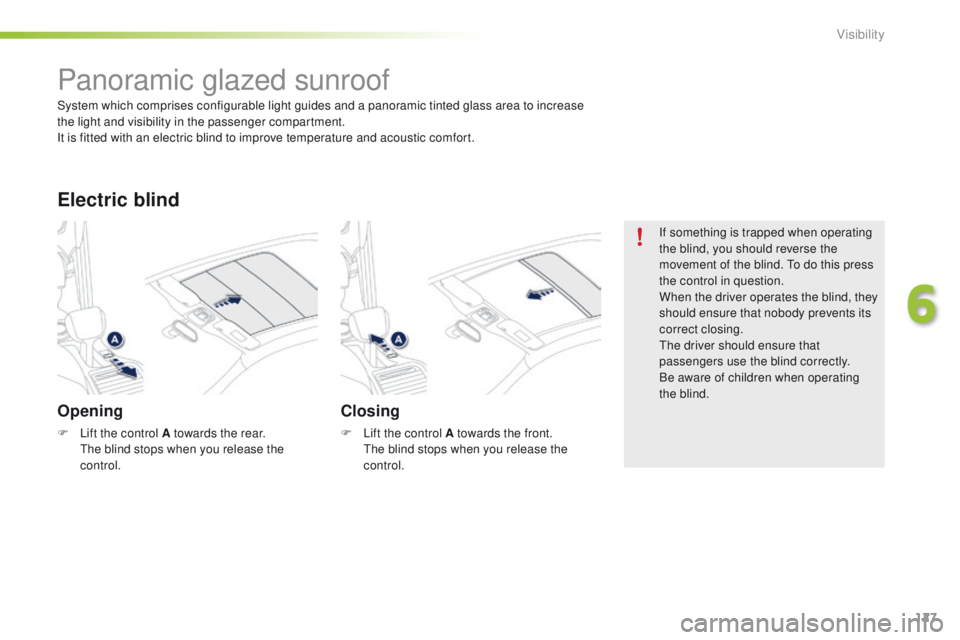
Panoramic glazed sunroof
Opening
F Lift the control A towards the rear. The blind stops when you release the
control.
Electric blind
Closing
F Lift the control A towards the front. T he blind stops when you release the
control. If something is trapped when operating
the blind, you should reverse the
movement of the blind. To do this press
the control in question.
When the driver operates the blind, they
should ensure that nobody prevents its
correct closing.
The driver should ensure that
passengers use the blind correctly.
Be aware of children when operating
the blind.
System which comprises configurable light guides and a panoramic tinted glass area to increase
the light and visibility in the passenger compartment.
It is fitted with an electric blind to improve temperature and acoustic comfort.
6
Visibility
Page 130 of 340
128
2008_en_Chap07_securite_ed01-2015
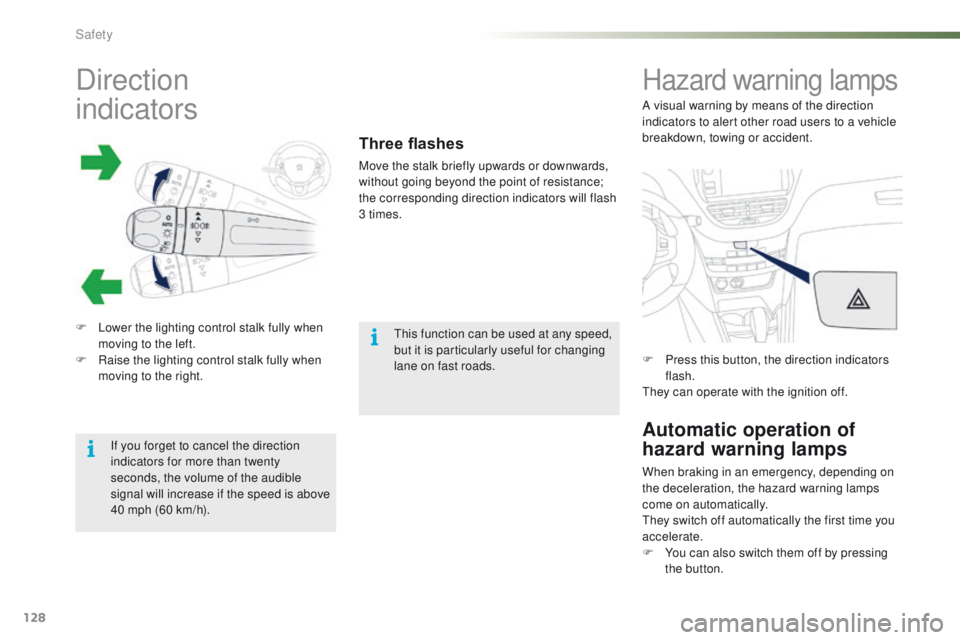
Direction
indicators
F Lower the lighting control stalk fully when moving to the left.
F
R
aise the lighting control stalk fully when
moving to the right.
Three flashes
Move the stalk briefly upwards or downwards,
without going beyond the point of resistance;
the corresponding direction indicators will flash
3 times.
If you forget to cancel the direction
indicators for more than twenty
seconds, the volume of the audible
signal will increase if the speed is above
40 mph (60 km/h).
Hazard warning lamps
F Press this button, the direction indicators flash.
They can operate with the ignition off.
This function can be used at any speed,
but it is particularly useful for changing
lane on fast roads. A visual warning by means of the direction
indicators to alert other road users to a vehicle
breakdown, towing or accident.
Automatic operation of
hazard warning lamps
When braking in an emergency, depending on
the deceleration, the hazard warning lamps
come on automatically.
They switch off automatically the first time you
accelerate.
F
Y
ou can also switch them off by pressing
the button.
Safety
Page 135 of 340

133
2008_en_Chap07_securite_ed01-2015
A set of the following Electronic Stability
systems:
-
a
nti-lock braking system (ABS) and
electronic brake force distribution (EBFD),
-
em
ergency braking assistance,
-
w
heel anti-slip regulation (ASR) or traction
control,
-
d
ynamic stability control (DSC).
Electronic stability control (ESC)
Definitions
Anti-lock braking system (ABS)
and electronic brake force
distribution (EBFD)
These systems improve the stability and
manoeuvrability of your vehicle when braking
and contribute towards improved control in
corners, in particular on poor or slippery road
surfaces.
The ABS prevents wheel lock in the event of
emergency braking.
The electronic brake force distribution system
manages the braking pressure wheel by wheel.
Emergency braking assistance
In an emergency, this system enables you to
reach the optimum braking pressure more
quickly and therefore reduce the stopping
distance.
It is triggered in relation to the speed at which
the brake pedal is pressed. This is felt by a
reduction in the resistance of the pedal and an
increase in the effectiveness of the braking.
Anti-slip regulation (ASR)
This system (also known as Traction Control)
optimises traction in order to avoid wheel
slip by acting on the brakes of the driving
wheels and on the engine. It also improves
the directional stability of the vehicle on
acceleration.
Dynamic stability control
(DSC)
If there is a difference between the path
followed by the vehicle and that required by the
driver, this system monitors each wheel and
automatically acts on the brake of one or more
wheels and on the engine to return the vehicle
to the required path, within the limits of the laws
of physics.
7
Safety
Page 142 of 340
140
2008_en_Chap07_securite_ed01-2015
The driver must ensure that passengers use
the seat belts correctly and that they are all
restrained securely before setting off.
Wherever you are seated in the vehicle,
always fasten your seat belt, even for short
journeys.
Do not interchange the seat belt buckles as
they will not fulfil their role fully.
The seat belts are fitted with an inertia reel
permitting automatic adjustment of the
length of the strap to your size. The seat belt
is stowed automatically when not in use.
Before and after use, ensure that the seat
belt is reeled in correctly.
The lower part of the strap must be
positioned as low as possible on the pelvis.
The upper part must be positioned in the
hollow of the shoulder.
The inertia reels are fitted with an automatic
locking device which comes into operation in
the event of a collision, emergency braking
or if the vehicle rolls over. You can release
the device by pulling the strap firmly and
then releasing it so that it reels in slightly.Recommendations for
children
Use a suitable child seat if the passenger is
less than 12 years old or shorter than one
and a half metres.
Never use the same seat belt to secure more
than one person.
Never allow a child to travel on your lap.
For more information, refer to the "Child
seats" section.
In order to be effective, a seat belt must:
-
b
e tightened as close to the body as
possible,
-
b
e pulled in front of you with a smooth
movement, checking that it does not
twist,
-
b
e used to restrain only one person,
-
n
ot bear any trace of cuts or fraying,
-
n
ot be converted or modified to avoid
affecting its performance.
In accordance with current safety
regulations, for all repairs on your vehicle's
seat belts, go to a qualified workshop with
the skills and equipment needed, which a
PEUGEOT dealer is able to provide.
Have your seat belts checked regularly by a
PEUGEOT dealer or a qualified workshop,
particularly if the straps show signs of
damage.
Clean the seat belt straps with soapy
water or a textile cleaning product, sold by
PEUGEOT dealers.
After folding or moving a seat or rear bench
seat, ensure that the seat belt is positioned
and reeled in correctly.
In the event of an impact
Depending on the nature and
seriousness of the impact , the
pretensioning device may be deployed
before and independently of the airbags.
Deployment of the pretensioners is
accompanied by a slight discharge of
harmless smoke and a noise, due to the
activation of the pyrotechnic cartridge
incorporated in the system.
In all cases, the airbag warning lamp
comes on.
Following an impact, have the seat belts
system checked, and if necessary replaced,
by a PEUGEOT dealer or a qualified
workshop.
Safety
Page 143 of 340
141
2008_en_Chap07_securite_ed01-2015
Airbags
System designed to contribute towards
improving the safety of the occupants (with
the exception of the rear centre passenger)
in the event of violent collisions. The airbags
supplement the action of the force-limiting
seat belts (with the exception of the centre rear
passenger).
If a collision occurs, the electronic detectors
record and analyse the front and side impacts
sustained in the impact detection zones:
-
i
n the case of a serious impact, the airbags
are deployed instantly and contribute
towards better protection of the occupants
of the vehicle (with the exception of the
rear centre passenger); immediately after
the impact, the airbags deflate rapidly so
that they do not hinder visibility or the exit
of the occupants,
-
i
n the case of a minor or rear impact or in
certain roll-over conditions, the airbags
may not be deployed; the seat belt
alone contributes towards ensuring your
protection in these situations.
The airbags do not operate when the
ignition is switched off. Deployment of one or more of the
airbags is accompanied by a slight
emission of smoke and a noise, due
to the activation of the pyrotechnic
cartridge incorporated in the system.
This smoke is not harmful, but sensitive
individuals may experience slight
irritation.
The noise of detonation related to the
deployment of one or more airbags may
result in a slight loss of hearing for a
short time.
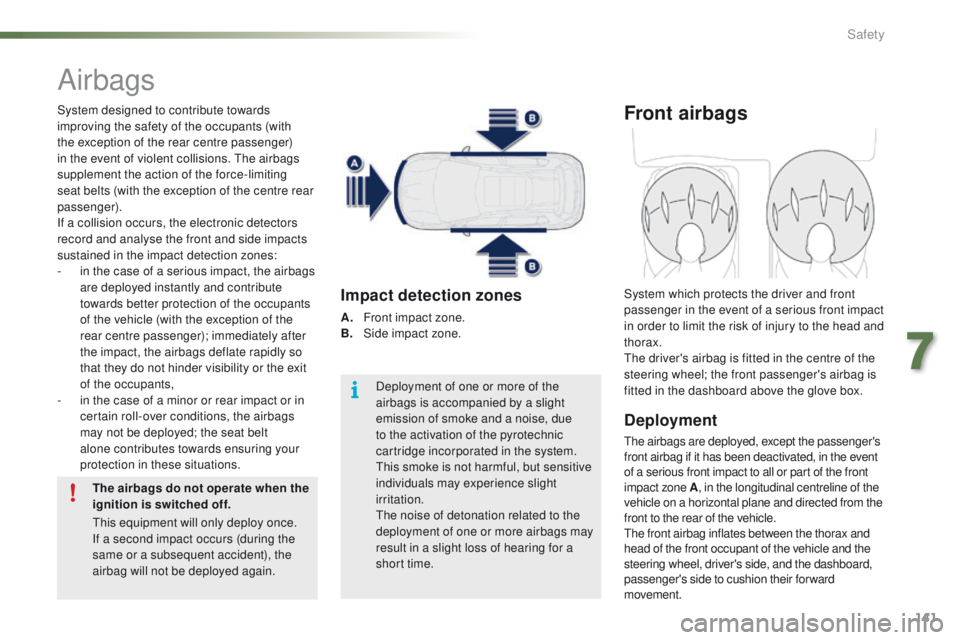
Impact detection zones
A. Front impact zone.
B. S
ide impact zone.
Front airbags
Deployment
The airbags are deployed, except the passenger's
front airbag if it has been deactivated, in the event
of a serious front impact to all or part of the front
impact zone A, in the longitudinal centreline of the
vehicle on a horizontal plane and directed from the
front to the rear of the vehicle.
The front airbag inflates between the thorax and
head of the front occupant of the vehicle and the
steering wheel, driver's side, and the dashboard,
passenger's side to cushion their forward
movement. System which protects the driver and front
passenger in the event of a serious front impact
in order to limit the risk of injury to the head and
thorax.
The driver's airbag is fitted in the centre of the
steering wheel; the front passenger's airbag is
fitted in the dashboard above the glove box.
This equipment will only deploy once.
If a second impact occurs (during the
same or a subsequent accident), the
airbag will not be deployed again.
7
Safety
Page 145 of 340
143
2008_en_Chap07_securite_ed01-2015
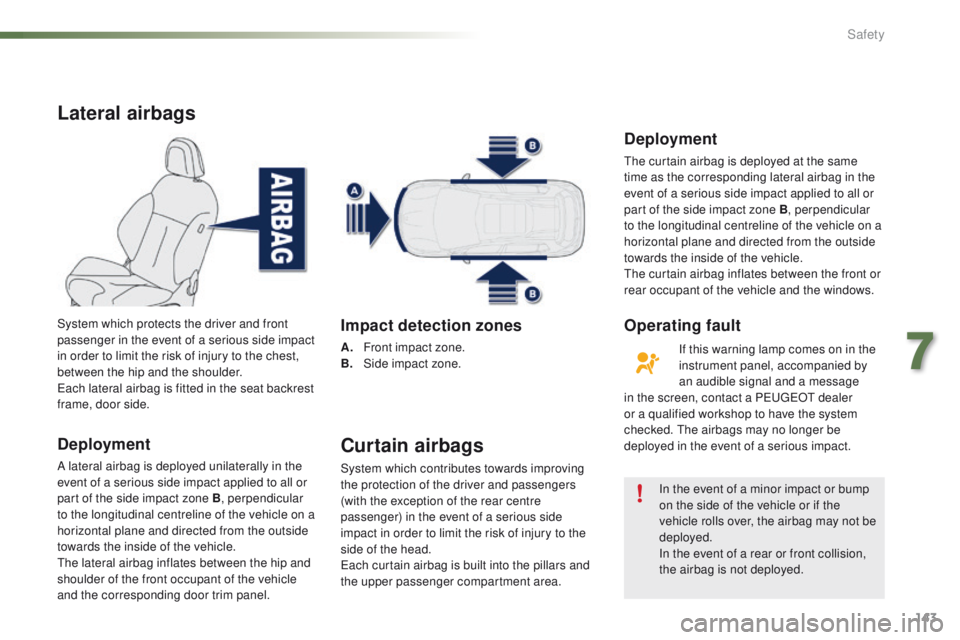
Lateral airbags
Deployment
A lateral airbag is deployed unilaterally in the
event of a serious side impact applied to all or
part of the side impact zone B, perpendicular
to the longitudinal centreline of the vehicle on a
horizontal plane and directed from the outside
towards the inside of the vehicle.
The lateral airbag inflates between the hip and
shoulder of the front occupant of the vehicle
and the corresponding door trim panel. System which protects the driver and front
passenger in the event of a serious side impact
in order to limit the risk of injury to the chest,
between the hip and the shoulder.
Each lateral airbag is fitted in the seat backrest
frame, door side.
Impact detection zones
A. Front impact zone.
B. Side impact zone.
Curtain airbags
System which contributes towards improving
the protection of the driver and passengers
(with the exception of the rear centre
passenger) in the event of a serious side
impact in order to limit the risk of injury to the
side of the head.
Each curtain airbag is built into the pillars and
the upper passenger compartment area. In the event of a minor impact or bump
on the side of the vehicle or if the
vehicle rolls over, the airbag may not be
deployed.
In the event of a rear or front collision,
the airbag is not deployed.
Deployment
The curtain airbag is deployed at the same
time as the corresponding lateral airbag in the
event of a serious side impact applied to all or
part of the side impact zone B, perpendicular
to the longitudinal centreline of the vehicle on a
horizontal plane and directed from the outside
towards the inside of the vehicle.
The curtain airbag inflates between the front or
rear occupant of the vehicle and the windows.
If this warning lamp comes on in the
instrument panel, accompanied by
an audible signal and a message
in the screen, contact a PEUGEOT dealer
or a qualified workshop to have the system
checked. The airbags may no longer be
deployed in the event of a serious impact.
Operating fault
7
Safety
Page 154 of 340
152
2008_en_Chap08_securite-enfants_ed01-2015
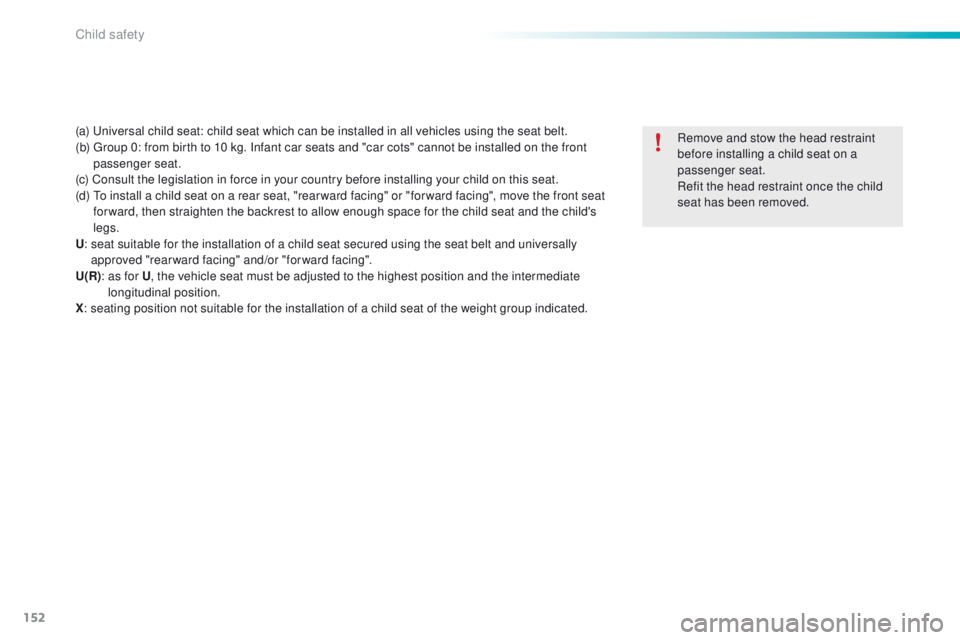
(a) Universal child seat: child seat which can be installed in all vehicles using the seat belt.
(b) G roup 0: from birth to 10 kg. Infant car seats and "car cots" cannot be installed on the front
passenger seat.
(c) Consult the legislation in force in your country before installing your child on this seat.
(d)
T
o install a child seat on a rear seat, "rear ward facing" or "for ward facing", move the front seat
for ward, then straighten the backrest to allow enough space for the child seat and the child's
legs.
U :
s
eat suitable for the installation of a child seat secured using the seat belt and universally
approved "rearward facing" and/or "forward facing".
U(R) :
a
s for U, the vehicle seat must be adjusted to the highest position and the intermediate
longitudinal position.
X : seating position not suitable for the installation of a child seat of the weight group indicated. Remove and stow the head restraint
before installing a child seat on a
passenger seat.
Refit the head restraint once the child
seat has been removed.
Child safety
Page 156 of 340
154
2008_en_Chap08_securite-enfants_ed01-2015
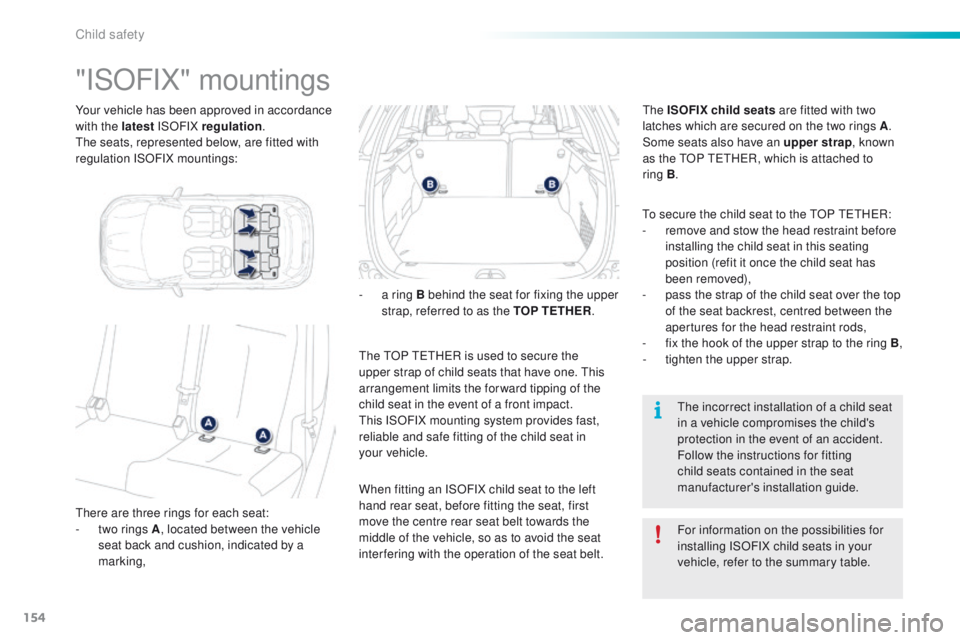
Your vehicle has been approved in accordance
with the latest ISOFIX regulation .
The seats, represented below, are fitted with
regulation ISOFIX mountings:
"ISOFIX" mountings
There are three rings for each seat:
- t wo rings A , located between the vehicle
seat back and cushion, indicated by a
marking, When fitting an ISOFIX child seat to the left
hand rear seat, before fitting the seat, first
move the centre rear seat belt towards the
middle of the vehicle, so as to avoid the seat
interfering with the operation of the seat belt.
For information on the possibilities for
installing ISOFIX child seats in your
vehicle, refer to the summary table.
-
a r
ing B behind the seat for fixing the upper
strap, referred to as the TOP TETHER .
The TOP TETHER is used to secure the
upper strap of child seats that have one. This
arrangement limits the forward tipping of the
child seat in the event of a front impact.
This ISOFIX mounting system provides fast,
reliable and safe fitting of the child seat in
your
vehicle.To secure the child seat to the TOP
TETHER
:
-
r
emove and stow the head restraint before
installing the child seat in this seating
position (refit it once the child seat has
been removed),
-
p
ass the strap of the child seat over the top
of the seat backrest, centred between the
apertures for the head restraint rods,
-
f
ix the hook of the upper strap to the ring B,
-
t
ighten the upper strap.
The incorrect installation of a child seat
in a vehicle compromises the child's
protection in the event of an accident.
Follow the instructions for fitting
child seats contained in the seat
manufacturer's installation guide.
The ISOFIX child seats are fitted with two
latches which are secured on the two rings A
.
Some seats also have an upper strap , known
as the TOP TETHER, which is attached to
ring B
.
Child safety
Page 159 of 340
157
2008_en_Chap08_securite-enfants_ed01-2015
Locations for ISOFIX child seats
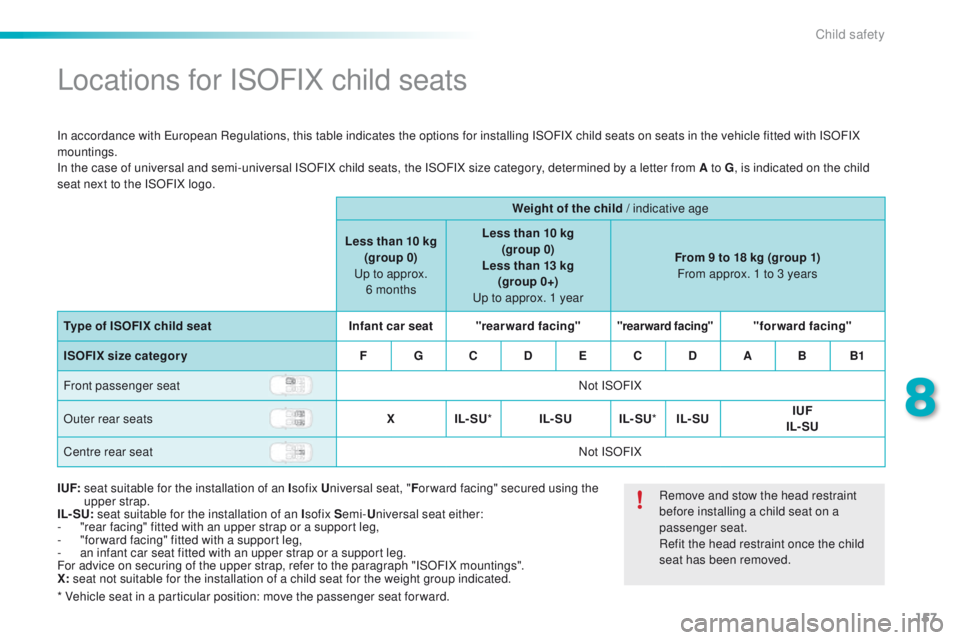
In accordance with European Regulations, this table indicates the options for installing ISOFIX child seats on seats in the vehicle fitted with ISOFIX
mountings.
In the case of universal and semi-universal ISOFIX child seats, the ISOFIX size category, determined by a letter from A to G, is indicated on the child
seat next to the ISOFIX logo.
Weight of the child / indicative age
Less than 10 kg (group 0)
Up to approx. 6 months Less than 10 kg
(group 0)
Less than 13 kg (group 0+)
Up to approx. 1 year From 9 to 18 kg (group 1)
From approx. 1 to 3 years
Type of ISOFIX child seat Infant car seat"rearward facing"
"rearward facing""forward facing"
ISOFIX size categor y F G C D E C D A B B1
Front passenger seat Not ISOFIX
Outer rear seats XIL- SU* IL- SU IL- SU *IL- SU IUF
IL- SU
Centre rear seat Not ISOFIX
I UF:
sea
t s uitable for the installation of an I sofix Universal seat, " For ward facing" secured using the
upper strap.
IL- SU: seat suitable for the installation of an I sofix Semi-Universal seat either:
-
"
rear facing" fitted with an upper strap or a support leg,
-
"
for ward facing" fitted with a support leg,
-
a
n infant car seat fitted with an upper strap or a support leg.
For advice on securing of the upper strap, refer to the paragraph "ISOFIX mountings".
X: seat not suitable for the installation of a child seat for the weight group indicated.
* Vehicle seat in a particular position: move the passenger seat for ward. Remove and stow the head restraint
before installing a child seat on a
passenger seat.
Refit the head restraint once the child
seat has been removed.
8
Child safety
Page 175 of 340
173
2008_en_Chap09_info-pratiques_ed01-2015
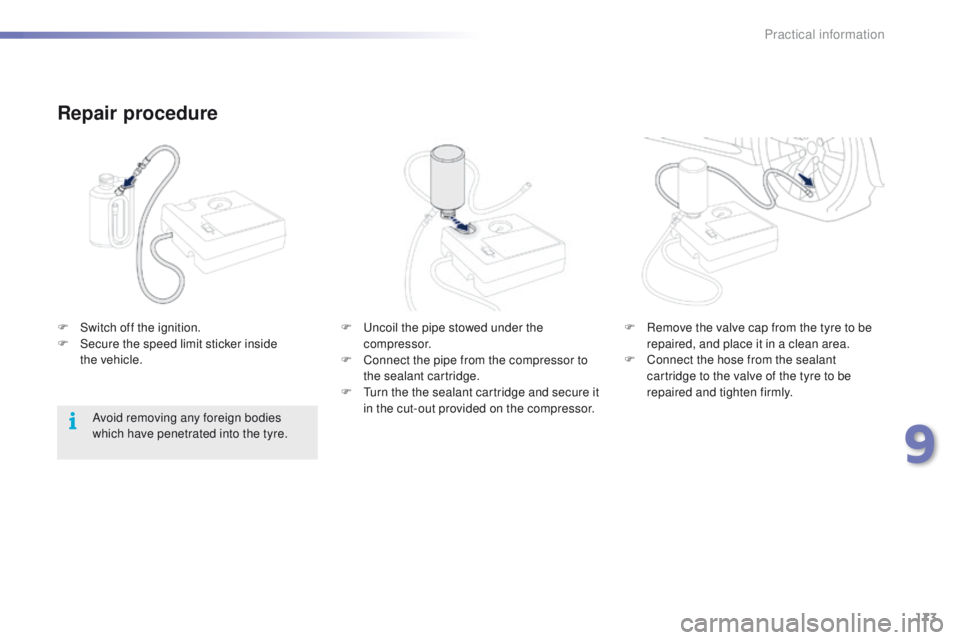
Repair procedure
F Uncoil the pipe stowed under the compressor.
F
C
onnect the pipe from the compressor to
the sealant cartridge.
F
T
urn the the sealant cartridge and secure it
in the cut-out provided on the compressor. F
R emove the valve cap from the tyre to be
repaired, and place it in a clean area.
F
C
onnect the hose from the sealant
cartridge to the valve of the tyre to be
repaired and tighten firmly.
Avoid removing any foreign bodies
which have penetrated into the tyre.
F
S
witch off the ignition.
F
S
ecure the speed limit sticker inside
the
vehicle.
9
Practical information