tow PEUGEOT 2008 2015 Service Manual
[x] Cancel search | Manufacturer: PEUGEOT, Model Year: 2015, Model line: 2008, Model: PEUGEOT 2008 2015Pages: 340, PDF Size: 8.4 MB
Page 208 of 340
206
2008_en_Chap09_info-pratiques_ed01-2015
Driving advice
Distribution of loads
F Distribute the load in the trailer so that the heaviest items are as close as possible to
the axle and the nose weight approaches
the maximum permitted without
exceeding
it.
Air density decreases with altitude, thus
reducing engine performance. Above
1
000 metres, the maximum towed load must
be reduced by 10
% for every 1 000 metres of
altitude.
Side wind
F Take into account the increased sensitivity to side wind.
Cooling
Towing a trailer on a slope increases the
temperature of the coolant.
As the fan is electrically controlled, its cooling
capacity is not dependent on the engine speed.
F
T
o lower the engine speed, reduce your
speed.
The maximum towed load on a long incline
depends on the gradient and the ambient
temperature.
In all cases, keep a check on the coolant
temperature.
F
I
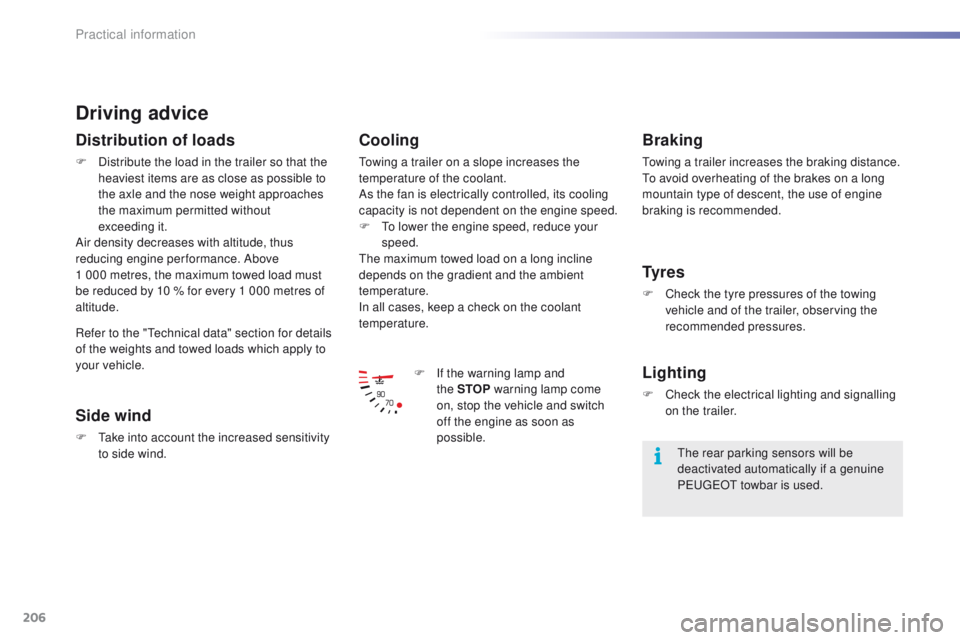
f the warning lamp and
the
STOP warning lamp come
on, stop the vehicle and switch
off the engine as soon as
possible.
Braking
Towing a trailer increases the braking distance.
To avoid overheating of the brakes on a long
mountain type of descent, the use of engine
braking is recommended.
Ty r e s
F Check the tyre pressures of the towing vehicle and of the trailer, observing the
recommended pressures.
Lighting
F Check the electrical lighting and signalling on the trailer.
The rear parking sensors will be
deactivated automatically if a genuine
PEUGEOT towbar is used.
Refer to the "Technical data" section for details
of the weights and towed loads which apply to
your vehicle.
Practical information
Page 210 of 340
208
2008_en_Chap09_info-pratiques_ed01-2015
Accessories
A wide range of accessories and genuine parts is available from the PEUGEOT dealer network.
These accessories and parts are all suitable for your vehicle and benefit from PEUGEOT's
recommendation and warranty.
Conversion kits
You can obtain an "Enterprise" kit to convert a
private car into a trade vehicle.
"Comfort":
door deflectors, side blinds and rear blind,
cigarette lighter, boot dividers, coat hanger
fixed to head restraint, front and rear parking
sensors...
"Transport solutions":
boot liner, luggage net, roof bars, bicycle
carrier on roof bars, ski carrier, roof box,
towbars....*
T
o avoid any risk of jamming of the pedals:
-
e
nsure that the mat is positioned and
secured correctly,
-
n
ever fit one mat on top of another.
"Styling":
gear lever knob, spoiler, styling strips, alloy
wheels, trims, chromed mirror shells, mirror
personalisation kits, wheel caps and exterior
stickers.....
"Security":
anti-theft alarm, window engraving, wheel
security bolts, child seats and booster
cushions, breathalyzer, first aid kit, warning
triangle, high visibility jacket, stolen vehicle
tracking system, temporary puncture repair kit,
snow chains, non-slip covers, front foglamps
kit, dog guard...
"Protection":
mats*, seat covers compatible with lateral
airbags, mud flaps, door sill protectors, bumper
protection strips, aluminium foot rest...
The towbar must be fitted by a
PEUGEOT dealer or a qualified
workshop.
Practical information
Page 212 of 340
210
2008_en_Chap10_verifications_ed01-2015
PEUGEOT & TOTAL,
A PARTNERSHIP TO DELIVER
B
ETTER
PERFORMANCE
!
Innovation, the key to success
The TOTAL Research and Development and
PEUGEOT teams work together to develop high
quality lubricants that meet the requirements
of PEUGEOT vehicles. For you, this is the
assurance that the performance of your engine
is optimised while also ensuring its durability.
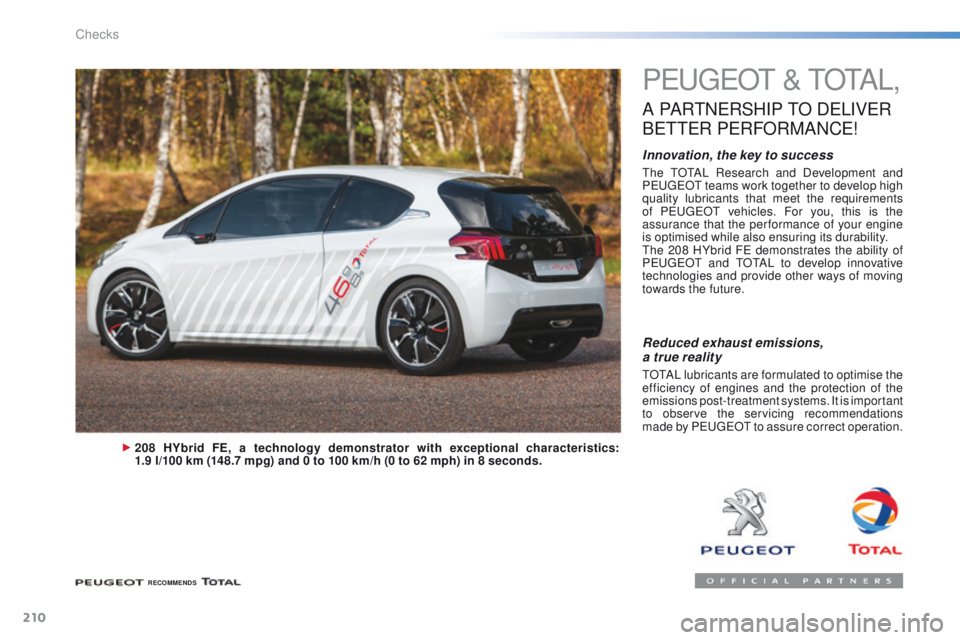
The 208 HYbrid FE demonstrates the ability of
PEUGEOT and TOTAL to develop innovative
technologies and provide other ways of moving
towards the future.
208 HYbrid FE, a technology demonstrator with exceptional characteristics:
1.9 l/100 km (148.7 mpg) and 0 to 100 km/h (0 to 62 mph) in 8 seconds.
Reduced exhaust emissions,
a true reality
TOTAL lubricants are formulated to optimise the
efficiency of engines and the protection of the
emissions post-treatment systems. It is important
to observe the servicing recommendations
made by PEUGEOT to assure correct operation.
RECOMMENDS
Checks
Page 213 of 340
211
2008_en_Chap10_verifications_ed01-2015
Bonnet
Before doing anything under the
bonnet, switch off the Stop & Start
system to avoid any risk of injury
resulting from an automatic change to
S TA R T m o d e .
Closing
F Take the stay C out of its support slot.
F C lip the stay back into its housing.
F
L
ower the bonnet and release it at the end
of its travel.
F
P
ull the bonnet to check that it has latched
c o r r e c t l y.
F
L
ift the safety catch B and raise the
bonnet.
Do not open the bonnet under very
windy conditions.
When the engine is hot, handle the
exterior safety catch and the stay with
care (risk of burns).
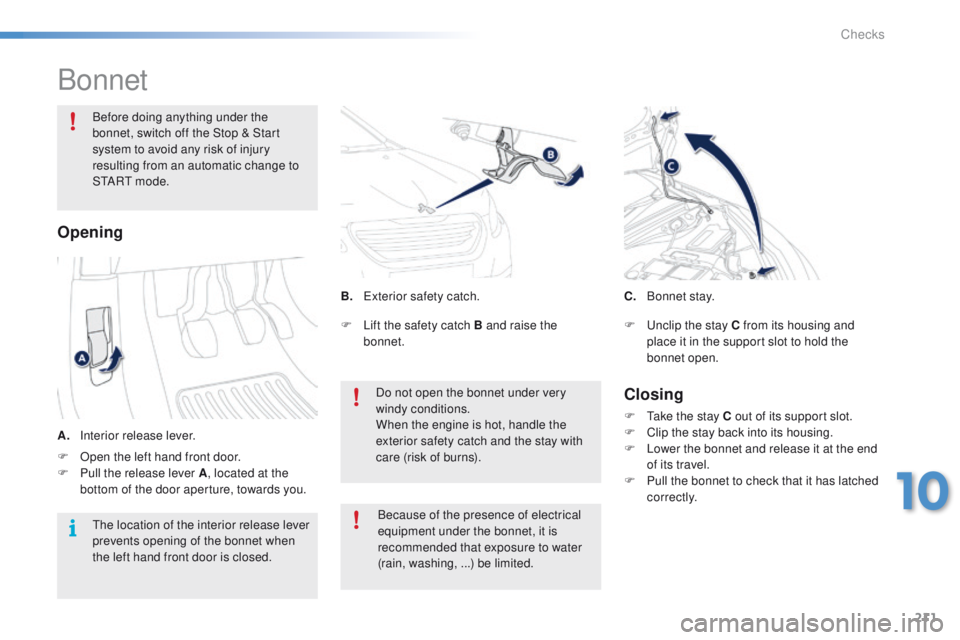
Opening
B. Exterior safety catch.
A.
I
nterior release lever. Because of the presence of electrical
equipment under the bonnet, it is
recommended that exposure to water
(rain, washing, ...) be limited.
The location of the interior release lever
prevents opening of the bonnet when
the left hand front door is closed. C. B
o n n et st ay.
F
U
nclip the stay C from its housing and
place it in the support slot to hold the
bonnet open.
F
O
pen the left hand front door.
F
P
ull the release lever A , located at the
bottom of the door aperture, towards you.
10
Checks
Page 220 of 340
218
2008_en_Chap10_verifications_ed01-2015
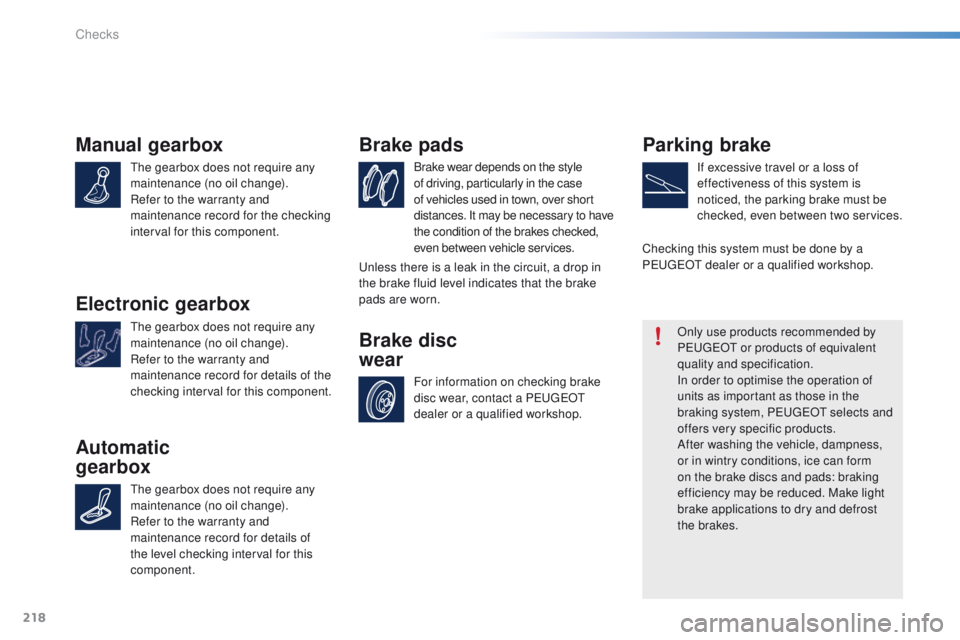
Manual gearbox
The gearbox does not require any
maintenance (no oil change).
Refer to the warranty and
maintenance record for the checking
interval for this component.
Electronic gearbox
The gearbox does not require any
maintenance (no oil change).
Refer to the warranty and
maintenance record for details of the
checking interval for this component.
Automatic
gearbox
The gearbox does not require any
maintenance (no oil change).
Refer to the warranty and
maintenance record for details of
the level checking interval for this
component.Brake wear depends on the style
of driving, particularly in the case
of vehicles used in town, over short
distances. It may be necessary to have
the condition of the brakes checked,
even between vehicle services.
Brake pads
For information on checking brake
disc wear, contact a PEUGEOT
dealer or a qualified workshop.
Brake disc
wear
Parking brake
If excessive travel or a loss of
effectiveness of this system is
noticed, the parking brake must be
checked, even between two services.
Only use products recommended by
PEUGEOT or products of equivalent
quality and specification.
In order to optimise the operation of
units as important as those in the
braking system, PEUGEOT selects and
offers very specific products.
After washing the vehicle, dampness,
or in wintry conditions, ice can form
on the brake discs and pads: braking
efficiency may be reduced. Make light
brake applications to dry and defrost
the brakes.
Checking this system must be done by a
PEUGEOT dealer or a qualified workshop.
Unless there is a leak in the circuit, a drop in
the brake fluid level indicates that the brake
pads are worn.
Checks
Page 221 of 340
219
2008_en_Chap11_caracteristiques-techniques_ed01-2015
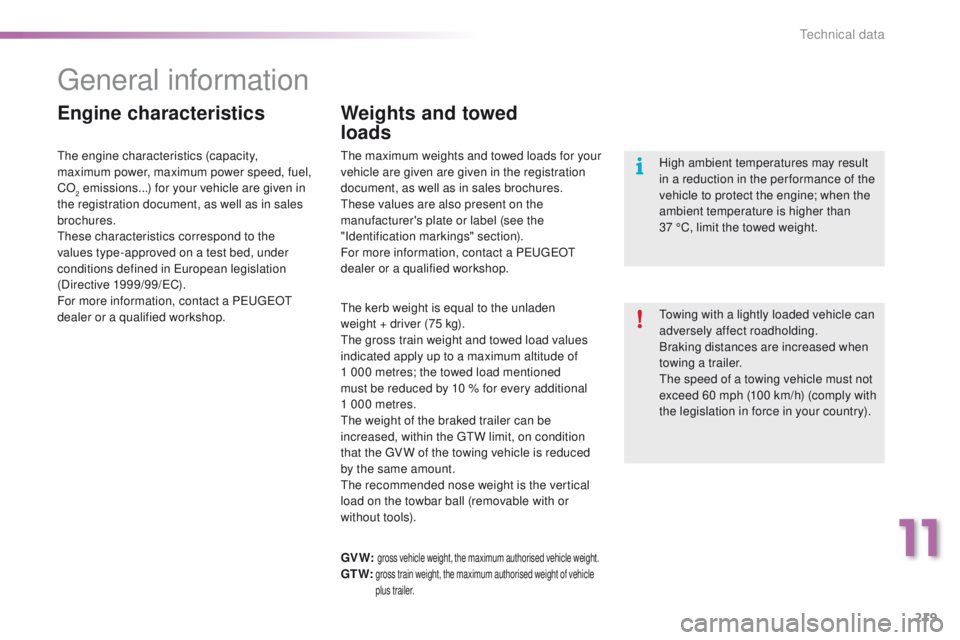
General information
Towing with a lightly loaded vehicle can
adversely affect roadholding.
Braking distances are increased when
towing a trailer.
The speed of a towing vehicle must not
exceed 60 mph (100 km/h) (comply with
the legislation in force in your country). High ambient temperatures may result
in a reduction in the per formance of the
vehicle to protect the engine; when the
ambient temperature is higher than
37 °C, limit the towed weight.
Engine characteristicsWeights and towed
loads
The engine characteristics (capacity,
maximum power, maximum power speed, fuel,
CO
2 emissions...) for your vehicle are given in
t
he registration document, as well as in sales
brochures.
These characteristics correspond to the
values type-approved on a test bed, under
conditions defined in European legislation
(Directive
1999/99/EC).
For more information, contact a PEUGEOT
dealer or a qualified workshop. The maximum weights and towed loads for your
vehicle are given are given in the registration
document, as well as in sales brochures.
These values are also present on the
manufacturer's plate or label (see the
"Identification markings" section).
For more information, contact a PEUGEOT
dealer or a qualified workshop.
The kerb weight is equal to the unladen
weight
+ driver (75 kg).
The gross train weight and towed load values
indicated apply up to a maximum altitude of
1 000 metres; the towed load mentioned
must be reduced by 10 % for every additional
1
000 metres.
The weight of the braked trailer can be
increased, within the GTW limit, on condition
that the GV W of the towing vehicle is reduced
by the same amount.
The recommended nose weight is the vertical
load on the towbar ball (removable with or
without tools).
GV W:
gross vehicle weight, the maximum authorised vehicle weight.GT W: gross train weight, the maximum authorised weight of vehicle plus trailer.
11
Technical data
Page 224 of 340
222
2008_en_Chap11_caracteristiques-techniques_ed01-2015
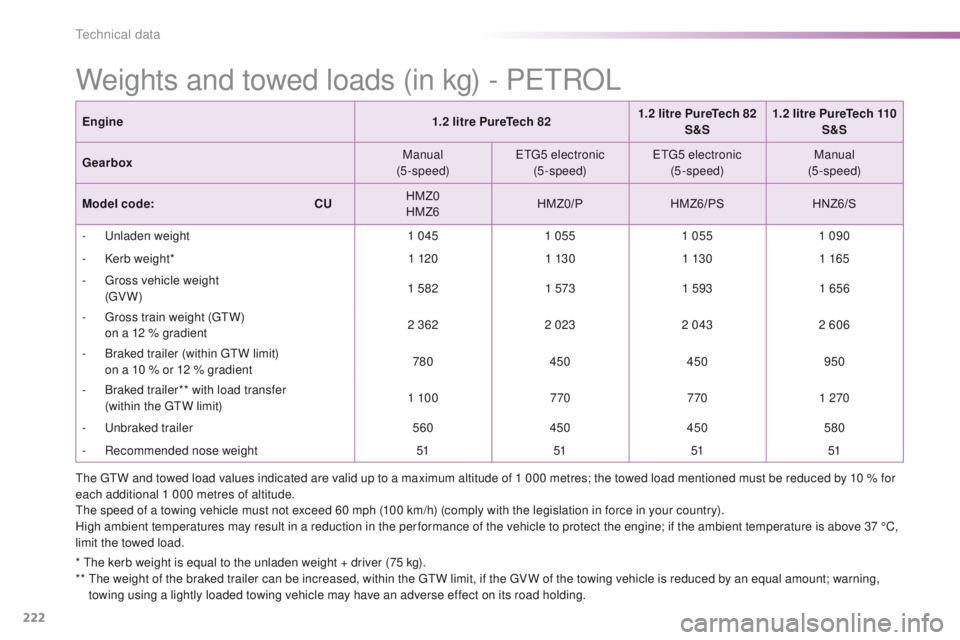
* The kerb weight is equal to the unladen weight + driver (75 kg).
** T he weight of the braked trailer can be increased, within the GTW limit, if the GV W of the towing vehicle is reduced by an equal amount; warning,
towing using a lightly loaded towing vehicle may have an adverse effect on its road holding.
Weights and towed loads (in kg) - PETROL
Engine 1.2 litre PureTech 821.2 litre PureTech 82
S&S 1.2 litre PureTech 110
S&S
Gearbox Manual
(5-speed) ETG5 electronic
(5-speed) ETG5 electronic
(5-speed) Manual
(5-speed)
Model code:
C
UHMZ0
HMZ6 HMZ0/P
HMZ6/PS HNZ6/S
-
U
nladen weight 1 0451 0551 0551 090
-
K
erb weight* 1 1201 13 0 1 13 01 165
-
G
ross vehicle weight
(GV W) 1 582
1 5731 593 1 656
-
G
ross train weight (GTW)
o
n a 12 % gradient 2 362
2 0232 043 2 606
-
B
raked trailer (within GTW limit)
o
n a 10 % or 12 % gradient 780
450 450950
-
B
raked trailer** with load transfer
(within the GTW limit) 1 10 0
7707701 270
-
U
nbraked trailer 560450450580
-
R
ecommended nose weight 51515151
The GTW and towed load values indicated are valid up to a maximum altitude of 1 000 metres; the towed load mentioned must be reduced by 10 % for
each additional 1 000 metres of altitude.
The speed of a towing vehicle must not exceed 60 mph (100 km/h) (comply with the legislation in force in your country).
High ambient temperatures may result in a reduction in the per formance of the vehicle to protect the engine; if the ambient temperature is above 37 °C,
limit the towed load.
Technical data
Page 225 of 340
223
2008_en_Chap11_caracteristiques-techniques_ed01-2015
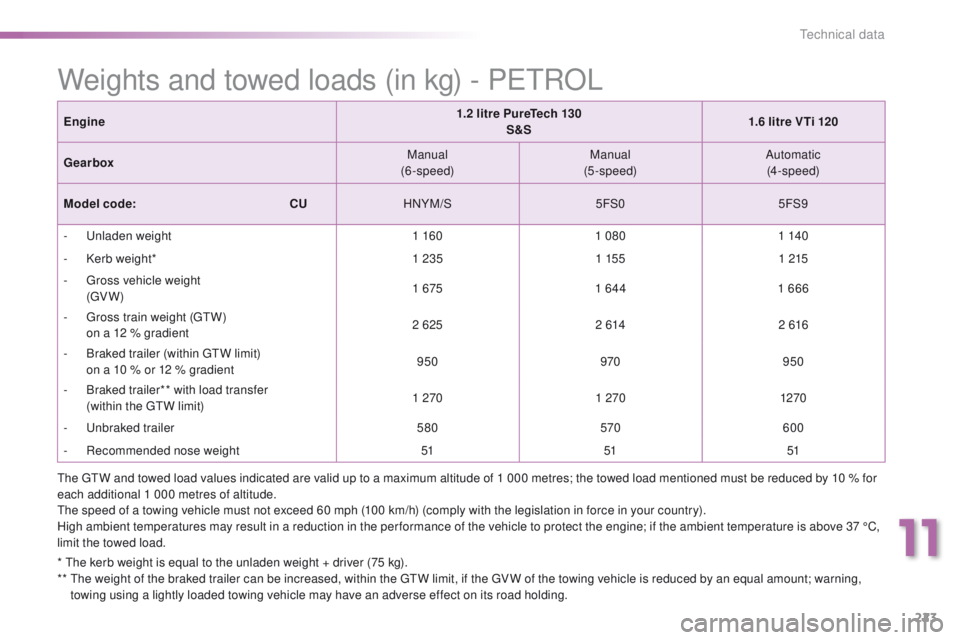
Weights and towed loads (in kg) - PETROL
Engine1.2 litre PureTech 130
S&S 1.6 litre VTi 120
Gearbox Manual
(6-speed) Manual
(5-speed) Automatic
(4-speed)
Model code:
C
UHNYM/S 5FS05FS9
-
U
nladen weight 1 1601 080 1 140
-
K
erb weight* 1 2351 1551 215
-
G
ross vehicle weight
(GV W) 1 675
1 644 1 666
-
G
ross train weight (GTW)
o
n a 12 % gradient 2 625
2 6142 616
-
B
raked trailer (within GTW limit)
o
n a 10 % or 12 % gradient 950
970950
-
B
raked trailer** with load transfer
(within the GTW limit) 1 270
1 270 1270
-
U
nbraked trailer 580570600
-
R
ecommended nose weight 515151
The GTW and towed load values indicated are valid up to a maximum altitude of 1 000 metres; the towed load mentioned must be reduced by 10 % for
each additional 1 000 metres of altitude.
The speed of a towing vehicle must not exceed 60 mph (100 km/h) (comply with the legislation in force in your country).
High ambient temperatures may result in a reduction in the per formance of the vehicle to protect the engine; if the ambient temperature is above 37 °C,
limit the towed load.
*
T
he kerb weight is equal to the unladen weight + driver (75 kg).
**
T
he weight of the braked trailer can be increased, within the GTW limit, if the GV W of the towing vehicle is reduced by an equal amount; warning,
towing using a lightly loaded towing vehicle may have an adverse effect on its road holding.
11
Technical data
Page 228 of 340
226
2008_en_Chap11_caracteristiques-techniques_ed01-2015
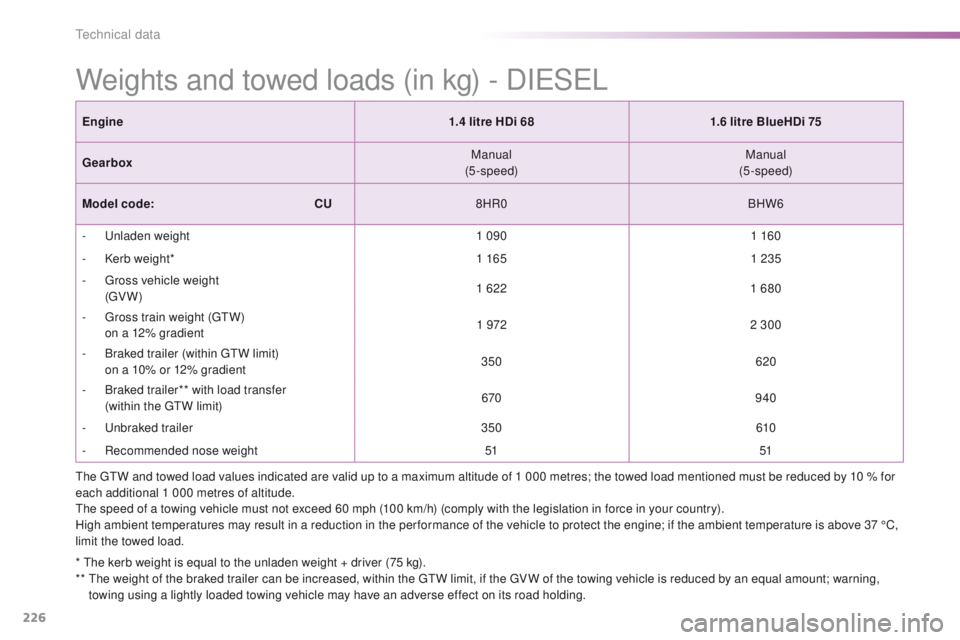
Weights and towed loads (in kg) - DIESEL
* The kerb weight is equal to the unladen weight + driver (75 kg).
** T he weight of the braked trailer can be increased, within the GTW limit, if the GV W of the towing vehicle is reduced by an equal amount; warning,
towing using a lightly loaded towing vehicle may have an adverse effect on its road holding.
Engine
1.4 litre HDi 681.6 litre BlueHDi 75
Gearbox Manual
(5-speed) Manual
(5-speed)
Model code:
C
U
8HR0 BHW6
-
U
nladen weight
1 0901 160
-
K
erb weight*
1 1651 235
-
G
ross vehicle weight
(GV W) 1 622
1 680
-
G
ross train weight (GTW)
o
n a 12% gradient
1 972
2 300
-
B
raked trailer (within GTW limit)
o
n a 10% or 12% gradient
350
620
-
B
raked trailer** with load transfer
(within the GTW limit) 670
940
-
U
nbraked trailer
350610
-
R
ecommended nose weight
5151
The GTW and towed load values indicated are valid up to a maximum altitude of 1 000 metres; the towed load mentioned must be reduced by 10 % for
each additional 1 000 metres of altitude.
The speed of a towing vehicle must not exceed 60 mph (100 km/h) (comply with the legislation in force in your country).
High ambient temperatures may result in a reduction in the per formance of the vehicle to protect the engine; if the ambient temperature is above 37 °C,
limit the towed load.
Technical data
Page 229 of 340
227
2008_en_Chap11_caracteristiques-techniques_ed01-2015
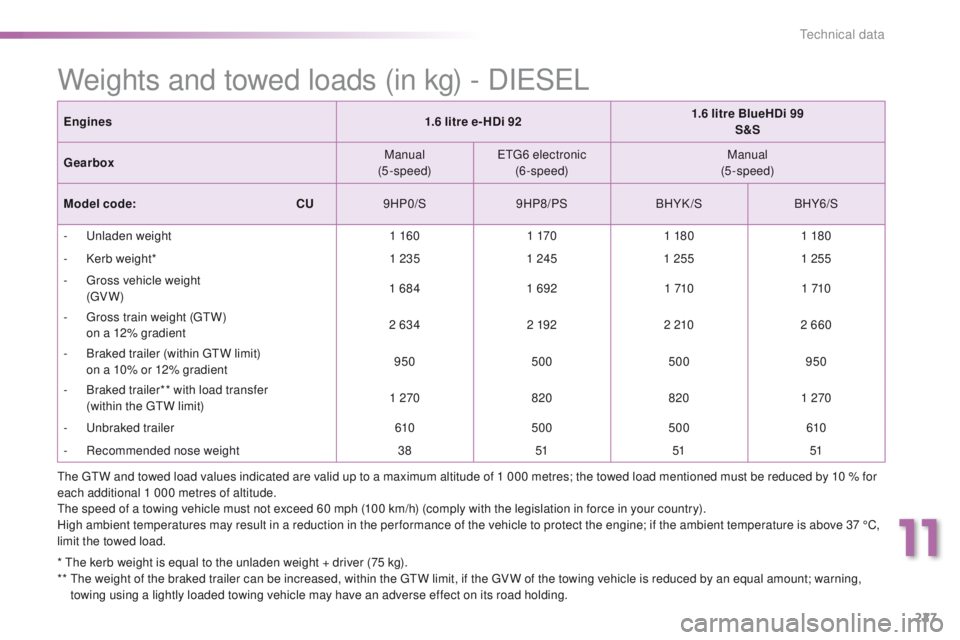
Weights and towed loads (in kg) - DIESEL
* The kerb weight is equal to the unladen weight + driver (75 kg).
** T he weight of the braked trailer can be increased, within the GTW limit, if the GV W of the towing vehicle is reduced by an equal amount; warning,
towing using a lightly loaded towing vehicle may have an adverse effect on its road holding.
Engines
1.6 litre e- HDi 921.6 litre BlueHDi 99
S&S
Gearbox Manual
(5-speed) ETG6 electronic
(6-speed) Manual
(5-speed)
Model code:
C
U
9HP0/S 9HP8/PS BHYK /SBHY6/S
-
U
nladen weight
1 1601 1701 180 1 180
-
K
erb weight*
1 2351 2451 255 1 255
-
G
ross vehicle weight
(GV W) 1 684
1 692 1 7101 710
-
G
ross train weight (GTW)
o
n a 12% gradient
2 634
2 1922 2102 660
-
B
raked trailer (within GTW limit)
o
n a 10% or 12% gradient
950
500 500 950
-
B
raked trailer** with load transfer
(within the GTW limit) 1 270
8208201 270
-
U
nbraked trailer
610500 500 610
-
R
ecommended nose weight
38515151
The GTW and towed load values indicated are valid up to a maximum altitude of 1 000 metres; the towed load mentioned must be reduced by 10 % for
each additional 1 000 metres of altitude.
The speed of a towing vehicle must not exceed 60 mph (100 km/h) (comply with the legislation in force in your country).
High ambient temperatures may result in a reduction in the per formance of the vehicle to protect the engine; if the ambient temperature is above 37 °C,
limit the towed load.
11
Technical data