engine PEUGEOT 2008 2015 Workshop Manual
[x] Cancel search | Manufacturer: PEUGEOT, Model Year: 2015, Model line: 2008, Model: PEUGEOT 2008 2015Pages: 340, PDF Size: 8.4 MB
Page 100 of 340
98
2008_en_Chap05_conduite_ed01-2015
Hill start assist
System which keeps your vehicle immobilised
temporarily (approximately 2 seconds) when
starting on a gradient, the time it takes to
move your foot from the brake pedal to the
accelerator pedal.
This function is only active when:
-
t
he vehicle is completely stationary, with
your foot on the brake pedal,
-
w
hen certain conditions of gradient are
met,
-
w
ith the driver’s door closed.
The hill start assist function cannot be
deactivated.
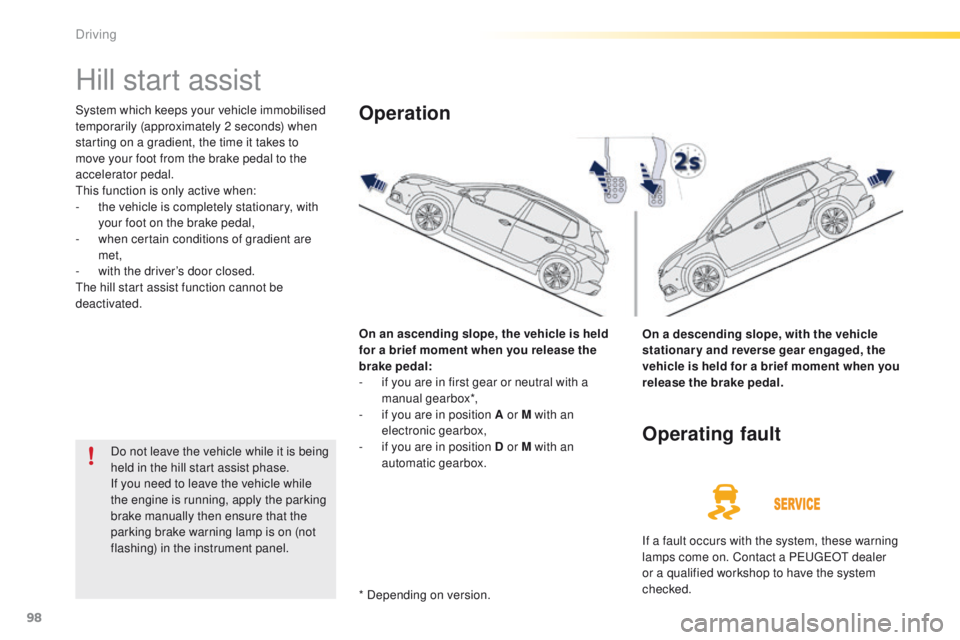
On an ascending slope, the vehicle is held
for a brief moment when you release the
brake pedal:
-
i
f you are in first gear or neutral with a
manual gearbox*,
-
i
f you are in position A or M with an
electronic gearbox,
-
i
f you are in position D or M with an
automatic gearbox.Operation
On a descending slope, with the vehicle
stationary and reverse gear engaged, the
vehicle is held for a brief moment when you
release the brake pedal.
Do not leave the vehicle while it is being
held in the hill start assist phase.
If you need to leave the vehicle while
the engine is running, apply the parking
brake manually then ensure that the
parking brake warning lamp is on (not
flashing) in the instrument panel.
Operating fault
If a fault occurs with the system, these warning
lamps come on. Contact a PEUGEOT dealer
or a qualified workshop to have the system
checked.
* Depending on version.
Driving
Page 109 of 340
107
2008_en_Chap05_conduite_ed01-2015
Park Assist
This system provides active assistance with parking, detecting a parking space then controlling the steering to park in the space.
It controls the steering while the driver manages the accelerator, brakes, gears and clutch (manual gearbox). During phases of entry into and exit from
a parking space, the system provides visual and audible information to the driver in order to make the manoeuvre safe. It may be necessary to move
forwards and backwards more than once.The Park Assist system cannot in any
circumstances replace the care and
responsibility of the driver.
The driver must remain in control of
their vehicle ensuring that the space
remains clear during the manoeuvre.
In some circumstances, the sensors
may not detect small obstacles located
in their blind spots.
Changing tyre sizes (out-size tyres,
winter tyres, ...) can inter fere with
the correct operation of the parking
assistance system.
During a manoeuvre the steering wheel
turns quickly: do not hold the steering
wheel, do not place your hand between
the spokes of the steering wheel and
take care with loose and bulky clothing,
scarves, handbags... There is a risk of
injury. For entry into a parking space (parallel
parking) the system does not detect
spaces which are clearly much smaller
or larger than the size of the vehicle.
This "parking assistance" system
is activated automatically during
manoeuvres; it is therefore possible
that a symbol comes on in the screen,
accompanied by an audible signal,
without affecting the manoeuvre.
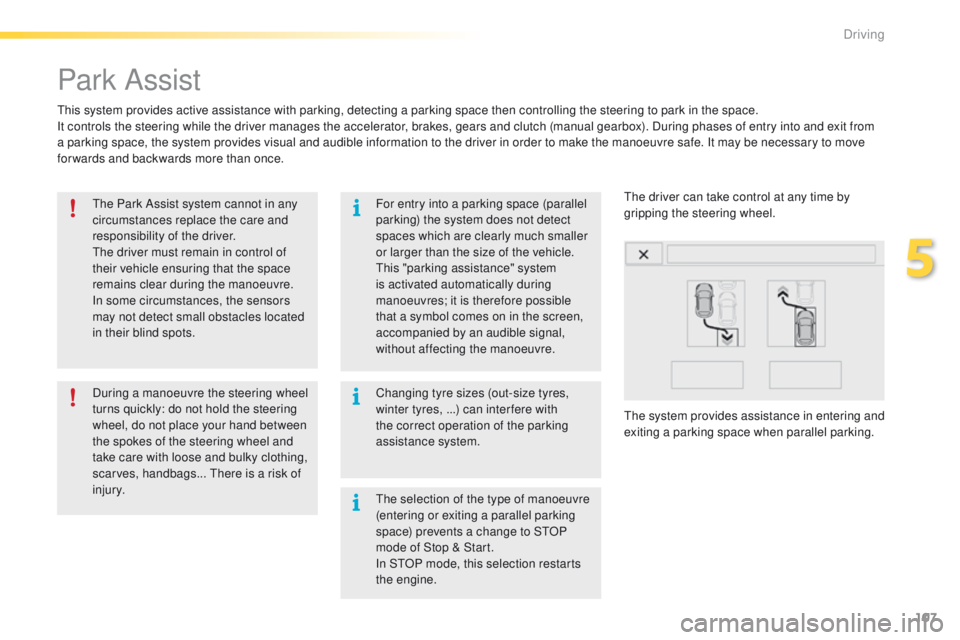
The system provides assistance in entering and
exiting a parking space when parallel parking. The driver can take control at any time by
gripping the steering wheel.
The selection of the type of manoeuvre
(entering or exiting a parallel parking
space) prevents a change to STOP
mode of Stop & Start.
In STOP mode, this selection restarts
the engine.
5
Driving
Page 111 of 340
109
2008_en_Chap05_conduite_ed01-2015
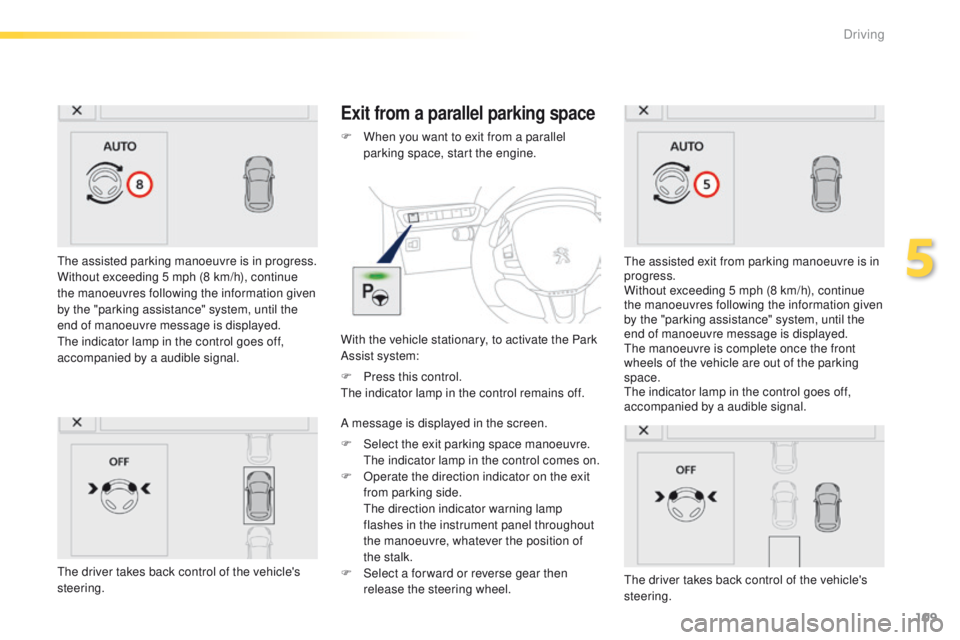
The assisted parking manoeuvre is in progress.
Without exceeding 5 mph (8 km/h), continue
the manoeuvres following the information given
by the "parking assistance" system, until the
end of manoeuvre message is displayed.
The indicator lamp in the control goes off,
accompanied by a audible signal.
Exit from a parallel parking space
With the vehicle stationary, to activate the Park
Assist system: F
W
hen you want to exit from a parallel
parking space, start the engine.
The assisted exit from parking manoeuvre is in
progress.
Without exceeding 5 mph (8 km/h), continue
the manoeuvres following the information given
by the "parking assistance" system, until the
end of manoeuvre message is displayed.
The manoeuvre is complete once the front
wheels of the vehicle are out of the parking
space.
The indicator lamp in the control goes off,
accompanied by a audible signal.
The driver takes back control of the vehicle's
steering.
F
P
ress this control.
The indicator lamp in the control remains off.
A message is displayed in the screen.
F
S
elect the exit parking space manoeuvre.
T
he indicator lamp in the control comes on.
F
O
perate the direction indicator on the exit
from parking side.
T
he direction indicator warning lamp
flashes in the instrument panel throughout
the manoeuvre, whatever the position of
the stalk.
F
S
elect a for ward or reverse gear then
release the steering wheel.
The driver takes back control of the vehicle's
steering.
5
Driving
Page 112 of 340
110
2008_en_Chap05_conduite_ed01-2015
In bad weather and in winter, ensure
that the sensors are not covered by
road dirt, ice or snow.
In the event of a fault, have the system
checked by a PEUGEOT dealer or a
qualified workshop.
If the system is deactivated during a
manoeuvre, the drive should reactivate
it manually to repeat the measurement. If the lateral distance between your vehicle
and the space is too great, the system may
not be able to measure the space.
Anything projecting beyond the envelope
of the vehicle (long or wide load) is not
taken into account by the Park Assist
system during a manoeuvre.
Deactivation
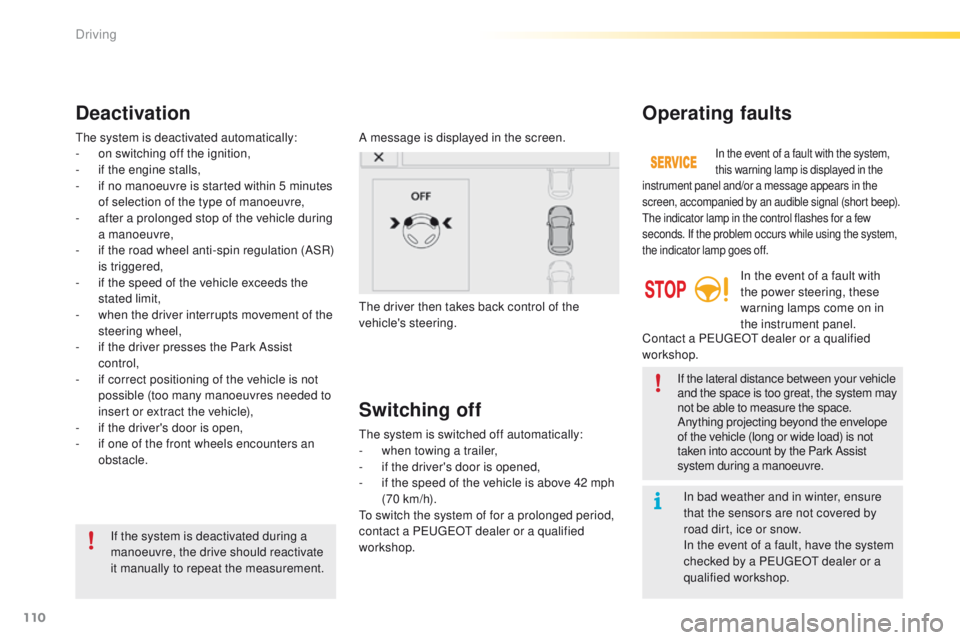
A message is displayed in the screen.
The driver then takes back control of the
vehicle's steering.
The system is deactivated automatically:
-
o
n switching off the ignition,
-
i
f the engine stalls,
-
i
f no manoeuvre is started within 5 minutes
of selection of the type of manoeuvre,
-
a
fter a prolonged stop of the vehicle during
a manoeuvre,
-
i
f the road wheel anti-spin regulation (ASR)
is triggered,
-
i
f the speed of the vehicle exceeds the
stated limit,
-
w
hen the driver interrupts movement of the
steering wheel,
-
i
f the driver presses the Park Assist
control,
-
i
f correct positioning of the vehicle is not
possible (too many manoeuvres needed to
insert or extract the vehicle),
-
i
f the driver's door is open,
-
i
f one of the front wheels encounters an
obstacle.
Switching off
The system is switched off automatically:
- w hen towing a trailer,
-
i
f the driver's door is opened,
-
i
f the speed of the vehicle is above 42 mph
(70 km/h).
To switch the system of for a prolonged period,
contact a PEUGEOT dealer or a qualified
workshop.
Operating faults
In the event of a fault with the system,
this warning lamp is displayed in the
instrument panel and/or a message appears in the
screen, accompanied by an audible signal (short beep).
The indicator lamp in the control flashes for a few
seconds. If the problem occurs while using the system,
the indicator lamp goes off.
In the event of a fault with
the power steering, these
warning lamps come on in
the instrument panel.
Contact a PEUGEOT dealer or a qualified
workshop.
Driving
Page 117 of 340
115
2008_en_Chap06_visibilite_ed01-2015
Daytime running lamps
Daytime lighting, compulsory in certain
countries, which comes on automatically when
the engine is started making the vehicle more
visible to other users.
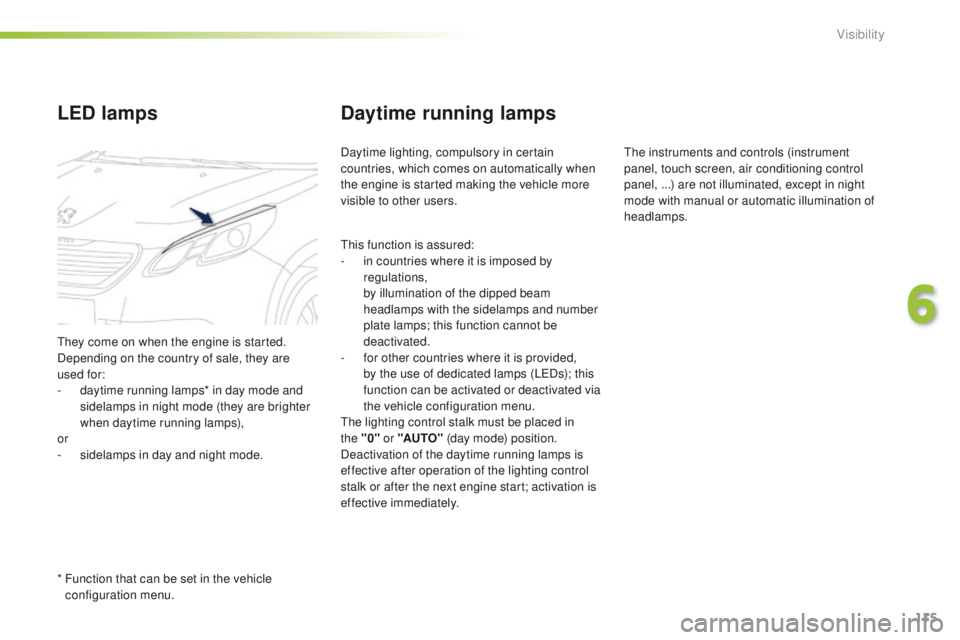
LED lamps
They come on when the engine is started.
Depending on the country of sale, they are
used for:
-
d
aytime running lamps* in day mode and
sidelamps in night mode (they are brighter
when daytime running lamps),
or
-
s
idelamps in day and night mode.
*
F
unction that can be set in the vehicle
configuration menu. This function is assured:
-
i
n countries where it is imposed by
regulations,
b
y illumination of the dipped beam
headlamps with the sidelamps and number
plate lamps; this function cannot be
deactivated.
- f or other countries where it is provided,
b
y the use of dedicated lamps (LEDs); this
function can be activated or deactivated via
the vehicle configuration menu.
The lighting control stalk must be placed in
the
"0"
or "AUTO" (day mode) position.
Deactivation of the daytime running lamps is
effective after operation of the lighting control
stalk or after the next engine start; activation is
effective immediately. The instruments and controls (instrument
panel, touch screen, air conditioning control
panel, ...) are not illuminated, except in night
mode with manual or automatic illumination of
headlamps.
6
Visibility
Page 127 of 340
125
2008_en_Chap06_visibilite_ed01-2015
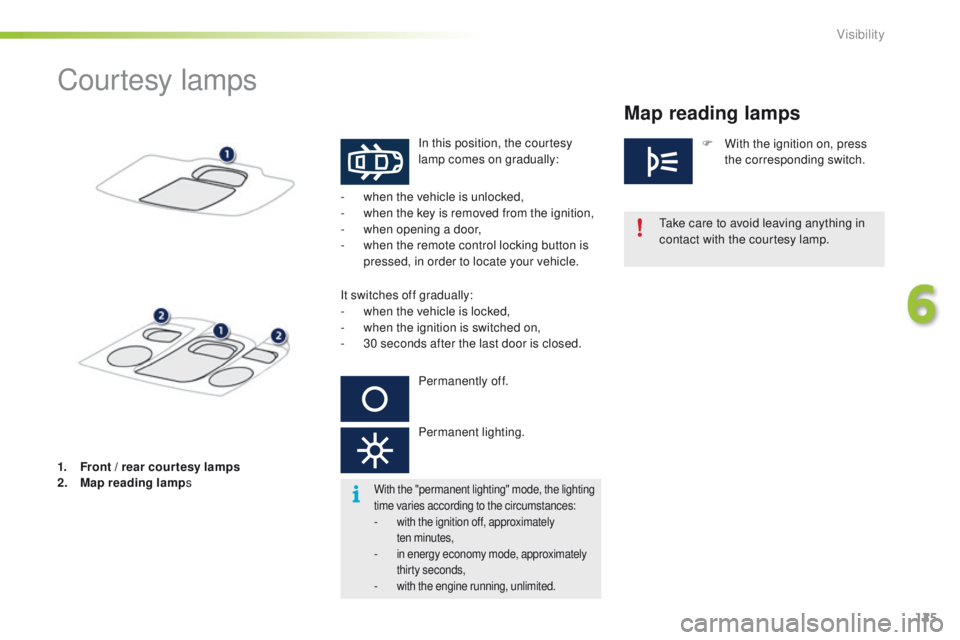
Courtesy lamps
In this position, the courtesy
lamp comes on gradually:Take care to avoid leaving anything in
contact with the courtesy lamp.
-
w
hen the vehicle is unlocked,
-
w
hen the key is removed from the ignition,
-
w
hen opening a door,
-
w
hen the remote control locking button is
pressed, in order to locate your vehicle.
It switches off gradually:
-
w
hen the vehicle is locked,
-
w
hen the ignition is switched on,
-
3
0 seconds after the last door is closed. Permanently off.
Permanent lighting. F
W ith the ignition on, press
the corresponding switch.
1.
F
ront / rear cour tesy lamps
2.
M
ap reading lamp s
With the "permanent lighting" mode, the lighting
time varies according to the circumstances:
- with the ignition off, approximately
ten
minutes,
- in energy economy mode, approximately thirty seconds,
- with the engine running, unlimited.
Map reading lamps
6
Visibility
Page 135 of 340

133
2008_en_Chap07_securite_ed01-2015
A set of the following Electronic Stability
systems:
-
a
nti-lock braking system (ABS) and
electronic brake force distribution (EBFD),
-
em
ergency braking assistance,
-
w
heel anti-slip regulation (ASR) or traction
control,
-
d
ynamic stability control (DSC).
Electronic stability control (ESC)
Definitions
Anti-lock braking system (ABS)
and electronic brake force
distribution (EBFD)
These systems improve the stability and
manoeuvrability of your vehicle when braking
and contribute towards improved control in
corners, in particular on poor or slippery road
surfaces.
The ABS prevents wheel lock in the event of
emergency braking.
The electronic brake force distribution system
manages the braking pressure wheel by wheel.
Emergency braking assistance
In an emergency, this system enables you to
reach the optimum braking pressure more
quickly and therefore reduce the stopping
distance.
It is triggered in relation to the speed at which
the brake pedal is pressed. This is felt by a
reduction in the resistance of the pedal and an
increase in the effectiveness of the braking.
Anti-slip regulation (ASR)
This system (also known as Traction Control)
optimises traction in order to avoid wheel
slip by acting on the brakes of the driving
wheels and on the engine. It also improves
the directional stability of the vehicle on
acceleration.
Dynamic stability control
(DSC)
If there is a difference between the path
followed by the vehicle and that required by the
driver, this system monitors each wheel and
automatically acts on the brake of one or more
wheels and on the engine to return the vehicle
to the required path, within the limits of the laws
of physics.
7
Safety
Page 137 of 340
135
2008_en_Chap07_securite_ed01-2015
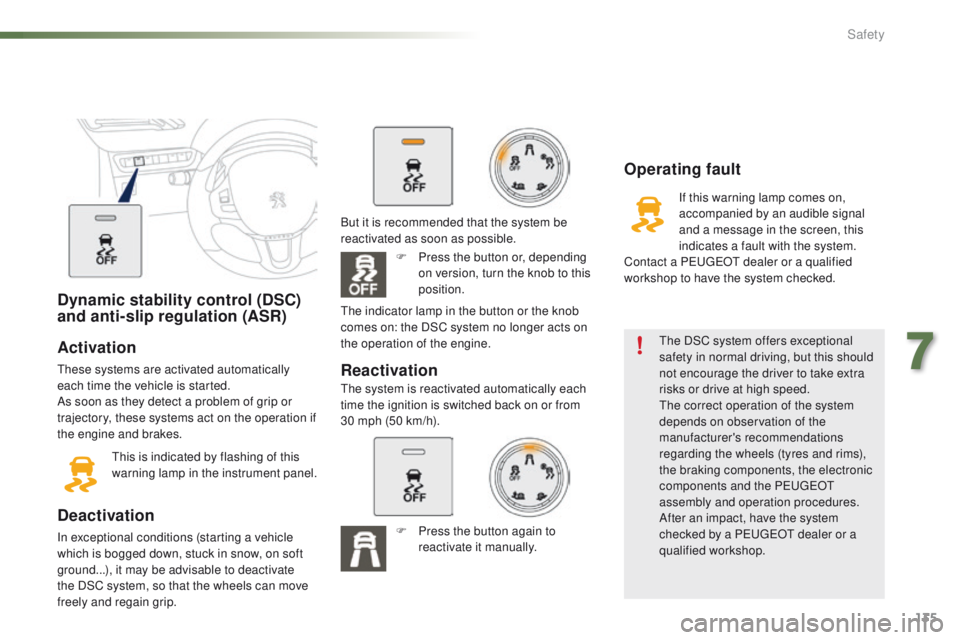
Dynamic stability control (DSC)
and anti-slip regulation (ASR)
Activation
These systems are activated automatically
each time the vehicle is started.
As soon as they detect a problem of grip or
trajectory, these systems act on the operation if
the engine and brakes.This is indicated by flashing of this
warning lamp in the instrument panel.
Deactivation
In exceptional conditions (starting a vehicle
which is bogged down, stuck in snow, on soft
ground...), it may be advisable to deactivate
the DSC system, so that the wheels can move
freely and regain grip. The DSC system offers exceptional
safety in normal driving, but this should
not encourage the driver to take extra
risks or drive at high speed.
The correct operation of the system
depends on observation of the
manufacturer's recommendations
regarding the wheels (tyres and rims),
the braking components, the electronic
components and the PEUGEOT
assembly and operation procedures.
After an impact, have the system
checked by a PEUGEOT dealer or a
qualified workshop.
Operating fault
If this warning lamp comes on,
accompanied by an audible signal
and a message in the screen, this
indicates a fault with the system.
Contact a PEUGEOT dealer or a qualified
workshop to have the system checked.
Reactivation
But it is recommended that the system be
reactivated as soon as possible.
F
P
ress the button or, depending
on version, turn the knob to this
position.
The system is reactivated automatically each
time the ignition is switched back on or from
30 mph (50 km/h). The indicator lamp in the button or the knob
comes on: the DSC system no longer acts on
the operation of the engine.
F
P
ress the button again to
reactivate it manually.
7
Safety
Page 138 of 340
136
2008_en_Chap07_securite_ed01-2015
Grip control
Special patented traction control system which
improves traction on snow, mud and sand.
This system, the operation of which has been
optimised for each situation, allows you to
manoeuvre in most conditions of poor grip
(encountered during touring use).
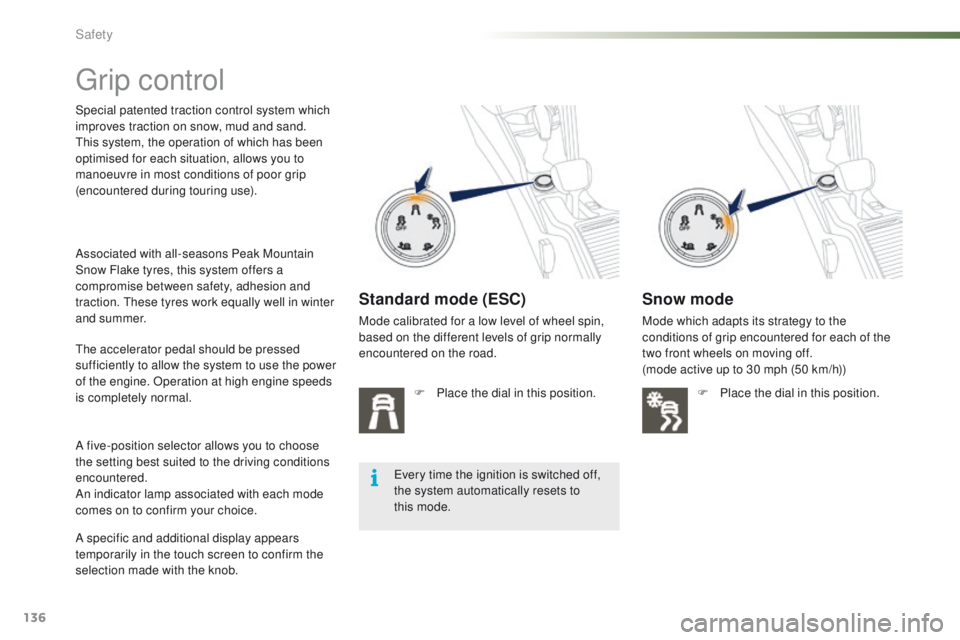
Standard mode (ESC)
Mode calibrated for a low level of wheel spin,
based on the different levels of grip normally
encountered on the road.F
P
lace the dial in this position.
Snow mode
Mode which adapts its strategy to the
conditions of grip encountered for each of the
two front wheels on moving off.
(mode active up to 30 mph (50 km/h))F
P
lace the dial in this position.
The accelerator pedal should be pressed
sufficiently to allow the system to use the power
of the engine. Operation at high engine speeds
is completely normal.
A five-position selector allows you to choose
the setting best suited to the driving conditions
encountered.
An indicator lamp associated with each mode
comes on to confirm your choice.
Every time the ignition is switched off,
the system automatically resets to
this
mode.
Associated with all-seasons Peak Mountain
Snow Flake tyres, this system offers a
compromise between safety, adhesion and
traction. These tyres work equally well in winter
and summer.
A specific and additional display appears
temporarily in the touch screen to confirm the
selection made with the knob.
Safety
Page 161 of 340
159
2008_en_Chap09_info-pratiques_ed01-2015
Low fuel level
When the fuel tank minimum level is
reached this warning lamp comes on
in the instrument panel. There remains
approximately 5 litres of fuel in the tank.
When the warning lamp flashes there is
ver y little fuel remaining in the tank.
The key cannot be removed from the
lock until the cap is refitted.
Removing the filler cap may cause an
inrush of air. This vacuum is per fectly
normal and results from the sealing of
the system.
Fuel tank
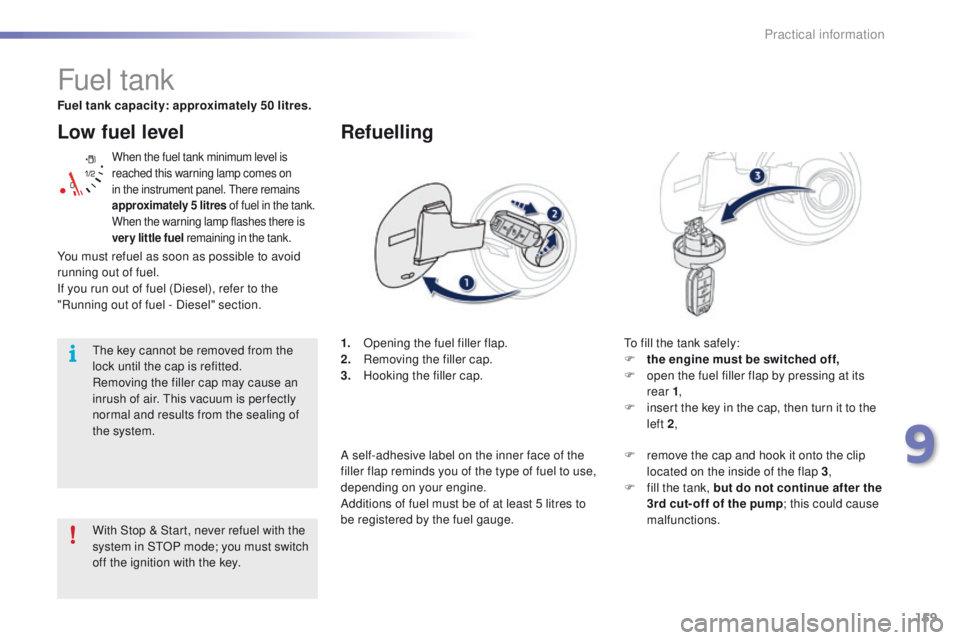
Fuel tank capacity: approximately 50 litres.
1.
O
pening the fuel filler flap.
2.
R
emoving the filler cap.
3.
H
ooking the filler cap.
Refuelling
To fill the tank safely:
F t he engine must be switched off,
F
o
pen the fuel filler flap by pressing at its
rear 1 ,
F
i
nsert the key in the cap, then turn it to the
left 2 ,
With Stop & Start, never refuel with the
system in STOP mode; you must switch
off the ignition with the key. F
r
emove the cap and hook it onto the clip
located on the inside of the flap 3 ,
F
f
ill the tank, but do not continue after the
3rd cut- off of the pump ; this could cause
malfunctions.
You must refuel as soon as possible to avoid
running out of fuel.
If you run out of fuel (Diesel), refer to the
"Running out of fuel - Diesel" section.
A self-adhesive label on the inner face of the
filler flap reminds you of the type of fuel to use,
depending on your engine.
Additions of fuel must be of at least 5 litres to
be registered by the fuel gauge.
9
Practical information