child lock PEUGEOT 2008 2015 Owners Manual
[x] Cancel search | Manufacturer: PEUGEOT, Model Year: 2015, Model line: 2008, Model: PEUGEOT 2008 2015Pages: 340, PDF Size: 8.4 MB
Page 5 of 340
.
2008_en_Chap00a_sommaire_ed01-2015
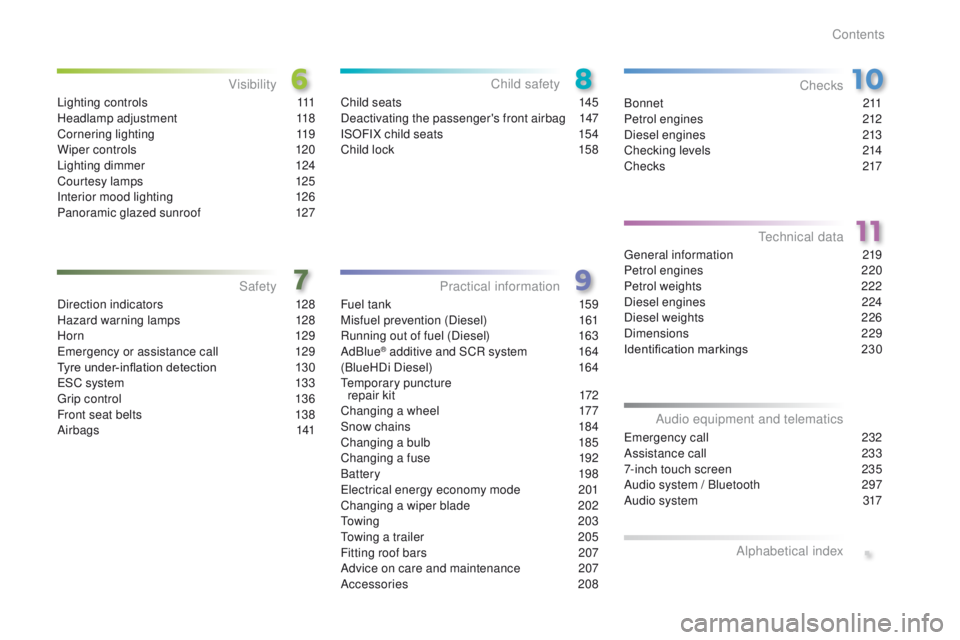
Direction indicators 128
Hazard warning lamps 1 28
H or n
129
Emergency or assistance call
1
29
Tyre under-inflation detection
1
30
ESC system
1
33
Grip control
1
36
Front seat belts
1
38
Airbags
1
41
Safety
Fuel tank 159
Misfuel prevention (Diesel) 1 61
Running out of fuel (Diesel)
1
63
AdBlue
® additive and SCR system 1 64
(BlueHDi Diesel) 1 64
Temporary puncture repair kit
1
72
Changing a wheel
1
77
Snow chains
1
84
Changing a bulb
1
85
Changing a fuse
1
92
Battery
198
Electrical energy economy mode
20
1
Changing a wiper blade
2
02
To w i n g
2 0 3
Towing a trailer
2
05
Fitting roof bars
2
07
Advice on care and maintenance
2
07
Accessories
208
Practical information
B o n n e t 2 11
Petrol engines 2 12
Diesel engines
2
13
Checking levels
2
14
C h e c ks
2
17
Checks
General information 219
Petrol engines 2 20
Petrol weights
2
22
Diesel engines
2
24
Diesel weights
2
26
Dimensions
229
Identification markings
2
30
Technical data
Emergency call 2 32
Assistance call 2 33
7-inch touch screen
2
35
Audio system / Bluetooth
2
97
Audio system
3
17
Audio equipment and telematics
Alphabetical index
Child seats 1 45
Deactivating the passenger's front airbag 1 47
ISOFIX child seats
1
54
Child lock
1
58
Child safety
Lighting controls 1 11
Headlamp adjustment 1 18
Cornering lighting
1
19
Wiper controls
1
20
Lighting dimmer
1
24
Courtesy lamps
1
25
Interior mood lighting
1
26
Panoramic glazed sunroof
1
27
Visibility
Contents
Page 7 of 340
5
2008_en_Chap00b_vue-ensemble_ed01-2015
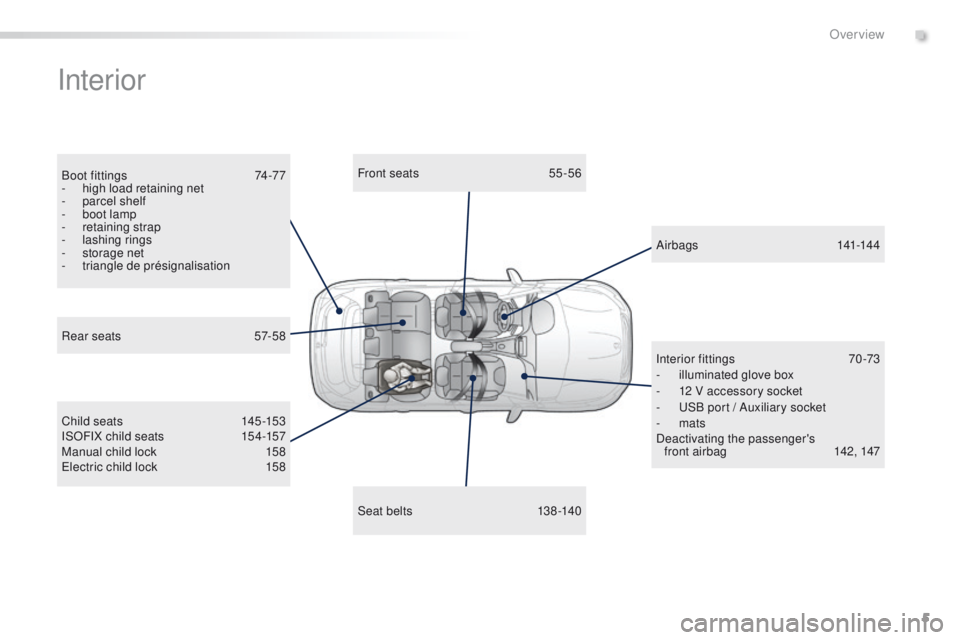
Interior
Boot fittings 74-77
- h igh load retaining net
-
par
cel shelf
-
b
oot lamp
-
r
etaining strap
-
la
shing rings
-
s
torage net
-
t
riangle de présignalisation Front seats
5 5 -56
Child seats
1
45 -153
ISOFIX child seats
1
54-157
Manual child lock
1
58
Electric child lock
1
58 A ir bags
141-14 4
Interior fittings
7
0-73
-
i
lluminated glove box
-
1
2 V accessory socket
-
U
SB port / Auxiliary socket
-
mats
Deactivating the passenger's front airbag
1
42, 147
Seat belts
1
38-140
Rear seats
5
7-58
.
Over view
Page 9 of 340
7
2008_en_Chap00b_vue-ensemble_ed01-2015
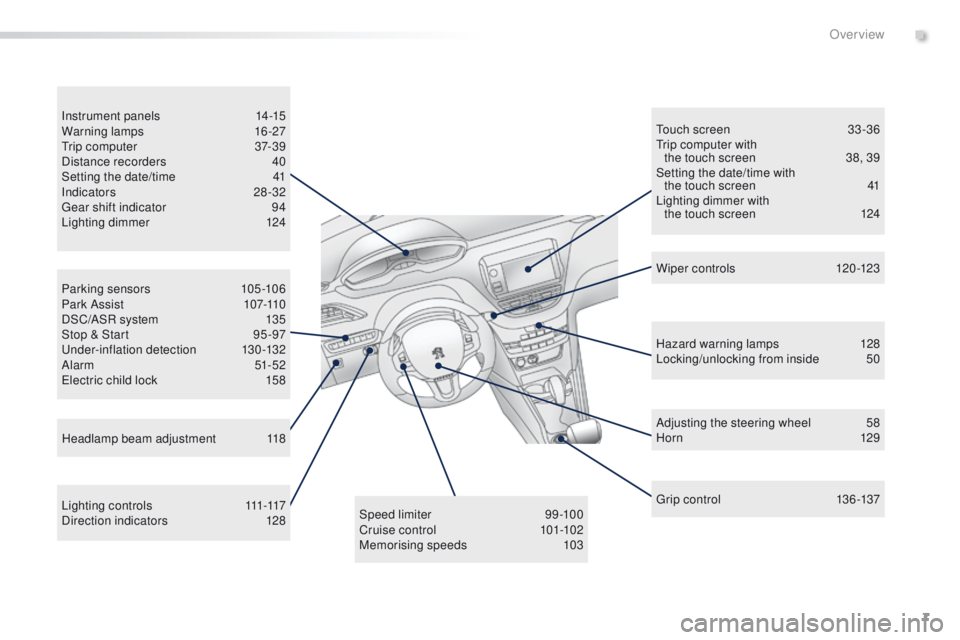
Parking sensors 105-106
Park Assist 10 7-110
DSC/ASR system
1
35
Stop & Start
9
5 -97
Under-inflation detection
1
30-132
Alarm
51-52
Electric child lock
1
58
Instrument panels
1
4-15
Warning lamps
1
6-27
Trip computer
3
7-39
Distance recorders
4
0
Setting the date/time
4
1
Indicators
2
8-32
Gear shift indicator
9
4
Lighting dimmer
1
24
L i g h t i n g c o n t r o l s
111
-117
Direction indicators
1
28Speed limiter
9
9-100
Cruise control
10
1-102
Memorising speeds
1
03Touch screen
3
3 -36
Trip computer with the touch screen
3
8, 39
Setting the date/time with the touch screen
4
1
Lighting dimmer with the touch screen
1
24
Headlamp beam adjustment
1
18 Wiper controls
1
20-123
Hazard warning lamps
1
28
Locking/unlocking from inside
5
0
Adjusting the steering wheel
5
8
H or n
12
9
G r ip c ontrol
13
6 -137
.
Over view
Page 11 of 340
9
2008_en_Chap00b_vue-ensemble_ed01-2015
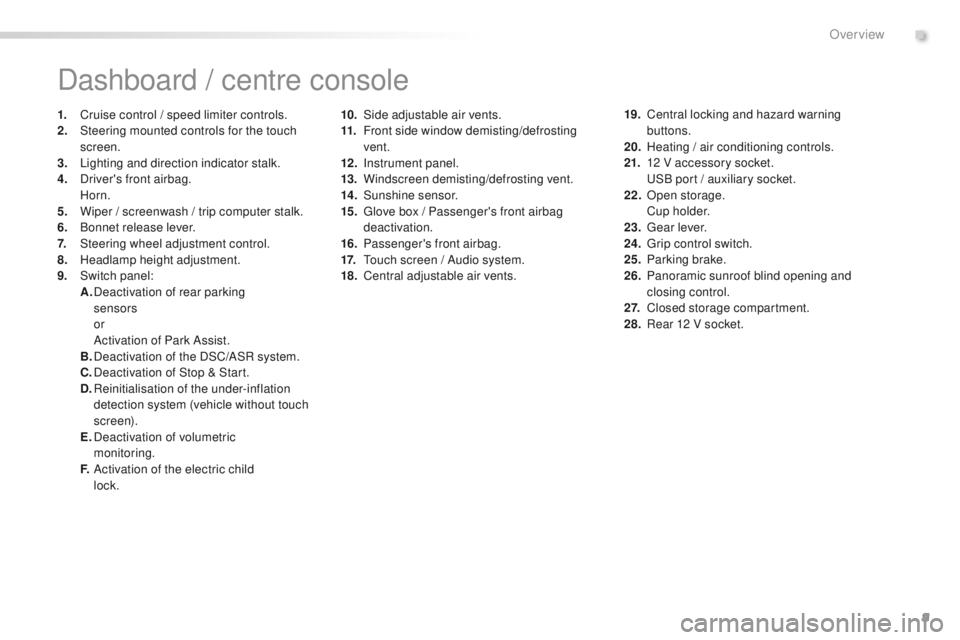
10. Side adjustable air vents.
11. Front side window demisting/defrosting
vent.
12 .
I
nstrument panel.
13.
W
indscreen demisting/defrosting vent.
14 .
S
unshine sensor.
15.
G
love box / Passenger's front airbag
deactivation.
16.
P
assenger's front airbag.
17.
T
ouch screen / Audio system.
18.
C
entral adjustable air vents.
Dashboard / centre console
1. Cruise control / speed limiter controls.
2. Steering mounted controls for the touch
screen.
3.
L
ighting and direction indicator stalk.
4.
D
river's front airbag.
Horn.
5.
W
iper / screenwash / trip computer stalk.
6.
B
onnet release lever.
7.
S
teering wheel adjustment control.
8.
H
eadlamp height adjustment.
9.
S
witch panel:
A.
D
eactivation of rear parking
sensors
or
A
ctivation of Park Assist.
B.
D
eactivation of the DSC/ASR system.
C.
D
eactivation of Stop & Start.
D.
R
einitialisation of the under-inflation
detection system (vehicle without touch
screen).
E.
D
eactivation of volumetric
monitoring.
F.
A
ctivation of the electric child
lock. 19. C
entral locking and hazard warning
buttons.
20.
H
eating / air conditioning controls.
21.
1
2 V accessory socket.
U
SB port / auxiliary socket.
22.
O
pen storage.
C
u p h o l d e r.
23.
G
ear lever.
24.
G
rip control switch.
25.
P
arking brake.
26.
P
anoramic sunroof blind opening and
closing control.
2 7.
C
losed storage compartment.
28.
R
ear 12 V socket.
.
Over view
Page 45 of 340
43
2008_en_Chap02_ouvertures_ed01-2015
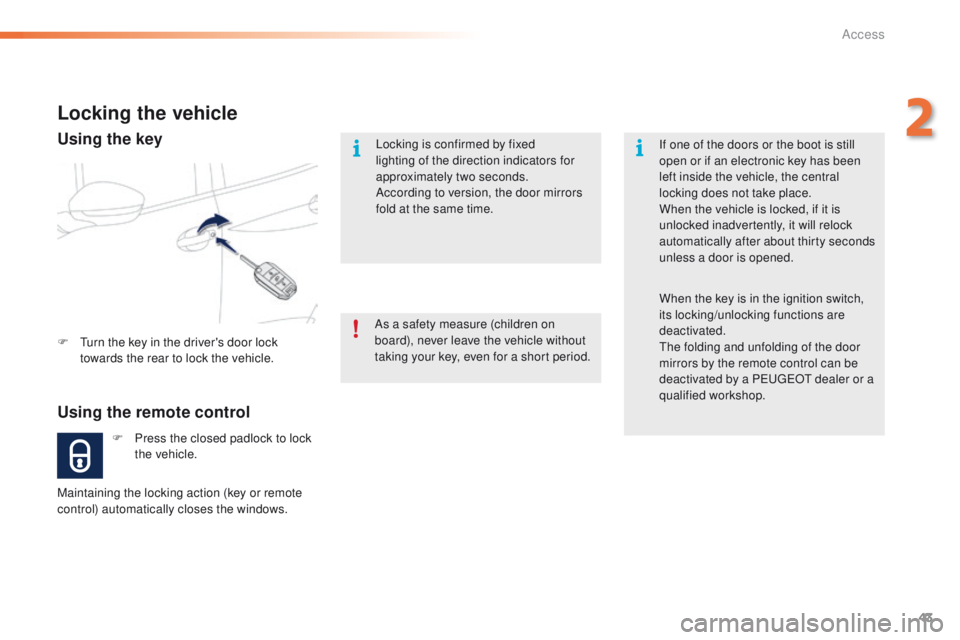
Locking is confirmed by fixed
lighting of the direction indicators for
approximately two seconds.
According to version, the door mirrors
fold at the same time.
As a safety measure (children on
board), never leave the vehicle without
taking your key, even for a short period.
Locking the vehicle
Using the remote control
F Press the closed padlock to lock the vehicle.
F
T
urn the key in the driver's door lock
towards the rear to lock the vehicle.
Maintaining the locking action (key or remote
control) automatically closes the windows. If one of the doors or the boot is still
open or if an electronic key has been
left inside the vehicle, the central
locking does not take place.
When the vehicle is locked, if it is
unlocked inadvertently, it will relock
automatically after about thirty seconds
unless a door is opened.
When the key is in the ignition switch,
its locking/unlocking functions are
deactivated.
The folding and unfolding of the door
mirrors by the remote control can be
deactivated by a PEUGEOT dealer or a
qualified workshop.
Using the key
2
Access
Page 48 of 340
46
2008_en_Chap02_ouvertures_ed01-2015
Lost keys
Go to a PEUGEOT dealer with the vehicle's registration document, your personal identification documents and if possible the key code label.
The PEUGEOT dealer will be able to look up the key code and the transponder code required to order a new key.
Remote control
The high frequency remote control is a sensitive system; do not operate it while it is in your pocket as there is a possibility that it may unlock the
vehicle, without you being aware of it.
Do not repeatedly press the buttons of your remote control out of range and out of sight of your vehicle. You run the risk of stopping it from
working and the remote control would have to be reinitialised.
No remote control can operate when the key is in the ignition switch, even when the ignition is switched off, except for reinitialisation.
Locking the vehicle
Driving with the doors locked may make access to the passenger compartment by the emergency services more difficult in an emergency.
As a safety precaution, never leave children alone in the vehicle, except for a very short period.
In all cases, it is essential to remove the key from the ignition switch when leaving the vehicle.
Anti-theft protection
Do not make any modifications to the electronic engine immobiliser system; this could cause malfunctions.
When purchasing a second-hand vehicle
Have the pairing of all of the keys in your possession checked by a PEUGEOT dealer, to ensure that only your keys can be used to open and
start the vehicle.
Access
Page 49 of 340
47
2008_en_Chap02_ouvertures_ed01-2015
Doors
Opening
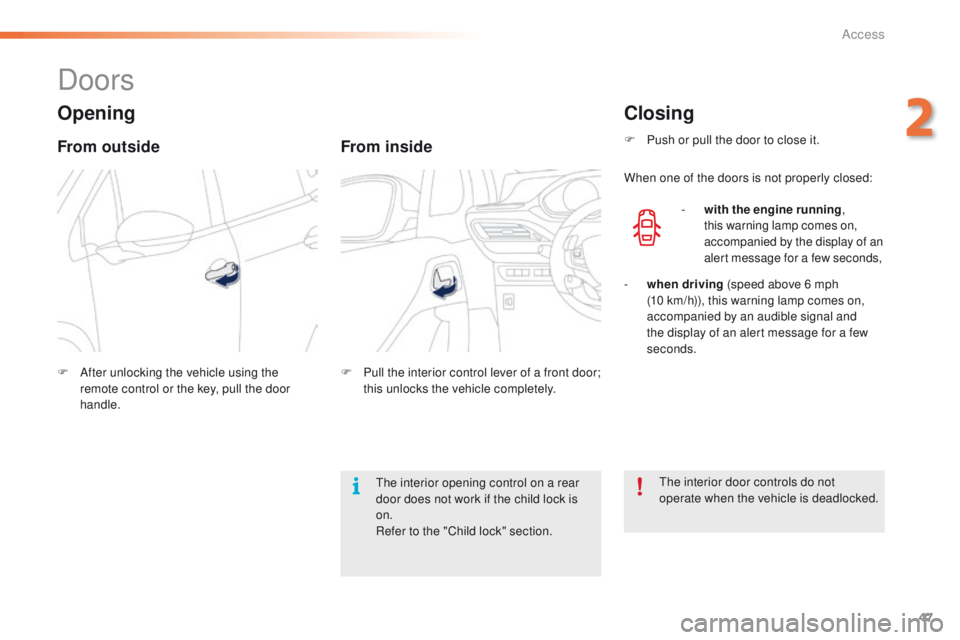
From outside
F After unlocking the vehicle using the remote control or the key, pull the door
handle.
From inside
F Pull the interior control lever of a front door; this unlocks the vehicle completely.
Closing
F Push or pull the door to close it.
When one of the doors is not properly closed:
-
w
ith the engine running ,
this warning lamp comes on,
accompanied by the display of an
alert message for a few seconds,
-
wh
en driving (speed above 6 mph
(10
km/h)), this warning lamp comes on,
accompanied by an audible signal and
the display of an alert message for a few
seconds.
The interior door controls do not
operate when the vehicle is deadlocked.
The interior opening control on a rear
door does not work if the child lock is
on.
Refer to the "Child lock" section.
2
Access
Page 50 of 340
48
2008_en_Chap02_ouvertures_ed01-2015
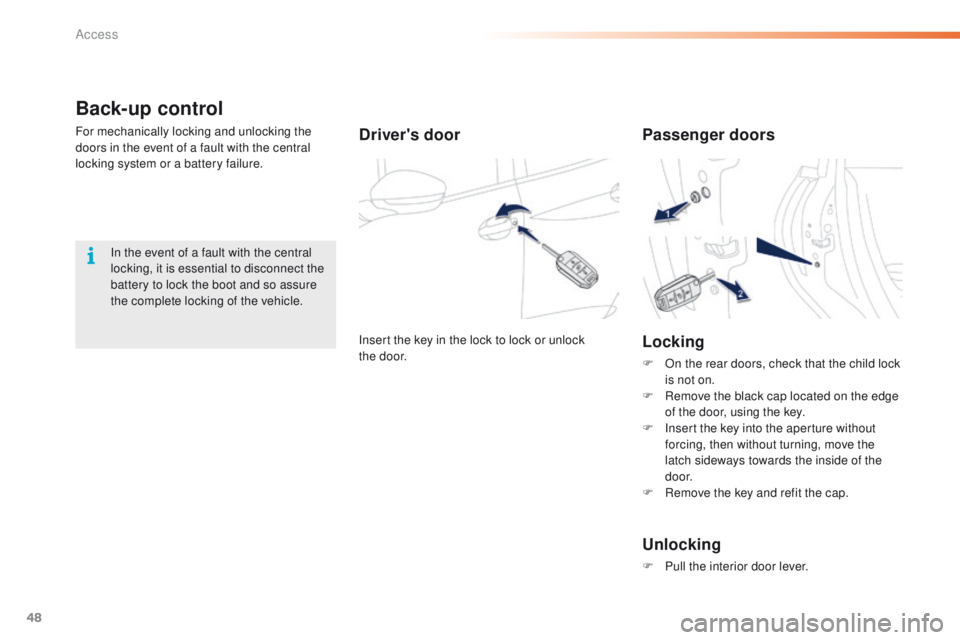
Back-up control
For mechanically locking and unlocking the
doors in the event of a fault with the central
locking system or a battery failure.Driver's door
Insert the key in the lock to lock or unlock
the door.
Passenger doors
Locking
F On the rear doors, check that the child lock is not on.
F
R
emove the black cap located on the edge
of the door, using the key.
F
I
nsert the key into the aperture without
forcing, then without turning, move the
latch sideways towards the inside of the
d o o r.
F
R
emove the key and refit the cap.
Unlocking
F Pull the interior door lever.
In the event of a fault with the central
locking, it is essential to disconnect the
battery to lock the boot and so assure
the complete locking of the vehicle.
Access
Page 142 of 340
140
2008_en_Chap07_securite_ed01-2015
The driver must ensure that passengers use
the seat belts correctly and that they are all
restrained securely before setting off.
Wherever you are seated in the vehicle,
always fasten your seat belt, even for short
journeys.
Do not interchange the seat belt buckles as
they will not fulfil their role fully.
The seat belts are fitted with an inertia reel
permitting automatic adjustment of the
length of the strap to your size. The seat belt
is stowed automatically when not in use.
Before and after use, ensure that the seat
belt is reeled in correctly.
The lower part of the strap must be
positioned as low as possible on the pelvis.
The upper part must be positioned in the
hollow of the shoulder.
The inertia reels are fitted with an automatic
locking device which comes into operation in
the event of a collision, emergency braking
or if the vehicle rolls over. You can release
the device by pulling the strap firmly and
then releasing it so that it reels in slightly.Recommendations for
children
Use a suitable child seat if the passenger is
less than 12 years old or shorter than one
and a half metres.
Never use the same seat belt to secure more
than one person.
Never allow a child to travel on your lap.
For more information, refer to the "Child
seats" section.
In order to be effective, a seat belt must:
-
b
e tightened as close to the body as
possible,
-
b
e pulled in front of you with a smooth
movement, checking that it does not
twist,
-
b
e used to restrain only one person,
-
n
ot bear any trace of cuts or fraying,
-
n
ot be converted or modified to avoid
affecting its performance.
In accordance with current safety
regulations, for all repairs on your vehicle's
seat belts, go to a qualified workshop with
the skills and equipment needed, which a
PEUGEOT dealer is able to provide.
Have your seat belts checked regularly by a
PEUGEOT dealer or a qualified workshop,
particularly if the straps show signs of
damage.
Clean the seat belt straps with soapy
water or a textile cleaning product, sold by
PEUGEOT dealers.
After folding or moving a seat or rear bench
seat, ensure that the seat belt is positioned
and reeled in correctly.
In the event of an impact
Depending on the nature and
seriousness of the impact , the
pretensioning device may be deployed
before and independently of the airbags.
Deployment of the pretensioners is
accompanied by a slight discharge of
harmless smoke and a noise, due to the
activation of the pyrotechnic cartridge
incorporated in the system.
In all cases, the airbag warning lamp
comes on.
Following an impact, have the seat belts
system checked, and if necessary replaced,
by a PEUGEOT dealer or a qualified
workshop.
Safety
Page 155 of 340
153
2008_en_Chap08_securite-enfants_ed01-2015
The incorrect installation of a child seat in a
vehicle compromises the child's protection in
the event of an accident.
Ensure that there is no seat belt or seat belt
buckle under the child seat, as this could
destabilise it.
Remember to fasten the seat belts or the
child seat harnesses keeping the slack
relative to the child's body to a minimum,
even for short journeys.
When installing a child seat using the seat
belt, ensure that the seat belt is tightened
correctly on the child seat and that it secures
the child seat firmly on the seat of your
vehicle. If your passenger seat is adjustable,
move it for wards if necessary.
At rear seating positions, always leave
sufficient space between the front seat and:
-
a "
rear ward facing" child seat,
-
t
he child's feet for a child seat fitted
"forward facing".
To do this, move the front seat for wards
and, if necessary, move its backrest into the
upright position.
Advice on child seats
Installing a booster
seatFor optimum installation of the "forward-
facing" child seat, ensure that the back of
the child seat is as close as possible to the
backrest of the vehicle's seat, in contact if
possible.
You mst remove the head restraint before
installing a child seat with backrest to a
passenger seat.
Ensure that the head restraint is stored or
attached securely to prevent it from being
thrown around the vehicle in the event of
sharp braking. Refit the head restraint when
the child seat is removed.
Children at the front
The legislation on carrying children on the
front passenger seat is specific to each
country. Refer to the legislation in force in
your country.
Deactivate the passenger airbag when a
"rear ward-facing" child seat is installed on
the front seat.
Otherwise, the child would risk being
seriously injured or killed if the airbag were
to inflate. The chest part of the seat belt must be
positioned on the child's shoulder without
touching the neck.
Ensure that the lap part of the seat belt
passes correctly over the child's thighs.
PEUGEOT recommends the use of a booster
seat which has a back, fitted with a seat belt
guide at shoulder level.
As a safety precaution, do not leave:
-
a c
hild or children alone and
unsupervised in a vehicle,
-
a c
hild or an animal in a vehicle which
is exposed to the sun, with the windows
closed,
- t he keys within reach of children inside
the vehicle.
To prevent accidental opening of the doors
and rear windows, use the "Child lock".
Take care not to open the rear windows by
more than one third.
To protect young children from the rays of
the sun, fit side blinds on the rear windows.
8
Child safety