engine oil PEUGEOT 2008 2016 User Guide
[x] Cancel search | Manufacturer: PEUGEOT, Model Year: 2016, Model line: 2008, Model: PEUGEOT 2008 2016Pages: 450, PDF Size: 14.16 MB
Page 192 of 450
190
2008_en_Chap09_info-pratiques_ed01-2016
Repair procedure
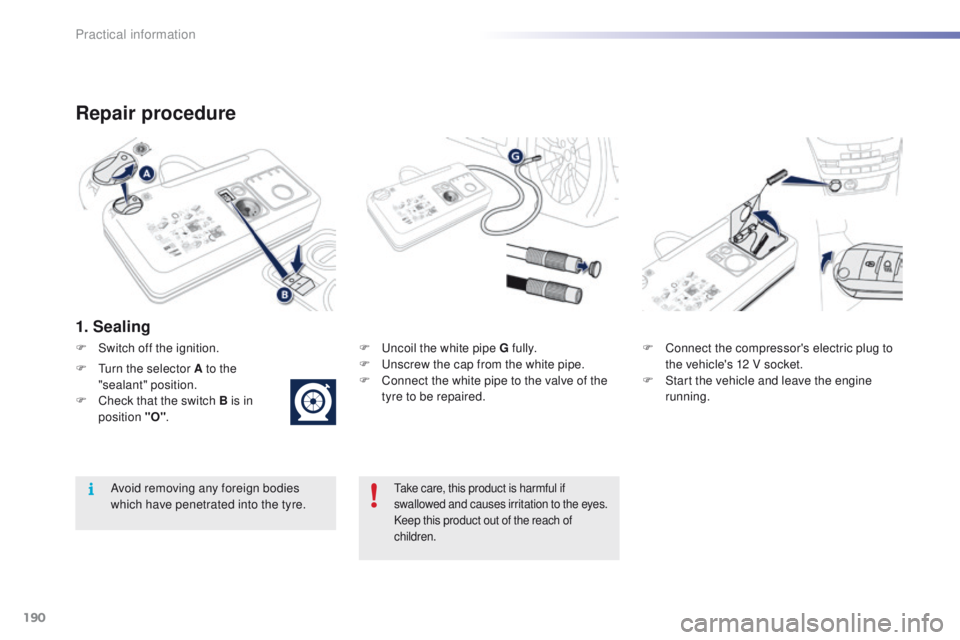
1. Sealing
F Uncoil the white pipe G fully.
F U nscrew the cap from the white pipe.
F
C
onnect the white pipe to the valve of the
tyre to be repaired. F
C onnect the compressor's electric plug to
the vehicle's 12 V socket.
F
S
tart the vehicle and leave the engine
running.
Take care, this product is harmful if
swallowed and causes irritation to the eyes.
Keep this product out of the reach of
children.Avoid removing any foreign bodies
which have penetrated into the tyre.
F
S
witch off the ignition.
F
T
urn the selector A to the
"sealant"
position.
F
C
heck that the switch B is in
position "O" .
Practical information
Page 194 of 450
192
2008_en_Chap09_info-pratiques_ed01-2016
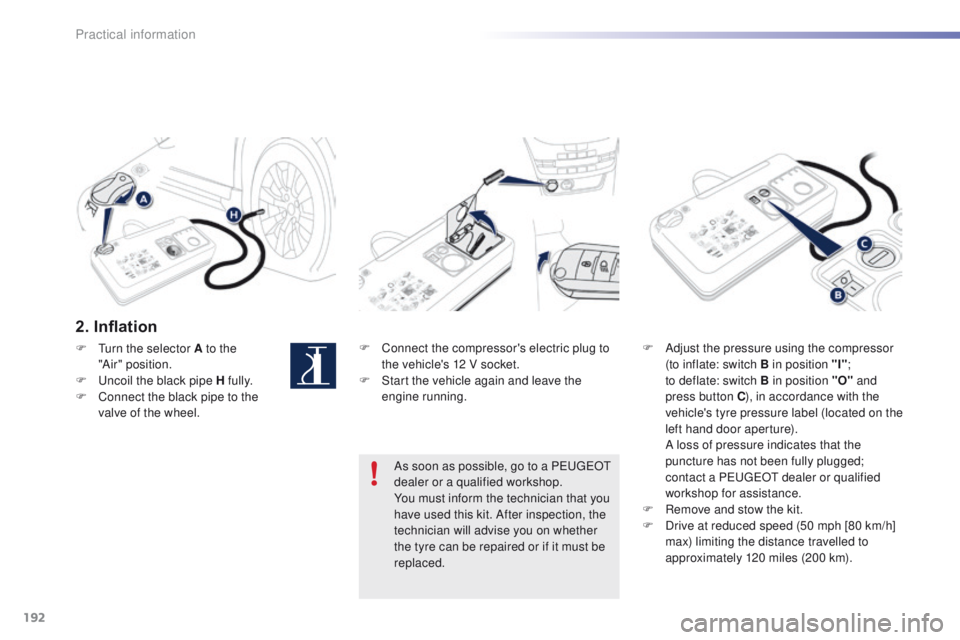
2. Inflation
F Connect the compressor's electric plug to the vehicle's 12 V socket.
F
S
tart the vehicle again and leave the
engine running. F
A djust the pressure using the compressor
(to inflate: switch B in position "I" ;
to
deflate: switch B in position "O" and
press button C ), in accordance with the
vehicle's tyre pressure label (located on the
left hand door aperture).
A l
oss of pressure indicates that the
puncture has not been fully plugged;
contact a PEUGEOT dealer or qualified
workshop for assistance.
F
R
emove and stow the kit.
F
D
rive at reduced speed (50 mph [80 km/h]
max) limiting the distance travelled to
approximately 120 miles (200 km).
As soon as possible, go to a PEUGEOT
dealer or a qualified workshop.
You must inform the technician that you
have used this kit. After inspection, the
technician will advise you on whether
the tyre can be repaired or if it must be
replaced.
F
T
urn the selector A to the
"Air"
position.
F
U
ncoil the black pipe H fully.
F
C
onnect the black pipe to the
valve of the wheel.
Practical information
Page 195 of 450
193
2008_en_Chap09_info-pratiques_ed01-2016
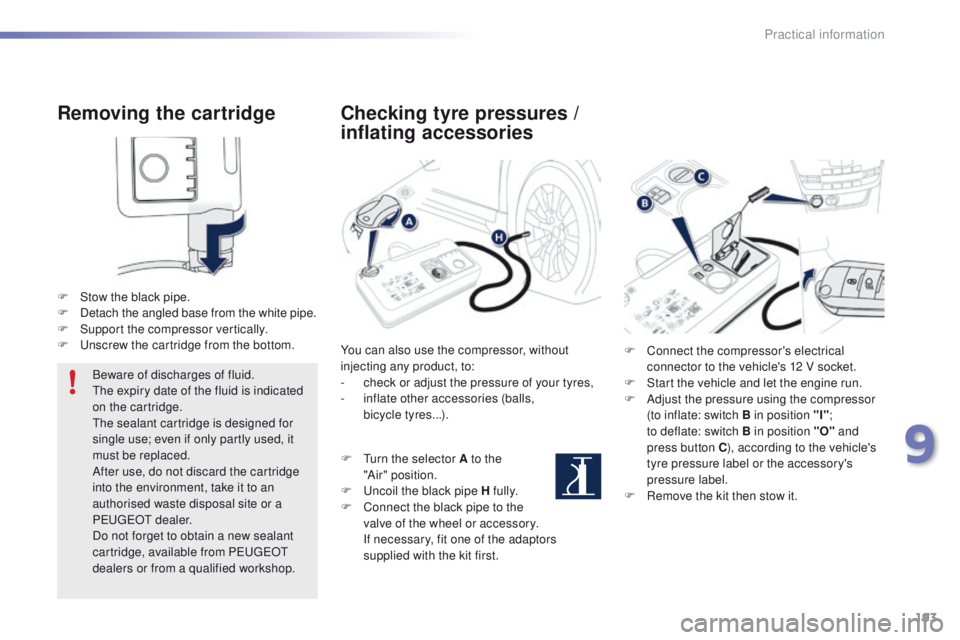
Removing the cartridge
F Stow the black pipe.
F D etach the angled base from the white pipe.
F
S
upport the compressor vertically.
F
U
nscrew the cartridge from the bottom.Beware of discharges of fluid.
The expiry date of the fluid is indicated
on the cartridge.
The sealant cartridge is designed for
single use; even if only partly used, it
must be replaced.
After use, do not discard the cartridge
into the environment, take it to an
authorised waste disposal site or a
PEUGEOT dealer.
Do not forget to obtain a new sealant
cartridge, available from PEUGEOT
dealers or from a qualified workshop.
Checking tyre pressures /
inflating accessories
You can also use the compressor, without
injecting any product, to:
-
c
heck or adjust the pressure of your tyres,
-
i
nflate other accessories (balls,
bicycle
tyres...).
F
T
urn the selector A to the
"Air"
position.
F
U
ncoil the black pipe H fully.
F
C
onnect the black pipe to the
valve of the wheel or accessory.
I
f necessary, fit one of the adaptors
supplied with the kit first. F
C onnect the compressor's electrical
connector to the vehicle's 12 V socket.
F
S
tart the vehicle and let the engine run.
F
A
djust the pressure using the compressor
(to inflate: switch B in position "I" ;
to
deflate: switch B in position "O" and
press button C ), according to the vehicle's
tyre pressure label or the accessory's
pressure label.
F
R
emove the kit then stow it.
9
Practical information
Page 237 of 450
235
2008_en_Chap10_verifications_ed01-2016
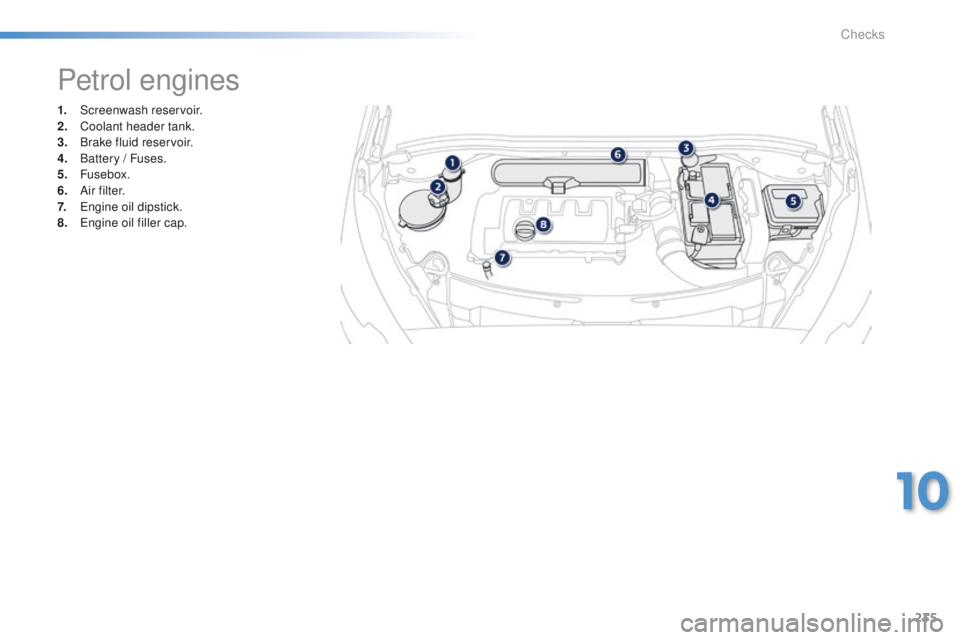
1. Screenwash reservoir.
2. Coolant header tank.
3.
B
rake fluid reservoir.
4.
B
attery / Fuses.
5.
Fusebox.
6.
A
i r f i l t e r.
7.
E
ngine oil dipstick.
8.
E
ngine oil filler cap.
Petrol engines
10
Checks
Page 238 of 450
236
2008_en_Chap10_verifications_ed01-2016
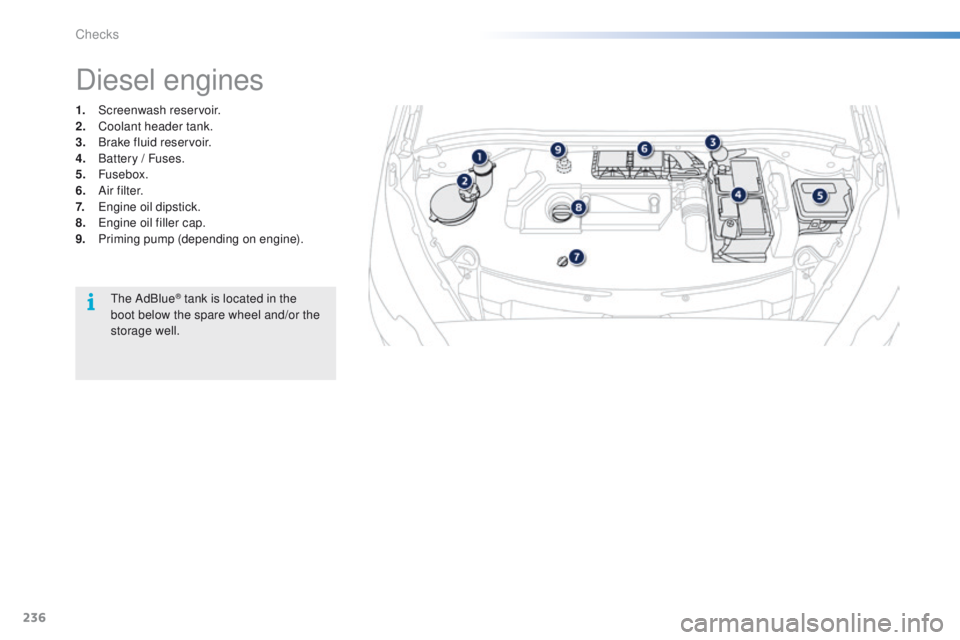
1. Screenwash reservoir.
2. Coolant header tank.
3.
B
rake fluid reservoir.
4.
B
attery / Fuses.
5.
Fusebox.
6.
A
i r f i l t e r.
7.
E
ngine oil dipstick.
8.
E
ngine oil filler cap.
9.
P
riming pump (depending on engine).
Diesel engines
The AdBlue® tank is located in the
boot below the spare wheel and/or the
storage well.
Checks
Page 239 of 450
237
2008_en_Chap10_verifications_ed01-2016
Checking levels
Oil level
The check is carried out either when the
ignition is switched on using the oil level
indicator in the instrument panel (depending
on version), or using the dipstick.Engine oil change
Refer to the warranty and maintenance record
for details of the interval for this operation.
In order to maintain the reliability of the engine
and emission control system, never use
additives in the engine oil.
Oil specification
The oil must be the correct grade for your
engine and conform to the manufacturer's
recommendations.The brake fluid level should be close
to the "MA X" mark. If it is not, check
the brake pad wear.
Brake fluid
Changing the fluid
Refer to the manufacturer's service schedule
for details of the interval for this operation.
Take care when working under the bonnet, as certain areas of the engine may be extremely hot (risk of burns) and the cooling fan could start at
any time (even with the ignition off).
Check all of these levels regularly, in line with the manufacturer's service schedule. Top them up if necessary, unless other wise indicated.
If a level drops significantly, have the corresponding system checked by a PEUGEOT dealer or a qualified workshop.
It is normal to top up the oil level
between two services (or oil changes).
PEUGEOT recommends that you check
the level, and top up if necessary, every
3 000 miles (5 000 kms).
It will only be correct if the vehicle is on level
ground and the engine has been off for more
than 30 minutes.
Fluid specification
The brake fluid must conform to the
manufacturer's recommendations.
Level
10
Checks
Page 242 of 450
240
2008_en_Chap10_verifications_ed01-2016
Checks
12 V battery
The battery does not require any maintenance.
However, check regularly that the terminals
are correctly tightened (versions without quick
release terminals) and that the connections
are clean.
Versions equipped with Stop & Start are
fitted with a 12 V lead-acid battery of specific
technology and specification.
Its replacement should be carried out only by a
PEUGEOT dealer or a qualified workshop.
Diesel
Particle filter
On a new vehicle, the first particle
filter regeneration operations may be
accompanied by a "burnt" smell, which
is normal.
Following prolonged operation of the
vehicle at very low speed or at idle,
you may, in exceptional circumstances,
notice the emission of water vapour at
the exhaust on acceleration. This does
not affect the behaviour of the vehicle
or the environment.
Unless other wise indicated, check these components in accordance with the warranty and maintenance record and according to your engine.
Other wise, have them checked by a PEUGEOT dealer or a qualified workshop.
Air filter and passenger compartment filter
Refer to the warranty and
maintenance record for details of
the replacement intervals for these
components.
Oil filter
Replace the oil filter each time the
engine oil is changed.
Refer to the warranty and
maintenance record for details of
the replacement interval for this
component.
When carrying out any operation on the 12 V
battery, refer to the corresponding section for
details of the precautions to be taken before
starting work.
Depending on the environment (e.g. dusty
atmosphere) and the use of the vehicle
(e.g. city driving), replace them twice as often
if necessary
.
A clogged passenger compartment filter may
have an adverse effect on the per formance
of the air conditioning system and generate
undesirable odours. The start of saturation of the
particle filter is indicated by
the fixed illumination of this warning lamp
accompanied by a warning message in the
screen (if a display screen is fitted).
As soon as the traffic conditions permit,
regenerate the filter by driving at a speed of at
least 40 mph (60 km/h) until the warning lamp
goes off.
If the warning lamp stays on, this indicates a
low additive level.
Checks
Page 245 of 450
243
2008_en_Chap11_caracteristiques-techniques_ed01-2016
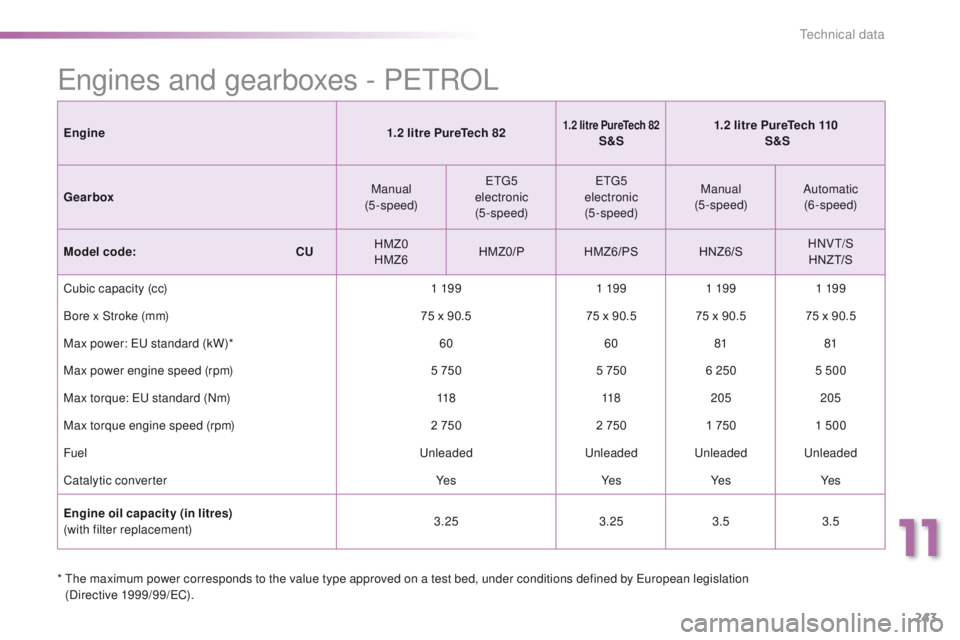
Engines and gearboxes - PETROL
* The maximum power corresponds to the value type approved on a test bed, under conditions defined by European legislation (Directive 1999/99/EC).
Engine
1.2 litre PureTech 82
1.2 litre PureTech 82S&S1.
2 litre PureTech 110
S&S
Gearbox Manual
(5-speed) ETG5
electronic (5-speed) ETG5
electronic (5-speed) Manual
(5-speed) Automatic
(6-speed)
Model code:
C
U HMZ0
HMZ6 HMZ0/P
HMZ6/PS HNZ6/SH N V T/S
H NZ T/S
Cubic capacity (cc) 1 19 91 19 91 19 91 19 9
Bore x Stroke (mm) 75 x 90.575 x 90.5 75 x 90.5 75 x 90.5
Max power: EU standard (kW)* 60608181
Max power engine speed (rpm) 5 7505 7506 2505 500
Max torque: EU standard (Nm) 118118205 205
Max torque engine speed (rpm) 2 7502 7501 7501 500
Fuel UnleadedUnleaded Unleaded Unleaded
Catalytic converter Ye sYe sYe sYe s
Engine oil capacity (in litres)
(with filter replacement) 3.25
3.253.53.5
11
Technical data
Page 246 of 450
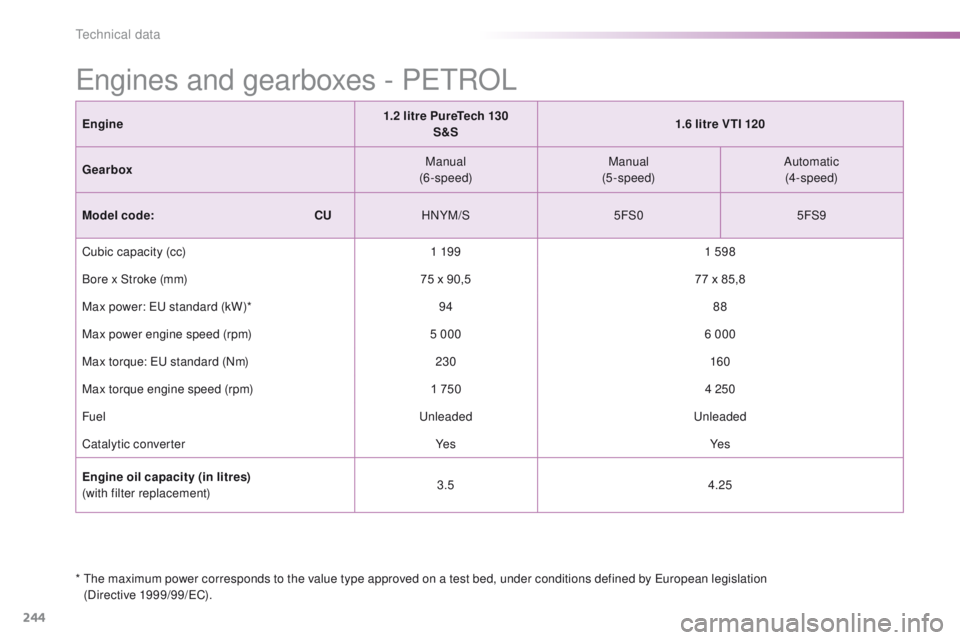
244
2008_en_Chap11_caracteristiques-techniques_ed01-2016
Engine1.2 litre PureTech 130
S&S 1.6 litre VTI 120
Gearbox Manual
(6-speed) Manual
(5-speed) Automatic
(4-speed)
Model code:
C
UHNYM/S 5FS05FS9
Cubic capacity (cc) 1 19 91 598
Bore x Stroke (mm) 75 x 90,577 x 85,8
Max power: EU standard (kW)* 9488
Max power engine speed (rpm) 5 0006 000
Max torque: EU standard (Nm) 230160
Max torque engine speed (rpm) 1 7504 250
Fuel UnleadedUnleaded
Catalytic converter Ye sYe s
Engine oil capacity (in litres)
(with filter replacement) 3.5
4.25
Engines and gearboxes - PETROL
* The maximum power corresponds to the value type approved on a test bed, under conditions defined by European legislation
(Directive 1999/99/EC).
Technical data
Page 249 of 450
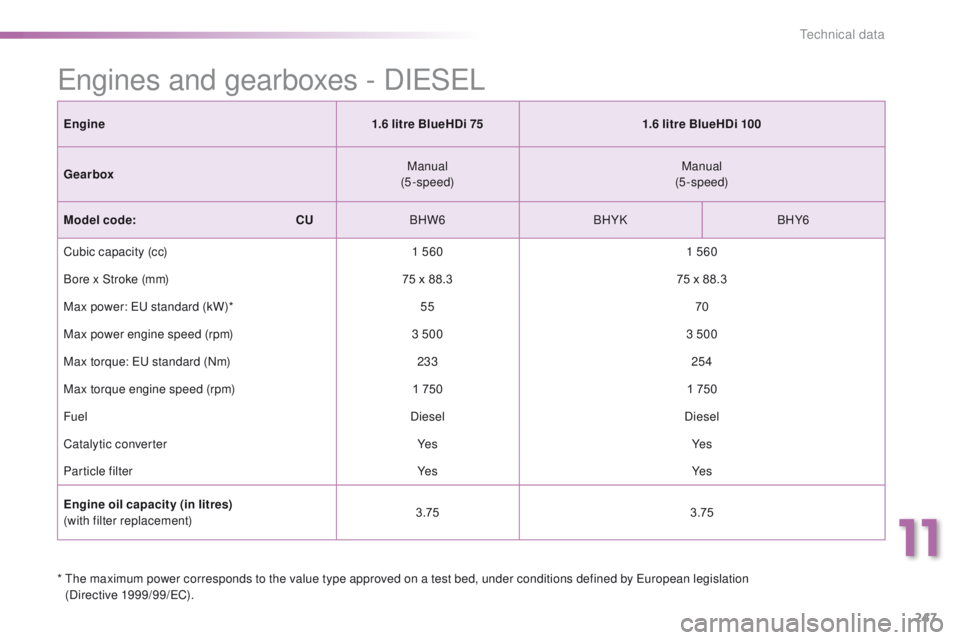
247
2008_en_Chap11_caracteristiques-techniques_ed01-2016
* The maximum power corresponds to the value type approved on a test bed, under conditions defined by European legislation (Directive 1999/99/EC).
Engines and gearboxes - DIESEL
Engine 1.6 litre BlueHDi 751.6 litre BlueHDi 100
Gearbox Manual
(5-speed) Manual
(5-speed)
Model code:
C
UBHW6 BHYKBHY6
Cubic capacity (cc) 1 5601 560
Bore x Stroke (mm) 75 x 88.375 x 88.3
Max power: EU standard (kW)* 5570
Max power engine speed (rpm) 3 5003 500
Max torque: EU standard (Nm) 233254
Max torque engine speed (rpm) 1 7501 750
Fuel DieselDiesel
Catalytic converter Ye sYe s
Particle filter Ye sYe s
Engine oil capacity (in litres)
(with filter replacement) 3.75
3.75
11
Technical data