fuel cap PEUGEOT 2008 2016 User Guide
[x] Cancel search | Manufacturer: PEUGEOT, Model Year: 2016, Model line: 2008, Model: PEUGEOT 2008 2016Pages: 450, PDF Size: 14.16 MB
Page 250 of 450
248
2008_en_Chap11_caracteristiques-techniques_ed01-2016
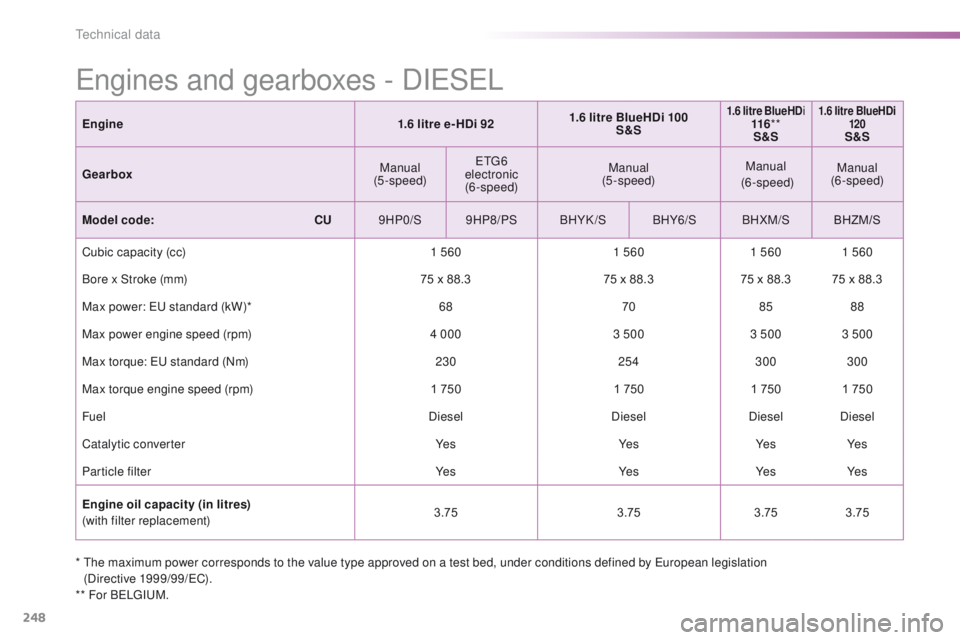
* The maximum power corresponds to the value type approved on a test bed, under conditions defined by European legislation (Directive 1999/99/EC).
** For BELGIUM.
Engines and gearboxes - DIESEL
Engine 1.6 litre e- HDi 921.6 litre BlueHDi 100
S&S1.6 litre BlueHD i
116 **
S&S1.6 litre BlueHDi 120
S&S
Gearbox Manual
(5-speed) ETG6
electronic (6-speed) Manual
(5-speed) Manual
(6-speed) Manual
(6-speed)
Model code:
C
U 9HP0/S 9HP8/PS BHYK /SBHY6/SBHXM/S BHZM/S
Cubic capacity (cc) 1 5601 5601 560 1 560
Bore x Stroke (mm) 75 x 88.375 x 88.375 x 88.3 75 x 88.3
Max power: EU standard (kW)* 68708588
Max power engine speed (rpm) 4 0003 5003 500 3 500
Max torque: EU standard (Nm) 230254300300
Max torque engine speed (rpm) 1 7501 7501 7501 750
Fuel DieselDieselDiesel Diesel
Catalytic converter Ye sYe sYe sYe s
Particle filter Ye sYe sYe sYe s
Engine oil capacity (in litres)
(with filter replacement) 3.75
3.753.753.75
Technical data
Page 361 of 450
359
2008_en_Chap13_index-alpha_ed01-2016
Accessories .......................................... 13 4, 231
Active City Brake ........................................... 14
5
AdBlue
® ............................... ............24, 175, 180
Adjusting headlamps .................................... 124
Adjusting head restraints
................................ 57
Adjusting seats
................................................ 56
Adjusting the air distribution
.....................66, 69
Adjusting the air flow
................................. 65, 69
Adjusting the date
........................................... 42
Adjusting the height and reach of the steering wheel
.......................... 59
A
djusting the seat
belt height
...............................
....................149
Adjusting the temperature
........................ 6
5, 68
Adjusting the time
........................................... 42
Advice on care and maintenance
............................................... 23
0
Advice on driving
.................................... 79, 224
Airbags
.................................................... 27, 152
Airbags, curtain
..................................... 15
4, 155
Airbags, front ......................................... 152, 155
Airbags, lateral
...................................... 15 4, 155
Air conditioning
............................................... 12
Air conditioning, digital
............................. 67, 70
Air conditioning, manual
........................... 65, 70
Air filter
.......................................................... 240
Air intake
................................................... 66, 69
Air vents
.......................................................... 62
Alarm
......................................................... 43, 52
Anti-lock braking system (ABS)
.............................................. 14
0
Anti-theft
................................................... 45, 47
Armrest, front
.................................................. 72
Assistance call
...................................... 13 6, 25 5
Assistance, emergency braking
...............
......................................... 140
Audible warning
............................................ 13 6
Audio streaming (Bluetooth)
........ 2
86, 288, 335Battery
...................................................214, 240
Battery, charging
...........................................216
Battery, remote control
............................. 4
6, 47
Blind
..............................................................13 3
BlueHDi
.........................................................175
Bluetooth (telephone)
............................314, 3 3 6
Bonnet
...........................................................234
Boot
...........................................................50, 75
Brake discs
.................................................... 2
41
Brake lamps
...............................
...................206
Brake pads
....................................................2 41
Brake warning lamp
........................................22
Braking assistance system
...........................14
0
Bulbs (changing)
...............................
............202
A
B
CarPlay connection ....................................... 307
CD ................................................ 286, 332, 352
Central locking
.......................................... 4 3 , 51
Changing a bulb
................................... 202, 206
Changing a fuse
............................................ 208
Changing a wheel
................................. 19 4, 195
Changing a wiper blade
........................129, 2 20
Changing the remote control battery ............................................... 46
Checking levels
...................................... 23
7-239
Checking the engine oil level
..................31, 237
Checking tyre pressures (using the kit)
..............................
........18 6, 193
Checks
...............
................................... 2 3 5 - 2 41
Child lock
...............................
........................169
Children (safety)
..................... 15
1, 153, 15 6 -16 0
Child seats
..............................
..............161-168
Child seats, conventional
..............................161
Child seats, ISOFIX
...................................... 16
7
Cleaning (advice)
.......................................... 23
0
Closing the boot
.............................................. 50
Closing the doors
............................................ 48
Connected services
...................................... 29
8
Connection, Bluetooth
..................300, 314, 335
Connection, MirrorLink
.................................302
Connection, Wi-Fi network
...........................300
Control, electric windows
................................54
Control, emergency boot release
...................50
Control, heated seats
...................................... 57
Controls, at steering..................... 260, 329, 349
Control stalk, lighting
.................................... 11
7
Control stalk, wipers
..................................... 127
Coolant level
................................................. 238
Courtesy lamps
............................................. 131
Cover, load space
............................................................ 77
Cruise control
........................................ 10
6, 108
Cup holder
...............................
........................71
Audio system
(r adi o)
.................................................. 327, 347
Automatic illumination of headlamps
.............................................. 118
Auxiliary socket
...................... 73, 286, 333, 352
Cable, audio
................................. 286, 333, 352
Capacity, fuel tank
..............................
.......... 170
C
.
Alphabetical index
Page 373 of 450
170
Practical information
2008-add_en_Chap09_info-pratiques_ed01-2016
Low fuel level
When the low fuel level is reached this warning lamp comes on in the instrument panel. There remains approximately 5 litres of fuel in the tank. When the warning lamp flashes, there is ver y little fuel left .
The key cannot be removed from the lock until the cap is refitted. Removing the filler cap may cause an inrush of air. This vacuum is per fectly normal and results from the sealing of the system.
Fuel tank
Fuel tank capacity: approximately 50 litres ( 45 litres for the BlueHDi Diesel engine).
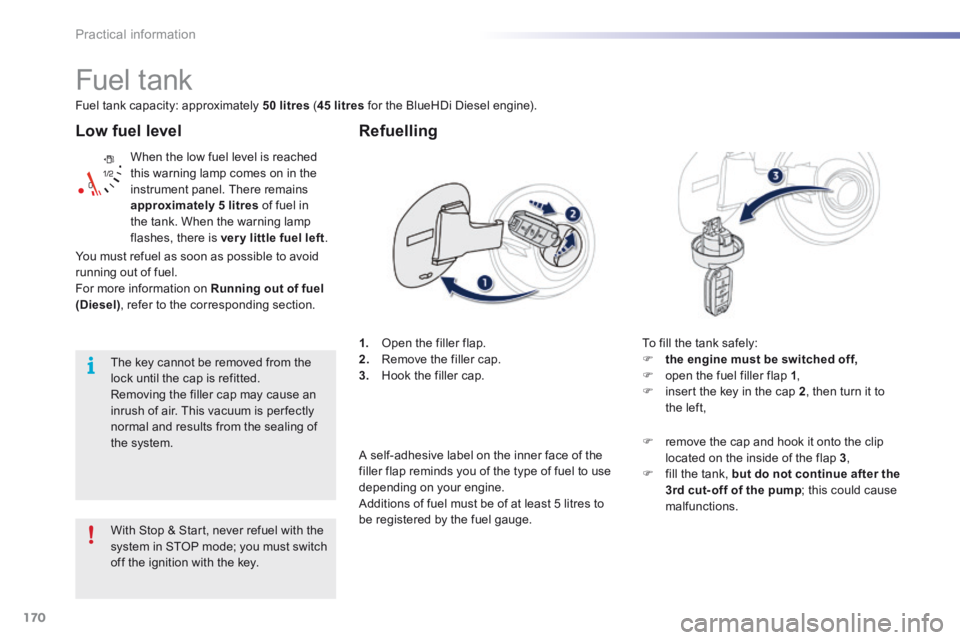
1. Open the filler flap. 2. Remove the filler cap. 3. Hook the filler cap.
Refuelling
To fill the tank safely: the engine must be switched off, open the fuel filler flap 1 , insert the key in the cap 2 , then turn it to the left,
With Stop & Start, never refuel with the
system in STOP mode; you must switch off the ignition with the key.
remove the cap and hook it onto the clip located on the inside of the flap 3 , fill the tank, but do not continue after the 3rd cut- off of the pump ; this could cause malfunctions.
You must refuel as soon as possible to avoid running out of fuel. For more information on Running out of fuel (Diesel) , refer to the corresponding section.
A self-adhesive label on the inner face of the filler flap reminds you of the type of fuel to use depending on your engine. Additions of fuel must be of at least 5 litres to be registered by the fuel gauge.
Page 374 of 450
171
9
Practical information
2008-add_en_Chap09_info-pratiques_ed01-2016
Fuel supply cut-off
Your vehicle is fitted with a safety system that cuts off the supply of fuel in the event of an impact.
When you have filled the tank: put the cap back in place, turn the key to the right, then remove it from the cap, close the flap.
If you have put in the wrong fuel for the engine of your vehicle, you must have the fuel tank drained and filled with the correct fuel before star ting the engine.
Page 375 of 450
26
Monitoring
2008-add_en_Chap01_controle-de-marche_ed01-2016
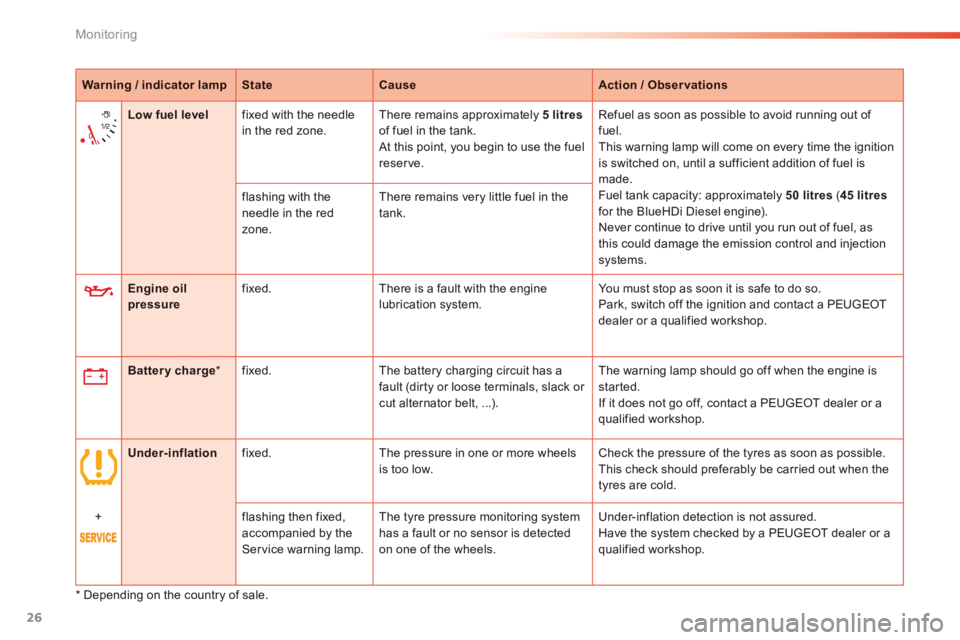
Warning / indicator lampStateCauseAction / Observations
Engine oil pressure fixed. There is a fault with the engine lubrication system. You must stop as soon it is safe to do so. Park, switch off the ignition and contact a PEUGEOT dealer or a qualified workshop.
Battery charge * fixed. The battery charging circuit has a fault (dirty or loose terminals, slack or cut alternator belt, ...).
The warning lamp should go off when the engine is started. If it does not go off, contact a PEUGEOT dealer or a qualified workshop.
Low fuel level fixed with the needle in the red zone. There remains approximately 5 litresof fuel in the tank. At this point, you begin to use the fuel reserve.
Refuel as soon as possible to avoid running out of fuel. This warning lamp will come on every time the ignition is switched on, until a sufficient addition of fuel is made. Fuel tank capacity: approximately 50 litres ( 45 litresfor the BlueHDi Diesel engine). Never continue to drive until you run out of fuel, as this could damage the emission control and injection systems.
flashing with the needle in the red zone.
There remains very little fuel in the tank.
Under-inflation fixed. The pressure in one or more wheels is too low. Check the pressure of the tyres as soon as possible. This check should preferably be carried out when the tyres are cold.
+ flashing then fixed,
accompanied by the Service warning lamp.
The tyre pressure monitoring system
has a fault or no sensor is detected on one of the wheels.
Under-inflation detection is not assured.
Have the system checked by a PEUGEOT dealer or a qualified workshop.
* Depending on the country of sale.
Page 376 of 450
1
1
Monitoring
2008-additif_en_Chap01_controle-de-marche_ed01-2016
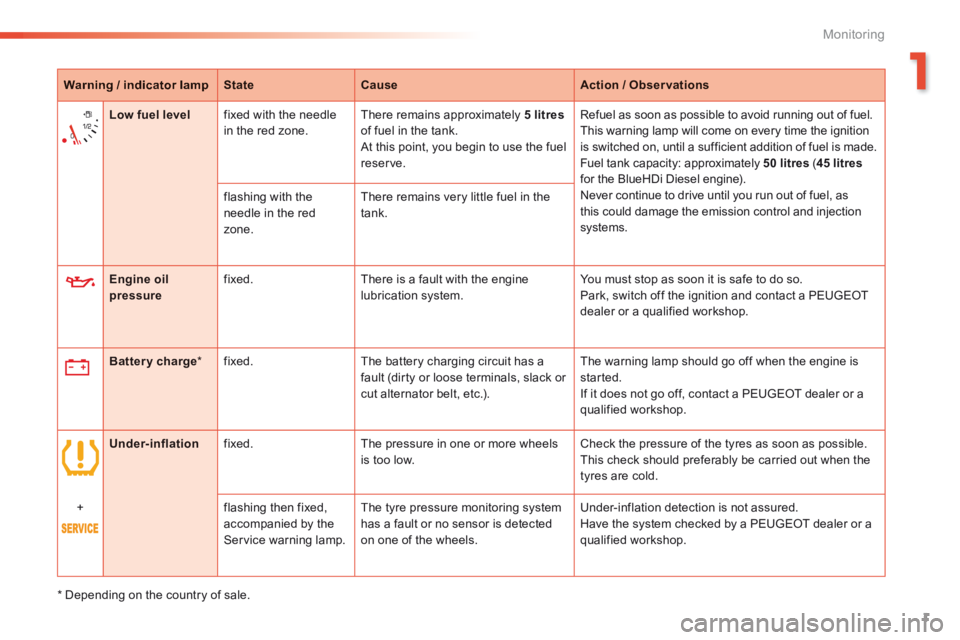
Warning / indicator lampStateCauseAction / Observations
Engine oil pressure fixed. There is a fault with the engine lubrication system. You must stop as soon it is safe to do so. Park, switch off the ignition and contact a PEUGEOT dealer or a qualified workshop.
Battery charge * fixed. The battery charging circuit has a fault (dirty or loose terminals, slack or cut alternator belt, etc.).
The warning lamp should go off when the engine is started. If it does not go off, contact a PEUGEOT dealer or a qualified workshop.
Low fuel level fixed with the needle in the red zone. There remains approximately 5 litresof fuel in the tank. At this point, you begin to use the fuel reserve.
Refuel as soon as possible to avoid running out of fuel. This warning lamp will come on every time the ignition is switched on, until a sufficient addition of fuel is made. Fuel tank capacity: approximately 50 litres ( 45 litres for the BlueHDi Diesel engine). Never continue to drive until you run out of fuel, as this could damage the emission control and injection systems.
flashing with the needle in the red zone.
There remains very little fuel in the tank.
Under-inflation fixed. The pressure in one or more wheels is too low. Check the pressure of the tyres as soon as possible. This check should preferably be carried out when the tyres are cold.
+ flashing then fixed, accompanied by the Service warning lamp.
The tyre pressure monitoring system has a fault or no sensor is detected on one of the wheels.
Under-inflation detection is not assured. Have the system checked by a PEUGEOT dealer or a qualified workshop.
* Depending on the country of sale.
Page 379 of 450
4
Practical information
2008-additif_en_Chap09_info-pratiques_ed01-2016
Low fuel level
When the low fuel level is reached, this warning lamp comes on in the instrument panel. There remains approximately 5 litres of fuel in the tank. When the warning lamp flashes, there is ver y little fuel left .
The key cannot be removed from the lock until the cap is refitted. Removing the filler cap may cause an inrush of air. This vacuum is per fectly normal and results from the sealing of the system.
Fuel tank
Fuel tank capacity: approximately 50 litres ( 45 litres for the BlueHDi Diesel engine).
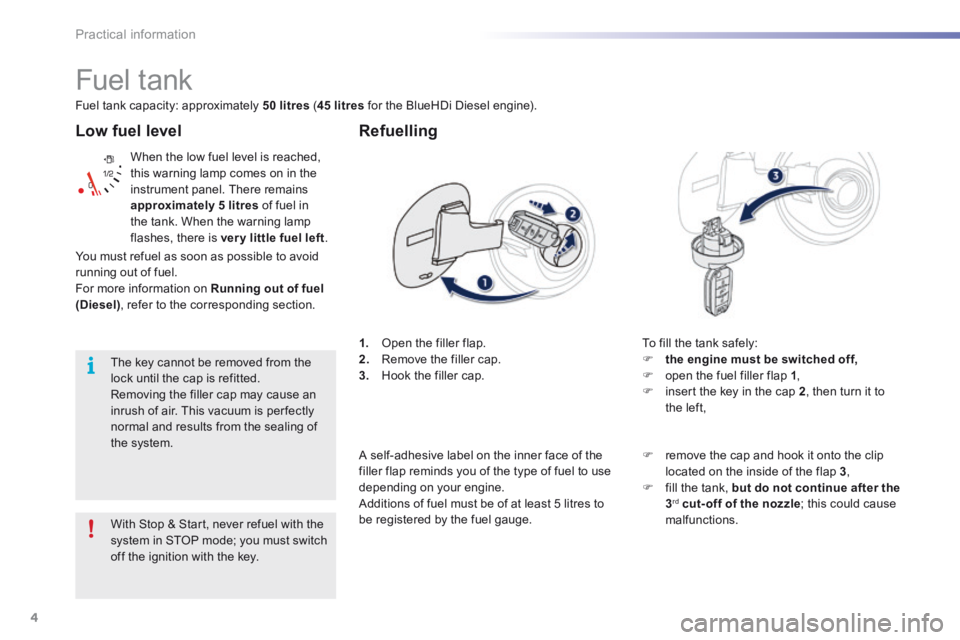
1. Open the filler flap. 2. Remove the filler cap. 3. Hook the filler cap.
Refuelling
To fill the tank safely: the engine must be switched off, open the fuel filler flap 1 , insert the key in the cap 2 , then turn it to the left,
With Stop & Start, never refuel with the system in STOP mode; you must switch off the ignition with the key.
remove the cap and hook it onto the clip located on the inside of the flap 3 , fill the tank, but do not continue after the3 rd cut-off of the nozzle ; this could cause malfunctions.
You must refuel as soon as possible to avoid running out of fuel. For more information on Running out of fuel (Diesel) , refer to the corresponding section.
A self-adhesive label on the inner face of the filler flap reminds you of the type of fuel to use depending on your engine. Additions of fuel must be of at least 5 litres to be registered by the fuel gauge.
Page 380 of 450
5
9
Practical information
2008-additif_en_Chap09_info-pratiques_ed01-2016
Fuel supply cut-off
Your vehicle is fitted with a safety system that cuts off the supply of fuel in the event of an impact.
When you have filled the tank: put the cap back in place, turn the key to the right, then remove it from the cap, close the flap.
If you have put in the wrong fuel for the engine of your vehicle, you must have the fuel tank drained and filled with the correct fuel before star ting the engine.
Page 381 of 450
6
Practical information
2008-additif_en_Chap09_info-pratiques_ed01-2016
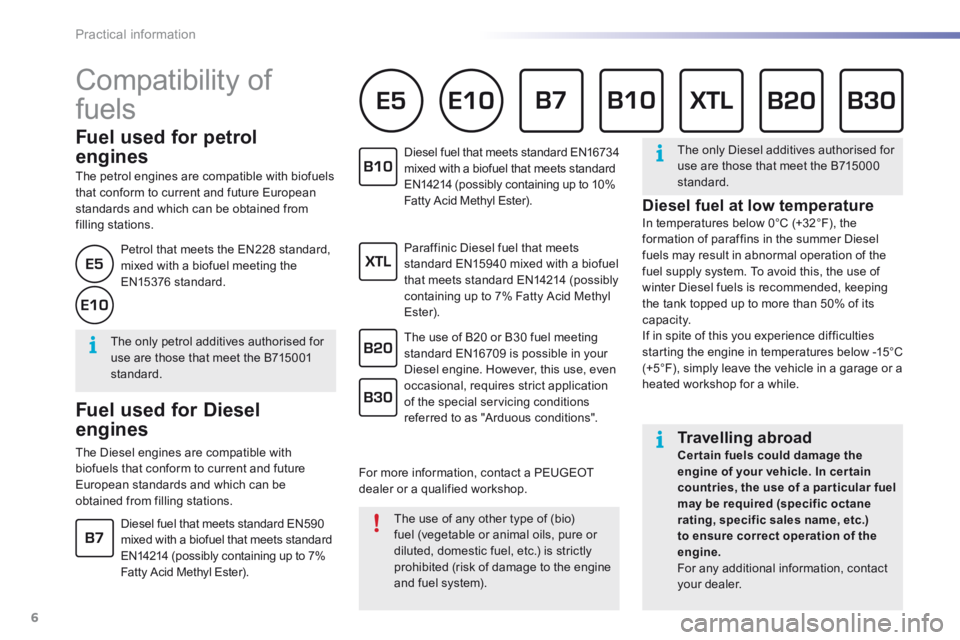
Compatibility of
fuels
Fuel used for petrol
engines
The petrol engines are compatible with biofuels that conform to current and future European standards and which can be obtained from filling stations.
The use of any other type of (bio)
fuel (vegetable or animal oils, pure or diluted, domestic fuel, etc.) is strictly prohibited (risk of damage to the engine and fuel system).
The only Diesel additives authorised for use are those that meet the B715000 standard.
Travelling abroad Cer tain fuels could damage the engine of your vehicle. In cer tain countries, the use of a par ticular fuel may be required (specific octane rating, specific sales name, etc.) to ensure correct operation of the engine. For any additional information, contact your dealer.
The only petrol additives authorised for use are those that meet the B715001 standard.
Fuel used for Diesel
engines
The Diesel engines are compatible with biofuels that conform to current and future European standards and which can be obtained from filling stations.
Diesel fuel that meets standard EN590 mixed with a biofuel that meets standard EN14214 (possibly containing up to 7% Fatty Acid Methyl Ester).
Paraffinic Diesel fuel that meets standard EN15940 mixed with a biofuel that meets standard EN14214 (possibly containing up to 7% Fatty Acid Methyl Ester).
Diesel fuel that meets standard EN16734 mixed with a biofuel that meets standard EN14214 (possibly containing up to 10% Fatty Acid Methyl Ester).
The use of B20 or B30 fuel meeting standard EN16709 is possible in your Diesel engine. However, this use, even occasional, requires strict application of the special servicing conditions referred to as "Arduous conditions".
Petrol that meets the EN228 standard, mixed with a biofuel meeting the EN15376 standard.
For more information, contact a PEUGEOT dealer or a qualified workshop.
Diesel fuel at low temperature In temperatures below 0°C (+32°F), the formation of paraffins in the summer Diesel fuels may result in abnormal operation of the fuel supply system. To avoid this, the use of winter Diesel fuels is recommended, keeping the tank topped up to more than 50% of its capacity. If in spite of this you experience difficulties starting the engine in temperatures below -15°C (+5°F), simply leave the vehicle in a garage or a heated workshop for a while.