steering PEUGEOT 2008 2016 User Guide
[x] Cancel search | Manufacturer: PEUGEOT, Model Year: 2016, Model line: 2008, Model: PEUGEOT 2008 2016Pages: 450, PDF Size: 14.16 MB
Page 88 of 450
86
2008_en_Chap05_conduite_ed01-2016
You must press the brake pedal firmly
while starting the engine.
Never select neutral N while the vehicle
is moving.
Only engage reverse gear R when the
vehicle is immobilised, with your foot on
the brake pedal.
In all cases, you must apply the parking
brake to immobilise the vehicle.
For best acceleration, when overtaking
another vehicle for example, press the
accelerator pedal firmly to pass the
point of resistance.
"Auto sequential" mode
In the automated mode, you can resume
control temporarily at any time using the
steering mounted control paddles.
The use of these paddles permits manual
selection of the gears in situations which
require a more rapid change-down than in
the automated mode (arrival at a roundabout,
leaving a car park with a steep gradient,
over taking...).
The gearbox engages the required gear if
the engine speed permits. AUTO
remains
displayed on the instrument panel.
After a few moments, the gearbox resumes
automatic control of the gears.
Stopping the vehicle
Before switching off the engine, you can
change to position N to be in neutral.
In this case, you must apply the parking
brake to immobilise the vehicle.
Reinitialisation
Following disconnection of the battery, the
gearbox must be reinitialised.
F
S
witch on the ignition.
AUTO and - appear in the instrument
panel.
F
Sel
ect position N .
F
P
ress the brake pedal.
F
W
ait approximately 30 seconds until N or a
gear appears in the instrument panel.
F
R
elease the brake pedal.
The gearbox is operational again.
Operating fault
With the ignition on, if this
warning lamp comes on and
AUTO flashes, accompanied by
an audible signal and a message in the screen,
this indicates a gearbox fault.
Have it checked by a PEUGEOT dealer or a
qualified workshop.
Driving
Page 89 of 450
87
2008_en_Chap05_conduite_ed01-2016
6-speed electronic gearbox
6-speed electronically controlled gearbox
which offers a choice between the ease of fully
automatic operation or the pleasure of manual
gear changing.
There are two driving modes:
-
a
utomated mode for automatic control of
the gears by the gearbox,
-
m
anual mode for sequential gear changing
by the driver.
In automated mode, it remains possible to
change gear manually by using the steering
mounted control paddles when required, when
overtaking, for example.Gear selector
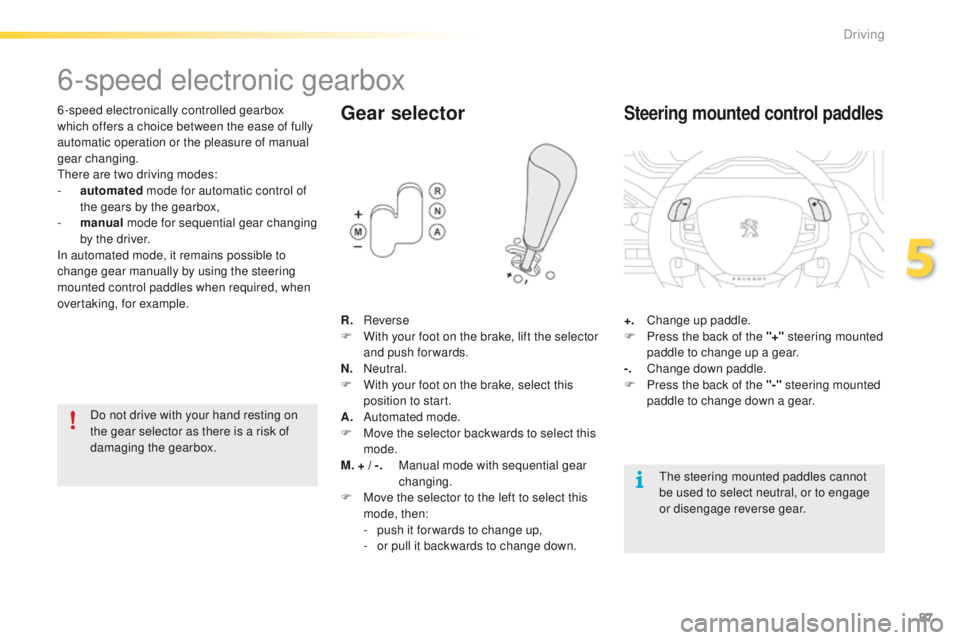
R. Reverse
F W ith your foot on the brake, lift the selector
and push forwards.
N.
N
eutral.
F
W
ith your foot on the brake, select this
position to start.
A.
A
utomated mode.
F
M
ove the selector backwards to select this
mode.
M. + / -.
M
anual mode with sequential gear
changing.
F
M
ove the selector to the left to select this
mode, then:
-
p
ush it forwards to change up,
-
o
r pull it backwards to change down. +. C
hange up paddle.
F P ress the back of the "+" steering mounted
paddle to change up a gear.
-.
C
hange down paddle.
F
P
ress the back of the "-" steering mounted
paddle to change down a gear.
Steering mounted control paddles
The steering mounted paddles cannot
be used to select neutral, or to engage
or disengage reverse gear.
Do not drive with your hand resting on
the gear selector as there is a risk of
damaging the gearbox.
5
Driving
Page 91 of 450
89
2008_en_Chap05_conduite_ed01-2016
At very low speed, if reverse gear
is requested, this will only be taken
into account when the vehicle is
immobilised. A warning lamp appears in
the instrument panel screen.
Manual gear changingManual mode
On sharp acceleration, the gearbox will
not change up unless the driver acts on
the gear lever or the steering mounted
paddles.
Never select neutral N while the vehicle
is moving.
Only engage reverse gear R when the
vehicle is immobilised with the brake
pedal pressed.
This selective gear change mode enables you
to overtake, for example, while still remaining in
automatic mode.
F
O
perate the + or - steering mounted control
paddle.
The gearbox engages the gear requested if the
engine speed permits. AUTO is still displayed
in the instrument panel.
After a few moments without any action on
the controls, the gearbox resumes automatic
control of the gears. F
W
hen the vehicle has moved off, select
position M to change to manual mode.
F
P
ull the selector towards the +
sign to
change up a gear.
F
P
ush the selector towards the - sign to
change down a gear.
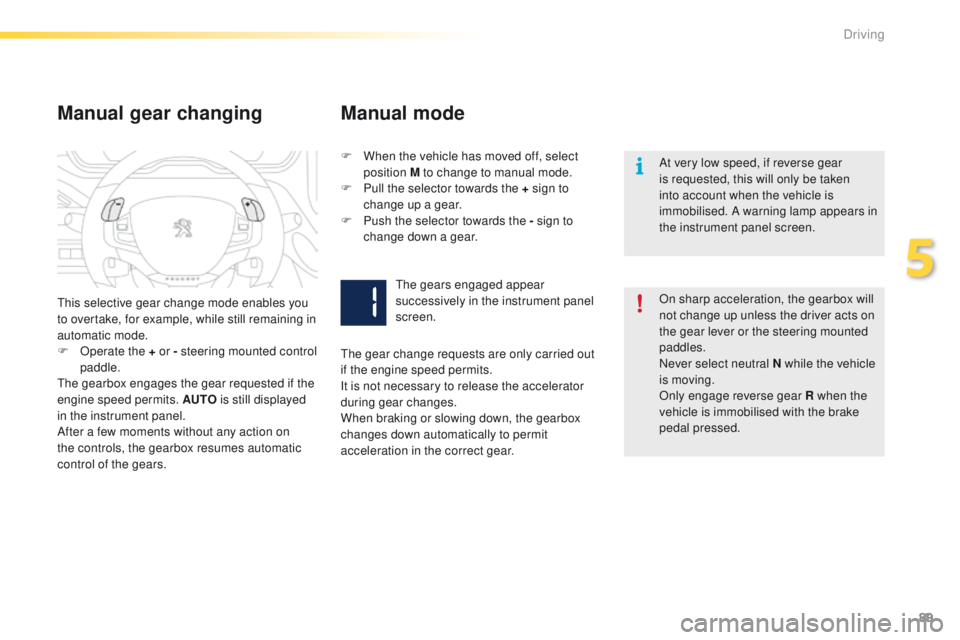
The gears engaged appear
successively in the instrument panel
screen.
The gear change requests are only carried out
if the engine speed permits.
It is not necessary to release the accelerator
during gear changes.
When braking or slowing down, the gearbox
changes down automatically to permit
acceleration in the correct gear.
5
Driving
Page 102 of 450
100
2008_en_Chap05_conduite_ed01-2016
Stop & Start
Operation
Going into engine STOP mode
The "ECO" warning lamp comes
on in the instrument panel and the
engine goes into standby:
-
for e-HDi Diesel engines :
●
w
ith a manual gearbox , at speeds
below 12 mph (20 km/h), when you place
the gear selector into neutral, and you
release the clutch pedal,
●
w
ith an electronic gearbox , at speeds
below 5 mph (8 km/h), when you press
the brake pedal or place the gear
selector into position N ,
-
for e-VTI and e-THP petrol engines and
BlueHDi Diesel engines, with the vehicle
stationary. Never refuel with the engine in STOP
mode; you must switch off the ignition
with the key. For your comfort, during parking
manoeuvres, STOP mode is not
available for a few seconds after
coming out of reverse gear.
Stop & Start does not affect the
vehicle's systems, such as for example,
braking, power steering...
Special cases: STOP mode not
available
STOP mode is not invoked when:
- t
he driver's door is open,
-
t
he driver's seat belt is not fastened,
-
t
he vehicle has not exceeded 6 mph
(10
km/h) since the last engine start using
t h e key,
-
t
he engine is needed to maintain a
comfortable temperature in the passenger
compartment,
-
d
emisting has been selected,
-
s
ome special conditions (battery charge,
engine temperature, braking assistance,
ambient temperature...) where the engine is
needed to assure control of a system.
A time counter calculates the sum
of the periods in STOP mode
during a journey. It rests itself
to zero every time the ignition is
switched on with the key. The "ECO"
warning lamp flashes for
a few seconds then goes off.
This operation is perfectly normal.
The Stop & Start
system puts the engine temporarily into standby - STOP mode - during stops in the traffic (red lights, traffic jams, or other...). The
engine restarts automatically - START mode - as soon as you want to move off. The restart takes place instantly, quickly and silently.
Per fect for urban use, the Stop & Start system reduces fuel consumption and exhaust emissions as well as the noise level when stationary.
Driving
Page 106 of 450
104
2008_en_Chap05_conduite_ed01-2016
Speed limiter
System which prevents the vehicle from
exceeding the speed programmed by the driver.
When the programmed speed limit is reached,
pressing the accelerator pedal in the normal
manner no longer has any effect.
The speed limiter is switched on manually: the
programmed speed must be at least 20 mph
(30 km/h).
The speed limiter is switched off by manual
operation of the control.
The programmed speed can be exceeded
temporarily by pressing the accelerator firmly.
To return to the programmed speed, simply
slow down to a speed below the programmed
speed.
The speed limiter cannot, in any circumstances,
replace the need to respect speed limits, nor can it
replace the need for vigilance on the part of the driver.
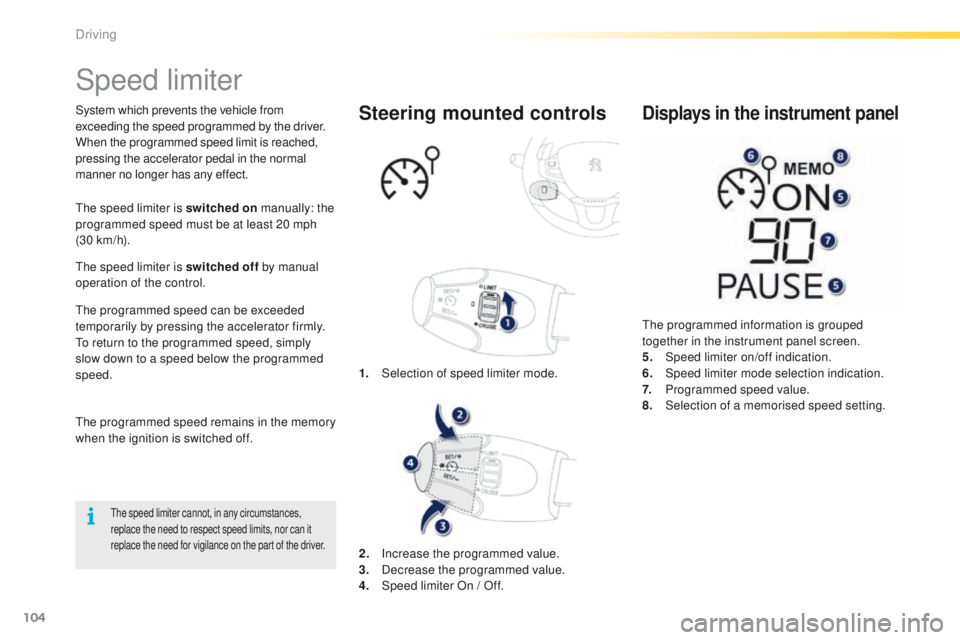
1. Selection of speed limiter mode.
Steering mounted controls
The programmed information is grouped
together in the instrument panel screen.
5.
Spe
ed limiter on/off indication.
6.
Spe
ed limiter mode selection indication.
7.
P
rogrammed speed value.
8.
Sel
ection of a memorised speed setting.
Displays in the instrument panel
The programmed speed remains in the memory
when the ignition is switched off.
2.
In
crease the programmed value.
3.
D
ecrease the programmed value.
4.
S
peed limiter On / Off.
Driving
Page 108 of 450
106
2008_en_Chap05_conduite_ed01-2016
Cruise control
System which automatically maintains the
speed of the vehicle at the value programmed
by the driver, without any action on the
accelerator pedal.
The cruise control is switched off manually
or by pressing the brake or clutch pedal or on
triggering of the electronic stability system for
safety reasons.
It is possible to exceed the programmed speed
temporarily by pressing the accelerator pedal.
To return to the programmed speed, simply
release the accelerator pedal.
Switching off the ignition cancels any
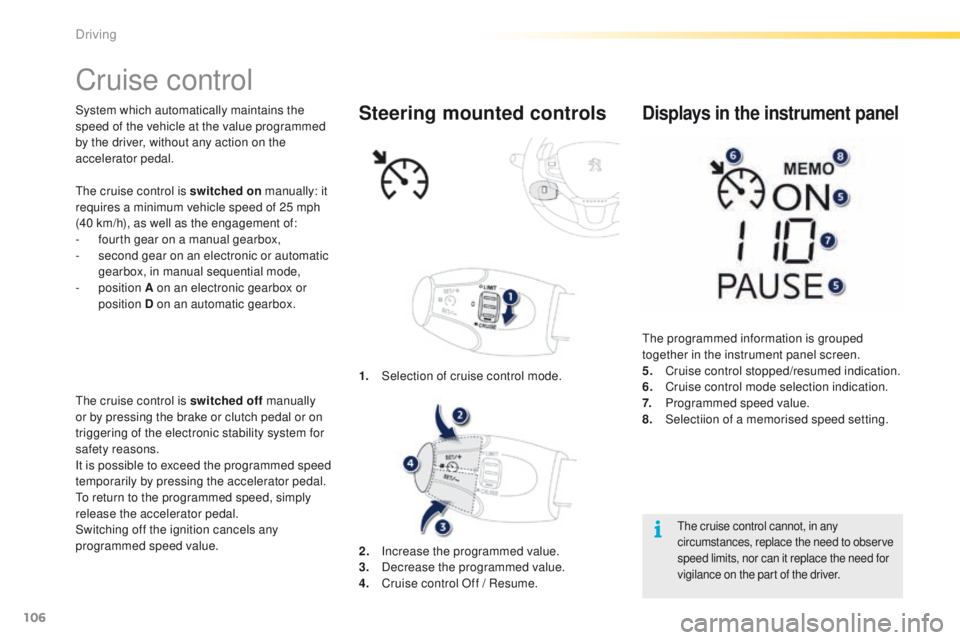
programmed speed value. 1.
Sel
ection of cruise control mode.Steering mounted controls
The cruise control cannot, in any
circumstances, replace the need to observe
speed limits, nor can it replace the need for
vigilance on the part of the driver.
The programmed information is grouped
together in the instrument panel screen.
5.
C
ruise control stopped/resumed indication.
6.
C
ruise control mode selection indication.
7.
P
rogrammed speed value.
8.
Sel
ectiion of a memorised speed setting.
Displays in the instrument panel
2. Increase the programmed value.
3. D ecrease the programmed value.
4.
C
ruise control Off / Resume.
The cruise control is switched on
manually: it
requires a minimum vehicle speed of 25 mph
(40 km/h), as well as the engagement of:
-
f
ourth gear on a manual gearbox,
-
s
econd gear on an electronic or automatic
gearbox, in manual sequential mode,
-
position
A on an electronic gearbox or
position D on an automatic gearbox.
Driving
Page 115 of 450
113
2008_en_Chap05_conduite_ed01-2016
Park Assist
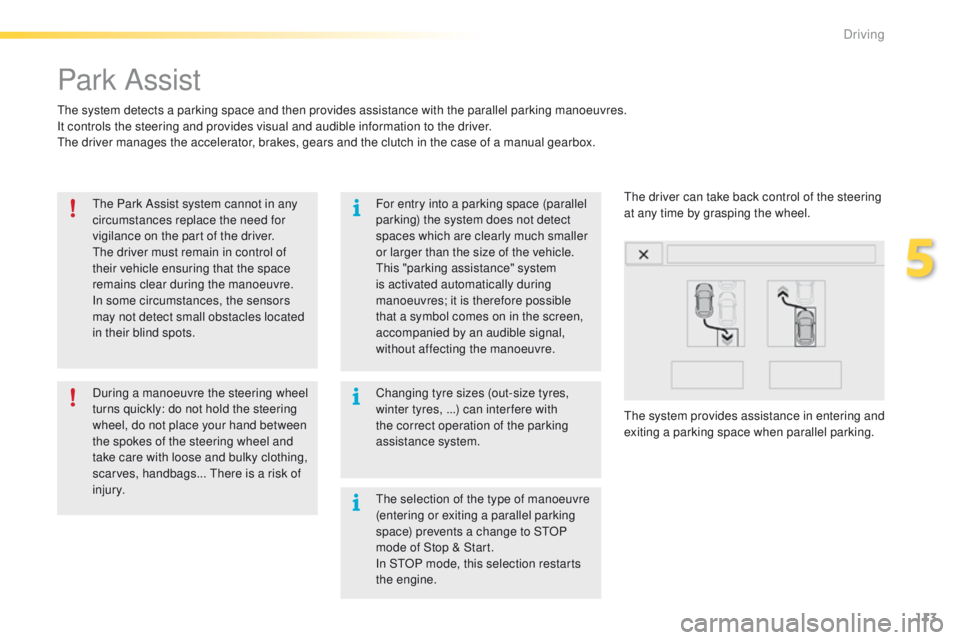
The system detects a parking space and then provides assistance with the parallel parking manoeuvres.
It controls the steering and provides visual and audible information to the driver.
The driver manages the accelerator, brakes, gears and the clutch in the case of a manual gearbox.The Park Assist system cannot in any
circumstances replace the need for
vigilance on the part of the driver.
The driver must remain in control of
their vehicle ensuring that the space
remains clear during the manoeuvre.
In some circumstances, the sensors
may not detect small obstacles located
in their blind spots. Changing tyre sizes (out-size tyres,
winter tyres, ...) can inter fere with
the correct operation of the parking
assistance system.
During a manoeuvre the steering wheel
turns quickly: do not hold the steering
wheel, do not place your hand between
the spokes of the steering wheel and
take care with loose and bulky clothing,
scarves, handbags... There is a risk of
injury. For entry into a parking space (parallel
parking) the system does not detect
spaces which are clearly much smaller
or larger than the size of the vehicle.
This "parking assistance" system
is activated automatically during
manoeuvres; it is therefore possible
that a symbol comes on in the screen,
accompanied by an audible signal,
without affecting the manoeuvre.
The system provides assistance in entering and
exiting a parking space when parallel parking. The driver can take back control of the steering
at any time by grasping the wheel.
The selection of the type of manoeuvre
(entering or exiting a parallel parking
space) prevents a change to STOP
mode of Stop & Start.
In STOP mode, this selection restarts
the engine.
5
Driving
Page 116 of 450
114
2008_en_Chap05_conduite_ed01-2016
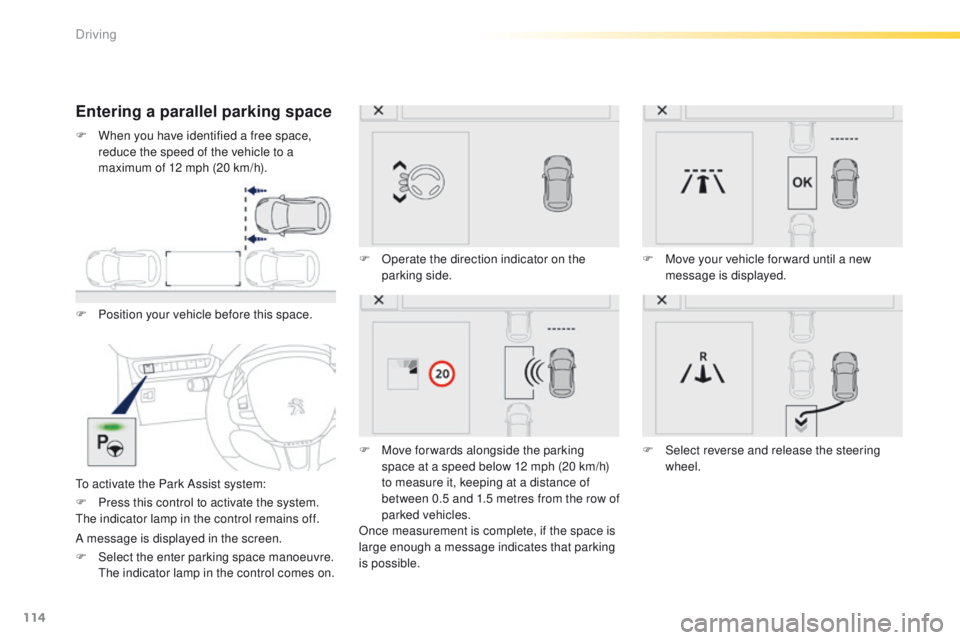
Entering a parallel parking space
F Position your vehicle before this space.
To activate the Park Assist system:F
O
perate the direction indicator on the
parking side.
F
M
ove for wards alongside the parking
space at a speed below 12 mph (20 km/h)
to measure it, keeping at a distance of
between 0.5 and 1.5 metres from the row of
parked vehicles.
Once measurement is complete, if the space is
large enough a message indicates that parking
is possible. F
M
ove your vehicle for ward until a new
message is displayed.
F
S
elect reverse and release the steering
wheel.
F
P
ress this control to activate the system.
The indicator lamp in the control remains off.
A message is displayed in the screen.
F
S
elect the enter parking space manoeuvre.
T
he indicator lamp in the control comes on.
F
W
hen you have identified a free space,
reduce the speed of the vehicle to a
maximum of 12 mph (20 km/h).
Driving
Page 117 of 450
115
2008_en_Chap05_conduite_ed01-2016
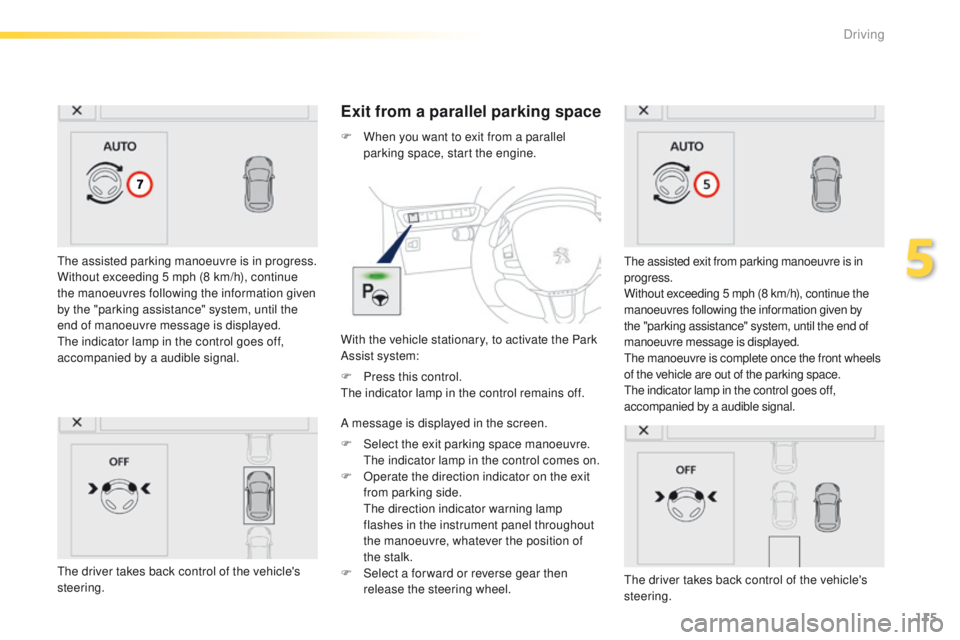
The assisted parking manoeuvre is in progress.
Without exceeding 5 mph (8 km/h), continue
the manoeuvres following the information given
by the "parking assistance" system, until the
end of manoeuvre message is displayed.
The indicator lamp in the control goes off,
accompanied by a audible signal.
Exit from a parallel parking space
With the vehicle stationary, to activate the Park
Assist system: F
W
hen you want to exit from a parallel
parking space, start the engine.
The assisted exit from parking manoeuvre is in
progress.
Without exceeding 5 mph (8 km/h), continue the
manoeuvres following the information given by
the "parking assistance" system, until the end of
manoeuvre message is displayed.
The manoeuvre is complete once the front wheels
of the vehicle are out of the parking space.
The indicator lamp in the control goes off,
accompanied by a audible signal.
F
P
ress this control.
The indicator lamp in the control remains off.
A message is displayed in the screen.
F
S
elect the exit parking space manoeuvre.
T
he indicator lamp in the control comes on.
F
O
perate the direction indicator on the exit
from parking side.
T
he direction indicator warning lamp
flashes in the instrument panel throughout
the manoeuvre, whatever the position of
the stalk.
F
S
elect a for ward or reverse gear then
release the steering wheel.
The driver takes back control of the vehicle's
steering.
The driver takes back control of the vehicle's
steering.
5
Driving
Page 118 of 450
116
2008_en_Chap05_conduite_ed01-2016
In bad weather and in winter, ensure
that the sensors are not covered by
road dirt, ice or snow.
In the event of a fault, have the system
checked by a PEUGEOT dealer or a
qualified workshop.
If the system is deactivated during a
manoeuvre, the drive should reactivate
it manually to repeat the measurement. If the lateral distance between your vehicle
and the space is too great, the system may
not be able to measure the space.
Anything projecting beyond the envelope
of the vehicle (long or wide load) is not
taken into account by the Park Assist
system during a manoeuvre.
Deactivation
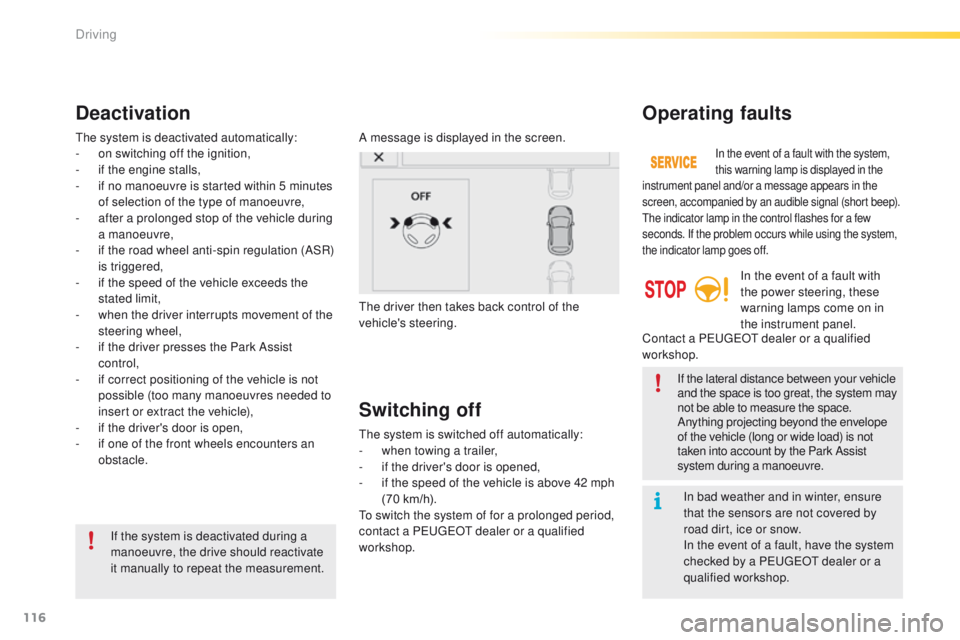
A message is displayed in the screen.
The driver then takes back control of the
vehicle's steering.
The system is deactivated automatically:
-
o
n switching off the ignition,
-
i
f the engine stalls,
-
i
f no manoeuvre is started within 5 minutes
of selection of the type of manoeuvre,
-
a
fter a prolonged stop of the vehicle during
a manoeuvre,
-
i
f the road wheel anti-spin regulation (ASR)
is triggered,
-
i
f the speed of the vehicle exceeds the
stated limit,
-
w
hen the driver interrupts movement of the
steering wheel,
-
i
f the driver presses the Park Assist
control,
-
i
f correct positioning of the vehicle is not
possible (too many manoeuvres needed to
insert or extract the vehicle),
-
i
f the driver's door is open,
-
i
f one of the front wheels encounters an
obstacle.
Switching off
The system is switched off automatically:
- w hen towing a trailer,
-
i
f the driver's door is opened,
-
i
f the speed of the vehicle is above 42 mph
(70 km/h).
To switch the system of for a prolonged period,
contact a PEUGEOT dealer or a qualified
workshop.
Operating faults
In the event of a fault with the system,
this warning lamp is displayed in the
instrument panel and/or a message appears in the
screen, accompanied by an audible signal (short beep).
The indicator lamp in the control flashes for a few
seconds. If the problem occurs while using the system,
the indicator lamp goes off.
In the event of a fault with
the power steering, these
warning lamps come on in
the instrument panel.
Contact a PEUGEOT dealer or a qualified
workshop.
Driving