wheel PEUGEOT 2008 2016 Owner's Manual
[x] Cancel search | Manufacturer: PEUGEOT, Model Year: 2016, Model line: 2008, Model: PEUGEOT 2008 2016Pages: 450, PDF Size: 14.16 MB
Page 127 of 450
125
2008_en_Chap06_visibilite_ed01-2016
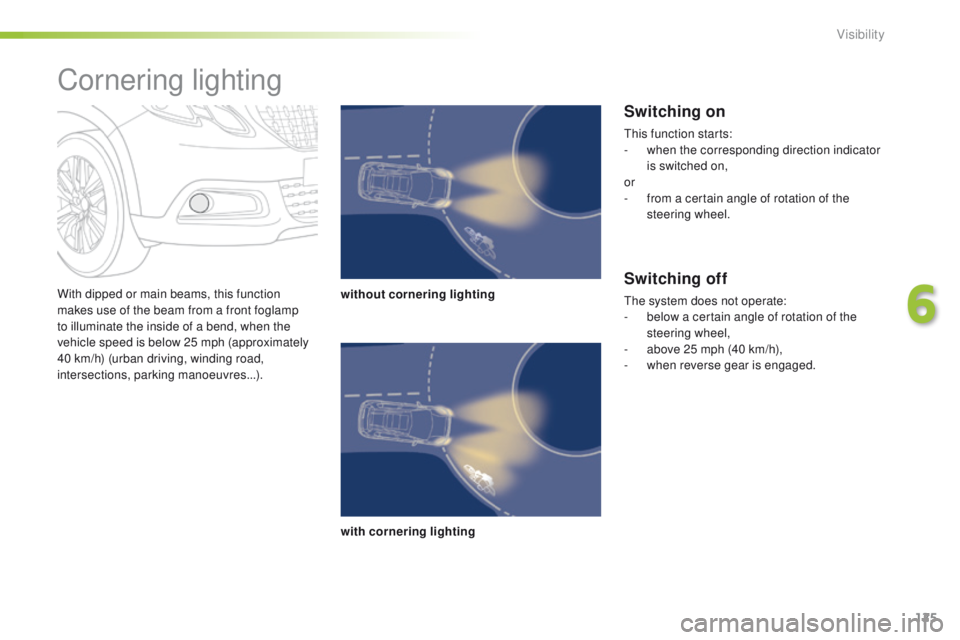
With dipped or main beams, this function
makes use of the beam from a front foglamp
to illuminate the inside of a bend, when the
vehicle speed is below 25 mph (approximately
40 km/h) (urban driving, winding road,
intersections, parking manoeuvres...).
Cornering lighting
with cornering lightingwithout cornering lighting
Switching on
This function starts:
-
w hen the corresponding direction indicator
is switched on,
or
-
f
rom a certain angle of rotation of the
steering wheel.
Switching off
The system does not operate:
- b elow a certain angle of rotation of the
steering wheel,
-
a
bove 25 mph (40 km/h),
-
w
hen reverse gear is engaged.
6
Visibility
Page 138 of 450
136
2008_en_Chap07_securite_ed01-2016
Horn
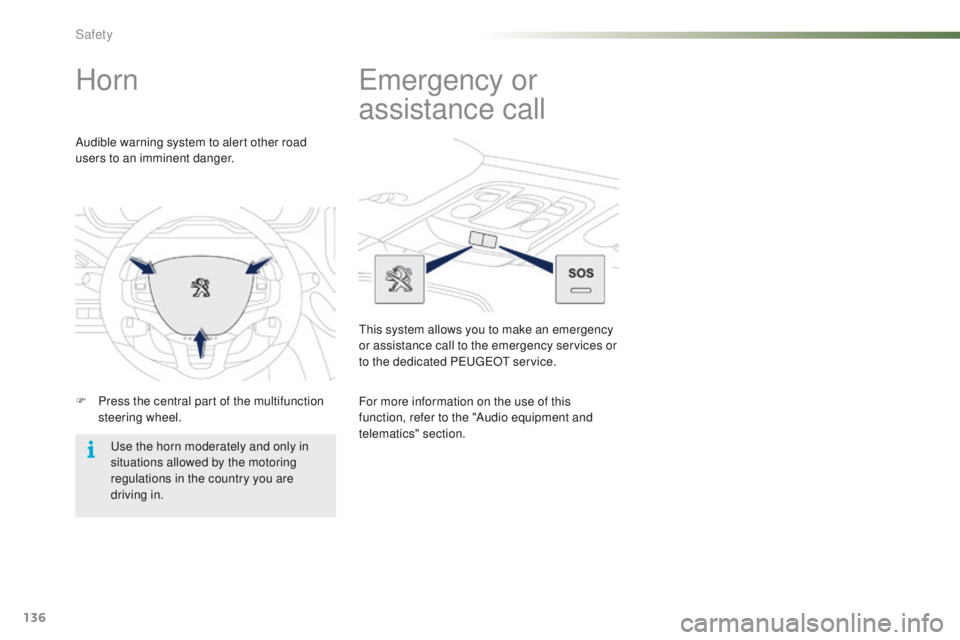
F Press the central part of the multifunction steering wheel.
Audible warning system to alert other road
users to an imminent danger.
Use the horn moderately and only in
situations allowed by the motoring
regulations in the country you are
driving in.
Emergency or
assistance call
This system allows you to make an emergency
or assistance call to the emergency services or
to the dedicated PEUGEOT service.
For more information on the use of this
function, refer to the "Audio equipment and
telematics" section.
Safety
Page 139 of 450
137
2008_en_Chap07_securite_ed01-2016
The under-inflation detection system
does not replace the need for vigilance
on the part of the driver.
This system does not avoid the need to
check the tyre pressures (including the
spare wheel) every month as well as
before a long journey.
Driving with under-inflated tyres impairs
road holding, extends braking distances
and causes premature tyre wear,
particularly under arduous conditions
(high loading, high speed, long journey).The inflation pressures defined for
your vehicle can be found on the tyre
pressure label.
For more information on the
identification markings, refer to the
corresponding section.
Tyre pressures should be checked
when the tyres are "cold" (vehicle
stopped for 1 hour or after a journey of
less than 6 miles (10 km) at moderate
speeds).
Other wise (when hot), add 0.3 bar to
the pressures shown on the label.
Driving with under-inflated tyres
increases fuel consumption.
Under-inflation detection
System which automatically checks the pressures of the tyres while driving.
The system monitors the pressures in the four
tyres, once the vehicle is moving.
It compares the information given by the four
wheel speed sensors with reference values,
which must be reinitialised ever y time the
tyre pressures are adjusted or a wheel
changed
.
The system triggers an alert as soon as it
detects a drop in the inflation pressure of one
or more tyres.
7
Safety
Page 140 of 450
138
2008_en_Chap07_securite_ed01-2016
Under-inflation alert
This is given by fixed illumination of
this warning lamp, accompanied by
an audible signal and, depending on
equipment, the display of a message.
F
R
educe speed immediately, avoid
excessive steering movements and sudden
braking
F
S
top the vehicle as soon as it is safe to do
so.
The loss of pressure detected does not
always cause visible bulging of the tyre.
Do not satisfy yourself with just a visual
check. Before reinitialising the system, ensure
that the pressures of the four tyres are
correct for the use of the vehicle and in
line with the recommendations on the
tyre pressure label.
The alert is maintained until the system
is reinitialised.
F
I n the event of a puncture, use the
temporary puncture repair kit or the spare
wheel (depending on equipment),
or
F
i
f you have a compressor, such as the one
in the temporary puncture repair kit, check
the pressures of the four tyres when cold,
or
F
i
f it is not possible to make this check
immediately, drive carefully at reduced
speed.
Reinitialisation
It is necessary to reinitialise the system every
time one or more tyre pressures are adjusted,
and after changing one or more wheels.
The under-inflation detection system
does not give a warning if a pressure is
incorrect at the time of reinitialisation.
Safety
Page 142 of 450
140
2008_en_Chap07_securite_ed01-2016
A set of the following Electronic Stability
systems:
-
a
nti-lock braking system (ABS) and
electronic brake force distribution (EBFD),
-
em
ergency braking assistance,
-
w
heel anti-slip regulation (ASR) or traction
control,
-
d
ynamic stability control (DSC).
Electronic stability control (ESC)
Definitions
Anti-lock braking system (ABS)
and electronic brake force
distribution (EBFD)
These systems improve the stability and
manoeuvrability of your vehicle when braking
and contribute towards improved control in
corners, in particular on poor or slippery road
surfaces.
The ABS prevents wheel lock in the event of
emergency braking.
The electronic brake force distribution system
manages the braking pressure wheel by wheel.
Emergency braking assistance
In an emergency, this system enables you to
reach the optimum braking pressure more
quickly and therefore reduce the stopping
distance.
It is triggered in relation to the speed at which
the brake pedal is pressed. This is felt by a
reduction in the resistance of the pedal and an
increase in the effectiveness of the braking.
Anti-slip regulation (ASR)
This system (also known as Traction Control)
optimises traction in order to avoid wheel
slip by acting on the brakes of the driving
wheels and on the engine. It also improves
the directional stability of the vehicle on
acceleration.
Dynamic stability control
(DSC)
If there is a difference between the path
followed by the vehicle and that required by the
driver, this system monitors each wheel and
automatically acts on the brake of one or more
wheels and on the engine to return the vehicle
to the required path, within the limits of the laws
of physics.
Safety
Page 143 of 450
141
2008_en_Chap07_securite_ed01-2016
Operation
Anti-lock braking system (ABS)
and electronic brake force
distribution (EBFD)
In emergency braking, press
very firmly without releasing the
pressure. When changing wheels (tyres and rims),
make sure that these are approved for
your vehicle.
Normal operation of the ABS may make
itself felt by slight vibrations of the brake
pedal.
When this warning lamp comes on,
accompanied by an audible signal
and a message, it indicates that
there is a fault with the ABS, which
could cause loss of control of the vehicle when
braking.
When this warning lamp comes on,
coupled with the STOP warning
lamp, accompanied by an audible
signal and a message, it indicates
that there is a fault with the electronic brake
force distribution (EBFD), which could cause
loss of control of the vehicle when braking.
You must stop as soon as it is safe to do so.
In both cases, contact a PEUGEOT dealer or a
qualified workshop.
7
Safety
Page 144 of 450
142
2008_en_Chap07_securite_ed01-2016
Dynamic stability control (DSC)
and anti-slip regulation (ASR)
Activation
These systems are activated automatically
each time the vehicle is started.
As soon as they detect a problem of grip or
trajectory, these systems act on the operation
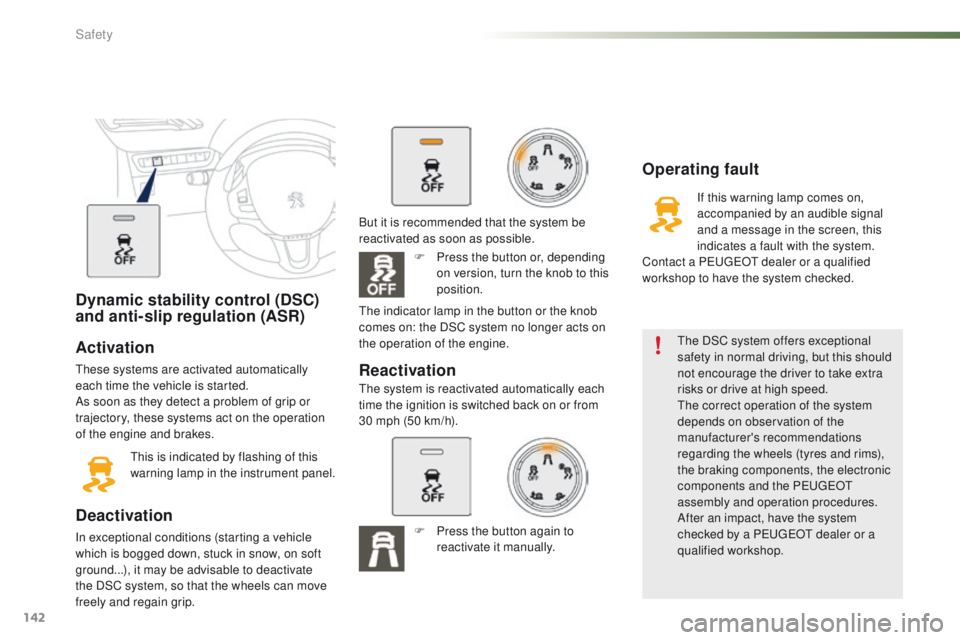
of the engine and brakes.This is indicated by flashing of this
warning lamp in the instrument panel.
Deactivation
In exceptional conditions (starting a vehicle
which is bogged down, stuck in snow, on soft
ground...), it may be advisable to deactivate
the DSC system, so that the wheels can move
freely and regain grip. The DSC system offers exceptional
safety in normal driving, but this should
not encourage the driver to take extra
risks or drive at high speed.
The correct operation of the system
depends on observation of the
manufacturer's recommendations
regarding the wheels (tyres and rims),
the braking components, the electronic
components and the PEUGEOT
assembly and operation procedures.
After an impact, have the system
checked by a PEUGEOT dealer or a
qualified workshop.
Operating fault
If this warning lamp comes on,
accompanied by an audible signal
and a message in the screen, this
indicates a fault with the system.
Contact a PEUGEOT dealer or a qualified
workshop to have the system checked.
Reactivation
But it is recommended that the system be
reactivated as soon as possible.
F
P
ress the button or, depending
on version, turn the knob to this
position.
The system is reactivated automatically each
time the ignition is switched back on or from
30 mph (50 km/h). The indicator lamp in the button or the knob
comes on: the DSC system no longer acts on
the operation of the engine.
F
P
ress the button again to
reactivate it manually.
Safety
Page 145 of 450
143
2008_en_Chap07_securite_ed01-2016
Grip control
Special patented traction control system which
improves traction on snow, mud and sand.
This system, the operation of which has been
optimised for each situation, allows you to
manoeuvre in most conditions of poor grip
(encountered during touring use).
Standard (ESC)
This mode is calibrated for a low level of wheel
spin, based on the different levels of grip
normally encountered on the road.F
P
lace the dial in this position.
Snow
This mode adapts its strategy to the conditions
of grip encountered for each of the two front
wheels on moving off.
(mode active up to 30 mph (50 km/h))F
P
lace the dial in this position.
The accelerator pedal should be pressed
sufficiently to allow the system to use the power
of the engine. Operation at high engine speeds
is completely normal.
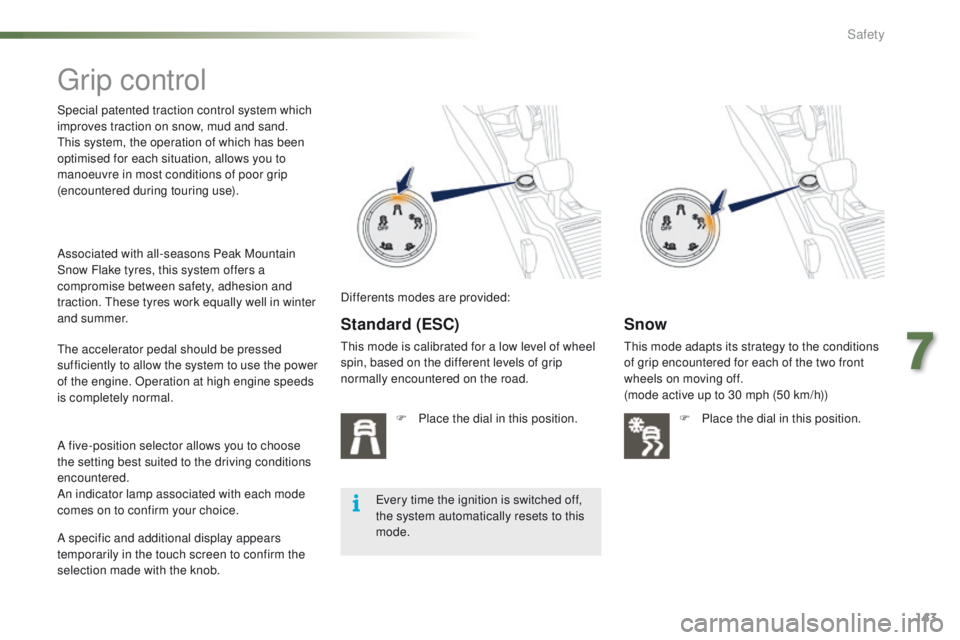
A five-position selector allows you to choose
the setting best suited to the driving conditions
encountered.
An indicator lamp associated with each mode
comes on to confirm your choice.
Every time the ignition is switched off,
the system automatically resets to this
mode.
Associated with all-seasons Peak Mountain
Snow Flake tyres, this system offers a
compromise between safety, adhesion and
traction. These tyres work equally well in winter
and summer.
A specific and additional display appears
temporarily in the touch screen to confirm the
selection made with the knob.
Differents modes are provided:
7
Safety
Page 146 of 450
144
2008_en_Chap07_securite_ed01-2016
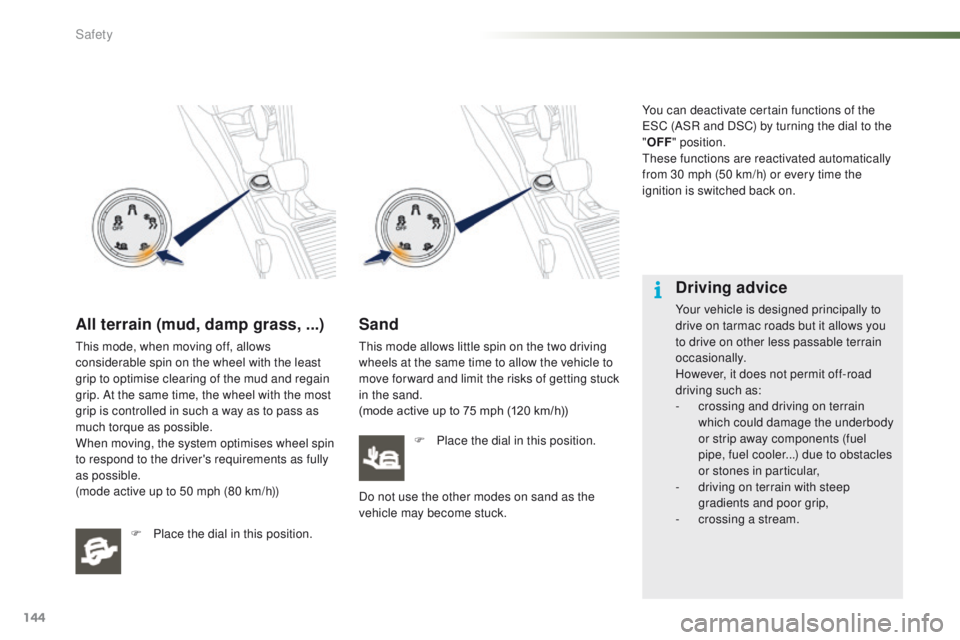
All terrain (mud, damp grass, ...)
This mode, when moving off, allows
considerable spin on the wheel with the least
grip to optimise clearing of the mud and regain
grip. At the same time, the wheel with the most
grip is controlled in such a way as to pass as
much torque as possible.
When moving, the system optimises wheel spin
to respond to the driver's requirements as fully
as possible.
(mode active up to 50 mph (80 km/h))F
P
lace the dial in this position.
Sand
This mode allows little spin on the two driving
wheels at the same time to allow the vehicle to
move for ward and limit the risks of getting stuck
in the sand.
(mode active up to 75 mph (120 km/h))F
P
lace the dial in this position.
Do not use the other modes on sand as the
vehicle may become stuck. You can deactivate certain functions of the
ESC (ASR and DSC) by turning the dial to the
"
OFF " position.
These functions are reactivated automatically
from 30 mph (50 km/h) or every time the
ignition is switched back on.
Driving advice
Your vehicle is designed principally to
drive on tarmac roads but it allows you
to drive on other less passable terrain
occasionally.
However, it does not permit off-road
driving such as:
-
c
rossing and driving on terrain
which could damage the underbody
or strip away components (fuel
pipe, fuel cooler...) due to obstacles
or stones in particular,
-
d
riving on terrain with steep
gradients and poor grip,
-
c
rossing a stream.
Safety
Page 149 of 450
147
2008_en_Chap07_securite_ed01-2016
Operating limits
The system only detects vehicles that are
stationary or moving in the same direction as
your vehicle.It does not detect small vehicles
(bicycles, motorcycles), pedestrians or
animals, nor non-reflective stationary
objects.
The system is not triggered or is interrupted if
the driver:
-
a
ccelerates strongly
-
o
r turns the steering wheel suddenly
(avoiding manoeuvre).With the touch screen
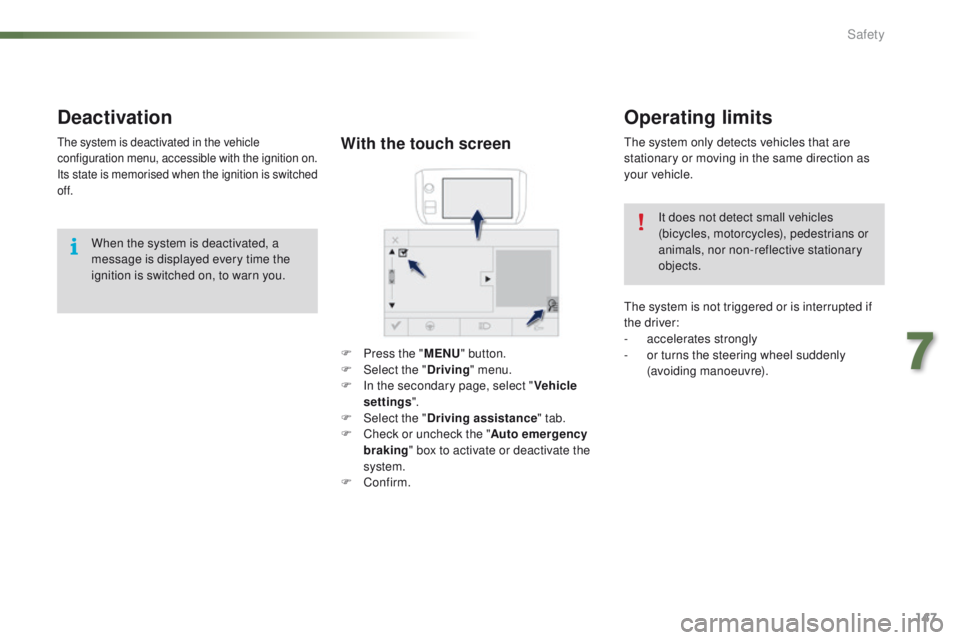
F Press the " MENU" button.
F Sel ect the " Driving" menu.
F
I
n the secondary page, select " Vehicle
settings ".
F
Sel
ect the " Driving assistance " tab.
F
C
heck or uncheck the " Auto emergency
braking " box to activate or deactivate the
system.
F
Confirm.
Deactivation
The system is deactivated in the vehicle
configuration menu, accessible with the ignition on.
Its state is memorised when the ignition is switched
of f.
When the system is deactivated, a
message is displayed every time the
ignition is switched on, to warn you.
7
Safety