wheel PEUGEOT 2008 2016 Service Manual
[x] Cancel search | Manufacturer: PEUGEOT, Model Year: 2016, Model line: 2008, Model: PEUGEOT 2008 2016Pages: 450, PDF Size: 14.16 MB
Page 198 of 450
196
2008_en_Chap09_info-pratiques_ed01-2016
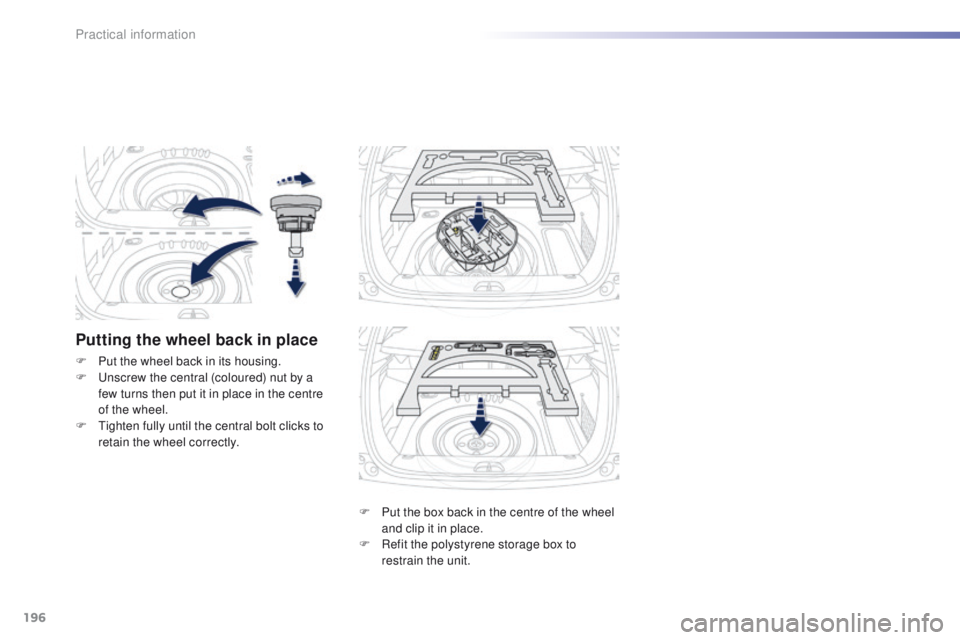
Putting the wheel back in place
F Put the box back in the centre of the wheel and clip it in place.
F
R
efit the polystyrene storage box to
restrain the unit.
F
P
ut the wheel back in its housing.
F
U
nscrew the central (coloured) nut by a
few
turns then put it in place in the centre
of the wheel.
F
T
ighten fully until the central bolt clicks to
retain the wheel correctly.
Practical information
Page 199 of 450
197
2008_en_Chap09_info-pratiques_ed01-2016
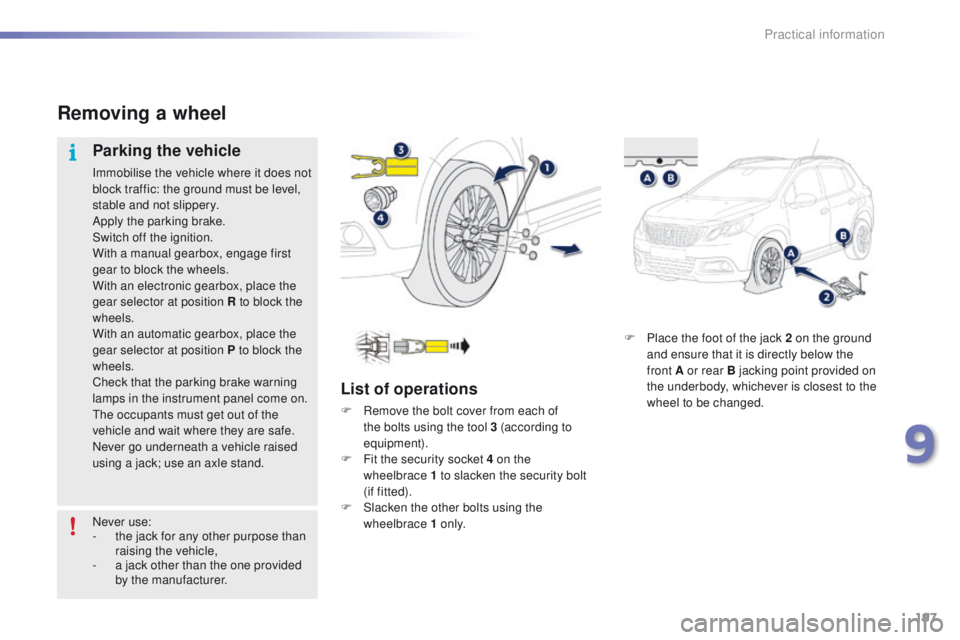
F Place the foot of the jack 2 on the ground and ensure that it is directly below the
front
A or rear B jacking point provided on
the underbody, whichever is closest to the
wheel to be changed.
Removing a wheel
Parking the vehicle
Immobilise the vehicle where it does not
block traffic: the ground must be level,
stable and not slippery.
Apply the parking brake.
Switch off the ignition.
With a manual gearbox, engage first
gear to block the wheels.
With an electronic gearbox, place the
gear selector at position R to block the
wheels.
With an automatic gearbox, place the
gear selector at position P to block the
wheels.
Check that the parking brake warning
lamps in the instrument panel come on.
The occupants must get out of the
vehicle and wait where they are safe.
Never go underneath a vehicle raised
using a jack; use an axle stand.
List of operations
F Remove the bolt cover from each of the bolts using the tool 3 (according to
equipment).
F
F
it the security socket 4 on the
wheelbrace
1 to slacken the security bolt
(if fitted).
F
S
lacken the other bolts using the
wheelbrace 1 o n l y.
Never use:
-
t
he jack for any other purpose than
raising the vehicle,
-
a j
ack other than the one provided
by the manufacturer.
9
Practical information
Page 200 of 450
198
2008_en_Chap09_info-pratiques_ed01-2016
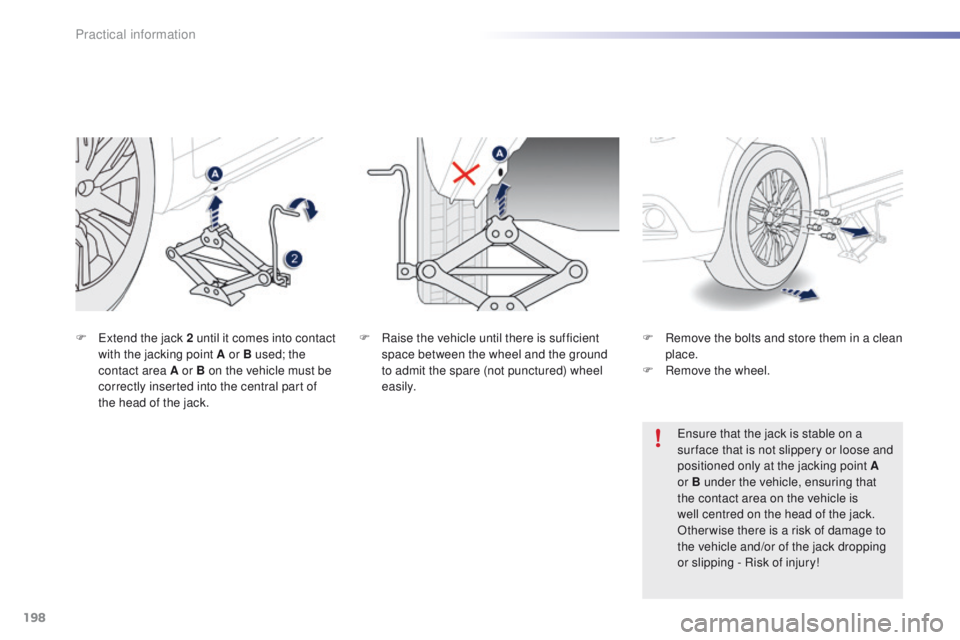
F Raise the vehicle until there is sufficient space between the wheel and the ground
to admit the spare (not punctured) wheel
easily.
F
E
xtend the jack 2 until it comes into contact
with the jacking point A or B used; the
contact area A or B on the vehicle must be
correctly inserted into the central part of
the head of the jack.
Ensure that the jack is stable on a
sur face that is not slippery or loose and
positioned only at the jacking point
A
or B under the vehicle, ensuring that
the contact area on the vehicle is
well centred on the head of the jack.
Otherwise there is a risk of damage to
the vehicle and/or of the jack dropping
or slipping - Risk of injury!
F
R emove the bolts and store them in a clean
place.
F
R
emove the wheel.
Practical information
Page 201 of 450
199
2008_en_Chap09_info-pratiques_ed01-2016
Fitting a wheel
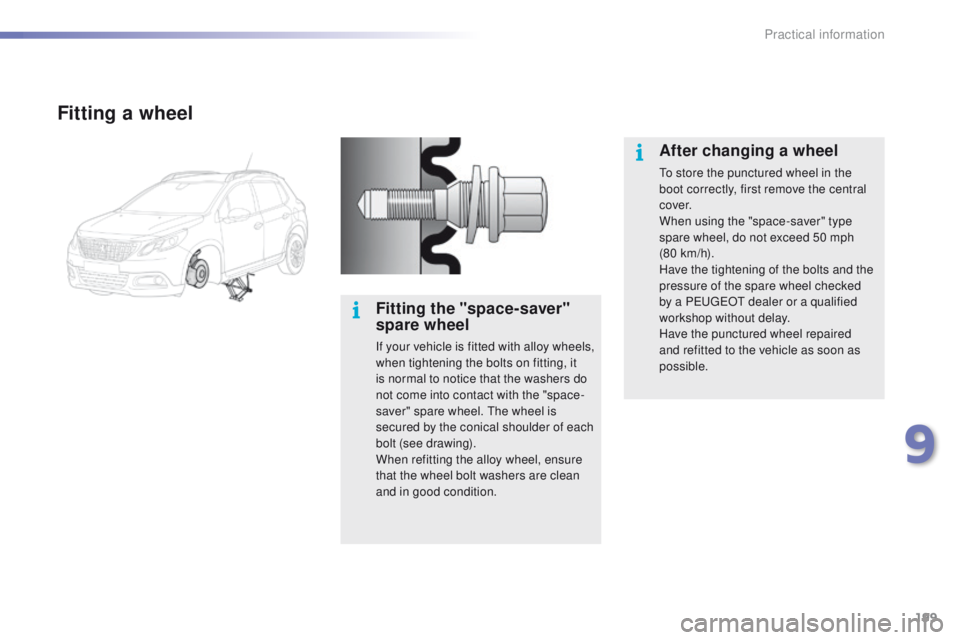
Fitting the "space-saver"
spare wheel
If your vehicle is fitted with alloy wheels,
when tightening the bolts on fitting, it
is normal to notice that the washers do
not come into contact with the "space-
saver" spare wheel. The wheel is
secured by the conical shoulder of each
bolt (see drawing).
When refitting the alloy wheel, ensure
that the wheel bolt washers are clean
and in good condition.
After changing a wheel
To store the punctured wheel in the
boot correctly, first remove the central
c ove r.
When using the "space-saver" type
spare wheel, do not exceed 50 mph
(80 km/h).
Have the tightening of the bolts and the
pressure of the spare wheel checked
by a PEUGEOT dealer or a qualified
workshop without delay.
Have the punctured wheel repaired
and refitted to the vehicle as soon as
possible.
9
Practical information
Page 202 of 450
200
2008_en_Chap09_info-pratiques_ed01-2016
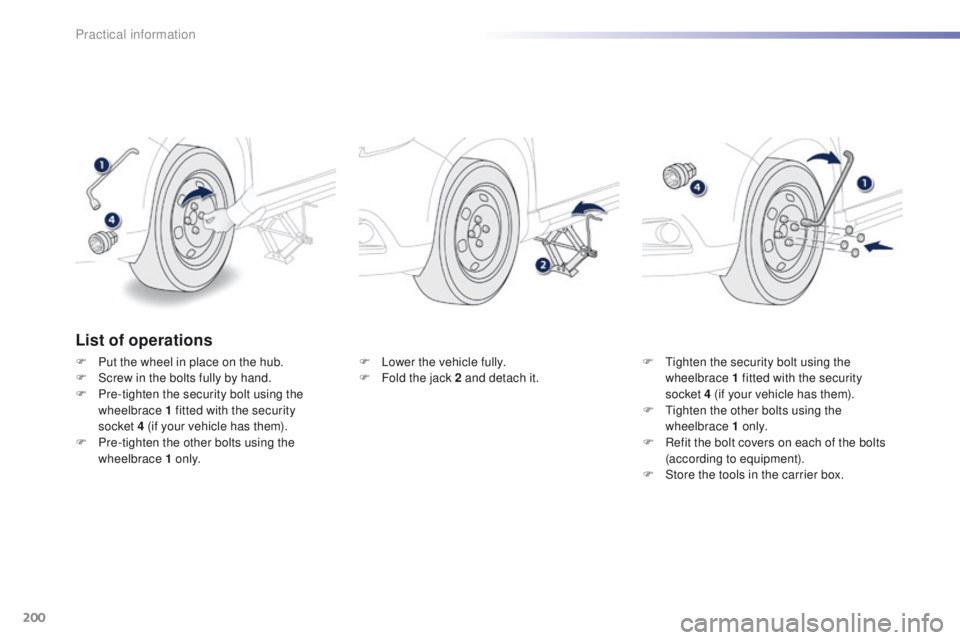
List of operations
F Put the wheel in place on the hub.
F S crew in the bolts fully by hand.
F
P
re-tighten the security bolt using the
wheelbrace 1 fitted with the security
socket
4 (if your vehicle has them).
F
P
re-tighten the other bolts using the
wheelbrace 1 o n l y. F
L ower the vehicle fully.
F F old the jack 2 and detach it.F
T ighten the security bolt using the
wheelbrace 1 fitted with the security
socket
4 (if your vehicle has them).
F
T
ighten the other bolts using the
wheelbrace 1 o n l y.
F
R
efit the bolt covers on each of the bolts
(according to equipment).
F
S
tore the tools in the carrier box.
Practical information
Page 203 of 450
201
2008_en_Chap09_info-pratiques_ed01-2016
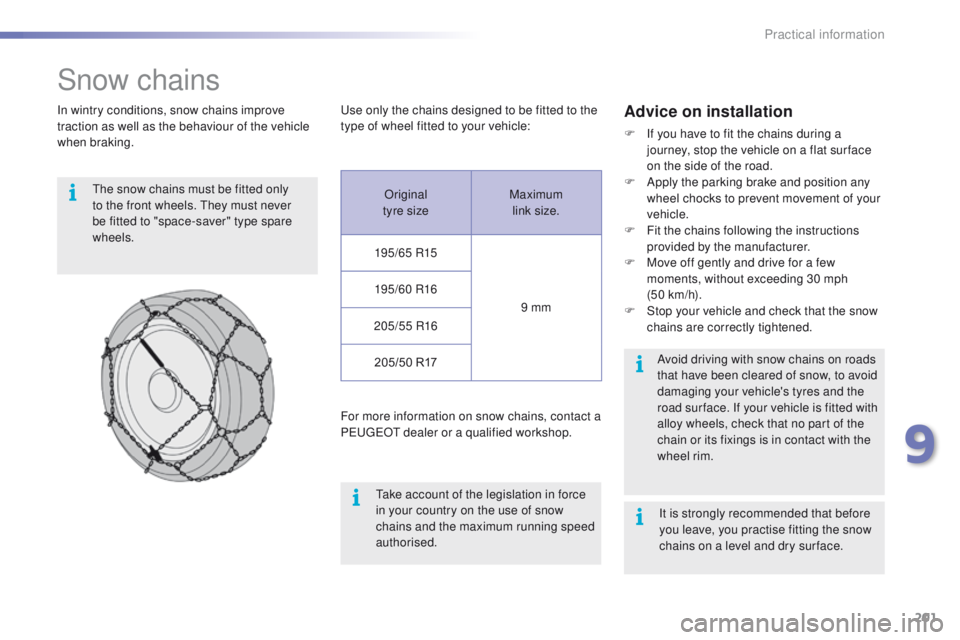
Snow chains
In wintry conditions, snow chains improve
traction as well as the behaviour of the vehicle
when braking.The snow chains must be fitted only
to the front wheels. They must never
be fitted to "space-saver" type spare
wheels.
Take account of the legislation in force
in your country on the use of snow
chains and the maximum running speed
authorised.
Use only the chains designed to be fitted to the
type of wheel fitted to your vehicle:
For more information on snow chains, contact a
PEUGEOT dealer or a qualified workshop.Advice on installation
F If you have to fit the chains during a
journey, stop the vehicle on a flat sur face
on the side of the road.
F
A
pply the parking brake and position any
wheel chocks to prevent movement of your
vehicle.
F
F
it the chains following the instructions
provided by the manufacturer.
F
M
ove off gently and drive for a few
moments, without exceeding 30 mph
(50
km/h).
F
S
top your vehicle and check that the snow
chains are correctly tightened.
Avoid driving with snow chains on roads
that have been cleared of snow, to avoid
damaging your vehicle's tyres and the
road sur face. If your vehicle is fitted with
alloy wheels, check that no part of the
chain or its fixings is in contact with the
wheel rim.
Original
tyre size Maximum
link size.
195/65 R15
9 mm
195/60 R16
205/55 R16 205/50 R17
It is strongly recommended that before
you leave, you practise fitting the snow
chains on a level and dry sur face.
9
Practical information
Page 217 of 450
215
2008_en_Chap09_info-pratiques_ed01-2016
Some functions, including Stop & Start,
are not available if the battery is not
sufficiently charged.
Starting using another
battery
When your vehicle's battery is discharged, the
engine can be started using a slave battery
(external or on another vehicle) and jump lead
cables or a battery booster.Never try to start the engine by
connecting a battery charger.
Never use a 24 V or higher battery
b o o s t e r.
First check that the slave battery has a
nominal voltage of 12 V and a capacity
at least equal to that of the discharged
battery.
The two vehicles must not be in contact
with each other.
Switch off the electrical consumers on
both vehicles (audio system, wipers,
lighting, ...).
Ensure that the jump lead cables do
not pass close to moving parts of the
engine (cooling fan, belts, ...).
Do not disconnect the (+) terminal when
the engine is running.
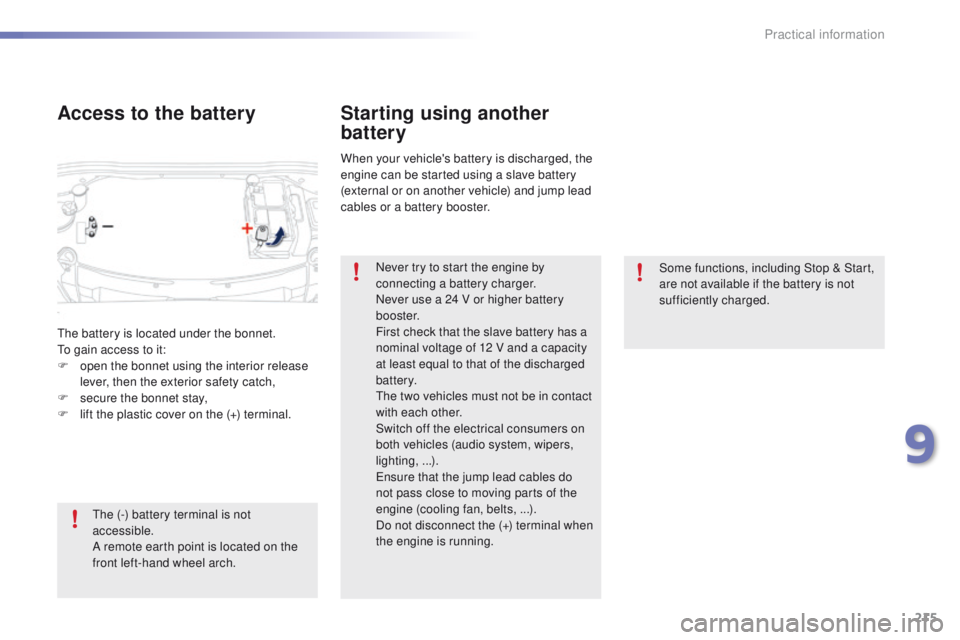
The battery is located under the bonnet.
To gain access to it:
F
o
pen the bonnet using the interior release
lever, then the exterior safety catch,
F
s
ecure the bonnet stay,
F
l
ift the plastic cover on the (+) terminal.
Access to the battery
The (-) battery terminal is not
accessible.
A remote earth point is located on the
front left-hand wheel arch.
9
Practical information
Page 223 of 450
221
2008_en_Chap09_info-pratiques_ed01-2016
To w i n g
To w i n g e y e
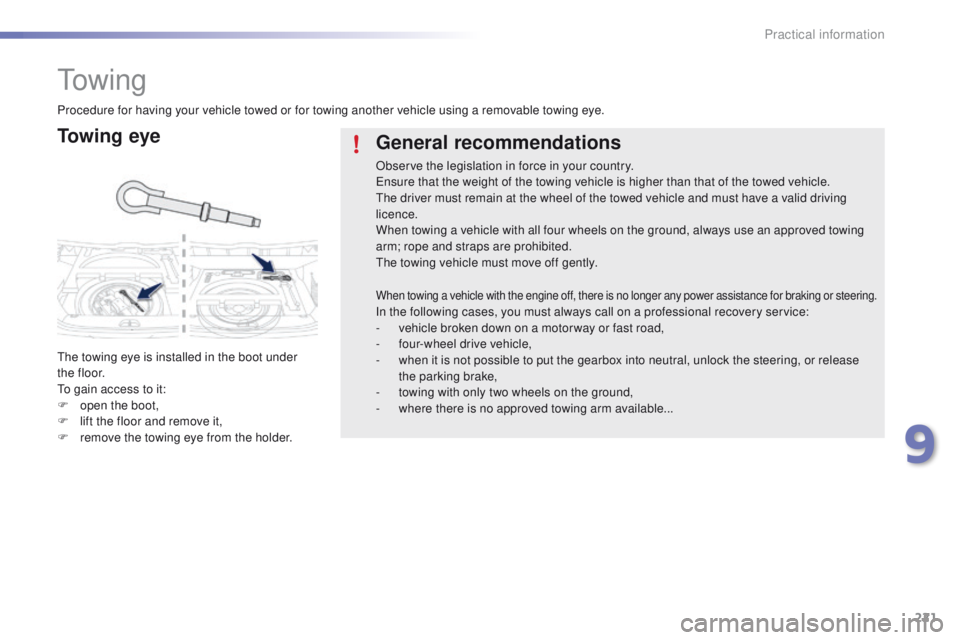
The towing eye is installed in the boot under
t h e f l o o r.
To gain access to it:
F
o
pen the boot,
F
l
ift the floor and remove it,
F
r
emove the towing eye from the holder.
General recommendations
Observe the legislation in force in your country.
Ensure that the weight of the towing vehicle is higher than that of the towed vehicle.
The driver must remain at the wheel of the towed vehicle and must have a valid driving
licence.
When towing a vehicle with all four wheels on the ground, always use an approved towing
arm; rope and straps are prohibited.
The towing vehicle must move off gently.
When towing a vehicle with the engine off, there is no longer any power assistance for braking or steering.In the following cases, you must always call on a professional recovery service:
- v ehicle broken down on a motor way or fast road,
-
f
our-wheel drive vehicle,
-
w
hen it is not possible to put the gearbox into neutral, unlock the steering, or release
the parking brake,
-
t
owing with only two wheels on the ground,
-
w
here there is no approved towing arm available...
Procedure for having your vehicle towed or for towing another vehicle using a removable towing eye.
9
Practical information
Page 227 of 450
225
2008_en_Chap09_info-pratiques_ed01-2016
Towbar with quickly detachable towball
Presentation
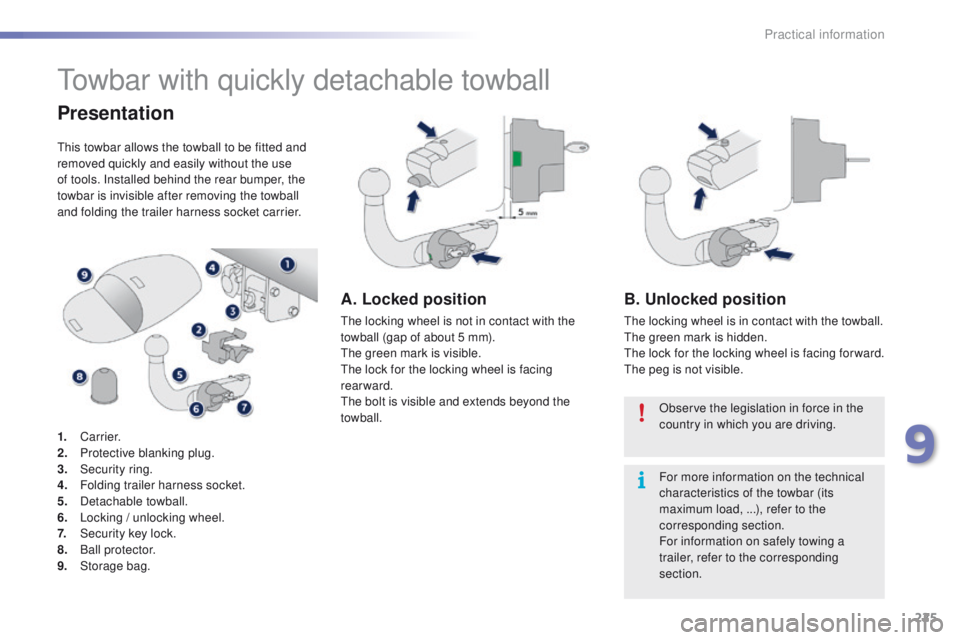
This towbar allows the towball to be fitted and
removed quickly and easily without the use
of tools. Installed behind the rear bumper, the
towbar is invisible after removing the towball
and folding the trailer harness socket carrier.
1.
Carrier.
2.
P
rotective blanking plug.
3.
S
ecurity ring.
4.
F
olding trailer harness socket.
5.
D
etachable towball.
6.
L
ocking / unlocking wheel.
7.
Sec
urity key lock.
8.
Ba
ll protector.
9.
St
orage bag.
A. Locked position
The locking wheel is not in contact with the
towball (gap of about 5 mm).
The green mark is visible.
The lock for the locking wheel is facing
rearward.
The bolt is visible and extends beyond the
towball.
B. Unlocked position
The locking wheel is in contact with the towball.
The green mark is hidden.
The lock for the locking wheel is facing for ward.
The peg is not visible. Observe the legislation in force in the
country in which you are driving.
For more information on the technical
characteristics of the towbar (its
maximum load, ...), refer to the
corresponding section.
For information on safely towing a
trailer, refer to the corresponding
section.
9
Practical information
Page 228 of 450
226
2008_en_Chap09_info-pratiques_ed01-2016
Fitting the towball
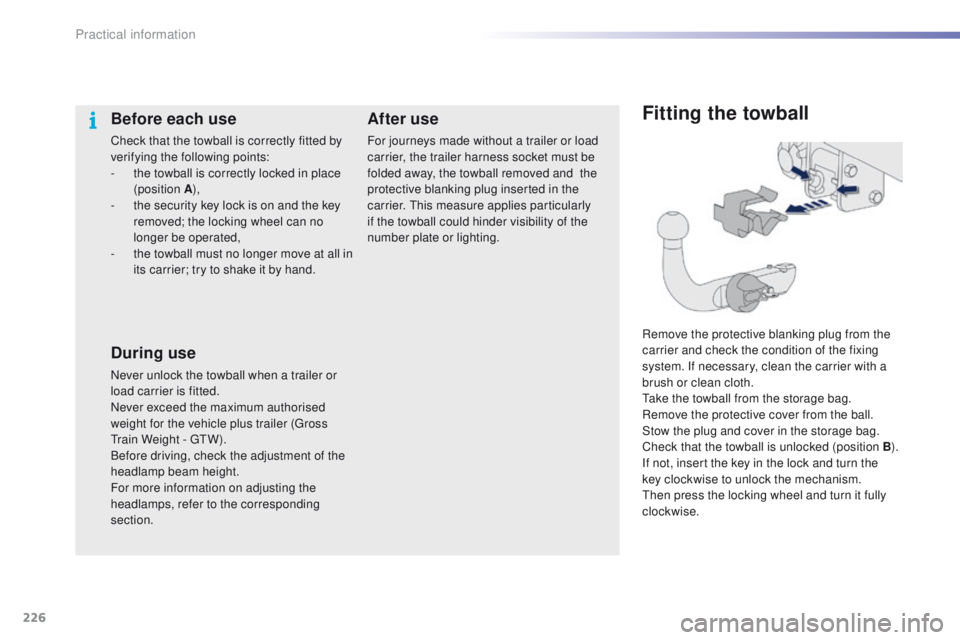
Remove the protective blanking plug from the
carrier and check the condition of the fixing
system. If necessary, clean the carrier with a
brush or clean cloth.
Take the towball from the storage bag.
Remove the protective cover from the ball.
Stow the plug and cover in the storage bag.
Check that the towball is unlocked (position B).
If not, insert the key in the lock and turn the
key clockwise to unlock the mechanism.
Then press the locking wheel and turn it fully
clockwise.
Before each use
Check that the towball is correctly fitted by
verifying the following points:
-
t
he towball is correctly locked in place
(position A ),
-
t
he security key lock is on and the key
removed; the locking wheel can no
longer be operated,
-
t
he towball must no longer move at all in
its carrier; try to shake it by hand.
During use
Never unlock the towball when a trailer or
load carrier is fitted.
Never exceed the maximum authorised
weight for the vehicle plus trailer (Gross
Train Weight - GTW).
Before driving, check the adjustment of the
headlamp beam height.
For more information on adjusting the
headlamps, refer to the corresponding
section.
After use
For journeys made without a trailer or load
carrier, the trailer harness socket must be
folded away, the towball removed and
the
protective blanking plug inserted in the
carrier. This measure applies particularly
if the towball could hinder visibility of the
number plate or lighting.
Practical information