steering PEUGEOT 207 2008 User Guide
[x] Cancel search | Manufacturer: PEUGEOT, Model Year: 2008, Model line: 207, Model: PEUGEOT 207 2008Pages: 255, PDF Size: 13.06 MB
Page 115 of 255
!
SAFETY
103
The ESP/ASR systems offer excep-
tional safety in normal driving, but
this should not encourage the driver
to take extra risks or drive at high
speed.
The correct functioning of these
systems depends on observation
of the manufacturer’s recommen-
dations regarding the wheels (tyres
and rims), the braking components,
the electronic components and the
PEUGEOT assembly and operation
procedures.
After an impact, have these systems
checked by a PEUGEOT dealer.
Disarming
In exceptional conditions (starting a
vehicle which is bogged down, stuck
in snow, on soft ground, ...), it may be
advisable to disarm the ASR and ESP
systems, so that the wheels can move
freely and regain grip.
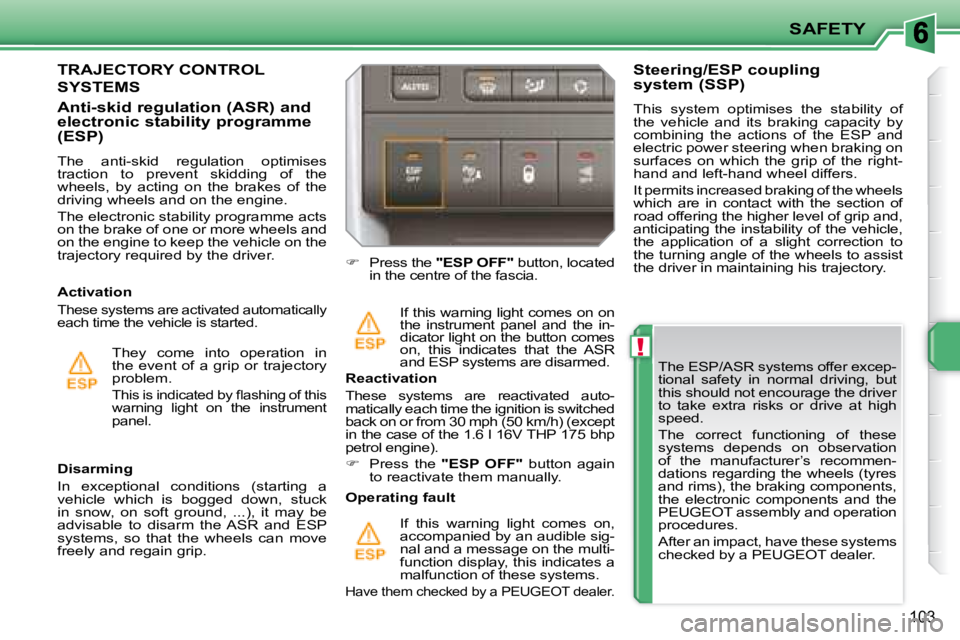
Press the "ESP OFF" button, located
in the centre of the fascia.
If this warning light comes on on
the instrument panel and the in-
dicator light on the button comes
on, this indicates that the ASR
and ESP systems are disarmed.
Reactivation
These systems are reactivated auto-
matically each time the ignition is switched
back on or from 30 mph (50 km/h) (except
in the case of the 1.6 l 16V THP 175 bhp
petrol engine).
Press the "ESP OFF" button again
to reactivate them manually.
Operating fault
If this warning light comes on,
accompanied by an audible sig-
nal and a message on the multi-
function display, this indicates a
malfunction of these systems.
Have them checked by a PEUGEOT dealer.
TRAJECTORY CONTROL
SYSTEMS
Activation
These systems are activated automatically
each time the vehicle is started.
Anti-skid regulation (ASR) and
electronic stability programme
(ESP)
The anti-skid regulation optimises
traction to prevent skidding of the
wheels, by acting on the brakes of the
driving wheels and on the engine.
The electronic stability programme acts
on the brake of one or more wheels and
on the engine to keep the vehicle on the
trajectory required by the driver.
They come into operation in
the event of a grip or trajectory
problem.
This is indicated by fl ashing of this
warning light on the instrument
panel.
Steering/ESP coupling
system (SSP)
This system optimises the stability of
the vehicle and its braking capacity by
combining the actions of the ESP and
electric power steering when braking on
surfaces on which the grip of the right-
hand and left-hand wheel differs.
It permits increased braking of the wheels
which are in contact with the section of
road offering the higher level of grip and,
anticipating the instability of the vehicle,
the application of a slight correction to
the turning angle of the wheels to assist
the driver in maintaining his trajectory.
Page 119 of 255
!
i
SAFETY
107
AIR BAGS The air bags do not operate
when the ignition is switched off.
This equipment will only operate
once. If a second impact occurs
(during the same or a subsequent
accident), the air bag will not operate.
Front air bags
System which protects the head and
chest of the driver and front passenger
in the event of a front impact.
The driver’s air bag is incorporated in the
centre of the steering wheel; the front
passenger’s air bag is incorporated in
the fascia above the glove box.
Activation
The air bags are triggered simultaneously,
unless the passenger’s front air bag is
disarmed, in the event of a serious front
impact applied to all or part of the front im-
pact zone A , in the longitudinal centreline
of the vehicle on a horizontal plane and
directed from the front to the rear of the
vehicle.
The front air bag infl ates between the front
occupant of the vehicle and the fascia to
cushion his forward movement.
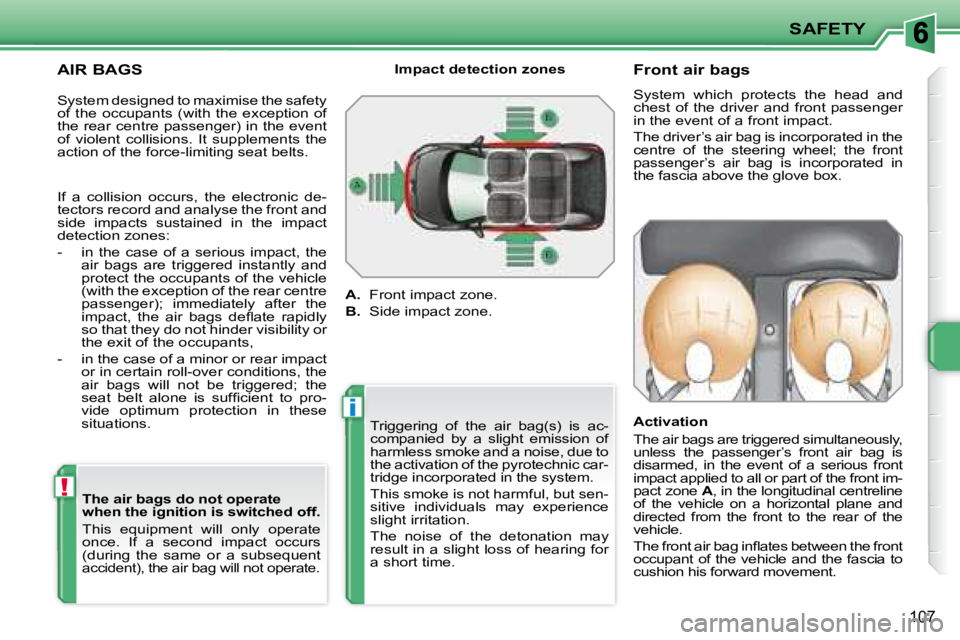
Impact detection zones
A. Front impact zone.
B. Side impact zone.
Triggering of the air bag(s) is ac-
companied by a slight emission of
harmless smoke and a noise, due to
the activation of the pyrotechnic car-
tridge incorporated in the system.
This smoke is not harmful, but sen-
sitive individuals may experience
slight irritation.
The noise of the detonation may
result in a slight loss of hearing for
a short time.
System designed to maximise the safety
of the occupants (with the exception of
the rear centre passenger) in the event
of violent collisions. It supplements the
action of the force-limiting seat belts.
If a collision occurs, the electronic de-
tectors record and analyse the front and
side impacts sustained in the impact
detection zones:
- in the case of a serious impact, the
air bags are triggered instantly and
protect the occupants of the vehicle
(with the exception of the rear centre
passenger); immediately after the
impact, the air bags defl ate rapidly
so that they do not hinder visibility or
the exit of the occupants,
- in the case of a minor or rear impact or in certain roll-over conditions, the
air bags will not be triggered; the
seat belt alone is suffi cient to pro-
vide optimum protection in these
situations.
Page 122 of 255
!
SAFETY
110
Front air bags
Do not drive holding the steering wheel by its spokes or resting your hands on
the centre part of the wheel.
Passengers must not place their feet on the fascia.
Smoke as little as possible as deployment of the air bags can ca use burns or
the risk of injury from a cigarette or pipe.
Never remove or pierce the steering wheel or hit it violently.
Side air bags *
Only put suitable covers on the seats. Consult a PEUGEOT deal er.
Do not fi x or glue anything to the seat backs. This could ca use injury to the
chest or arms when the side air bag infl ates.
Do not sit with the upper part of the body any nea rer to the door than necessary.
Curtain air bags *
Do not fi x or glue anything to the roof. This could cause injury to the head when
the curtain air bag infl ates.
Do not remove the grab handles installed on the ro of, they play a part in securing
the curtain air bags.
For the air bags to be fully
effective, observe the following
safety rules:
Sit in a normal upright position.
Wear a correctly adjusted seat belt.
Do not leave anything between the
occupants and the air bags (a child,
pet, object...). This could hamper the
operation of the air bags or injure the
occupants.
After an accident or if the vehicle has
been stolen or broken into, have the
air bag systems checked.
All work on the air bag system is strictly
forbidden unless it is carried out by quali-
fi ed personnel of the PEUGEOT net-
work.
Even if all of the precautions men-
tioned are observed, a risk of injury
or of minor burns to the head, chest
or arms when an air bag is triggered
cannot be ruled out. In fact, the bag
infl ates almost instantly (within a few
milliseconds) then defl ates within the
same time discharging the hot gas via
openings provided for this purpose.
Page 124 of 255
i
112
"2 TRONIC" GEARBOX
(SALOON)
Five-speed controlled manual gearbox
which offers a choice between the comfort
of automatic operation or the pleasure of
manual gear changing.
Three driving modes are offered:
- the automated mode for automatic
control of the gears by the gearbox,
- the sequential mode for manual
changing of the gears by the driver,
- the auto sequential mode for over-
taking, for example, remaining in
the automated mode while using the
functions of the sequential mode.
R. Reverse
With your foot on the brake, move
the lever upwards to select this posi-
tion.
N. Neutral.
With your foot on the brake, select
this position to start the engine.
A. Automated mode.
Move the lever downwards to select
this mode.
M. +/- Sequential mode with manual
gear changing.
Move the lever downwards, then to
the left to select this mode, then:
- push forwards to change up a gear,
- or push rearwards to change down a gear.
Gear lever
+. Change up control.
Press the back of the steering wheel
control "+" to change up a gear.
-. Change down control.
Press the back of the steering wheel
control "-" to change down a gear.
Steering wheel controls
The steering wheel controls do not
permit the selection of neutral or
the engaging and disengaging of
reverse gear.
Page 126 of 255
!
i
114
"Auto sequential" mode
In the automated mode, you can resume
control temporarily at any time using the
steering wheel controls.
The use of these controls permits man-
ual selection of the gears in situations
which require a more rapid change-down
than in the automated mode (arrival at
a roundabout, leaving a car park with a
steep gradient, overtaking...).
The gearbox engages the required gear if
the engine speed permits. AUTO remains
displayed on the instrument panel.
After a few minutes, the gearbox resumes
automatic control of the gears. "Snow" automated mode
In the automated mode, if the vehicle de-
tects poor grip, the gearbox will change
automatically to the "snow" automated
mode.
Stopping the vehicle
Before switching off the engine, you can
change to position
N to be in neutral.
In this case, it is imperative that you
apply the handbrake to immobilise the
vehicle.
Reinitialisation
Following disconnection of the battery,
the gearbox must be reinitialised.
Switch on the ignition. Operating fault
With the ignition on, if this warn-
ing light comes on and AUTO
fl ashes, accompanied by an au-
dible signal and a message on
the multifunction display, this indicates
a gearbox malfunction.
Have it checked by a PEUGEOT dealer.
It is compulsory to press the brake
pedal while starting the engine.
Never select neutral N while the
vehicle is moving.
Only engage reverse gear R when
the vehicle is immobilised, with
your foot on the brake pedal.
In all cases, it is imperative that you
apply the handbrake to immobilise
the vehicle.
If you press the accelerator pedal
beyond the point of resistance, the
gearbox selects the gear below to
permit sharper acceleration.
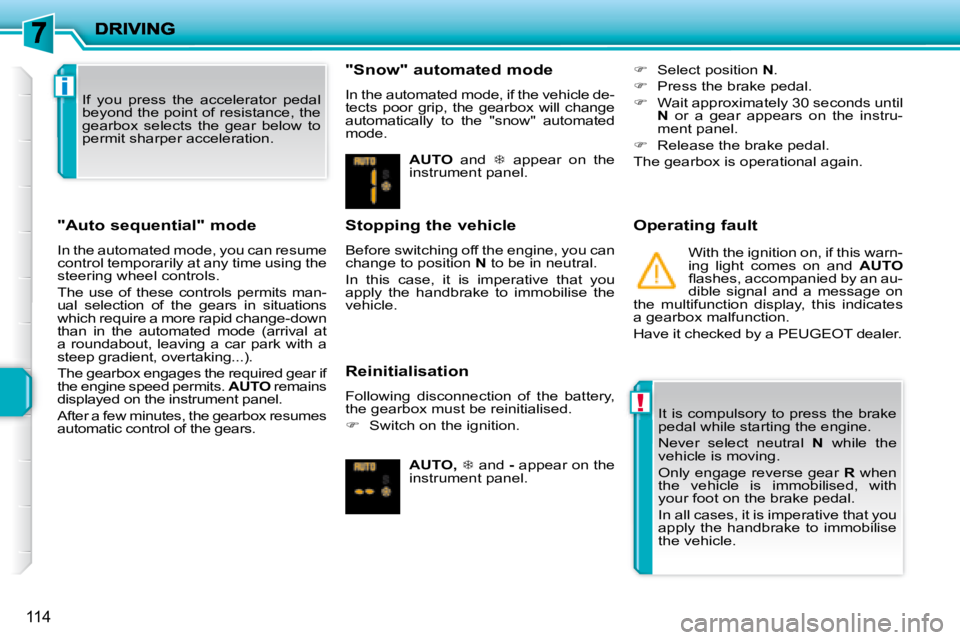
AUTO and appear on the
instrument panel.
AUTO, and - appear on the
instrument panel.
Select position N .
Press the brake pedal.
Wait approximately 30 seconds until
N or a gear appears on the instru-
ment panel.
Release the brake pedal.
The gearbox is operational again.
Page 130 of 255
i
118
SPEED LIMITER
System which prevents the vehicle from
exceeding the speed programmed by
the driver.
When the programmed speed limit is
reached, pressing the accelerator pedal
no longer has any effect.
The speed limiter is switched on man-
ually: it requires a programmed speed
of at least 20 mph (30 km/h).
The speed limiter is switched off by
manual operation of the control.
The programmed speed can be exceeded
temporarily by pressing the accelerator
fi rmly.
To return to the programmed speed,
simply slow down to a speed below the
programmed speed.
The programmed speed remains in the
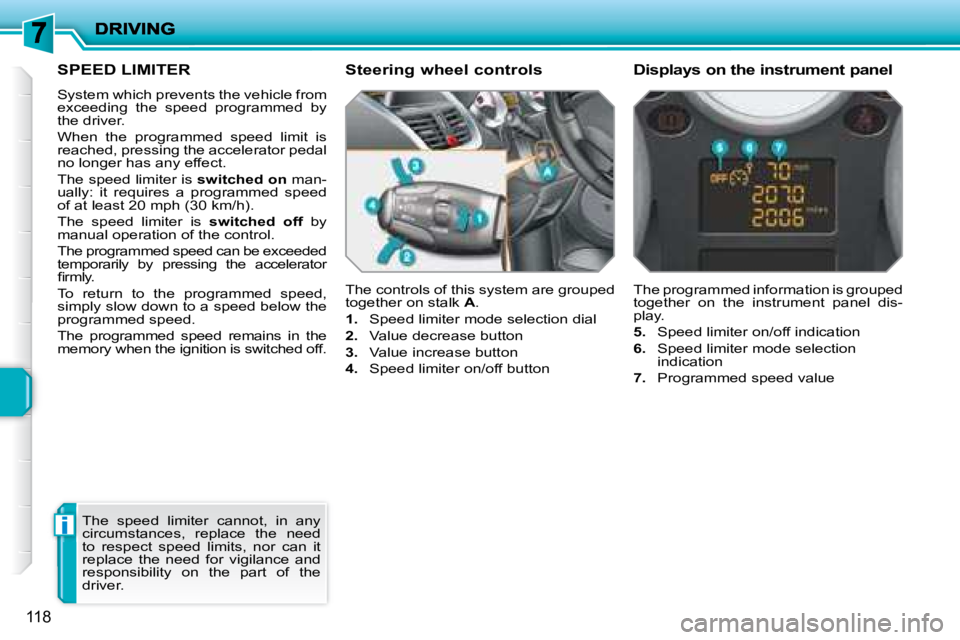
memory when the ignition is switched off. The controls of this system are grouped
together on stalk
A .
1. Speed limiter mode selection dial
2. Value decrease button
3. Value increase button
4. Speed limiter on/off button The programmed information is grouped
together on the instrument panel dis-
play.
5. Speed limiter on/off indication
6. Speed limiter mode selection
indication
7. Programmed speed value
Steering wheel controls Displays on the instrument
panel
The speed limiter cannot, in any
circumstances, replace the need
to respect speed limits, nor can it
replace the need for vigilance and
responsibility on the part of the
driver.
Page 132 of 255
i
120
CRUISE CONTROL
System which automatically maintains
the speed of the vehicle at the value
programmed by the driver, without any
action on the accelerator pedal.
The cruise control is switched on
manually: it requires a minimum vehicle
speed of 25 mph (40 km/h), as well as
the engaging:
- of fourth gear on the manual gear- box,
- of second gear with the "2 Tronic" or automatic gearbox, in sequential
mode,
- of position A on the "2 Tronic" gear-
box or D on the automatic gearbox.
The cruise control is switched off man-
ually or by pressing the brake or clutch
pedal or on triggering of the ESP sys-
tem for safety reasons.
It is possible to exceed the programmed
speed temporarily by pressing the ac-
celerator pedal.
To return to the programmed speed,
simply release the accelerator pedal.
Switching off the ignition cancels any
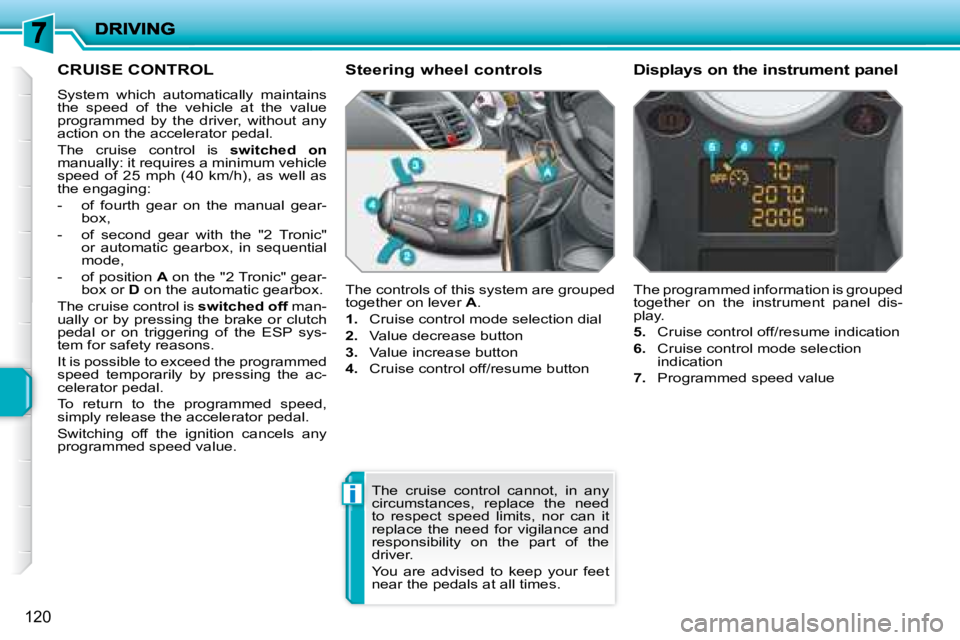
programmed speed value. The controls of this system are grouped
together on lever
A .
1. Cruise control mode selection dial
2. Value decrease button
3. Value increase button
4. Cruise control off/resume button The programmed information is grouped
together on the instrument panel dis-
play.
5. Cruise control off/resume indication
6. Cruise control mode selection
indication
7. Programmed speed value
Steering wheel controls Displays on the instrument
panel
The cruise control cannot, in any
circumstances, replace the need
to respect speed limits, nor can it
replace the need for vigilance and
responsibility on the part of the
driver.
You are advised to keep your feet
near the pedals at all times.
Page 156 of 255
144
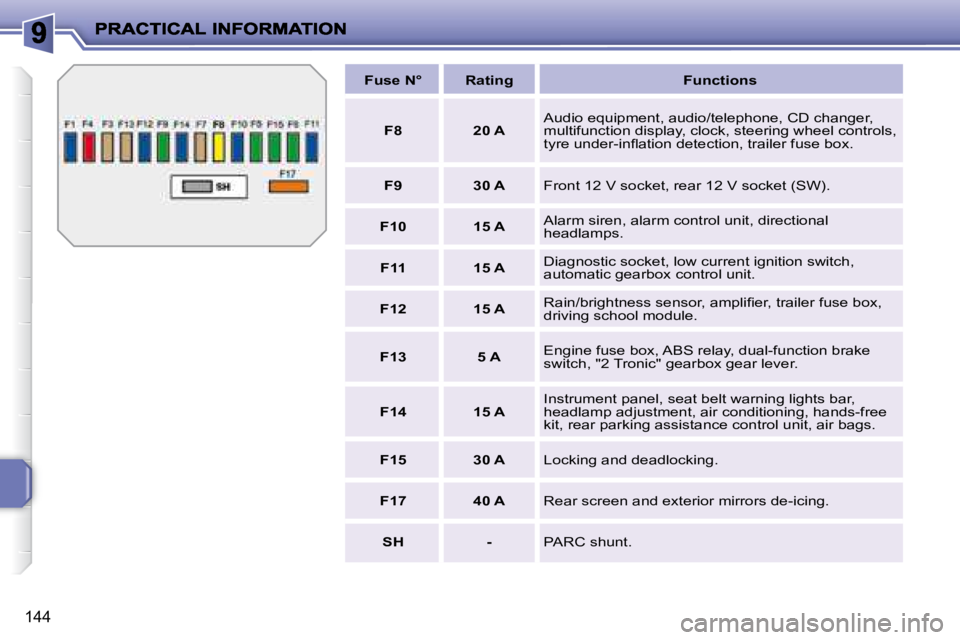
Fuse N° Rating Functions
F8 20 A Audio equipment, audio/telephone, CD changer,
multifunction display, clock, steering wheel controls,
tyre under-infl ation detection, trailer fuse box.
F9 30 A Front 12 V socket, rear 12 V socket (SW).
F10 15 A Alarm siren, alarm control unit, directional
headlamps.
F11 15 A Diagnostic socket, low current ignition switch,
automatic gearbox control unit.
F12 15 A Rain/brightness sensor, amplifi er, trailer fuse box,
driving school module.
F13 5 A Engine fuse box, ABS relay, dual-function brake
switch, "2 Tronic" gearbox gear lever.
F14 15 A Instrument panel, seat belt warning lights bar,
headlamp adjustment, air conditioning, hands-free
kit, rear parking assistance control unit, air bags.
F15 30 A Locking and deadlocking.
F17 40 A Rear screen and exterior mirrors de-icing.
SH - PARC shunt.
Page 157 of 255
145
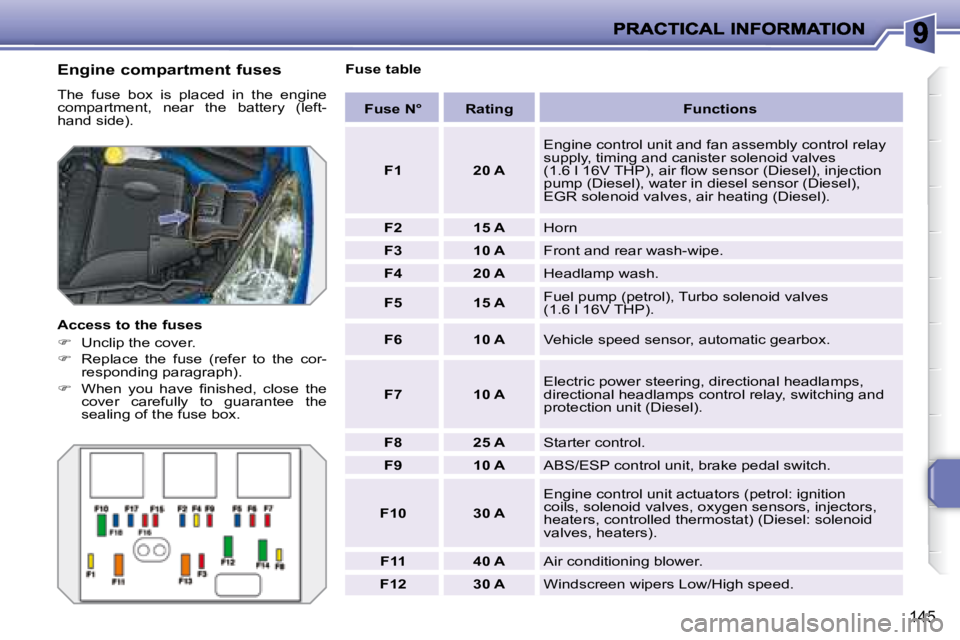
Engine compartment fuses
The fuse box is placed in the engine
compartment, near the battery (left-
hand side).
Access to the fuses
Unclip the cover.
Replace the fuse (refer to the cor-
responding paragraph).
When you have fi nished, close the
cover carefully to guarantee the
sealing of the fuse box. Fuse table
Fuse N° Rating Functions
F1 20 A Engine control unit and fan assembly control relay
supply, timing and canister solenoid valves
(1.6 l 16V THP), air fl ow sensor (Diesel), injection
pump (Diesel), water in diesel sensor (Diesel),
EGR solenoid valves, air heating (Diesel).
F2 15 A Horn
F3 10 A Front and rear wash-wipe.
F4 20 A Headlamp wash.
F5 15 A Fuel pump (petrol), Turbo solenoid valves
(1.6 l 16V THP).
F6 10 A Vehicle speed sensor, automatic gearbox.
F7 10 A Electric power steering, directional headlamps,
directional headlamps control relay, switching and
protection unit (Diesel).
F8 25 A Starter control.
F9 10 A ABS/ESP control unit, brake pedal switch.
F10 30 A Engine control unit actuators (petrol: ignition
coils, solenoid valves, oxygen sensors, injectors,
heaters, controlled thermostat) (Diesel: solenoid
valves, heaters).
F11 40 A Air conditioning blower.
F12 30 A Windscreen wipers Low/High speed.
Page 158 of 255
146
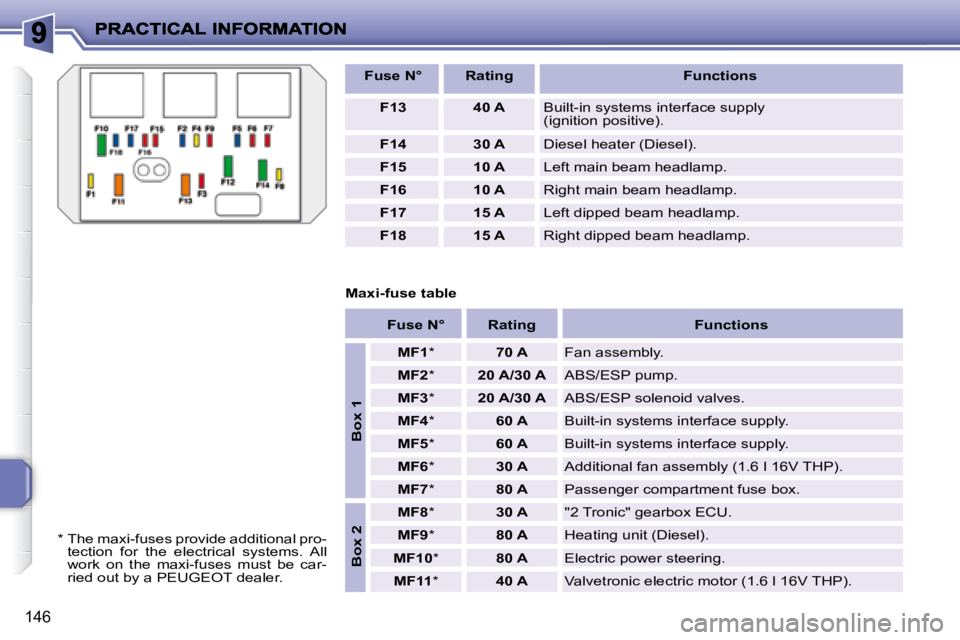
Fuse N° Rating Functions
F13 40 A Built-in systems interface supply
(ignition positive).
F14 30 A Diesel heater (Diesel).
F15 10 A Left main beam headlamp.
F16 10 A Right main beam headlamp.
F17 15 A Left dipped beam headlamp.
F18 15 A Right dipped beam headlamp.
* The maxi-fuses provide additional pro- tection for the electrical systems. All
work on the maxi-fuses must be car-
ried out by a PEUGEOT dealer. Maxi-fuse table
Fuse N° Rating Functions
Box 1
MF1 * 70 A Fan assembly.
MF2 * 20 A/30 A ABS/ESP pump.
MF3 * 20 A/30 A ABS/ESP solenoid valves.
MF4 * 60 A Built-in systems interface supply.
MF5 * 60 A Built-in systems interface supply.
MF6 * 30 A Additional fan assembly (1.6 l 16V THP).
MF7 * 80 A Passenger compartment fuse box.
Box 2
MF8 * 30 A "2 Tronic" gearbox ECU.
MF9 * 80 A Heating unit (Diesel).
MF10 * 80 A Electric power steering.
MF11 * 40 A Valvetronic electric motor (1.6 l 16V THP).