light PEUGEOT 207 2011 Owner's Guide
[x] Cancel search | Manufacturer: PEUGEOT, Model Year: 2011, Model line: 207, Model: PEUGEOT 207 2011Pages: 248, PDF Size: 8.61 MB
Page 105 of 248
6
i
!
!
SAFETY
103
BRAKING ASSISTANCE
SYSTEMS *
Group of supplementary systems which
help you to obtain optimum braking in
complete safety in emergency situations:
- anti-lock braking system (ABS),
- electronic brake force distribution
(EBFD),
- emergency braking assistance (EBA).
Anti-lock braking system
and electronic brake force
distribution
Linked systems which improve the sta-
bility and manoeuvrability of your vehi-
cle when braking, in particular on poor
or slippery surfaces.
When braking in an emergency,
press very fi rmly without releasing
the pressure.
Emergency braking assistance
System which, in an emergency, en-
ables you to obtain the optimum braking
pressure more quickly, thus reducing
the stopping distance.
Activation
The anti-lock braking system comes
into operation automatically when there
is a risk of wheel lock.
Normal operation of the ABS may make
itself felt by slight vibration of the brake
pedal.
Activation
It is triggered by the speed at which the
brake pedal is pressed.
The effect of this is a reduction in the
resistance of the pedal and an increase
in braking effi ciency.
*
According to country. When braking in an emergency,
press fi rmly without releasing the
pressure.
Operating fault
If this warning lamp comes on,
accompanied by an audible sig-
nal and a message in the mul-
tifunction screen, it indicates a
malfunction of the anti-lock braking sys-
tem which could result in loss of control
of the vehicle when braking.
If this warning lamp comes on,
together with the STOP
and
ABS
warning lamps, accompa-
nied by an audible signal and a
message in the multifunction screen, it
indicates a malfunction of the electron-
ic brake force distribution which could
result in loss of control of the vehicle
when braking.
You must stop as soon as it is safe
to do so.
In either case, contact a PEUGEOT
dealer or a qualifi ed workshop.
When replacing wheels (tyres and
rims), ensure that they conform to
the manufacturer's recommenda-
tions.
Page 106 of 248
6
!
SAFETY
104
The ESP/ASR systems offer ex-
ceptional safety in normal driving,
but this should not encourage the
driver to take extra risks or drive at
high speed.
The correct functioning of these
systems depends on observation
of the manufacturer's recommen-
dations on:
- wheels (tyres and rims),
- braking system components,
- electronic components,
- assembly and repair proce-
dures.
After an impact, have these sys-
tems checked by a PEUGEOT
dealer or a qualifi ed workshop.
Deactivation
In exceptional conditions (starting a
vehicle which is bogged down, stuck
in snow, on soft ground, ...), it may be
advisable to disarm the ASR and ESP
systems, so that the wheels can move
freely and regain grip.
)
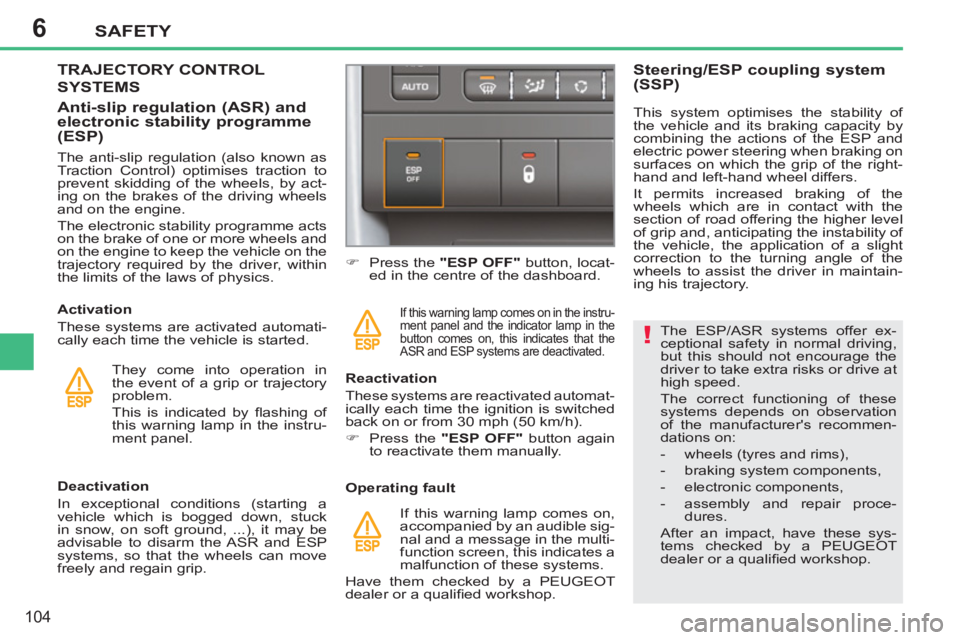
Press the "ESP OFF"
button, locat-
ed in the centre of the dashboard.
If this warning lamp comes on in the instru-
ment panel and the indicator lamp in the
button comes on, this indicates that the
ASR and ESP systems are deactivated.
Reactivation
These systems are reactivated automat-
ically each time the ignition is switched
back on or from 30 mph (50 km/h).
)
Press the "ESP OFF"
button again
to reactivate them manually.
TRAJECTORY CONTROL
SYSTEMS
Activation
These systems are activated automati-
cally each time the vehicle is started.
Anti-slip regulation (ASR) and
electronic stability programme
(ESP)
They come into operation in
the event of a grip or trajectory
problem.
This is indicated by fl ashing of
this warning lamp in the instru-
ment panel.
Steering/ESP coupling system
(SSP)
The anti-slip regulation (also known as
Traction Control) optimises traction to
prevent skidding of the wheels, by act-
ing on the brakes of the driving wheels
and on the engine.
The electronic stability programme acts
on the brake of one or more wheels and
on the engine to keep the vehicle on the
trajectory required by the driver, within
the limits of the laws of physics.
This system optimises the stability of
the vehicle and its braking capacity by
combining the actions of the ESP and
electric power steering when braking on
surfaces on which the grip of the right-
hand and left-hand wheel differs.
It permits increased braking of the
wheels which are in contact with the
section of road offering the higher level
of grip and, anticipating the instability of
the vehicle, the application of a slight
correction to the turning angle of the
wheels to assist the driver in maintain-
ing his trajectory.
Operating fault
If this warning lamp comes on,
accompanied by an audible sig-
nal and a message in the multi-
function screen, this indicates a
malfunction of these systems.
Have them checked by a PEUGEOT
dealer or a qualifi ed workshop.
Page 109 of 248
6
i
SAFETY
107
The driver must ensure that the
passengers use the seat belts cor-
rectly and that they are all properly
restrained before setting off.
Wherever you are seated in the ve-
hicle, always fasten your seat belt,
even for short journeys.
Do not invert the seat belt buckles
as they will not fulfi l their role fully.
If the seats have armrests * , the lap
part of the seat belt must always
pass under the armrest.
The seat belts are fi tted with an in-
ertia reel permitting automatic ad-
justment of the length of the strap
to your size. The seat belt is stored
automatically when not in use.
Before and after use, ensure that
the seat belt is reeled in correctly.
The lower part of the strap must be
positioned as low as possible on
the pelvis.
The upper part must be positioned
in the hollow of the shoulder.
The inertia reels are fi tted with an
automatic locking device which
comes into operation in the event of
a collision, on emergency braking
or if the vehicle rolls over. You can
release the device by pulling rapidly
on the strap and releasing it.
*
According to model. In order to be effective, a seat belt:
- must be tightened as close to the
body as possible,
- must restrain one adult only,
- must not bear any trace of cuts or
fraying,
- must be pulled in front of you with a
smooth movement, checking that it
does not twist,
- must not be transformed or modifi ed
to avoid altering its performance.
In accordance with current safety regu-
lations, all repairs and checks must be
carried out by a PEUGEOT dealer who
can guarantee that the work is carried
out correctly, or qualifi ed workshop.
Have your seat belts checked regularly
by a PEUGEOT dealer or a qualifi ed
workshop and particularly if the straps
show signs of damage.
Clean the seat belt straps with soapy
water or a textile cleaning product, sold
by PEUGEOT dealers.
After folding or moving a seat or rear
bench seat, ensure that the seat belt is
positioned and rolled up correctly.
Recommendations for children:
- use a suitable child seat if the pas-
senger is less than 12 years old or
shorter than one metre fi fty,
- do not use the strap-guide * when
a child seat is installed,
- never use the same seat belt to
secure more than one person,
- never allow a child to travel on
your lap.
Depending on the nature and se-
riousness of the impacts
, the pre-
tensioning device may be triggered
before and independently of the air-
bags. Triggering of the pre-tensioners
is accompanied by a slight emission of
harmless smoke and a noise, due to
the activation of the pyrotechnic car-
tridge incorporated in the system.
In all cases, the airbag warning lamp
comes on.
Following an impact, have the seat
belts system checked, and if neces-
sary replaced, by a PEUGEOT dealer
or a qualifi ed workshop.
Page 110 of 248
6
i
!
SAFETY
108
AIRBAGS
The airbags do not operate when
the ignition is switched off.
This equipment will only operate
once. If a second impact occurs (dur-
ing the same or a subsequent acci-
dent), the airbag will not operate.
Front airbags
System which protects the head and
chest of the driver and front passenger
in the event of a front impact.
The driver's airbag is fi tted in the centre
of the steering wheel; the front passen-
ger's airbag is fi tted in the dashboard
above the glove box.
Operation
The airbags are deployed simultane-
ously, unless the passenger's front
airbag is deactivated, in the event of a
serious front impact applied to all or part
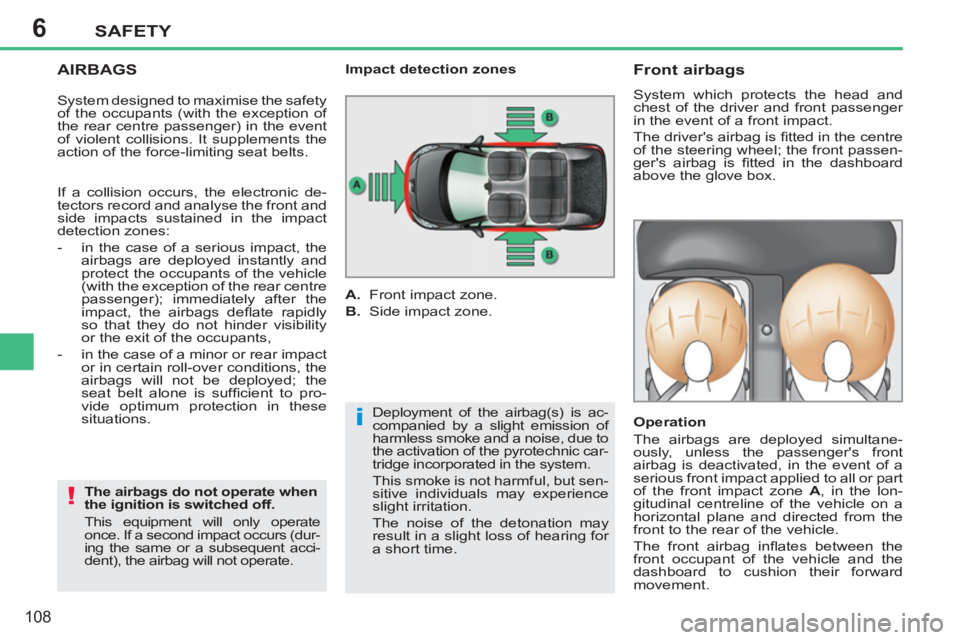
of the front impact zone A
, in the lon-
gitudinal centreline of the vehicle on a
horizontal plane and directed from the
front to the rear of the vehicle.
The front airbag infl ates between the
front occupant of the vehicle and the
dashboard to cushion their forward
movement.
Impact detection zones
A.
Front impact zone.
B.
Side impact zone.
Deployment of the airbag(s) is ac-
companied by a slight emission of
harmless smoke and a noise, due to
the activation of the pyrotechnic car-
tridge incorporated in the system.
This smoke is not harmful, but sen-
sitive individuals may experience
slight irritation.
The noise of the detonation may
result in a slight loss of hearing for
a short time.
System designed to maximise the safety
of the occupants (with the exception of
the rear centre passenger) in the event
of violent collisions. It supplements the
action of the force-limiting seat belts.
If a collision occurs, the electronic de-
tectors record and analyse the front and
side impacts sustained in the impact
detection zones:
- in the case of a serious impact, the
airbags are deployed instantly and
protect the occupants of the vehicle
(with the exception of the rear centre
passenger); immediately after the
impact, the airbags defl ate rapidly
so that they do not hinder visibility
or the exit of the occupants,
- in the case of a minor or rear impact
or in certain roll-over conditions, the
airbags will not be deployed; the
seat belt alone is suffi cient to pro-
vide optimum protection in these
situations.
Page 113 of 248
6
!
SAFETY
111
Front airbags
Do not drive holding the steering wheel by its spokes or resting your hands on the
centre part of the wheel.
Passengers must not place their feet on the dashboard.
Smoke as little as possible as deployment of the airbags can cause burns or the
risk of injury from a cigarette or pipe.
Never remove or pierce the steering wheel or hit it violently.
Lateral airbags *
Only put approved covers on the seats, compatible with deployment of the lateral air-
bags. To see the range of compatible seat covers for your vehicle, visit a PEUGEOT
dealer (see "Practical information § Accessories").
Do not fi x or attach anything to the seat backs. This could cause injury to the chest
or arms when the lateral airbag infl ates.
Do not sit with the upper part of the body any nearer to the door than necessary.
Curtain airbags *
Do not fi x or attach anything to the roof. This could cause injury to the head when
the curtain airbag infl ates.
Do not remove the grab handles installed on the roof, they play a part in securing
the curtain airbags.
For the airbags to be fully
effective, observe the following
safety rules:
Sit in a normal upright position.
Wear a correctly adjusted seat belt.
Do not leave anything between the
occupants and the airbags (a child,
pet, object...). This could hamper
the operation of the airbags or in-
jure the occupants.
After an accident or if the vehicle
has been stolen or broken into,
have the airbag systems checked.
All work on the airbag system must
be carried out by a PEUGEOT deal-
er or a qualifi ed workshop.
Even if all of the precautions men-
tioned above are observed, a risk of
injury or of slight burns to the head,
chest or arms when an airbag is de-
ployed cannot be ruled out. In fact,
the bag infl ates almost instantly
(within a few milliseconds) then
defl ates within the same time dis-
charging hot gas via the openings
provided for this purpose.
*
According to country.
Page 118 of 248
7
i!
DRIVING
116
Stopping the vehicle
Before switching off the engine, you
can engage position P
or N
to place the
gearbox in neutral.
In both cases, apply the parking brake
to immobilise the vehicle.
Operating fault
When the ignition is on, the
lighting of this warning lamp,
accompanied by an audible
signal and a message in the
multifunction screen, indicates a gear-
box fault.
In this case, the gearbox switches to
back-up mode and is locked in 3rd gear.
You may feel a substantial knock when
changing from P
to R
and from N
to R
.
This will not cause any damage to the
gearbox.
Do not exceed 60 mph (100 km/h), local
speed restrictions permitting.
Contact a PEUGEOT dealer or a quali-
fi ed workshop as soon as possible.
There is a risk of damage to the
gearbox:
- if you press the accelerator and
brake pedals at the same time,
- if you force the movement of
the gear lever from the P
po-
sition to another position when
the battery is fl at.
To reduce fuel consumption when
at a prolonged standstill with the
engine running (traffi c jam...), put
the gear lever in the N
position and
apply the parking brake.
Manual operation
)
Select position M
for sequential
changing of the four gears.
)
Push the lever towards the +
sign to
change up a gear.
)
Pull the lever towards the -
sign to
change down a gear.
D
disappears and the gears
engaged appear in succes-
sion on the instrument panel.
If the engine speed is too low
or too high, the gear selected
fl ashes for a few seconds, then the ac-
tual gear engaged is displayed.
It is possible to change from position D
(automatic) to position M
(manual) at
any time.
When the vehicle is stationary or mov-
ing very slowly, the gearbox selects
gear M1
automatically.
The sport and snow programmes do not
operate in manual mode. If the lever is not in position P
,
when the driver's door is opened
or approximately 45 seconds after
the ignition is switched off, a mes-
sage appears in the multifunction
screen.
)
Return the lever to position P
;
the message disappears.
It is only possible to change from one
gear to another if the vehicle speed and
engine speed permit; otherwise, the
gearbox will operate temporarily in au-
tomatic mode.
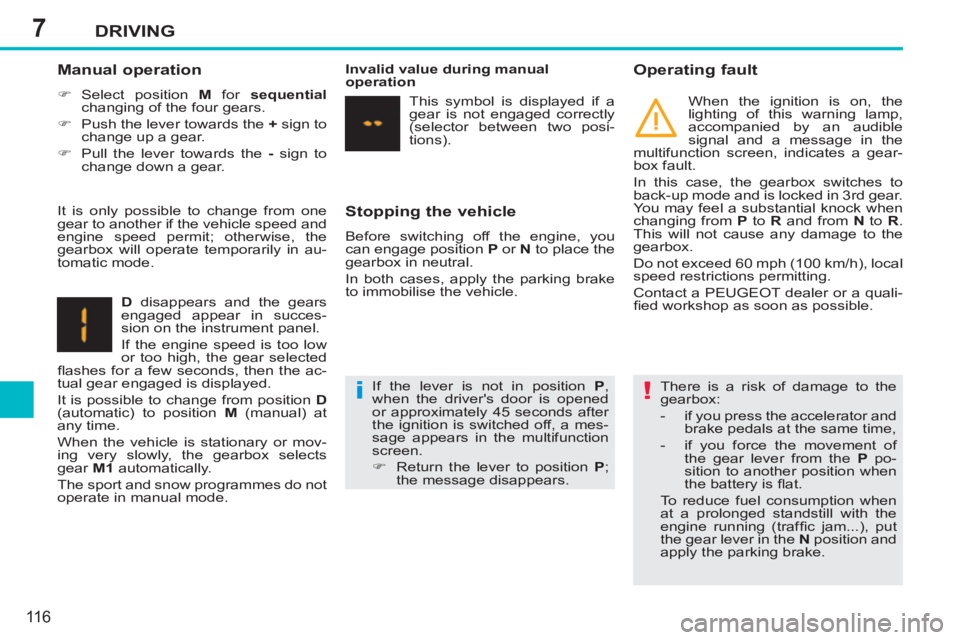
Invalid value during manual
operation
This symbol is displayed if a
gear is not engaged correctly
(selector between two posi-
tions).
Page 131 of 248
8
!
CHECKS
129
To avoid any risk of scalding, unscrew
the cap by two turns to allow the pres-
sure to drop. When the pressure has
dropped, remove the cap and top up
the level.
Coolant level
The coolant level should be close
to the "MAX" mark but should nev-
er exceed it.
When the engine is warm, the tem-
perature of the coolant is regulated by the
fan. This can operate with the ignition off.
On vehicles which are fi tted with a par-
ticle emission fi lter, the fan may operate
after the vehicle has been switched off,
even if the engine is cold.
In addition, as the cooling system is pres-
surised, wait at least one hour after switch-
ing off the engine before carrying out any
work.
Screenwash and headlamp
wash * fluid
The minimum level of this fl uid
is indicated by an audible sig-
nal and a message on the mul-
tifunction screen.
Top up the level when you stop the
vehicle.
*
According to country.
Changing the coolant
The coolant does not have to be
changed.
Fluid specifi cation
The coolant must conform to the manu-
facturer's recommendations.
Fluid specifi cation
To guarantee optimum cleaning and
avoid freezing, plain water should not
be used to top up or replace this fl uid.
Avoid any prolonged contact of
used oil or fl uids with the skin.
Most of these fl uids are harmful to
health or indeed very corrosive.
Do not discard used oil or fl uids
into sewers or onto the ground.
Take used oil to a PEUGEOT
dealer or a qualifi ed workshop
(France) or an authorised waste
disposal site.
Diesel additive level (Diesel with
particle emission filter)
The minimum level of this additive is in-
dicated by lighting of the service warn-
ing lamp, accompanied by an audible
signal and a message on the multifunc-
tion screen.
Used products
Topping up
This additive must be topped up by a
PEUGEOT dealer or a qualifi ed work-
shop without delay.
Page 151 of 248
9PRACTICAL INFORMATION
149
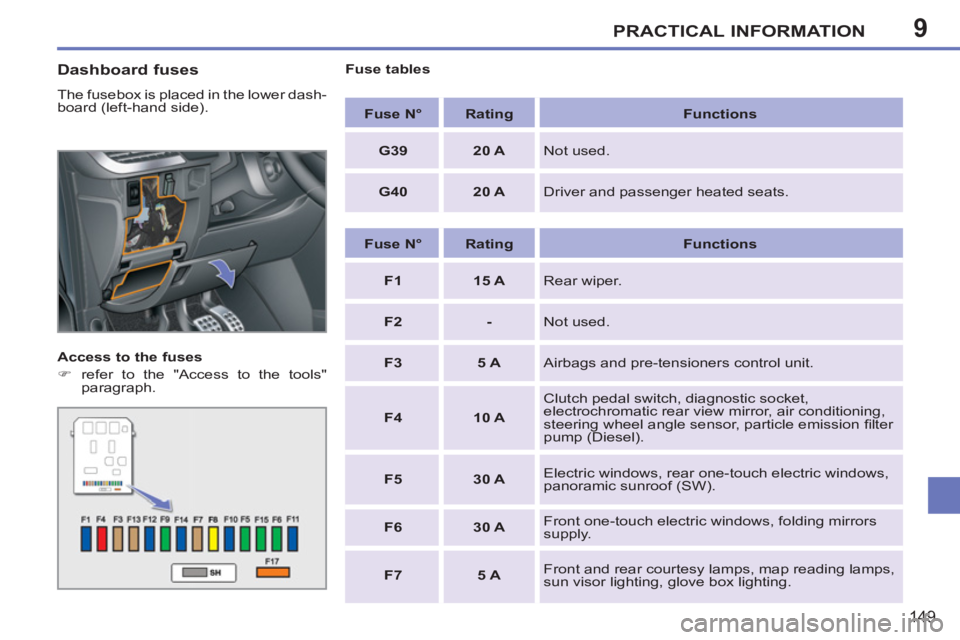
Dashboard fuses
The fusebox is placed in the lower dash-
board (left-hand side).
Access to the fuses
)
refer to the "Access to the tools"
paragraph.
Fuse tables
Fuse N°
Rating
Functions
G39
20 A
Not used.
G40
20 A
Driver and passenger heated seats.
Fuse N°
Rating
Functions
F1
15 A
Rear wiper.
F2
-
Not used.
F3
5 A
Airbags and pre-tensioners control unit.
F4
10 A
Clutch pedal switch, diagnostic socket,
electrochromatic rear view mirror, air conditioning,
steering wheel angle sensor, particle emission fi lter
pump (Diesel).
F5
30 A
Electric windows, rear one-touch electric windows,
panoramic sunroof (SW).
F6
30 A
Front one-touch electric windows, folding mirrors
supply.
F7
5 A
Front and rear courtesy lamps, map reading lamps,
sun visor lighting, glove box lighting.
Page 156 of 248
9
!
i
i
PRACTICAL INFORMATION
154
Do not charge the batteries with-
out disconnecting the terminals
fi rst.
Do not disconnect the terminals
while the engine is running.
The batteries contain harmful sub-
stances such as sulphuric acid
and lead. They must be disposed
of in accordance with regulations
and must not, in any circumstanc-
es, be discarded with household
waste.
Take used remote control batteries
and vehicle batteries to a special col-
lection point.
Charging the battery using a
battery charger
)
Disconnect the battery from the vehicle.
)
Follow the instructions for use pro-
vided by the manufacturer of the
charger.
)
Reconnect starting with the negative
terminal (-).
)
Check that the terminals and connec-
tors are clean. If they are covered with
sulphate (whitish or greenish deposit),
remove them and clean them.
It is advisable to disconnect the
battery if the vehicle is to be left
unused for more than one month.
Before disconnecting the
battery
Wait 2 minutes after switching off
the ignition before disconnecting
the battery.
Close the windows and the doors
before disconnecting the battery.
Following reconnection of the
battery
Following reconnection of the bat-
tery, switch on the ignition and wait
1 minute before starting to permit
initialisation of the electronic sys-
tems. However, if slight diffi cul-
ties are encountered following this
operation, contact a PEUGEOT
dealer or a qualifi ed workshop.
Referring to the corresponding
section, you must yourself reini-
tialise:
- the remote control key,
- the one-touch electric windows,
- the GPS satellite navigation
system.
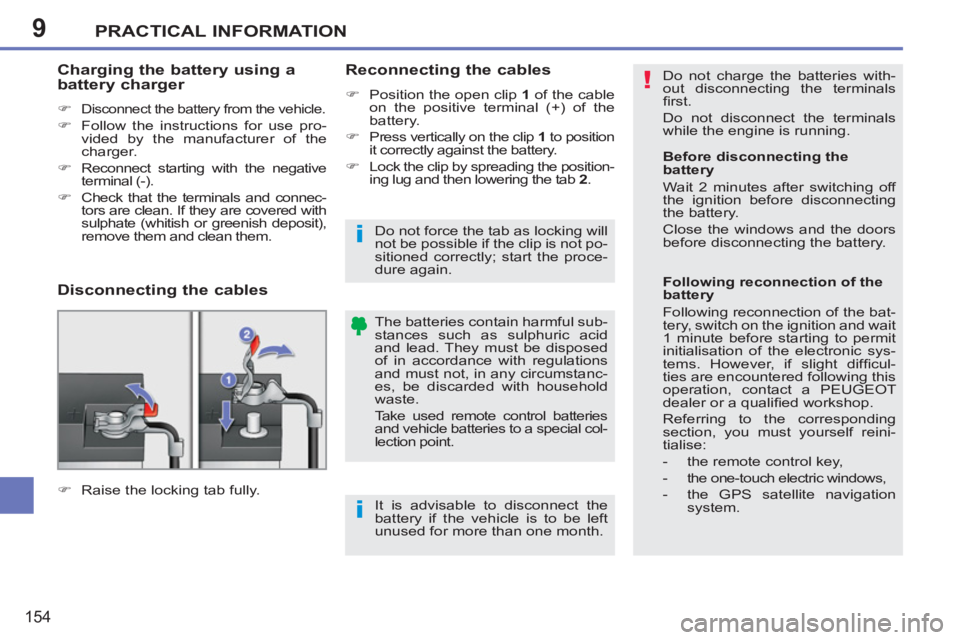
Disconnecting the cables
Reconnecting the cables
)
Position the open clip 1
of the cable
on the positive terminal (+) of the
battery.
)
Press vertically on the clip 1
to position
it correctly against the battery.
)
Lock the clip by spreading the position-
ing lug and then lowering the tab 2
.
)
Raise the locking tab fully.
Do not force the tab as locking will
not be possible if the clip is not po-
sitioned correctly; start the proce-
dure again.
Page 159 of 248
9
ii
PRACTICAL INFORMATION
157
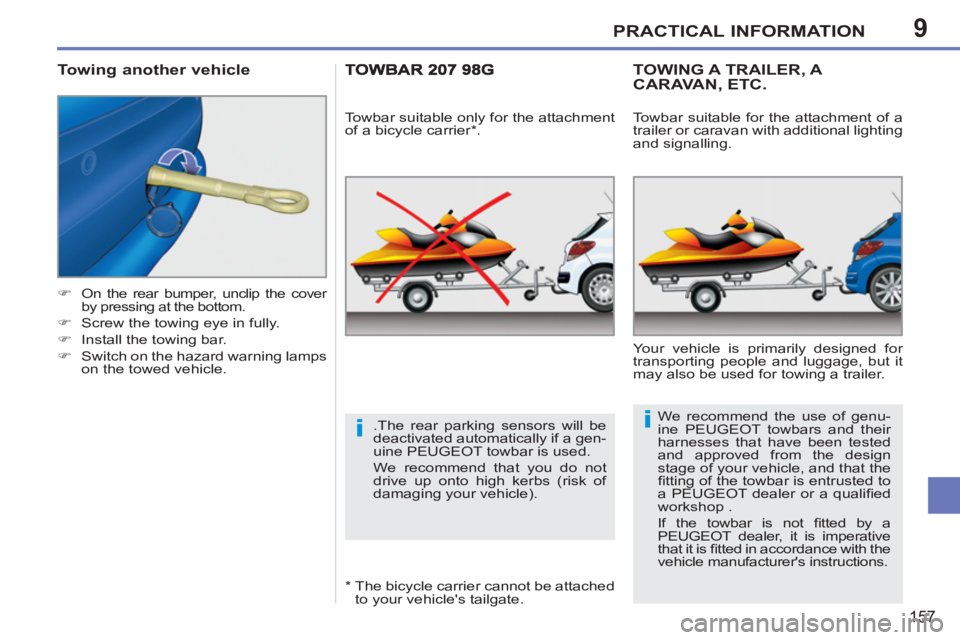
)
On the rear bumper, unclip the cover
by pressing at the bottom.
)
Screw the towing eye in fully.
)
Install the towing bar.
)
Switch on the hazard warning lamps
on the towed vehicle.
Towing another vehicle
*
The bicycle carrier cannot be attached
to your vehicle's tailgate.
Towbar suitable only for the attachment
of a bicycle carrier *
.
TOWING A TRAILER, A
CARAVAN, ETC.
Your vehicle is primarily designed for
transporting people and luggage, but it
may also be used for towing a trailer.
Towbar suitable for the attachment of a
trailer or caravan with additional lighting
and signalling.
We recommend the use of genu-
ine PEUGEOT towbars and their
harnesses that have been tested
and approved from the design
stage of your vehicle, and that the
fi tting of the towbar is entrusted to
a PEUGEOT dealer or a qualifi ed
workshop .
If the towbar is not fi tted by a
PEUGEOT dealer, it is imperative
that it is fi tted in accordance with the
vehicle manufacturer's instructions. . The rear parking sensors will be
deactivated automatically if a gen-
uine PEUGEOT towbar is used.
We recommend that you do not
drive up onto high kerbs (risk of
damaging your vehicle).