battery PEUGEOT 207 CC 2011 User Guide
[x] Cancel search | Manufacturer: PEUGEOT, Model Year: 2011, Model line: 207 CC, Model: PEUGEOT 207 CC 2011Pages: 224, PDF Size: 7.12 MB
Page 111 of 224
7
!i
DRIVING
109
Stopping the vehicle
Before switching off the engine, you
can engage position P
or N
to place the
gearbox in neutral.
In both cases, apply the parking brake
to immobilise the vehicle.
Operating fault
There is a risk of damage to the
gearbox:
- if you press the accelerator and
brake pedals at the same time,
- if you force the movement of
the gear lever from the P
posi-
tion to another position when
the battery is fl at.
To reduce fuel consumption when
at a prolonged standstill with the
engine running (traffi c jam...), put
the gear lever in the N
position and
apply the parking brake.
Manual operation
)
Select position M
for sequential
changing of the four gears.
)
Push the lever towards the +
sign to
change up a gear.
)
Pull the lever towards the -
sign to
change down a gear.
D
disappears and the gears
engaged appear in succes-
sion on the instrument panel.
If the engine speed is too low
or too high, the gear selected
fl ashes for a few seconds, then the ac-
tual gear engaged is displayed.
It is possible to change from position D
(automatic) to position M
(manual) at
any time.
When the vehicle is stationary or mov-
ing very slowly, the gearbox selects
gear M1
automatically.
The sport and snow programmes do not
operate in manual mode. If the lever is not in position P
, when
the driver's door is opened or ap-
proximately 45 seconds after the
ignition is switched off, a message
appears in the multifunction screen.
)
Return the lever to position P
;
the message disappears.
It is only possible to change from one
gear to another if the vehicle speed and
engine speed permit; otherwise, the
gearbox will operate temporarily in au-
tomatic mode.
Invalid value during manual
operation
This symbol is displayed if a
gear is not engaged correctly
(selector between two posi-
tions).
When the ignition is on, the
lighting of this warning lamp,
accompanied by an audible
signal and a message in the
multifunction screen, indicates a gear-
box fault.
In this case, the gearbox switches to
back-up mode and is locked in 3rd gear.
You may feel a substantial knock when
changing from P
to R
and from N
to R
.
This will not cause any damage to the
gearbox.
Do not exceed 60 mph (100 km/h), local
speed restrictions permitting.
Contact a PEUGEOT dealer or a quali-
fi ed workshop as soon as possible.
Page 120 of 224
8CHECKS
118
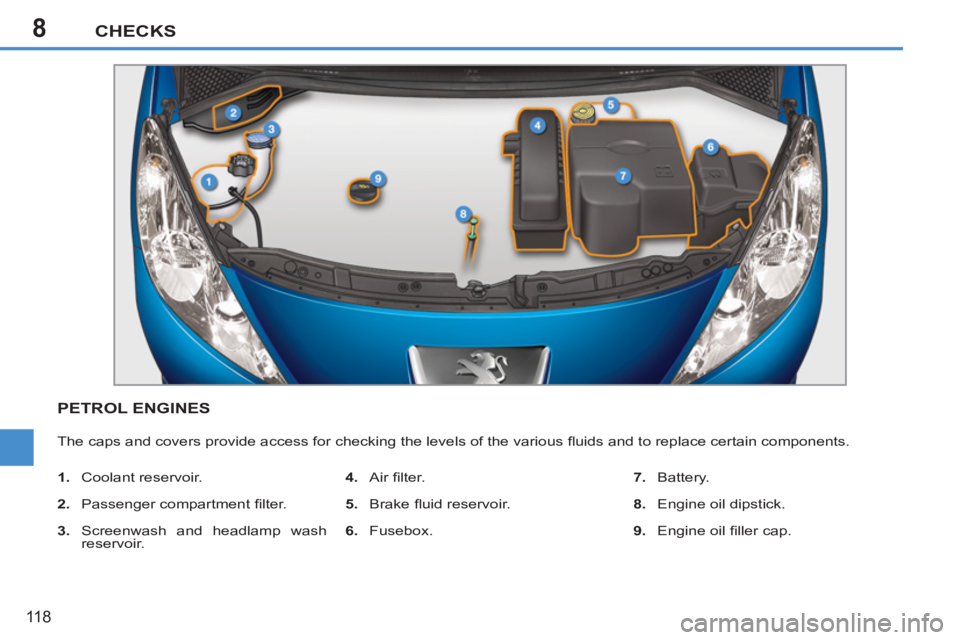
PETROL ENGINES
The caps and covers provide access for checking the levels of the various fl uids and to replace certain components.
1.
Coolant reservoir.
2.
Passenger compartment fi lter.
3.
Screenwash and headlamp wash
reservoir.
4.
Air fi lter.
5.
Brake fl uid reservoir.
6.
Fusebox.
7.
Battery.
8.
Engine oil dipstick.
9.
Engine oil fi ller cap.
Page 121 of 224
8CHECKS
119
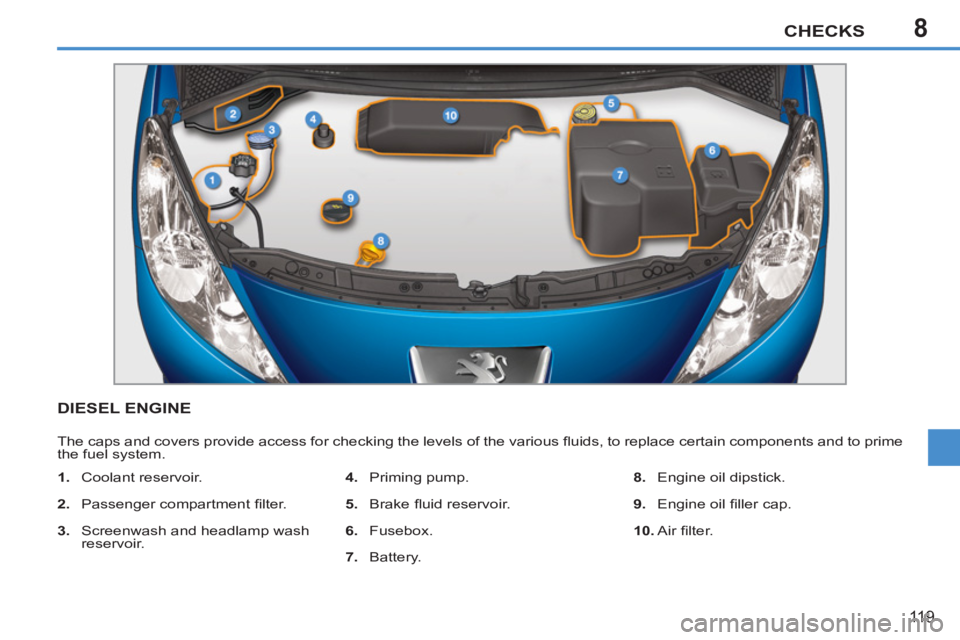
DIESEL ENGINE
The caps and covers provide access for checking the levels of the various fl uids, to replace certain components and to prime
the fuel system.
1.
Coolant reservoir.
2.
Passenger compartment fi lter.
3.
Screenwash and headlamp wash
reservoir.
4.
Priming pump.
5.
Brake fl uid reservoir.
6.
Fusebox.
7.
Battery.
8.
Engine oil dipstick.
9.
Engine oil fi ller cap.
10.
Air fi lter.
Page 123 of 224
8
!
i
CHECKS
121
Avoid any prolonged contact of
used oil or fl uids with the skin.
Most of these fl uids are harmful to
health or indeed very corrosive.
Do not discard used oil or fl uids
into sewers or onto the ground.
Take used oil to a PEUGEOT dealer
or a qualifi ed workshop (France) or
an authorised waste disposal site.
Diesel additive level (Diesel with
particle emission filter)
The minimum level of this additive is in-
dicated by lighting of the service warning
lamp, accompanied by an audible signal
and a message on the multifunction
screen.
Used products
Unless otherwise indicated, check
these components in accordance with
the servicing booklet and in relation to
your engine.
Otherwise, have them checked by a
PEUGEOT dealer or a qualifi ed workshop.
Battery
The battery does not require
any maintenance.
However, check that the ter-
minals are clean and correctly
tightened, particularly in sum-
mer and winter.
When carrying out work on the battery,
refer to the "Practical information" sec-
tion for details of the precautions to be
taken before disconnecting the battery
and following its reconnection.
Air filter and passenger compartment filter
Refer to the servicing booklet
for details of the replacement
intervals for these compo-
nents.
Depending on the environ-
ment (dusty atmosphere...) and the use
of the vehicle (city driving...), replace
them twice as often if necessary
.
A clogged passenger compartment fi lter
may have an adverse effect on the per-
formance of the air conditioning system
and generate undesirable odours.
Particle emission filter (Diesel)
Illumination of the service warning lamp togeth-
er with a related message indicates the start of
saturation of the particle emissions fi lter.
Oil filter
Replace the oil fi lter each time
the engine oil is changed.
Refer to the servicing booklet
for details of the replacement
interval for this component. As soon as the driving conditions
permit, regenerate the fi lter by driv-
ing at a speed of at least 35 mph
(60 km/h) until the service warning
lamp goes off.
Maintenance of the particle emis-
sion fi lter must be carried out by
a PEUGEOT dealer or a qualifi ed
workshop.
Following prolonged operation of
the vehicle at very low speed or at
idle, you may, exceptionally, notice
the emission of water vapour at the
exhaust on acceleration. This does
not have any adverse effect on the
performance of the vehicle or on
the environment.
Topping up
This additive must be topped up by a
PEUGEOT dealer or a qualifi ed work-
shop without delay.
Page 141 of 224

9PRACTICAL INFORMATION
139
Fuse N°
Rating
Functions
F1
20 A
Engine control unit and fan assembly control
relay supply, timing and canister electrovalves
(1.6 litre16V THP), air fl ow sensor (Diesel),
injection pump (Diesel), water in diesel sensor
(Diesel), EGR electrovalves, air heating (Diesel).
F2
15 A
Horn.
F3
10 A
Front wash-wipe.
F4
20 A
Headlamp wash.
F5
15 A
Fuel pump (petrol), Turbo electrovalves
(1.6 litre 16V THP).
F6
10 A
Vehicle speed sensor, automatic gearbox.
F7
10 A
Electric power steering, directional headlamps,
directional headlamps control relay, switching and
protection unit (Diesel).
F8
20 A
Starter control.
F9
10 A
ABS/ESP control unit, brake pedal switch.
F10
30 A
Engine control unit actuators (petrol: ignition coils,
electrovalves, oxygen sensors, injectors, heaters,
electronic thermostat) (Diesel: electrovalves,
heaters).
F11
40 A
Air conditioning blower.
F12
30 A
Windscreen wipers Low/High speed.
F13
40 A
Built-in systems interface supply (ignition positive).
Engine compartment fuses
The fuse box is placed in the engine
compartment, near the battery (left-
hand side).
Access to the fuses
)
Unclip the cover.
)
Replace the fuse (refer to the cor-
responding paragraph).
)
When you have fi nished, close the
cover carefully to ensure the sealing
of the fuse box.
Fuse table
Page 143 of 224
9PRACTICAL INFORMATION
141
BATTERY
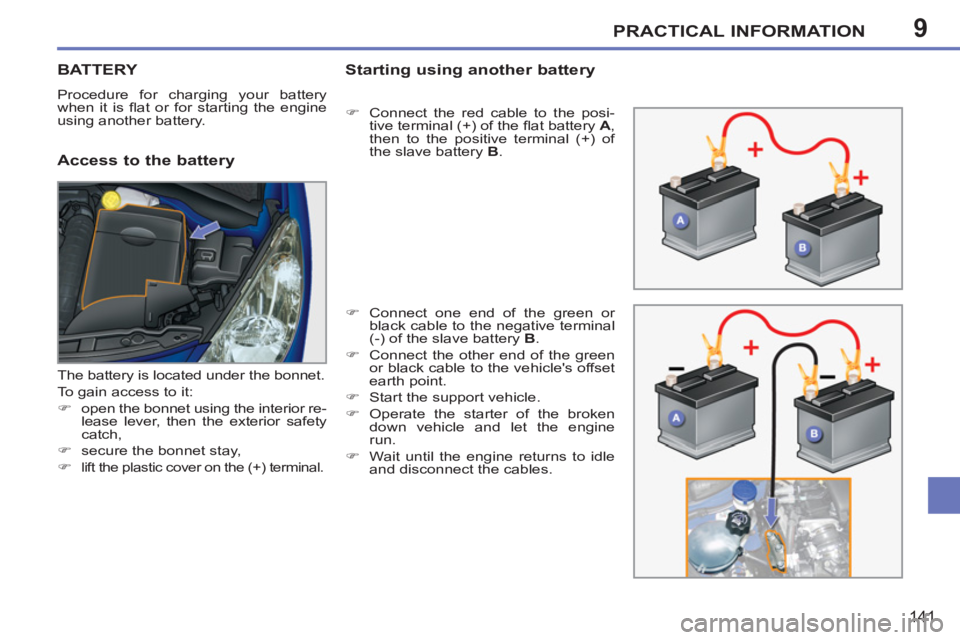
Procedure for charging your battery
when it is fl at or for starting the engine
using another battery.
Access to the battery Startin
g using another battery
)
Connect the red cable to the posi-
tive terminal (+) of the fl at battery A
,
then to the positive terminal (+) of
the slave battery B
.
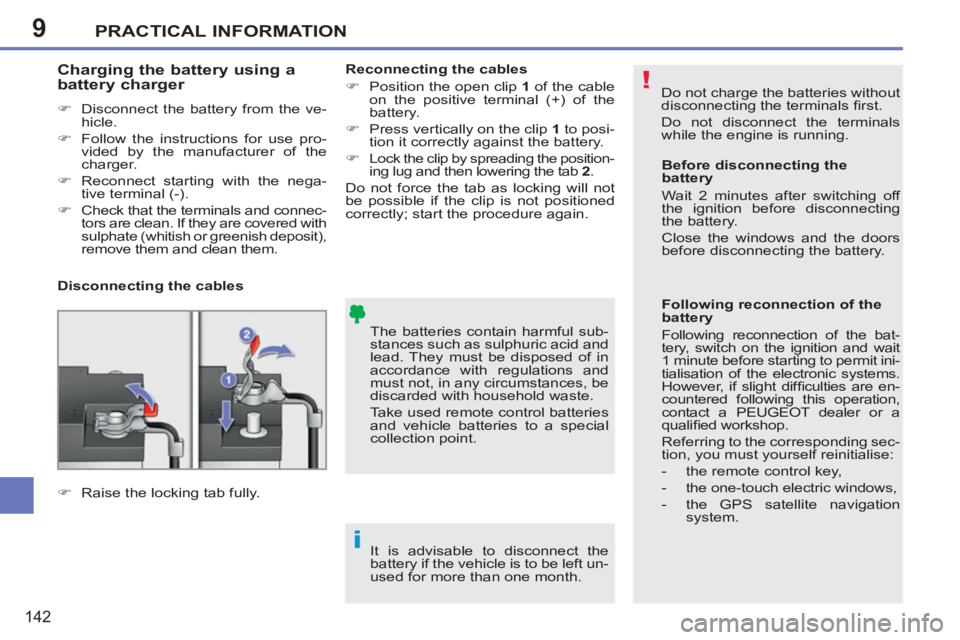
)
Connect one end of the green or
black cable to the negative terminal
(-) of the slave battery B
.
)
Connect the other end of the green
or black cable to the vehicle's offset
earth point.
)
Start the support vehicle.
)
Operate the starter of the broken
down vehicle and let the engine
run.
)
Wait until the engine returns to idle
and disconnect the cables.
The battery is located under the bonnet.
To gain access to it:
)
open the bonnet using the interior re-
lease lever, then the exterior safety
catch,
)
secure the bonnet stay,
)
lift the plastic cover on the (+) terminal.
Page 144 of 224
9
!
i
PRACTICAL INFORMATION
142
Do not charge the batteries without
disconnecting the terminals fi rst.
Do not disconnect the terminals
while the engine is running.
The batteries contain harmful sub-
stances such as sulphuric acid and
lead. They must be disposed of in
accordance with regulations and
must not, in any circumstances, be
discarded with household waste.
Take used remote control batteries
and vehicle batteries to a special
collection point.
Charging the battery using a
battery charger
)
Disconnect the battery from the ve-
hicle.
)
Follow the instructions for use pro-
vided by the manufacturer of the
charger.
)
Reconnect starting with the nega-
tive terminal (-).
)
Check that the terminals and connec-
tors are clean. If they are covered with
sulphate (whitish or greenish deposit),
remove them and clean them.
It is advisable to disconnect the
battery if the vehicle is to be left un-
used for more than one month.
Before disconnecting the
battery
Wait 2 minutes after switching off
the ignition before disconnecting
the battery.
Close the windows and the doors
before disconnecting the battery.
Following reconnection of the
battery
Following reconnection of the bat-
tery, switch on the ignition and wait
1 minute before starting to permit ini-
tialisation of the electronic systems.
However, if slight diffi culties are en-
countered following this operation,
contact a PEUGEOT dealer or a
qualifi ed workshop.
Referring to the corresponding sec-
tion, you must yourself reinitialise:
- the remote control key,
- the one-touch electric windows,
- the GPS satellite navigation
system.
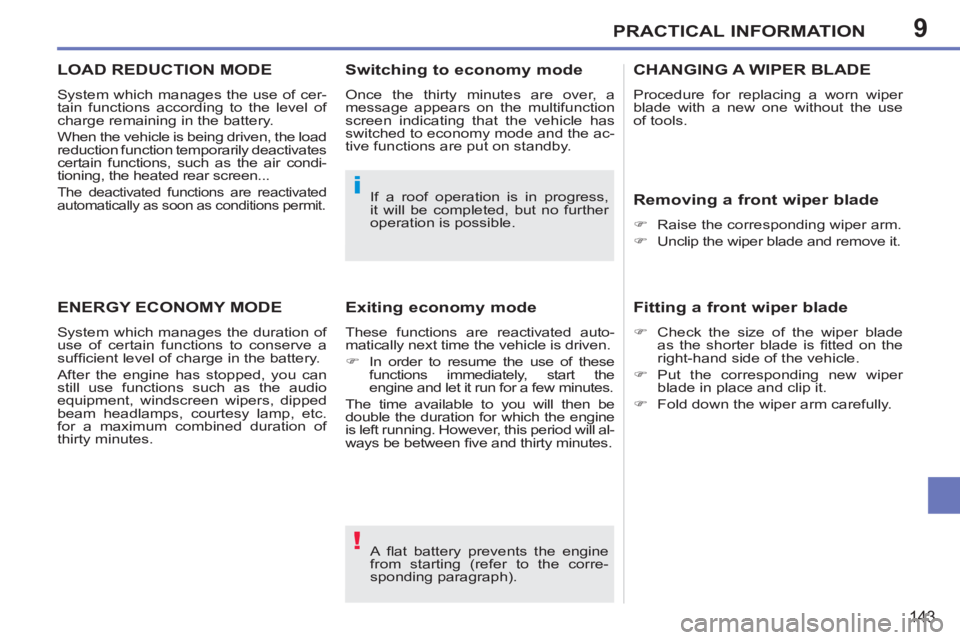
Disconnecting the cables
Reconnecting the cables
)
Position the open clip 1
of the cable
on the positive terminal (+) of the
battery.
)
Press vertically on the clip 1
to posi-
tion it correctly against the battery.
)
Lock the clip by spreading the position-
ing lug and then lowering the tab 2
.
Do not force the tab as locking will not
be possible if the clip is not positioned
correctly; start the procedure again.
)
Raise the locking tab fully.
Page 145 of 224
9
!
i
PRACTICAL INFORMATION
143
A fl at battery prevents the engine
from starting (refer to the corre-
sponding paragraph). If a roof operation is in progress,
it will be completed, but no further
operation is possible.
ENERGY ECONOMY MODE
System which manages the duration of
use of certain functions to conserve a
suffi cient level of charge in the battery.
After the engine has stopped, you can
still use functions such as the audio
equipment, windscreen wipers, dipped
beam headlamps, courtesy lamp, etc.
for a maximum combined duration of
thirty minutes.
Exiting economy mode
These functions are reactivated auto-
matically next time the vehicle is driven.
)
In order to resume the use of these
functions immediately, start the
engine and let it run for a few minutes.
The time available to you will then be
double the duration for which the engine
is left running. However, this period will al-
ways be between fi ve and thirty minutes.
Switching to economy mode
Once the thirty minutes are over, a
message appears on the multifunction
screen indicating that the vehicle has
switched to economy mode and the ac-
tive functions are put on standby.
CHANGING A WIPER BLADE
Procedure for replacing a worn wiper
blade with a new one without the use
of tools.
Removing a front wiper blade
)
Raise the corresponding wiper arm.
)
Unclip the wiper blade and remove it.
Fitting a front wiper blade
)
Check the size of the wiper blade
as the shorter blade is fi tted on the
right-hand side of the vehicle.
)
Put the corresponding new wiper
blade in place and clip it.
)
Fold down the wiper arm carefully.
LOAD REDUCTION MODE
System which manages the use of cer-
tain functions according to the level of
charge remaining in the battery.
When the vehicle is being driven, the load
reduction function temporarily deactivates
certain functions, such as the air condi-
tioning, the heated rear screen...
The deactivated functions are reactivated
automatically as soon as conditions permit.
Page 158 of 224
156
EMERGENCY OR ASSISTANCE CALL
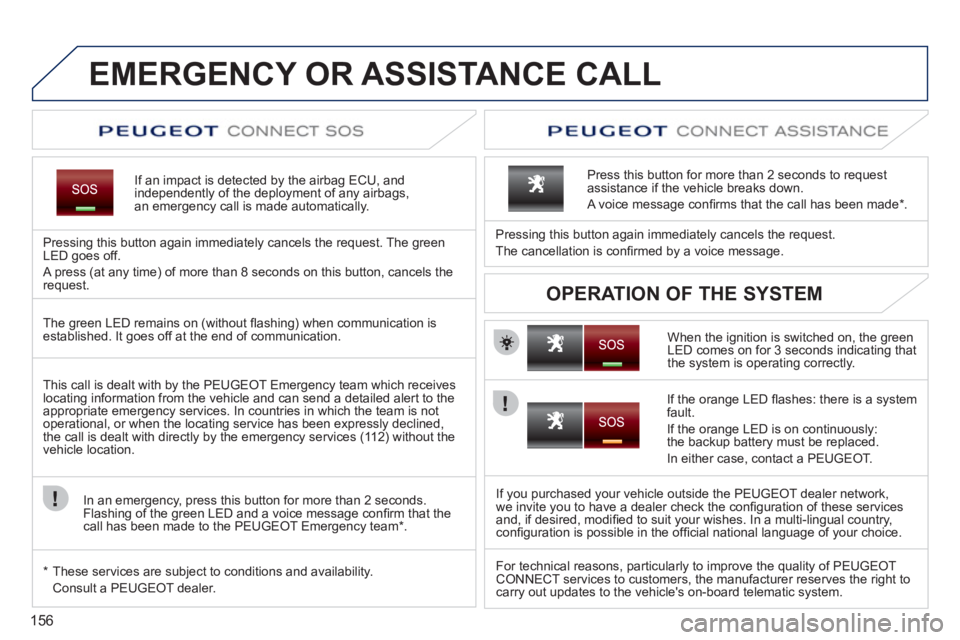
If an impact is detected by the airbag ECU, andindependently of the deployment of any airbags,an emergency call is made automatically.
Pressing this button again immediately cancels the request. The green LED goes off.
A press
(at any time) of more than 8 seconds on this button, cancels the
request.
When the ignition is switched on, the green
LED comes on for 3 seconds indicating that
the system is operating correctly. Pressin
g this button again immediately cancels the request.
The cancellation is confi rmed b
y a voice message.
Press this button for more than 2 seconds to request
assistance if the vehicle breaks down.
A voice message confi rms that the call has been made *
.
OPERATION OF THE SYSTEM
The green LED remains on (without fl ashing) when communication is established. It goes off at the end of communication.
This call is dealt with b
y the PEUGEOT Emergency team which receiveslocating information from the vehicle and can send a detailed alert to theappropriate emergency services. In countries in which the team is not
operational, or when the locating service has been expressly declined,
the call is dealt with directly by the emergency services (11 2) without the
vehicle location.
In an emergency, press this button
for more than 2 seconds.
Flashing of the green LED and a voice message confi rm that the call has been made to the PEUGEOT Emergency team * .
*
These services are sub
ject to conditions and availability.
Consult a PEUGEOT dealer.
If the oran
ge LED fl ashes: there is a system
fault.
If the oran
ge LED is on continuously:
the backup battery must be replaced.
In either case, contact a PEU
GEOT.
I
f you purchased your vehicle outside the PEUGEOT dealer network,
we invite you to have a dealer check the confi guration of these services
and, if desired, modifi ed to suit your wishes. In a multi-lingual country,confi guration is possible in the offi cial national language of your choice.
For technical reasons, particularl
y to improve the quality of PEUGEOTCONNECT services to customers, the manufacturer reserves the right tocarry out updates to the vehicle's on-board telematic system.
Page 159 of 224
157
The Peugeot Connect Navigation (RNEG) is protected in such a way that it will only operate in your vehicle.
If it is to be installed in another vehicle, contact aPEUGEOT dealer for confi guration of the system.
Certain functions described in this handbook will
become available during the year.
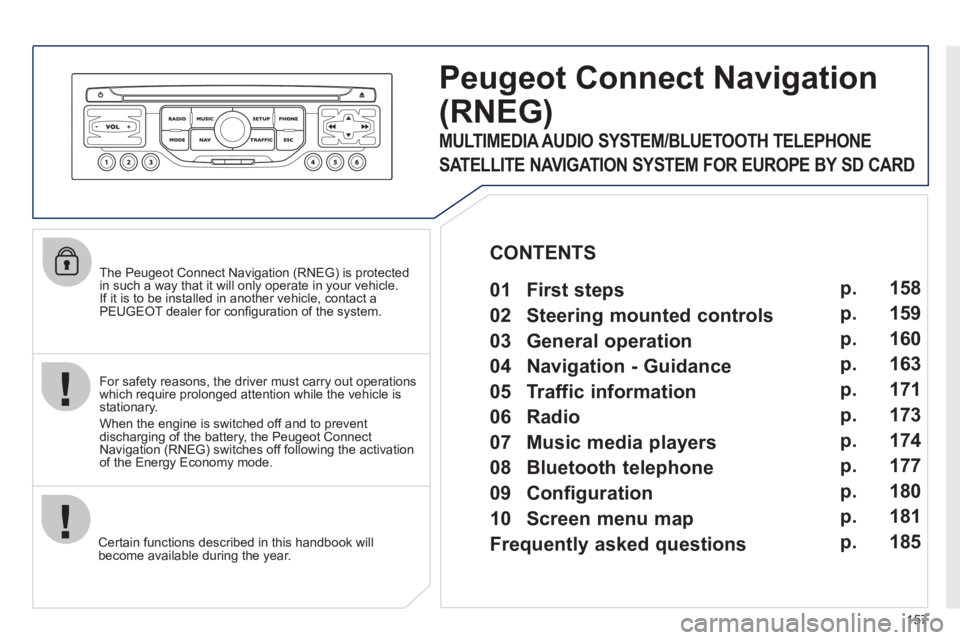
Peugeot Connect Navigation
(RNEG)
For safety reasons, the driver must carry out operations which require prolonged attention while the vehicle is stationary.
When the en
gine is switched off and to prevent
discharging of the battery, the Peugeot Connect
Navigation (RNEG) switches off following the activation of the Energy Economy mode.
MULTIMEDIA AUDIO SYSTEM/BLUETOOTH TELEPHONE
SATELLITE NAVIGATION SYSTEM FOR EUROPE BY SD CARD
01 First steps
CONTENTS
02 Steering mounted controls
03 General operation
04 Navigation - Guidance
05 Traffic information
06 Radio
07 Music media players
08 Bluetooth telephone
09 Configuration
10 Screen menu map p.
p.
p.
p.
p.
p.
p.
p.
p.
p.
Frequently asked questions p. 158
159
160
163
171
173
174
177
180
181
185