ignition PEUGEOT 207 CC 2011 Service Manual
[x] Cancel search | Manufacturer: PEUGEOT, Model Year: 2011, Model line: 207 CC, Model: PEUGEOT 207 CC 2011Pages: 224, PDF Size: 7.12 MB
Page 114 of 224
7
i
DRIVING
11 2
CRUISE CONTROL
System which automatically maintains
the speed of the vehicle at the value
programmed by the driver, without any
action on the accelerator pedal.
The cruise control is switched on
manually: it requires a minimum vehicle
speed of 25 mph (40 km/h), as well as
the engaging of:
- fourth gear on a manual gearbox,
- second gear on an automatic gearbox
in sequential mode,
- position D
on an automatic gearbox.
The cruise control is switched off
man-
ually or by pressing the brake or clutch
pedal or on triggering of the ESP sys-
tem for safety reasons.
It is possible to exceed the programmed
speed temporarily by pressing the ac-
celerator pedal.
To return to the programmed speed,
simply release the accelerator pedal.
Switching off the ignition cancels any
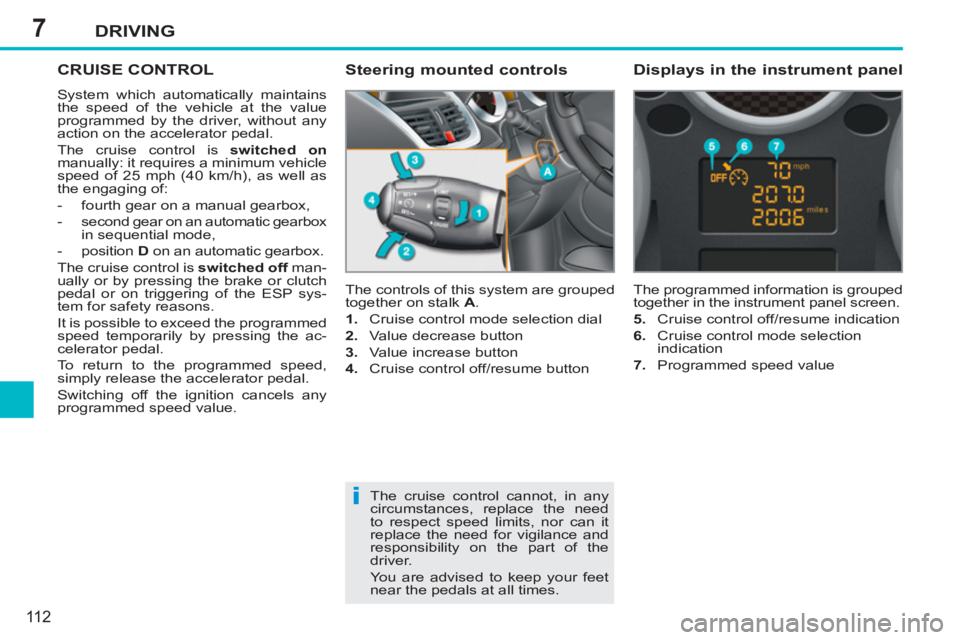
programmed speed value. The controls of this system are grouped
together on stalk A
.
1.
Cruise control mode selection dial
2.
Value decrease button
3.
Value increase button
4.
Cruise control off/resume button
The programmed information is grouped
together in the instrument panel screen.
5.
Cruise control off/resume indication
6.
Cruise control mode selection
indication
7.
Programmed speed value
Steering mounted controls
Displays in the instrument panel
The cruise control cannot, in any
circumstances, replace the need
to respect speed limits, nor can it
replace the need for vigilance and
responsibility on the part of the
driver.
You are advised to keep your feet
near the pedals at all times.
Page 117 of 224

7
ii
i
DRIVING
115
Deactivation/Activation of the rear
parking sensors
Operating fault
In bad weather or in winter, ensure
that the sensors are not covered
with mud, ice or snow. When re-
verse gear is engaged, an audible
signal (long beep) indicates that
the sensors may be dirty.
When the vehicle is moving at a
speed below 6 mph (10 km/h), cer-
tain sound sources (motorcycle,
lorry, pneumatic drill, etc.) may trig-
ger the audible signals of the park-
ing sensor system.
In the event of a malfunction of
the system, when reverse gear is
engaged this warning lamp is dis-
played in the instrument panel and/
or a message appears in the screen, accom-
panied by an audible signal (short beep).
Contact a PEUGEOT dealer or a quali-
fi ed workshop.
The status of the function is stored
when the ignition is switched off.
For more information on access to
the parking sensors menu, refer to
the section covering the confi gura-
tion of vehicle systems.
The function will be deactivated au-
tomatically if a trailer is being towed
or a bicycle carrier is fi tted (vehicle
fi tted with a towbar or bicycle car-
rier recommended by PEUGEOT).
The function is deactivated
or activated via the vehicle
confi guration menu.
Page 122 of 224
8CHECKS
120
CHECKING LEVELS
Check all of these levels regularly and
top them up if necessary, unless other-
wise indicated.
If a level drops signifi cantly, have the
corresponding system checked by a
PEUGEOT dealer or a qualifi ed work-
shop.
Take care when working under the bon-
net, as some parts of the engine can be
extremely hot (risk of burns).
Brake fluid level
To avoid any risk of scalding, unscrew
the cap by two turns to allow the pres-
sure to drop. When the pressure has
dropped, remove the cap and top up
the level.
Oil level
The reading will only be correct
if the vehicle is on level ground
and the engine has been off for
more than 30 minutes.
The check is carried out either when
the ignition is switched on using the oil
level indicator on the instrument panel,
or using the dipstick.
It is normal to top up the engine oil between
two services. The manufacturer recom-
mends a check of the oil level, and top up
if necessary, every 3 000 miles (5 000 km).
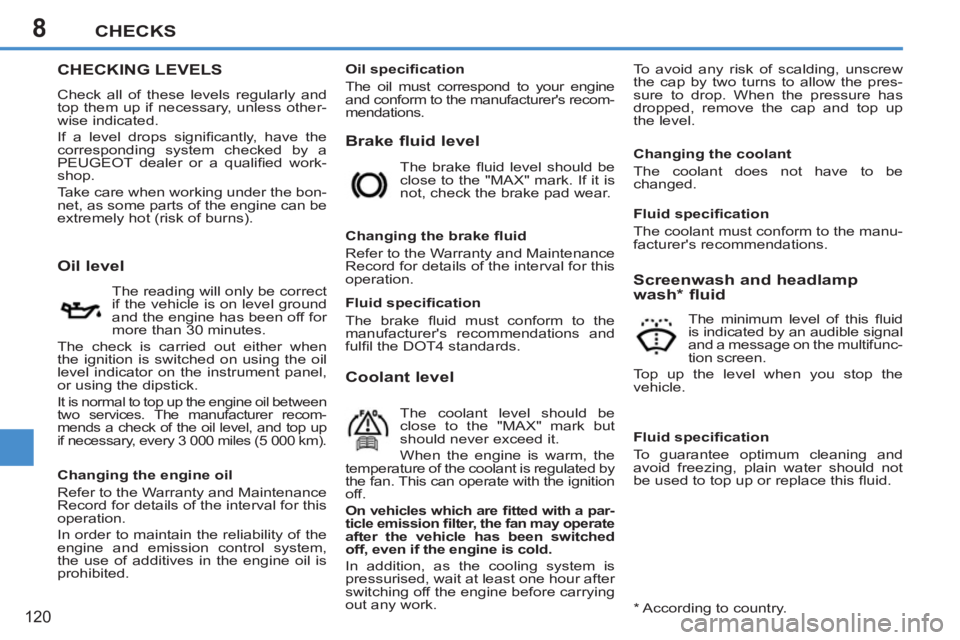
The brake fl uid level should be
close to the "MAX" mark. If it is
not, check the brake pad wear.
Changing the brake fl uid
Refer to the Warranty and Maintenance
Record for details of the interval for this
operation.
Coolant level
The coolant level should be
close to the "MAX" mark but
should never exceed it.
When the engine is warm, the
temperature of the coolant is regulated by
the fan. This can operate with the ignition
off.
On vehicles which are fi tted with a par-
ticle emission fi lter, the fan may operate
after the vehicle has been switched
off, even if the engine is cold.
In addition, as the cooling system is
pressurised, wait at least one hour after
switching off the engine before carrying
out any work.
Screenwash and headlamp
wash * fluid
The minimum level of this fl uid
is indicated by an audible signal
and a message on the multifunc-
tion screen.
Top up the level when you stop the
vehicle.
* According to country.
Changing the engine oil
Refer to the Warranty and Maintenance
Record for details of the interval for this
operation.
In order to maintain the reliability of the
engine and emission control system,
the use of additives in the engine oil is
prohibited.
Oil specifi cation
The oil must correspond to your engine
and conform to the manufacturer's recom-
mendations.
Fluid specifi cation
The brake fl uid must conform to the
manufacturer's recommendations and
fulfi l the DOT4 standards.
Changing the coolant
The coolant does not have to be
changed.
Fluid specifi cation
The coolant must conform to the manu-
facturer's recommendations.
Fluid specifi cation
To guarantee optimum cleaning and
avoid freezing, plain water should not
be used to top up or replace this fl uid.
Page 126 of 224
9
i!!
PRACTICAL INFORMATION
124
Avoid removing any foreign bodies
which have penetrated into the
tyre.
Take care, this product is harmful
(e.g. ethylene-glycol, colophony...)
if swallowed and causes irritation
to the eyes.
Keep it out of reach of children.
Repair procedure
1. Sealing
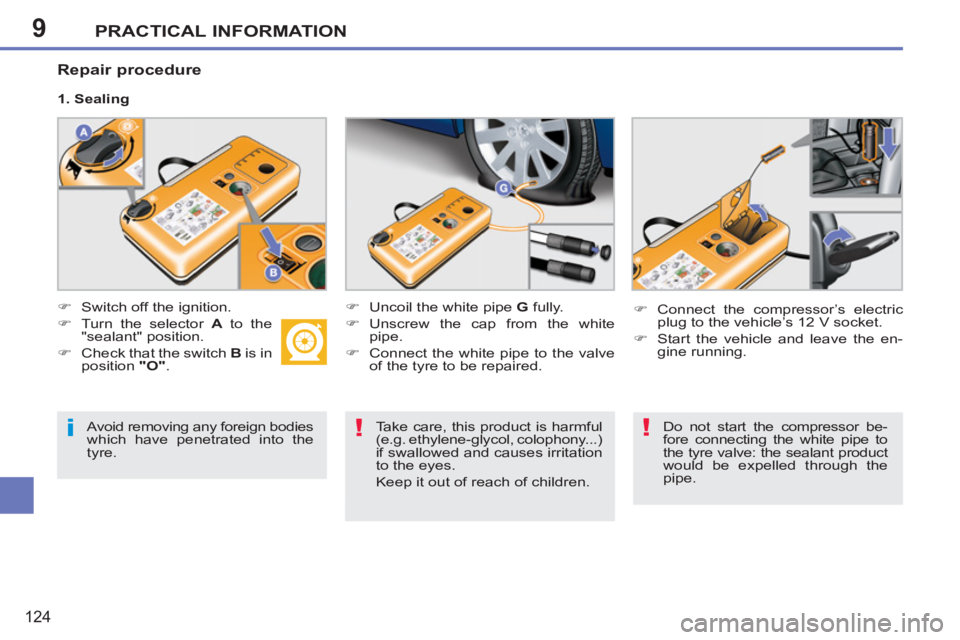
)
Switch off the ignition.
)
Turn the selector A
to the
"sealant" position.
)
Check that the switch B
is in
position "O"
.
)
Uncoil the white pipe G
fully.
)
Unscrew the cap from the white
pipe.
)
Connect the white pipe to the valve
of the tyre to be repaired.
)
Connect the compressor’s electric
plug to the vehicle’s 12 V socket.
)
Start the vehicle and leave the en-
gine running.
Do not start the compressor be-
fore connecting the white pipe to
the tyre valve: the sealant product
would be expelled through the
pipe.
Page 132 of 224
9
i
PRACTICAL INFORMATION
130
Parking the vehicle
Immobilise the vehicle where it
does not block traffi c: if possible,
park the vehicle on level, stable
and non-slippery ground.
Apply the parking brake, switch off
the ignition and engage fi rst gear *
to lock the wheels.
If necessary, place a chock under
the wheel diagonally opposite the
wheel to be changed.
It is imperative that you ensure that
the occupants get out of the vehicle
and wait in a safe location.
Never go underneath a vehicle
raised using a jack; use an axle
stand.
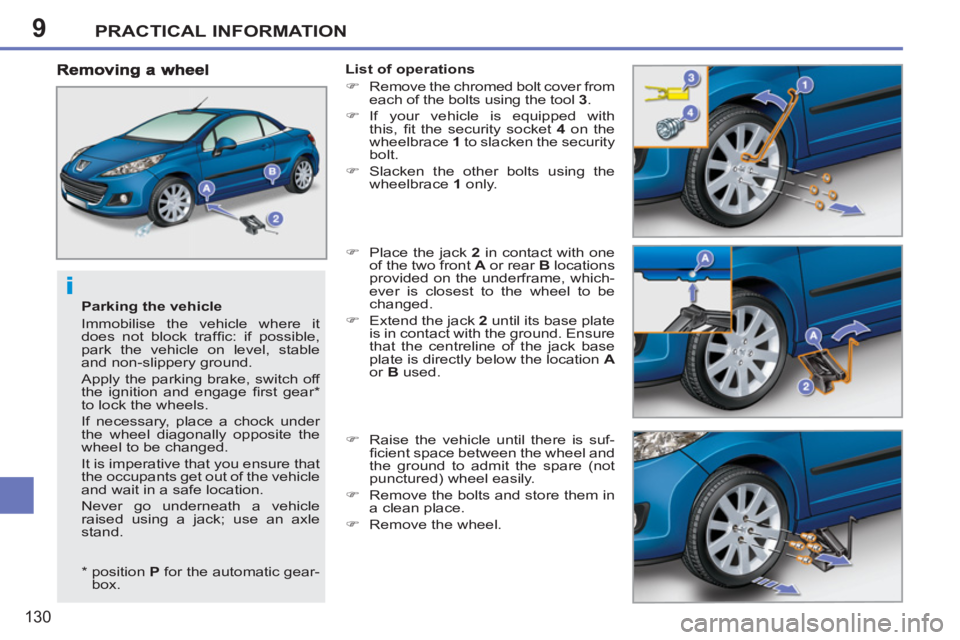
List of operations
)
Remove the chromed bolt cover from
each of the bolts using the tool 3
.
)
If your vehicle is equipped with
this, fi t the security socket 4
on the
wheelbrace 1
to slacken the security
bolt.
)
Slacken the other bolts using the
wheelbrace 1
only.
)
Place the jack 2
in contact with one
of the two front A
or rear B
locations
provided on the underframe, which-
ever is closest to the wheel to be
changed.
)
Extend the jack 2
until its base plate
is in contact with the ground. Ensure
that the centreline of the jack base
plate is directly below the location A
or B
used.
)
Raise the vehicle until there is suf-
fi cient space between the wheel and
the ground to admit the spare (not
punctured) wheel easily.
)
Remove the bolts and store them in
a clean place.
)
Remove the wheel.
* position P
for the automatic gear-
box.
Page 140 of 224
9PRACTICAL INFORMATION
138
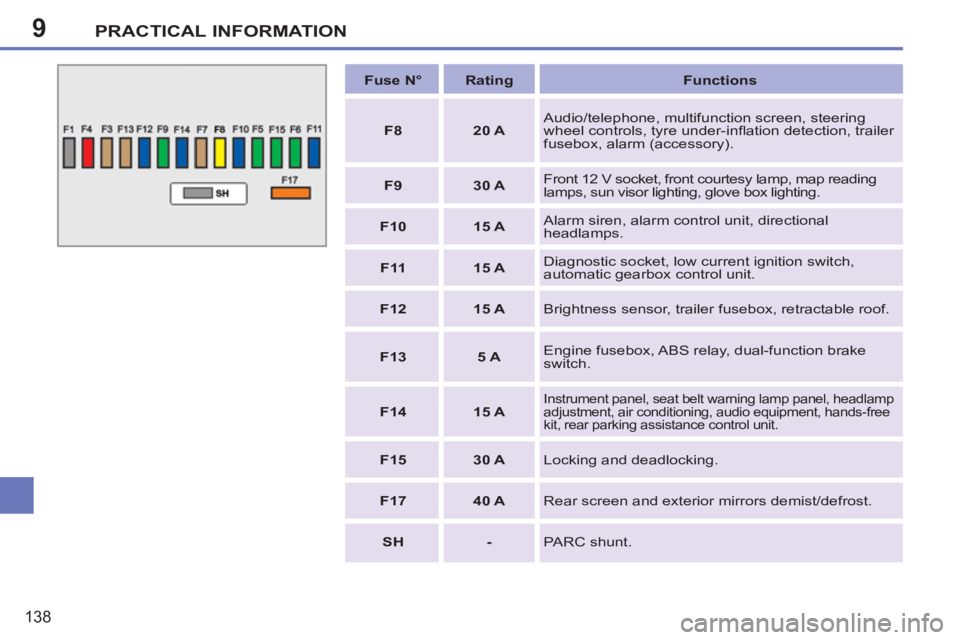
Fuse N°
Rating
Functions
F8
20 A
Audio/telephone, multifunction screen, steering
wheel controls, tyre under-infl ation detection, trailer
fusebox, alarm (accessory).
F9
30 A
Front 12 V socket, front courtesy lamp, map reading
lamps, sun visor lighting, glove box lighting.
F10
15 A
Alarm siren, alarm control unit, directional
headlamps.
F11
15 A
Diagnostic socket, low current ignition switch,
automatic gearbox control unit.
F12
15 A
Brightness sensor, trailer fusebox, retractable roof.
F13
5 A
Engine fusebox, ABS relay, dual-function brake
switch.
F14
15 A
Instrument panel, seat belt warning lamp panel, headlamp
adjustment, air conditioning, audio equipment, hands-free
kit, rear parking assistance control unit.
F15
30 A
Locking and deadlocking.
F17
40 A
Rear screen and exterior mirrors demist/defrost.
SH
-
PARC shunt.
Page 141 of 224

9PRACTICAL INFORMATION
139
Fuse N°
Rating
Functions
F1
20 A
Engine control unit and fan assembly control
relay supply, timing and canister electrovalves
(1.6 litre16V THP), air fl ow sensor (Diesel),
injection pump (Diesel), water in diesel sensor
(Diesel), EGR electrovalves, air heating (Diesel).
F2
15 A
Horn.
F3
10 A
Front wash-wipe.
F4
20 A
Headlamp wash.
F5
15 A
Fuel pump (petrol), Turbo electrovalves
(1.6 litre 16V THP).
F6
10 A
Vehicle speed sensor, automatic gearbox.
F7
10 A
Electric power steering, directional headlamps,
directional headlamps control relay, switching and
protection unit (Diesel).
F8
20 A
Starter control.
F9
10 A
ABS/ESP control unit, brake pedal switch.
F10
30 A
Engine control unit actuators (petrol: ignition coils,
electrovalves, oxygen sensors, injectors, heaters,
electronic thermostat) (Diesel: electrovalves,
heaters).
F11
40 A
Air conditioning blower.
F12
30 A
Windscreen wipers Low/High speed.
F13
40 A
Built-in systems interface supply (ignition positive).
Engine compartment fuses
The fuse box is placed in the engine
compartment, near the battery (left-
hand side).
Access to the fuses
)
Unclip the cover.
)
Replace the fuse (refer to the cor-
responding paragraph).
)
When you have fi nished, close the
cover carefully to ensure the sealing
of the fuse box.
Fuse table
Page 144 of 224
9
!
i
PRACTICAL INFORMATION
142
Do not charge the batteries without
disconnecting the terminals fi rst.
Do not disconnect the terminals
while the engine is running.
The batteries contain harmful sub-
stances such as sulphuric acid and
lead. They must be disposed of in
accordance with regulations and
must not, in any circumstances, be
discarded with household waste.
Take used remote control batteries
and vehicle batteries to a special
collection point.
Charging the battery using a
battery charger
)
Disconnect the battery from the ve-
hicle.
)
Follow the instructions for use pro-
vided by the manufacturer of the
charger.
)
Reconnect starting with the nega-
tive terminal (-).
)
Check that the terminals and connec-
tors are clean. If they are covered with
sulphate (whitish or greenish deposit),
remove them and clean them.
It is advisable to disconnect the
battery if the vehicle is to be left un-
used for more than one month.
Before disconnecting the
battery
Wait 2 minutes after switching off
the ignition before disconnecting
the battery.
Close the windows and the doors
before disconnecting the battery.
Following reconnection of the
battery
Following reconnection of the bat-
tery, switch on the ignition and wait
1 minute before starting to permit ini-
tialisation of the electronic systems.
However, if slight diffi culties are en-
countered following this operation,
contact a PEUGEOT dealer or a
qualifi ed workshop.
Referring to the corresponding sec-
tion, you must yourself reinitialise:
- the remote control key,
- the one-touch electric windows,
- the GPS satellite navigation
system.
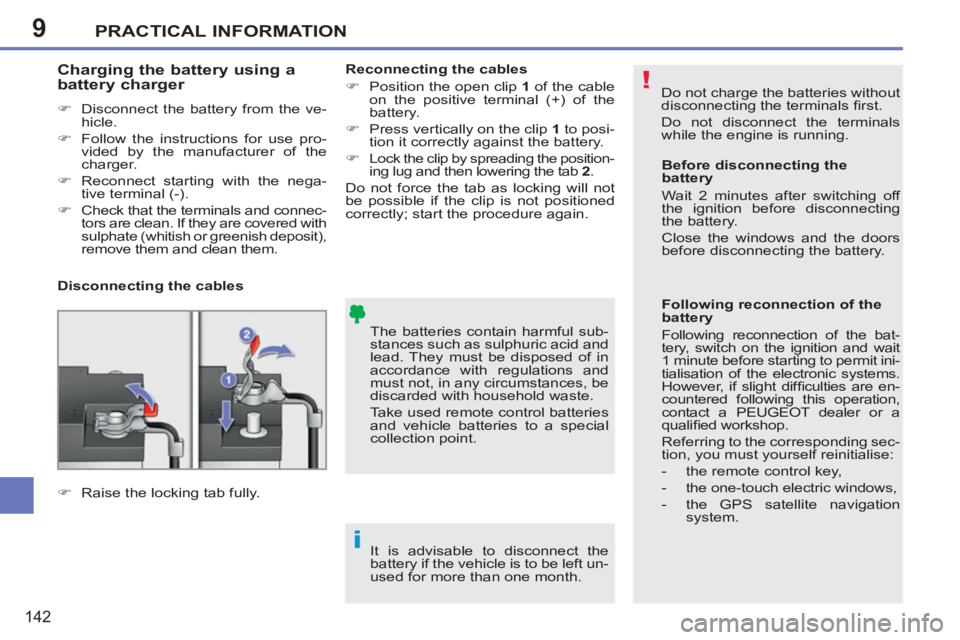
Disconnecting the cables
Reconnecting the cables
)
Position the open clip 1
of the cable
on the positive terminal (+) of the
battery.
)
Press vertically on the clip 1
to posi-
tion it correctly against the battery.
)
Lock the clip by spreading the position-
ing lug and then lowering the tab 2
.
Do not force the tab as locking will not
be possible if the clip is not positioned
correctly; start the procedure again.
)
Raise the locking tab fully.
Page 158 of 224
156
EMERGENCY OR ASSISTANCE CALL
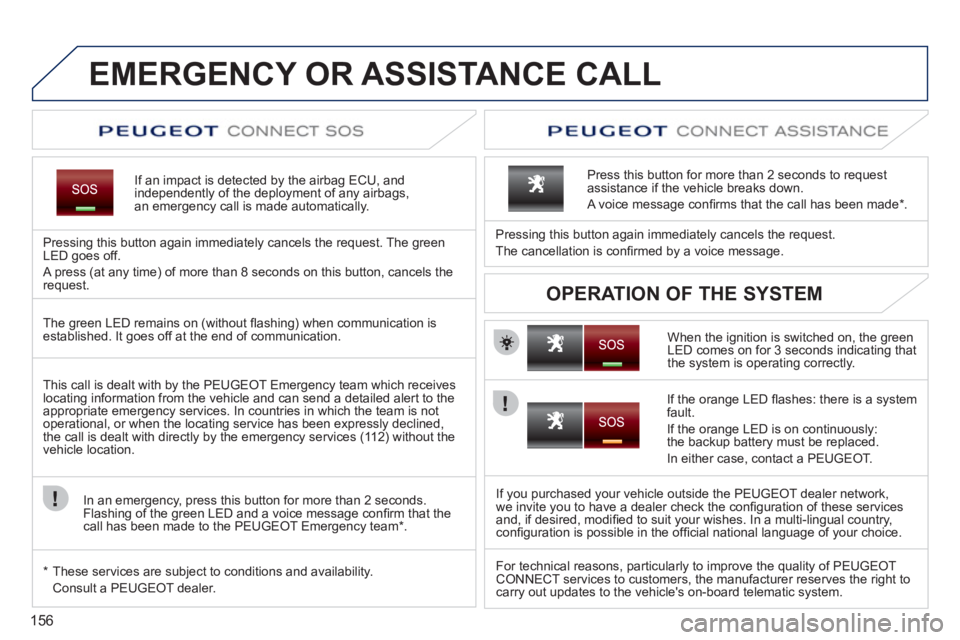
If an impact is detected by the airbag ECU, andindependently of the deployment of any airbags,an emergency call is made automatically.
Pressing this button again immediately cancels the request. The green LED goes off.
A press
(at any time) of more than 8 seconds on this button, cancels the
request.
When the ignition is switched on, the green
LED comes on for 3 seconds indicating that
the system is operating correctly. Pressin
g this button again immediately cancels the request.
The cancellation is confi rmed b
y a voice message.
Press this button for more than 2 seconds to request
assistance if the vehicle breaks down.
A voice message confi rms that the call has been made *
.
OPERATION OF THE SYSTEM
The green LED remains on (without fl ashing) when communication is established. It goes off at the end of communication.
This call is dealt with b
y the PEUGEOT Emergency team which receiveslocating information from the vehicle and can send a detailed alert to theappropriate emergency services. In countries in which the team is not
operational, or when the locating service has been expressly declined,
the call is dealt with directly by the emergency services (11 2) without the
vehicle location.
In an emergency, press this button
for more than 2 seconds.
Flashing of the green LED and a voice message confi rm that the call has been made to the PEUGEOT Emergency team * .
*
These services are sub
ject to conditions and availability.
Consult a PEUGEOT dealer.
If the oran
ge LED fl ashes: there is a system
fault.
If the oran
ge LED is on continuously:
the backup battery must be replaced.
In either case, contact a PEU
GEOT.
I
f you purchased your vehicle outside the PEUGEOT dealer network,
we invite you to have a dealer check the confi guration of these services
and, if desired, modifi ed to suit your wishes. In a multi-lingual country,confi guration is possible in the offi cial national language of your choice.
For technical reasons, particularl
y to improve the quality of PEUGEOTCONNECT services to customers, the manufacturer reserves the right tocarry out updates to the vehicle's on-board telematic system.
Page 179 of 224
177
08
1
2
3
4
BLUETOOTH TELEPHONE
*
The services available depend on the network, the SIM card and thecompatibility of the Bluetooth telephone used. Check the telephone
manual and with your network provider for details of the servicesavailable to you.
PAIRING A TELEPHONE
FIRST CONNECTION
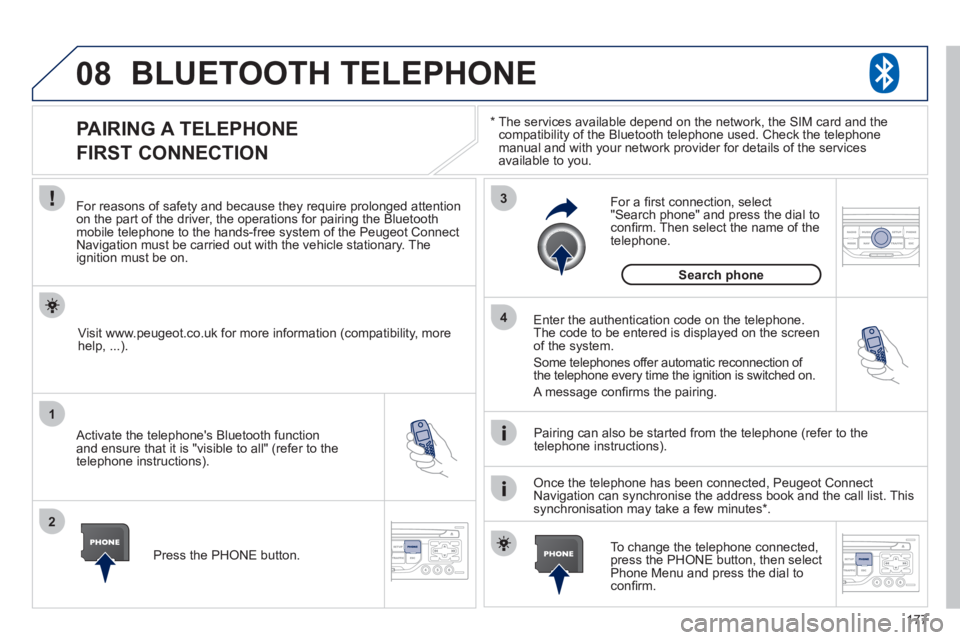
For reasons of safety and because they require prolonged attentionon the part of the driver, the operations for pairing the Bluetooth mobile telephone to the hands-free system of the Peugeot ConnectNavigation must be carried out with the vehicle stationary. Theignition must be on.
Activate the telephone's Bluetooth
function
and ensure that it is "visible to all" (refer to the
telephone instructions). Enter the authentication code on the tele
phone.
The code to be entered is displayed on the screen
of the system.
Some telephones offer automatic reconnection o
f
the telephone every time the ignition is switched on.
A messa
ge confi rms the pairing.
To change the telephone connected, press the PHONE button, then select Phone Menu and press the dial toconfi rm.
Once the telephone has been connected, Peugeot Connect
Navigation can synchronise the address book and the call list. This
synchronisation may take a few minutes * . Pairin
g can also be started from the telephone (refer to the
telephone instructions). Visit www.peu
geot.co.uk for more information (compatibility, more
help, ...).
Press the PH
ONE button.
For a
fi rst connection, select"Search phone" and press the dial to confi rm. Then select the name of thetelephone.
Search
phone