window Peugeot 208 2015 Owner's Manual - RHD (UK, Australia)
[x] Cancel search | Manufacturer: PEUGEOT, Model Year: 2015, Model line: 208, Model: Peugeot 208 2015Pages: 341, PDF Size: 38.75 MB
Page 4 of 341
2
208_en_Chap00a_sommaire_ed01-2015
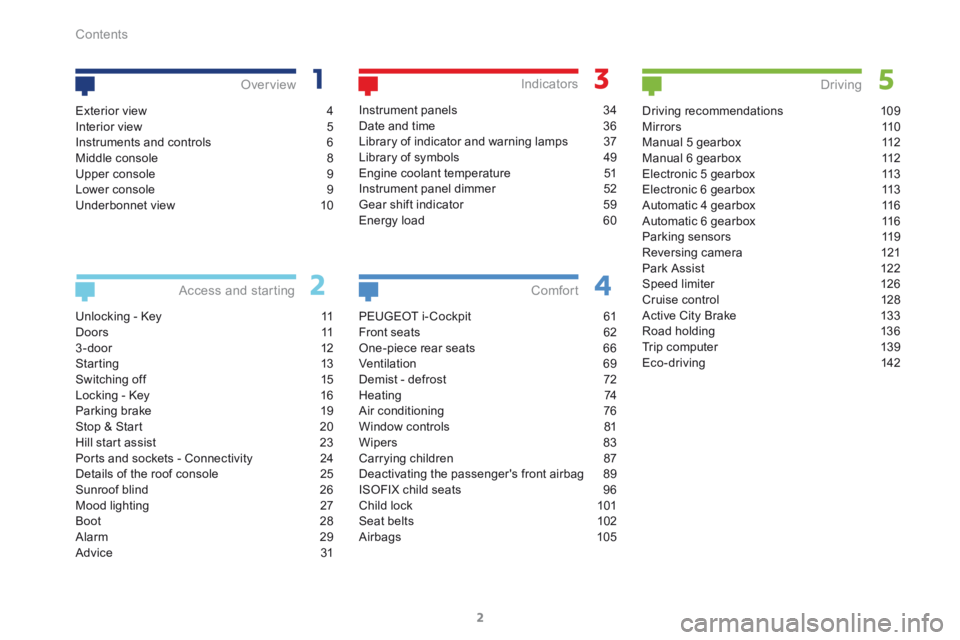
Unlocking - Key 11
D o o r s 11
3 - door 12
Starting 13
Switching off 15
Locking - Key 16
Parking brake 19
Stop & Start 20
Hill start assist 23
Ports and sockets - Connectivity 24
Details of the roof console 25
Sunroof blind 26
Mood lighting 27
Boot 28
Alarm 29
Advice 31
Access and starting Over view
Instrument panels
34
Date and time 36
Library of indicator and warning lamps 37
Library of symbols 49
Engine coolant temperature 51
Instrument panel dimmer 52
Gear shift indicator 59
Energy load 60
Indicators
PEUGEOT i- Cockpit 61
Front seats 62
One-piece rear seats 66
Ventilation 69
Demist - defrost 72
Heating 74
Air conditioning 76
Window controls 81
Wipers 83
Carrying children 87
Deactivating the passenger's front airbag 89
ISOFIX child seats 96
Child lock 101
Seat belts 102
Airbags 105
Comfort
Driving recommendations 109
M i r r o r s 11 0
Manual 5 gearbox 112
Manual 6 gearbox 112
Electronic 5 gearbox 113
Electronic 6 gearbox 113
Automatic 4 gearbox 116
Automatic 6 gearbox 116
Parking sensors 119
Reversing camera 121
Park Assist 122
Speed limiter 126
Cruise control 128
Active City Brake 133
Road holding 136
Trip computer 139
Eco-driving 142
Driving
Exterior view 4
Interior view 5
Instruments and controls 6
Middle console 8
Upper console 9
Lower console 9
Underbonnet view 10
Contents
Page 6 of 341
4
208_en_Chap01_vue-ensemble_ed01-2015
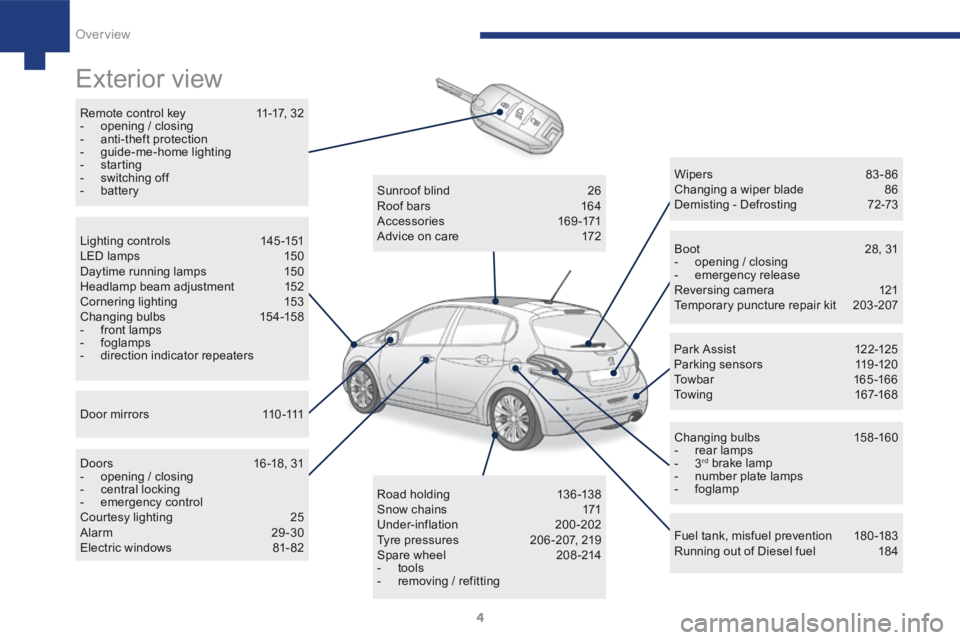
Exterior view
Remote control key 11-17, 32
- opening / closing
- anti-theft protection
- guide-me-home lighting
- starting
- switching off
- battery
Boot 28, 31
- opening / closing
- emergency release
Reversing camera 121
Temporary puncture repair kit 203-207
Wipers 83 - 86
Changing a wiper blade
86
Demisting - Defrosting 72-73
Changing bulbs 158-160
- rear lamps
- 3
rd brake lamp
- number plate lamps
- foglamp
Fuel tank, misfuel prevention 180-183
Running out of Diesel fuel 184
Sunroof blind
26
Roof bars 164
Accessories 169-171
Advice on care 172
Road holding 13 6 -13 8
Snow chains 171
Under-inflation 200-202
Tyre pressures 206 -207, 219
Spare wheel 208-214
- tools
- removing / refitting
Lighting controls
145-151
LED lamps 150
Daytime running lamps 150
Headlamp beam adjustment 152
Cornering lighting 153
Changing bulbs 154-158
- front lamps
- foglamps
- direction indicator repeaters
D o o r m i r r o r s 11 0 -111
Doors 16 -18, 31
- opening / closing
- central locking
- emergency control
Courtesy lighting 25
Alarm 29-30
Electric windows 81- 82 Par k A ssist
12 2-125
Parking sensors 119-120
Towbar 165 -166
Towing 167-168
Over view
Page 18 of 341
16
208_en_Chap02_ Acces-Demarrage_ed01-2015
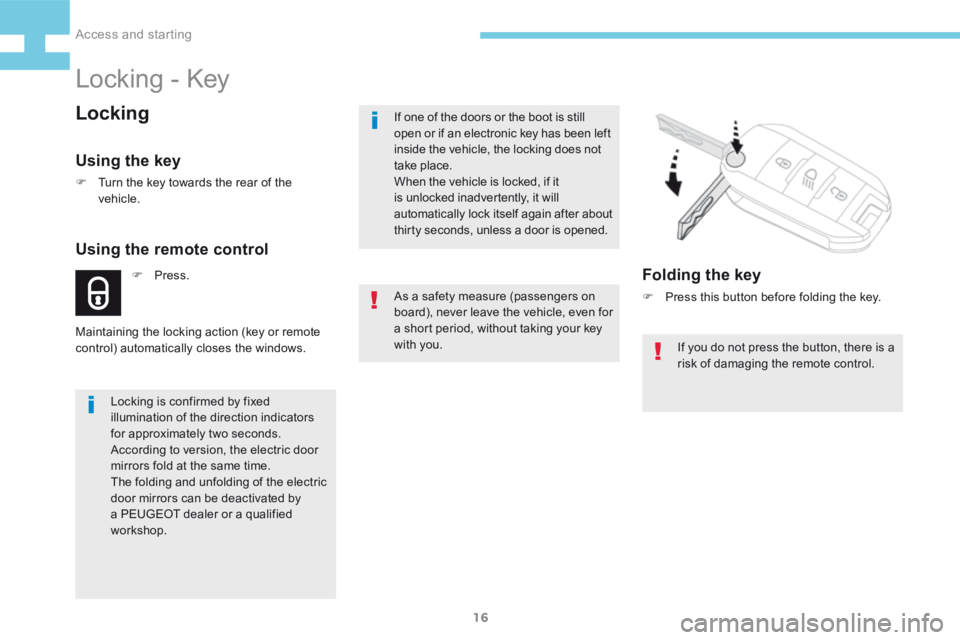
F Press.
Using the remote control
Maintaining the locking action (key or remote
control) automatically closes the windows.
Locking - Key
Locking
Using the key
F Turn the key towards the rear of the
vehicle.
As a safety measure (passengers on
board), never leave the vehicle, even for
a short period, without taking your key
with you.
Locking is confirmed by fixed
illumination of the direction indicators
for approximately two seconds.
According to version, the electric door
mirrors fold at the same time.
The folding and unfolding of the electric
door mirrors can be deactivated by
a PEUGEOT dealer or a qualified
workshop. If one of the doors or the boot is still
open or if an electronic key has been left
inside the vehicle, the locking does not
take place.
When the vehicle is locked, if it
is unlocked inadvertently, it will
automatically lock itself again after about
thirty seconds, unless a door is opened.
Folding the key
F
Press this button before folding the key.
If you do not press the button, there is a
risk of damaging the remote control.
Access and starting
Page 31 of 341

29
208_en_Chap02_ Acces-Demarrage_ed01-2015
The alarm provides the following types of monitoring:
Alarm
Monitoring
- Exterior perimeter
The system checks for opening of the vehicle.
The alarm is triggered if anyone tries to open a
door, the boot, the bonnet...
Operation
Armed
F Switch off the ignition and get out
of the vehicle.
The alarm monitoring system is active: the
indicator lamp in the button flashes once per
second. F
Press the unlocking button on
the remote control.
Disarmed
The alarm system is switched off: the
indicator lamp in the button goes off.
F Press the locking button on the
remote control.
- Interior volumetric
The system checks for any variation in the
volume in the passenger compartment.
The alarm is triggered if anyone breaks a
window, enters the passenger compartment or
moves inside the vehicle.
Self-protection function
The alarm is triggered if the battery, the central
control or the wires of the siren are put out of
service or damaged. For all work on the alarm system, contact a
PEUGEOT dealer or a qualified workshop.
To t a l
Automatic arming (depending on version)
Monitoring is active 2 minutes after the last
door or the boot is closed.
F
To avoid triggering the alarm on entering
the vehicle, first press the button on the
remote control before opening a door.
Perimeter
Operation
Deactivate the interior volumetric monitoring
to avoid unwanted triggering of the alarm in
certain cases such as:
- leaving a pet in the vehicle,
- leaving a window partially open,
- washing your vehicle.
Timing:
The exterior perimeter monitoring is activated
after a delay of 5 seconds.
The interior volumetric monitoring after a delay
of 45 seconds.
If an opening (door, boot...) is not closed
fully, the vehicle is not locked but the exterior
perimeter monitoring will be activated after a
delay of 45 seconds at the same time as the
interior volumetric monitoring.
2
Access and starting
Page 52 of 341
50
208_en_Chap03_Indicateurs_ed01-2015
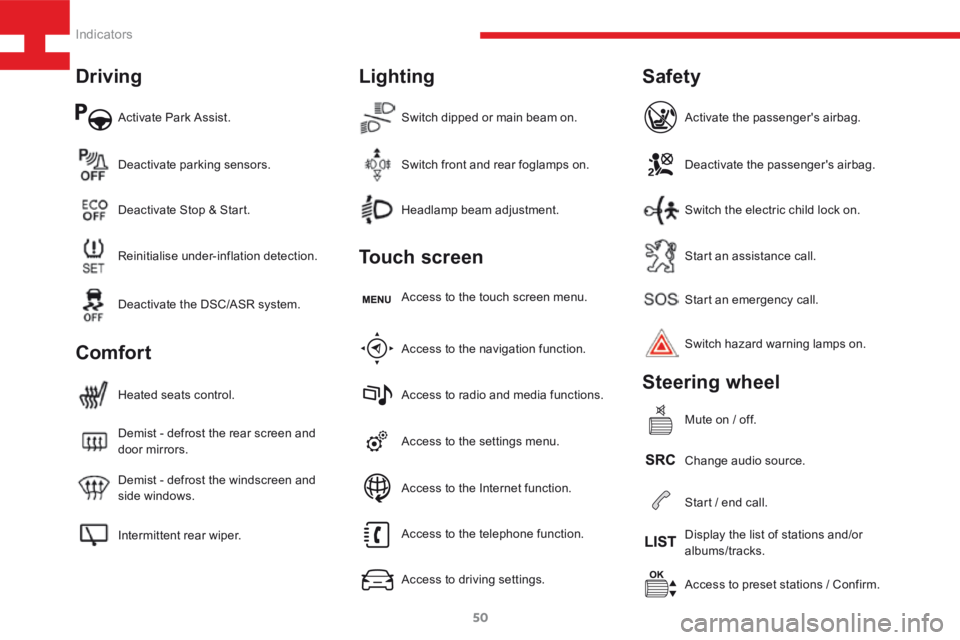
Activate Park Assist.
Intermittent rear wiper. Demist - defrost the windscreen and
side windows. Demist - defrost the rear screen and
door mirrors. Heated seats control.Access to the settings menu.Start an emergency call.
Access to preset stations / Confirm.
Headlamp beam adjustment.
Deactivate parking sensors.
Access to the navigation function. Access to the touch screen menu.Deactivate the passenger's airbag.
Change audio source. Switch hazard warning lamps on. Activate the passenger's airbag.
Mute on / off.
Switch dipped or main beam on.
Reinitialise under-inflation detection. Deactivate Stop & Start.
Access to radio and media functions.Start an assistance call.
Display the list of stations and/or
albums/tracks.
Switch front and rear foglamps on.
Deactivate the DSC/ASR system.
Access to the telephone function.
Access to driving settings.Switch the electric child lock on.
Start / end call.
Access to the Internet function.
Driving
Comfort Lighting
Touch screen
Safety
Steering wheel
Indicators
Page 71 of 341

69
208_en_Chap04_confort_ed01-2015
Ventilation
Air intake
The air circulating in the passenger
compartment is filtered and originates either
from the outside via the grille located at the
base of the windscreen or from the inside in air
recirculation mode.
Air intake flow
The incoming air follows various paths
depending on the controls selected by the
driver:
- direct arrival in the passenger
compartment (air intake),
- passage through a heating circuit (heating),
- passage through a cooling circuit (air
conditioning).
Control panel
The controls of this system are grouped
together on the control panel on the centre
console.
General points
Air distribution
The incoming air is distributed via various
outlets:
- windscreen demisting-defrosting vents,
- front side window demisting-defrosting
vents,
- side adjustable air vents,
- central adjustable air vents,
- air outlets to the front footwells,
- air outlets to the rear footwells.
4
Comfort
Page 74 of 341

72
208_en_Chap04_confort_ed01-2015
Demist - defrost
These markings on the control panel
indicate the control positions for
rapid demisting or defrosting of the
windscreen and side windows.
Manual air conditioning
With Stop & Start, when demisting has
been activated, the STOP mode is not
available.
Dual-zone digital air conditioning
Auto - Visibility programme
Switching on
Windscreen
Operation
F Press the "A /C " button again;
the indicator lamp in the button
goes off. F
Press the "visibility" button
again or on "AUTO" ; the
indicator lamp in the button goes
off and the indicator lamp in the
"AUTO" button comes on.
Switching on
F Put the air flow, temperature
and distribution controls to the
dedicated marked position. F
Press the " visibility" button to
demist or defrost the windscreen
and side windows as quickly as
possible.
Switching off
The system automatically manages the air
conditioning, air flow and air intake, and
provides optimum distribution towards the
windscreen and side windows.
Switching off
The system reverts to the previous settings.
F
Press the "A /C " button for air
conditioning; the indicator lamp
in the button comes on.
Comfort
Page 75 of 341

73
208_en_Chap04_confort_ed01-2015
F Switch off the demisting/defrosting
of the rear screen and electric door
mirrors as soon as appropriate, as
lower current consumption results
in reduced fuel consumption.
Advice
Door mirrors
Demisting - Defrosting
To demist or defrost the electric door
mirrors, with the engine running
press the heated rear window switch.
Rear screen
Switching on
F
Press this button to demist /defrost the rear
screen and (depending on version) the
electric door mirrors. The indicator lamp
associated with the button comes on. The control button is located on the
air conditioning system control panel.
The rear screen demisting/defrosting can only
operate when the engine is running.
Operation
Switching off
The demisting/defrosting switches off
automatically to prevent an excessive
consumption of current.
F It is possible to stop the demisting/
defrosting operation before it is switched
off automatically by pressing the button
again. The indicator lamp associated with
the button goes off.
4
Comfort
Page 77 of 341

75
208_en_Chap04_confort_ed01-2015
Recirculation of the air in the vehicle isolates
the passenger compartment from exterior
odours and fumes.
Return to the intake of exterior air as soon as
possible to avoid the risk of deterioration of air
quality and misting.
Air intake / Air recirculation
F Press the button to recirculate
the interior air: the indicator lamp
is on.
F Press the button again to allow the intake
of exterior air: the indicator lamp is off.
Adjusting the air distribution
Windscreen and side windows.
Windscreen, side windows and
footwells.
Footwells.
Centre and side air vents.
The air distribution can be
modulated by placing the knob at an
intermediate position.
4
Comfort
Page 79 of 341

77
208_en_Chap04_confort_ed01-2015
Air conditioning On / Off
It enables you to:
- lower the temperature, in summer,
- increase the effectiveness of the demisting
in winter, above 3 °C.
Switching on
F Press the "A /C " button, the button's
indicator lamp comes on.
Switching off
F Press the "A /C " button again, the button's
indicator lamp goes off.
Switching off may affect comfort levels
(humidity, condensation). The air conditioning is designed to
operate effectively in all seasons,
with the windows closed.
The air conditioning does not operate
when the air flow adjustment control is
in position "0" .
To obtain cooled air more quickly, you can use
recirculation of interior air for a few moments.
Then return to fresh air intake.
Air distribution adjustment
Windscreen and side windows.
Windscreen, side windows and
footwells.
Footwells.
Central and side vents.
The air distribution can be adapted
by placing the dial in an intermediate
position. The recirculation of interior air insulates the
passenger compartment from exterior odours
and smoke.
Return to exterior air intake as soon as possible
to prevent deterioration of the air quality and
the formation of mist.
Air intake / Air recirculation
F
Press the button to recirculate
the interior air: the indicator lamp
is on.
F Press the button again to allow fresh air
into the passenger compartment: the
indicator lamp is off.
4
Comfort