check engine PEUGEOT 3008 2012 User Guide
[x] Cancel search | Manufacturer: PEUGEOT, Model Year: 2012, Model line: 3008, Model: PEUGEOT 3008 2012Pages: 328, PDF Size: 62.62 MB
Page 90 of 328
DIESEL
88
ACCESS
Quality of the fuel used for
petrol engines
The petrol engines are perfectly com-
patible with E10 or E24 type petrol
biofuels (containing 10 % or 24 % etha-
nol), conforming to European standards
EN 228 and EN 15376.
E85 type fuels (containing up to 85 %
ethanol) are reserved exclusively for ve-
hicles marketed for the use of this type
of fuel (BioFlex vehicles). The quality of
the ethanol must comply with European
standard EN 15293.
For Brazil only, special vehicles are
marketed to run on fuels containing up
to 100 % ethanol (E100 type).
Quality of the fuel used for
Diesel engines
The Diesel engines are perfectly com-
patible with biofuels which conform to
current and future European standards
(Diesel fuel which complies with stan-
dard EN 590 mixed with a biofuel which
complies with standard EN 14214)
available at the pumps (containing up
to 7 % Fatty Acid Methyl Ester).
The B30 biofuel can be used in cer-
tain Diesel engines; however, this use
is subject to strict application of the
special servicing conditions. Contact a
PEUGEOT dealer or a qualifi ed work-
shop.
The use of any other type of (bio)fuel
(vegetable or animal oils, pure or dilut-
ed, domestic fuel...) is strictly prohibited
(risk of damage to the engine and fuel
system).
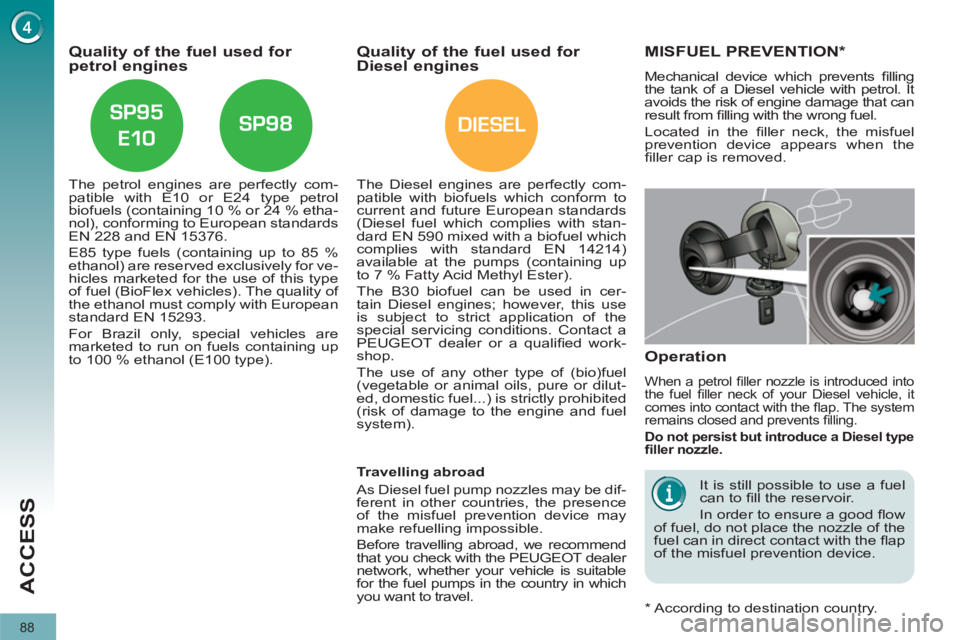
MISFUEL PREVENTION *
Mechanical device which prevents fi lling
the tank of a Diesel vehicle with petrol. It
avoids the risk of engine damage that can
result from fi lling with the wrong fuel.
Located in the fi ller neck, the misfuel
prevention device appears when the
fi ller cap is removed.
Operation
When a petrol fi ller nozzle is introduced into
the fuel fi ller neck of your Diesel vehicle, it
comes into contact with the fl ap. The system
remains closed and prevents fi lling.
Do not persist but introduce a Diesel type
fi ller nozzle.
It is still possible to use a fuel
can to fi ll the reservoir.
In order to ensure a good fl ow
of fuel, do not place the nozzle of the
fuel can in direct contact with the fl ap
of the misfuel prevention device.
Travelling abroad
As Diesel fuel pump nozzles may be dif-
ferent in other countries, the presence
of the misfuel prevention device may
make refuelling impossible.
Before travelling abroad, we recommend
that you check with the PEUGEOT dealer
network, whether your vehicle is suitable
for the fuel pumps in the country in which
you want to travel.
* According to destination country.
Page 129 of 328
127
SAFETY
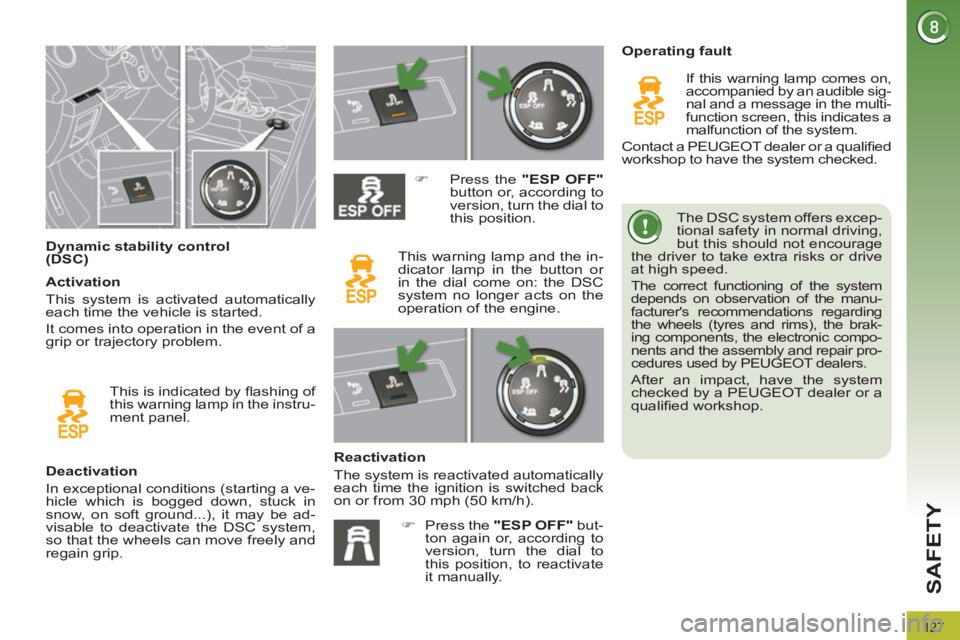
Dynamic stability control
(DSC) The DSC system offers excep-
tional safety in normal driving,
but this should not encourage
the driver to take extra risks or drive
at high speed.
The correct functioning of the system
depends on observation of the manu-
facturer's recommendations regarding
the wheels (tyres and rims), the brak-
ing components, the electronic compo-
nents and the assembly and repair pro-
cedures used by PEUGEOT dealers.
After an impact, have the system
checked by a PEUGEOT dealer or a
qualifi ed workshop.
Deactivation
In exceptional conditions (starting a ve-
hicle which is bogged down, stuck in
snow, on soft ground...), it may be ad-
visable to deactivate the DSC system,
so that the wheels can move freely and
regain grip.
)
Press the "ESP OFF"
button or, according to
version, turn the dial to
this position.
This warning lamp and the in-
dicator lamp in the button or
in the dial come on: the DSC
system no longer acts on the
operation of the engine.
Reactivation
The system is reactivated automatically
each time the ignition is switched back
on or from 30 mph (50 km/h).
Operating fault
If this warning lamp comes on,
accompanied by an audible sig-
nal and a message in the multi-
function screen, this indicates a
malfunction of the system.
Contact a PEUGEOT dealer or a qualifi ed
workshop to have the system checked.
This is indicated by fl ashing of
this warning lamp in the instru-
ment panel.
Activation
This system is activated automatically
each time the vehicle is started.
It comes into operation in the event of a
grip or trajectory problem.
)
Press the "ESP OFF"
but-
ton again or, according to
version, turn the dial to
this position, to reactivate
it manually.
Page 133 of 328
131
SAFETY
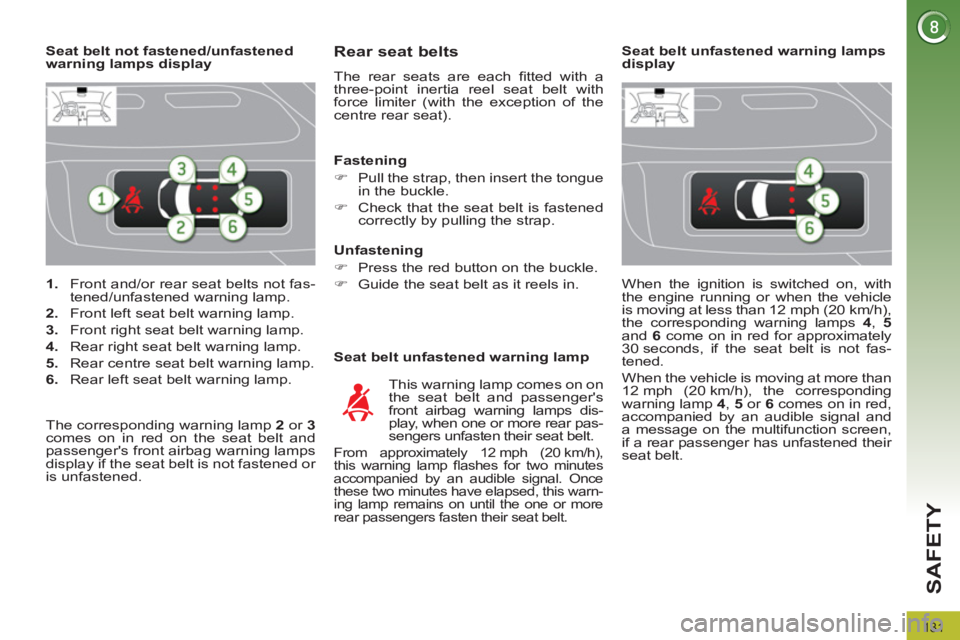
1.
Front and/or rear seat belts not fas-
tened/unfastened warning lamp.
2.
Front left seat belt warning lamp.
3.
Front right seat belt warning lamp.
4.
Rear right seat belt warning lamp.
5.
Rear centre seat belt warning lamp.
6.
Rear left seat belt warning lamp.
Seat belt not fastened/unfastened
warning lamps display
Rear seat belts
The rear seats are each fi tted with a
three-point inertia reel seat belt with
force limiter (with the exception of the
centre rear seat).
Seat belt unfastened warning lamp
This warning lamp comes on on
the seat belt and passenger's
front airbag warning lamps dis-
play, when one or more rear pas-
sengers unfasten their seat belt.
From approximately 12 mph (20 km/h),
this warning lamp fl ashes for two minutes
accompanied by an audible signal. Once
these two minutes have elapsed, this warn-
ing lamp remains on until the one or more
rear passengers fasten their seat belt.
Fastening
)
Pull the strap, then insert the tongue
in the buckle.
)
Check that the seat belt is fastened
correctly by pulling the strap.
Unfastening
)
Press the red button on the buckle.
)
Guide the seat belt as it reels in.
The corresponding warning lamp 2
or 3
comes on in red on the seat belt and
passenger's front airbag warning lamps
display if the seat belt is not fastened or
is unfastened.
When the ignition is switched on, with
the engine running or when the vehicle
is moving at less than 12 mph (20 km/h),
the corresponding warning lamps 4
, 5
and 6
come on in red for approximately
30 seconds, if the seat belt is not fas-
tened.
When the vehicle is moving at more than
12 mph (20 km/h), the corresponding
warning lamp 4
, 5
or 6
comes on in red,
accompanied by an audible signal and
a message on the multifunction screen,
if a rear passenger has unfastened their
seat belt.
Seat belt unfastened warning lamps
display
Page 140 of 328
138
DRIVING
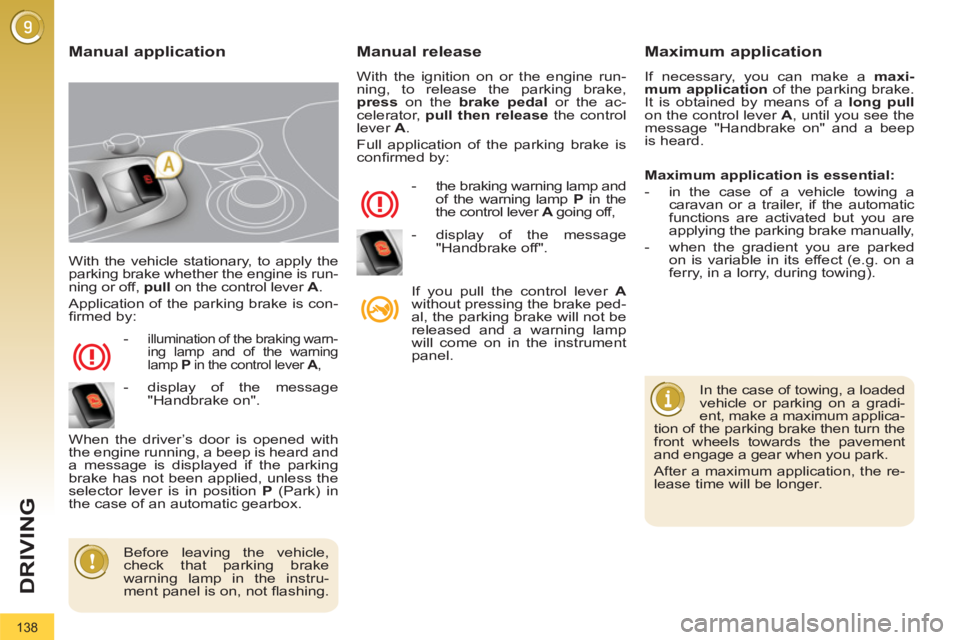
With the vehicle stationary, to apply the
parking brake whether the engine is run-
ning or off, pull
on the control lever A
.
Application of the parking brake is con-
fi rmed by:
-
illumination of the braking warn-
ing lamp and of the warning
lamp P
in the control lever A
,
When the driver’s door is opened with
the engine running, a beep is heard and
a message is displayed if the parking
brake has not been applied, unless the
selector lever is in position P
(Park) in
the case of an automatic gearbox.
Manual release
With the ignition on or the engine run-
ning, to release the parking brake,
press
on the brake
pedal
or the ac-
celerator, pull then release
the control
lever A
.
Full application of the parking brake is
confi rmed by:
- the braking warning lamp and
of the warning lamp P
in the
the control lever A
going off,
If you pull the control lever A
without pressing the brake ped-
al, the parking brake will not be
released and a warning lamp
will come on in the instrument
panel.
Manual application
Maximum application
If necessary, you can make a maxi-
mum application
of the parking brake.
It is obtained by means of a long pull
on the control lever A
, until you see the
message "Handbrake on" and a beep
is heard.
In the case of towing, a loaded
vehicle or parking on a gradi-
ent, make a maximum applica-
tion of the parking brake then turn the
front wheels towards the pavement
and engage a gear when you park.
After a maximum application, the re-
lease time will be longer.
Before leaving the vehicle,
check that parking brake
warning lamp in the instru-
ment panel is on, not fl ashing.
Maximum application is essential:
- in the case of a vehicle towing a
caravan or a trailer, if the automatic
functions are activated but you are
applying the parking brake manually,
- when the gradient you are parked
on is variable in its effect (e.g. on a
ferry, in a lorry, during towing).
- display of the message
"Handbrake on".
- display of the message
"Handbrake off".
Page 141 of 328
139
DRIVING
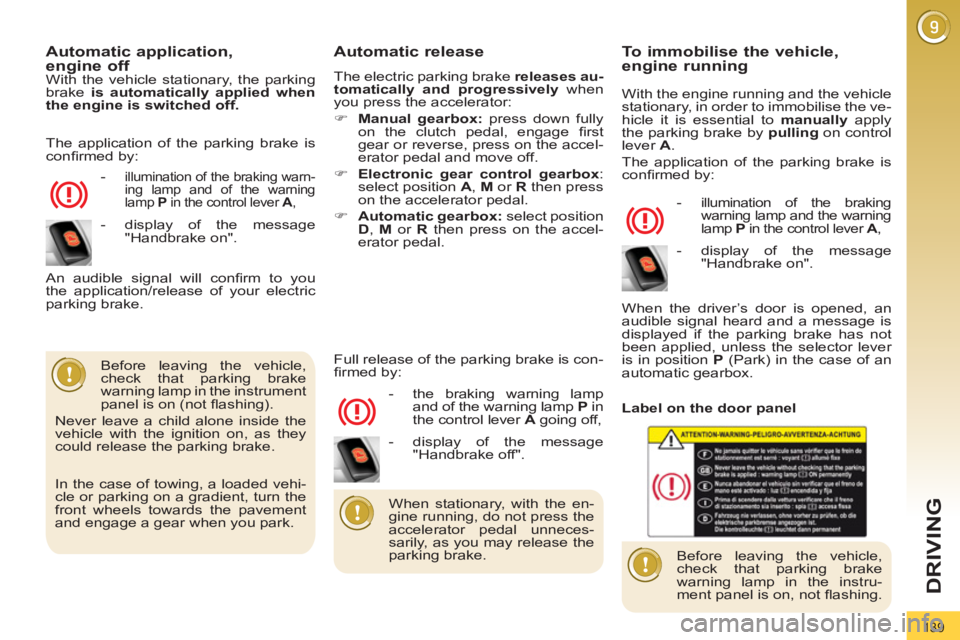
Automatic application,
engine off
With the vehicle stationary, the parking
brake is automatically applied when
the engine is switched off.
-
illumination of the braking warn-
ing lamp and of the warning
lamp P
in the control lever A
,
Automatic release
The electric parking brake releases au-
tomatically and progressively
when
you press the accelerator:
)
Manual gearbox:
press down fully
on the clutch pedal, engage fi rst
gear or reverse, press on the accel-
erator pedal and move off.
)
Electronic gear control gearbox
:
select position A
, M
or R
then press
on the accelerator pedal.
)
Automatic gearbox:
select position
D
, M
or R
then press on the accel-
erator pedal.
Before leaving the vehicle,
check that parking brake
warning lamp in the instrument
panel is on (not fl ashing).
Never leave a child alone inside the
vehicle with the ignition on, as they
could release the parking brake.
- the braking warning lamp
and of the warning lamp P
in
the control lever A
going off, An audible signal will confi rm to you
the application/release of your electric
parking brake.
Full release of the parking brake is con-
fi rmed by:
To immobilise the vehicle,
engine running
With the engine running and the vehicle
stationary, in order to immobilise the ve-
hicle it is essential to manually
apply
the parking brake by pulling
on control
lever A
.
The application of the parking brake is
confi rmed by:
-
illumination of the braking
warning lamp and the warning
lamp P
in the control lever A
,
When the driver’s door is opened, an
audible signal heard and a message is
displayed if the parking brake has not
been applied, unless the selector lever
is in position P
(Park) in the case of an
automatic gearbox.
Before leaving the vehicle,
check that parking brake
warning lamp in the instru-
ment panel is on, not fl ashing.
When stationary, with the en-
gine running, do not press the
accelerator pedal unneces-
sarily, as you may release the
parking brake.
The application of the parking brake is
confi rmed by:
- display of the message
"Handbrake on".
In the case of towing, a loaded vehi-
cle or parking on a gradient, turn the
front wheels towards the pavement
and engage a gear when you park.
- display of the message
"Handbrake off".
- display of the message
"Handbrake on".
Label on the door panel
Page 144 of 328
142
DRIVING
HILL START ASSIST
System which keeps your vehicle im-
mobilised temporarily (approximately
2 seconds) when starting on a gradi-
ent, the time it takes to move your foot
from the brake pedal to the accelerator
pedal.
This system only operates when:
- the vehicle is completely stationary,
with your foot on the brake pedal,
- in particular conditions on a slope,
- with the driver’s door closed.
The hill start assist system cannot be
deactivated.
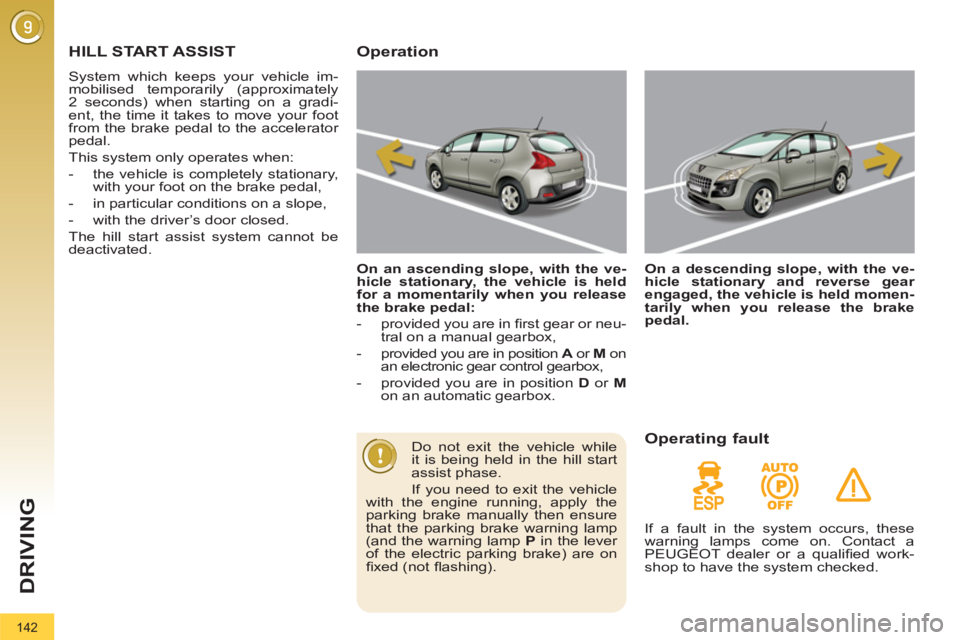
Operation
On an ascending slope, with the ve-
hicle stationary, the vehicle is held
for a momentarily when you release
the brake pedal:
- provided you are in fi rst gear or neu-
tral on a manual gearbox,
- provided you are in position A
or M
on
an electronic gear control gearbox,
- provided you are in position D
or M
on an automatic gearbox.
On a descending slope, with the ve-
hicle stationary and reverse gear
engaged, the vehicle is held momen-
tarily when you release the brake
pedal.
Do not exit the vehicle while
it is being held in the hill start
assist phase.
If you need to exit the vehicle
with the engine running, apply the
parking brake manually then ensure
that the parking brake warning lamp
(and the warning lamp P
in the lever
of the electric parking brake) are on
fi xed (not fl ashing).
Operating fault
If a fault in the system occurs, these
warning lamps come on. Contact a
PEUGEOT dealer or a qualifi ed work-
shop to have the system checked.
Page 159 of 328
157
DRIVING
Stopping the vehicle
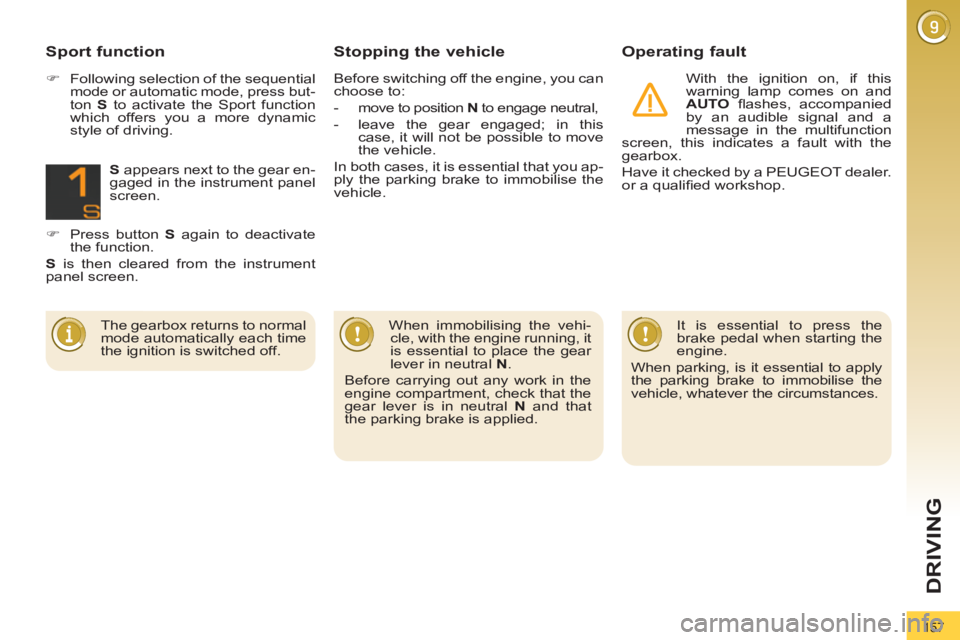
Operating fault
With the ignition on, if this
warning lamp comes on and
AUTO
fl ashes, accompanied
by an audible signal and a
message in the multifunction
screen, this indicates a fault with the
gearbox.
Have it checked by a PEUGEOT dealer.
or a qualifi ed workshop.
It is essential to press the
brake pedal when starting the
engine.
When parking, is it essential to apply
the parking brake to immobilise the
vehicle, whatever the circumstances.
When immobilising the vehi-
cle, with the engine running, it
is essential to place the gear
lever in neutral N
.
Before carrying out any work in the
engine compartment, check that the
gear lever is in neutral N
and that
the parking brake is applied.
Sport function
)
Following selection of the sequential
mode or automatic mode, press but-
ton S
to activate the Sport function
which offers you a more dynamic
style of driving.
S
appears next to the gear en-
gaged in the instrument panel
screen.
)
Press button S
again to deactivate
the function.
S
is then cleared from the instrument
panel screen.
The gearbox returns to normal
mode automatically each time
the ignition is switched off.
Before switching off the engine, you can
choose to:
- move to position N
to engage neutral,
- leave the gear engaged; in this
case, it will not be possible to move
the vehicle.
In both cases, it is essential that you ap-
ply the parking brake to immobilise the
vehicle.
Page 162 of 328
160
DRIVING
Stopping the vehicle
Before switching off the engine, you
can engage position P
or N
to place the
gearbox in neutral.
In both cases, apply the parking brake
to immobilise the vehicle, unless it is
programmed to automatic mode.
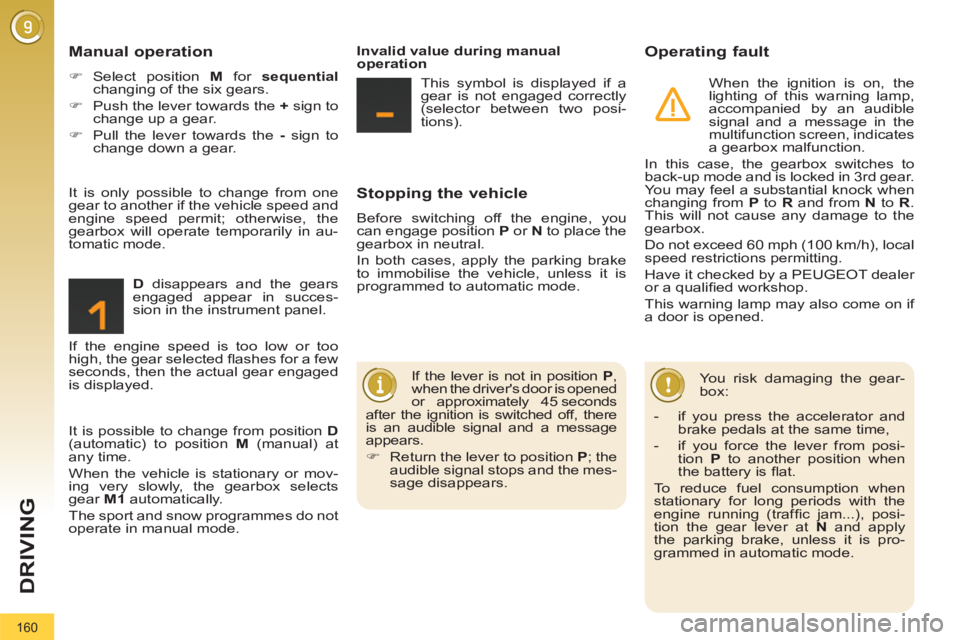
Operating fault
When the ignition is on, the
lighting of this warning lamp,
accompanied by an audible
signal and a message in the
multifunction screen, indicates
a gearbox malfunction.
In this case, the gearbox switches to
back-up mode and is locked in 3rd gear.
You may feel a substantial knock when
changing from P
to R
and from N
to R
.
This will not cause any damage to the
gearbox.
Do not exceed 60 mph (100 km/h), local
speed restrictions permitting.
Have it checked by a PEUGEOT dealer
or a qualifi ed workshop.
This warning lamp may also come on if
a door is opened.
You risk damaging the gear-
box:
Manual operation
)
Select position M
for sequential
changing of the six gears.
)
Push the lever towards the +
sign to
change up a gear.
)
Pull the lever towards the -
sign to
change down a gear.
D
disappears and the gears
engaged appear in succes-
sion in the instrument panel.
If the lever is not in position P
,
when the driver's door is opened
or approximately 45 seconds
after the ignition is switched off, there
is an audible signal and a message
appears.
)
Return the lever to position P
; the
audible signal stops and the mes-
sage disappears.
It is only possible to change from one
gear to another if the vehicle speed and
engine speed permit; otherwise, the
gearbox will operate temporarily in au-
tomatic mode.
Invalid value during manual
operation
This symbol is displayed if a
gear is not engaged correctly
(selector between two posi-
tions).
It is possible to change from position D
(automatic) to position M
(manual) at
any time.
When the vehicle is stationary or mov-
ing very slowly, the gearbox selects
gear M1
automatically.
The sport and snow programmes do not
operate in manual mode. If the engine speed is too low or too
high, the gear selected fl ashes for a few
seconds, then the actual gear engaged
is displayed.
- if you press the accelerator and
brake pedals at the same time,
- if you force the lever from posi-
tion P
to another position when
the battery is fl at.
To reduce fuel consumption when
stationary for long periods with the
engine running (traffi c jam...), posi-
tion the gear lever at N
and apply
the parking brake, unless it is pro-
grammed in automatic mode.
Page 165 of 328
163
DRIVING
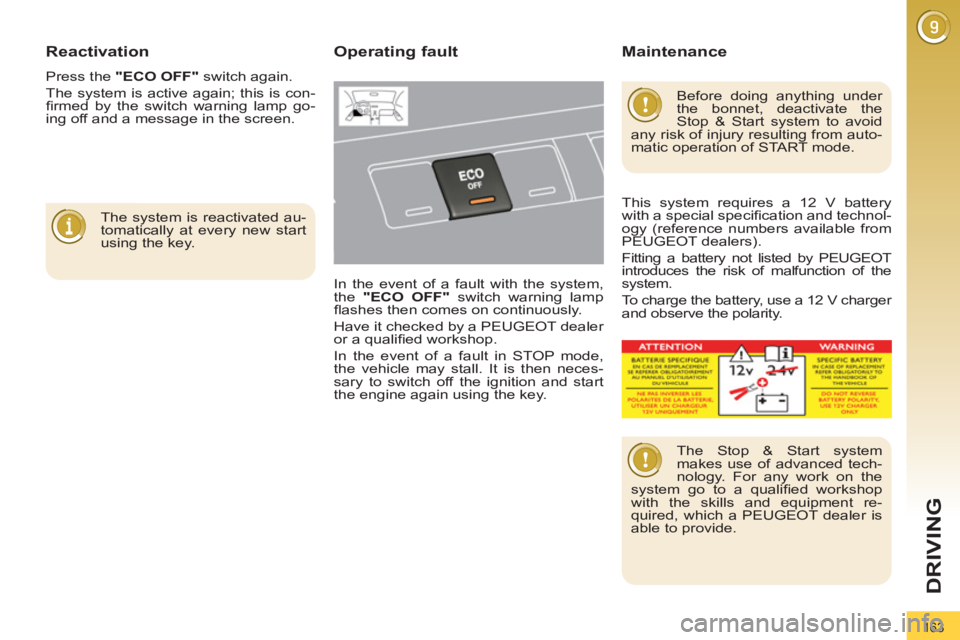
Reactivation
Press the "ECO OFF"
switch again.
The system is active again; this is con-
fi rmed by the switch warning lamp go-
ing off and a message in the screen.
The system is reactivated au-
tomatically at every new start
using the key.
Operating fault
In the event of a fault with the system,
the "ECO OFF"
switch warning lamp
fl ashes then comes on continuously.
Have it checked by a PEUGEOT dealer
or a qualifi ed workshop.
In the event of a fault in STOP mode,
the vehicle may stall. It is then neces-
sary to switch off the ignition and start
the engine again using the key.
Before doing anything under
the bonnet, deactivate the
Stop & Start system to avoid
any risk of injury resulting from auto-
matic operation of START mode.
The Stop & Start system
makes use of advanced tech-
nology. For any work on the
system go to a qualifi ed workshop
with the skills and equipment re-
quired, which a PEUGEOT dealer is
able to provide.
Maintenance
This system requires a 12 V battery
with a special specifi cation and technol-
ogy (reference numbers available from
PEUGEOT dealers).
Fitting a battery not listed by PEUGEOT
introduces the risk of malfunction of the
system.
To charge the battery, use a 12 V charger
and observe the polarity.
Page 168 of 328
166
CHECKS
PEUGEOT & TOTAL
PARTNERS IN PERFORMANCE
AND PROTECTION OF THE
ENVIRONMENT
Innovation at the service of performance
The TOTAL Research and Development teams
develop lubricants for PEUGEOT which satisfy
the requirements of the latest technical innova-
tions incorporated in PEUGEOT vehicles.
This ensures that you obtain the best perfor-
mance and the maximum engine life.
Reduced exhaust emissions
TOTAL lubricants are formulated to optimise
the effi ciency of engines and the protection
of the emissions post-treatment systems. It
is crucial to observe the servicing recom-
mendations made by PEUGEOT to ensure
correct operation.
RECOMMENDS