engine PEUGEOT 3008 2012 Owner's Guide
[x] Cancel search | Manufacturer: PEUGEOT, Model Year: 2012, Model line: 3008, Model: PEUGEOT 3008 2012Pages: 328, PDF Size: 62.62 MB
Page 90 of 328
DIESEL
88
ACCESS
Quality of the fuel used for
petrol engines
The petrol engines are perfectly com-
patible with E10 or E24 type petrol
biofuels (containing 10 % or 24 % etha-
nol), conforming to European standards
EN 228 and EN 15376.
E85 type fuels (containing up to 85 %
ethanol) are reserved exclusively for ve-
hicles marketed for the use of this type
of fuel (BioFlex vehicles). The quality of
the ethanol must comply with European
standard EN 15293.
For Brazil only, special vehicles are
marketed to run on fuels containing up
to 100 % ethanol (E100 type).
Quality of the fuel used for
Diesel engines
The Diesel engines are perfectly com-
patible with biofuels which conform to
current and future European standards
(Diesel fuel which complies with stan-
dard EN 590 mixed with a biofuel which
complies with standard EN 14214)
available at the pumps (containing up
to 7 % Fatty Acid Methyl Ester).
The B30 biofuel can be used in cer-
tain Diesel engines; however, this use
is subject to strict application of the
special servicing conditions. Contact a
PEUGEOT dealer or a qualifi ed work-
shop.
The use of any other type of (bio)fuel
(vegetable or animal oils, pure or dilut-
ed, domestic fuel...) is strictly prohibited
(risk of damage to the engine and fuel
system).
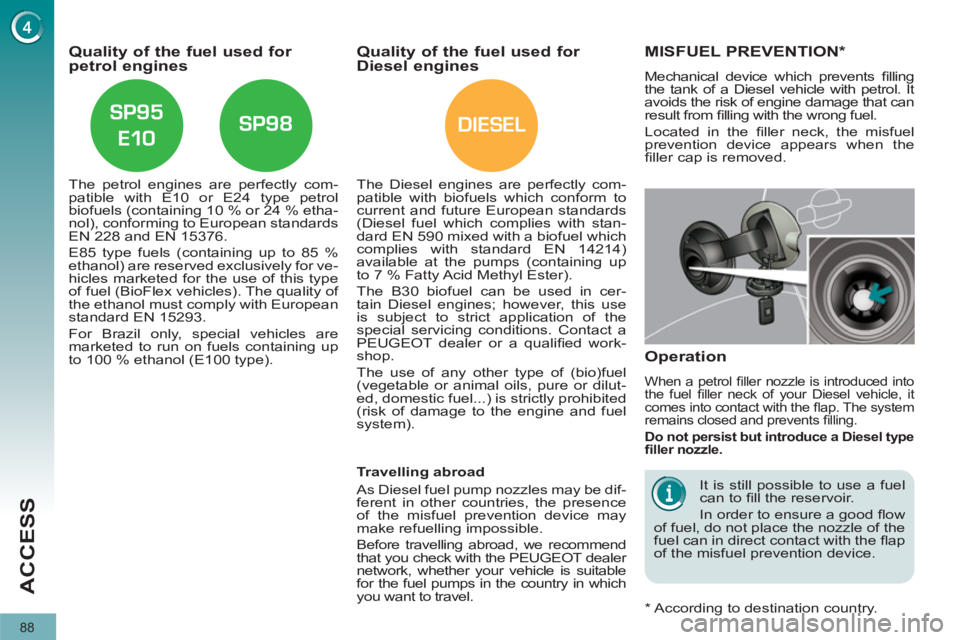
MISFUEL PREVENTION *
Mechanical device which prevents fi lling
the tank of a Diesel vehicle with petrol. It
avoids the risk of engine damage that can
result from fi lling with the wrong fuel.
Located in the fi ller neck, the misfuel
prevention device appears when the
fi ller cap is removed.
Operation
When a petrol fi ller nozzle is introduced into
the fuel fi ller neck of your Diesel vehicle, it
comes into contact with the fl ap. The system
remains closed and prevents fi lling.
Do not persist but introduce a Diesel type
fi ller nozzle.
It is still possible to use a fuel
can to fi ll the reservoir.
In order to ensure a good fl ow
of fuel, do not place the nozzle of the
fuel can in direct contact with the fl ap
of the misfuel prevention device.
Travelling abroad
As Diesel fuel pump nozzles may be dif-
ferent in other countries, the presence
of the misfuel prevention device may
make refuelling impossible.
Before travelling abroad, we recommend
that you check with the PEUGEOT dealer
network, whether your vehicle is suitable
for the fuel pumps in the country in which
you want to travel.
* According to destination country.
Page 99 of 328
97
VISIBILITY
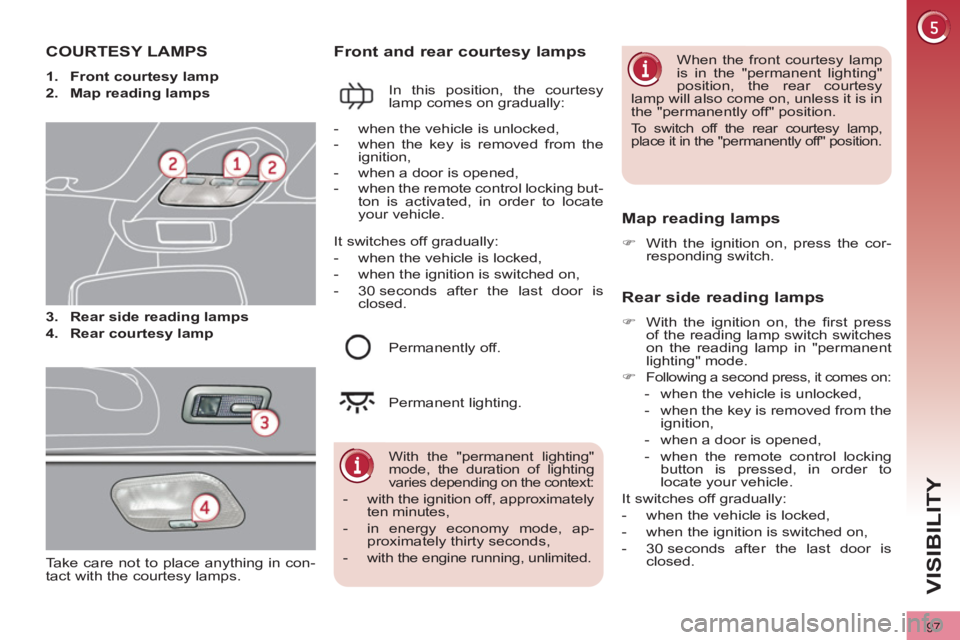
COURTESY LAMPS
1.
Front courtesy lamp
2.
Map reading lamps
3.
Rear side reading lamps
4.
Rear courtesy lamp
Front and rear courtesy lamps
In this position, the courtesy
lamp comes on gradually:
Map reading lamps
)
With the ignition on, press the cor-
responding switch.
With the "permanent lighting"
mode, the duration of lighting
varies depending on the context:
- with the ignition off, approximately
ten minutes,
- in energy economy mode, ap-
proximately thirty seconds,
- with the engine running, unlimited.
- when the vehicle is unlocked,
- when the key is removed from the
ignition,
- when a door is opened,
- when the remote control locking but-
ton is activated, in order to locate
your vehicle.
Permanently off.
Permanent lighting. When the front courtesy lamp
is in the "permanent lighting"
position, the rear courtesy
lamp will also come on, unless it is in
the "permanently off" position.
To switch off the rear courtesy lamp,
place it in the "permanently off" position.
Rear side reading lamps
)
With the ignition on, the fi rst press
of the reading lamp switch switches
on the reading lamp in "permanent
lighting" mode.
)
Following a second press, it comes on:
- when the vehicle is unlocked,
- when the key is removed from the
ignition,
- when a door is opened,
- when the remote control locking
button is pressed, in order to
locate your vehicle.
It switches off gradually:
- when the vehicle is locked,
- when the ignition is switched on,
- 30 seconds after the last door is
closed.
It switches off gradually:
- when the vehicle is locked,
- when the ignition is switched on,
- 30 seconds after the last door is
closed.
Take care not to place anything in con-
tact with the courtesy lamps.
Page 101 of 328
99
VISIBILITY
Different lighting times are
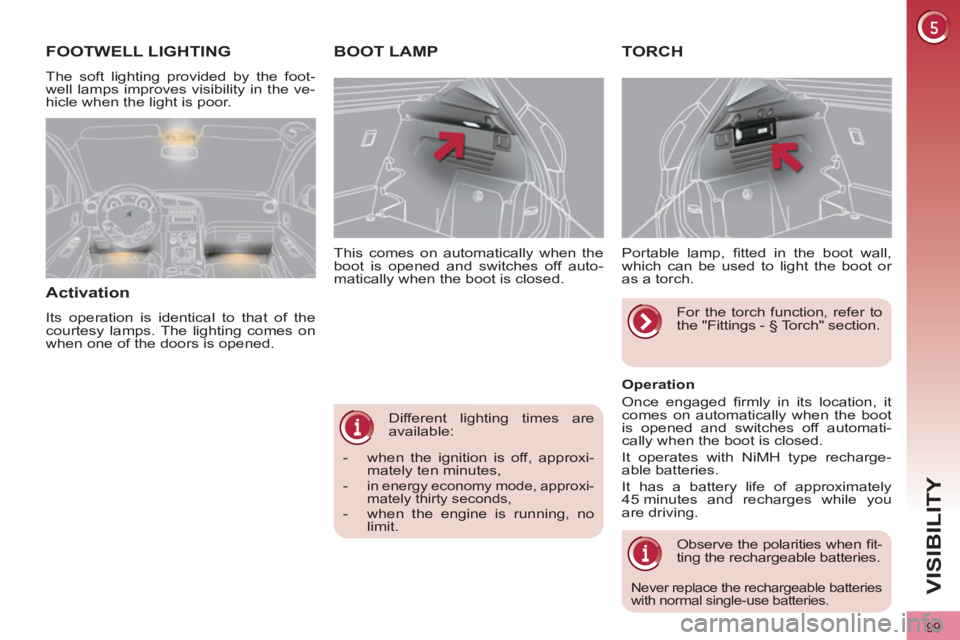
available: This comes on automatically when the
boot is opened and switches off auto-
matically when the boot is closed.
BOOT LAMP
TORCH
Portable lamp, fi tted in the boot wall,
which can be used to light the boot or
as a torch.
Operation
Once engaged fi rmly in its location, it
comes on automatically when the boot
is opened and switches off automati-
cally when the boot is closed.
It operates with NiMH type recharge-
able batteries.
It has a battery life of approximately
45 minutes and recharges while you
are driving.
Observe the polarities when fi t-
ting the rechargeable batteries.
Never replace the rechargeable batteries
with normal single-use batteries.
For the torch function, refer to
the "Fittings - § Torch" section.
FOOTWELL LIGHTING
The soft lighting provided by the foot-
well lamps improves visibility in the ve-
hicle when the light is poor.
Activation
Its operation is identical to that of the
courtesy lamps. The lighting comes on
when one of the doors is opened.
- when the ignition is off, approxi-
mately ten minutes,
-
in energy economy mode, approxi-
mately thirty seconds,
- when the engine is running, no
limit.
Page 106 of 328
104
FITTINGS
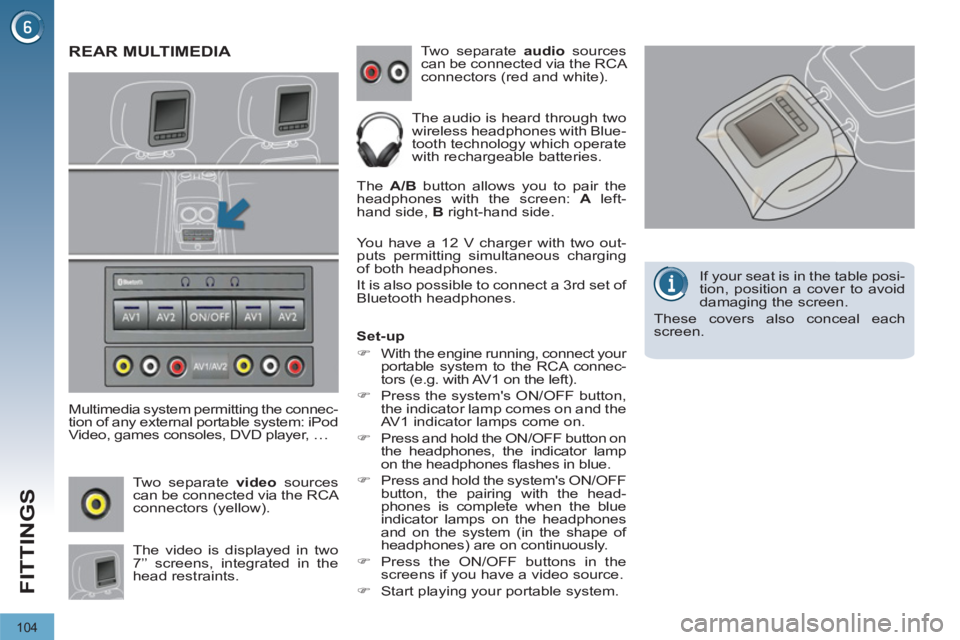
REAR MULTIMEDIA
Multimedia system permitting the connec-
tion of any external portable system: iPod
Video, games consoles, DVD player, …
Two separate video
sources
can be connected via the RCA
connectors (yellow).
The video is displayed in two
7’’ screens, integrated in the
head restraints. Two separate audio
sources
can be connected via the RCA
connectors (red and white).
The audio is heard through two
wireless headphones with Blue-
tooth technology which operate
with rechargeable batteries.
The A/B
button allows you to pair the
headphones with the screen: A
left-
hand side, B
right-hand side.
You have a 12 V charger with two out-
puts permitting simultaneous charging
of both headphones.
It is also possible to connect a 3rd set of
Bluetooth headphones.
Set-up
)
With the engine running, connect your
portable system to the RCA connec-
tors (e.g. with AV1 on the left).
)
Press the system's ON/OFF button,
the indicator lamp comes on and the
AV1 indicator lamps come on.
)
Press and hold the ON/OFF button on
the headphones, the indicator lamp
on the headphones fl ashes in blue.
)
Press and hold the system's ON/OFF
button, the pairing with the head-
phones is complete when the blue
indicator lamps on the headphones
and on the system (in the shape of
headphones) are on continuously.
)
Press the ON/OFF buttons in the
screens if you have a video source.
)
Start playing your portable system.
If your seat is in the table posi-
tion, position a cover to avoid
damaging the screen.
These covers also conceal each
screen.
Page 128 of 328
126
SAFETY
ELECTRONIC STABILITY
PROGRAMME (ESC)
Electronic Stability Programme (ESC:
Electronic Stability Control) incorporat-
ing the following systems:
- the anti-lock braking system (ABS)
and the electronic brake force distri-
bution (EBFD),
- the emergency braking assistance,
- the anti-slip regulation (ASR) or
traction control,
- the dynamic stability control (DSC).
Definitions
Anti-skid regulation (ASR)
The ASR system (also known as Trac-
tion Control) optimises traction in order
to avoid wheel slip by acting on the
brakes of the driving wheels and on the
engine. It also improves the directional
stability of the vehicle on acceleration.
Dynamic stability control (DSC)
If there is a difference between the path
followed by the vehicle and that re-
quired by the driver, the DSC monitors
each wheel and automatically acts on
the brake of one or more wheels and
on the engine to return the vehicle to
the required path, within the limits of the
laws of physics.
Emergency braking assistance
In an emergency, this system enables
you to reach the optimum braking pres-
sure more quickly and therefore reduce
the stopping distance.
It is triggered in relation to the speed at
which the brake pedal is pressed. This
is felt by a reduction in the resistance of
the pedal and an increase in the effec-
tiveness of the braking.
Anti-lock braking system (ABS) and
electronic brake force distribution
(EBFD)
This system improves the stability and
manoeuvrability of your vehicle when
braking and offers improved control in
corners, in particular on poor or slippery
road surfaces.
The ABS prevents wheel lock in the
event of emergency braking.
The electronic brake force distribution
system manages the braking pressure
wheel by wheel.
Operation
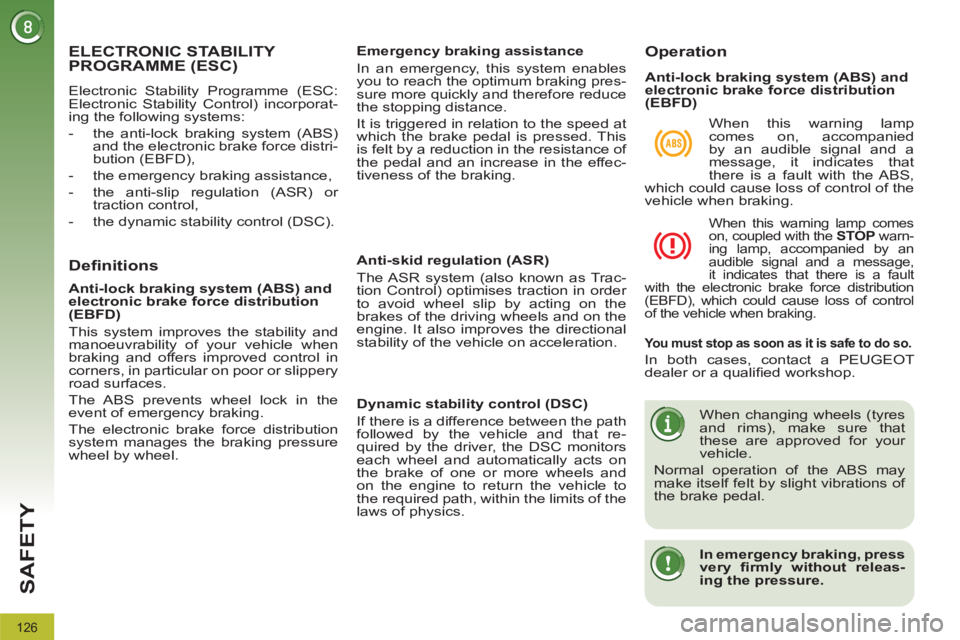
When this warning lamp
comes on, accompanied
by an audible signal and a
message, it indicates that
there is a fault with the ABS,
which could cause loss of control of the
vehicle when braking.
When this warning lamp comes
on, coupled with the STOP
warn-
ing lamp, accompanied by an
audible signal and a message,
it indicates that there is a fault
with the electronic brake force distribution
(EBFD), which could cause loss of control
of the vehicle when braking.
You must stop as soon as it is safe to do so.
In both cases, contact a PEUGEOT
dealer or a qualifi ed workshop.
When changing wheels (tyres
and rims), make sure that
these are approved for your
vehicle.
Normal operation of the ABS may
make itself felt by slight vibrations of
the brake pedal.
In emergency braking, press
very fi rmly without releas-
ing the pressure.
Anti-lock braking system (ABS) and
electronic brake force distribution
(EBFD)
Page 129 of 328
127
SAFETY
Dynamic stability control
(DSC) The DSC system offers excep-
tional safety in normal driving,
but this should not encourage
the driver to take extra risks or drive
at high speed.
The correct functioning of the system
depends on observation of the manu-
facturer's recommendations regarding
the wheels (tyres and rims), the brak-
ing components, the electronic compo-
nents and the assembly and repair pro-
cedures used by PEUGEOT dealers.
After an impact, have the system
checked by a PEUGEOT dealer or a
qualifi ed workshop.
Deactivation
In exceptional conditions (starting a ve-
hicle which is bogged down, stuck in
snow, on soft ground...), it may be ad-
visable to deactivate the DSC system,
so that the wheels can move freely and
regain grip.
)
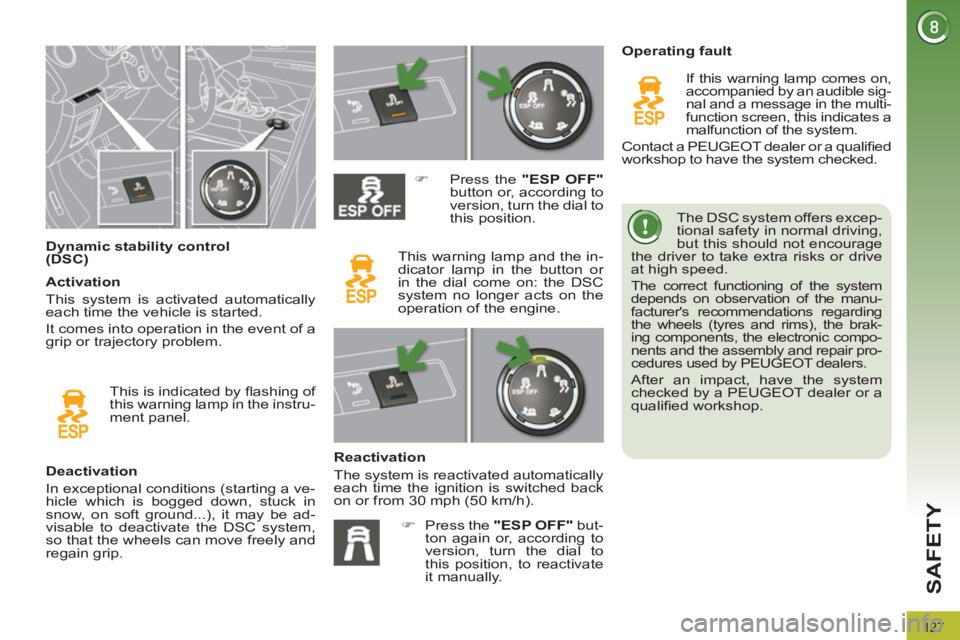
Press the "ESP OFF"
button or, according to
version, turn the dial to
this position.
This warning lamp and the in-
dicator lamp in the button or
in the dial come on: the DSC
system no longer acts on the
operation of the engine.
Reactivation
The system is reactivated automatically
each time the ignition is switched back
on or from 30 mph (50 km/h).
Operating fault
If this warning lamp comes on,
accompanied by an audible sig-
nal and a message in the multi-
function screen, this indicates a
malfunction of the system.
Contact a PEUGEOT dealer or a qualifi ed
workshop to have the system checked.
This is indicated by fl ashing of
this warning lamp in the instru-
ment panel.
Activation
This system is activated automatically
each time the vehicle is started.
It comes into operation in the event of a
grip or trajectory problem.
)
Press the "ESP OFF"
but-
ton again or, according to
version, turn the dial to
this position, to reactivate
it manually.
Page 130 of 328
128
SAFETY
GRIP CONTROL
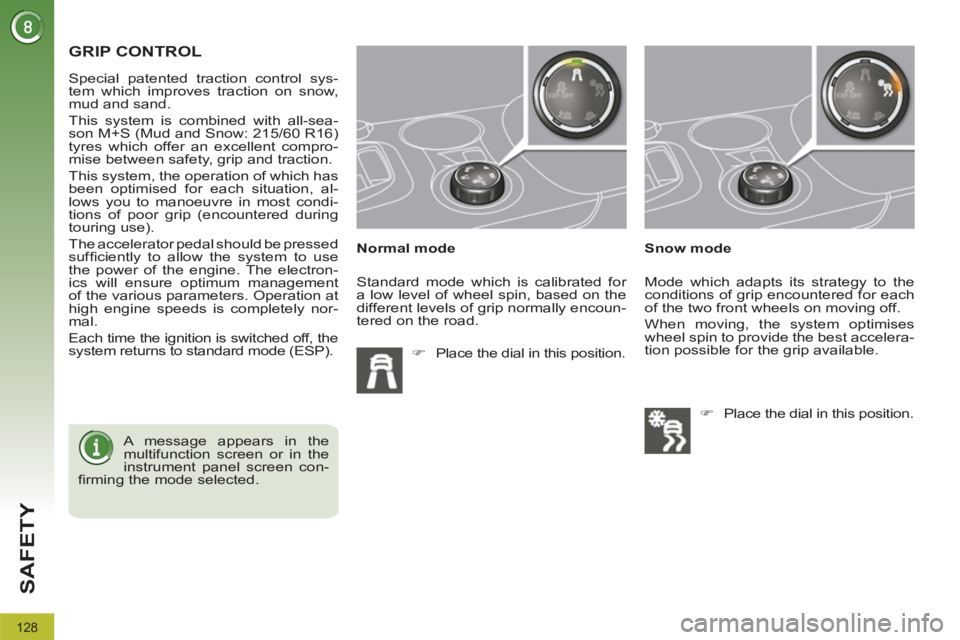
Normal mode
)
Place the dial in this position.
Snow mode Special patented traction control sys-
tem which improves traction on snow,
mud and sand.
This system is combined with all-sea-
son M+S (Mud and Snow: 215/60 R16)
tyres which offer an excellent compro-
mise between safety, grip and traction.
This system, the operation of which has
been optimised for each situation, al-
lows you to manoeuvre in most condi-
tions of poor grip (encountered during
touring use).
The accelerator pedal should be pressed
suffi ciently to allow the system to use
the power of the engine. The electron-
ics will ensure optimum management
of the various parameters. Operation at
high engine speeds is completely nor-
mal.
Each time the ignition is switched off, the
system returns to standard mode (ESP). Standard mode which is calibrated for
a low level of wheel spin, based on the
different levels of grip normally encoun-
tered on the road. Mode which adapts its strategy to the
conditions of grip encountered for each
of the two front wheels on moving off.
When moving, the system optimises
wheel spin to provide the best accelera-
tion possible for the grip available.
)
Place the dial in this position.
A message appears in the
multifunction screen or in the
instrument panel screen con-
fi rming the mode selected .
Page 133 of 328
131
SAFETY
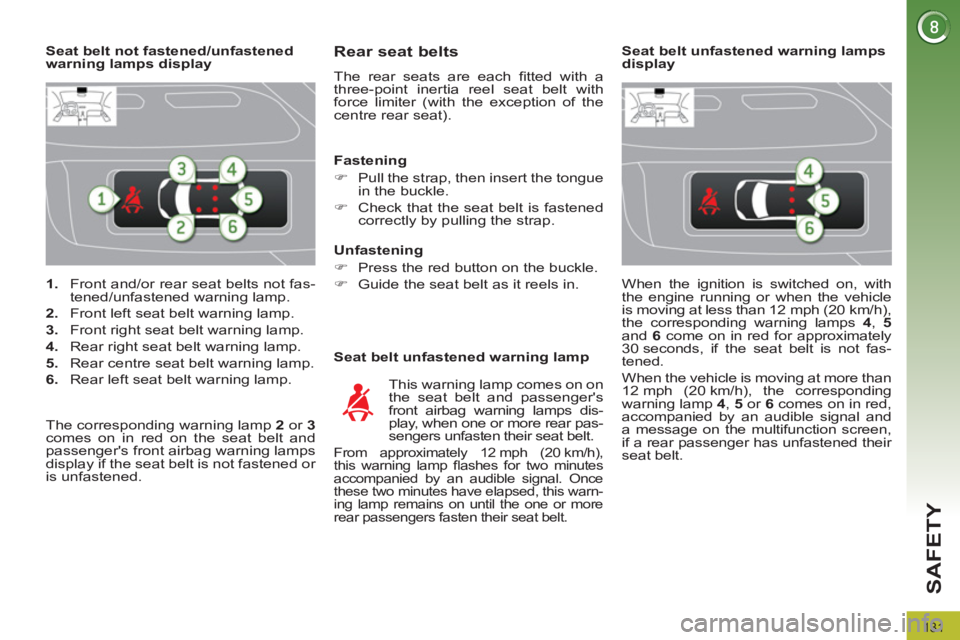
1.
Front and/or rear seat belts not fas-
tened/unfastened warning lamp.
2.
Front left seat belt warning lamp.
3.
Front right seat belt warning lamp.
4.
Rear right seat belt warning lamp.
5.
Rear centre seat belt warning lamp.
6.
Rear left seat belt warning lamp.
Seat belt not fastened/unfastened
warning lamps display
Rear seat belts
The rear seats are each fi tted with a
three-point inertia reel seat belt with
force limiter (with the exception of the
centre rear seat).
Seat belt unfastened warning lamp
This warning lamp comes on on
the seat belt and passenger's
front airbag warning lamps dis-
play, when one or more rear pas-
sengers unfasten their seat belt.
From approximately 12 mph (20 km/h),
this warning lamp fl ashes for two minutes
accompanied by an audible signal. Once
these two minutes have elapsed, this warn-
ing lamp remains on until the one or more
rear passengers fasten their seat belt.
Fastening
)
Pull the strap, then insert the tongue
in the buckle.
)
Check that the seat belt is fastened
correctly by pulling the strap.
Unfastening
)
Press the red button on the buckle.
)
Guide the seat belt as it reels in.
The corresponding warning lamp 2
or 3
comes on in red on the seat belt and
passenger's front airbag warning lamps
display if the seat belt is not fastened or
is unfastened.
When the ignition is switched on, with
the engine running or when the vehicle
is moving at less than 12 mph (20 km/h),
the corresponding warning lamps 4
, 5
and 6
come on in red for approximately
30 seconds, if the seat belt is not fas-
tened.
When the vehicle is moving at more than
12 mph (20 km/h), the corresponding
warning lamp 4
, 5
or 6
comes on in red,
accompanied by an audible signal and
a message on the multifunction screen,
if a rear passenger has unfastened their
seat belt.
Seat belt unfastened warning lamps
display
Page 139 of 328
137
DRIVING
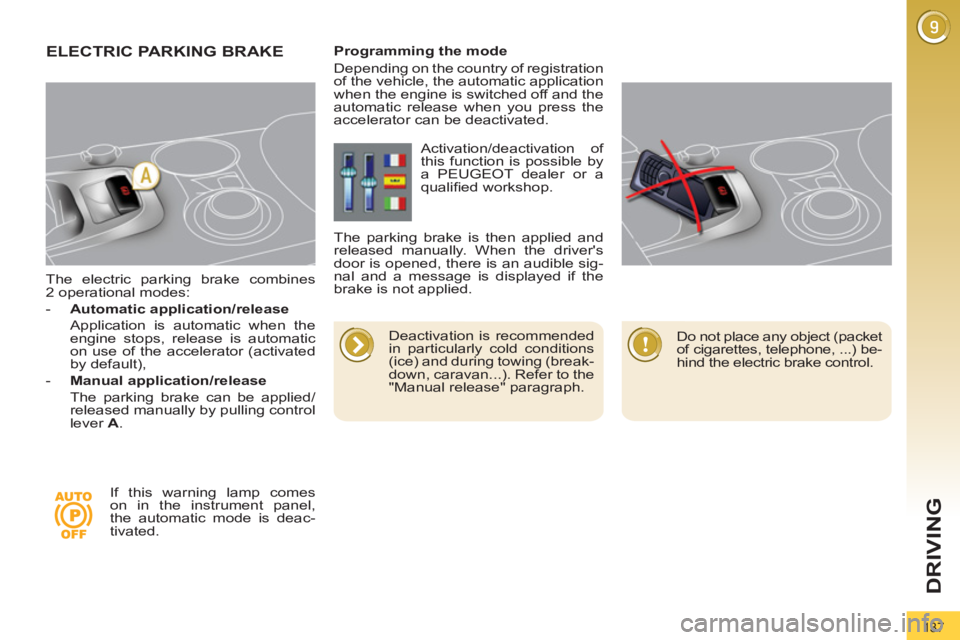
The electric parking brake combines
2 operational modes:
- Automatic application/release
Application is automatic when the
engine stops, release is automatic
on use of the accelerator (activated
by default),
- Manual application/release
The parking brake can be applied/
released manually by pulling control
lever A
.
ELECTRIC PARKING BRAKE
Deactivation is recommended
in particularly cold conditions
(ice) and during towing (break-
down, caravan...). Refer to the
"Manual release" paragraph.
Programming the mode
Depending on the country of registration
of the vehicle, the automatic application
when the engine is switched off and the
automatic release when you press the
accelerator can be deactivated.
If this warning lamp comes
on in the instrument panel,
the automatic mode is deac-
tivated. Activation/deactivation of
this function is possible by
a PEUGEOT dealer or a
qualifi ed workshop.
The parking brake is then applied and
released manually. When the driver's
door is opened, there is an audible sig-
nal and a message is displayed if the
brake is not applied.
Do not place any object (packet
of cigarettes, telephone, ...) be-
hind the electric brake control.
Page 140 of 328
138
DRIVING
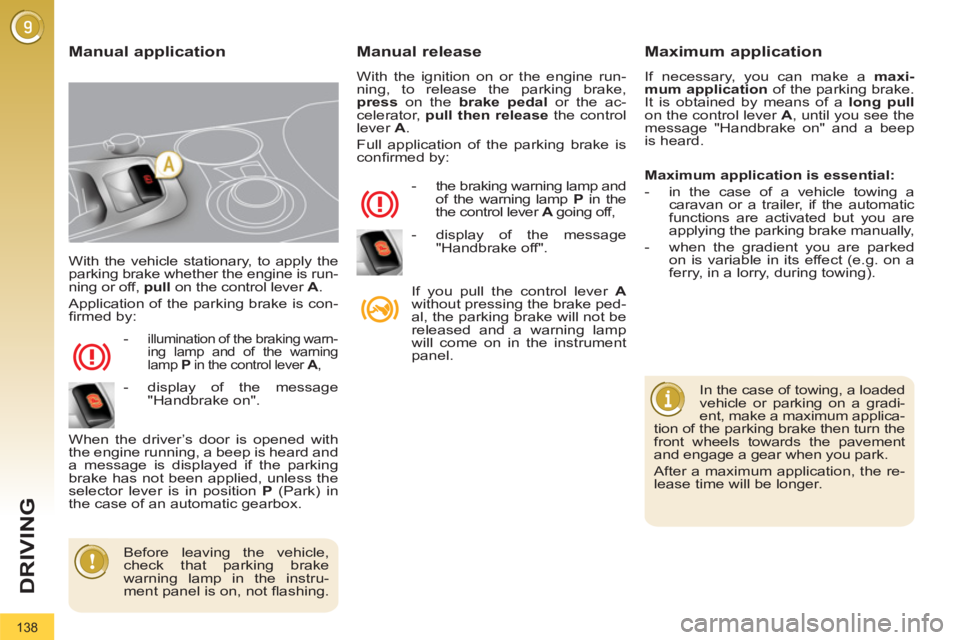
With the vehicle stationary, to apply the
parking brake whether the engine is run-
ning or off, pull
on the control lever A
.
Application of the parking brake is con-
fi rmed by:
-
illumination of the braking warn-
ing lamp and of the warning
lamp P
in the control lever A
,
When the driver’s door is opened with
the engine running, a beep is heard and
a message is displayed if the parking
brake has not been applied, unless the
selector lever is in position P
(Park) in
the case of an automatic gearbox.
Manual release
With the ignition on or the engine run-
ning, to release the parking brake,
press
on the brake
pedal
or the ac-
celerator, pull then release
the control
lever A
.
Full application of the parking brake is
confi rmed by:
- the braking warning lamp and
of the warning lamp P
in the
the control lever A
going off,
If you pull the control lever A
without pressing the brake ped-
al, the parking brake will not be
released and a warning lamp
will come on in the instrument
panel.
Manual application
Maximum application
If necessary, you can make a maxi-
mum application
of the parking brake.
It is obtained by means of a long pull
on the control lever A
, until you see the
message "Handbrake on" and a beep
is heard.
In the case of towing, a loaded
vehicle or parking on a gradi-
ent, make a maximum applica-
tion of the parking brake then turn the
front wheels towards the pavement
and engage a gear when you park.
After a maximum application, the re-
lease time will be longer.
Before leaving the vehicle,
check that parking brake
warning lamp in the instru-
ment panel is on, not fl ashing.
Maximum application is essential:
- in the case of a vehicle towing a
caravan or a trailer, if the automatic
functions are activated but you are
applying the parking brake manually,
- when the gradient you are parked
on is variable in its effect (e.g. on a
ferry, in a lorry, during towing).
- display of the message
"Handbrake on".
- display of the message
"Handbrake off".