boot PEUGEOT 3008 2017 User Guide
[x] Cancel search | Manufacturer: PEUGEOT, Model Year: 2017, Model line: 3008, Model: PEUGEOT 3008 2017Pages: 566, PDF Size: 16.05 MB
Page 62 of 566
60
3008-2_en_Chap02_ouvertures_ed01-2016
If one of the doors or the boot is still
open or if the electronic key for the
Keyless Entry and Starting system has
been left inside the vehicle, the central
locking does not take place.
However, the alarm (if fitted) will be fully
activated after about 45 seconds.As a safety measure (children on
board), never leave the vehicle without
taking the electronic key for the Keyless
Entry and Starting system with you,
even for a short period.
Be aware of the risk of theft when the
electronic key for the Keyless Entry and
Starting system is in one of the defined
zones with the vehicle unlocked.
The automatic folding and unfolding
of the door mirrors can be deactivated
by a PEUGEOT dealer or a qualified
workshop. In order to preserve the battery in the
electronic key and the vehicle's battery,
the "hands-free" functions are put into
long-term standby after 21 days without
use. To restore these functions, press
one of the remote control buttons or
start the engine with the electronic key
in the reader.
For more information on starting with
Keyless Entr y and Star ting
, refer to
the corresponding section.
If the vehicle is unlocked by mistake
and with no action on the doors or boot,
the vehicle will lock again automatically
after about 30 seconds.
If fitted to your vehicle, the alarm will
also be reactivated automatically.
Access
Page 70 of 566
68
3008-2_en_Chap02_ouvertures_ed01-2016
Central locking
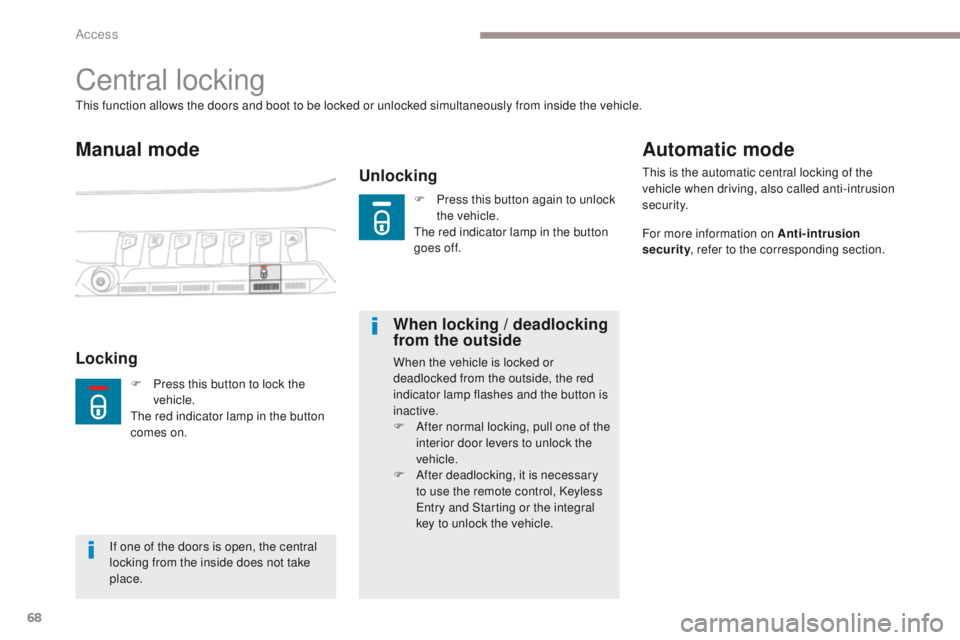
Manual mode
Unlocking
This function allows the doors and boot to be locked or unlocked simultaneously from inside the vehicle.
LockingWhen locking / deadlocking
from the outsideWhen the vehicle is locked or
deadlocked from the outside, the red
indicator lamp flashes and the button is
inactive.
F
A
fter normal locking, pull one of the
interior door levers to unlock the
vehicle.
F
A
fter deadlocking, it is necessary
to use the remote control, Keyless
Entry and Starting or the integral
key to unlock the vehicle.
Automatic mode
This is the automatic central locking of the
vehicle when driving, also called anti-intrusion
s e c u r i t y.
For more information on Anti-intrusion
security , refer to the corresponding section.
If one of the doors is open, the central
locking from the inside does not take
place. F
P
ress this button to lock the
vehicle.
The red indicator lamp in the button
comes on. F
P
ress this button again to unlock
the vehicle.
The red indicator lamp in the button
goes off.
Access
Page 71 of 566
69
3008-2_en_Chap02_ouvertures_ed01-2016
Activation / Deactivation
Anti-intrusion security
Operation
This system allows automatic simultaneous locking of the doors and boot as soon as the speed of the vehicle exceeds 6 mph (10 km/h).
If one of the doors or the boot is open, the
automatic central locking does not take place.
Carrying long or
voluminous objects
If you want to drive with the boot open,
you should press the central locking
button to lock the doors. Other wise,
every time the speed of the vehicle
exceeds 6 mph (10 km/h), the locks
will rebound and the alerts mentioned
above will appear.
Pressing the central locking button
unlocks the vehicle.
Above 6 mph (10 km/h), this unlocking
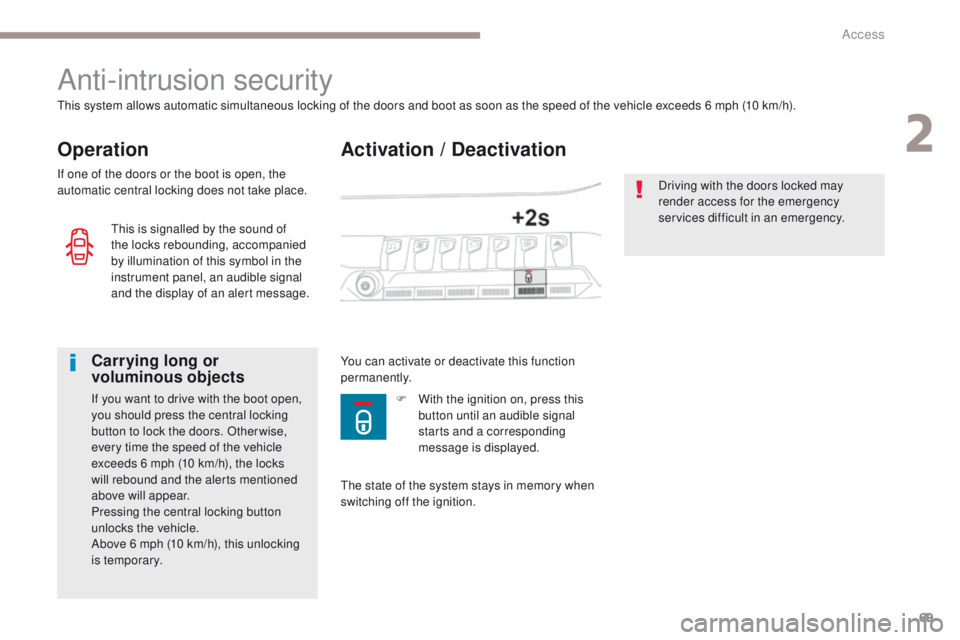
is temporary.You can activate or deactivate this function
permanently.
Driving with the doors locked may
render access for the emergency
services difficult in an emergency.
This is signalled by the sound of
the locks rebounding, accompanied
by illumination of this symbol in the
instrument panel, an audible signal
and the display of an alert message.
The state of the system stays in memory when
switching off the ignition.F
W ith the ignition on, press this
button until an audible signal
starts and a corresponding
message is displayed.
2
Access
Page 72 of 566
70
3008-2_en_Chap02_ouvertures_ed01-2016
* Depending on version.
Alarm*
- exterior perimeter
The system checks for opening of the vehicle.
The alarm is triggered if anyone tries to open a
door, the boot, the bonnet...
- interior volumetric
The system checks for any variation in the
volume in the passenger compartment.
The alarm is triggered if anyone breaks a
window, enters the passenger compartment or
moves inside the vehicle.
- anti-tilt**
The system checks for any change in the
attitude of the vehicle.
The alarm is triggered if the vehicle is lifted,
moved or knocked.
Self-protection function
The system checks for the putting out of
service of its components.
The alarm is triggered if the battery, the central
control or the siren wiring are put out of service
or damaged. For all work on the alarm system,
contact a PEUGEOT dealer or a
qualified workshop.
** Depending on engine.
System which protects and provides a deterrent
against theft and break-ins. It provides the
following types of monitoring:
Access
Page 73 of 566
71
3008-2_en_Chap02_ouvertures_ed01-2016
Locking the vehicle with full
alarm system
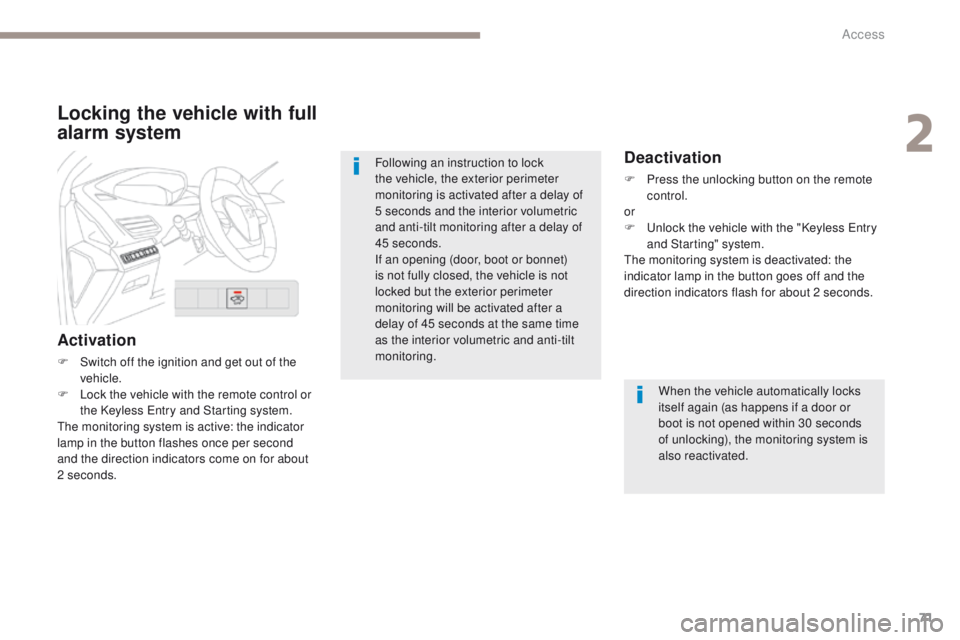
Activation
F Switch off the ignition and get out of the vehicle.
F
L
ock the vehicle with the remote control or
the Keyless Entry and Starting system.
The monitoring system is active: the indicator
lamp in the button flashes once per second
and the direction indicators come on for about
2 seconds.
Deactivation
F Press the unlocking button on the remote control.
or
F
U
nlock the vehicle with the "Keyless Entry
and Starting" system.
The monitoring system is deactivated: the
indicator lamp in the button goes off and the
direction indicators flash for about 2 seconds.
Following an instruction to lock
the vehicle, the exterior perimeter
monitoring is activated after a delay of
5 seconds and the interior volumetric
and anti-tilt monitoring after a delay of
45 seconds.
If an opening (door, boot or bonnet)
is not fully closed, the vehicle is not
locked but the exterior perimeter
monitoring will be activated after a
delay of 45
seconds at the same time
as the interior volumetric and anti-tilt
monitoring.
When the vehicle automatically locks
itself again (as happens if a door or
boot is not opened within 30 seconds
of unlocking), the monitoring system is
also reactivated.
2
Access
Page 77 of 566
75
3008-2_en_Chap02_ouvertures_ed01-2016
Boot
Opening the tailgate
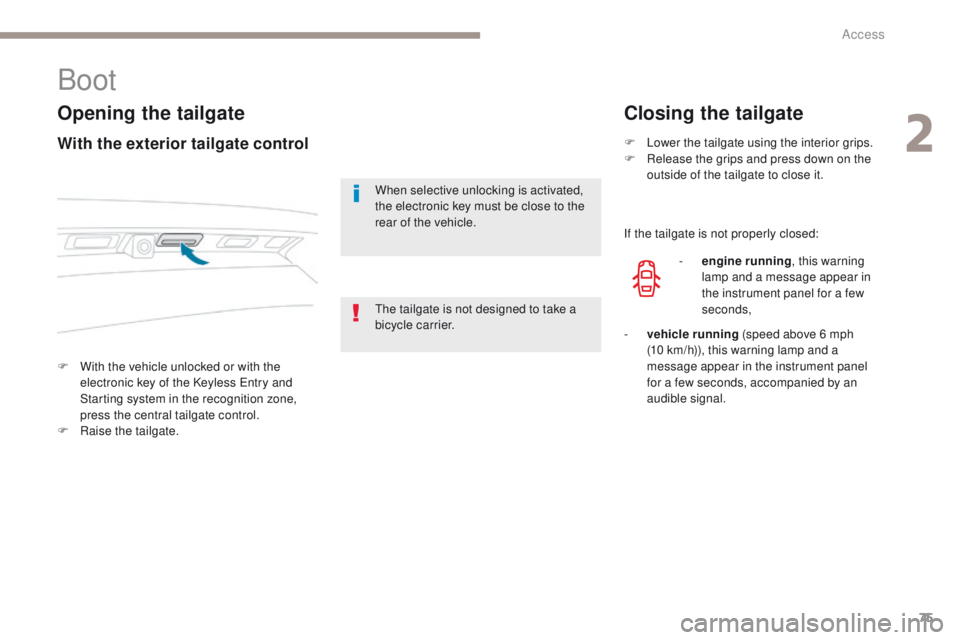
F With the vehicle unlocked or with the electronic key of the Keyless Entry and
Starting system in the recognition zone,
press the central tailgate control.
F
Ra
ise the tailgate.
Closing the tailgate
When selective unlocking is activated,
the electronic key must be close to the
rear of the vehicle. F
L
ower the tailgate using the interior grips.
F
R
elease the grips and press down on the
outside of the tailgate to close it.
With the exterior tailgate control
The tailgate is not designed to take a
bicycle carrier. If the tailgate is not properly closed:
-
e
ngine running
, this warning
lamp and a message appear in
the instrument panel for a few
seconds,
-
v
ehicle running (speed above 6 mph
(10
km/h)), this warning lamp and a
message appear in the instrument panel
for a few seconds, accompanied by an
audible signal.
2
Access
Page 80 of 566
78
3008-2_en_Chap02_ouvertures_ed01-2016
"Hands-free" motorised
opening
This movement first unlocks just the
boot, or the vehicle if the latter was
locked.
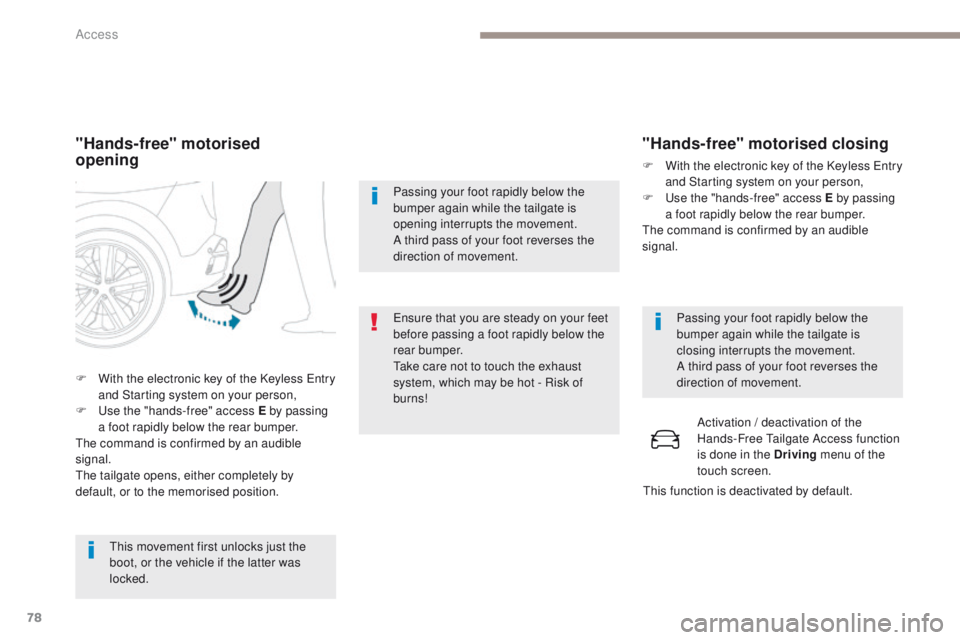
F
W
ith the electronic key of the Keyless Entry
and Starting system on your person,
F
U
se the "hands-free" access E by passing
a foot rapidly below the rear bumper.
The command is confirmed by an audible
signal.
The tailgate opens, either completely by
default, or to the memorised position. Ensure that you are steady on your feet
before passing a foot rapidly below the
rear bumper.
Take care not to touch the exhaust
system, which may be hot - Risk of
burns! Passing your foot rapidly below the
bumper again while the tailgate is
opening interrupts the movement.
A third pass of your foot reverses the
direction of movement.
"Hands-free" motorised closing
F With the electronic key of the Keyless Entry
and Starting system on your person,
F
U
se the "hands-free" access E by passing
a foot rapidly below the rear bumper.
The command is confirmed by an audible
signal.
Passing your foot rapidly below the
bumper again while the tailgate is
closing interrupts the movement.
A third pass of your foot reverses the
direction of movement.Activation / deactivation of the
Hands-Free Tailgate Access function
is done in the Driving menu of the
touch screen.
This function is deactivated by default.
Access
Page 83 of 566
81
3008-2_en_Chap02_ouvertures_ed01-2016
Back-up release
Unlocking
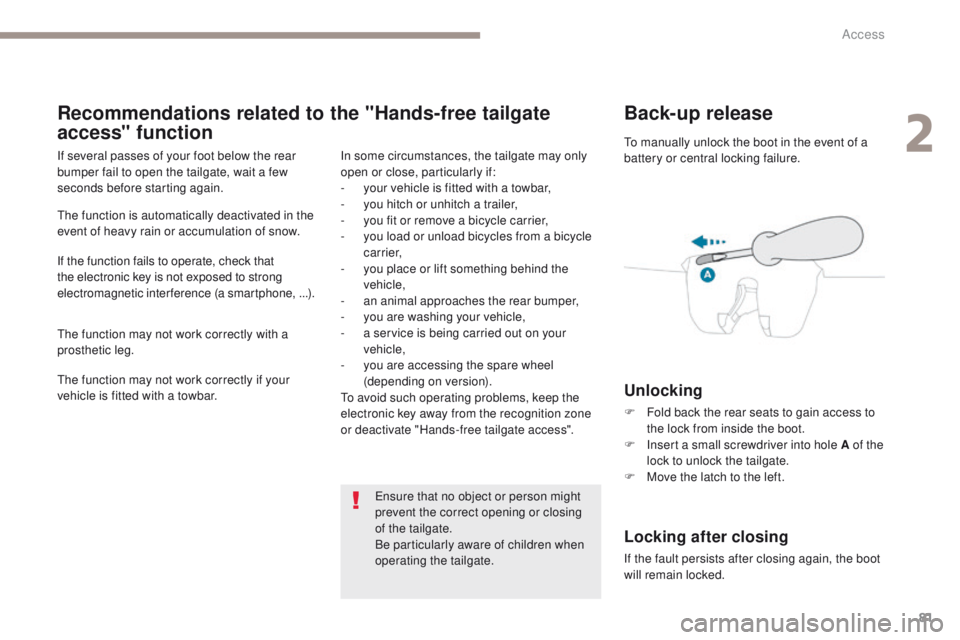
F Fold back the rear seats to gain access to the lock from inside the boot.
F
I
nsert a small screwdriver into hole A of the
lock to unlock the tailgate.
F
M
ove the latch to the left.
Locking after closing
If the fault persists after closing again, the boot
will remain locked. To manually unlock the boot in the event of a
battery or central locking failure.
Recommendations related to the "Hands-free tailgate
access" function
If several passes of your foot below the rear
bumper fail to open the tailgate, wait a few
seconds before starting again.
The function is automatically deactivated in the
event of heavy rain or accumulation of snow.
If the function fails to operate, check that
the electronic key is not exposed to strong
electromagnetic interference (a smartphone, ...).
The function may not work correctly with a
prosthetic leg.
The function may not work correctly if your
vehicle is fitted with a towbar. In some circumstances, the tailgate may only
open or close, particularly if:
-
y
our vehicle is fitted with a towbar,
-
y
ou hitch or unhitch a trailer,
-
y
ou fit or remove a bicycle carrier,
-
y
ou load or unload bicycles from a bicycle
c a r r i e r,
-
y
ou place or lift something behind the
vehicle,
-
an
animal approaches the rear bumper,
-
y
ou are washing your vehicle,
-
a s
ervice is being carried out on your
vehicle,
-
y
ou are accessing the spare wheel
(depending on version).
To avoid such operating problems, keep the
electronic key away from the recognition zone
or deactivate "Hands-free tailgate access".
Ensure that no object or person might
prevent the correct opening or closing
of the tailgate.
Be particularly aware of children when
operating the tailgate.
2
Access
Page 107 of 566
105
3008-2_en_Chap03_ergonomie-et-confort_ed01-2016
Stop & Start
The heating and air conditioning
systems only work when the engine is
running.
To maintain a comfortable temperature
in the passenger compartment, you can
temporarily deactivate the Stop & Start
system.
For more information on Stop & Star t,
refer to the corresponding section.
In order for these systems to be fully effective, follow the operation and maintenance
guidelines below:
F
T
o obtain an even air distribution, take care not to obstruct the exterior air intake grilles
located at the base of the windscreen, the nozzles, the vents and the air outlets, as well
as the air extractor located in the boot.
F
D
o not cover the sunshine sensor, located on the dashboard; this is used for regulation
of the air conditioning system.
F
O
perate the air conditioning system for at least 5 to 10 minutes, once or twice a month
to keep it in per fect working order.
F
E
nsure that the passenger compartment filter is in good condition and have the filter
elements replaced regularly.
W
e recommend the use of a combined passenger compartment filter. Thanks to
its special active additive, it contributes to the purification of the air breathed by the
occupants and the cleanliness of the passenger compartment (reduction of allergic
symptoms, bad odours and greasy deposits).
F
T
o ensure correct operation of the air conditioning system, you are also advised to have
it checked regularly as recommended in the warranty and maintenance record.
F
I
f the system does not produce cold air, switch it off and contact a PEUGEOT dealer or
a qualified workshop.
When towing the maximum load on a steep gradient in high temperatures, switching off the
air conditioning increases the available engine power and so improves the towing ability. The condensation created by the air
conditioning results in a discharge
of water under the vehicle which is
perfectly normal.
If after an extended stop in sunshine,
the interior temperature is very
high, first ventilate the passenger
compartment for a few moments.
Put the air flow control at a setting high
enough to quickly change the air in the
passenger compartment.
The air conditioning system does not
contain chlorine and does not present
any danger to the ozone layer.
Recommendations for ventilation and air conditioning
3
Ease of use and comfort
Page 132 of 566
130
3008-2_en_Chap03_ergonomie-et-confort_ed01-2016
Rear seats
Rear head restraints
Bench seat with a fixed cushion and split folding backrests (2/3 -1/3) to adapt the boot load space.
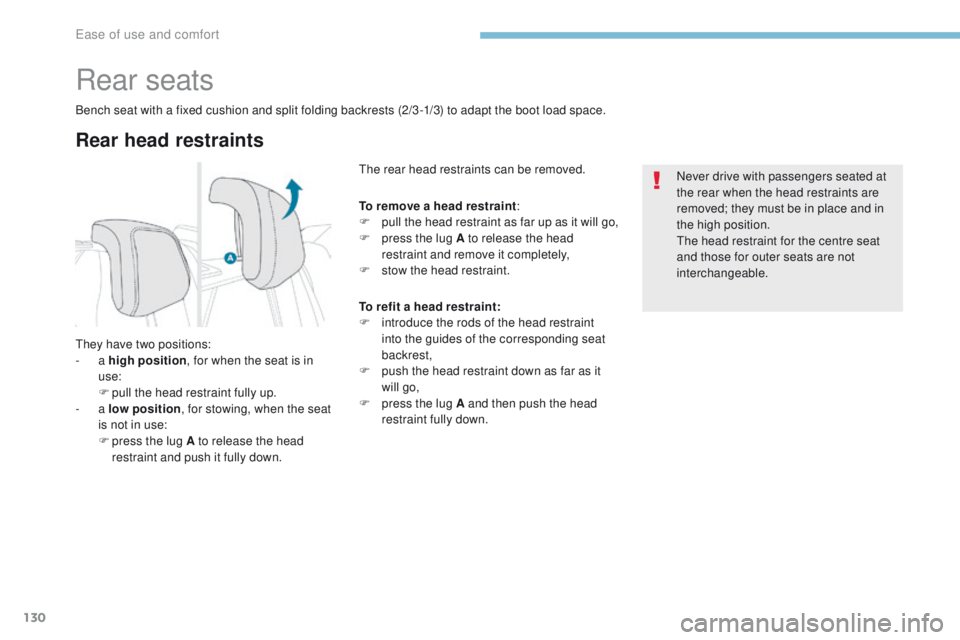
They have two positions:
- a high position , for when the seat is in
use:
F
p
ull the head restraint fully up.
-
a low position , for stowing, when the seat
is not in use:
F
p
ress the lug A to release the head
restraint and push it fully down. The rear head restraints can be removed.
Never drive with passengers seated at
the rear when the head restraints are
removed; they must be in place and in
the high position.
The head restraint for the centre seat
and those for outer seats are not
interchangeable.
To remove a head restraint
:
F
p
ull the head restraint as far up as it will go,
F
p
ress the lug A to release the head
restraint and remove it completely,
F
s
tow the head restraint.
To refit a head restraint:
F
i
ntroduce the rods of the head restraint
into the guides of the corresponding seat
backrest,
F
p
ush the head restraint down as far as it
will go,
F
p
ress the lug A and then push the head
restraint fully down.
Ease of use and comfort