heating PEUGEOT 3008 2017 User Guide
[x] Cancel search | Manufacturer: PEUGEOT, Model Year: 2017, Model line: 3008, Model: PEUGEOT 3008 2017Pages: 566, PDF Size: 16.05 MB
Page 125 of 566
123
3008-2_en_Chap03_ergonomie-et-confort_ed01-2016
Charging
F First ensure that the charging zone is clear of other articles.
F
P
lace a portable device in the middle of the
charging zone.
F
O
nce the portable device is detected, the
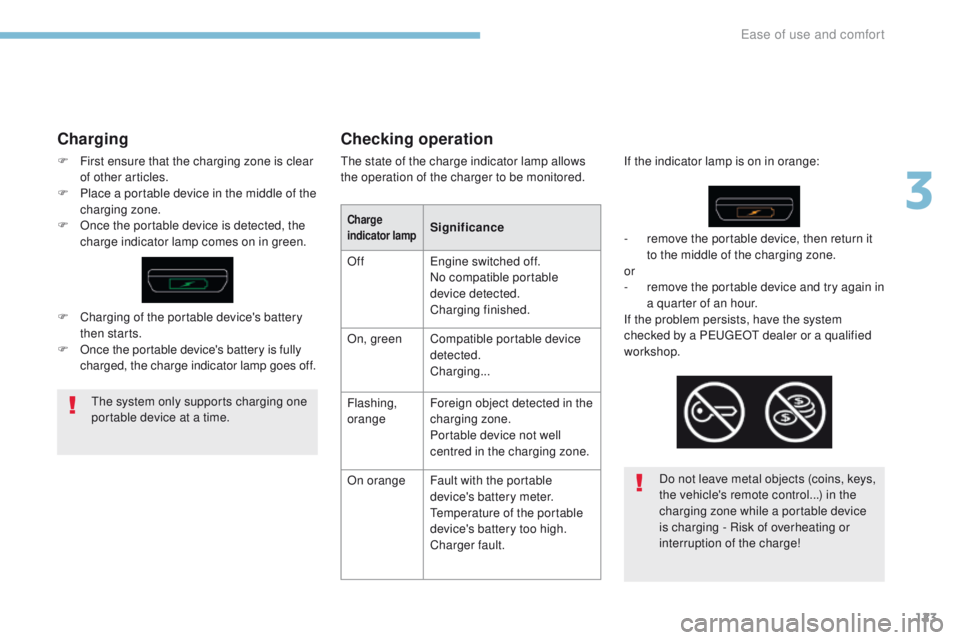
charge indicator lamp comes on in green. If the indicator lamp is on in orange:
Do not leave metal objects (coins, keys,
the vehicle's remote control...) in the
charging zone while a portable device
is charging - Risk of overheating or
interruption of the charge!
-
r
emove the portable device, then return it
to the middle of the charging zone.
or
-
r
emove the portable device and try again in
a quarter of an hour.
If the problem persists, have the system
checked by a PEUGEOT dealer or a qualified
workshop.
F
C
harging of the portable device's battery
then starts.
F
O
nce the portable device's battery is fully
charged, the charge indicator lamp goes off.
Checking operation
The state of the charge indicator lamp allows
the operation of the charger to be monitored.
The system only supports charging one
portable device at a time.
Charge
indicator lampSignificance
Off Engine switched off.
No compatible portable
device detected.
Charging finished.
On, green Compatible portable device
detected.
Charging...
Flashing,
orange Foreign object detected in the
charging zone.
Portable device not well
centred in the charging zone.
On orange Fault with the portable
device's battery meter.
Temperature of the portable
device's battery too high.
Charger fault.
3
Ease of use and comfort
Page 197 of 566
195
3008-2_en_Chap06_conduite_ed01-2016
Driving recommendations
Observe the driving regulations and remain
vigilant whatever the traffic conditions.
Pay close attention to the traffic and keep your
hands on the wheel so that you are ready to
react at any time to any eventuality.
On a long journey, a break every two hours is
strongly recommended.
In difficult weather, drive smoothly, anticipate
the need to brake and increase the distance
from other vehicles.
Driving on flooded roads
We strongly advise against driving on flooded
roads, as this could cause serious damage
to the engine or gearbox, as well as to the
electrical systems of your vehicle.
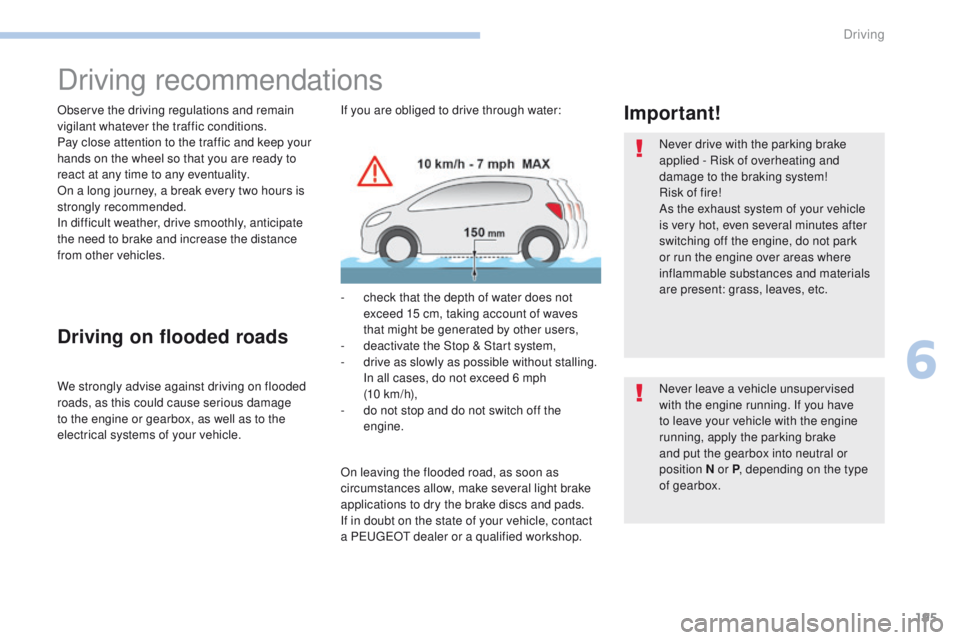
Important!If you are obliged to drive through water:
-
c
heck that the depth of water does not
exceed 15 cm, taking account of waves
that might be generated by other users,
-
d
eactivate the Stop & Start system,
-
d
rive as slowly as possible without stalling.
In all cases, do not exceed 6 mph
(10 km/h),
-
d
o not stop and do not switch off the
engine. Never drive with the parking brake
applied - Risk of overheating and
damage to the braking system!
Risk of fire!
As the exhaust system of your vehicle
is very hot, even several minutes after
switching off the engine, do not park
or run the engine over areas where
inflammable substances and materials
are present: grass, leaves, etc.
Never leave a vehicle unsupervised
with the engine running. If you have
to leave your vehicle with the engine
running, apply the parking brake
and put the gearbox into neutral or
position
N or P, depending on the type
of gearbox.
On leaving the flooded road, as soon as
circumstances allow, make several light brake
applications to dry the brake discs and pads.
If in doubt on the state of your vehicle, contact
a PEUGEOT dealer or a qualified workshop.
6
Driving
Page 198 of 566
196
3008-2_en_Chap06_conduite_ed01-2016
When towing
Distribution of loads
F Distribute the load in the trailer so that the heaviest items are as close as possible to
the axle and the nose weight approaches
the maximum permitted without
exceeding
it.
Air density decreases with altitude, thus
reducing engine performance. Above
1
000 metres, the maximum towed load must
be reduced by 10
% for every 1 000 metres of
altitude.
Side wind
F Take into account the increased sensitivity to side wind.
For more information on Weights
, refer to the
corresponding section. F
I
f the warning lamp and the
STOP warning lamp come on,
stop the vehicle and switch off
the engine as soon as possible.
Braking
Towing a trailer increases the braking distance.
To avoid overheating of the brakes, the use of
engine braking is recommended.
Ty r e s
F Check the tyre pressures of the towing vehicle and of the trailer, observing the
recommended pressures.
Lighting
F Check the electrical lighting and signalling on the trailer and the headlamp beam
height of your vehicle.
For more information on Adjusting the
headlamp beam height , refer to the
corresponding section.
The rear parking sensors will be
deactivated automatically to avoid the
audible signal if a genuine PEUGEOT
towbar is used.
Cooling
Towing a trailer on a slope increases the
temperature of the coolant.
As the fan is electrically controlled, its cooling
capacity is not dependent on the engine speed.
F
T
o lower the engine speed, reduce your
speed.
The maximum towed load on a long incline
depends on the gradient and the ambient
temperature.
In all cases, keep a check on the coolant
temperature.
Driving
Page 199 of 566
197
3008-2_en_Chap06_conduite_ed01-2016
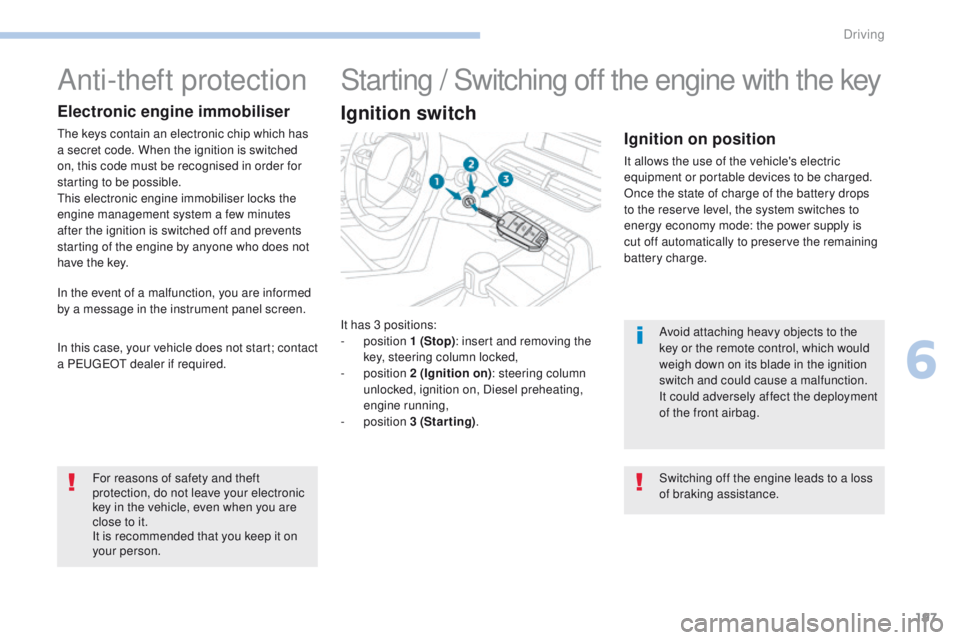
It has 3 positions:
- position 1 (Stop): insert and removing the
key, steering column locked,
-
position 2 (Ignition on) : steering column
unlocked, ignition on, Diesel preheating,
engine running,
-
position 3 (Starting) .
Ignition on position
It allows the use of the vehicle's electric
equipment or portable devices to be charged.
Once the state of charge of the battery drops
to the reserve level, the system switches to
energy economy mode: the power supply is
cut off automatically to preserve the remaining
battery charge.
Starting / Switching off the engine with the key
Ignition switch
Avoid attaching heavy objects to the
key or the remote control, which would
weigh down on its blade in the ignition
switch and could cause a malfunction.
It could adversely affect the deployment
of the front airbag.
Switching off the engine leads to a loss
of braking assistance.
Anti-theft protection
In the event of a malfunction, you are informed
by a message in the instrument panel screen.
For reasons of safety and theft
protection, do not leave your electronic
key in the vehicle, even when you are
close to it.
It is recommended that you keep it on
your person.
Electronic engine immobiliser
The keys contain an electronic chip which has
a secret code. When the ignition is switched
on, this code must be recognised in order for
starting to be possible.
This electronic engine immobiliser locks the
engine management system a few minutes
after the ignition is switched off and prevents
starting of the engine by anyone who does not
have the key.
In this case, your vehicle does not start; contact
a PEUGEOT dealer if required.
6
Driving
Page 200 of 566
198
3008-2_en_Chap06_conduite_ed01-2016
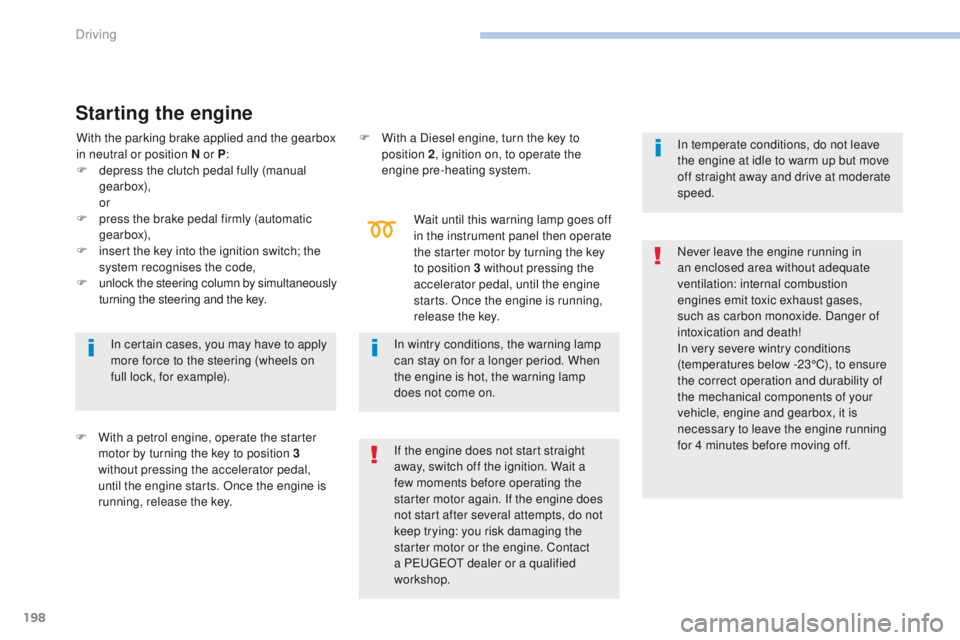
Starting the engine
F With a petrol engine, operate the starter motor by turning the key to position 3
without pressing the accelerator pedal,
until the engine starts. Once the engine is
running, release the key. F
W
ith a Diesel engine, turn the key to
position 2 , ignition on, to operate the
engine pre-heating system.
Wait until this warning lamp goes off
in the instrument panel then operate
the starter motor by turning the key
to position 3 without pressing the
accelerator pedal, until the engine
starts. Once the engine is running,
release the key.
If the engine does not start straight
away, switch off the ignition. Wait a
few moments before operating the
starter motor again. If the engine does
not start after several attempts, do not
keep trying: you risk damaging the
starter motor or the engine. Contact
a PEUGEOT dealer or a qualified
workshop. Never leave the engine running in
an enclosed area without adequate
ventilation: internal combustion
engines emit toxic exhaust gases,
such as carbon monoxide. Danger of
intoxication and death!
In very severe wintry conditions
(temperatures below -23°C), to ensure
the correct operation and durability of
the mechanical components of your
vehicle, engine and gearbox, it is
necessary to leave the engine running
for 4 minutes before moving off.
In certain cases, you may have to apply
more force to the steering (wheels on
full lock, for example).
In wintry conditions, the warning lamp
can stay on for a longer period. When
the engine is hot, the warning lamp
does not come on.In temperate conditions, do not leave
the engine at idle to warm up but move
off straight away and drive at moderate
speed.
With the parking brake applied and the gearbox
in neutral or position N or P
:
F
d
epress the clutch pedal fully (manual
gearbox),
or
F
p
ress the brake pedal firmly (automatic
gearbox),
F
i
nsert the key into the ignition switch; the
system recognises the code,
F
u
nlock the steering column by simultaneously
turning the steering and the key.
Driving
Page 350 of 566
348
3008-2_en_Chap11_index-alpha_ed01-2016
Headlamps, automatic dipping ...............17, 149
Headlamps, automatic illumination
.................................. 141, 146 , 147
Headlamps, dipped beam
................17, 323-325
Headlamps, halogen
..................................... 324
Headlamps, main beam
................... 17,
323-325
Head restraints, front
...................................... 93
Head restraints, rear
..................................... 13 0
Heating
.................................... 10, 104 , 10 6 , 108
Hi-Fi system
.................................................. 12 2
Hill Assist Descent Control
.................................................. 20,
166
Hill start assist
............................................... 2
16
Horn ............................................................... 157Inflating tyres
..........................................
10, 345
Inflating tyres and accessories (using the kit)
..........................312
Instrument panel
..................... 12,
13, 40 , 42, 43
Intelligent Traction Control
........................................................ 16
1
ISOFIX
..........................................................187
Isofix mountings
...............................
.............18 6
i- Cockpit amplify function
................................. 98, 102 , 125, 217
Ignition
................
................................... 19 9, 201
Immobiliser, electronic
............................63, 197
Indicator, AdBlue
®
range
....................................................... 30, 37
Indicator, coolant temperature
.................................................. 32
Indicator, engine oil level
.................................................... 36, 40
Indicator lamps, operation
........................................... 17, 19 , 21
Indicator lamps, status
............................................................ 19
Indicators, direction
.............................. 14 4, 324 Jack
........
.......................................................
310
Jump starting
..............................
..................
333
I
J
Key ..................................................... 54, 63 , 64
Key, electronic ..................................... 58, 60-62
Keyless Entry and Starting
......................58, 61- 63 , 197, 200
Key not recognised
....................................... 202
Key with remote control
......................................................... 19
7
Kit, temporary puncture repair
................................................... 309, 312
K
Fuel .......................................................... 10, 283
Fuel consumption ............................................ 10
Fu
el tank ................................................ 281, 282
Fuses
............................................................. 331
Gauge, fuel .................................................... 281
Gearbox, automatic
....... 10,
2 11, 216 , 217, 219 , 302 , 332
Gearbox, manual
....10, 210 , 216 , 217, 219 , 302
Gear lever
..............................
.........................10
Gear lever, automatic gearbox
................
....................................... 2 11
Gear lever, manual gearbox
................
....................................... 210
Gear shift indicator
....................................... 218
Glove box
...................................................... 120
Grab handles
................................................ 11
9
G
Hands-free access ..........................................78
H ands-free tailgate ............................. 76,
78, 79
Hazard warning lamps
..........................157, 307
Headlamp adjustment
...................................145
H
Alphabetical index
Page 544 of 566
4
Reinitialising the motorised
tailgate
This operation is necessary where there is
no movement - after detection of an obstacle,
connecting or recharging the battery, etc.
F Open the tailgate manually, if necessary.
F Fully close the tailgate manually.
If the problem persists, contact a PEUGEOT
dealer or a qualified workshop.
Memorising an opening
position
To limit the motorised tailgate opening angle:
F open the tailgate to the desired position,
F press button C or the exterior control B for
more than 3 seconds.
Memorisation of the maximum opening position
of the tailgate is confirmed by an audible signal.
Manual operation
The tailgate can be manoeuvred by hand, even
with motorised operation activated.
The tailgate must be immobile.
When opening and closing a motorised tailgate
manually, there is no assistance from gas
struts. Resistance to opening and closing is
therefore entirely normal.
Repeatedly opening and closing of the
motorised tailgate can cause overheating
of its electric motor, after which opening
and closing will not be possible.
Allow at least 10 minutes for the electric
motor to cool down before operating the
tailgate again.
If you are unable to wait, operate it
manually.
To cancel the memorised position:
F
stop the tailgate in an intermediate
position,
F press button C or the exterior control B for
more than 3 seconds.
Cancellation of the memorised position is
confirmed by an audible signal.
Access
Page 545 of 566
5
Precautions in use
In wintry conditions
In the event of an accumulation of snow
on the tailgate, clear the snow before
commanding a motorised opening of the
tailgate.
The formation of ice can block the tailgate
and prevent its opening: wait until the ice
melts with the heating of the passenger
compartment.When washing
When washing the vehicle in an automatic
car wash, don't forget to lock your vehicle
to avoid the risk of unexpected opening.
Recommendations related to the "Hands-Free Tailgate
Access" function
If several kicking movements to operate the
tailgate have no effect, wait a few seconds
before trying again.
The function automatically deactivates in heavy
rain or following a build-up of snow.
If it does not work, check that the electronic key
is not exposed to a source of electromagnetic
pollution (smartphone etc.).
The function may not work correctly with a
prosthetic leg.
The function may not work correctly if your
vehicle is fitted with a towbar. In some circumstances, the tailgate may open
or close by itself, particularly if:
-
you hitch or unhitch a trailer,
- you fit or remove a bicycle carrier,
- you load or unload bicycles from a bicycle
c a r r i e r,
- you place or lift something behind the
vehicle,
- an animal approaches the rear bumper,
- you are washing your vehicle,
- your vehicle is being serviced,
- you are accessing the spare wheel
(depending on version).
To avoid such operating problems, keep the
electronic key away from the sensor zone or
deactivate the "Hands-Free Tailgate Access"
function.
2
Access
Page 546 of 566
6
The programmable heating operates independently from the engine.
With the engine off, it preheats the coolant circuit to ensure optimal engine operating temperature
as soon as it is started up.
The programmable heating is switched on by the long range remote control. It may be immediate or
deferred thanks to a programming function.
Programmable heating
Always switch off the programmable heating when refuelling to avoid any risk of fire or
explosion.
The programmable heating is powered by the vehicle fuel tank. Before use, ensure that
the remaining quantity of fuel is sufficient. If the fuel tank is in its reser ve, we strongly
recommend you do not programme the heating.
To avoid the risks of intoxication or asphyxia, the programmable heating must not be used,
even for short periods, in a closed environment such as a garage or workshop which are not
equipped with an exhaust gas extraction system.
Do not park the vehicle on a flammable sur face (dry grass, dead leaves, paper, etc.) - risk of
fire!
The volumetric alarm movement detector
may be disrupted by the programmable
heating air flows when it is operating.
To avoid any untimely triggering of the
alarm when using the programmable
heating, it is advisable that the volumetric
monitoring is deactivated. Adapting the programmable heating
enables you to use it to preheat the
passenger compartment of your vehicle.
Contact a PEUGEOT dealer or a qualified
workshop.
Presentation
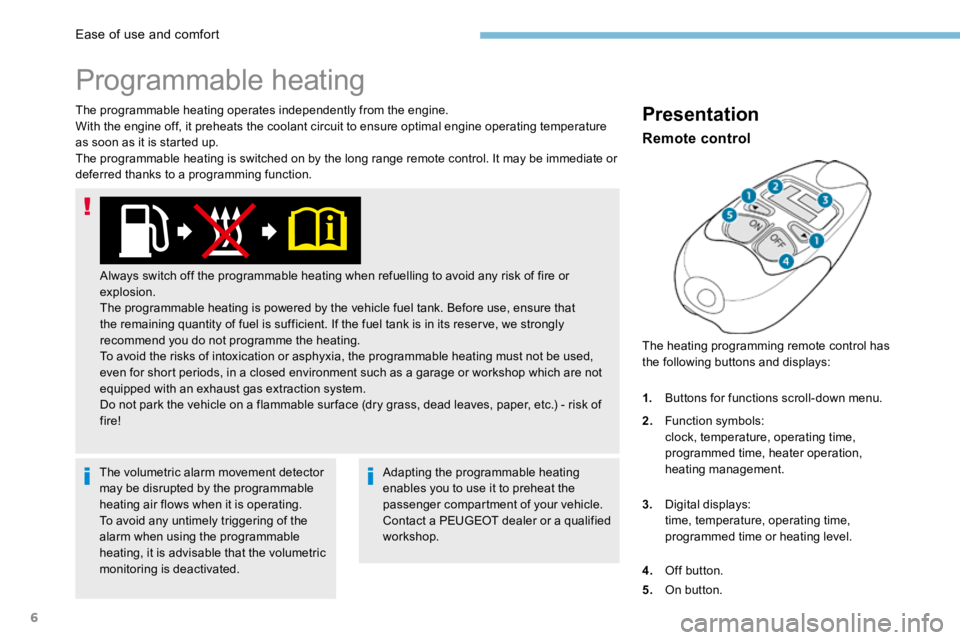
The heating programming remote control has
the following buttons and displays:
Remote control
1.
Buttons for functions scroll-down menu.
2. Function symbols:
clock, temperature, operating time,
programmed time, heater operation,
heating management.
3. Digital displays:
time, temperature, operating time,
programmed time or heating level.
4. Off button.
5. On button.
Ease of use and comfort
Page 547 of 566
7
lit up: deferred programmed start-up.
flashing: heating on.
turned off: heating off.
Operating indicator light
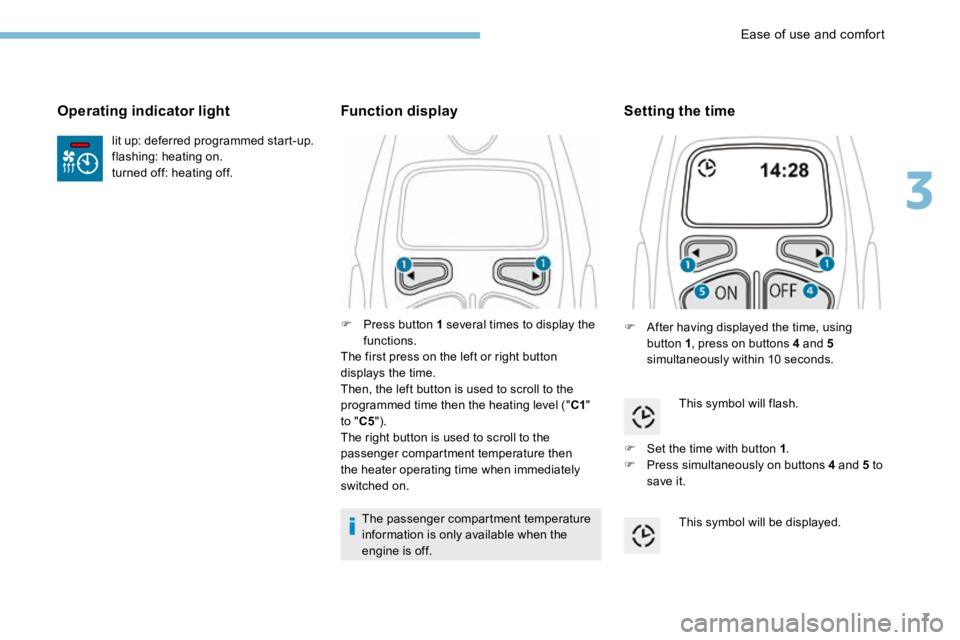
F Press button 1 several times to display the
functions.
The first press on the left or right button
displays the time.
Then, the left button is used to scroll to the
programmed time then the heating level (" C1"
to " C5").
The right button is used to scroll to the
passenger compartment temperature then
the heater operating time when immediately
switched on.
Function display
The passenger compartment temperature
information is only available when the
engine is off.
Setting the time
F After having displayed the time, using
button 1 , press on buttons 4 and 5
simultaneously within 10 seconds.
This symbol will flash.
F Set the time with button 1 .
F Press simultaneously on buttons 4 and 5 to
save it.
This symbol will be displayed.
3
Ease of use and comfort