roof Peugeot 3008 Hybrid 4 2013 Owner's Manual
[x] Cancel search | Manufacturer: PEUGEOT, Model Year: 2013, Model line: 3008 Hybrid 4, Model: Peugeot 3008 Hybrid 4 2013Pages: 340, PDF Size: 16.54 MB
Page 4 of 340
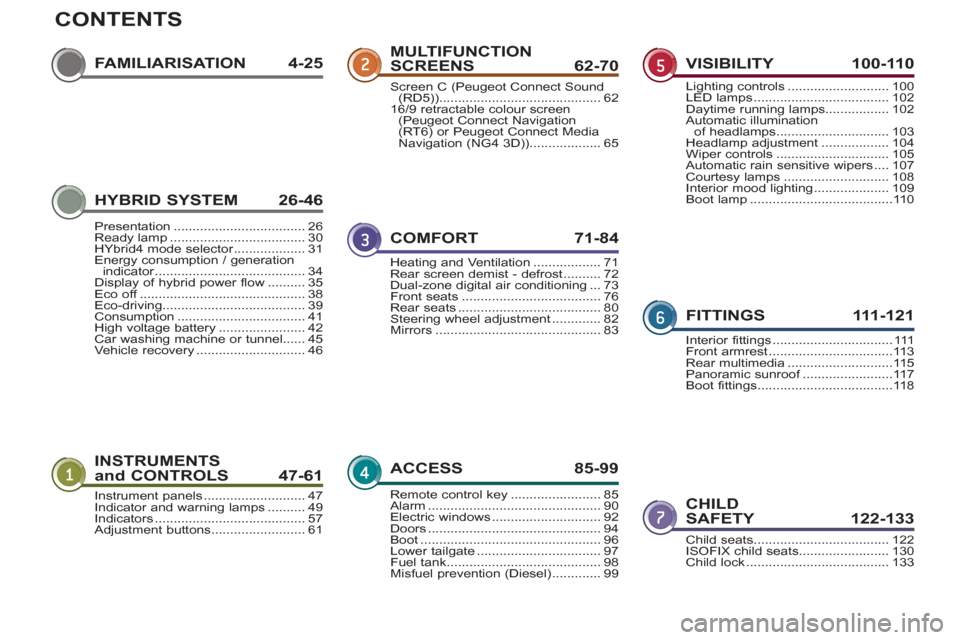
CONTENTS
FAMILIARISATION 4-25
INSTRUMENTS
and CONTROLS 47-61
CHILD
SAFETY 122-133
MULTIFUNCTION
SCREENS 62-70
COMFORT 71-8
4
ACCESS 85-99
VISIBILITY 100-110
FITTINGS 111-12
1
Instrument panels...........................47Indicator and warning lamps ..........49Indicators........................................57Adjustment buttons.........................61Child seats ....................................122ISOFIX child seats........................130Child lock ......................................133
Screen C (Peugeot Connect Sound(RD5)) ...........................................6216/9 retractable colour screen (Peugeot Connect Navigation(RT6) or Peugeot Connect Media
Navigation (NG4 3D))...................65
Heating and Ventilation ..................71Rear screen demist - defrost ..........72Dual-zone digital air conditioning...73Front seats.....................................76Rear seats......................................80Steering wheel adjustment .............82Mirrors............................................83
Remote control key........................85Alarm ..............................................90Electric windows.............................92Doors ..............................................94Boot................................................96Lower tailgate.................................97Fuel tank.........................................98Misfuel prevention (Diesel) .............99
Lighting controls...........................100LED lamps....................................102Daytime running lamps.................102Automatic illuminationof headlamps..............................103Headlamp adjustment ..................104Wiper controls..............................105Automatic rain sensitive wipers....107Courtesy lamps ............................108Interior mood lighting....................109Boot lamp......................................110
Interior fittings................................111Front armrest.................................113Rear multimedia............................115Panoramic sunroof........................f117Boot fittings....................................118
HYBRID SYSTEM 26-46
Presentation...................................26Ready lamp ....................................30HYbrid4 mode selector...................r31Energy consumption / generationindicator........................................r34Display of hybrid power flow..........35Eco off............................................f38Eco-driving......................................39Consumption..................................41High voltage battery .......................42Car washing machine or tunnel......45Vehicle recovery.............................46
Page 5 of 340

CONTENTS
ALPHABETICAL
INDEX 327-330 SAFETY 134-14
3
DRIVING 144-163
CHECKS 164-171
PRACTICAL
INFORMATION 172-201
TECHNICAL DATA 202-206
AUDIO EQUIPMENTand TELEMATICS 207-326
Direction indicators.......................134Hazard warning lamps..................134Horn..............................................134ESC system ..................................135Front seat belts.............................137Airbags.........................................140
Electric parking brake ...................144Hill start assist..............................149Head-up display...........................152Speed limiter................................r154Cruise control...............................1566-speed electronic gear control
gearbox......................................158Parking sensors ............................162
Bonnet..........................................165Running out of fuel (Diesel)..........166Diesel engine................................167Checking levels............................168Checks..........................................170
Temporary puncture repair kit......172Changing a wheel.........................178Changing a bulb...........................181Changing a fuse ...........................18512 V battery ..................................192Energy economy mode................195Changing a wiper blade...............196Recovering the vehicle.................196Vehicle recovery ...........................197Towing a trailer.............................r198Fitting roof bars............................199Very cold climate screen..............199Accessories..................................200
Electric motor...............................r202Diesel engine................................203Diesel weights ..............................204Dimensions ...................................205Identification markings..................206
VISUAL
SEARCH 331-336
Emergency or assistance.............207Peugeot Connect Media Navigation(NG4 3D).....................................211Peugeot Connect Navigation(RT6) ..........................................255Peugeot Connect Sound (RD5).....309
Page 10 of 340

8
FA
M
FOR ECONOMICAL DRIVING, CARING FOR THE ENVIRONMENT
Main recommendations for driving economically
Gear lever
Use the automatic
mode A
as much
as possible as this optimises gear
changes to suit the requirements.
The fuel consumption
of a vehicle varies greatly
:
- according to the driver's style of driving
(moderate, aggressive, fast, ...),
- according to the type of journeys
made (urban, main road, motorway, fl owing,
heavy traffi c, …) and the speed.
Hybrid mode selector
To optimise fuel consumption, use the
Auto
mode
of the selector whenever
possible (the mode is activated auto-
matically when starting) including for
urban journeys.
This mode optimises the use of the ener-
gy sources (internal combustion engine
and/or electric) contrary to other modes,
which are for use in particular cases.
Stay in the "eco" zone
displayed in the
energy consumption / generation indi-
cator: accelerate gently, drive at steady
speeds using the speed limiter or cruise
control as soon as possible.
Causes of high consumption and
checks
As with any vehicle, limit overloading,
wind resistance (windows open above
30 mph (50 km/h), roof rack, loaded or
not, …), the use of power consumers
(air conditioning, heated seats, heated
rear screen, …).
Observe the recommendations on
checks (regular check of tyre pres-
sures, correct tyre pressures, …) and
routine servicing.
Consumption history
See the impact of your style of driving
and the type of journey by reviewing
the history of your energy consumption.
Refer to the "Multifunction screens"
section.
Use the "charge"
zone: anticipate the
need to slow down by taking your foot
off the accelerator rather than braking.
The movement of the energy consump-
tion / generation indicator needle (into
the "charge" zone), shows the level of
energy recovery.
Drive smoothly
Page 11 of 340

9
FA
M
EXTERIOR
Panoramic sunroof
This roof provides incomparable visibility
and light in the passenger compartment.
117
Temporary tyre repair kit
This kit is a complete system, consisting
of a compressor and an integral sealant
cartridge, for the temporary repair of a
tyre.
172
Lower tailgate
This lower tailgate permits remarkable
accessibility and makes the loading of
bulky objects easier.
97
Visual and audible front and/or rear
parking sensors
This system warns you if an obstacle is
detected in front of or behind the vehicle
in forward or reverse gear.
162
When using an automatic car wash.
- Unscrew the aerial.
- fold back the mirrors.
Page 41 of 340

HY
B
39
ECO-DRIVING
Eco-driving is a range of everyday practices that allow the motorist to optimise their fuel consumption and CO2 emissions.
Optimise the use of your gearbox
Use automated mode A
as much as
possible as this optimises gear chang-
es to suit the circumstances.
Drive smoothly
If your vehicle has cruise control, make
use of the system at speeds above
25 mph (40 km/h) when the traffi c is
fl owing well.
Control the use of your electrical equipment
Before moving off, if the passenger
compartment is too warm, ventilate it by
opening the windows and air vents be-
fore using the air conditioning.
Above 30 mph (50 km/h), close the win-
dows and leave the air vents open.
Remember to make use of equipment
that can help keep the temperature in
the passenger compartment down (sun
roof and window blinds...).
Switch off the air conditioning, unless
it has automatic digital regulation, as
soon as the desired temperature is at-
tained.
Switch off the demisting and defrosting
controls, if not automatic.
Switch off the heated seat as soon as
possible.
Switch off the headlamps and front fo-
glamps when the level of light does not
require their use.
Avoid running the Diesel engine when
stationary, particularly in winter; your
vehicle will warm up much faster while
driving.
As a passenger, if you avoid connect-
ing your multimedia devices (fi lm, mu-
sic, video game...), you will contribute
towards limiting the consumption of
electrical energy, and so of fuel.
Disconnect your portable devices be-
fore leaving the vehicle.
Maintain a safe distance between vehi-
cles, use engine braking rather than the
brake pedal, and press the accelerator
progressively. These practices contribute
towards a reduction in fuel consumption
and CO
2 emissions and also helps re-
duce the background traffi c noise.
Page 42 of 340

HY
B
40
Limit the causes of excess consumption
Spread loads throughout the vehicle;
place the heaviest items in the bottom
of the boot, as close as possible to the
rear seats.
Limit the loads carried in the vehicle
and reduce wind resistance (roof bars,
roof rack, bicycle carrier, trailer...). Use
a roof box in preference.
Remove roof bars and roof racks after
use.
At the end of winter, remove snow
tyres and refi t your summer tyres.
Observe the recommendationson maintenance
Check the tyre pressures regularly,
when cold, referring to the label in the
door aperture, driver's side.
Carry out this check in particular:
- before a long journey,
- at each change of season,
- after a long period out of use.
Have your vehicle serviced regularly
(engine oil, oil fi lter, air fi lter...) and ob-
serve the schedule of operations recom-
mended by the manufacturer.
When refuelling, do not continue after
the 3 rd cut-off of the nozzle to avoid
any overfl ow.
At the wheel of your new vehicle,
it is only after the fi rst 1 800 miles
(3 000 kilometres) that you will see
the fuel consumption settle down to a
consistent average.
Page 119 of 340

FITTINGS
11 7
PANORAMIC SUNROOF
Component which has a tinted glass
panoramic surface to increase the light
and visibility in the passenger compart-
ment.
Fitted with an electric blind in several
sections to improve temperature and
noise related comfort.
If the blind meets an obstacle
during operation, you must
reverse the movement of the
blind. To do this, press the control
concerned.
When the driver operates the blind
control, he must ensure that no one
is preventing correct closing of the
blind.
The driver must ensure that passengers
use the blind correctly.
Be aware of children when operating
the blind.
Manual mode
)
Pull or press control A
gently, without
going past the point of resistance.
The blind stops when you release
the control.
Automatic mode
)
Pull or press control A
fi rmly, going
beyond the point of resistance.
One press opens or closes the blind
completely.
Pressing the control again stops the
blind.
Safety anti-pinch
In automatic mode and at the end of
its travel, if the blind meets an obstacle
while closing it stops and moves back
slightly.
One-touch electric blind
There are two ways of opening and
closing.
If the blind re-opens during a
closing manoeuvre, and im-
mediately after it stops.
)
Pull the control until the blind is
fully open.
)
Press the control until the blind is
fully closed.
The safety anti-pinch function is not
operational during these operations.
Reinitialisation:
if the blind's supply is
cut off while it is moving, the safety anti-
pinch must be reinitialised.
)
Press the control until the blind is
fully closed.
)
Continue to press for at least 3 seconds.
A slight movement of the blind will then be
noticeable, confi rming the reinitialisation.
Page 145 of 340

SA
F
143
For the airbags to be fully
effective, observe the
following safety rules:
Sit in a normal upright position.
Wear a correctly adjusted seat belt.
Do not leave anything between the
occupants and the airbags (a child,
pet, object...). This could hamper the
operation of the airbags or injure the
occupants.
After an accident or if the vehicle has
been stolen or broken into, have the
airbag systems checked.
All work on the airbag system must
be carried out by a PEUGEOT dealer
or a qualifi ed workshop.
Even if all of the precautions mentioned
are observed, a risk of injury or of minor
burns to the head, chest or arms when an
airbag is deployed cannot be ruled out.
The bag infl ates almost instantly (within a
few milliseconds) then defl ates within the
same time discharging the hot gas via
openings provided for this purpose.
Front airbags
Do not drive holding the steering wheel
by its spokes or resting your hands on
the centre part of the wheel.
Passengers must not place their feet
on the dashboard.
If possible, do not smoke as deployment
of the airbags can cause burns or the
risk of injury from a cigarette or pipe.
Never remove or pierce the steering
wheel or hit it violently.
Lateral airbags
Use only approved covers on the seats,
compatible with the deployment the lat-
eral airbags. For information on the range
of seat covers suitable for your vehicle,
you can contact a PEUGEOT dealer.
Refer to the "Accessories" section.
Do not fi x or attach anything to the
seat backs (clothing...). This could
cause injury to the chest or arms if
the lateral airbag is deployed.
Do not sit with the upper part of the
body any nearer to the door than
necessary.
Curtain airbags
Do not fi x or attach anything to the roof.
This could cause injury to the head if the
curtain airbag is deployed.
If fi tted on your vehicle, do not remove
the grab handles installed on the roof,
they play a part in securing the curtain
airbags.
Page 190 of 340

PRACTICAL INFORMATION
188
Fuse
N°
Rating
(A)
Functions
F29
-
Not used.
F30
5
Heated door mirrors.
F31
30
Boot 12 V socket.
F32
5
Electronic gear control gearbox gear lever.
F33
10
Head-up display, Bluetooth system, air
conditioning, retractable screen.
F34
5
Seat belt warning lamps display.
F35
10
Parking sensors.
F36
30
Front heated seats.
F37
5
Hi-Fi amplifi er.
F38
30
Traction battery control unit
F39
20
Panoramic sunroof blind.
F40
10
Trailer interface, driver's door control panel.
Page 201 of 340

PRACTICAL INFORMATION
199
VERY COLD CLIMATE SCREEN
Removable protective screen which
prevents the accumulation of snow at
the radiator cooling fan.
Before fi tting or removing the screen,
ensure that the engine is off and the
cooling fan has stopped. It is recom-
mended that the screen be fi tted and
removed by a PEUGEOT dealer or a
qualifi ed workshop.
FITTING ROOF BARS
Maximum authorised weight
on the roof rack, for a loading
height not exceeding 40 cm
(with the exception of bicycle
carriers): 65
kg.
If the height exceeds 40 cm, adapt
the speed of the vehicle to the pro-
fi le of the road to avoid damaging the
roof bars and the fi xings on the roof.
Be sure to refer to national legislation
in order to comply with the regula-
tions for transporting objects that are
longer than the vehicle.
When fi tting transverse roof bars, use
the four quick-fi t fi xings provided for this
purpose:
)
lift the concealing fl aps,
)
open the fi xing covers on each bar
using the key,
)
put each fi xing in place and lock
them on the roof one by one,
)
ensure that roof bars are correctly
fi tted (by shaking them),
)
close the fi xing covers on each bar
using the key.
Fitting
)
Offer up the screen to the front of
the lower section of the front bum-
per (do not use the upper ventilation
grille position).
)
Press on the edges A
to engage its
fi xing clips.
)
Press on the middle at B
to com-
plete the engagement of the fi xing
clips.