ECO mode Peugeot 301 2015 Owner's Guide
[x] Cancel search | Manufacturer: PEUGEOT, Model Year: 2015, Model line: 301, Model: Peugeot 301 2015Pages: 285, PDF Size: 13.55 MB
Page 211 of 285
209
301_en_Chap12b_RDE1_ed01-2014
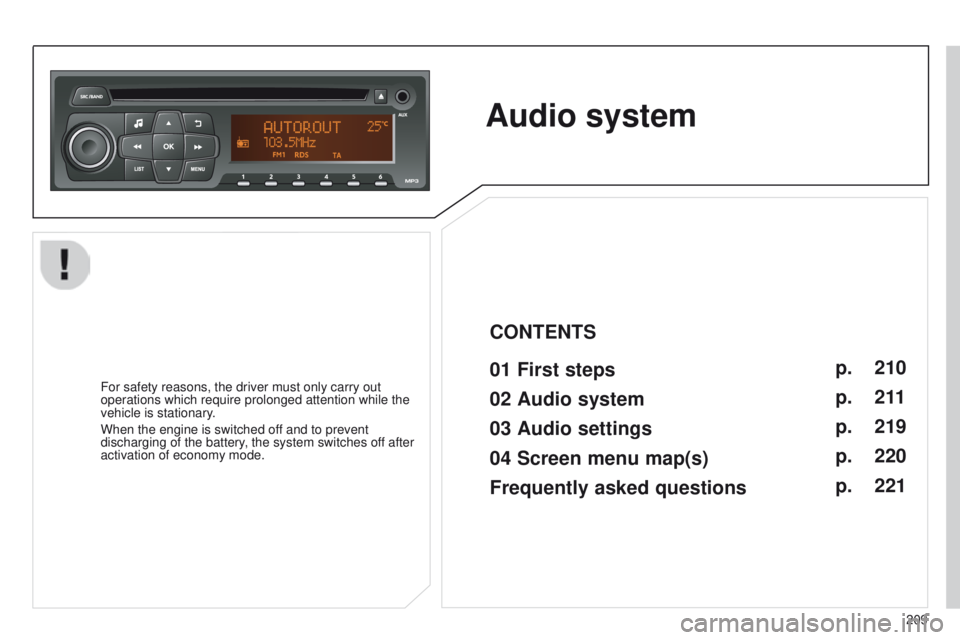
Audio system
01 First steps For safety reasons, the driver must only carry out
operations which require prolonged attention while the
vehicle is stationary.
When the engine is switched off and to prevent
discharging of the battery, the system switches off after
activation of economy mode.
CONTENTS
02 Audio system
03
Audio settings
04
Screen menu map(s)
Frequently
asked questions p.
p.
p.
p.
p.
210
2 11
219
220
221
Page 224 of 285
222
301_en_Chap12b_RDE1_ed01-2014
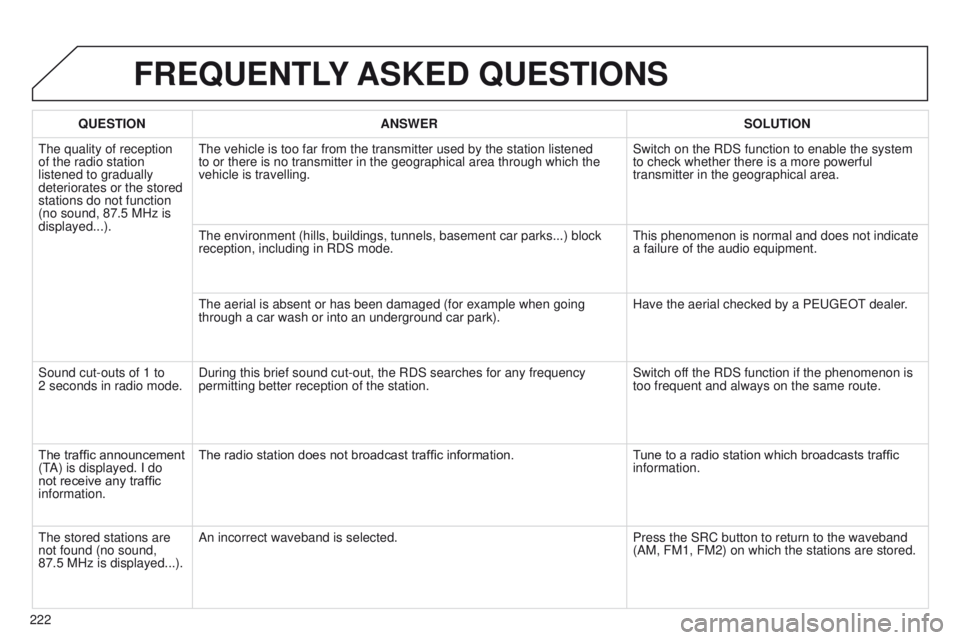
FREqUENTLY ASKED q UESTIONS
qUESTION ANSWER SOLUTION
The quality of reception
of the radio station
listened to gradually
deteriorates or the stored
stations do not function
(no sound, 87.5
MHz is
displayed...). The vehicle is too far from the transmitter used by the station listened\
to or there is no transmitter in the geographical area through which the\
vehicle is travelling.
Switch on the RDS function to enable the system
to check whether there is a more powerful
transmitter in the geographical area.
The environment (hills, buildings, tunnels, basement car parks...) blo\
ck
reception, including in RDS mode. This phenomenon is normal and does not indicate
a failure of the audio equipment.
The aerial is absent or has been damaged (for example when going
through a car wash or into an underground car park). Have the aerial checked by a PEUGEOT dealer.
Sound cut-outs of 1 to
2
seconds in radio mode. During this brief sound cut-out, the RDS searches for any frequency
permitting better reception of the station. Switch off the RDS function if the phenomenon is
too frequent and always on the same route.
The traffic announcement
(TA) is displayed. I do
not receive any traffic
information. The radio station does not broadcast traffic information.
Tune to a radio station which broadcasts traffic
information.
The stored stations are
not found (no sound,
87.5
MHz is displayed...). An incorrect waveband is selected.
Press the SRC button to return to the waveband
(AM, FM1, FM2) on which the stations are stored.
Page 225 of 285
223
301_en_Chap12b_RDE1_ed01-2014
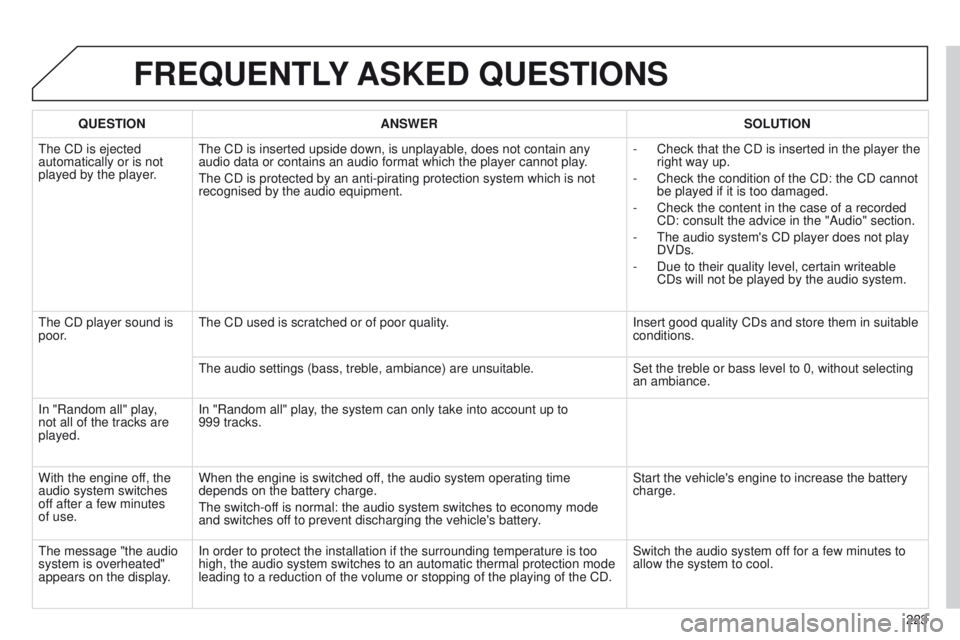
FREqUENTLY ASKED q UESTIONS
qUESTION ANSWER SOLUTION
The CD is ejected
automatically or is not
played by the player
.The CD is inserted upside down, is unplayable, does not contain any
audio data or contains an audio format which the player cannot play.
The CD is protected by an anti-pirating protection system which is not
recognised by the audio equipment. -
Check that the CD is inserted in the player the
right way up.
-
Check the condition of the CD: the CD cannot
be played if it is too damaged.
-
Check the content in the case of a recorded
CD: consult the advice in the "Audio" section.
-
The audio system's CD player does not play
DVDs.
-
Due to their quality level, certain writeable
CDs will not be played by the audio system.
The CD player sound is
poor
. The CD used is scratched or of poor quality.
Insert good quality CDs and store them in suitable
conditions.
The audio settings (bass, treble, ambiance) are unsuitable. Set the treble or bass level to 0, without selecting
an ambiance.
In "Random all" play,
not all of the tracks are
played. In "Random all" play, the system can only take into account up to
999
tracks.
With the engine off, the
audio system switches
off after a few minutes
of use. When the engine is switched off, the audio system operating time
depends on the battery charge.
The switch-off is normal: the audio system switches to economy mode
and switches off to prevent discharging the vehicle's battery. Start the vehicle's engine to increase the battery
charge.
The message "the audio
system is overheated"
appears on the display. In order to protect the installation if the surrounding temperature is t\
oo
high, the audio system switches to an automatic thermal protection mode \
leading to a reduction of the volume or stopping of the playing of the C\
D. Switch the audio system off for a few minutes to
allow the system to cool.
Page 230 of 285
228
301_en_Chap13_recherche-visuelle_ed01-2014
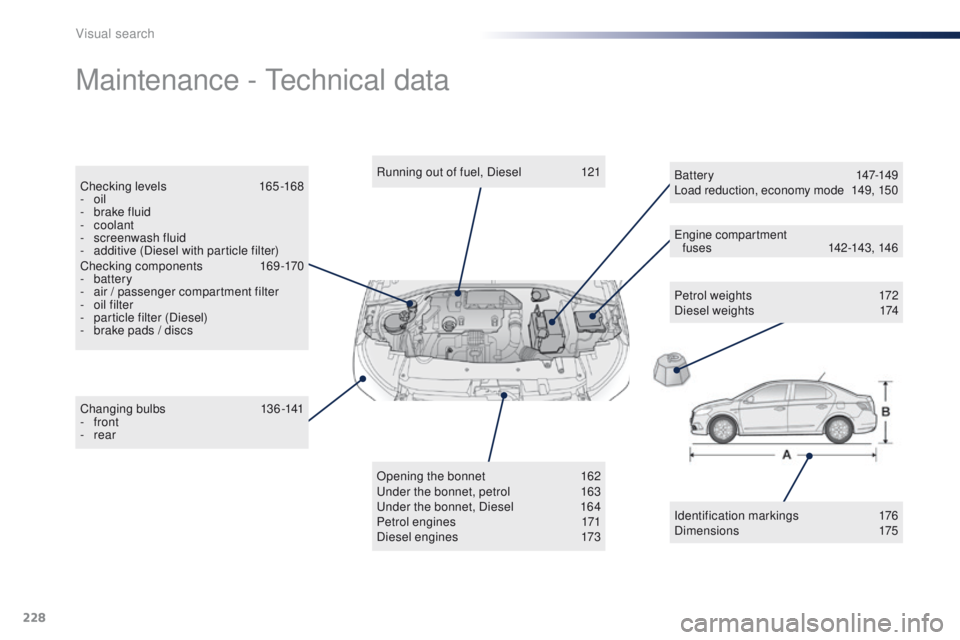
Maintenance - Technical data
Petrol weights 172
Diesel weights 1 74
Changing bulbs
1
36-141
-
front
-
rear Running out of fuel, Diesel
1
21
Opening the bonnet
1
62
Under the bonnet, petrol
1
63
Under the bonnet, Diesel
1
64
Petrol engines
1
71
Diesel engines
1
73 Bat ter y
147-149
Load reduction, economy mode
1
49, 150
Engine compartment
fuses
14
2-143, 146
Checking levels
16
5 -168
-
oil
-
b
rake fluid
-
coolant
-
s
creenwash fluid
-
a
dditive (Diesel with particle filter)
Checking components
1
69-170
-
battery
- a
ir / passenger compartment filter
-
o
il filter
-
p
article filter (Diesel)
-
b
rake pads / discs
Identification markings
1
76
Dimensions
175
Visual search
Page 232 of 285
230
301_en_Chap14_index-alpha_ed01-2014
J
F
Ignition ............................................................. 63
Indicators, direction ........................90, 137, 140
Inflating accessories (using the kit)
..............127
Inflating tyres
.................................................... 8
Inputs for audio system
...........57, 186, 189, 217
Instrument panel
...............................
..............10
Instrument panel screen
........................... 1
0 , 74
Interior fittings
...........................................55, 56
ISOFIX mountings ..........................112 , 115 , 11 6
Jack
........
....................................................... 128
JACK socket
............................ 57, 186, 189, 217
Gearbox, automatic
........................ 70, 149, 170
Gearbox, electronic
........................ 66, 149, 170
Gearbox, manual
.................................... 6 5 , 170
Gear lever, automatic gearbox
....................... 70
G
ear lever, electronic gearbox
....................... 66
Gear lever, manual gearbox
........................... 65
Gear shift indicator
......................................... 74
Glove box
........................................................ 56
I
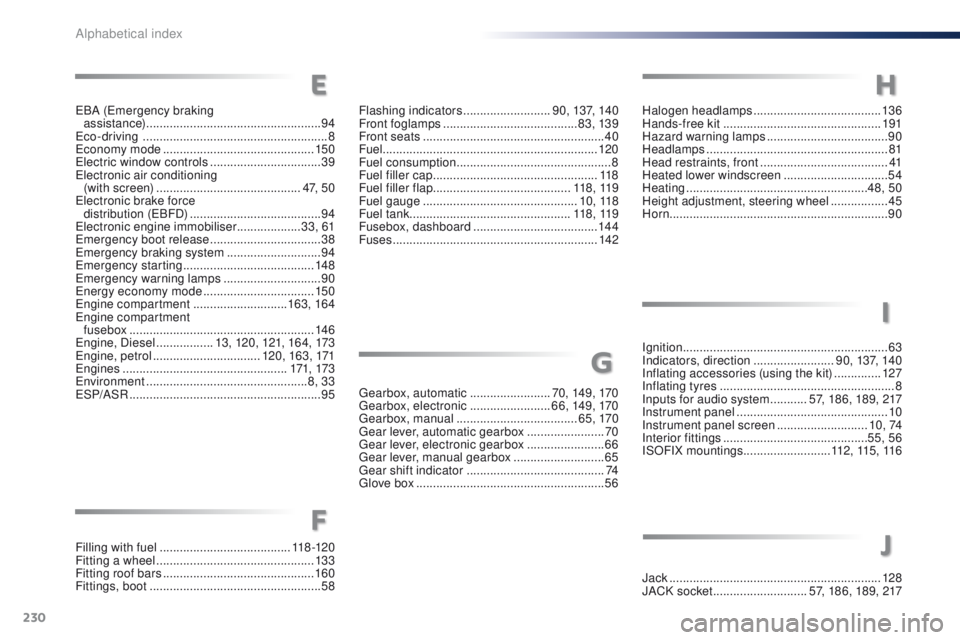
EBA (Emergency braking
assistance) .................................................... 94
Eco-driving
....................................................... 8
Economy mode
............................................. 150
Electric window controls
.................................39
Electronic air conditioning (with screen)
........................................... 4 7, 5 0
Electronic brake force distribution (EBFD)
....................................... 94
Electronic engine immobiliser ...................33, 61
Emergency boot release
................................. 38
E
mergency braking system
............................94
Emergency starting
....................................... 148
Emergency warning lamps
............................. 90
E
nergy economy mode
.................................150
Engine compartment
............................163, 16 4
Engine compartment fusebox
....................................................... 146
Engine, Diesel
................. 1
3, 120, 121, 164, 173
Engine, petrol
................................ 120, 163, 171
Engines
................................................. 171, 173
Environment
...............................
.................8, 33
ESP/ASR
......................................................... 95Flashing indicators
..........................90, 137, 140
Front foglamps
........................................8 3, 13 9
Front seats
......................................................40
Fuel ................................................................ 120
Fuel consumption
.............................................. 8
F
uel filler cap .................................................118
Fuel filler flap
.........................................118 , 11 9
Fuel gauge
..............................................1 0 , 118
Fuel tank ................................................ 118 , 11 9
Fusebox, dashboard
.....................................14 4
Fuses
.............................................................142Halogen headlamps
......................................13 6
Hands-free kit
...............................................191
Hazard warning lamps
....................................90
Headlamps
......................................................81
Head restraints, front
......................................41
Heated lower windscreen
...............................54
Heating
......................................................48, 50
Height adjustment, steering wheel
................. 45
H
orn................................................................. 90
EH
G
Filling with fuel .......................................11 8 -12 0
Fitting a wheel ............................... ................13 3
Fitting roof bars
............................................. 160
Fittings, boot
................................................... 58
Alphabetical index
Page 243 of 285
25
11
Technical data
301-add_en_Chap11_caracteristiques-techniques_ed01-2014
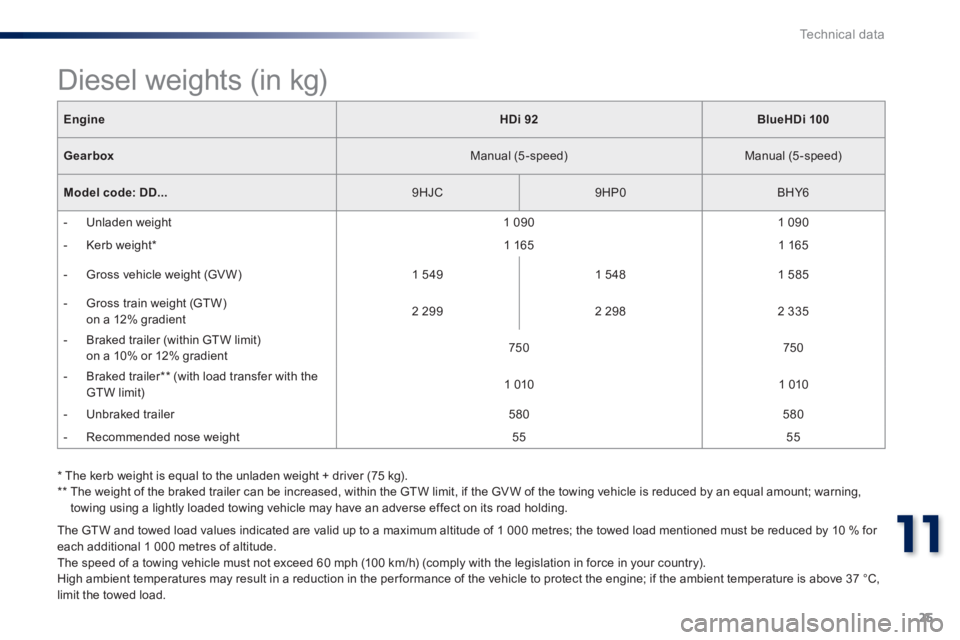
The GTW and towed load values indicated are valid up to a maximum altitude of 1 000 metres; the towed load mentioned must be reduced by 10 % for each additional 1 000 metres of altitude. The speed of a towing vehicle must not exceed 60 mph (100 km/h) (comply with the legislation in force in your country). High ambient temperatures may result in a reduction in the per formance of the vehicle to protect the engine; if the ambient temperature is above 37 °C,
limit the towed load.
* The kerb weight is equal to the unladen weight + driver (75 kg). ** The weight of the braked trailer can be increased, within the GTW limit, if the GV W of the towing vehicle is reduced by an equal amount; warning, towing using a lightly loaded towing vehicle may have an adverse effect on its road holding.
EngineHDi 92BlueHDi 100
Gearbox Manual (5-speed) Manual (5-speed)
Model code: DD... 9HJC 9HP0 BHY6
- Unladen weight 1 090 1 090
- Kerb weight * 1 165 1 165
- Gross vehicle weight (GV W) 1 549 1 548 1 585
- Gross train weight (GTW) on a 12% gradient 2 299 2 298 2 335
- Braked trailer (within GTW limit) on a 10% or 12% gradient 750 750
- Braked trailer ** (with load transfer with the GTW limit) 1 010 1 010
- Unbraked trailer 580 580
- Recommended nose weight 55 55
Diesel weights (in kg)
Page 247 of 285
4
Monitoring
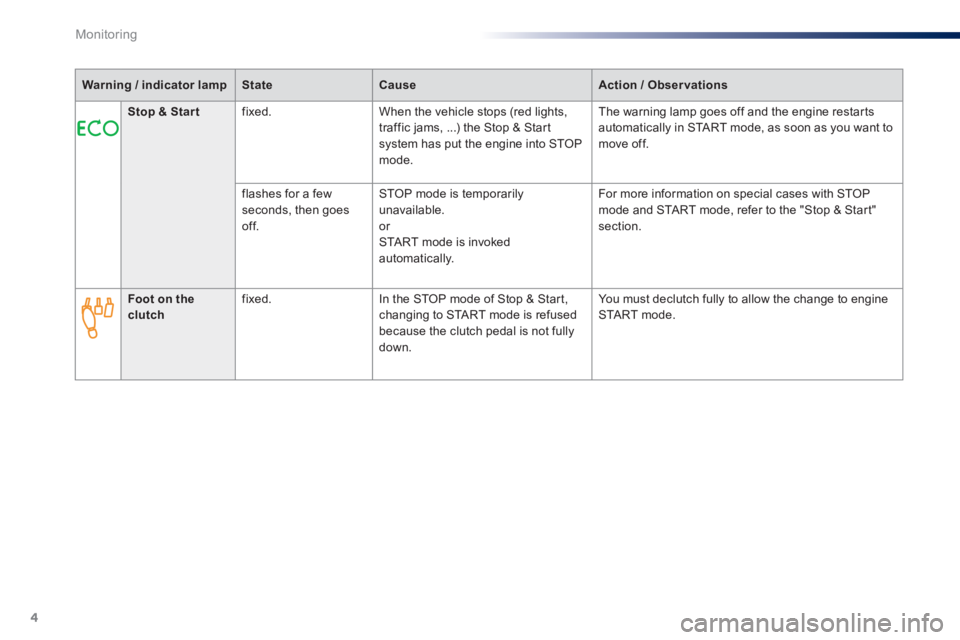
Warning / indicator lampStateCauseAction / Observations
Stop & Star t fixed. When the vehicle stops (red lights, traffic jams, ...) the Stop & Start system has put the engine into STOP mode.
The warning lamp goes off and the engine restarts automatically in START mode, as soon as you want to move off.
flashes for a few seconds, then goes of f.
STOP mode is temporarily unavailable. or START mode is invoked automatically.
For more information on special cases with STOP mode and START mode, refer to the "Stop & Start" section.
Foot on the clutch fixed. In the STOP mode of Stop & Start, changing to START mode is refused because the clutch pedal is not fully down.
You must declutch fully to allow the change to engine START mode.
Page 250 of 285
7
5
Driving
301-add_en_Chap05_conduite_ed01-2014
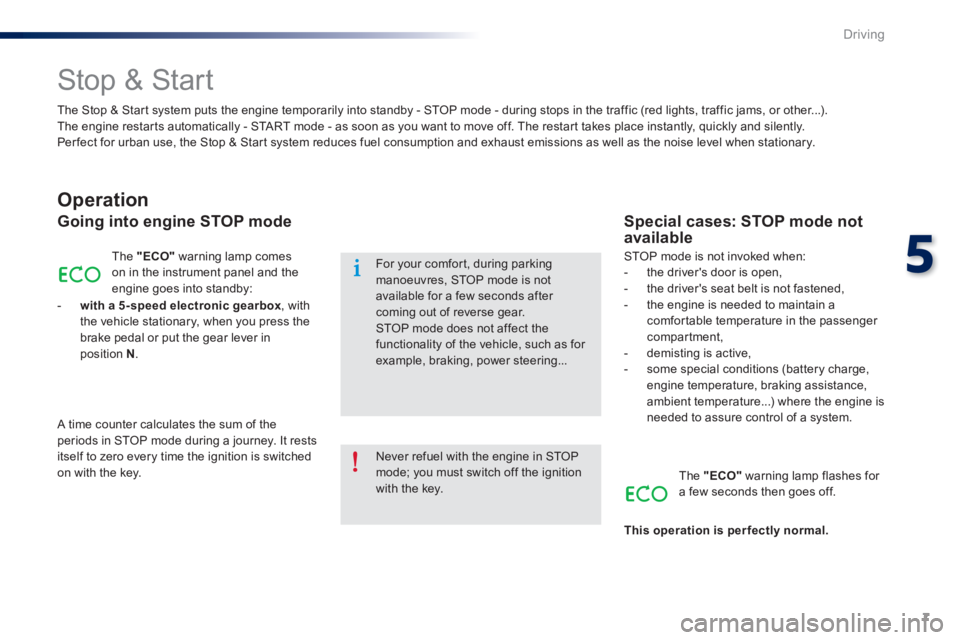
Stop & Start
Operation
Going into engine STOP mode
The "ECO" warning lamp comes on in the instrument panel and the engine goes into standby:
- with a 5-speed electronic gearbox , with the vehicle stationary, when you press the brake pedal or put the gear lever in position N .
A time counter calculates the sum of the periods in STOP mode during a journey. It rests itself to zero every time the ignition is switched on with the key.
Special cases: STOP mode not available
STOP mode is not invoked when: - the driver's door is open, - the driver's seat belt is not fastened, - the engine is needed to maintain a comfortable temperature in the passenger compartment, - demisting is active, - some special conditions (battery charge, engine temperature, braking assistance, ambient temperature...) where the engine is needed to assure control of a system.
The "ECO" warning lamp flashes for a few seconds then goes off.
This operation is perfectly normal.
The Stop & Start system puts the engine temporarily into standby - STOP mode - during stops in the traffic (red lights, traffic jams, or other...). The engine restarts automatically - START mode - as soon as you want to move off. The restart takes place instantly, quickly and silently. Per fect for urban use, the Stop & Start system reduces fuel consumption and exhaust emissions as well as the noise level when stationary.
Never refuel with the engine in STOP mode; you must switch off the ignition with the key.
For your comfort, during parking manoeuvres, STOP mode is not available for a few seconds after coming out of reverse gear. STOP mode does not affect the functionality of the vehicle, such as for example, braking, power steering...
Page 251 of 285
8
Driving
301-add_en_Chap05_conduite_ed01-2014
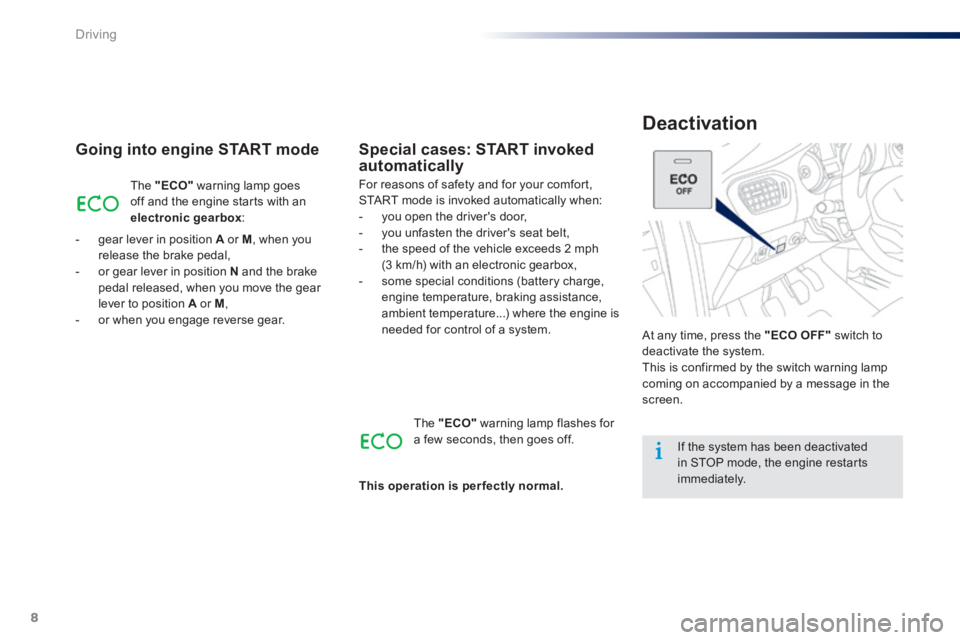
Deactivation
Going into engine START mode
At any time, press the "ECO OFF" switch to deactivate the system. This is confirmed by the switch warning lamp coming on accompanied by a message in the screen.
Special cases: START invoked automatically
The "ECO" warning lamp goes off and the engine starts with an electronic gearbox :
- gear lever in position A or M , when you release the brake pedal, - or gear lever in position N and the brake pedal released, when you move the gear lever to position A or M , - or when you engage reverse gear.
For reasons of safety and for your comfort, START mode is invoked automatically when: - you open the driver's door, - you unfasten the driver's seat belt, - the speed of the vehicle exceeds 2 mph (3 km/h) with an electronic gearbox, - some special conditions (battery charge, engine temperature, braking assistance, ambient temperature...) where the engine is needed for control of a system.
The "ECO" warning lamp flashes for
a few seconds, then goes off.
This operation is perfectly normal.
If the system has been deactivated in STOP mode, the engine restarts immediately.
Page 252 of 285
9
5
Driving
301-add_en_Chap05_conduite_ed01-2014
Maintenance
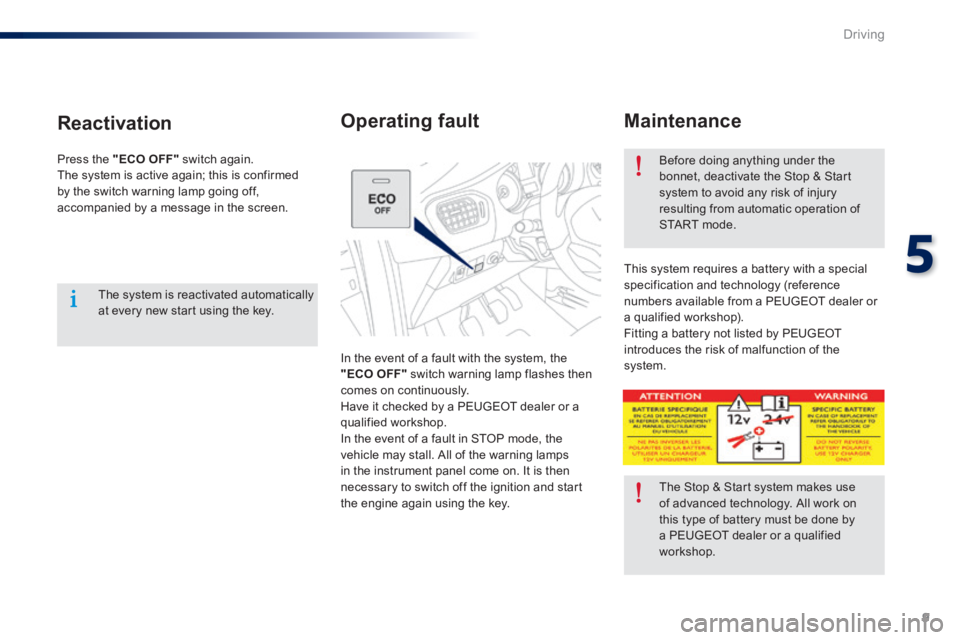
In the event of a fault with the system, the "ECO OFF" switch warning lamp flashes then comes on continuously. Have it checked by a PEUGEOT dealer or a qualified workshop.
In the event of a fault in STOP mode, the vehicle may stall. All of the warning lamps in the instrument panel come on. It is then necessary to switch off the ignition and start the engine again using the key.
Operating fault
This system requires a battery with a special specification and technology (reference numbers available from a PEUGEOT dealer or a qualified workshop). Fitting a battery not listed by PEUGEOT introduces the risk of malfunction of the system.
Before doing anything under the bonnet, deactivate the Stop & Start system to avoid any risk of injury resulting from automatic operation of START mode.
The Stop & Start system makes use of advanced technology. All work on this type of battery must be done by a PEUGEOT dealer or a qualified workshop.
Reactivation
The system is reactivated automatically at every new start using the key.
Press the "ECO OFF" switch again. The system is active again; this is confirmed by the switch warning lamp going off, accompanied by a message in the screen.