instrument panel Peugeot 301 2015 Owner's Guide
[x] Cancel search | Manufacturer: PEUGEOT, Model Year: 2015, Model line: 301, Model: Peugeot 301 2015Pages: 285, PDF Size: 13.55 MB
Page 98 of 285
96
301_en_Chap07_securite_ed01-2014
Seat belts
Front seat belts
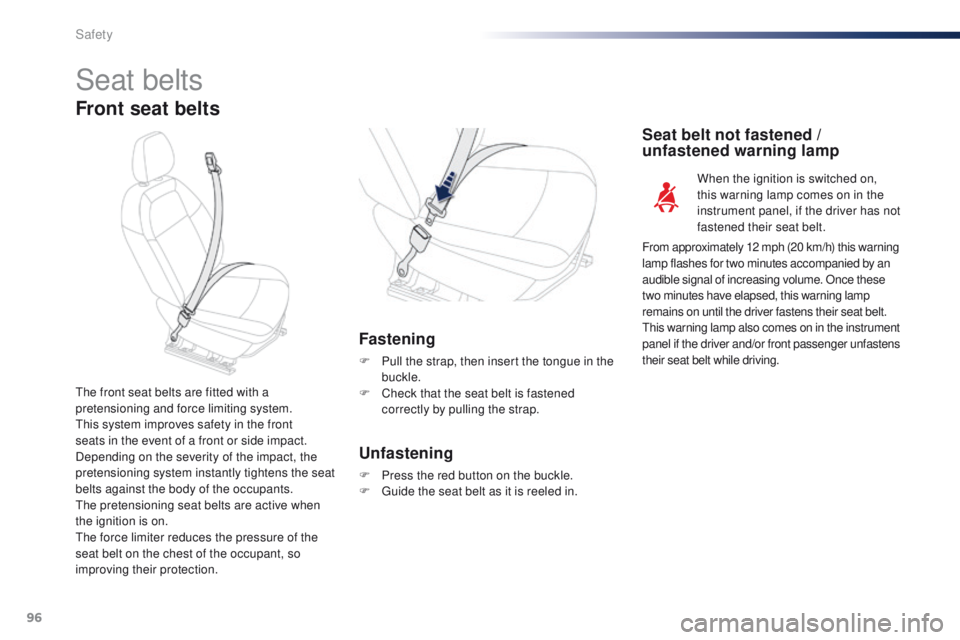
Fastening
F Pull the strap, then insert the tongue in the buckle.
F
C
heck that the seat belt is fastened
correctly by pulling the strap.
Unfastening
F Press the red button on the buckle.
F G uide the seat belt as it is reeled in.
The front seat belts are fitted with a
pretensioning and force limiting system.
This system improves safety in the front
seats in the event of a front or side impact.
Depending on the severity of the impact, the
pretensioning system instantly tightens the seat
belts against the body of the occupants.
The pretensioning seat belts are active when
the ignition is on.
The force limiter reduces the pressure of the
seat belt on the chest of the occupant, so
improving their protection. When the ignition is switched on,
this warning lamp comes on in the
instrument panel, if the driver has not
fastened their seat belt.
Seat belt not fastened /
unfastened warning lamp
From approximately 12 mph (20 km/h) this warning
lamp flashes for two minutes accompanied by an
audible signal of increasing volume. Once these
two minutes have elapsed, this warning lamp
remains on until the driver fastens their seat belt.
This warning lamp also comes on in the instrument
panel if the driver and/or front passenger unfastens
their seat belt while driving.
Safety
Page 102 of 285
100
301_en_Chap07_securite_ed01-2014
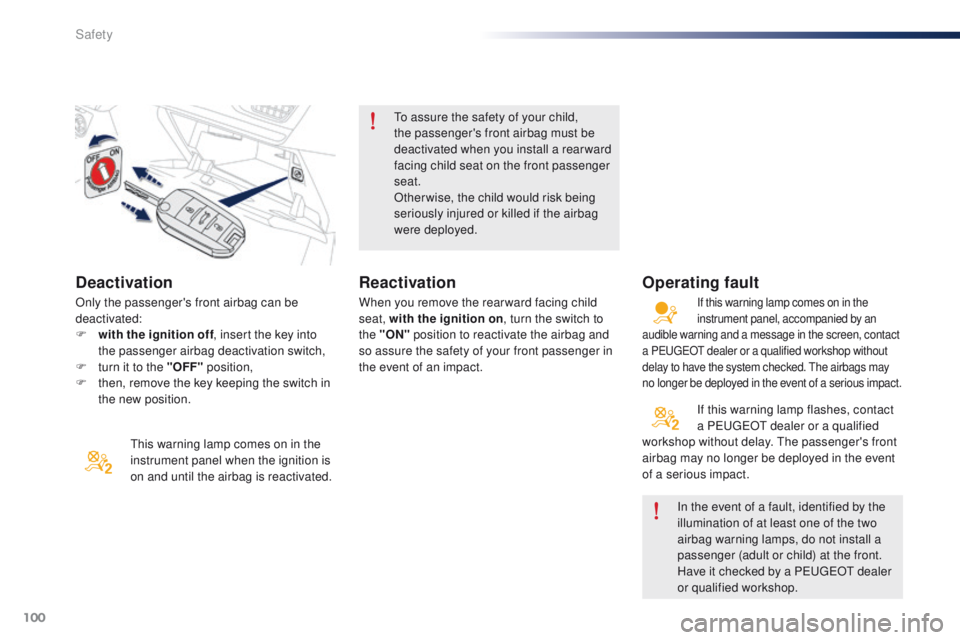
Deactivation
This warning lamp comes on in the
instrument panel when the ignition is
on and until the airbag is reactivated.To assure the safety of your child,
the passenger's front airbag must be
deactivated when you install a rear ward
facing child seat on the front passenger
seat.
Otherwise, the child would risk being
seriously injured or killed if the airbag
were deployed.
Reactivation
Only the passenger's front airbag can be
deactivated:
F
w
ith the ignition off , insert the key into
the passenger airbag deactivation switch,
F
t
urn it to the "OFF" position,
F
t
hen, remove the key keeping the switch in
the new position. When you remove the rear ward facing child
seat, with the ignition on
, turn the switch to
the "ON" position to reactivate the airbag and
so assure the safety of your front passenger in
the event of an impact.
Operating fault
If this warning lamp comes on in the
instrument panel, accompanied by an
audible warning and a message in the screen, contact
a PEUGEOT dealer or a qualified workshop without
delay to have the system checked. The airbags may
no longer be deployed in the event of a serious impact.
If this warning lamp flashes, contact
a PEUGEOT dealer or a qualified
workshop without delay. The passenger's front
airbag may no longer be deployed in the event
of a serious impact.
In the event of a fault, identified by the
illumination of at least one of the two
airbag warning lamps, do not install a
passenger (adult or child) at the front.
Have it checked by a PEUGEOT dealer
or qualified workshop.
Safety
Page 103 of 285
101
301_en_Chap07_securite_ed01-2014
Lateral airbags
Deployment
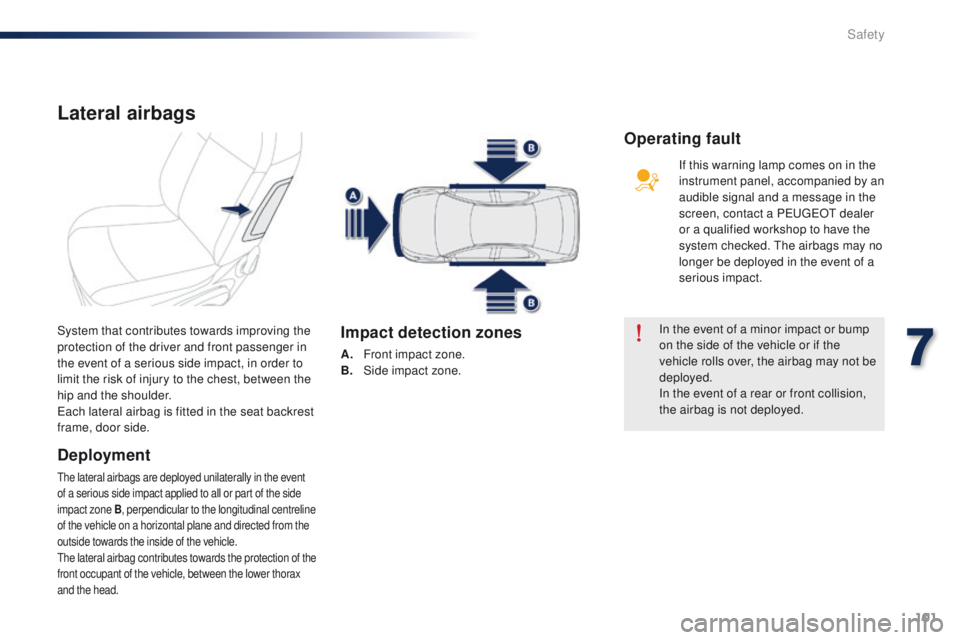
The lateral airbags are deployed unilaterally in the event
of a serious side impact applied to all or part of the side
impact zone B, perpendicular to the longitudinal centreline
of the vehicle on a horizontal plane and directed from the
outside towards the inside of the vehicle.
The lateral airbag contributes towards the protection of the
front occupant of the vehicle, between the lower thorax
and the head.
System that contributes towards improving the
protection of the driver and front passenger in
the event of a serious side impact, in order to
limit the risk of injury to the chest, between the
hip and the shoulder.
Each lateral airbag is fitted in the seat backrest
frame, door side.Impact detection zones
A. Front impact zone.
B. S ide impact zone. If this warning lamp comes on in the
instrument panel, accompanied by an
audible signal and a message in the
screen, contact a PEUGEOT dealer
or a qualified workshop to have the
system checked. The airbags may no
longer be deployed in the event of a
serious impact.
Operating fault
In the event of a minor impact or bump
on the side of the vehicle or if the
vehicle rolls over, the airbag may not be
deployed.
In the event of a rear or front collision,
the airbag is not deployed.
7
Safety
Page 120 of 285
118
301_en_Chap09_info-pratiques_ed01-2014
Low fuel level
When the low fuel level in the tank is
reached, this warning lamp comes
on in the instrument panel.Opening the filler cap may result in an
inrush of air. This vacuum is entirely
normal and results from the sealing of
the fuel system.
Fuel tank
Capacity of the tank: approximately 50 litres. A label on the inside of the filler flap reminds
you of the type of fuel to use according to your
engine.
Additions of fuel must be of at least 5 litres to
be registered by the fuel gauge.
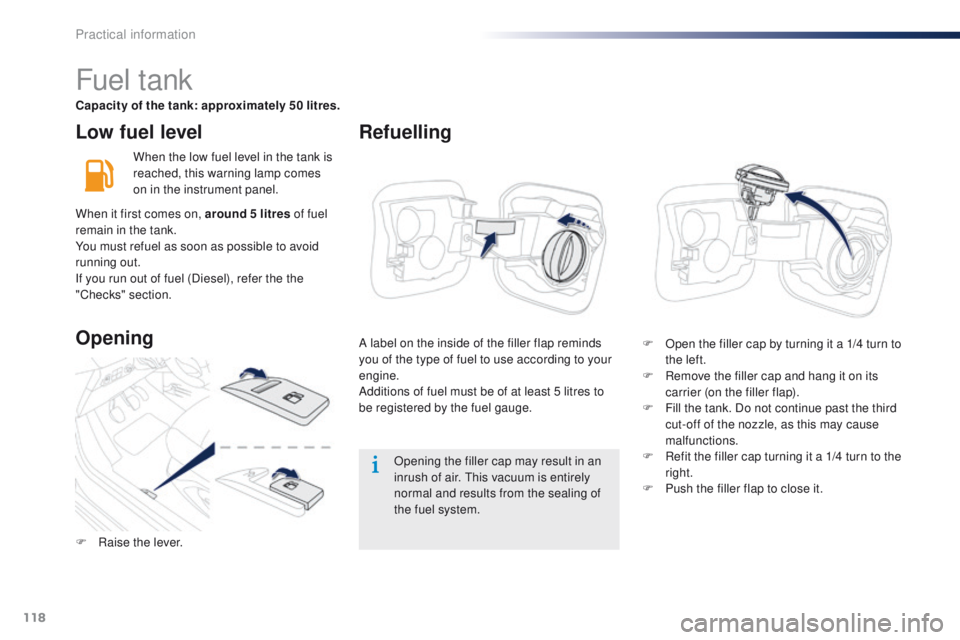
Refuelling
F Open the filler cap by turning it a 1/4 turn to the left.
F
R
emove the filler cap and hang it on its
carrier (on the filler flap).
F
F
ill the tank. Do not continue past the third
cut-off of the nozzle, as this may cause
malfunctions.
F
R
efit the filler cap turning it a 1/4 turn to the
right.
F
P
ush the filler flap to close it.Opening
F Raise the lever. When it first comes on, around 5 litres of fuel
remain in the tank.
You must refuel as soon as possible to avoid
running out.
If you run out of fuel (Diesel), refer the the
"Checks" section.
Practical information
Page 133 of 285
131
301_en_Chap09_info-pratiques_ed01-2014
Removing a wheel
Parking the vehicle
Immobilise the vehicle where it does not
block traffic: the ground must be level,
stable and not slippery.
Apply the parking brake, switch off the
ignition and engage first gear* to block
the wheels.
Check that the parking brake warning
lamps in the instrument panel come on.
The occupants must get out of the
vehicle and wait where they are safe.
Ensure that the jack is correctly
positioned at one of the vehicle's
jacking points.
Incorrect use of the jack could cause
the vehicle to drop.
Never go underneath a vehicle raised
using a jack; use an axle stand.
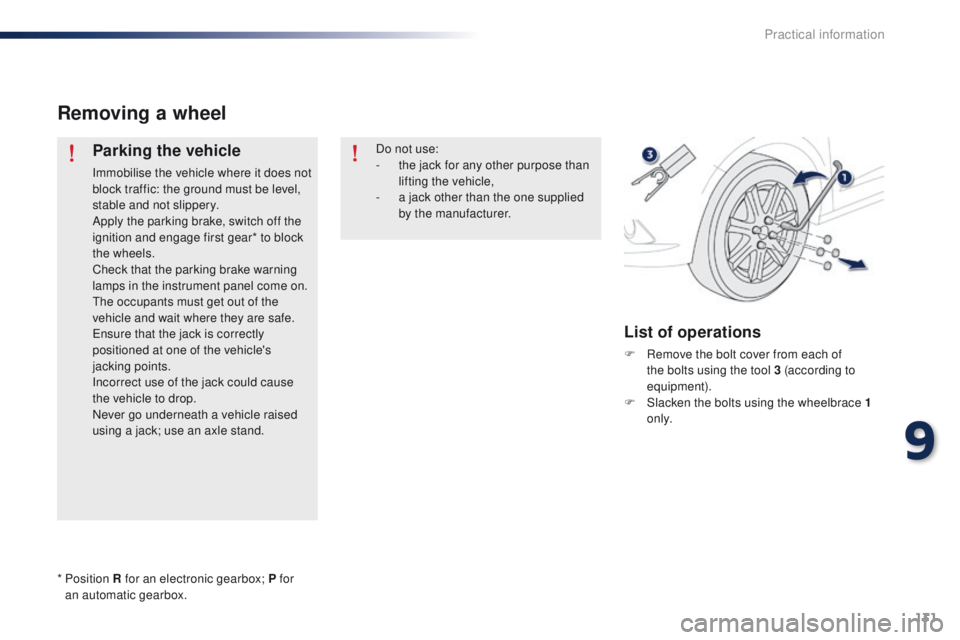
List of operations
F Remove the bolt cover from each of the bolts using the tool 3 (according to
equipment).
F
S
lacken the bolts using the wheelbrace 1
o n l y.
Do not use:
-
t
he jack for any other purpose than
lifting the vehicle,
-
a j
ack other than the one supplied
by the manufacturer.
*
Position R for an electronic gearbox; P for
an automatic gearbox.
9
Practical information
Page 229 of 285
227
301_en_Chap13_recherche-visuelle_ed01-2014
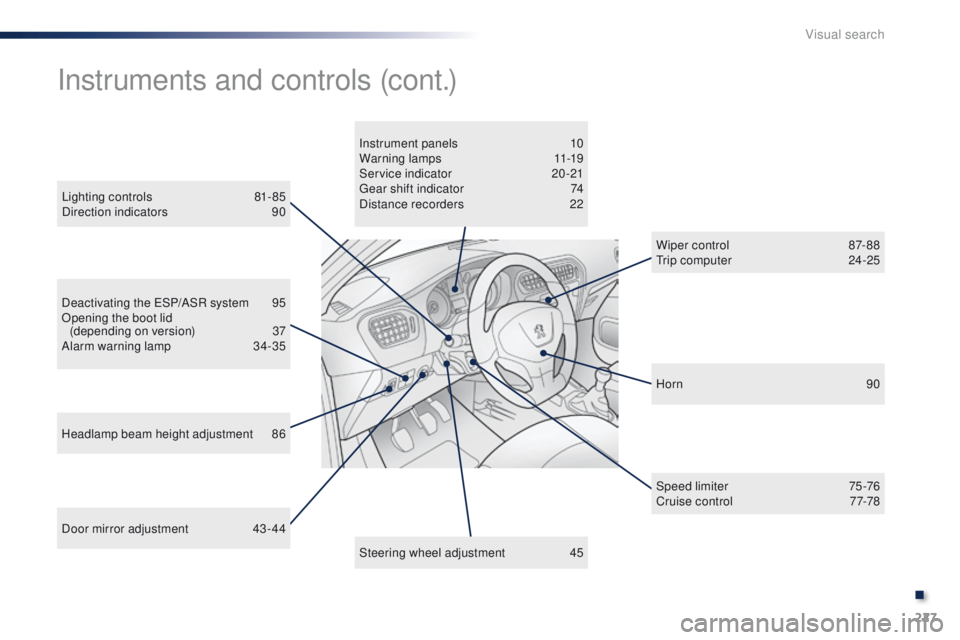
Door mirror adjustment 43 - 44
Deactivating the ESP/ASR system
9
5
Opening the boot lid (depending on version)
3
7
Alarm warning lamp
3
4-35Instrument panels
1
0
Warning lamps
1
1-19
Service indicator
2
0-21
Gear shift indicator
7
4
Distance recorders
2
2
Lighting controls
8
1-85
Direction indicators
9
0
Horn 90
Instruments and controls (cont.)
Headlamp beam height adjustment 8
6 Wiper control
87
- 88
Trip computer
2
4-25
Speed limiter
7
5-76
Cruise control
7
7-78
Steering wheel adjustment
4
5
.
Visual search
Page 232 of 285
230
301_en_Chap14_index-alpha_ed01-2014
J
F
Ignition ............................................................. 63
Indicators, direction ........................90, 137, 140
Inflating accessories (using the kit)
..............127
Inflating tyres
.................................................... 8
Inputs for audio system
...........57, 186, 189, 217
Instrument panel
...............................
..............10
Instrument panel screen
........................... 1
0 , 74
Interior fittings
...........................................55, 56
ISOFIX mountings ..........................112 , 115 , 11 6
Jack
........
....................................................... 128
JACK socket
............................ 57, 186, 189, 217
Gearbox, automatic
........................ 70, 149, 170
Gearbox, electronic
........................ 66, 149, 170
Gearbox, manual
.................................... 6 5 , 170
Gear lever, automatic gearbox
....................... 70
G
ear lever, electronic gearbox
....................... 66
Gear lever, manual gearbox
........................... 65
Gear shift indicator
......................................... 74
Glove box
........................................................ 56
I
EBA (Emergency braking
assistance) .................................................... 94
Eco-driving
....................................................... 8
Economy mode
............................................. 150
Electric window controls
.................................39
Electronic air conditioning (with screen)
........................................... 4 7, 5 0
Electronic brake force distribution (EBFD)
....................................... 94
Electronic engine immobiliser ...................33, 61
Emergency boot release
................................. 38
E
mergency braking system
............................94
Emergency starting
....................................... 148
Emergency warning lamps
............................. 90
E
nergy economy mode
.................................150
Engine compartment
............................163, 16 4
Engine compartment fusebox
....................................................... 146
Engine, Diesel
................. 1
3, 120, 121, 164, 173
Engine, petrol
................................ 120, 163, 171
Engines
................................................. 171, 173
Environment
...............................
.................8, 33
ESP/ASR
......................................................... 95Flashing indicators
..........................90, 137, 140
Front foglamps
........................................8 3, 13 9
Front seats
......................................................40
Fuel ................................................................ 120
Fuel consumption
.............................................. 8
F
uel filler cap .................................................118
Fuel filler flap
.........................................118 , 11 9
Fuel gauge
..............................................1 0 , 118
Fuel tank ................................................ 118 , 11 9
Fusebox, dashboard
.....................................14 4
Fuses
.............................................................142Halogen headlamps
......................................13 6
Hands-free kit
...............................................191
Hazard warning lamps
....................................90
Headlamps
......................................................81
Head restraints, front
......................................41
Heated lower windscreen
...............................54
Heating
......................................................48, 50
Height adjustment, steering wheel
................. 45
H
orn................................................................. 90
EH
G
Filling with fuel .......................................11 8 -12 0
Fitting a wheel ............................... ................13 3
Fitting roof bars
............................................. 160
Fittings, boot
................................................... 58
Alphabetical index
Page 244 of 285
1
1
Monitoring
301-add_en_Chap01_controle-de-marche_ed01-2014
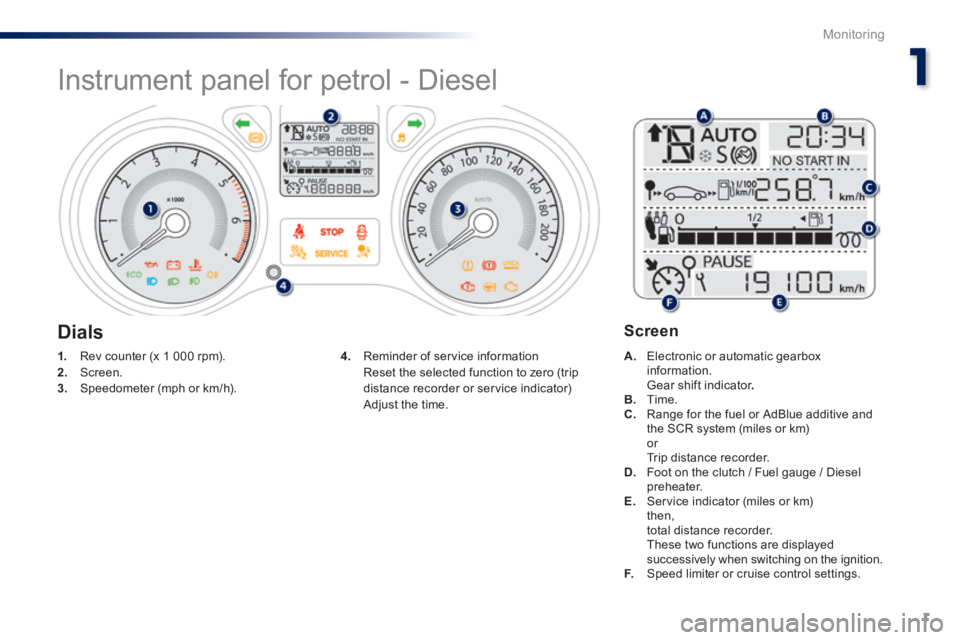
Instrument panel for petrol - Diesel
1. Rev counter (x 1 000 rpm). 2. Screen. 3. Speedometer (mph or km/h).
A. Electronic or automatic gearbox information. Gear shift indicator .B. Time. C. Range for the fuel or AdBlue additive and the SCR system (miles or km) or Trip distance recorder. D. Foot on the clutch / Fuel gauge / Diesel preheater. E. Service indicator (miles or km) then, total distance recorder. These two functions are displayed successively when switching on the ignition .F. Speed limiter or cruise control settings.
4. Reminder of service information Reset the selected function to zero (trip distance recorder or service indicator) Adjust the time.
Dials Screen
Page 250 of 285
7
5
Driving
301-add_en_Chap05_conduite_ed01-2014
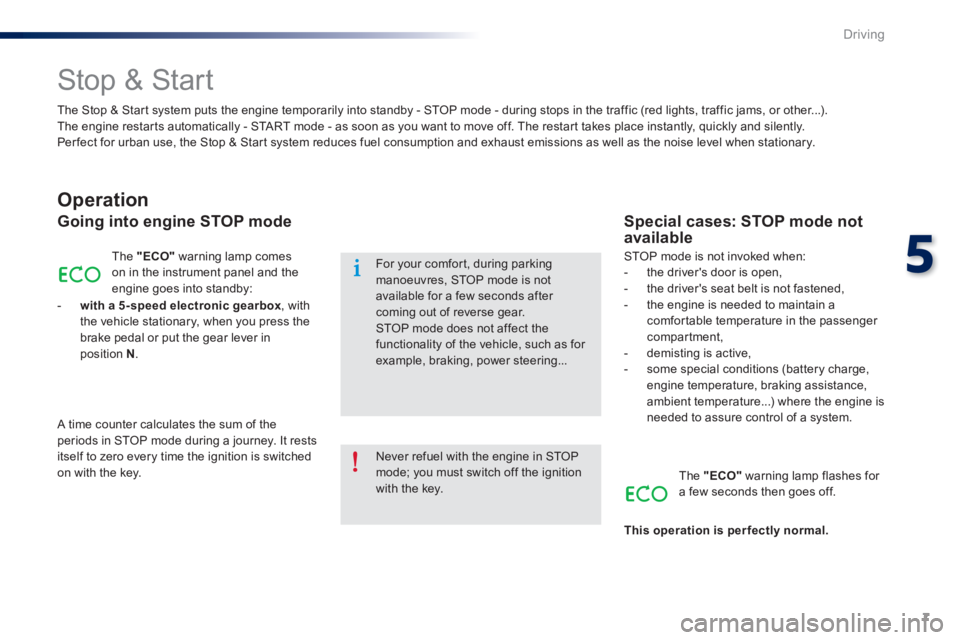
Stop & Start
Operation
Going into engine STOP mode
The "ECO" warning lamp comes on in the instrument panel and the engine goes into standby:
- with a 5-speed electronic gearbox , with the vehicle stationary, when you press the brake pedal or put the gear lever in position N .
A time counter calculates the sum of the periods in STOP mode during a journey. It rests itself to zero every time the ignition is switched on with the key.
Special cases: STOP mode not available
STOP mode is not invoked when: - the driver's door is open, - the driver's seat belt is not fastened, - the engine is needed to maintain a comfortable temperature in the passenger compartment, - demisting is active, - some special conditions (battery charge, engine temperature, braking assistance, ambient temperature...) where the engine is needed to assure control of a system.
The "ECO" warning lamp flashes for a few seconds then goes off.
This operation is perfectly normal.
The Stop & Start system puts the engine temporarily into standby - STOP mode - during stops in the traffic (red lights, traffic jams, or other...). The engine restarts automatically - START mode - as soon as you want to move off. The restart takes place instantly, quickly and silently. Per fect for urban use, the Stop & Start system reduces fuel consumption and exhaust emissions as well as the noise level when stationary.
Never refuel with the engine in STOP mode; you must switch off the ignition with the key.
For your comfort, during parking manoeuvres, STOP mode is not available for a few seconds after coming out of reverse gear. STOP mode does not affect the functionality of the vehicle, such as for example, braking, power steering...
Page 252 of 285
9
5
Driving
301-add_en_Chap05_conduite_ed01-2014
Maintenance
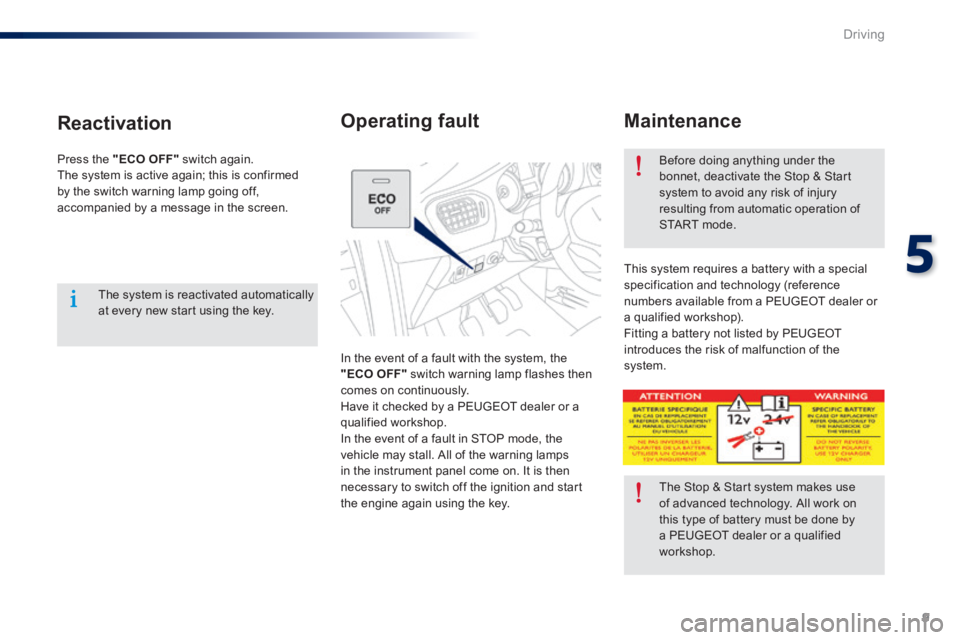
In the event of a fault with the system, the "ECO OFF" switch warning lamp flashes then comes on continuously. Have it checked by a PEUGEOT dealer or a qualified workshop.
In the event of a fault in STOP mode, the vehicle may stall. All of the warning lamps in the instrument panel come on. It is then necessary to switch off the ignition and start the engine again using the key.
Operating fault
This system requires a battery with a special specification and technology (reference numbers available from a PEUGEOT dealer or a qualified workshop). Fitting a battery not listed by PEUGEOT introduces the risk of malfunction of the system.
Before doing anything under the bonnet, deactivate the Stop & Start system to avoid any risk of injury resulting from automatic operation of START mode.
The Stop & Start system makes use of advanced technology. All work on this type of battery must be done by a PEUGEOT dealer or a qualified workshop.
Reactivation
The system is reactivated automatically at every new start using the key.
Press the "ECO OFF" switch again. The system is active again; this is confirmed by the switch warning lamp going off, accompanied by a message in the screen.