steering wheel Peugeot 301 2017 Owner's Manual
[x] Cancel search | Manufacturer: PEUGEOT, Model Year: 2017, Model line: 301, Model: Peugeot 301 2017Pages: 306, PDF Size: 9.87 MB
Page 4 of 306
2
.
.
Instrument panel 11
Warning lights 1 2
Service indicator
2
5
Distance recorders
3
0
Date and time adjustment
3
1
Trip computer
3
3Remote control
3
6
Alarm
39
D o o r s
41
Boo
t
43
Electric Windows
4
5
Front seats
4
6
Rear bench seat
4
8
Steering wheel adjustment 5 0
Mirrors 5 0
Heating
52
Manual air conditioning (without display screen)
5
2
Electronic air conditioning (with display screen)
5
4
Front demist - defrost
5
7
Rear screen demist - defrost
5
8
Fittings
6
0
Mats
6
3Lighting control
6
4
Headlight beam height adjustment
6
7
Wiper control stalk
6
8
Courtesy lights
6
9
General safety recommendations
7
0
Direction indicators
7
1
Hazard warning lamps 7 1
Audible warning 7 1
Emergency or assistance
7
2
Under-inflation detection
7
4
Electronic stability programme (ESC)
7
7
Seat belts
8
0
Air bags
8
3
Child seats
87
D
eactivating the front passenger airbag
9
0
ISOFIX mountings
9
7
Child lock
1
00
Eco-driving
9
Eco-driving
Instruments Access
Over view
Ergonomics and comfort Lighting and visibility
Security and safety
Contents
Page 9 of 306
7
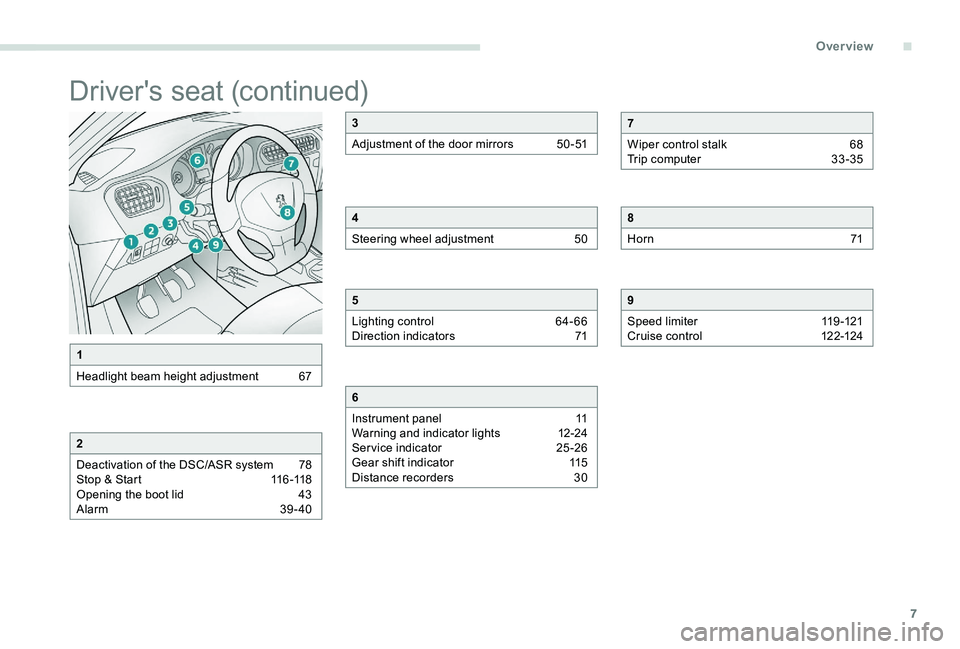
Driver's seat (continued)
1
Headlight beam height adjustment
6
7
2
Deactivation of the DSC/ASR system
7
8
Stop & Start
1
16 -118
Opening the boot lid
4
3
Alarm
3
9- 40
3
Adjustment of the door mirrors
5
0 -51
4
Steering wheel adjustment
5
0
5
Lighting control
6
4-66
Direction indicators
7
1
6
Instrument panel
1
1
Warning and indicator lights
1
2-24
Service indicator
2
5-26
Gear shift indicator
1
15
Distance recorders
3
0
7
Wiper control stalk
6
8
Trip computer
3
3 -35
8
H o r n
71
9
Speed limiter
1
19-121
Cr uise c ontrol
12
2-124
.
Over view
Page 41 of 306
39
Alarm
Perimeter protection
The system checks for opening of the vehicle.
The alarm is triggered if anyone tries to open a
door, the boot, the bonnet...Self-protection function
The system checks for the putting out of
service of its components.
The alarm is triggered if the battery, the
central control or the siren wiring are put
out of service or damaged.
For all work on the alarm system,
contact a PEUGEOT dealer or a qualified
workshop.
Locking the vehicle with
alarm
Activation
F Turn the vehicle off and exit.
Deactivation
F Press the unlocking button on the remote control.
F
P
ress the locking button on the
remote control.
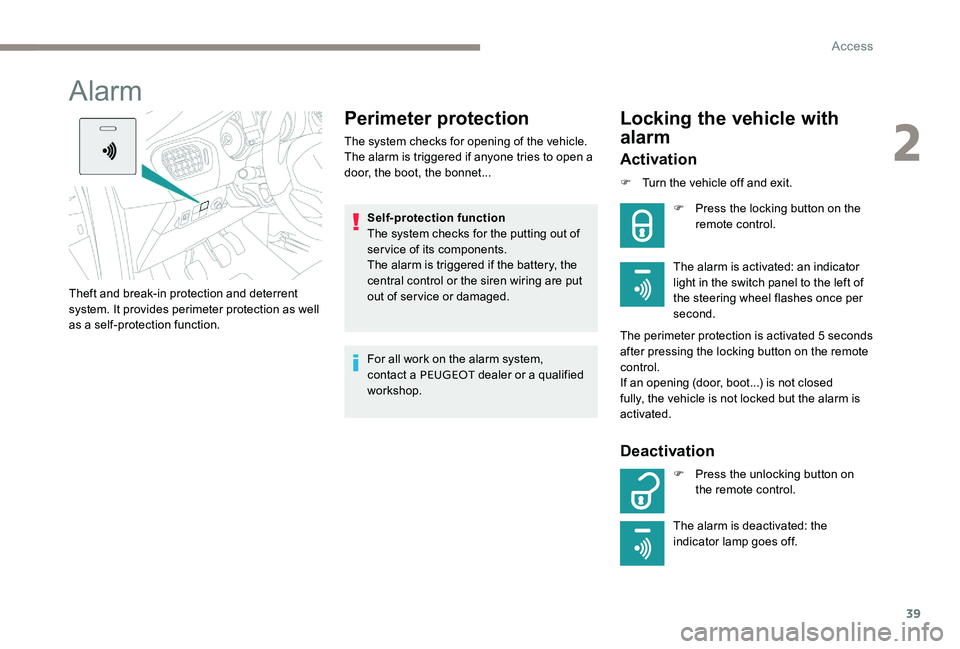
The alarm is activated: an indicator
light in the switch panel to the left of
the steering wheel flashes once per
second.
The alarm is deactivated: the
indicator lamp goes off.
Theft and break-in protection and deterrent
system. It provides perimeter protection as well
as a self-protection function.
The perimeter protection is activated 5 seconds
after pressing the locking button on the remote
control.
If an opening (door, boot...) is not closed
fully, the vehicle is not locked but the alarm is
activated.
2
Access
Page 52 of 306
50
Steering wheel adjustment
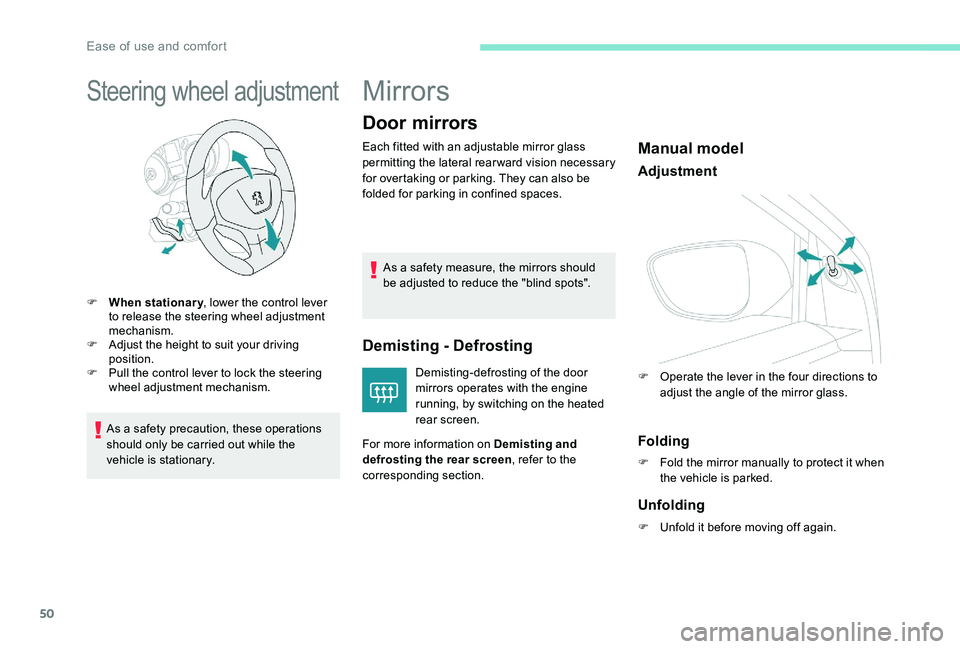
F When stationary, lower the control lever
to release the steering wheel adjustment
mechanism.
F
A
djust the height to suit your driving
position.
F
P
ull the control lever to lock the steering
wheel adjustment mechanism.
As a safety precaution, these operations
should only be carried out while the
vehicle is stationary.
Mirrors
Door mirrors
Each fitted with an adjustable mirror glass
permitting the lateral rearward vision necessary
for overtaking or parking. They can also be
folded for parking in confined spaces.
As a safety measure, the mirrors should
be adjusted to reduce the "blind spots".
Demisting - Defrosting
Demisting-defrosting of the door
mirrors operates with the engine
running, by switching on the heated
rear screen.
For more information on Demisting and
defrosting the rear screen , refer to the
corresponding section.
Manual model
Adjustment
F Operate the lever in the four directions to adjust the angle of the mirror glass.
Folding
F Fold the mirror manually to protect it when the vehicle is parked.
Unfolding
F Unfold it before moving off again.
Ease of use and comfort
Page 69 of 306
67
Headlight beam height adjustment
To avoid causing a nuisance to other road
users, the height of the headlight beams should
be adjusted according to the load in the vehicle.
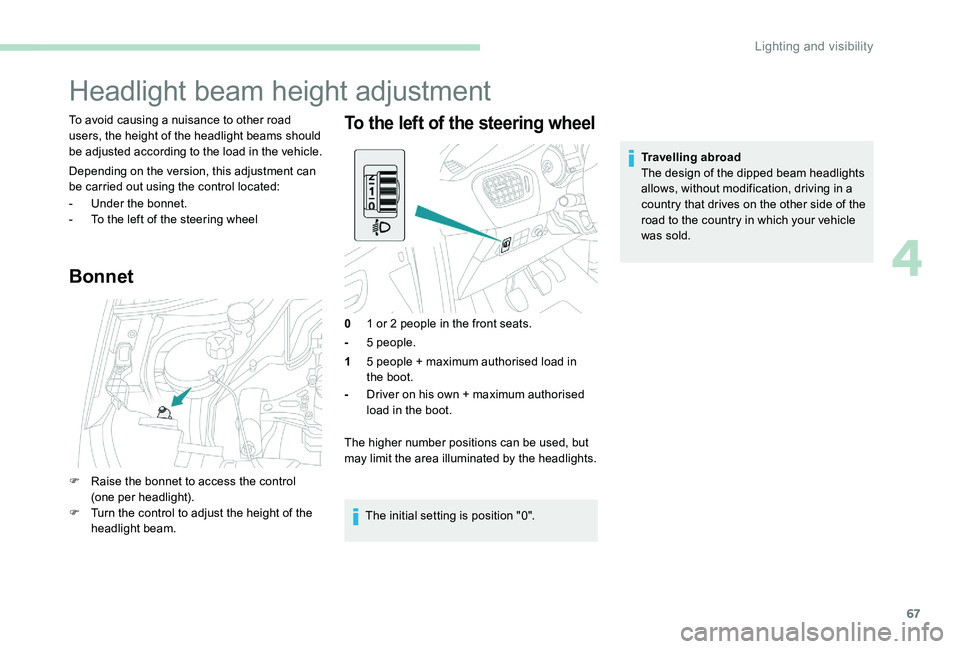
Depending on the version, this adjustment can
be carried out using the control located:
-
U
nder the bonnet.
-
T
o the left of the steering wheel
Bonnet
F Raise the bonnet to access the control (one per headlight).
F
T
urn the control to adjust the height of the
headlight beam.
To the left of the steering wheel
0 1 or 2 people in the front seats.
- 5 people.
1 5 people + maximum authorised load in
the boot.
- Driver on his own + maximum authorised
load in the boot.
The higher number positions can be used, but
may limit the area illuminated by the headlights.
The initial setting is position "0". Travelling abroad
The design of the dipped beam headlights
allows, without modification, driving in a
country that drives on the other side of the
road to the country in which your vehicle
was sold.
4
Lighting and visibility
Page 73 of 306
71
Direction indicators
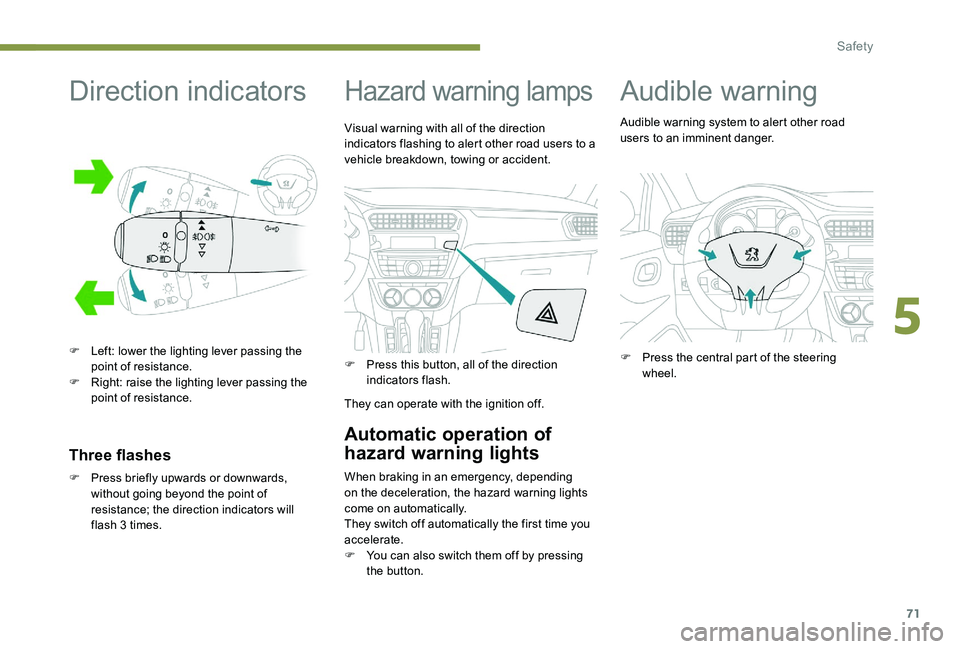
F Left: lower the lighting lever passing the point of resistance.
F
R
ight: raise the lighting lever passing the
point of resistance.
Three flashes
F Press briefly upwards or downwards, without going beyond the point of
resistance; the direction indicators will
flash 3 times.
Hazard warning lampsAudible warning
Audible warning system to alert other road
users to an imminent danger.
Visual warning with all of the direction
indicators flashing to alert other road users to a
vehicle breakdown, towing or accident.
F
P
ress this button, all of the direction
indicators flash.
They can operate with the ignition off.
Automatic operation of
hazard warning lights
When braking in an emergency, depending
on the deceleration, the hazard warning lights
come on automatically.
They switch off automatically the first time you
accelerate.
F
Y
ou can also switch them off by pressing
the button. F
P
ress the central part of the steering
wheel.
5
Safety
Page 76 of 306
74
Tyre under-inflation detection
System which automatically checks the
pressures of the tyres while driving.
The system monitors the pressures in the four
tyres, once the vehicle is moving.
It compares the information given by the four
wheel speed sensors with reference values,
which must be reinitialised ever y time the
tyre pressures are adjusted or a wheel
changed.
The system triggers an alert as soon as it
detects a drop in the inflation pressure of one
or more tyres.Under-inflation alert
The under-inflation detection system does
not replace the need for vigilance on the
part of the driver.
This system does not avoid the need to
check the tyre pressures (including the
spare wheel) every month as well as
before a long journey.
Driving with under-inflated tyres worsens
road-holding, lengthens braking distances,
causes premature wear of the tyres,
particularly in adverse conditions (heavy
loads, high speeds, long journeys). Driving with under-inflated tyres
increases fuel consumption.
The inflation pressures defined for your
vehicle can be found on the tyre pressure
label.
For more information on the
Identification markings , refer to the
corresponding section.
Checking tyre pressures
This check should be done when the tyres
are "cold" (vehicle stopped for 1 hour or
after a journey of less than 6 miles (10 km)
at moderate speeds).
Other wise, add 0.3 bar to the pressures
shown on the label. This warning is indicated by
continuous illumination of the light,
an audible signal and a message
displayed on the screen.
F
R
educe speed immediately, avoid
excessive steering movements and sudden
braking.
F
S
top as soon as it is safe to do so.
The loss of pressure detected does not
always cause visible bulging of the tyre.
Do not rely on a simple visual check.
F I f you have a compressor (such as the
one in the temporary puncture repair kit),
check the pressures of the four tyres when
cold. If it is not possible to make this check
immediately, drive carefully at reduced
speed.
or
F
I
n the event of a puncture, use the
temporary puncture repair kit or the spare
wheel (depending on equipment).
The warning remains active until the
system is reinitialised.
Safety
Page 85 of 306
83
Air bags
Designed to contribute to the safety of the
occupants in case of violent collisions The
airbags supplement the action of the force-
limiting seat belts.
If a collision occurs, the electronic detectors
record and analyse the front and side impacts
sustained in the impact detection zones:
-
I
n the event of violent impact, the air
bags are deployed instantly and help
better protect occupants of the vehicle;
immediately after the impact, the air
bags deflate rapidly in order not to hinder
the visibility nor the possible exit of the
occupants.
-
I
n the event of a non violent impact, impact
on the back and under certain conditions of
a rollover, the air bags may not deploy; only
the seat belt helps to protect you in these
situations.Impact detection zones Front air bags
The air bags do not operate when the
ignition is switched off.
This equipment will only deploy once. If a
second impact occurs (during the same or
a subsequent accident), the airbag will not
be deployed again. The deployment of an air bag is
accompanied by a slight emission of
smoke and a noise, due to the detonation
of the pyrotechnic charge incorporated in
the system.
This smoke is not harmful, but sensitive
individuals may experience slight irritation.
The detonation noise associated with the
deployment of an air bag may result in a
slight loss of hearing for a short time.
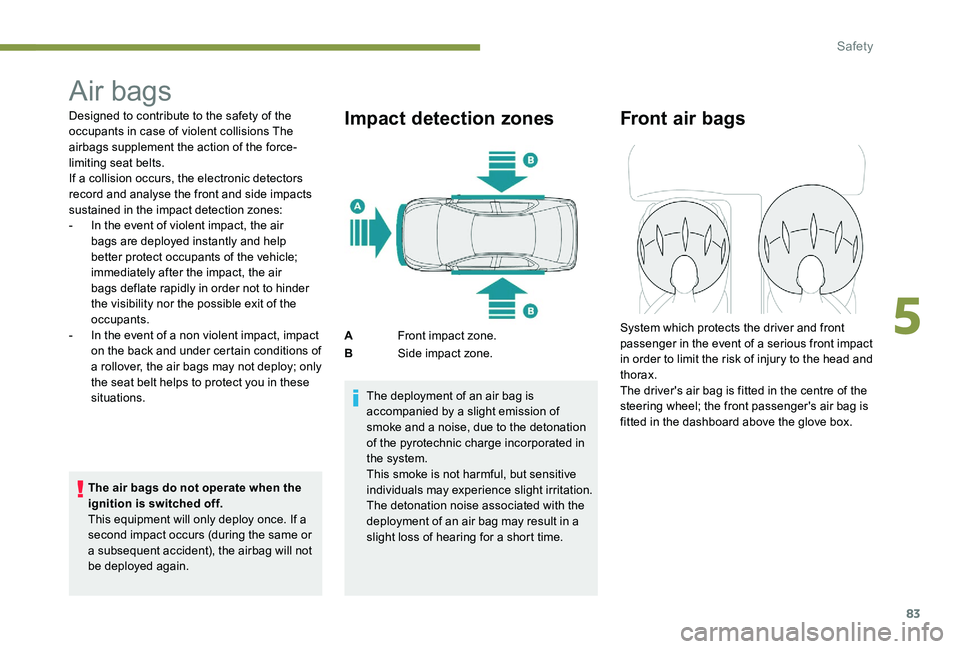
A
Front impact zone.
B Side impact zone. System which protects the driver and front
passenger in the event of a serious front impact
in order to limit the risk of injury to the head and
thorax.
The driver's air bag is fitted in the centre of the
steering wheel; the front passenger's air bag is
fitted in the dashboard above the glove box.
5
Safety
Page 86 of 306
84
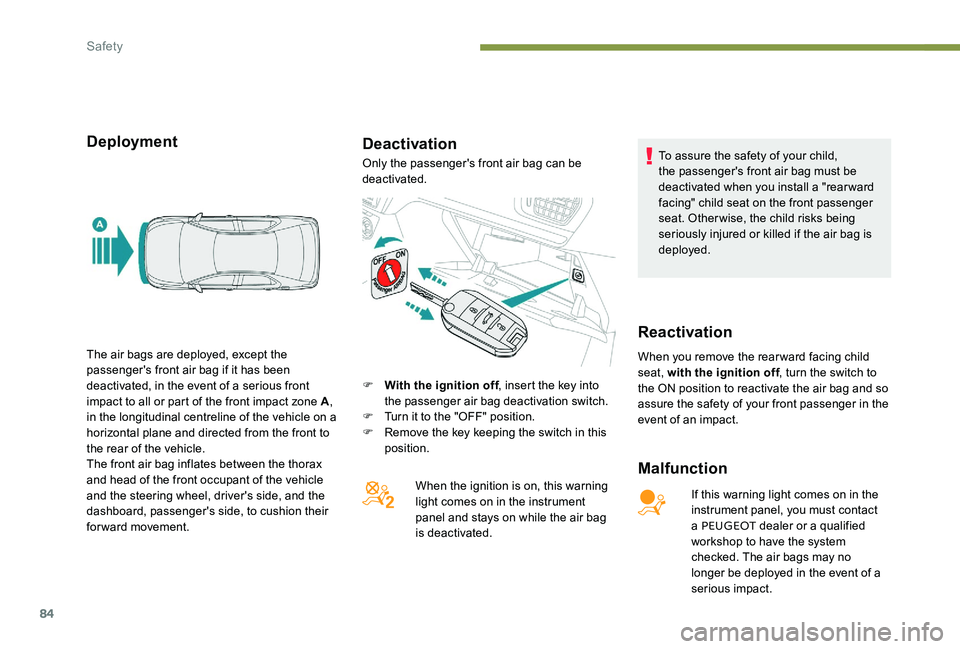
DeploymentDeactivation
Malfunction
If this warning light comes on in the
instrument panel, you must contact
a PEUGEOT dealer or a qualified
workshop to have the system
checked. The air bags may no
longer be deployed in the event of a
serious impact.
Reactivation
When you remove the rear ward facing child
seat, with the ignition off , turn the switch to
the ON position to reactivate the air bag and so
assure the safety of your front passenger in the
event of an impact.
Only the passenger's front air bag can be
deactivated.
F
W
ith the ignition off , insert the key into
the passenger air bag deactivation switch.
F
T
urn it to the "OFF" position.
F
R
emove the key keeping the switch in this
position.
When the ignition is on, this warning
light comes on in the instrument
panel and stays on while the air bag
is deactivated. To assure the safety of your child,
the passenger's front air bag must be
deactivated when you install a "rear ward
facing" child seat on the front passenger
seat. Otherwise, the child risks being
seriously injured or killed if the air bag is
deployed.
The air bags are deployed, except the
passenger's front air bag if it has been
deactivated, in the event of a serious front
impact to all or part of the front impact zone A ,
in the longitudinal centreline of the vehicle on a
horizontal plane and directed from the front to
the rear of the vehicle.
The front air bag inflates between the thorax
and head of the front occupant of the vehicle
and the steering wheel, driver's side, and the
dashboard, passenger's side, to cushion their
for ward movement.
Safety
Page 88 of 306
86
Advice
The vehicle's front door panels include side
impact sensors.
A damaged door or any unauthorised or
incorrectly executed work (modification or
repair) on the front doors or their interior trim
could compromise the operation of these
sensors - Risk of malfunction of the side air
bags!
Such work must only be done by a
PEUGEOT dealer or a qualified workshop.
Front air bags
Do not drive holding the steering wheel by its
spokes or resting your hands on the centre
part of the wheel.
Passengers must not place their feet on the
dashboard.
Do not smoke as deployment of the air bags
can cause burns or the risk of injury from a
cigarette or pipe.
Never remove or pierce the steering wheel or
hit it violently.
Do not fasten or attach anything to the
steering wheel or dashboard, this could
cause injuries with deployment of the air
bags.
Adopt a normal and upright sitting position.
Fasten your seat belt, ensuring it is
positioned correctly.
Do not leave anything between the
occupants and the air bags (a child, pet,
object...), nor fix or attach anything close to
the inflation trajectory of the air bags; this
could cause injuries during their deployment.
Never modify the original definition of your
vehicle, particularly in the area directly
around the air bags.
After an accident or if the vehicle has been
stolen or broken into, have the air bag
systems checked.
All work on the air bag system must be
carried out by a PEUGEOT
dealer or a
qualified workshop.
Even when following all the precautions
listed, a risk of injuries or slight burns to
the head, the chest or the arms, when an
air bag deploys cannot be excluded. The
bag inflates almost instantly (within a few
milliseconds) then deflates within the same
time discharging the hot gas via openings
provided for this purpose. For the air bags to be fully effective, obser ve the safety recommendations below.
Side air bags
Use only approved covers on the seats,
compatible with the deployment of the side
air bags. For information on the range of
covers suitable for your vehicle, you can
contact a dealer PEUGEOT.
Do not attach anything to or hang anything
from the seat backrests (clothes, etc.) as
this could cause injuries to the thorax or arm
when the side air bag is deployed.
Do not sit with the upper part of the body any
nearer to the door than necessary.
Safety