battery Peugeot 308 2014 Owner's Guide
[x] Cancel search | Manufacturer: PEUGEOT, Model Year: 2014, Model line: 308, Model: Peugeot 308 2014Pages: 400, PDF Size: 10.05 MB
Page 132 of 400
130
Driving
308_EN_CHAP04_CONDUITE_ED02-2013
Going into engine START mode
The "ECO" warning lamp goes off and the engine starts automatically:
- With a manual gearbox , when you fullydepress the clutch pedal.
START mode is invoked automatically when:
Special cases: START invoked automatically
- you open the driver's door, - you unfasten the driver's seat belt, - the speed of the vehicle exceeds 15 mph (25 km/h) or 2 mph (3 km/h) (depending on the engine) with a manual gearbox, - the speed of the vehicle exceeds 2 mph (3 km/h) with an automatic gearbox, - the electric parking brake is being applied, - some special conditions (battery charge, engine temperature, braking assistance, ambient temperature...) where the engine is needed for control of a system.
If the system has been deactivated in STOP mode, the engine restarts immediately.
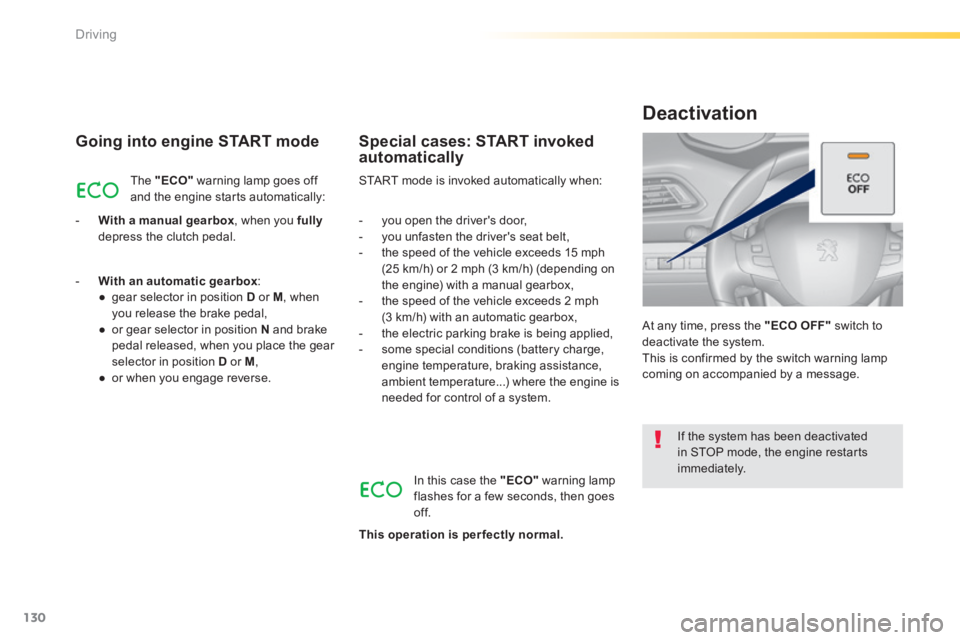
At any time, press the "ECO OFF" switch to deactivate the system. This is confirmed by the switch warning lamp coming on accompanied by a message.
Deactivation
In this case the "ECO" warning lamp flashes for a few seconds, then goes of f.
This operation is perfectly normal.
- With an automatic gearbox : ● gear selector in position D or M , when you release the brake pedal, ● or gear selector in position N and brake pedal released, when you place the gear selector in position D or M , ● or when you engage reverse.
Page 133 of 400
131
4
Driving
308_EN_CHAP04_CONDUITE_ED02-2013
The system is reactivated automatically at every new engine start by the driver.
Reactivation
Press the "ECO OFF" switch again. The system is active again; this is confirmed by the switch warning lamp going off, accompanied by a message.
Operating fault
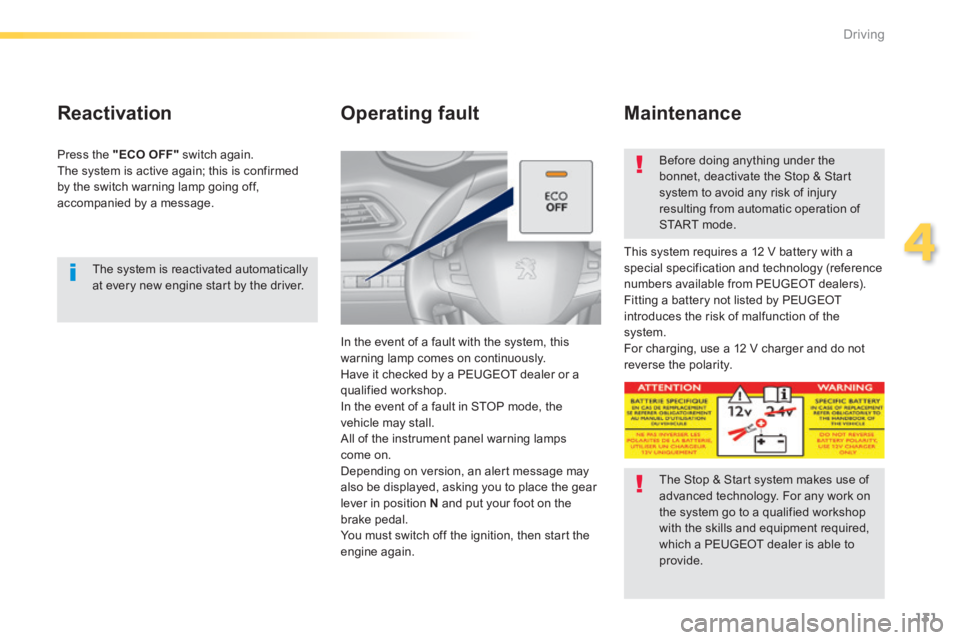
In the event of a fault with the system, this warning lamp comes on continuously. Have it checked by a PEUGEOT dealer or a qualified workshop. In the event of a fault in STOP mode, the vehicle may stall.
All of the instrument panel warning lamps come on. Depending on version, an alert message may also be displayed, asking you to place the gear lever in position N and put your foot on the brake pedal. You must switch off the ignition, then start the engine again.
Before doing anything under the bonnet, deactivate the Stop & Start system to avoid any risk of injury resulting from automatic operation of START mode.
This system requires a 12 V battery with a special specification and technology (reference numbers available from PEUGEOT dealers). Fitting a battery not listed by PEUGEOT introduces the risk of malfunction of the system. For charging, use a 12 V charger and do not reverse the polarity.
Maintenance
The Stop & Start system makes use of advanced technology. For any work on the system go to a qualified workshop with the skills and equipment required,
which a PEUGEOT dealer is able to provide.
Page 178 of 400
176
Visibility
308_EN_CHAP05_VISIBILITE_ED02-2013
In good or rainy weather, both day and night, the front foglamps and the
rear foglamps are prohibited. In these situations, the power of their beams may dazzle other drivers. They should only be used in fog or snow. In these weather conditions, it is your responsibility to switch on the foglamps and dipped headlamps manually as the sunshine sensor may detect sufficient light. Do not forget to switch off the front foglamps and the rear foglamps when they are no longer needed.
Lighting left on audible signal
An audible signal when a front door is opened warns the driver that the vehicle's exterior lighting is on, with the ignition off and in manual lighting mode. In this case, switching off the lighting stops the audible signal. With the ignition off, if the dipped headlamps remain on, the vehicle goes into "ECO" mode to avoid discharging the battery.
In some weather conditions (e.g. low temperature or humidity), the presence of misting on the internal sur face of the glass of the headlamps and rear lamps is normal; it disappears after the lamps have been on for a few minutes.
The lighting goes off when you switch off the ignition, but you can always switch it on again using the lighting control stalk.
Page 249 of 400
247
7
Practical information
308_EN_CHAP07_INFO PR ATIQUES_ED02-2013
Dashboard fuses
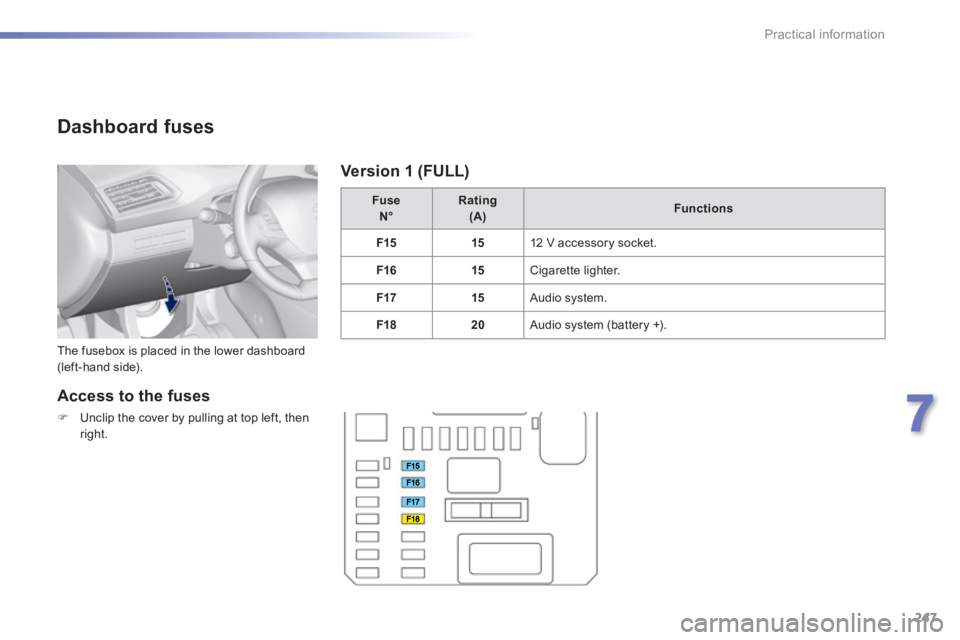
The fusebox is placed in the lower dashboard (left-hand side).
Fuse N° Rating (A)Functions
F1515 12 V accessory socket.
F1615 Cigarette lighter.
F1715 Audio system.
F1820 Audio system (battery +).
Access to the fuses
Unclip the cover by pulling at top left, then
right.
Version 1 (FULL)
Page 250 of 400
248
Practical information
308_EN_CHAP07_INFO PR ATIQUES_ED02-2013
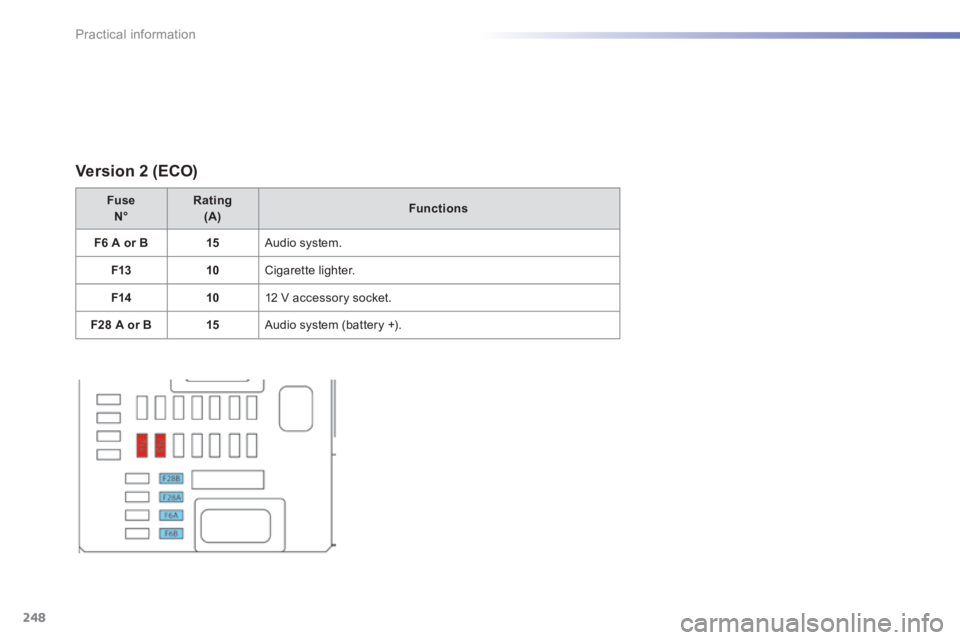
Version 2 (ECO)
Fuse N°Rating (A)Functions
F6 A or B15 Audio system.
F1310 Cigarette lighter.
F1410 12 V accessory socket.
F28 A or B15 Audio system (battery +).
Page 251 of 400
249
7
Practical information
308_EN_CHAP07_INFO PR ATIQUES_ED02-2013
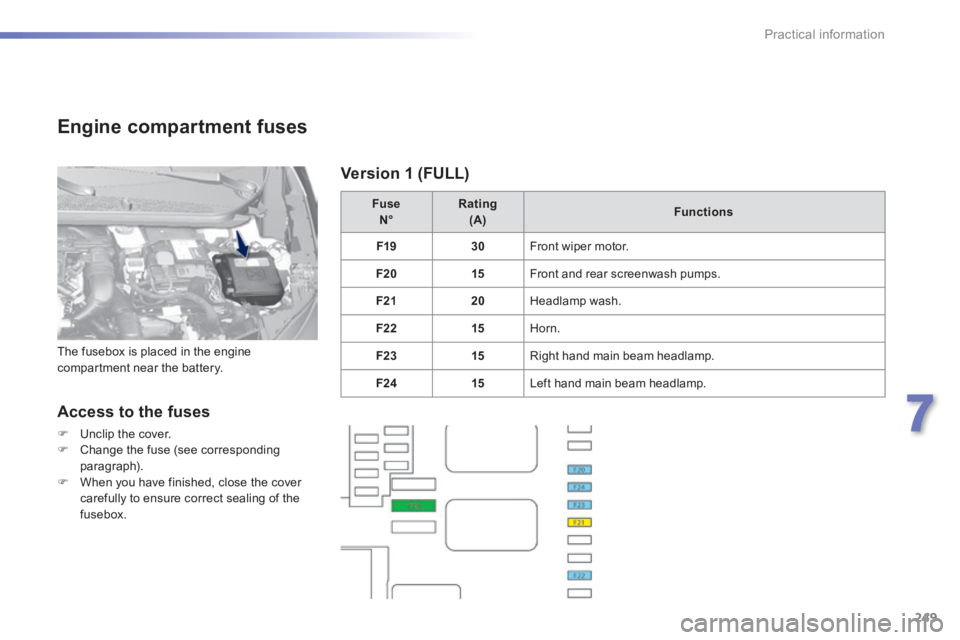
Engine compartment fuses
Access to the fuses
Unclip the cover. Change the fuse (see corresponding paragraph). When you have finished, close the cover carefully to ensure correct sealing of the fusebox.
Fuse N° Rating (A)Functions
F1930 Front wiper motor.
F2015 Front and rear screenwash pumps.
F2120 Headlamp wash.
F2215 Horn.
F2315 Right hand main beam headlamp.
F2415 Left hand main beam headlamp.
The fusebox is placed in the engine compartment near the battery.
Version 1 (FULL)
Page 253 of 400
251
7
Practical information
308_EN_CHAP07_INFO PR ATIQUES_ED02-2013
12 V battery
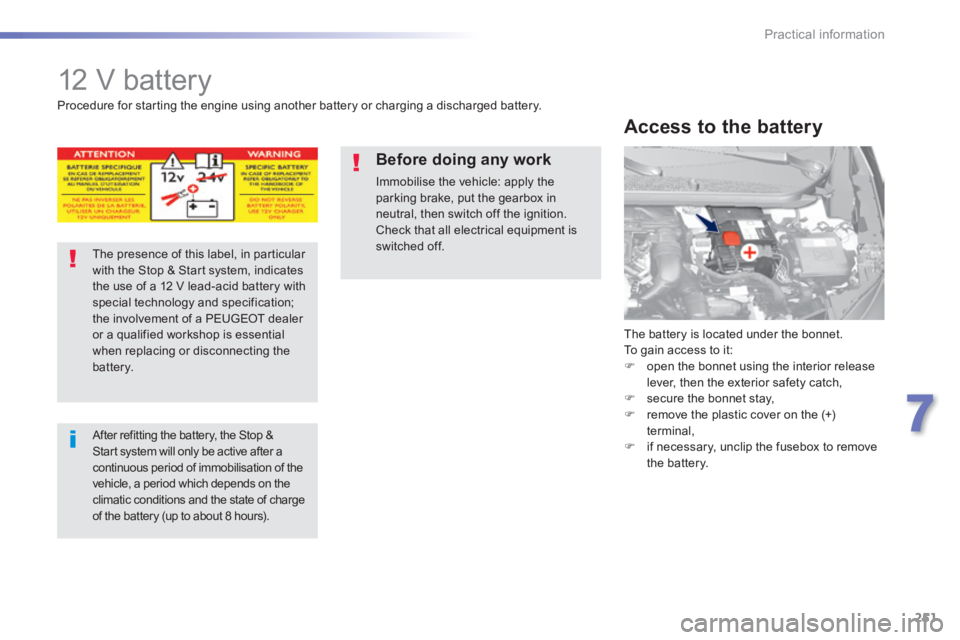
The battery is located under the bonnet. To gain access to it: open the bonnet using the interior release lever, then the exterior safety catch, secure the bonnet stay, remove the plastic cover on the (+) terminal, if necessary, unclip the fusebox to remove the battery.
Access to the battery
Procedure for starting the engine using another battery or charging a discharged battery.
The presence of this label, in particular with the Stop & Start system, indicates the use of a 12 V lead-acid battery with special technology and specification; the involvement of a PEUGEOT dealer or a qualified workshop is essential when replacing or disconnecting the battery.
After refitting the battery, the Stop & Start system will only be active after a continuous period of immobilisation of the vehicle, a period which depends on the climatic conditions and the state of charge of the battery (up to about 8 hours).
Before doing any work
Immobilise the vehicle: apply the parking brake, put the gearbox in neutral, then switch off the ignition.
Check that all electrical equipment is switched off.
Page 254 of 400
252
Practical information
308_EN_CHAP07_INFO PR ATIQUES_ED02-2013
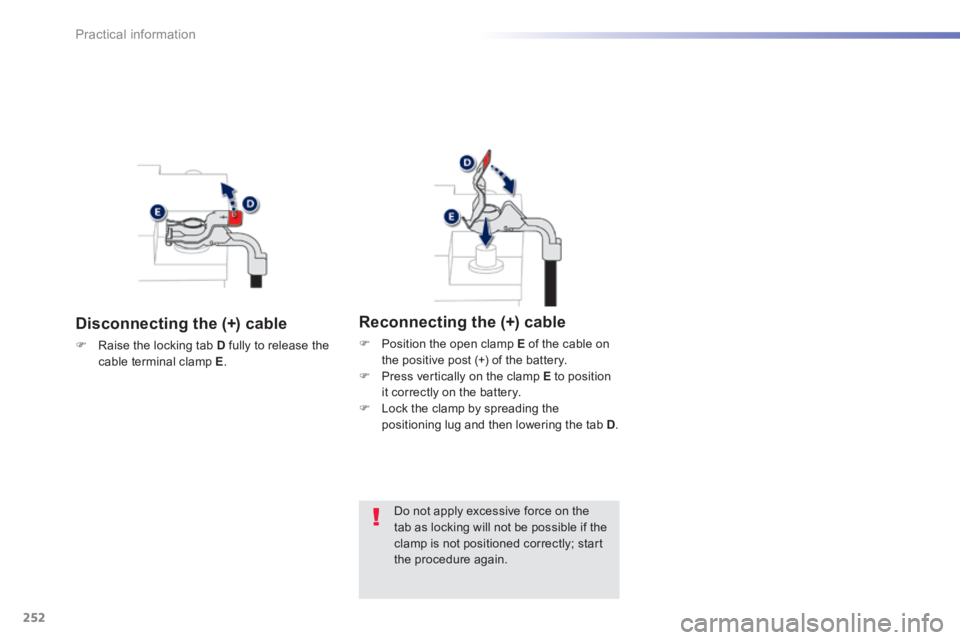
Disconnecting the (+) cable
Raise the locking tab D fully to release the cable terminal clamp E .
Reconnecting the (+) cable
Position the open clamp E of the cable on the positive post (+) of the battery. Press vertically on the clamp E to position it correctly on the battery. Lock the clamp by spreading the positioning lug and then lowering the tab D .
Do not apply excessive force on the tab as locking will not be possible if the clamp is not positioned correctly; start the procedure again.
Page 255 of 400
253
7
Practical information
308_EN_CHAP07_INFO PR ATIQUES_ED02-2013
Starting using another
battery
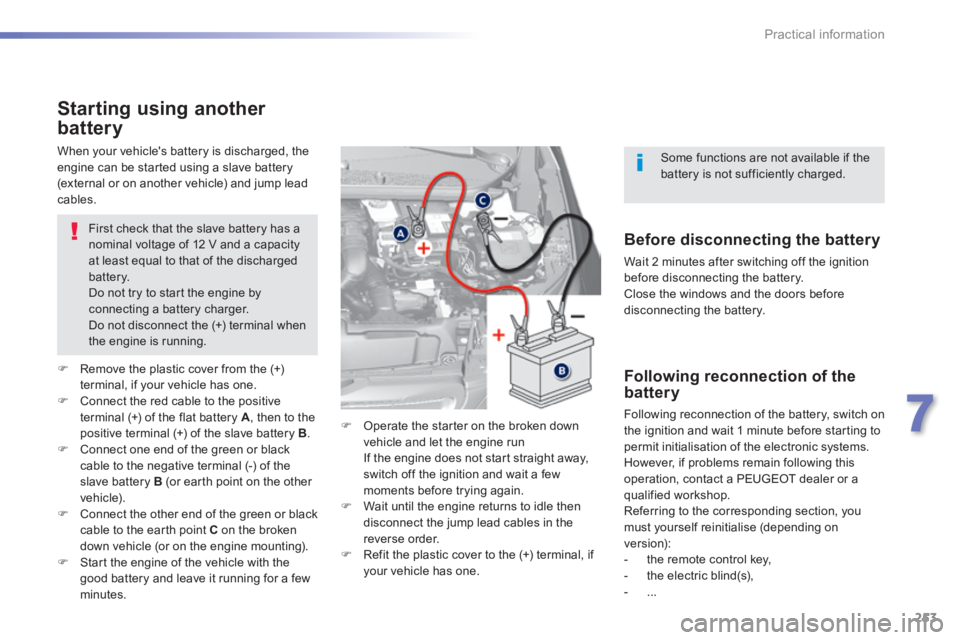
First check that the slave battery has a nominal voltage of 12 V and a capacity at least equal to that of the discharged battery. Do not try to start the engine by connecting a battery charger. Do not disconnect the (+) terminal when the engine is running.
Remove the plastic cover from the (+) terminal, if your vehicle has one. Connect the red cable to the positive terminal (+) of the flat battery A , then to the
positive terminal (+) of the slave battery B . Connect one end of the green or black cable to the negative terminal (-) of the slave battery B (or earth point on the other vehicle). Connect the other end of the green or black cable to the earth point C on the broken down vehicle (or on the engine mounting). Start the engine of the vehicle with the good battery and leave it running for a few minutes.
Operate the starter on the broken down vehicle and let the engine run If the engine does not start straight away, switch off the ignition and wait a few moments before trying again. Wait until the engine returns to idle then disconnect the jump lead cables in the reverse order. Refit the plastic cover to the (+) terminal, if your vehicle has one.
When your vehicle's battery is discharged, the engine can be started using a slave battery (external or on another vehicle) and jump lead cables.
Before disconnecting the battery
Wait 2 minutes after switching off the ignition before disconnecting the battery. Close the windows and the doors before disconnecting the battery.
Following reconnection of the battery
Following reconnection of the battery, switch on
the ignition and wait 1 minute before starting to permit initialisation of the electronic systems. However, if problems remain following this operation, contact a PEUGEOT dealer or a qualified workshop. Referring to the corresponding section, you must yourself reinitialise (depending on version): - the remote control key, - the electric blind(s), - ...
Some functions are not available if the battery is not sufficiently charged.
Page 256 of 400
254
Practical information
308_EN_CHAP07_INFO PR ATIQUES_ED02-2013
The batteries contain harmful substances such as sulphuric acid and lead. They must be disposed of in accordance with regulations and must not, in any circumstances, be discarded with household waste. Take used remote control batteries and vehicle batteries to a special collection point.
It is advisable to disconnect the battery if the vehicle is to be left unused for more than one month.
Protect your eyes and face before handling the battery. All operations on the battery must be carried out in a well ventilated area and away from naked flames and sources of sparks, so as to avoid the risk of explosion or fire. Do not try to charge a frozen battery; the battery must first be thawed out to avoid the risk of explosion. If the battery has been frozen, before charging have it checked by a PEUGEOT dealer or a qualified workshop who will check that the internal components have not been damaged and the casing is not cracked, which could cause a leak of toxic and corrosive acid. Do not reverse the polarity and use only a 12 V charger. Do not disconnect the terminals while the engine is running. Do not charge the batteries without disconnecting the terminals first. Wash your hands after wards.
With Stop & Start, the battery does not have to be disconnected for charging.
Disconnect the battery from the vehicle. Follow the instructions for use provided by the manufacturer of the charger. Connect the battery starting with the negative terminal (-). Check that the terminals and connectors are clean. If they are covered with sulphate (whitish or greenish deposit), remove them and clean them.
Charging the battery using
a battery charger