towing Peugeot 308 2015 User Guide
[x] Cancel search | Manufacturer: PEUGEOT, Model Year: 2015, Model line: 308, Model: Peugeot 308 2015Pages: 416, PDF Size: 11.81 MB
Page 167 of 416
165
308_en_Chap04_conduite_ed01-2015
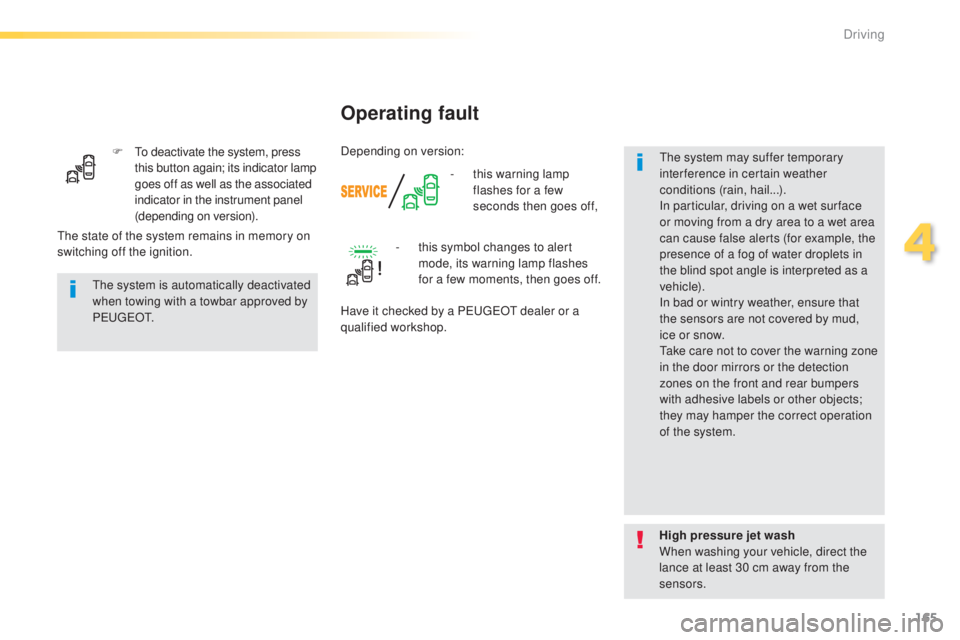
F to deactivate the system, press this button again; its indicator lamp
goes off as well as the associated
indicator in the instrument panel
(depending on version). -
t
his warning lamp
flashes for a few
seconds then goes off,
Operating fault
the system is automatically deactivated
when towing with a towbar approved by
P
e
u g e
Ot
.
High pressure jet wash
When washing your vehicle, direct the
lance at least 30 cm away from the
sensors.
th
e state of the system remains in memory on
switching off the ignition. -
t
his symbol changes to alert
mode, its warning lamp flashes
for a few moments, then goes off.
Have it checked by a P
e
uge
Ot
dealer or a
qualified workshop.
th
e system may suffer temporary
interference in certain weather
conditions (rain, hail...).
In particular, driving on a wet sur face
or moving from a dry area to a wet area
can cause false alerts (for example, the
presence of a fog of water droplets in
the blind spot angle is interpreted as a
vehicle).
In bad or wintry weather, ensure that
the sensors are not covered by mud,
ice or snow.
ta
ke care not to cover the warning zone
in the door mirrors or the detection
zones on the front and rear bumpers
with adhesive labels or other objects;
they may hamper the correct operation
of the system.
Depending on version:
4
Driving
Page 179 of 416
177
308_en_Chap04_conduite_ed01-2015
the system is deactivated by pressing the
control.
the
system is deactivated automatically:
-
o
n switching off the ignition,
-
i
f the engine stalls,
-
i
f no manoeuvre is started within 5 minutes
of selection of the type of manoeuvre,
-
a
fter a prolonged stop of the vehicle during
a manoeuvre,
-
i
f the road wheel anti-slip regulation (ASR)
is triggered,
-
i
f the speed of the vehicle exceeds the
stated limit,
-
w
hen the driver interrupts movement of the
steering wheel,
-
a
fter 4 manoeuvre cycles,
-
o
n opening the driver's door,
-
i
f one of the front wheels encounters an
obstacle.
th
e operation indicator lamp goes off in the
instrument panel and a message is displayed
accompanied by an audible signal.
th
e driver should then take back control of the
vehicle's steering.
Deactivation
If the system is deactivated during a
manoeuvre, the drive should reactivate it to
repeat the measurement.
th
e system is switched off automatically:
-
w
hen towing a trailer,
-
i
f the driver's door is opened,
-
i
f the speed of the vehicle is above 42 mph
(70 km/h).
to s
witch the system of for a prolonged period,
contact a P
e
uge
Ot
dealer or a qualified
workshop.
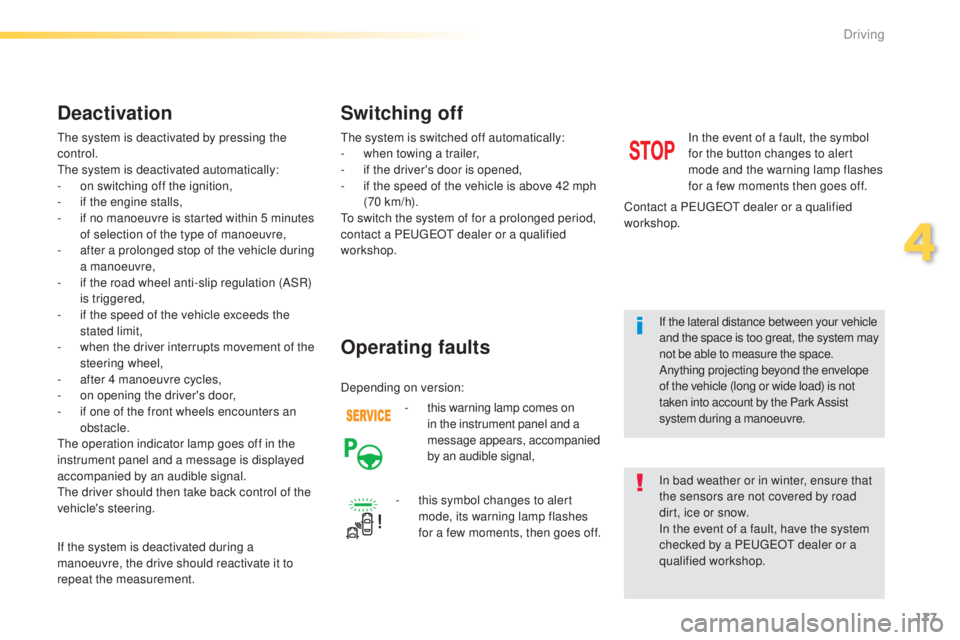
-
t
his warning lamp comes on
in the instrument panel and a
message appears, accompanied
by an audible signal,
Operating faults
In the event of a fault, the symbol
for the button changes to alert
mode and the warning lamp flashes
for a few moments then goes off.
Contact a P
e
uge
Ot
dealer or a qualified
workshop.
Switching off
In bad weather or in winter, ensure that
the sensors are not covered by road
dirt, ice or snow.
In the event of a fault, have the system
checked by a P
e
uge
Ot
dealer or a
qualified workshop.
-
t
his symbol changes to alert
mode, its warning lamp flashes
for a few moments, then goes off. If the lateral distance between your vehicle
and the space is too great, the system may
not be able to measure the space.
Anything projecting beyond the envelope
of the vehicle (long or wide load) is not
taken into account by the Park Assist
system during a manoeuvre.
Depending on version:
4
Driving
Page 197 of 416
195
308_en_Chap06_securite_ed01-2015
Automatic operation of
hazard warning lamps
Direction indicators
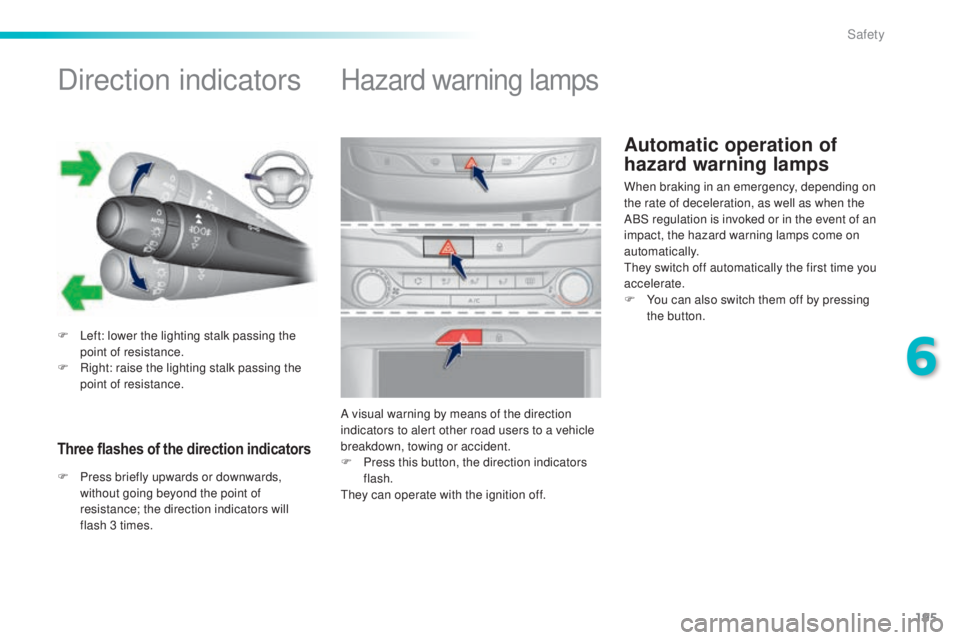
F Left: lower the lighting stalk passing the point of resistance.
F
R
ight: raise the lighting stalk passing the
point of resistance.
Three flashes of the direction indicators
Hazard warning lamps
A visual warning by means of the direction
indicators to alert other road users to a vehicle
breakdown, towing or accident.
F
P
ress this button, the direction indicators
flash.
th
ey can operate with the ignition off.
F
P
ress briefly upwards or downwards,
without going beyond the point of
resistance; the direction indicators will
flash 3 times. When braking in an emergency, depending on
the rate of deceleration, as well as when the
ABS regulation is invoked or in the event of an
impact, the hazard warning lamps come on
automatically.
th
ey switch off automatically the first time you
accelerate.
F
Y
ou can also switch them off by pressing
the button.
6
Safety
Page 267 of 416
265
308_en_Chap07_info-pratiques_ed01-2015
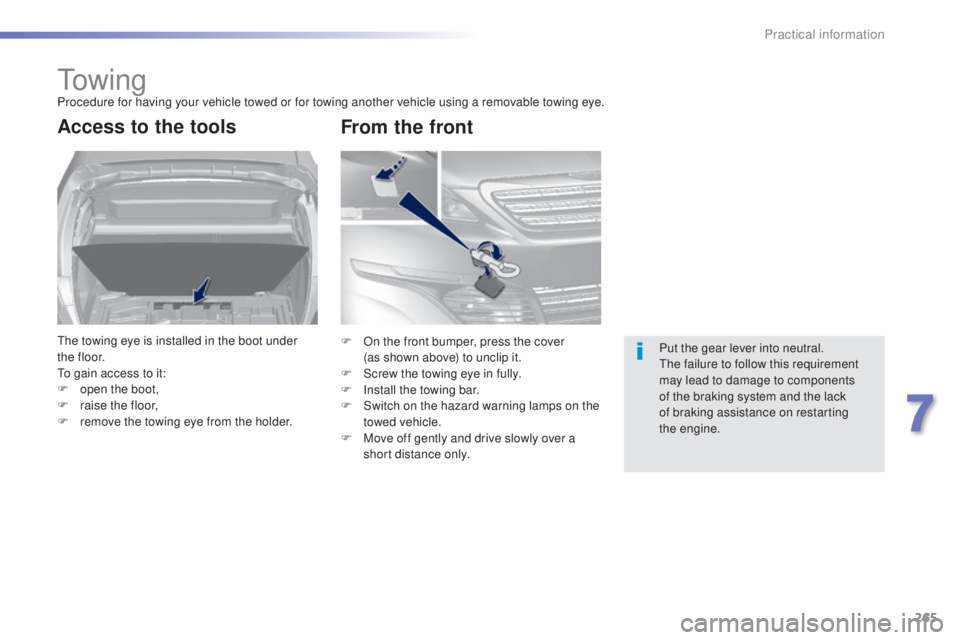
to w i n gProcedure for having your vehicle towed or for towing another vehicle using a removable towing eye.
Access to the tools
the towing eye is installed in the boot under
t h e f l o o r.
to g
ain access to it:
F
o
pen the boot,
F
r
aise the floor,
F
r
emove the towing eye from the holder. Put the gear lever into neutral.
th
e failure to follow this requirement
may lead to damage to components
of the braking system and the lack
of braking assistance on restarting
the
engine.
F
O n the front bumper, press the cover
(as
shown above) to unclip it.
F
S
crew the towing eye in fully.
F
I
nstall the towing bar.
F
S
witch on the hazard warning lamps on the
towed vehicle.
F
M
ove off gently and drive slowly over a
short distance only.
From the front
7
Practical information
Page 268 of 416
266
308_en_Chap07_info-pratiques_ed01-2015
General recommendations
Observe the legislation in force in your country.ensure that the weight of the towing vehicle is higher than that of the towed vehicle.
th
e driver must remain at the wheel of the towed vehicle and must have a valid driving licence.
When towing a vehicle with all four wheels on the ground, always use an approved towing
arm; rope and straps are prohibited.
th
e towing vehicle must move off gently.
When towing a vehicle with the engine off, there is no longer any power assistance for
braking or steering.
In the following cases, you must always call on a professional recovery service:
-
v
ehicle broken down on a motor way or fast road,
-
f
our-wheel drive vehicle,
-
w
hen it is not possible to put the gearbox into neutral, unlock the steering, or release
the parking brake,
-
t
owing with only two wheels on the ground,
-
w
here there is no approved towing arm available...
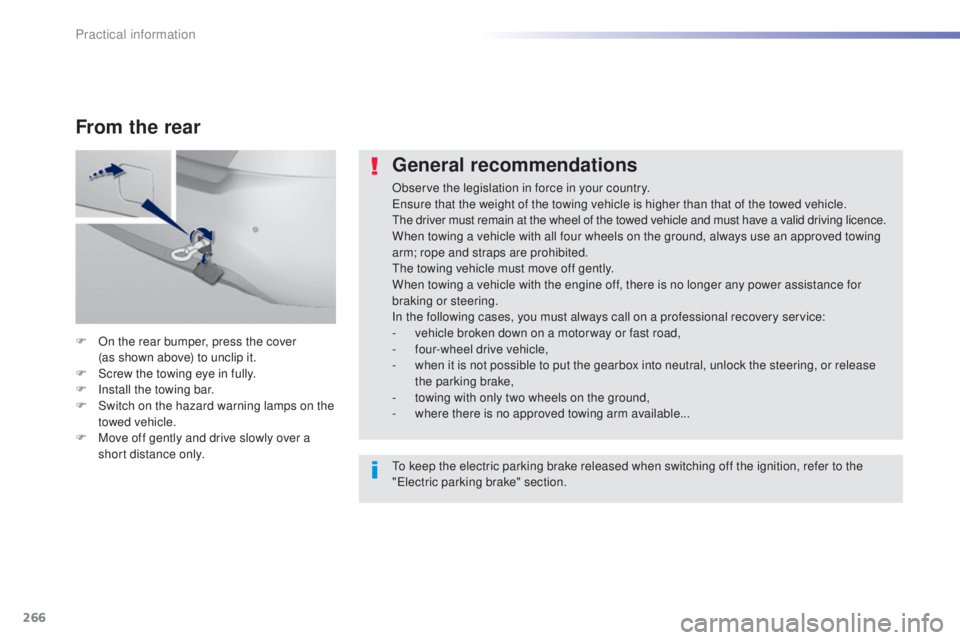
F
O
n the rear bumper, press the cover
(as shown above) to unclip it.
F
S
crew the towing eye in fully.
F
I
nstall the towing bar.
F
S
witch on the hazard warning lamps on the
towed vehicle.
F
M
ove off gently and drive slowly over a
short distance only.
From the rear
to keep the electric parking brake released when switching off the ignition, refer to the
"el ectric parking brake" section.
Practical information
Page 269 of 416
267
308_en_Chap07_info-pratiques_ed01-2015
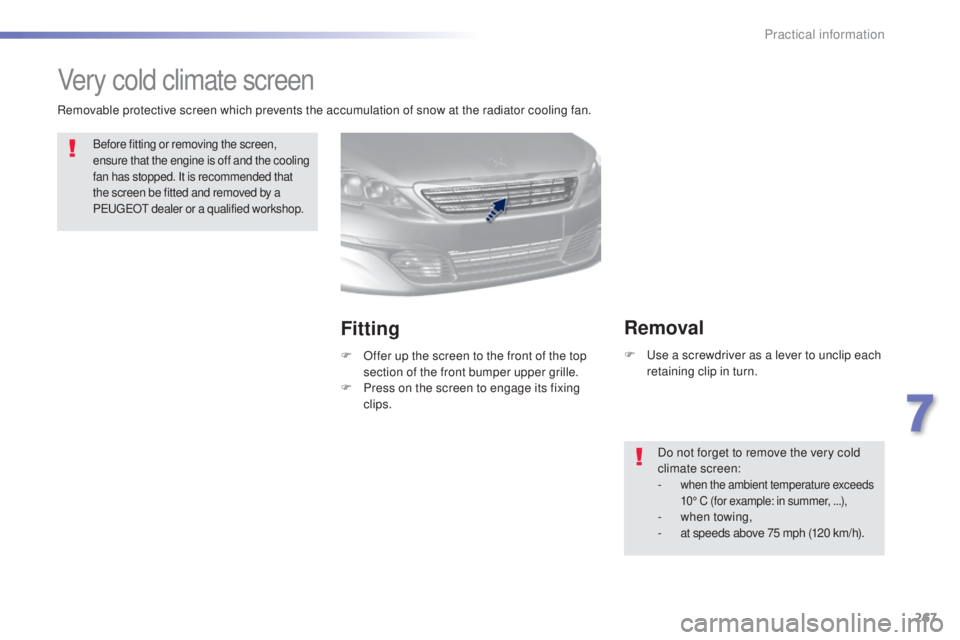
Very cold climate screen
Before fitting or removing the screen,
ensure that the engine is off and the cooling
fan has stopped. It is recommended that
the screen be fitted and removed by a
P
e
uge
Ot
dealer or a qualified workshop.
Fitting
F Offer up the screen to the front of the top section of the front bumper upper grille.
F
P
ress on the screen to engage its fixing
clips.
Removal
F use a screwdriver as a lever to unclip each retaining clip in turn.
Do not forget to remove the very cold
climate screen:
-
when the ambient temperature exceeds
10° C (for example: in summer, ...),
- when towing,
- at speeds above 75 mph (120 km/h).
Removable protective screen which prevents the accumulation of snow at the radiator cooling fan.
7
Practical information
Page 270 of 416
268
308_en_Chap07_info-pratiques_ed01-2015
towing a trailer
We recommend the use of genuine
PeugeOt towbars and their harnesses
that have been tested and approved
from the design stage of your vehicle,
and that the fitting of the towbar is
entrusted to a P
e
uge
Ot
dealer or a
qualified workshop.
If the towbar is not fitted by a
P
e
uge
Ot
dealer, it must still be
fitted in accordance with the vehicle
manufacturer's instructions.
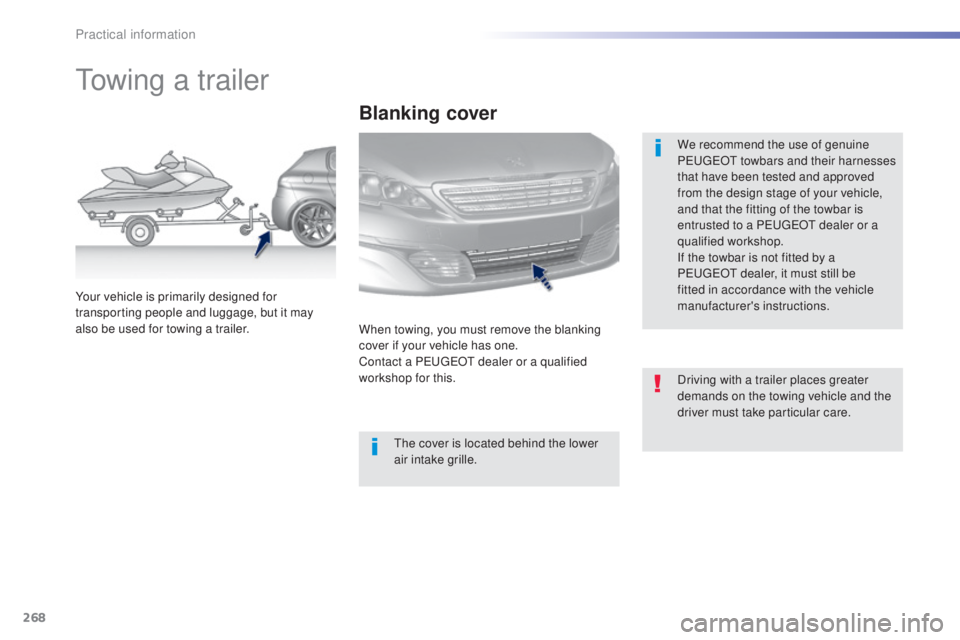
Your vehicle is primarily designed for
transporting people and luggage, but it may
also be used for towing a trailer.
Blanking cover
When towing, you must remove the blanking
cover if your vehicle has one.
Contact a P
e
uge
Ot
dealer or a qualified
workshop for this. Driving with a trailer places greater
demands on the towing vehicle and the
driver must take particular care.
th
e cover is located behind the lower
air intake grille.
Practical information
Page 271 of 416
269
308_en_Chap07_info-pratiques_ed01-2015
Driving advice
Distribution of loads
F Distribute the load in the trailer so that the heaviest items are as close as possible to
the axle and the nose weight approaches
the maximum permitted without
exceeding
it.
Air density decreases with altitude, thus
reducing engine performance. Above
1
000 metres, the maximum towed load must
be reduced by 10
% for every 1 000 metres of
altitude.
Side wind
F take into account the increased sensitivity to side wind.
Cooling
towing a trailer on a slope increases the
temperature of the coolant.
As the fan is electrically controlled, its cooling
capacity is not dependent on the engine speed.
F
t
o l
ower the engine speed, reduce your
speed.
th
e maximum towed load on a long incline
depends on the gradient and the ambient
temperature.
In all cases, keep a check on the coolant
temperature.
F
I
f the warning lamp and the
STOP warning lamp come on,
stop the vehicle and switch off
the engine as soon as possible.
Braking
towing a trailer increases the braking distance.to a void overheating of the brakes on a long
mountain type of descent, the use of engine
braking is recommended.
Ty r e s
F Check the tyre pressures of the towing vehicle and of the trailer, observing the
recommended pressures.
Lighting
F Check the electrical lighting and signalling on the trailer.
Refer to the "
te
chnical data" section for
details of the weights and towed loads
which apply to your vehicle.
th
e rear parking sensors will be
deactivated automatically if a genuine
P
e
uge
Ot
towbar is used.
7
Practical information
Page 295 of 416
293
308_en_Chap09_caracteristiques-techniques_ed01-2015
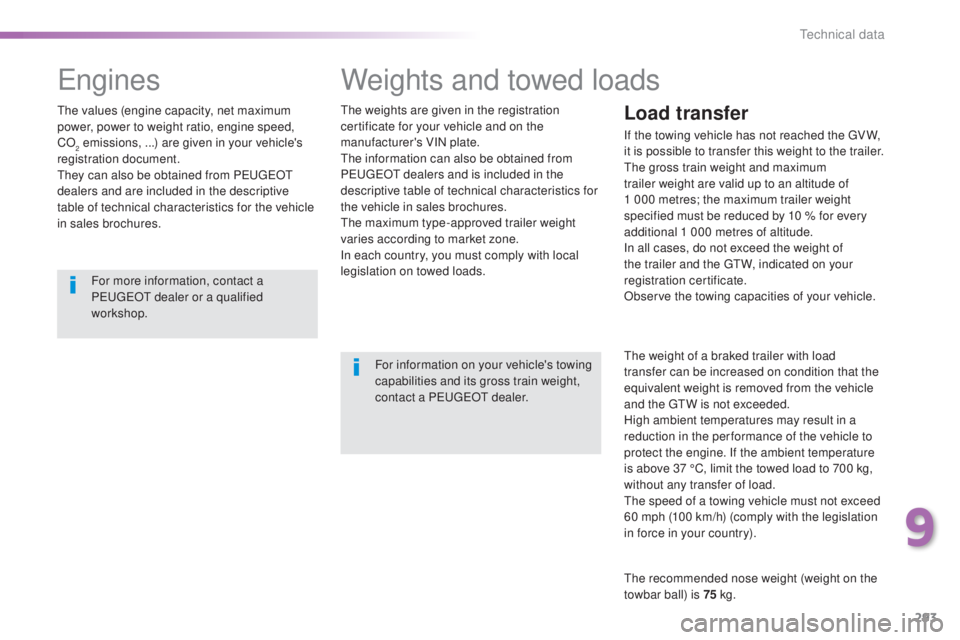
Weights and towed loads
the weights are given in the registration
certificate for your vehicle and on the
manufacturer's VIN plate.
th
e information can also be obtained from
P
e
uge
Ot
dealers and is included in the
descriptive table of technical characteristics for
the vehicle in sales brochures.
th
e maximum type-approved trailer weight
varies according to market zone.
In each country, you must comply with local
legislation on towed loads.
For information on your vehicle's towing
capabilities and its gross train weight,
contact a P
e
uge
Ot
dealer.Load transfer
If the towing vehicle has not reached the gV W,
it is possible to transfer this weight to the trailer.
th
e gross train weight and maximum
trailer weight are valid up to an altitude of
1
000 metres; the maximum trailer weight
specified must be reduced by 10 % for every
additional 1
000 metres of altitude.
In all cases, do not exceed the weight of
the trailer and the
gt
W
, indicated on your
registration certificate.
Observe the towing capacities of your vehicle.
th
e weight of a braked trailer with load
transfer can be increased on condition that the
equivalent weight is removed from the vehicle
and the
gt
W i
s not exceeded.
High ambient temperatures may result in a
reduction in the per formance of the vehicle to
protect the engine. If the ambient temperature
is above 37 °C, limit the towed load to 700 kg,
without any transfer of load.
th
e speed of a towing vehicle must not exceed
60 mph (100 km/h) (comply with the legislation
in force in your country).
th
e recommended nose weight (weight on the
towbar ball) is 75 kg.
engines
the values (engine capacity, net maximum
power, power to weight ratio, engine speed,
CO
2 emissions, ...) are given in your vehicle's
registration document.
th
ey can also be obtained from P
e
uge
Ot
dealers and are included in the descriptive
table of technical characteristics for the vehicle
in sales brochures.
For more information, contact a
P
e
uge
Ot
dealer or a qualified
workshop.
9
technical data
Page 400 of 416
398
Seat adjustment ........................................80, 81
Seat belts ...................................... 20
4-206, 218
Seats, electric
................................................. 81
Seats, rear
................................................. 85, 86
Serial number, vehicle
......................................................... 296
Service indicator
............................................. 29
Servicing
...............................
..........................10
Setting the clock
...........................46, 47, 48, 49
Sidelamps
.................................... 181, 243, 244,
246 -248, 250
Side repeater
..............................
..................247
Ski flap
..............................
..............................93
Snow chains
.................................................. 2
42
Spare wheel
...............................
..........235, 236
Speed limiter
......................................... 13 9, 14 0
Spotlamps, side
.................................... 187, 247
Starting the engine
........................113 , 11 6 , 118
Starting using another battery
...................... 2
61
Steering mounted controls, audio
................................................... 305, 375
Stop & Start
........................ 24, 38, 76, 110, 136,
137, 259, 275, 291
Storage
.......................................... 88, 90, 93 -95
Storage wells
............................................ 94, 95
Storing driving positions ........................................................ 82
Stowing rings
............................................ 94, 95
Switching off the engine
................ 11
5 , 117, 118
Synchronising the remote control
..................................................... 5
6, 66
Synthesiser, voice ............................................................ 343
System settings
............................................. 352
Paint colour code
..........................................
296
Panoramic glass sunroof
................................ 75
Park Assist
............................................. 170 -17 7
Parking brake, electric
............. 20, 121-127, 292
Parking brake manual
..................... 1
5, 120, 292
Parking sensors, front
................................... 167
Parking sensors, rear .................................... 166
Particle filter
.......................................... 290, 291
Passenger compartment filter
...................... 291
P
e
uge
Ot C
ONN
eCt A
PPS
....................... 35
5
Peuge
O
t Connect Assistance
................... 298
Peuge
O
t Connect SOS
............................. 29
8
Peuge
O
t Connect Sound (RD5)
................ 37
3
Player, CD MP3
..................................... 318, 379
Port,
u
S
B
......................... 8
8, 91, 318, 382, 384
Priming the fuel system
................................ 278
Protecting children
................ 206, 208, 212-228
Puncture
........................................................ 229
Radio
..................................................... 312, 37 7
RDS
....................................................... 315, 377
Rear foglamp .................183, 248, 249, 250, 251
Rear screen (demisting)
................................ 111
Recharging the battery
................................. 2
62
Reduction of electrical load
.......................... 263
Refilling AdBlue ..................................... 284-287
Regeneration of the particle filter
................. 2
91
Reinitialising the remote control
............... 5
6, 66
Remote control
.......................................... 5
0- 67
Removable screen (snow shield).......... 267, 268Safety for children
................. 206, 208, 212-228
Screen, instrument panel
.................. 12, 35, 130
Screen menu map
....... 306, 308, 310, 324, 326,
328, 344, 356, 358, 388 -390
Screen, multifunction (with audio equipment)
........... 4
7, 48, 376, 388
Screen, without audio equipment
................... 49
Screenwash
.................................................. 19 0
Screenwash fluid level
.......................... 191, 29 0
Screenwash reservoir
................................... 290
SCR (Selective Catalytic Reduction)
............ 279
P
RS
Removing a wheel ........................................ 23 8
Removing the mat ........................................... 89
Repair kit, puncture
....................................... 229
Replacing bulbs
.................................... 243-252
Replacing fuses
..............................
......253-258
Replacing the air filter
...................................291
Replacing the oil filter
................................... 2
91
Replacing the passenger compartment filter
...................................... 291
Replacing wiper blades .........................192, 26 4
Resetting the service indicator
.......................31
Resetting the trip recorder
..............................33
Reversing camera
......................................... 169
Reversing lamp
..................................... 2
48, 250
Risk areas (update)
....................................... 333
Roof bars
............................................... 2
70, 271
Roof blind
........................................................ 75
Routine checks
..................................... 291, 292
Running out of fuel (Diesel)
..........................2
78
Alphabetical index